To have any hope of stepping outside the current mess, we need to step away from the money economy. This isn’t abstract ideology or lifestyle branding, it’s a practical question about how we live, relate, survive, and build together.
The best path we already have is the gift economy – In the cash economy, value becomes transactional, every action gets measured, every relationship becomes a potential market, every creative act turns into “content”. We are trained to calculate instead of care, to compete instead of cooperate, to protect instead of share, this is the emotional logic of capitalism, the logic of scarcity.
The result is isolation, burnout, and endless low-level fear. People become customers, audiences, brands, influencers, service providers – anything except communities. The gift economy works differently, in a gift economy, value comes from reciprocity, trust, and social connection. You give what you can because you are part of a living network. You receive what you need because others are too, no receipts, no invoices, no endless accounting. The wealth is in the relationships themselves.
This isn’t utopian fantasy, as large parts of human society worked this way for thousands of years, and fragments of it still exist everywhere around us despite capitalism constantly trying to enclose and monetize them. Think about the moments where life actually feels human:
A neighbour helping repair your roof.
Friends fixing each other’s bikes.
People sharing tools instead of everyone buying new ones.
Community gardens growing food collectively.
Food co-ops reducing dependency on supermarkets.
Free kitchens at protests and festivals.
Mutual aid groups helping people survive winters, floods, or repression.
Open-source developers building software for shared use.
Pirate radio stations.
Grassroots media collectives.
Towpath film screenings with shared food and conversation under the evening sky.
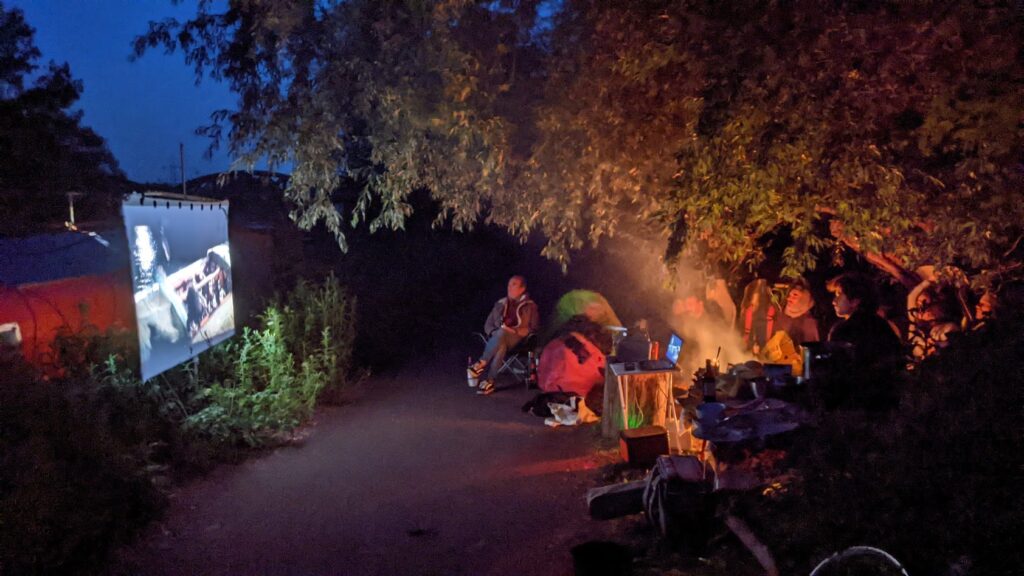
The Oxford boater communities screening films beside the river while cooking together is a good example. Nobody is extracting profit, nobody is optimizing engagement metrics. The value comes from the social fabric created through participation itself. That’s the thing the money economy cannot understand, that some of the most valuable human experiences become weaker when monetized.
The #openweb originally grew through gift economy logic, people built websites because they cared, they shared code because sharing was useful, they wrote blogs, moderated forums, translated software, hosted servers, and organized communities largely outside direct financial extraction. Projects like #FOSS, #Indymedia, and the early #fediverse emerged from this culture and the #OMN path grows from the same roots.
Of course, money still exists, people still need food, housing, healthcare, infrastructure. Nobody is pretending we can simply opt out tomorrow. The point is direction, not purity. Every hour spent building mutual aid instead of consumer dependency matters. Every skill shared freely matters.
Every community meal matters.
Every commons project matters.
Every local repair network matters.
Every bit of infrastructure held in common matters.
Because each one reduces dependence on extraction systems. This is why so much #fashernista activism fails. It stays trapped inside the logic of the money economy while pretending to resist it. NGOs compete for grants. Influencers monetize radical aesthetics. Startups brand themselves as “ethical disruption”. Conferences sell access to “community”. Even resistance becomes another market sector. The system absorbs opposition by turning it into careers, branding, and content.
The gift economy is harder to absorb because it produces relationships instead of products. This is also why the gift economy scares power structures. A population that can feed itself, organize itself, repair things together, share knowledge, and communicate outside commercial platforms becomes harder to manage through fear and scarcity.
That doesn’t mean abandoning structure or responsibility. Healthy gift economies depend on trust, reputation, contribution, and long-term relationships. People notice who gives and who only takes, social accountability matters, the difference is that accountability stays rooted in human connection rather than abstract transactions.
The challenge now is rebuilding these cultures after decades of neoliberal atomization and #stupidindividualism. Capitalism teaches us to ask “What can I get?” were the the gift economy teaches us to ask: “What can we build together?” That shift sounds small, but it changes everything.
The more time, care, skills, and energy we invest in commons and gift relationships, the less trapped we become inside systems of extraction and artificial scarcity. And the freer we become to imagine futures beyond the current #deathcult.
Build the gift economy not as charity, not as moral purity and not as nostalgia. As survival, resistance and a way to start living again.

One thought on “Get Out of the Money Economy – Rediscover the Gift Economy”