This mess is driven by climate breakdown, growing inequality, technological disruption, war, political instability and the weakening of democratic institutions are no longer separate problems, they reinforce each other. At the same time, we are seeing a feedback loop of political movements built around fear, scapegoating, hierarchy and fantasies of escape. This creates a basic question we need to focus on – how do we build the means to live through these crises together, rather than retreating into individual survival, authoritarianism or delusions of technological escape?
One of the strongest #blocks running through the current crisis is what we could be called exit culture. The wealthy #nastyfew pushing the mess can try to buy their way out through the nasty fantasy of private security, property and technology. Some feed political movements that imagine an escape into an ethnically or culturally purified nation. Some religious movements look towards another imagined world. Some technology #geekproblem culture imagines that humanity can escape its material limits through AI, automation, space or digital transcendence.
Different ideologies, but a similar mess – the world is broken, so find a way out. This is a dangerous stupid response to systemic crisis. There is no #stupidindividualism exit from #climatechaos. There is no technological #dotcons platform that allows us to escape social relationships. And there is no bunker large enough to protect a society from the consequences of destroying the living systems it depends upon. We need to actively be composting this mainstreaming mess, the alternative is not to escape, it is to focus on becoming more capable of being here.
Then on the left the is a matching fantasy, collapse is not automatically progressive. It is easy to look at broken institutions and think that their collapse must create an opportunity for something better. But collapse has no political direction of its own, maybe it can produce mutual aid, solidarity and new forms of democratic organization. More likely we get authoritarianism, scapegoating, violence and stronger hierarchies.
The outcome depends partly on what people and communities are ready to do when crisis washes over them. If communities have networks (like the #OMN), relationships, communication systems, practical skills and ways of making decisions together (like the #OGB), crisis can become an opportunity to build something new. If they don’t, people are much more likely to fall back on fear and whoever appears to offer simple answers.
So preparation matters, but preparation is hopeless when it means becoming an individual survivalist. We need to balance this commons sense urge with working collective ways of looking after each other. It 20 years past time to move for survivalism to #KISS mutual aid. We need focus on how do we make sure people can look after each other when things become difficult?
That means better late than never to building relationships before the crisis, knowing who is around us, knowing how to communicate, where resources are, how to organize. Knowing how to disagree without destroying the group, how to make decisions, share responsibility. This is grassroots working democratic resilience from the bottom up.
We need real repossess to authoritarian pushing insecurity – Find someone to blame – The nation against the foreigner – The majority against the minority – The “real people” against outsiders – The pure against the contaminated. The hard right are pushing belonging through this kinda exclusion.
To balance this mess we need need another form of belonging, that means building coalitions capable of holding difference without turning every disagreement into another power struggles. We need to compost the false choice between local organizing and large-scale networks. We need the strong local relationships to provide the social foundation.
But we also need lossy #4opens flow networks to allow those communities to exchange knowledge, tools, resources and experience without surrendering their autonomy. This is one of the reasons the #Fediverse and #ActivityPub are interesting. Federation gives us a technical path where independent communities can remain independent while still communicating with each other.
This principle can extend beyond the current copy’s of #dotcons social media. We need to build projects like the #OMN based on local relationships + open networks = distributed resilience. This is a much more interesting path than simply building another or replenishing the normal centralized platforms.
A #KISS move from participation to action is to grow federated networks of people who organize, communicate, take responsibility, resolve conflicts and build things together. Based on technology that supports social process rather than replace it with blinded control.
We don’t need a perfect future, a lot of political narrow thinking is trapped between two fantasies. One says, the existing institutions will eventually fix themselves. The other says, the whole thing has to collapse before we can build something new. It is dangerous to accept either of these paths blindly. What we do need to grow is trust networks, practical democratic experiments, its fine that none of these is perfect. They just need to work better than the current mess, to connect people and communities, so they can move from fear to cooperation.
The hard right is good at turning insecurity into fear. they feed from fear of migration, cultural change, technological change. Fear of economic collapse, losing status and fear of the future. But the knee jerk reactions cant be to simply tell people not to be afraid as people have real reasons to feel insecure. The better balancing is to build something that gives people something better to fall back on than fear. That means replacing fear → scapegoating → authoritarianism with crisis → cooperation → solidarity. Not utopian, but as practical.
On the native openweb path this is the question – the bigger reason for building the #OMN. As we don’t know exactly what the next twenty or forty years will look like, we do know that the existing system is becoming increasingly unstable. We know that climate chaos is accelerating, that #dotcons technology is concentrating power. We know that authoritarian politics is growing. And we know that simply defending the existing structures is not enough.
So rather than waiting for the next crisis to tell us what to do, we start building now. Not an escape route, another #closedweb platform as smoke and mirrors for another hierarchy waiting to take control. A network of people and communities that can communicate, remember, cooperate, organize and govern themselves. That is the native #openweb path to compost this mess, that is the practical meaning of the old slogan another world is possible.
We don’t have to wait for another world, we can start building the means for it here.
Going to an Oxford event tonight where the #mainstreaming people will be idealistic about cynical politics – while I’m going to be cynical about idealistic politics. My mission is to stay positive, avoid the usual political trench warfare, and try to build bridges across that gap. There is a useful conversation between idealism and cynicism: keep the ideals, but be realistic about how power actually works.
To get beyond people feeling lost and political debate becoming pointless, it helps to use a simple #KISS lens: fear and trust. The right mobilize through fear – fear of loss, outsiders, disorder and change. The left has been strongest when it builds from trust – solidarity, openness, cooperation and collective action. These are not absolute categories, but they can help us see some of the dynamics underneath political arguments. Fear creates cycles of control; trust creates the possibility of openness and collaboration.
This matters for the current #openweb reboot. What happens when #mainstreaming pushes projects away from trust and towards fear, control, exclusion and defensive code? Could we use this simple lens to highlight which direction our projects are actually moving in – regardless of what language games people play? And this leads to the sharper question: are we building systems based on fear, or systems based on trust? The fear loop is simple:
Fear the right → fight the right → feed the right → create more fear of the right → fight the right harder. Fear becomes the fuel, the response becomes the problem, the cycle feeds itself. You can end up fighting the politics you fear in ways that reproduce the fear, division and control that give those politics space. So the #KISS question to talk about tonight is, are we breaking the fear loop, or feeding it?
For the native #openweb path, that means building from trust, solidarity and collective capacity rather than letting fear set the agenda. This is also why I keep coming back to the practical work around #OMN, #4opens, #makeinghistory,#IndymediaBack and #OGB. The point isn’t to win another argument on the existing path, it is to grow working alternatives outside current assumptions.
The challenge tonight is to keep the bridge open, cynical about power, but not cynical about people, idealistic about the future, but practical about how we get there.
The #Fediverse exists because the corporate #dotcons are not enough, we don’t wont more of our social lives as products, our relationships into #closeddata, and our communities into audiences to be managed. We wont a different way to communicate, organize and build power together.
But the #Fediverse is not simply a kinder version of corporate social media, its has a promise based on the history of the #openweb: people and communities building their own spaces, connecting through open standards, and sharing power without handing control to a central platform.
The problem we need to compost is that there are few working, humane alternatives to the current #deathcult. So for meany people simply stepping away isn’t an option – We need practical alternatives that work in the real world, rooted in grassroots experience and capable of growing beyond isolated projects for these people to step to.
We already have a first step, that is the point of federation, with #ActivityPub, independent communities can connect and share without having to surrender their autonomy. We can scale horizontally, linking working social projects together rather than building another “common sense” centralized empire.
The #OMN takes this to the next step by bringing in grassroots practices we know work to this open technology, human trust and shared responsibility. #MakingHistory, #IndymediaBack, the #OGB and the #4opens are stepping stones towards a more sustainable world, not products to consume, but tools for #KISS collective action.
This is why the current push for #mainstreaming is more problem than solution. If we bring the habits of the #dotcons into the #Fediverse, we are pushing the turning of build something different into another version of the same old “common sense” mess – we become users demanding personal comfort, rather than participants building communities.
And this is where #BLOCKING becomes political. Blocking has a place, especially when people need protection from harassment and abuse. But if it becomes our default answer to every disagreement, it turns despair into the appearance of action. We retreat into smaller and smaller spaces while the structures of power who are ripping the world apart remain untouched.
We cannot build solidarity by pretending differences don’t exist, we build it by developing and growing ways to work through those differences, set boundaries, share responsibility and act together. That is how grassroots movements for the last 100 years have always built real capacity.
“Another world is possible” cannot just be a slogan, we have to make it possible, through practical projects, open infrastructure and communities that learn how to govern themselves. The #Fediverse exists to give us a path to do that. Whether we use it to build a different world, or simply recreate the one we already have, is up to us.
Keep it #KISS, less platform worship, less knee-jerk rejection, more collective work. We won’t block our way into another world, we have to build and grow it.
“Another world is possible” – but our friendly enemies keep pushing #mainstreaming dressed up in radical language. The result? We’re accepting “common sense” of the system instead of challenging it. Solidarity gets fragmented into identity and partisan battles, while class power escapes scrutiny. We end up pointing fingers at each other while the #deathcult carries on.
We need to defend the right to care, but turn that care into collective power. Real solidarity means looking beyond the latest distraction, naming structural power and building alternatives together. Don’t just make the existing world look kinder.
There is a temptation to see today’s hard right move as something new. Looking at this mess, the #deathcult is the name I use for the destructive logic of #neoliberal capitalism: a world where profit, growth and competition are the dominant measures of value, while human needs, shared resources and collective responsibility are pushed aside.
If we want to understand the political crisis, we need to dig beneath its surface of how social crisis becomes authoritarian politics. The hard right doesn’t emerge in a vacuum, it draws power from the insecurity, anger and social fragmentation that this system helps produce. History offers some uncomfortable lessons.
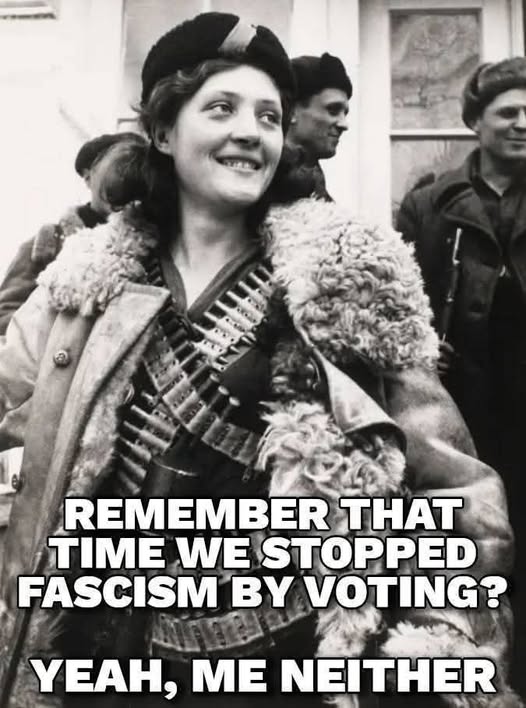
Mussolini came from the socialist movement before breaking with the left over the First World War and moving towards nationalism, political violence and authoritarianism. Early fascism combined different political currents before developing into a more defined authoritarian project. In Germany, the Nazis used the myth that internal enemies had betrayed the nation to explain defeat and social crisis. Antisemitic conspiracy theories became central to their account of national decline.
The pattern matters more than any simple comparison between past and present. A society experiences economic insecurity, political failure and declining trust. People feel betrayed, existing institutions appear unable to respond. There are often genuine grievances underneath this anger, the dangerous move comes when structural problems are turned into stories about enemies.
Economic insecurity becomes the fault of immigrants. Political failure becomes the fault of an imagined conspiracy. Cultural change becomes evidence of national decline. Complex social problems are reduced to a few people or groups who can be blamed. The system disappears from view, and the scapegoat takes its place. This is politically powerful because it gives people a clear target without requiring anyone to challenge the structures producing the crisis.
The promise to make the nation great again, authoritarian nationalism often offers a story of lost greatness and promised renewal. Mussolini drew on an idealised image of the Roman past. Nazi ideology constructed a racialised national community around ideas of ethnic purity and exclusion.
National identity itself is not the problem. People need belonging, shared history and meaningful relationships with the places where they live. The danger comes when belonging becomes exclusion. “We live here together” becomes “this is ours, and those people do not belong.” A collective need for security is turned into a demand to identify outsiders. The promise of renewal becomes permission to deny others their place in society.
This is one way the #deathcult and the hard right can reinforce each other. A society organised around competition and insecurity leaves people looking for explanations. Authoritarian nationalism offers belonging and certainty without requiring a fundamental change to the economic structures producing the insecurity. The blame moves around, the underlying system remains.
The important point is the process of #mainstreaming. In social democracy, a fringe idea becomes a campaign demand, it enters a manifesto, other parties adopt parts of it. Newspapers discuss it as common sense, eventually, the boundaries of acceptable political debate have moved. The mess is not only the most extreme position, it is the gradual normalisation of the assumptions underneath it: that particular groups are the cause of national decline, that exclusion will restore social stability, or that some people’s rights can be treated as expendable.
This is how political culture changes before a decisive break with democratic institutions ever occurs. There is an important difference between the political environment of the twentieth century and our own, as the #dotcons algorithmic control industrialize the problem. The old hard right relied on newspapers, meetings, party organisations and physical networks. Today, political messages also travel through algorithmic platforms capable of distributing them at enormous speed.
The #dotcons turn grievance into a feedback loop: anger → attention → engagement → more anger. A complicated social problem becomes a short video with a villain. A conspiracys travel faster than a careful explanation. Outrage becomes a product, and the systems distributing it have incentives to keep feeding people these digital drugs to keep people engaged.
The #dotcons commercial incentives of attention-driven systems amplify conflict, reward emotional reaction and make it harder to sustain a shared understanding of reality. That is part of the #techshit problem, were, technical systems built around commercial incentives reproduce and intensify social problems while presenting themselves as neutral tools.
The #deathcult encourages #stupidindividualism the idea that everyone is responsible for their own survival, that social problems are individual failures, and that collective solutions are either impossible or unnecessary.
History shows how political fragmentation pushes authoritarian movements. In the final years of the Weimar Republic, conflict between the left’s major parties, violence and the selling out/weakening of parliamentary government contributed to the conditions in which the Nazis gained power.
Polarization makes collective action harder when it turns differences into an existential conflicts, when movements spend all their energy fighting internally, they stop building. When every disagreement becomes betrayal, cooperation becomes impossible.
When people lose the ability to work together across differences, someone can arrive promising to settle everything through force and authority. This leaves people isolated precisely when they need one another. When the emergency becomes permanent, we cannot build an alternative society if we destroy every space in which we might cooperate.
Another historical warning concerns the politics of exception. Authoritarian movements argue that ordinary democratic processes are too weak to handle a crisis, extraordinary circumstances supposedly require extraordinary authority. An emergency like on rushing #climatechaos does not automatically produce authoritarianism, societies sometimes genuinely need exceptional measures to respond to immediate dangers.
The #deathcult thrives on the claim that there is no alternative. The hard right turns that same sense of inevitability into a demand for control. If people are persuaded that the only choices are fear or authoritarian order, the space for alternatives becomes smaller. This leads to the next stage of the #deathcult – when human beings become economically useless.
Beneath these political mechanisms sits a deeper problem, the idea that human worth depends on blinded economic usefulness. As people are encouraged to see themselves as individual economic units, competing for a place in a system that treats profit, growth and capital accumulation as its highest values. Work harder. Consume more. Compete better. Become more productive. Apologise for needing anything.
What happens when you become ill, disabled, unemployed, old, poor or simply unwilling to spend your life enriching someone else? If your value depends on your productivity, it becomes easy to treat your needs as a burden and your existence as something that must be justified. This is one of the cruellest tricks of #stupidindividualism: a structural problem becomes a personal shame.
People begin asking whether they deserve a decent life, rather than asking why the conditions for a decent life are being made conditional in the first place. At the same time, the concentration of wealth creates opportunities for a small number of #nastyfew actors to influence politics, media, infrastructure and public debate. The danger of systems that weaken accountability and treat the suffering of some people as an acceptable cost of doing business.
Homelessness, preventable illness, poverty, displacement and environmental destruction do not all arise in the same way. They do, however, show how human needs can be subordinated to other priorities. A system can destroy lives without ever officially deciding to kill anyone. The question is not only whether a class of people might directly target those they consider economically useless. It is why we tolerate arrangements that make some lives more expendable than others.
And why do we internalize that judgement, apologizing for our existence instead of challenging the system making us feel ashamed? The problem is social, not individual, as there is no individual solution to a fundamentally collective problem.
We cannot buy our way out of a crisis produced by the concentration of wealth and power. We cannot solve social isolation through endless individual self-improvement. We cannot rebuild shared reality by retreating further into personalised feeds and private bubbles. Nor can we expect a change of politicians, a new app or another set of slogans to solve the deeper problem on its own.
We need to rebuild the social capacity to act together, that means practical communities, independent media, shared resources, public accountability and spaces where people can disagree without destroying their ability to cooperate. It means creating alternatives before a crisis forces us to act, rather than waiting for existing institutions to fail completely.
This is where the #openweb becomes important, the #OMN: news, archiving and governance. The path is news → archiving → governance. Before we can govern together, we need ways to remember together. Before we can remember together, we need trustworthy public media. And before that works, we need communities capable of disagreeing without destroying themselves.
The #OMN works towards federated media flows in which people and communities can publish, subscribe, moderate, archive and share information without handing ownership of the entire media environment to a central platform. The #4opens – open data, open source, open standards and open process – provide practical principles for examining whether this infrastructure is genuinely open and accountable.
The aim is not to pretend that technology alone will save us, it is to build tools that support collective participation rather than passive consumption, and shared resources rather than platform ownership. The same principle lies behind #OGB, the Openweb Governance Body: exploring how autonomous communities coordinate, negotiate and govern their relationships without surrendering everything to a central authority.
These projects are small parts of a much larger social challenge. But they offer a practical direction beyond simply complaining about the existing system. This is social composting: learning from the mess
We need to compost history, that does not mean romanticizing the past or pretending that every earlier movement got things right. It means treating history as material we can work with. Keep what helps us understand, expose what failed, learn from the damage. Do not repeat the structures that produced it.
The hard right thrives when people believe that the only choices are fear or control. The #deathcult thrives when people believe that there is no alternative to competition, extraction and permanent insecurity. Our task is to make other possibilities practical.
Trust instead of fear, commons instead of concentrated ownership, participation instead of spectatorship, cooperation instead of permanent culture war. Not another shiny political platform, and not another round of #techchurn. We need social infrastructure through which people can build together, maintain shared memory, challenge concentrated power and create alternatives rooted in everyday life.
The future is not predetermined, the worst outcomes are not inevitable. But ignoring the mechanisms that produce them will not make them disappear. The hard right becomes dangerous while its assumptions are becoming normal. The #deathcult becomes harder to challenge when we mistake its values for common sense.
We need to dig at the roots, not just cut back the visible growth. Pick up the shovels to start growing the commons. That’s the #OMN path.
There is a recurring argument about the #Fediverse that starts with a reasonable question of how can the Fediverse scale? So why, because, yes, it doesn’t yet have the same ease of use as mainstream social media. Infrastructure can be fragile. Servers can struggle when large numbers of people arrive at once. Developers need support and servers cost money. There are no universal performance guarantees, and there isn’t a single business model paying for the whole system. All of that is real.
But underneath this question is a important distinction. Are we trying to scale a platform, or are we trying to scale a network of communities? Those are not the same project, platform scale versus network scale. The #dotcons are built around platform scaling, the basic model is: one organization → one platform → millions of users → centralized infrastructure → centralized governance → monetized attention. The objective is to get as many people as possible onto the same system.
The Fediverse nativly comes from a different tradition, its #KISS path is: many communities → many servers → open protocols → federation → local autonomy → shared network. The objective isn’t necessarily to put everyone in the same place, it is to allow different places to connect. That is the central distinction that gets ignored by mainstreaming crew in discussions about “scaling the Fediverse”.
Scaling the platform is not the same as scaling the network, if we take the #dotcons model as our definition of success, then the Fediverse will always look deficient. It doesn’t have one company providing everything, have one business model funding everything, it doesn’t have one #UX controlling everyone, or one central authority making all the decisions. But these aren’t simply missing features, they are features we deliberately don’t want to reproduce.
The common sense question shouldn’t be – why isn’t the #Fediverse more like mainstream social media? The more need focus should be on – how do we make a federated network of communities sustainable at much larger scale? That is a different engineering, economic and social problem, a different idea of scale.
The problem we need to compost is then when #mainstreaming blindness asks – how do we get millions of people onto one platform? The openweb asks – how do we make thousands or millions of people able to participate in sustainable communities that can connect to each other? That is still scale, it is distributed scale rather than centralized scale. Instead of building one giant machine capable of containing everyone, we build a network of autonomous communities capable of supporting themselves while remaining interoperable. This is native to the historic logic of the #openweb.
This changes the #UX question, the cultural problem that is easy to mistake for a UX problem #mainstreaming common sense talks about. The #dotcons have spent years developing effective systems for capturing attention, infinite feeds, control algorithms, notifications, status competition, engagement metrics pushing personalized outrage. Constant “novelty”, better named as people becoming accustomed to digital drugs. So the mainstreaming “fix” is “why doesn’t this work like the platforms I’m used to?” But if the alternative simply reproduces the same addictive relationship between people and media, we haven’t built anything at all that we need, and the will still be no alternative.
Our native project we have worked so hard on for the last 50 years, is not only about changing the plumbing, its better understood as drug detox. The openweb needs working detox, what we do not need is a “better” version of the same addiction. The current reboot needs a different relationship with media to move from passive consumption towards participation – publish → participate → moderate → organize → build. This is the reasons the #OMN is interested in the federated flow #UX question.
The aim isn’t to make another platform that is easier to consume, it is to make participation easier than consumption. On this different path the #mainstreaming people still have veiled points, but the problem is they still use these to push us down bad paths. Yes, distributed doesn’t mean free, and this distinction should not become an excuse for ignoring the real material problems. Servers cost money, developers need to live, systems need maintenance, communities need resources, infrastructure needs reliability.
You cannot wish these problems away, but to rebalance this we do have seed paths, platform cooperatives are one possible response. Shared ownership and cooperative funding can provide useful ways of sustaining infrastructure and development. But this needed “business model” is not the same thing as a governance model.
And this is where the argument gets more interesting, the governance problem. Once we accept that the #Fediverse is a network rather than a platform, we need governance appropriate to a network, with questions like: Who decides? Who represents whom? How do autonomous communities resolve conflicts? How are shared resources managed? How do communities negotiate with powerful external organizations? What happens when commercial interests arrive? And how do we prevent a small number of organizations from becoming permanent gatekeepers?
These aren’t abstract questions, the more successful the #openweb becomes, the more contested it will become. The #dotcons have enormous resources and existing user bases. Governments, NGOs, foundations and commercial interests will also have reasons to influence an increasingly important open network. So governance needs to be designed before concentrated power becomes embedded.
The historical disagreement, the difference between the two approaches becomes clearer. One path says – The Fediverse needs to become sustainable enough to compete with Big Tech. Build better infrastructure, develop business models, support developers and perhaps use platform cooperatives.
The other says – yes, we need sustainable infrastructure – but don’t define success as becoming another Big Tech platform. Build the economic and governance systems around federation rather than replacing federation with centralization. These positions overlap on many practical problems, they diverge over the path of the thing being built. One starts from the platform, the other starts from the network. That distinction matters because the governance that follows will be different.
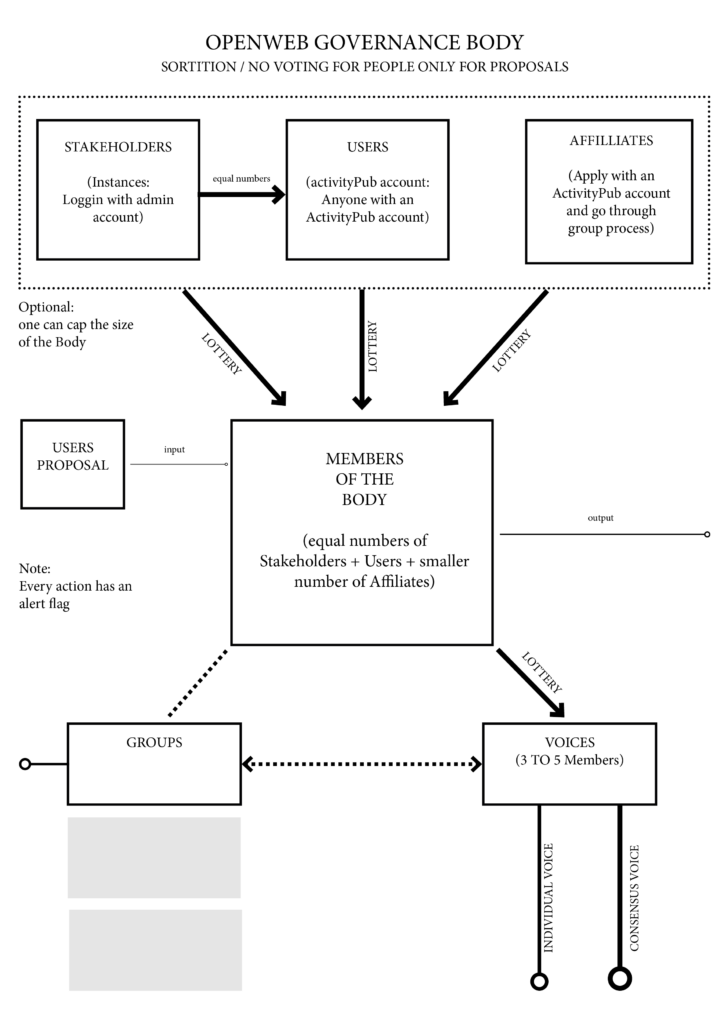
This is the gap that led to the #OGB – the Openweb Governance Body. The proposal for a native governance layer for a federated network. Using the same principles that make federation possible – autonomous communities, open protocols, distributed participation, federation between communities, local decision-making, shared standards, negotiation and mediation, accountability between participating groups.
In other words governance that follows the architecture, rather than creating one institution above the network, building ways for the communities within the network to coordinate. Governance between communities “Who should control the Fediverse?” – “How can autonomous communities govern their relationships with each other?” very different questions.
A community shouldn’t have to surrender its autonomy in order to participate, different groups should be able to connect, negotiate, delegate, challenge decisions and coordinate around shared problems. Governance becomes a network capability, rather than a permanent hierarchy sitting above the network. Institutions can still exist, foundations can still exist, cooperatives can still exist. The important thing is that they don’t become synonymous with the network itself.
#OMN is the media version of the same problem – how do we build federated media flows where communities publish, subscribe, moderate, archive and share information without handing ownership of the whole media environment to a platform? #OMN and #OGB are therefore two parts of the same larger project to build the social infrastructure needed for a federated openweb to remain federated as it grows.
The technology matters, #ActivityPub matters, federation matters, #FOSS matters. But none of these automatically produce a healthy social system, they are tools. The culture, economics and governance built around them matter just as much. Don’t scale the wrong thing, is the central lesson.
We should absolutely work on reliability, infrastructure, sustainability and usability, but we should stop treating the #dotcons platform model as the measuring stick for anything. Scaling a platform means concentrating more people and resources into one system, scaling a federated network means enabling more autonomous communities to participate and connect. Those are fundamentally different forms of scale.
What we need to compost is the mainstreaming mess of when we “forget” the historical openweb wasn’t created because people wanted a slightly nicer version of #Facebook. What these people forget is that it came from a different idea of what networked communication could be. The challenge, what we need to support, now is to preserve and develop that difference while dealing realistically with money, infrastructure, scale, governance and the arrival of powerful actors.
So please focus – the real question isn’t simply, can the Fediverse scale? It is, can a federated network scale without turning itself into a platform? And underneath that is can the openweb grow without becoming the thing it was built to replace? A basic #KISS governance problem, that is why we need to build the alternatives now, before the vacuum is filled for us.
Federation, not a central organization – OGB isn’t one body governing everyone. It is a federated governance layer that communities, projects and servers can participate in.
#ActivityPub native, were overnance functions are distributed through the same federation model as the #Fediverse. Groups can communicate, propose, delegate, challenge and record decisions across organizational boundaries.
Permissionless participation as the is no central gatekeeper deciding who is allowed to join the governance network. Communities can connect when they meet the basic protocol/social requirements.
Affinity groups rather than permanent representatives, were people organize around issues, projects or communities. Authority comes from participation and demonstrated trust, rather than simply holding an institutional position.
Sortition and recall. Where representatives are needed, selection is based on sortition rather than elections or permanent appointment. Delegates remain accountable and can be recalled.
Dilution of concentrated power. No person, organization or community is able to accumulate permanent control. Roles, influence and decision-making capacity are deliberately distributed.
Voices rather than a single leadership. A small rotating group of 3–5 “Voices” provides coordination and a public interface without becoming a permanent ruling committee.
Governance as a protocol/social practice. The important thing isn’t creating another institution, it’s creating a shared way for autonomous communities to negotiate with each other.
So in the current Fediverse the example is:
#SWF governance through an institution. #OGB governance between federated communities.
And that fits the #openweb because the governance path follows the architecture – distributed, federated, contestable and permissionless, rather than the normal default common sense of centralized ownership. The interesting bit is that #OGB doesn’t have to replace existing institutions, it can talk to them, mediate with them, and provide a counterweight to them while the #openweb remains open.
We have done this before, we take a useful technology, wrap it in a huge financial story. We centralize it, try and monetize it to turn it into a platform. Then we pretend the social consequences were somehow an accident, it is what we are doing with LLMs. We took an interesting piece of software and started selling it as AI, then AI became AGI, became super-intelligence. This smoke and mirrors feeds the path of building gigantic data centres, burning enormous amounts of energy, raising billions, signing extraordinary infrastructure contracts and concentrating yet more power in a hands of the #nastyfew.
And now we are supposed to believe this is progress, nop, this is the normal #deathcult doing what the #deathcult does – take something useful and turn it into an extraction machine. the mess we need to compost is that “interesting software” doesn’t justify a trillion-dollar mythology – AI will transform everything – AI will replace everyone – AI will solve science – AI will destroy civilization – AI is the next industrial revolution – AI is the singularity – AI is almost AGI – AI is too dangerous to release – AI is progressing faster than anyone expected – AI will change humanity forever. Can you see the smoke and mirrors trick?
Both the utopian story and the apocalypse story sell the same thing, more #AI, more computing, more investment in data centres. More centralization of money for the companies already building the machines of control. Maybe the argument changes, the conclusion doesn’t. Pushing fear is also marketing, this is where the current AI “doom” industry pushes mess. Tell people your machine might destroy the world and you have simultaneously told them your machine is incredibly powerful. This is about grasping for the control of focus, creating scarcity, you have created fear you have created importance.
This mess is about #fashionista capture, its a old story, were you try to created a lever for governments, and the chattering classes, there servants to listen to you, for investors to keep funding you, to build even bigger machines. The apocalypse it self becomes a business model.
That doesn’t mean the risks aren’t real, #AI implementations can create real security, economic, social and political problems. But we need to separate those problems from the mythology. A badly isolated autonomous coding system is an engineering and security failure, it doesn’t mean the machine has “woken up”. An LLM producing confident bullshit isn’t evidence of an emerging artificial mind, it is an LLM producing confident bullshit. And a company repeatedly telling us that its next model might be AGI doesn’t make AGI a meaningful scientific milestone.
Sometimes #KISS is the radical answer, please look at what the machine actually does, not what the marketing department says it might eventually do. We have already seen this mess play through.
Web 1.0.
Web 2.0.
Crypto.
Blockchain.
NFTs.
Metaverse.
Web3.
DAOs.
Now AI.
Every few years Silicon Valley discovers the next thing that will “transform” nothing. The technology changes, were the investment logic barely does. Hype → investment → infrastructure → more hype → bigger investment → pressure to monetize, it is #techchurn.
Except now the machines require gigantic amounts of physical infrastructure and enormous financial commitments. This is the bit that gets hidden behind the shiny chatbot interface, LLM’s isn’t floating in the cloud, it is powered by somebody else’s warehouse, somebody else’s electricity bill and somebody else’s infrastructure. The supposedly weightless future has a very large material footprint.
The #deathcult loves this machine – but something deeper is happening here – the #deathcult has spent fifty years teaching us to worship – growth – efficiency – scale – competition – automation – consumption – financialization – individualism – technology. The AI industry is the last-ist gasp at pushing the mythology – more computing, more scale, more automation, more investment, growth, more efficiency. And because this machine is called “intelligent”, we are encouraged to bow down even further. The machine knows, the machine decides, the machine optimizes, the machine will solve all our knee ach problems. Meanwhile, the #nastyfew who own and direct the machine accumulate power.
Its a part of the #geekproblem were technical people make things work, this has real value, but technical expertise is one tool, not the toolbox. You cannot engineer your way out of social problems, or code trust. You cannot automate democracy. You cannot solve inequality with a better interface. You cannot fix the political economy of capitalism by making the algorithms slightly cleverer. And you certainly cannot hand over social decisions to machines because the humans have become inconvenient to a few nasty people.
This is the same blindness we have been suffering from for decades, if the problem is difficult, make it technical. But then “common sense” technical people become the gatekeepers, becomes the institution, becomes infrastructure. Then fingers in ears, nobody remembers that the original decision was political, as the power disappears into code – #AI becomes just more #dotcons.
To balance this mess, by composting, we need to open our eyes to the history of the #openweb. The original web was built messy on #4opens standards. hyperlinks, RSS to grow small websites were people published, people connected built by people making their own tools. Then Web 2.0 arrived, the UX got better, the platforms got bigger, the money arrived and the web became #dotcons.
Blindly, repeating this same mistake with the dotcons LLM’s in the era of #climatechaos is stupidity. Its a big mistake to be building another generation of giant closed systems of control. At best we should be asking – what would an open AI infrastructure look like? What data? What standards? What ownership? What governance? What accountability? What local control? What human oversight? What right to challenge? What right to rollback? What happens when the system is wrong? Who gets to decide? These are political questions.
That is backwards, technology is a tool for people, and yet here we are. agen we are generating the problem to feed the machine built to solve the problem, peak #techshit. So what do we do? We don’t have time for another #fashionista moral panic please. Not “ban everything”, not “AI will save us”, not “AI will kill us”. Not another fucking blinded conference where everybody agrees that governance is important and then goes home and builds the same centralized paths.
What we do need is to compost is this mess, take the useful technology, the useful research, the open models to build automation that actually gives people more time and power. Knowledge is always useful, but please throw the mythology onto the compost heap, the fake AGI worship, the #nastyfew billionaire saviour stories, the singularity smoke. We cant survive the endless-growth assumptions, of the #closedweb platforms, the surveillance economy, we need to compost this social #techshit.
Composting this is why the #openweb is a tool that still matters, not because openness is fashionable, or that another technical architecture will magically save us. It matters because power has to be distributed somewhere. Open data – Open source – Open standards – Open process – The #4opens. To make this tool work we need to grow the path of human moderation, community trust, distributed infrastructure and shared public knowledge.
The #OMN has practical projects for this path – archives with #makeinghistory – news with #indymediaback and eventually governance with #OGB. A practical #KISS path that understands that we need useful technology, to help communities organize, remember, communicate and act. We need infrastructure that belongs to the people using it, And the community to use this “shovel” to stop worshipping the mythology of the #deathcult machines and start rebuilding the commons.
Yes, this is a first small step in the path we need, not a dogmatic answer to everything. We clearly do not need more blinded technological salvation story’s. What we do need is a practical path to build news, archiving and eventually governance around open flows, trust and participation rather than surveillance, extraction and platform ownership.
The #deathcult has had fifty years, look at the mess, now lift your eyes and let’s start composting.
As the worshipping the #deathcult for the last 50 years becomes harder to hide, the lies are more naked. The lie of endless growth, trickle-down wealth, technological salvation and individual freedom are running into the material reality they created. The mess can no no longer be hidden in the abstract.
#Climatechaos, inequality, war, social fragmentation, political decay. #techshit. The question now is impossible to keep ignoring, not whether the system has problems, it is whether we can see the problems clearly to stop worshipping the mess that created them.
This is where we need social composting. Turn the pile. Expose the assumptions. Keep what is useful. Let the dead ideas rot down. Then grow something alive.
One of the simplest lessons from revolutionary politics is that power should stay with the people doing the work, not with a permanent party, bureaucracy, or managerial class. This has strong relevance for the #OMN project’s first step.
A clear second step is needed, one that moves beyond reformism as an end point, not a rejection of reforms outright. Winning better wages, shorter working hours, stronger rights, and better conditions matters. These are how people develop confidence, solidarity, and an understanding of their collective power. The problem arises when reform becomes the destination, rather than a deeper process of social change.
When movements become satisfied with managing the existing system, the system itself becomes invisible. Language changes, structures become professionalised, leaders become representatives, activists become stakeholders, and participation becomes consultation. Eventually, the movement is managing the symptoms of the system it originally wanted to change and challenge.
Reform is a means of building collective power, not an excuse to abandon the possibility of fundamental change. We’re not interested in building better communications infrastructure to serve existing power structures. Our path is changing who has meaningful power over media, information, and governance.
This is an old story, moving from representation to participation – council communism. The alternative paths explored were the workers’ council, a project like the #OGB, where power wasn’t handed to a permanent party leadership.
In our 21st-century digital version, delegates are sorted, held accountable, and recallable. Governance bodies federate together without becoming subordinate to a permanent central authority. To grow spaces were the question is not – who represents us? The question isn’t who represents us, but how people participating in something retain meaningful control. A very different starting point from the current mainstreaming.
The #OMN social tech project is built from this federation, not centralisation. People and groups participate locally while remaining connected to bigger networks through #4opens standards and shared protocols. A local group is autonomous while participating in a wider network. #OGB ideas like recallability, transparency, open process, and distributed decision-making become practical, not just theoretical.
For the #OMN, the daily struggle and larger transformation are connected, reform is a means of building collective power, not an excuse to abandon the possibility of fundamental change. On this path, we are not interested in building better communications infrastructure so that the existing power structures can communicate more efficiently. Our path is changing who has meaningful power over media, information and eventually governance.
But, yes, there is a temptation to romanticise grassroots movements, we should resist this, as the historically these paths declined for good reasons. They were to frequently divided by factional disputes, ideological arguments and organisational conflicts. We should not need to repeat how suspicion of bureaucracy sometimes became suspicion of organisation itself.
To heavy structure creates problems, but to light structure also creates problems, if you build no durable structures, somebody else eventually fills the vacuum. Romantic anti-authoritarian intentions do not automatically produce democratic outcomes, a group can reject formal hierarchy while developing powerful informal hierarchies. A movement can reject leaders while allowing a few confident voices to dominate discussions. An organisation can demand decentralisation while becoming impossible for ordinary people to participate in, and can become so fragmented that cooperation becomes harder than centralisation. This is one of the most important lessons, that shapes the #OMN.
Decentralisation needs usable governance, that is not to abandon structure, but make structures that remain accountable to the people using them. That means keeping governance simple enough to understand, open enough to inspect and flexible enough to change. It means separating coordination from ownership, by making sortition temporary and contestable.
This is where the #OGB idea becomes important, It allows people to disagree without turning every disagreement into a schism, and build processes that can survive this disagreement. The path is governance that can become something communities can actually do, rather than something handed over to specialists.
Then we need the #4opens as a defence against capture, it is not simply a technical preference, they are social safeguards. Together, they make it harder for power to hide/disappear into a black box. Openness creates places where hierarchy can be seen, challenged and, when necessary, bypassed. We need this to mediate the mess of everyday elitist vanguards that claims to speak for us, but the balance is, neither do we want a collection of isolated individuals pretending that society does not require organisation – the trap of #stupidindividualism. People need shared infrastructure, shared knowledge, shared processes and ways of making decisions together, to hold commons in place.
With the #OGB people participate directly, delegate where useful, contest decisions, fork when necessary and reconnect when possible. That makes low-energy structures more flexible than both the traditional party or the centralised platform. Democracy cannot simply be postponed until after the revolution as people learn collective power by exercising it. When they make mistakes they argue and experiment, change their minds to find what works through participation. Democracy is therefore not just a mechanism for selecting leaders, it is part of the process through which people become capable of governing themselves
We need useful historical lesson about keeping power close to participation. As when a party, committee, NGO, platform or the normal technical elitists begin making decisions on behalf of everyone else, the movement’s own capacity for self-government begins to atrophy. The #OGB simply keeps delegation recallable and infrastructure federated, processes visible and standards open. To keep governance simple enough for ordinary people to use.
And, critically, we need to grow enough structure that disagreement does not automatically destroy the organisation. This is the balance we are looking for, not bureaucracy – not chaos. Not permanent leadership – not isolated individualism. But, native grassroots federated, participatory, accountable organisation. Please – don’t forget anti-authoritarian intent is not enough, without workable governance, openness and trust, decentralised movements can still fragment, stagnate or recreate informal elitists.
The #OMN path is about building the infrastructure to hold those two truths together. Power to the participants, structure without hierarchy, federation without centralisation, governance without a ruling class. That is the path from old political arguments towards more practical working commons paths.
The #deathcult is selling the void, turning meaning into a market, in this post we cover the normal themes of #stupidindividualism, commodification, atomisation, trust and community.
One of the deeper tricks of the #deathcult is that it doesn’t only sell us products. It sells us back the meaning, belonging and connection that the system itself has striped away. Nietzsche’s famous declaration “God is dead.” was not simply that religion was disappearing, but that an outdated system of shared meaning and moral authority had collapsed.
For many people, that leaves a void, a longing for meaning, connection, protection and purpose, for something larger than the isolated self. And where there is longing, capitalism sees a market – consumer capitalism, the market for meaning has always promised that dissatisfaction can be solved through consumption. Buy the car, the clothes, the holiday, the experience, buy the lifestyle. But what this hides is the more profound needs of belonging, meaning, safety, trust, community – don’t fit comfortably into commodity form – more stuff does not fill the hole – so the market moves further inward.
Instead of simply selling objects, it starts selling the self with self-improvement, self-mastery, self-optimization and personal growth. Manifestation and spiritual awakening, the lie becomes: the problem is not the society you live in, the surrounding relationships, or the structures shaping your life, the problem is you. And in the mainstreaming, conveniently, there is always another influencer peddling a course, book, retreat, coach or guru available to fix you.
This is the perfect market because the product must never work, if people actually became fulfilled, the market would disappear. So people need to remain almost healed, almost whole, almost happy, almost enough – the longing itself becomes the business model – this is #stupidindividualism dressed as enlightenment.
Then we have religion reborn – the commercialised form of Western spiritualism – not community ritual, religion or spiritual practice, but the Instagram-ready world of manifestation, “high vibration”, gurus, retreats and personal enlightenment. This supposedly alternative culture simply reproduces the core values of capitalism: individualism, control, competition, self-surveillance and the hero narrative.
Our current “thinking” instead of challenging these values, we spiritualise them, you are told that your thoughts create your reality, everything happens specifically for your personal development. That success proves you are aligned, suffering means you failed to think correctly. The fantasy is that you can become the god of your own reality.
This looks like liberation, but underneath it is the same old #stupidindividualism. The individual becomes the centre of everything, society disappears, material conditions disappear, history disappears and power disappears. The outcome is you treat other people as supporting characters in your personal journey, then exploit them by turning structural problems in to personal failure.
This is where politics becomes important, if every outcome is understood as a reflection of your mindset, then structural criticism becomes difficult. Poverty? It is a mindset problem. Loneliness? Means you need to work on yourself. Abuse? A lesson the universe sent you. Illness? Your energy is wrong. Failure? You did not manifest hard enough.
The effect of this “thinking” is deeply conservative, instead of asking why people are suffering, we tell them their suffering is evidence of their own failure. Instead of rebellion, we get self-improvement. Instead of solidarity, introspection. Instead of collective action, another #SEO journal.
This is an affective #mainstreaming way of neutralising dissent because it turns social pain into private inadequacy. The death of empathy is the ugliest part of this, if someone’s suffering is something they “manifested”, then nobody has to sit with them in it. Nobody has to listen, has to ask what happened, has to offer real help. A platitude replaces solidarity “Everything happens for a reason.” “You need to forgive.” “This is a lesson.” “You attracted this into your life.”
The language sounds caring, but the practice becomes the opposite – cruelty is renamed healing, blame as wisdom, detachment is renamed enlightenment. This is simply more emotional capitalism, were the language of empathy remains everywhere, while the actual social practice of empathy disappears, but when empathy dies, connection dies with it.
Community is dangerous to power, people who gather can organise, people who form relationships can resist. People who trust each other become harder to govern through fear and isolation. The current mess does not need tanks in the streets to atomise people, it can do it culturally as when connection is labelled dependency, needing people becomes weakness and community becomes inconvenient. In our worship of the #deathcult the ideal person becomes the isolated, self-managing individual who treats every problem as something to solve alone.
At the #OMN we keep coming back to the #mainstreaming problem. Why? A system is most powerful when its values stop looking political, when they become common sense, when individualism becomes blinded freedom, competition becomes human nature, consumption becomes happiness. Self-surveillance becomes personal growth and isolation becomes independence. At this point, the system barely needs to tell people what to do, people reproduce the values themselves. They discipline themselves, blame themselves, sell the same worldview to each other. The #deathcult ideology becomes culture, becomes infrastructure.
But, the path away from this mess is simple, without followers, the hierarchy collapses, this is particularly obvious in digital culture. The supposed influencer is still dependent on likes, subscribers, sales, views and reputation. They claim independence while being embedded in the same attention economy they supposedly escaped. They are not outside the market, they are a particularly efficient product of it.
We need to remember that human beings have always created ritual, meaning, myth and shared practices. The #OMN path points in this direction, less self-obsession, more participation. Less individual optimisation, more shared action. Less influencer culture, more horizontal knowledge. Less performance, more trust. Less “fix yourself” more “build something together”.
The #openweb matters here because the structure of our technology also shapes our culture. The #dotcons push the isolated individual, your feed, brand, your followers, your engagement, your identity. The #deathcult repeatedly breaks social things into individual fragments and then sells them back to us. It breaks community and sells networking, meaning and sells lifestyle, confidence and sells self-help. It breaks connection and sells social media, belonging and sells branding.
The answer is not another product, its simply to rebuild the social fabric that commodification has been eating away. Yes, real connection is messy, solidarity is inconvenient, community involves disagreement, compromise, responsibility and mutual care. You cannot optimise it, you have to participate in it. And it is one of the reasons the #OMN keeps saying the same apparently simple thing – Trust matters. Community matters. Participation matters. The #deathcult wants you staring endlessly into yourself, the commons start when we look outward and find each other #KISS
I kind of though this was incomplete so did some reading and added this section.
Maybe focus on different paths to get a balance of good and bad…
The Chinese Cultural Revolution remains a difficult and important experiences for anyone seriously interested in emancipatory politics. It is tempting to reduce it to the normal #mainstreaming a story of authoritarianism, Mao, political violence and social chaos, but doing that misses something more useful. The Cultural Revolution was also a huge experiment in what happens when millions of people are encouraged to challenge established political power and create new forms of organisation.
Its failure raises a question that remains relevant today – how do people share real power without reproducing the behaviour of the structures we are trying to replace? – This is a central question for the #OMN path to walk from challenging power to creating alternatives.
The distinction between dismissal and pluralisation.
Dismissal is the politics of removing people, defeating factions and taking control. It is fundamentally about deciding who should have power and who should be excluded from it.
Pluralisation is different. It is about people organising themselves, experimenting with new relationships and creating institutions outside existing hierarchies.
The Cultural Revolution contained both tendencies, in its early years, independent organisations and new forms of mass political participation emerged. But these experiments became caught up in factional struggles. Groups began fighting over who would control political power rather than concentrating on what new forms of social organisation they could create.
The result was destructive, the politics of negation overwhelmed the politics of creation. This distinction matters as it is relatively easy to define what we are against. It is much harder to build something that people actually want to participate in. A movement can become good at identifying enemies while becoming progressively worse at creating alternatives.
That is one of the traps that the #OMN path is avoiding. A simple problem is that authoritarianism does not require a state, it is possible for people to reproduce authoritarian relationships among themselves. You can see this today in cancel culture, how ordinary people became involved in policing one another, enforcing political identities and attacking those considered insufficiently revolutionary.
This creates a difficult problem for anyone pursuing decentralised or anti-authoritarian politics, simply removing the state does not automatically create freedom. Simply decentralising power does not automatically make relationships democratic. A crowd can become authoritarian, a community can become authoritarian, a movement can become authoritarian or a social-media group can become authoritarian.
Even a supposedly horizontal organisation do develop informal hierarchies, gatekeepers and systems of exclusion. This is why “power to the people” is not enough as a political programme. We also need structures that help people exercise power without turning that power into domination over others. This is what the #OGB is for and about.
The danger of dismissal has a connection with what we now call cancel culture, although the underlying behaviour is much older than social media. The important issue is not simply criticism of individuals, criticism is necessary in any functioning democratic culture. The problem is the development of an internal policing culture where belonging depends upon ideological or moral purity. People are divided into the good and the bad. Disagreement becomes evidence of corruption. Mistakes become grounds for exclusion and political differences become moral crimes, eventually the movement starts consuming its own members. This is the logic of dismissal.
And it is particularly dangerous for grassroots movements because they lack the institutional safeguards that exist, at least theoretically, within formal democratic structures. Without some way of managing disagreement, accountability and conflict, decentralisation simply produce competing factions fighting for informal control.
Creation has to be the core path, this is the most important lesson, not simply “don’t be authoritarian.” It is more positive than that. Build, build! Institutions, relationships, build commons, build democratic practices, build alternative infrastructures. Build ways for people to participate without having to surrender control to a central authority, this #KISS step changes the political question.
Instead of asking – who should control the existing system? We ask – what can we create that makes the existing system less necessary? This is a much more interesting question, that moves politics away from permanent opposition and towards experimentation. The goal is not simply to seize somebody else’s institution and run it with different people, it is to create institutions with different relationships built into them.
Then we have the old stalwart of class analysis, this is useful for understanding economic power and exploitation, but when class becomes a moral label, it becomes another mechanism of dismissal. Someone is no longer disagreed with because of what they are proposing, they are dismissed because of what category they have been placed into.
This creates a strange reversal, the people who were supposedly building a more egalitarian society can become increasingly concerned with identifying and eliminating the “wrong” people. The category becomes more important than the political project, a historical paradox that people who had been oppressed under the old system could become defenders of the new hierarchy, while people from previously privileged backgrounds could become radical opponents of bureaucratic privilege. People are more complicated than political categories that matters for any attempt to build a genuinely participatory politics.
A needed balance is that institutions matter, we should not only romanticise spontaneity. People organising themselves is important, grassroots experimentation is important, but spontaneous organisation does not automatically remain democratic. There need to be ways to deal with disputes, abuse, exclusion, manipulation and concentrations of informal power.
This does not mean rebuilding a centralised bureaucracy, more about developing lightweight (like the #4opens) democratic institutions that protect pluralism and participation. The challenge is to create enough structure to prevent domination without creating so much structure that the institution becomes another hierarchy. Yes, a difficult balance, but avoiding the problem does not make it disappear.
The #OMN project is not about building another political machine, it is to experiment with infrastructure that allows people to organise, communicate, publish, archive and make decisions while retaining meaningful control over their own participation. That means moving away from the logic of the centralised platform, instead of one organisation → one authority → one set of rules, we can explore, many participants → shared protocols → transparent processes → distributed participation.
But distributed does not mean unaccountable, the infrastructure needs mechanisms for trust, moderation, transparency, rollback, correction and disagreement. The aim is not to eliminate conflict, it is to make conflict productive rather than destructive. But openness alone is not enough, an open system can still develop closed social relationships. A technically decentralised network can still become dominated by a few people. A community project can still develop gatekeepers. So the technical architecture and the social architecture have to develop together.
This is why the #OMN path is not simply about technology, it is about learning how to build social systems that are capable of remaining open, while not repeating the politics of negation. The path is therefore be surprisingly simple, a movement cannot define itself forever by what it opposes. If all our energy goes into removing enemies, exposing bad actors, denouncing ideological impurity and winning internal arguments, we eventually become trapped in the same power logic we claim to oppose.
We need to spend more energy on creating, create spaces where people can participate, commons where people can contribute without surrendering ownership to a corporation, archives that preserve collective memory. We need media systems that don’t depend upon algorithmic gatekeepers, governance where disagreement does not become exclusion. Not only that, but we need to create institutions that can learn, this path is the difference between negation and creation.
We need a path, not a blueprint. Questions to address, problems any emancipatory movement has to confront. How do we prevent bureaucracy from becoming permanent? How do we stop decentralisation becoming factionalism? How do we deal with disagreement without turning it into moral warfare? How do we give people real power without enabling new forms of domination? How do we create democratic institutions that remain open to change?
The #OMN therefore starts from a path of creation rather than dismissal, we should not try to build a perfect system. We build systems that people can participate in, question, modify and improve. That means accepting disagreement, allowing experimentation to create mechanisms that prevent any one group from permanently capturing the commons. This path to self-government has to be learned, practised and institutionally supported.
Freedom is not created simply by removing authority, it is created by building the social relationships and institutions that allow people to exercise power together without turning that power into domination. That is a much harder project, but also the more interesting one.
The #OMN path is not about taking power – it is about building the capacity for people to share power #KISS
This is the web 1.5 idea, with the #OMN people ask whether this is just rebuilding Web 2.0, the answer should be no. We are trying to undo some of the damage Web 2.0 did to Web 1.0 while keeping the useful things we learned from it.
Web 1.0 openness. Web 2.0 UX. Fediverse federation. #4opens process. Community trust. News and archives first. Governance further down the road.
That is the rough shape of Web 1.5, it isn’t about making another giant platform, it is building infrastructure where media objects can flow between communities, where history can be preserved without everything being privately owned, and where social intelligence isn’t replaced by a central algorithm. The mess we’ve inherited is real, but perhaps we don’t need to clean it all up before we can build something new, we can compost it.
So, let’s dive a bit deeper into this, how is #OMN different from Web 2.0? The short answer is, it isn’t trying to rebuild Web 2.0. It is trying to recover what Web 1.0 got right, while keeping the useful UX lessons of Web 2.0. Web 2.0 took much of the openness of Web 1.0, wrapped it in better UX, and then turned it into the #dotcons – centralised, privatised platforms that captured and monetised the value of the #openweb.
#OMN takes a different path – the basic idea flows rather than ownership. Instead of everything being centred on individual accounts, owned databases and personal content silos, media objects can flow between trusted nodes. Media comes in, are curated and grouped into Stories, and those Stories then flow back into the network as new media objects. That makes #OMN feel like Web 1.5, it keeps the Web 1.0 openness, decentralisation and interoperability, but adds some of the better usability lessons from Web 2.0. The difference is that we’re not bringing back the centralised ownership model.
In #OMN, an instance isn’t primarily a collection of individual social-media accounts. It is more like a node in a shared media flow, providing curation through media objects and collective Stories. Users can still exist in the underlying software, it’s a balance, but they don’t need to be pushed to the surface as the centre of the #OMN network. This also changes how we think about participation. You don’t necessarily have to “own” the media to participate in it. You can contribute, curate, tag, connect, remix, archive and pass things on. As we put it – less ownership, more participation, more flow, more commons.
The aim is also to get away from the popularity contests of social media. Objects move through the federation towards the nodes and communities where they have value. Things that aren’t useful don’t necessarily need to be centrally deleted, the network can be deliberately lossy, allowing some things to fade while other things are carried forward. Though instances can choose to save everything if they can scale this, even apparently useless material might become useful as compost for future work.
And importantly, #OMN is not social media, it is about news and archiving, with governance further down the road. It works alongside social media rather than trying to become another social-media platform.
The bigger idea is that we shouldn’t have to choose between the open but sometimes awkward Web 1.0 and the polished but enclosed Web 2.0. Like the #Fediverse we balance the best of both, Web 1.0 openness + Web 2.0 UX + today’s federated infrastructure = Web 1.5. Not a return to the past, not another #dotcon. A reboot of the #openweb, using what we have learned since.
UPDATE01: OK for #web1.5 am going to use #web15 as the point breaks the hashtag #KISS
UPDATE02: why is this important? It’s simple, participation rather than passive consumption is a cultural problem. The #dotcons trained people to become consumers – Scroll. Like. Share. Repeat – The #openweb needs a different relationship.
To move past this current mess, let’s look how the #OMN changes this, you might start by simply reading, then you learn how the system works. Eventually, you contribute something to become part of the production process rather than remaining a consumer at the end of it.
The aim is to lower the barriers between producer and consumer. This doesn’t mean everybody has to become a journalist or programmer. It means creating systems where participation is possible and meaningful.
Technical expertise matters, the problem begins when technical expertise is treated as the only legitimate way of understanding a social problem. This is the trap of technocracy: taking a useful tool for understanding parts of the world and turning it into a complete worldview. The expertise problem “We need more technical expertise in government.” But that is half the answer. The mistake is to jump from “politicians need technical expertise” to “technical experts should make decisions.” That replaces one form of stupidity with another.
A functioning society needs engineers, scientists, programmers and researchers. But it also needs historians, sociologists, artists, carers, journalists, workers, communities and ordinary users Technical knowledge is one tool in a toolbox, it is not the toolbox.
We have seen the consequences repeatedly. Politicians who barely understand how the internet works are expected to regulate it. At the same time, technology companies and technical communities assume that because they understand the machinery, they therefore understand the society surrounding it. Neither position is good enough – we need technical people involved in politics and governance, but we also need those technical people to understand that engineering is not governance.
The #geekproblem hashtag is particularly important part of the story for the #openweb. A lot of contemporary technology culture has inherited a blinded belief that social problems can be converted into technical problems: if something is messy, build a perfect system, when people disagree, write a protocol, when something is unsafe, add security. If information is difficult to manage, build an algorithm, when people behave badly, moderate them automatically. If a community is struggling, optimise the workflow. Sometimes these things are useful, but often the “technical solution” simply hides the social problem.
The problem isn’t that geeks are bad people. It is that technical culture can become too comfortable with abstraction. People become numbers, communities datasets, politics optimisation. Relationships become networks, trust becomes authentication and participation becomes a user interface. And suddenly, we have designed a technically elegant system that nobody actually wants to live inside.
This is the deeper danger of #technocracy, it is not simply about having too many computers, engineers or technical experts. It is about turning technical expertise into political authority. The idea has been around for a long time. During the crisis of the 1930s, technocratic movements argued that society could be managed by scientific and technical experts rather than through the messy processes of democratic politics. The appeal was understandable: when society is in crisis, efficiency, certainty and expertise can look much more attractive than disagreement, compromise and uncertainty.
But that is the problem – democracy is messy because society is messy. There is no technical system that can contain all the values, histories, relationships, conflicts and experiences of the people affected by a decision. The belief that a small group of people with enough information can simply calculate the correct answer is not an escape from politics, it is politics disguised as engineering.
We can see the same problem emerging in our own technology culture. Silicon Valley has presented itself as being above politics: just build the system, scale it and let the technology solve the problem. But these companies have accumulated enormous economic and political power precisely because their systems shape how people communicate, work, organise, consume information and understand the world. Technology is therefore not neutral infrastructure, who owns it matters – who controls it matters – who funds it matters – who writes the rules matters – who has the power to change those rules matters. And what happens when the system is wrong matters.
The danger becomes serious when technological power and political power start merging. A technology billionaire does not become democratically accountable simply because their company operates critical infrastructure. A powerful algorithm does not become legitimate because it is technically sophisticated. A government does not become more democratic because it uses AI. Technology can be used to amplifie power without making that power accountable.
Technologies of humility
This is where the idea of technologies of humility becomes useful: technical and policy systems need to take uncertainty, ambiguity, vulnerability and the limits of knowledge seriously. Four principles might be useful.
Framing
How are we defining the problem? Are we actually addressing the problem, or simply addressing the part that is easiest to measure? This is hugely important in #OMN development, if we define the problem as “How do we distribute content efficiently?” we will build one kind of system. If we define it as “How do communities maintain trustworthy shared media and social memory?” we build something very different. The technical architecture follows the social framing.
Vulnerability
Who gets hurt by the solution? A system can be efficient and still be destructive. Algorithms can optimise engagement while making people miserable. A moderation system can reduce abuse while silencing marginalised voices. A security system can protect one group while excluding another. We need to ask: who is missing from the path?
Distribution
Who gets the benefits? Who gets the power, the money and who carries the risks? This is one of the most important questions in technology because “innovation” is rarely distributed equally. The #dotcons have become good at extracting value from social relationships while presenting the resulting technology as neutral infrastructure, it isn’t neutral. The ownership model matters, governance matters. The #4opens matters because it tries to move these questions into the open.
Learning
What happens when we are wrong? This may be the most important principle of all, there is rarely one perfect answer to a complex social problem. We need systems that can learn, not simply systems that can scale. This is one of the reasons #OMN is interested in things like moderation, rollback, metadata, federation and open governance. A social system needs mechanisms for correction, needs to be possible to say “That didn’t work. Let’s change it.” without treating the previous decision as sacred.
We need to understand that open systems need more than code, you can have beautifully engineered open-source software running a terrible social system, a decentralised network full of authoritarian communities, transparent code supporting opaque power, and you can build technically open systems that are socially closed.
So the challenge isn’t simply – how do we make the technology open? It is, how do we make technology part of an open social process? That is a much harder question, and much more interesting and why #OMN is deliberately messy.
The #OMN approach isn’t to pretend that we can design the perfect social system in advance. It is to build enough open infrastructure for communities to experiment, disagree, adapt and learn. That means accepting that different communities will do things differently, while providing common building blocks that allow different paths to develop – different interfaces, different workflows, different communities and different forms of participation. It means designing for disagreement rather than pretending disagreement can be engineered away, a path from technical systems to social infrastructure.
Composting the current mess is where the critique of tech authoritarianism connects directly to the #geekproblem, it is the problem of expertise becoming authority without accountability. And the answer is not to remove technical people from decision-making. Quite the opposite. We need their knowledge. But we need it alongside other forms of knowledge and inside democratic, open and accountable processes.
Engineers can tell us what a system can do, but they cannot, by themselves, tell us what society should want. Programmers can design protocols, but they cannot decide what relationships a community should have. Data scientists can identify patterns, they cannot determine what those patterns mean to the people living through them. And AI can process enormous quantities of information, it still cannot replace human judgement, lived experience, disagreement and democratic legitimacy.
This is why #4opens + #OGB + #OMN + #MakingHistory belong together, attempts to build technical infrastructure that leaves room for social intelligence rather than replacing it. To repeat endlessly the path is not one perfect platform, one perfect algorithm or one perfect governance model, #KISS we need more tools, not one answer.
On this native path, mess is not necessarily a failure, it can be the space where learning, disagreement, adaptation and democracy actually happen. That is a much humbler – and potentially much more powerful – ambition.
One of the useful arguments in the debate around decentralisation, blockchain and the #openweb is also one of the simplest – We do not actually live in a trustless world, we live in a world built on different kinds of trust. This is why the Fediverse worked because it was #4opens with a good #UI.
The problem it had to overcome and still does is that much of #geekproblem pushing technology is obsessed with trying to eliminate trust rather than understanding how trust works. The idea of the “trustless” technology sounds attractive. If we cannot trust governments, corporations, banks, platforms, administrators or even other people, why not build digital systems where nobody needs to trust anybody?
This is a simple mindset, instead of trusting a person, trust the mathematics, instead of trusting an institution, trust the protocol. Instead of trusting a moderator, trust the code. Instead of trusting a community, trust the ledger. It sounds wonderfully clean, but there is a problem – you cannot eliminate trust, the social truth is you can only move it somewhere else.
A #blockchain can make it difficult to alter records after they have been entered, but it cannot magically make the information entered into the system true. Someone still has to enter the information, someone has to write the software, someone has to maintain the infrastructure, someone has to interpret the results and someone has to decide what happens when reality doesn’t fit the rules. That distinction, people, is important for thinking about the future of the #openweb as the path to trustless is usually just displaced trust.
Imagine buying a digital object through a “trustless” smart contract. The theory says that you don’t need to trust the seller. The contract automatically enforces the transaction. But do you trust the person who wrote the smart contract? That the code does what you think it does? Do you understand the code well enough to audit it? Do you trust the software running on your computer? Do you trust that the thing described by the contract is actually the thing you want? Suddenly, the system isn’t trustless in any way.
On this blinded pushed #geekproblem path, you are exchanging trust in people and community for trust in software, tech infrastructure and your own technical ability. A tiny number of people are grasping for power, in this it is a “grassroots” mirroring of the current #dotcons mess. Supposedly trustless transactions always fall back on reputation, previous experience, known counterparties or the assumption that somebody will behave fairly.
And this isn’t necessarily a failure, it is a recognition of how society actually works, trust is basic infrastructure. We think of trust as something soft and personal, a handshake, reputation, knowing somebody. Being part of a community, a history with an organisation. But trust is actually a form of core social infrastructure.
When you buy something from a local shop, you don’t individually audit every component of the business. You trust the shopkeeper, the reputation of the shop, the legal framework. You trust food standards, trust that if something goes badly wrong, there are mechanisms for dealing with it. None of this means that the shop is perfectly trustworthy, it means that layers of “soft” trust, accountability and social mechanisms make cooperation possible.
The same thing happens online, we trust websites, moderators, administrators, developers. We trust maintainers, communities. They all have reputations, the interesting question here isn’t – how do we eliminate trust? It is, how do we build better systems of trust? The #geekproblem problem of pretending that trust doesn’t exist, is a fantasy of the trustless system that makes things less democratic. If trust is made invisible inside code, people lose sight of where power shapes process and actually sits. So replacing a human decision with a technical decision doesn’t remove politics, it hardens and hides it by simply hiding politics inside infrastructure.
The #geekproblem isn’t about technical people being bad or that technical knowledge isn’t relevant. Quite the opposite, complex systems need technical knowledge. The current problem comes when technical expertise becomes a substitute for social and political accountability. The system says, “The code says so.” But somebody decided what the code should say, decided what the code should not say – that is governance.
Open Data. Open Source. Open Standards. Open Process.
The point of this simple clarification of #FOSS is to make the system trustworthy enough to participate in and transparent enough that people can understand how that trust is produced. Open source allows people to inspect and modify the software. Open standards allow different systems to communicate. Open data allows information to be examined and reused. Open process makes decision-making visible. They together make trust more accountable, a much healthier goal.
On this current broken path, some people assume that decentralisation means removing trusted intermediaries. But decentralisation does not mean removing relationships, it means distributing relationships and accountability. Instead of one corporation controlling everything, you have many independent communities. Instead of one giant moderation department, you have distributed moderation, one platform deciding the rules, instead communities establish their own rules while communicating through shared standards. Instead of one central archive, many organisations hold copies and contribute metadata flows.
That is not in any way trustless, it is distributed trust, and distributed trust is much closer to how healthy communities actually operate. Reputation matters, people have always used reputation to decide whom to trust. You recommend a builder because someone you know had good experience with them, choose a restaurant because friends recommend it. You work with someone because they have a history of doing good work, participate in a community because you know the people involved.
An example of this #geekproblem in tech the last 20 years of #blockchain projects, is that they have to recreate reputation systems, off chain, to grow trusted parties because people need them to function. This shouldn’t surprise us, reputation is accumulated social knowledge, a record of relationships, it is one of the ways communities remember.
And that common sense is something that technology should help communities develop rather than trying to replace with abstract technical mechanism. This is the danger of “code is law” a seductive idea, if the rules are encoded into software, nobody can arbitrarily change them. But real life doesn’t work like software, people make mistakes, circumstances change. Sometimes the rules themselves are wrong.
A genuinely sustainable social system needs the ability to interpret, moderate, appeal, correct and change, this requires people, relationships and basic governance. It requires trust, were a completely rigid system may be technically predictable while being socially disastrous. Trust needs accountability, this is particularly important for grassroots technology. When we build alternatives to the #dotcons, we shouldn’t simply recreate their power structures with different software. We need to ask:
Who can make decisions?
Who can see what is happening?
Who can challenge a decision?
Who can correct mistakes?
Who can leave?
Who can fork the system?
Who can moderate?
Who controls the infrastructure?
Who owns the data?
These are trust questions, a trustworthy system isn’t one where nobody has power, it is one where power is visible, distributed and accountable. Trust isn’t blind faith, yes, there is a danger in romanticising trust, trust doesn’t mean blindly believing people. Good trust is built through evidence.
You trust somebody because you have a relationship with them.
You trust an organisation because it has demonstrated competence.
You trust a process because you can see how it works.
You trust a community because people hold each other accountable.
You trust software because it is open, tested and maintained.
You trust a system because there are ways to challenge it when it fails.
So the opposite of “trustless” isn’t “blind trust”, it is earned, observable, and accountable. This gives us a useful direction for the current #openweb reboot. It points to the mess we need to compost, we don’t need to recreate the fantasy of an entirely trustless internet. The commercial internet already tried extreme centralised trust – for 20 years the #dotcons became trusted intermediaries for almost everything, owning the infrastructure, controlling the algorithms, identity, data, moderation. They controlled visibility, they still control the economic relationship with users. That isn’t trustless, it is concentrated trust and concentrated power.
Trust is the missing layer, there is a tendency in narrow #geekproblem paths to think in terms of infrastructure first. Servers, protocols, APIs, encryption, algorithms. But underneath all of these sits a social question – why should anyone trust this system? And the answer cannot simply be “Because the code works.” as a system can work perfectly and still be socially terrible. The important question is whether the technology helps people create relationships that are transparent, accountable, resilient and capable of self-correction. That is a much bigger challenge than creating a trustless protocol, but it is also much more useful.
To build on a different path, we need networks where communities can trust their own infrastructure. We are already doing this on the #Fediverse, building on #ActivityPub standard that allow communities to communicate. Moderation systems where decisions are kind of visible and accountable. What is lacking is building governance that people can participate in, this is where projects such as #OMN and #OGB become interesting. There goal isn’t to make human relationships unnecessary, it is to build technical infrastructure that supports better human relationships.
From trustless to trustworthy, means accepting that trust is unavoidable and then making trust visible and accountable. It means combining open standards with open governance, decentralisation with community and recognising that humans aren’t bugs in the system – humans are the system.
Technology should therefore not be designed around the fantasy that people are unreliable components that need to be eliminated. It should be designed around the reality that people cooperate through relationships, reputation, shared history, norms, institutions and accountability. The #KISS task of the #openweb is not to eliminate these things, it is to build better versions of them, real alternative to the #dotcons – not more dead-end trustless technology.
The #OMN path is distributed trust, supported by open technology and democratic governance. And perhaps a more radical idea – rather than trying to remove trust from society, we should get much better at building it, sharing it and making it accountable #KISS.
One of the important ideas in the sociology of science is also one of the easiest to misunderstand: knowledge is socially produced. This does not mean that scientists simply make things up, it means something much more practical. Science is a human activity, it requires people, institutions, money, equipment, archives, universities, laboratories, communities and time. What we choose to investigate – and what we choose not to investigate – is therefore shaped by society.
That means there is another side to the politics of knowledge, we construct knowledge, but we can also construct ignorance. This is the idea of agnotology: the study of how ignorance is produced, maintained and as we see todays messy world, deliberately manufactured. Yes, this should be common sense, that the consequence of science is unavoidable selectivity: we look here rather than there, and every decision to investigate one thing means that something else receives less attention.
The important question is therefore not – what do we know? It is also, what don’t we know, why don’t we know it, and who benefits from that ignorance? Science does not happen outside society, there is a persistent #fashernista fantasy that science exists somewhere above politics and society. In this common sense fantasy, scientists simply follow the evidence, eventually discovering the truth. Any gaps in knowledge are assumed to be temporary, eventually somebody will get around to researching the missing pieces and the picture will become complete.
But our current capitalist science doesn’t work like that, as research needs resources, someone has to decide what gets funded, has to establish institutions and employ researchers. Someone has to maintain archives and databases. Someone has to decide which questions are legitimate enough to investigate. This means that the social organisation of knowledge is itself part of the knowledge system. Science is not an abstract ideal, as meany people treat it, but a human practice made up of institutions, resources and people. Political forces influence the scientific ecosystem without needing to dictate the results of individual experiments.
This matters – you don’t need to falsify scientific evidence to manipulate science, you can simply make sure that the research never happens. The politics of the missing, lets look at an example, imagine two possible worlds.
In one, researchers spend twenty years investigating a particular health problem. Thousands of people contribute data. Universities train specialists. Public institutions maintain long-term datasets. Researchers develop treatments, identify risks and improve policy.
In another, funding disappears. The research programme closes. The datasets are deleted. Researchers move into other fields. Young academics decide there is no career in the subject. Communities become reluctant to participate because they no longer trust the institutions.
Nobody has announced “we have banned this knowledge”, but the knowledge disappears anyway. This is one of the most powerful things about agnotology. Ignorance does not have to be created by a giant conspiracy, it can emerge through apparently ordinary administrative decisions: funding priorities, institutional closures, data deletion, censorship, intimidation, restructuring and changes in what counts as a legitimate research question. Over time, the result becomes material.
Scientific knowledge is cumulative, new work depends upon old work, archives and datasets. Remove the foundations and you don’t simply lose yesterday’s knowledge – you make tomorrow’s knowledge harder to produce. The archive is political infrastructure – this is where the #OMN path becomes important. We often think of archives as passive things, as librarys siting somewhere, a database sits on a server, a government website publishes information, a research paper exists in a journal. But these things are infrastructure, if the infrastructure disappears, access to knowledge disappears with it.
This is why #makinghistory matters – society needs the ability to remember itself, not just the official history or whatever survives inside corporate platforms or that happens to remain profitable. We need distributed, community-controlled records of what happened, what people experienced, what institutions did, what communities built and what was subsequently removed. That is media infrastructure, but it is also social memory infrastructure – closed systems make forgetting easy, sometimes this is deliberate, often it isn’t.
The social record becomes fragile, is one of the problems with concentrating so much of our communication inside a small number of commercial platforms. We have allowed a huge amount of collective memory to become dependent on organisations whose primary responsibility is not to society but to their own narrow institutional interests. That is not the resilient information system we need today in the era of #climatechaos.
The #openweb is a memory machine – the alternative isn’t that everything needs to be permanently preserved forever, that would be another form of technological fundamentalism. The point is to create distributed capacity, multiple archives, multiple publishers, multiple communities, institutions. Multiple ways of finding and verifying information, multiple copies, open formats, standards, source and proces. This is what the #4opens approach is trying to get at, not simply technical principles, they are social protections.
Open Data means information can remain accessible.
Open Source means the tools themselves can be inspected and maintained.
Open Standards mean that information doesn’t have to remain trapped inside one company’s technical ecosystem.
Open Process means that decisions can be challenged rather than disappearing behind institutional walls.
Together these create a technical architecture of social resilience.
Then we have the danger of the “no data, no problem” argument, is a particularly nasty political trick that follows from manufactured ignorance. First, prevent the research, then point to the lack of research as evidence that the problem isn’t real No evidence.”, “No consensus.”, “More research is needed.”, “We simply don’t know.” Sometimes those statements are reasonable, but they can also become circular.
If you systematically prevent people from collecting the evidence, you cannot then use the absence of evidence as proof that nothing is happening. The rhetorical pattern is that the assumption that if something were true, science would already have conclusively demonstrated it. But a lack of evidence can also result from social forces preventing researchers from doing the work in the first place. This matters far beyond any single political issue, it applies to climate research, poverty, housing, public health, marginalised communities, the effects of technology. It applies to almost anything where powerful interests might prefer that certain questions remain unanswered.
Information needs communities, is another lesson – knowledge doesn’t survive simply because somebody writes it down. It survives because communities care enough to maintain it, institutions train people, maintain archives, provide context. Researchers build upon previous work, journalists document events, activists preserve evidence, technologists maintain infrastructure, historians connect fragments together. This is a social ecosystem and when you break enough parts of it, knowledge starts disappearing.
That is why the #OMN isn’t simply about making another publishing platform, the larger idea is to build infrastructure for collective knowledge production and memory. Publishing is one part, metadata another, moderation, trust, archives, federation are all parts. The ability to edit, correct, contextualise and preserve information needs to work together.
The #openweb gives us a possibility that centralised media never really delivered: a network where different communities maintain their own spaces while still communicating with one another. That creates disagreement without requiring isolation, creates diversity without requiring fragmentation and it gives us a chance to build something much more resilient than the current model of a handful of corporate databases surrounded by billions of users. From information to social truth, is a political question.
This is the reason I keep coming back to #makinghistory – if somebody deletes a webpage, we should have copy, if a community documents an event, that record should not depend upon one #dotcons corporation continuing to host it. If an organisation changes its story, there should be an accessible historical record. If a government removes information, communities should be able to preserve what was orgionaly published.
If today’s activists disappear, tomorrow’s activists should still be able to understand what they did. If a research project closes, the work should not simply evaporate. This doesn’t mean believing every archive is automatically true – archives need context, metadata, discussion, provenance and criticism. In fact, that is exactly the point – the answer to bad information is not less information, it is better social infrastructure for comparing, contextualising and challenging information.
There is a tendency to think of technology as neutral plumbing, but the plumbing determines what can flow through it. A centralised system encourages centralised memory – a closed system encourages institutional dependency – a disposable platform encourages disposable history. Were open systems create the possibility of continuity beyond any single organisation. What we do with those #4opens possibilities is a social question, it is why #OMN, #MakingHistory, #Indymediaback, #OGB and the wider #4opens approach belong together. They are different pieces of the same argument.
That is the danger of manufactured ignorance, and why preserving the #openweb is not a technical hobby, it is part of preserving our collective ability to think.