The #encryptionist detour

Let’s look back to before the #Fediverse, to be honest about the last two decades of #openweb failure, for a long time we got pulled off the path. Not only by enemies, but by a mix of fear, fashion, and half-understood technical “solutions” that felt right to fearful people at the time.

The rise of the dogmatic, blinded #encryptionist mindset came out of real conditions of mass surveillance revelations (Snowden era), common sense #neoliberal distrust of states and corporations and the real harms of our worship of the (same neoliberal) #deathcult of the #dotcons

Encryption mattered – and still does – private space matters, protection matters. But what happened next at this time is where things went wrong – we shifted focus from necessary tool to blinded totalising path. For the #geekproblem and its fashionista followers – encryption shifted from being a tool in the stack to the answer to everything.

Instead of asking what should be public? – what should be private? And how do we build shared, accountable space? We got a flattened answer of “make everything encrypted and trustless” that sounds good to the blinded fear filled crew as It feels “safe”. But if you are not blind, it obviously undermines the foundations of the #openweb we were working to reboot, the #openweb isn’t built on secrecy – it’s built on shared visibility, trust, and negotiation.

This was mess, enter #blockchain and #DAO – the peak of the detour, this is where the #fashionista layer really took over. Into this already confused path stepped #blockchain, #NFT’s and #DAO governance models of token economies. The mess making was wrapped in smoke and mirrors language of decentralisation, autonomy and trustlessness to “fixing governance”.

But look at what they actually did – financialisation of everything, instead of building commons, we got tokens, ledgers, “market” incentives leading to speculation. This is a very easy to see failed imagination of market logic reintroduced through the back door of wealth = power, not in any way new, it’s smoke and mirrors to hide the same old system the native #openweb path was supposed to move beyond. This detour directly contradicts gift economies, commons-based governance and trust-based collaboration, it was used to push this needed path out of sight.

    It’s the normal mess of fear based #stupidindividualism – governance avoidance disguised as governance. DAOs didn’t in any way solve governance, they simply avoided it as real governance is messy, social, contextual, rooted in trust and relationships. DAOs tried and failed to replace this with hard voting mechanisms, token-weighted decisions and rigid rules. That’s not in any way useful governance, that’s automation of power to remove the human layer instead of engaging with it, its pure #geekproblem that our #fashionistas were to blind (or self-interested) to see past.

      This is the same problem we are repeating today (still in embryo) with the current new crew taking over pushing the #openweb reboot – this time its not only encryption, but it’s the same mess of shifting focus away from what actually matters, the same distraction.

      What can we compost from the last mess, to shine light on this path, back in the day people were busy writing whitepapers, launching tokens, debating protocol layers. Were they should have been building communities, maintaining infrastructure to grow trust networks to support real-world use #KISS This misdirection of focus, resources and energy is the recurring damage as attention is diverted away from the soil layer into tiny self-interested abstract cliques that never root.

        The #geekproblem and the #NGO loop feed this mess, as the fashionista class capture does not happen in isolation. It is amplified by two reinforcing dynamics – the #geekproblem – preference for technical certainty over social mess, belief that systems can replace relationships, discomfort with ambiguity and lived complexity. The #NGO layer with its need for fundable, legible “solutions”, preference for clean frameworks – over messy reality, career pathways built on producing narratives, not outcomes.

        Put these together, and you get complicated “solutions” that look impressive, but don’t work in practice. Back then we had a decade of drift we need to not repeat now. Back then we ended up with over-engineered systems nobody uses, governance models disconnected from lived communities and fragmented efforts chasing the next “solution”. This weakened focus on building actual alternatives, meanwhile, the #dotcons carried on consolidating power.

        The reality check for today is we built a pile of #techshit, and we are doing the same now with the current takeover crew of the #Fediverse. The last time because we failed to compost the accumulated outcome of the mess of abandoned projects, broken promises, conceptual clutter we still have the current confused direction. We need to now compost this historical mess, as keeping pretending this is fine is part of the problem, it’s not fine. But – and this matters – this “shit” doesn’t need to be useless, it’s compost.

        The native path we didn’t take (but still can), was always simpler, and still is, to build in public (#4opens), separate public and private space (#KISS), focus on trust, not “trustless”, grow from real communities, not closed cliques.

        We need to develop governance as lived practice, not only code, this is what #OMN and #OGB are pointing toward – human networks first, tech as support, not driver, openness as default for shared knowledge, privacy where it actually matters. If we’re serious about a future – it is to stop chasing totalising tech fixes, stop “common sense” financialising community, stop pretending governance can be automated and start growing from the soil up. And most importantly shift from control → collaboration, from abstraction → grounded practice to shift from narrative → lived reality.

        The point is the #encryptionist turn wasn’t (only) evil as it was a reaction to real harm. But it became a dead end when it tried to replace the social with the technical. What we need to lean from this to shift the current mess is if we want a real #openweb we don’t need more “solutions”, we need to get our hands dirty again to compost the mess to make soil to plant something much more real that can grow.

        #openweb #4opens #OGB #OMN #geekproblem #techshit #KISS

        So what path should we be focusing on to balance this current oligarchy mess. The #OMN (Open Media Network) is decentralized, grassroots, focused on an “open process” rather than a fixed, top-down control structure, it’s a governance model:

        • Continuous ecological process, as navigation through lived memory rather than a set of static rules.
        • Decentralized & community-driven, from users, producers/creators, and admins, aiming to balance out central authority.
        • Federated coordination, strong transparency were no one has to agree, but reasoning and actions are publicly visible to produce accountability for public mess making.
        • The #4opens Principles – building on open data, open source, open standards, and open process.
        • Emergent structure, grows organically through “lived collaboration” and social federated tech flows #OGB (Open Governance Body).

        The #OMN is a path to growing an alternative to corporate-controlled platforms (#dotcons), a “public-first” digital commons.

        #OMN Grounding (the roots as a story)

        #techchurn is the endless cycle of adopting new platforms, tools, and technologies – not because they solve any real problems, but because novelty is mistaken for progress. It burns community trust, institutional memory, and activist energy, while leaving the underlying #nastyfew power structures untouched.
        https://hamishcampbell.com/?s=techchurn


        The #OMN uses #stupidindividualism to describe the culturally manufactured habit of prioritising personal gain and self-interest over collective well-being – a behaviour normalised by forty years of #neoliberalism, where people work against their own community and ecological survival while believing they are exercising “freedom”.
        https://hamishcampbell.com/?s=stupidindividualism


        In the #OMN hashtag story, #spiky is the confrontational, direct, and uncompromising tendency within radical movements – the willingness to push back against power, name uncomfortable truths, and refuse to sand down political edges for mainstream comfort.
        https://hamishcampbell.com/?s=spiky


        #RSS is the unglamorous but democratic backbone of the #openweb – a simple, open standard that allows content to flow without the gatekeeping, algorithmic manipulation, and the data hoarding of the #dotcons.


        #reboot is the necessary reset of the #openweb – stepping away from the dead ends of #techshit and #dotcons to rebuild human-centred, trust infrastructure using tools like #activitypub and the #fediverse, guided by the #4opens.
        https://hamishcampbell.com/?s=reboot


        #postmodernism is the cultural current that dissolved shared truth into competing narratives, undermines the foundations needed for collective action – leaving people fragmented, cynical, and unable to build solidarity.
        https://hamishcampbell.com/?s=postmodern


        In the #OMN hashtag story, #Oxford is a grounded example of real-world contradiction – where elitist power (#mainstreaming, #NGO, #deathcult) coexists with genuine grassroots community, making it a test bed for grassroots #openweb organising and the #4opens path.
        https://hamishcampbell.com/?s=Oxford


        In the #OMN hashtag story, #PGA (Peoples’ Global Action) represents horizontal, grassroots, anti-capitalist organising – a prefiguration of the #openweb, built on direct action and solidarity rather than #NGO bureaucracy or #mainstreaming compromise.
        https://hamishcampbell.com/?s=PGA


        In the #OMN path, #p2p means people-to-people before peer-to-peer – real human relationships and trust as the foundation that decentralised tech should serve, not replace.
        https://hamishcampbell.com/?s=p2p


        In the #OMN view, #opensource is not just a licence – it’s a political commitment to transparency, shared ownership, and community control over code, data, and process.
        https://hamishcampbell.com/?s=opensource


        The #openweb is internet infrastructure built on open standards, open-source code, and community control – where users share power – as opposed to the #dotcons, with the #closedweb which enclose and monetise the commons.
        https://hamishcampbell.com/?s=openweb


        #openprocess means decisions and governance happen visibly and participatorily – not behind closed doors, so people can see, challenge, and shape outcomes.
        https://hamishcampbell.com/?s=openprocess


        #opendata means data that is freely accessible and shareable – controlled by communities rather than locked inside corporate silos.
        https://hamishcampbell.com/?s=opendata


        In the #OMN path, #open means building on the #4opens – open code, data, standards, and process as a foundation for technology that serves people, not profit.
        https://hamishcampbell.com/?s=open


        #OMN (Open Media Network) is a grassroots project to build human-centred, trust-based digital infrastructure on the #openweb, grounded in the #4opens and focused on community control over technology.
        https://hamishcampbell.com/?s=OMN


        The #OGB (Open Governance Body) is a framework for transparent, inclusive decision-making – replacing hidden power structures with accountable, federated, messy collective governance.
        https://hamishcampbell.com/?s=OGB


        In the #OMN story, #nothingnew reminds us that cycles of co-option and failure have all happened before – and ignoring this history is how we repeat mistakes.
        https://hamishcampbell.com/?s=nothingnew


        In the #OMN story, #NGO refers to professionalised activism that defuses radical politics – replacing grassroots power with managed, funder-friendly “dissent”.
        https://hamishcampbell.com/?s=NGO


        In the #OMN path, #neoliberalism is the dominant ideology of markets over people – normalising greed and eroding solidarity into the logic of the #deathcult.
        https://hamishcampbell.com/?s=neoliberalism


        #makinghistory is the practice of communities reclaiming storytelling – building open, living archives rather than leaving history to those in power.
        https://hamishcampbell.com/?s=makeinghistory


        In #OMN usage, #mainstreaming is how radical ideas get absorbed and neutralised – keeping the language while stripping out real challenge.
        https://hamishcampbell.com/?s=mainstreaming


        In the #OMN path, #KISS (“Keep It Simple, Stupid”) is a political stance against the #geekproblem – rejecting unnecessary complexity as a form of control.
        https://hamishcampbell.com/?s=KISS


        #indymediaback is a call to rebuild grassroots, community-controlled media as an alternative to both #dotcons and hollow #NGO media structures.
        https://hamishcampbell.com/?s=indymediaback


        In the #OMN path, a hashtag is not just a label – it’s a node in a shared political vocabulary, building a map of meaning and direction.
        https://hamishcampbell.com/?s=hashtag


        #grassroots means bottom-up organising rooted in real communities – accountable to collective need, not institutions.
        https://hamishcampbell.com/?s=grassroots


        The #geekproblem is the tendency to replace human trust with technical control – embedding narrow values into systems that shape everyone’s lives.
        https://hamishcampbell.com/?s=geekproblem


        In #OMN, #FOSS is a political commitment to collective ownership of technology – not just a licensing model.
        https://hamishcampbell.com/?s=FOSS


        In #OMN language, #fluffy describes feel-good politics that avoid conflict – prioritising comfort over any real change.
        https://hamishcampbell.com/?s=fluffy


        #feudalism describes the emerging digital structure where platform owners extract value like lords from dependent users.
        https://hamishcampbell.com/?s=feudalism


        #fascism is what happens when the #deathcult drops its mask – authoritarian control to defend failing systems.
        https://hamishcampbell.com/?s=fascism


        On the #OMN path, the #fediverse is practical #openweb infrastructure – decentralised, federated, and not owned by corporations.
        https://hamishcampbell.com/?s=fediverse


        #encryptionist describes the tendency to prioritise technical security over social trust – a core expression of the #geekproblem.
        https://hamishcampbell.com/?s=Encryptionist


        #dotcons are corporate platforms built on data extraction and control, presenting themselves as neutral while enclosing the commons.
        https://hamishcampbell.com/?s=dotcon


        In the #OMN story, #DIY means reclaiming the ability to build and organise outside institutional control – grounding politics in practice.
        https://hamishcampbell.com/?s=DIY


        The #deathcult is the self-destructive logic of #neoliberalism – sacrificing social and ecological survival for short-term fear drivern greed.
        https://hamishcampbell.com/?s=deathcult


        In the #OMN story, #compost means breaking down failure and mess into fuel for new growth.
        https://hamishcampbell.com/?s=compost


        In #OMN, #closedweb is controlled, extractive digital infrastructure where users have no power.
        https://hamishcampbell.com/?s=closed


        #climatechaos describes the accelerating breakdown driven by the #deathcult, beyond manageable “climate change.”
        https://hamishcampbell.com/?s=climate


        #classwar is the ongoing conflict between the #nastyfew and the communities they exploit – often hidden by #mainstreaming narratives.
        https://hamishcampbell.com/?s=classwar


        #capitalism is the dominant system turning everything – relationships, nature, culture – into “profit”.
        https://hamishcampbell.com/?s=capitalism


        In #OMN, #block is the reflex to shut down challenge – preventing the messy work needed for real change.
        https://hamishcampbell.com/?s=block


        #blinded is being unable or unwilling to see beyond #mainstreaming and #dotcons logic.
        https://hamishcampbell.com/?s=blinded


        #fashernista describes performative activism that prioritises appearance over substance.
        https://hamishcampbell.com/?s=fashionistas


        #dotcons are the corporate platforms – Facebook, Twitter/X, Instagram, YouTube and their kin – whose business model is built on harvesting user data, manufacturing engagement, and converting human attention and community into profit, while presenting themselves as neutral public spaces.

        https://hamishcampbell.com/?s=dotcon


        In the #OMN hashtag story, #DIY means reclaiming the practical capacity to build, organise, and maintain tools and communities outside of corporate and state control – not as a lifestyle choice, but as a political act of grounding radical change in real skills, real trust, and real human relationships rather than outsourcing power to institutions that don’t serve you.

        https://hamishcampbell.com/?s=DIY


        The #deathcult is the #OMN metaphor for the self-destructive logic of forty years of #neoliberalism – an ideology so committed to short-term profit, individualism, and economic growth that it knowingly sacrifices the ecological and social foundations that human life depends on.

        https://hamishcampbell.com/?s=deathcult


        In the #OMN hashtag story, #compost means taking the failures, mistakes, and accumulated mess of past movements and tech projects – rather than discarding or ignoring them – and breaking them down into something that can feed new growth, treating dysfunction and #blocking dead ends as raw material for building better rather than as waste to be hidden.

        https://hamishcampbell.com/?s=compost


        In #OMN language, #closedweb refers to the controlled digital infrastructure – platforms like Facebook, Google, and Twitter – built on proprietary code, extractive business models, and centralised power, where people have no meaningful control over their data, their communities, or the rules that govern them.

        https://hamishcampbell.com/?s=closed


        The #deathcult of #neoliberalism has driven us past the point where “climate change” – with its implication of manageable, orderly shifts – remains any honest description of what we face now. What we actually have is #climatechaos: cascading, systemic breakdown of the ecosystems, weather patterns, and social structures that human civilisation depends on, accelerating faster than institutions built on forty years of market logic are capable of, or willing to, address.

        https://hamishcampbell.com/?s=climate


        #classwar is the ongoing and unacknowledged conflict between those who benefit from and actively reproduce the #deathcult of #neoliberalism – the #nastyfew, managing, and credentialed classes – and the communities, workers, and ecosystems they exploit. A conflict that #mainstreaming culture works to render invisible, reframing systemic dispossession as individual failure.

        https://hamishcampbell.com/?s=classwar


        #capitalism is the current common sense – the water we swim in – the economic system that systematically converts collective goods, human relationships, and the natural world into private profit, enforcing this logic through every institution and platform we touch, while presenting itself as the only possible reality.

        https://hamishcampbell.com/?s=capitalism


        In the #OMN hashtag story, #block refers to the reflexive, unconscious tendency of individuals and communities to shut down unfamiliar and challenging ideas, people, and processes – a defensive gesture rooted in #stupidindividualism and #postmodernism that prevents the trust-building and messy collective work needed for real #openweb organising.

        https://hamishcampbell.com/?s=block


        #blinded refers to being so captured by #mainstreaming tech orthodoxy and ideological “common sense” – particularly #neoliberalism and #dotcons culture – that you no longer see, or refuse to see, the harms those systems cause or any alternative paths that exist outside them.

        https://hamishcampbell.com/?s=blinded


        #fashernista describes a person in progressive or radical spaces who prioritises the appearance and aesthetic of activism – the right look, language, and social positioning – over the unglamorous, difficult work of actually building lasting structural change.

        https://hamishcampbell.com/?s=fashionistas


        If you want, the next step is to cluster these into a clean “chapter flow” (roots → mess → behaviours → solutions) so this stops being just a glossary and becomes a narrative tool.

        These are the foundation tags – the ones everything else grows out of – the overall project: grassroots, trust-based, human-centred media infrastructure

        #openweb – the political/technical terrain we’re trying to reclam

        #4opens – the non-negotiable baseline (open code, data, standards, process)\openprocess – visible, participatory decision-making as default

        #grassroots – bottom-up power, not institutional mediation

        This cluster is about legitimacy, if it’s not grounded in these, it drifts into #NGO capture or #dotcons logic quickly. This is the “native soil” everything else either grows from or gets rejected by.

        The Problem Space (what we’re composting), these tags describe the mess we’re in – the stuff we don’t ignore, but break down.

        #deathcult (neoliberalism as destructive common sense)

        #neoliberalism – 40 years of market logic shaping behaviour

        #dotcons – corporate capture of digital space

        #closedweb – controlled, extractive infrastructure

        #mainstreaming – dilution and co-option of radical ideas

        #NGO – managed dissent and professionalised politics

        #classwar – underlying structural conflict

        This is the compost heap, you don’t fix this directly, you don’t “win” against it head-on. You break it down, reuse what’s useful, and grow alternatives around and through it.

        The #geekproblem Layer (tech distortions) is where things go wrong in implementation.

        #geekproblem – replacing social trust with technical control

        #techchurn – endless pointless rebuilding

        #encryptionists – over-prioritising technical purity over social reality

        #KISS – counterbalance: keep things simple and usable.

        This cluster is why good ideas fail, not because the ideas are wrong, but because the tools and culture get shaped by people who don’t understand social process. This is where most #openweb projects die.

        Cultural/Behavioural Patterns (how people act). The human layer – messy, unavoidable, and central.

        #stupidindividualism – learned self-interest over collective good

        #postmodernism – fragmentation of shared meaning

        #fluffy – avoidance of conflict, feel-good paralysis

        #spiky – necessary confrontation and edge

        #block – reflex rejection of challenge

        #blinded – inability to see outside dominant narratives

        #fashernista – prioritising appearance over substance

        This is the real battlefield, not tech, not policy – behaviour. If you don’t mediate this layer, everything collapses back into dysfunction, no matter how good your structure is.

        The Alternative Infrastructure (what we build), are the actual tools and practices that make change possible.

        #fediverse – decentralised network as a base layer

        #activitypub – the protocol glue

        #RSS – simple, open distribution backbone

        #p2p – people-to-people first, tech second

        #FOSS / #opensource – shared ownership of tools

        #opendata – accessible, non-extractive information

        These only work if rooted in the first cluster, otherwise they get captured and turned into another layer of the #closedweb.

        Governance & Process (how we hold it together). Where most projects fail – or succeed.

        #OGB – structured, open governance

        #openprocess – again, because it’s that important

        #DIY – practical ownership and responsibility

        Without this, informal power takes over. You end up with hidden hierarchies, gatekeeping, and eventual burnout. With it, you get messy but functional collective control.

        Practice & Direction (how we move).

        #reboot – reset and rebuild from working patterns

        #indymediaback – learning from past grassroots media

        #makinghistory – documenting and owning our narratives

        #nothingnew – grounding in historical cycles

        This cluster stops you repeating mistakes, without it, every new wave thinks it’s inventing something new and walks straight into the same traps.

        Grounding Example Layer

        #Oxford – real-world test bed of contradictions

        #PGA – historical example of horizontal organising

        Without grounding, this all drifts into theory, these are example tags anchoring it in lived practice, where things break, and where they can actually work.

        The Meta Layer (how to use this)

        #compost – break down failure into growth

        This is the key to the whole thing – Don’t try to “fix” the mess. Don’t try to “win” cleanly, you compost:

        bad behaviour → learning

        failed projects → patterns

        conflict → structure

        Final point (this matters) is the mistake people make is trying to tidy this into a neat theory, reduce it to messaging, turn it into a fixed ideology. That kills it, this clustering is not about control – it’s about navigation.

        The mess stays messy, but now people can walk through it without getting lost.If you don’t cluster this stuff, it turns into a wall of noise. The mess is useful.
        Why do we keep bringing this up?

        If we want a better web, we have to stop pretending this is just about “bad tech companies doing bad things.” Of course, they are-that’s what capitalist incentives produce. The real question is: what are we doing differently?

        That means accepting some uncomfortable truths. The better path will be less convenient, at least at first. We will have to socially support things that used to look free on the #dotcons. Because the cost we didn’t want to face is simple: the #openweb was always going to be harder, someone has to:

        • run the servers
        • maintain the software
        • fund development
        • handle abuse, moderation, and #UX

        The fantasy wasn’t that this work didn’t exist. The fantasy was that the market – advertising – would cover it without consequences.

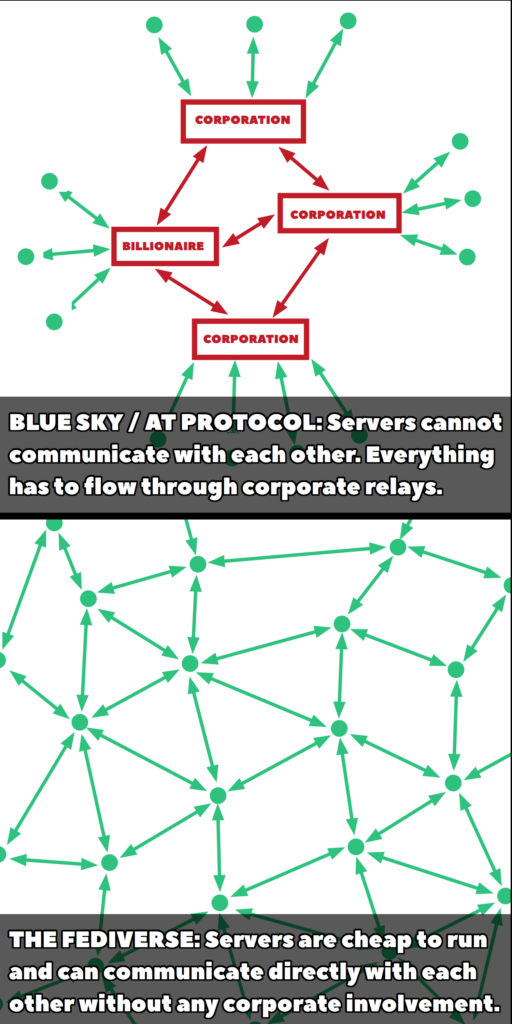
        In the current mess in tech paths, this becomes visible again. Bluesky and #ATproto keep getting lumped in with #ActivityPub under the easy label of “open protocols, yay”… but that’s just not true. Yes, they both sit in the #openweb space, but there’s a real structural problem here, and we’re seeing it play out in real time.

        At AtmosphereConf, the signal was stark:

        “Why would anyone fund an Atmosphere project if Bluesky, with $100 million in the bank, might ship a competing feature at any moment?”

        That’s not an ecosystem. That’s a platform with enough gravity to crush its own edges. And people are noticing. The old pattern is back:

        • invite the community in
        • let them build the value
        • then absorb and replace them

        Same playbook, again and again. It feels open – but the centre still holds the power. The same dynamic we saw with Twitter. The DNA is obvious.

        The difference really matters. #ActivityPub was built as a commons path from the start – messy, flawed, but natively open. #ATproto is something else: a platform-first model with openness layered on top. That’s why it keeps drifting this way. It’s not a bug, it’s the design.

        Too much #techshit, and everything starts to stink. Why would anyone step into the #openweb if that’s the smell? This creates a bigger problem, that it’s a mess that keeps coming back, and as usual we’ll be the ones left to compost it, underfunded, unrecorded, and unthanked.

        We’ve been here before – with the #encryptionists and the #blockchain mess. Big promises, lots of noise, overlapping hype cycles. Now there’s a clear overlap with #Bluesky and #AI. The risk isn’t just that this fails. It’s that when it fails, it leaves a miasma behind, making it harder for people to trust the actually working open paths. That’s the real damage.

        Neglect is not innocence, this isn’t about blaming users instead of power. Power matters. Monopolies matter. Venture capital mess matters. But still, if the #openweb mattered, why didn’t we support it?

        Why do people pay for streaming, cloud, and delivery, but not support publishing tools, independent media, hosting, or open infrastructure?

        Why did so many #NGO organisations that talked about openness still push people onto closed platforms the moment growth and analytics are on the table? We keep choosing short-term convenience over long-term stewardship, not just a market failure, a cultural one.

        So lets look at this mess again. I’ve been trying to find a way to express my view of the people who took over outreach in the #Fediverse, and in doing so helped shape the current #openweb reboot.

        DRAFT: naïve, controlling, and self-interested.

        They’ve left a mess that the people they pushed aside now have to compost. It’s really useful to look at how we got here.

        In the early years, outreach was organised by a genuinely diverse, native crew. It was a good time – three open conferences, and even getting the EU to adopt the standard. But that group burned out, focus splintered, self-interest crept in, driven by the need to control resources. The balance shifted, and grifters gradually outnumbered them, eventually tearing it apart. In the space left behind, a new crew stepped in – filling the vacuum with centralised power and influence. And that’s where we are today.

        We don’t fix this by arguing harder. We fix it by building – and holding – open spaces that don’t follow this pattern.

        It’s not about features. It’s about culture.

        #ActivityPub comes out of the #openweb tradition.

        #Bluesky comes out of a split lineage – #openweb roots, shaped by #dotcons incentives, with an #encryptionist upbringing.

        Trust, encryption, and the risk of “trustless” thinking

        The #encryptionist movement has a blind spot. Not because encryption itself is bad – it isn’t. Encryption is a tool to protect dissidents, journalists, communities under threat, and everyday privacy. In the small picture, strong encryption is often necessary.

        But in the bigger picture, something more subtle is happening. Strands of crypto and decentralisation culture promote the idea of removing trust – replacing social relationships with mathematical guarantees, “trustless systems,” and automated consensus. And this is where the problem begins. Because human societies are not built on the absence of trust, they are built on trust itself.

        Trust is not a bug in human systems, it is the foundation of cooperation, empathy, and shared reality. When we frame progress as eliminating trust rather than cultivating it, we weaken the social fabric that allows communities to exist. Trust is social infrastructure.

        Research consistently shows that societies with higher social trust have lower corruption, crime, stronger institutions and healthier civic participation. Trust grows through openness, shared norms, and collective accountability – not through technical enforcement.

        Encryption can support trust by protecting vulnerable communication. But “trustlessness” as an ideology, as often unintentionally erodes by framing humans as inherently untrustworthy, replacing social accountability with technical rules and encouraging isolation rather than relationship-building.

        The paradox of crypto culture is that the rise of crypto and “trustless systems” is itself a symptom of declining institutional trust. People turn to mathematical systems because they no longer trust governments, media, or social institutions, it’s a feedback loop, thus is understandable. But if the common sense solution becomes removing trust from social systems altogether, we are accelerating the fragmentation we are trying to escape. You cannot build healthy societies purely through cryptography.

        It’s worth thinking about – Open vs closed – Historically, most meaningful social change has emerged from open processes with shared debate building public knowledge commons to feed into collective organising. Many #encryptionists don’t realise they may be contributing to this dynamic, because their motivation often comes from good places: protecting freedom, resisting surveillance and empowering individuals.

        The challenge is not to reject encryption, but to ask a deeper question. Are we building systems that strengthen human trust, or replace it? Are we designing for cooperation, or just adversarial verification? Are we reinforcing shared humanity, or modelling a world where nobody trusts anyone?

        So yes, please have a conversation with an #encryptionist today, not to argue, but to explore whether our tools are helping rebuild trust, or unintentionally dissolving it. Because the goal isn’t a “trustless” world. The goal is a world where trust can flourish again.

        OMN #openweb #4opens

        What Did We Learn from Web3, Crypto?

        Looking back from the mid-2020s, the arc of #web03, #NFTs, and blockchain culture is very clear. What once promised (lied about) decentralisation, liberation, and a break from corporate capture now looks like the same, mess, #techcurn pattern repeating itself, yes it had new language, new branding, but it was easy to see it had the same underlying mess making dynamics.

        As these #geekproblem projects hollowed out, the signs became hard to ignore. The technical optimism faded, the user bases thinned, and the economic logic exposed itself. What followed was totally predictable: spin. Makeup and perfume slapped onto decaying projects to hide the smell of rot and exploitation. Rebrands. New narratives. New demographics. Same extraction. This was the outcome of building “liberation tech” on foundations that still centred virtical money, speculation, and power concentration.

        With these projects we are now in the zombie phase, projects kept moving, kept talking, kept selling – long after the animating ideas had died. Influencers and promoters continued to perform belief, even as any substance drained away.

        This is a few years when #fashionista culture met #encryptionist ideology – aesthetics and technical absolutism snogging the undead remnants of a failed #deatcult vision. The result wasn’t in any way decentralisation; it was a simply a new enclosure. People weren’t being freed, they were being financialised, the money problem #KISS

        At the core was a simple structural truth: #dotcons feed on money. Put money in, influence comes out. That logic doesn’t disappear just because you wrap it in cryptography or decentralised rhetoric. “Bad actors” weren’t anomalies – they were following the incentives as designed. Aany social good becomes just collateral damage. This is why the lie collapsed in te end.

        The deeper harm and problem with #techcurn is each wave claims to have fixed the problems of the last. But each wave reproduces them, because this is what works when worshiping a #deathcult. This isn’t just a failed tech trend, the #techcurn disparity, driven by extraction systems cause enormous human harm, displacing livelihoods, concentrating power, and amplifying inequality at planetary scale.

        These systems don’t fail harmlessly, they fail onto people. That’s why the call isn’t just to “be critical,” but to step away – and help others step away too. Not through purity exits or individual moralising, but through collective paths back to technologies built for people rather than profit, life over zombies

        There has always been another path: the #openweb. Messy, imperfect, slower, less glamorous, but grounded in shared infrastructure, social trust, and human-scale governance. The #OMN approach doesn’t promise salvation. It offers compost instead of speculation. Process instead of hype. People over tokens.

        A note on hashtags: And yes, the hashtags matter. Click them., search for them. They cut sideways through algorithms – small back doors into less mediated, less controlled ways of seeing. Not a solution, but a crack in the wall.

        The current #Ai hype bubble is repeating this mess with a little more useful #LLM functionality, but on top of this is a huge mess of #techchurn, which will need composting.


        Observation: some people go into news to speak truth from power – using institutions to legitimise the status quo and defend the worship of the #deathcult.

        Others speak truth to power – using journalism to expose, question, and challenge unequal power and its consequences.

        Only one of those serves the public interest #KISS

        Building Alt/Grassroots Media Networks to Challenge and Widen Traditional Media

        The current ecosystem of alternative and grassroots media is too narrow in its imagination of what media could, and should, be. There’s a persistent naivety or, in some cases, a self-serving dishonesty. Many of the most “successful” progressive media groups continue to mimic #traditionalmedia without understanding, or addressing, the fact that they do not control their distribution. In effect, they’re renting space in someone else’s empire.

        This is not just a mistake. It’s the same mistake that corporate media has been making for years: relying entirely on the #dotcons, especially Google/Meta/Facebook, to reach people. The algorithms shape the message. The gatekeepers never disappeared, they were replaced by code, powered by ad dollars.

        Where are we now? Most grassroots and alt-media outlets do have websites, which means they technically sit on the #openweb. But their sites rarely, if ever, link to other alt-media projects. Despite the rhetoric of solidarity, there is little visible network of mutual support, not even basic hyperlinking between allies.

        They podcast, another foot in the #openweb. Yet their outreach and engagement still happen inside #silos like Spotify, YouTube, and Apple Podcasts. In practice, this reinforces the #deathcult’s control of visibility. You can’t build a new world inside the structures of the old, not if the old is designed to undermine you. Why is this mess happening? Two dominant forces are shaping this failure:

        1. On the big scale, we have the #Fashernista embrace of the #dotcons

        Many alt-media producers came of age inside the mainstream tech stack. They built their platforms and careers inside the same closed systems they claim to challenge. Their political commitments might be radical, but their infrastructure choices are entirely conventional. This is the liberal, capitalist version of #mainstreaming – reform, not replacement.

        1. On the small scale, #Encryptionist obsession and the #geekproblem

        At the other extreme, we have alt-tech projects so obsessed with privacy and control that they create pointless parallel networks that no one uses. They fetishize encryption and “clean standards” over actual human use. The result is tech that is “safe” but irrelevant, drifting into a shrinking ghetto of #stupidindividualism. This is the libertarian version of #mainstreaming – escape, not engagement.

        The has been practical work on the ground, over the last years an #openweb tech revolution built around ActivityPub and Fediverse, with projects like Mastodon, which in theory is guided by the #4opens. Yet, despite this, we still hit a wall of self-interest, naivety, and careerist short-termism from the media groups and meany individuals inside this movement.

        What can we do? The web is made of links, the #openweb dies without them. If alt/grassroots media want to be part of the solution, they must start acting like a network. A simple step is to start linking to each other. Publicly. Repeatedly. On websites. On blogs. On Fediverse accounts. Use hashtags. Use lists. Tag each other. Cross-publish when relevant. This one act can change the ecosystem.

        To solidify this, it’s past time for a new alt-media reboot, a small crew of linked-up, working examples that can pull others onto a sustainable, #openweb path. A real, living network of trust and mutual visibility. If we can show what’s possible, by doing it, we might begin to shift the culture. Let’s find the hopeful, grounded people to help shovel this forward.

        If you’re interested in building the open media commons, join the #OMN conversation at https://unite.openworlds.info/explore/organizations to “Make the world you want to see.” or splash some dosh here https://opencollective.com/open-media-network we will make good use of it


        The #OMN really complex? It’s not in the code – it’s in us. Let’s be blunt:

        The Outside Threats:

        The #dotcons (Facebook, Google, Amazon, etc.)

        Surveillance capitalism

        Attention farming

        Closed distribution algorithms

        Platform lock-in

        The Internal Saboteurs:

        Encryptionist geeks obsessed with crypto but forgetting human users

        NGO social media managers who talk community but build silos

        Process vampires who kill projects by committee

        Fashionistas who follow hype cycles and abandon working tools for shiny vaporware

        The #OMN is native to none of these tribes. That’s its strength. But also why it’s often ignored or misunderstood. No permissions, no gatekeeping, no central database. It just works. That’s the #KISS principle: Keep It Simple, Stupid.

        None of the usual suspects like this: Geeks: Don’t like using old tools like RSS or thinking socially. Politicos: Prefer being seen at the cutting edge, even if it leads nowhere. NGOs: Want measurable outcomes, not messy grassroots growth. But we need to stop building castles in the sky. Start building bridges instead.

        The real block? The mental model of our tech and political culture. We’re still thinking in terms of silos, ownership, and control.

        Tech governance fails, its pastime to compost the mess

        The last 20 years of tech governance projects keep missing the mark because they refuse to engage with the real, lived experiences of grassroots activists and community builders. Instead of listening, they fall back into the comfort zones of the #geekproblem: control over collaboration, certainty over-curiosity, code over community.

        This is further compounded by the “professional” #NGO class of detached, branding-obsessed, and career-driven #mainstreaming. They claim to serve communities but remain disconnected from the daily struggles, uncertainty, and messiness that define grassroots organizing. These people aren’t building relationships; they’re building resumes.

        If they could stop and actually listen to those of us who’ve been in the trenches, those who’ve composted decades of failures and seeded collective wins, they’d quickly see the futility of their rigid, technocratic paths. Real governance isn’t found in plush committee rooms or geeky blockchains. It always emerges from shared struggle, radical trust, and the mess of collaboration.

        Until tech governance initiatives shift focus, from control to cooperation, from professional advancement to collective empowerment, they will continue to fail. Worse, they will undermine the communities they claim to support. And let’s be honest, it’s well past time to compost the last ten years of #encryptionist fantasy-making as a first step.

        The #OGB (Open Governance Body) was created as a response to this mess making. Rooted in the #4opens principles, it challenges the false promises of #blockchain and #DAOs, which replicate the worst aspects of capitalist market logic, financialization, scarcity, and the concentration of power. Tokens and ledgers are not the future of grassroots governance, they’re its co-option.

        We need to actively resist these technological distractions because we know that community is not code. And governance is not a smart contract. We need grassroots paths that reflect gift economies, mutual aid, and social trust, not digital casinos. The truth is that still too many #mainstreaming #NGO types are more interested in branding their codebases and instances than actually serving the messy, vibrant, collective reality of the #openweb as it exists.

        That’s why we need the #OMN (Open Media Network). Because governance, media, and tech are not separate, they’re bound together. The #OMN path is about rooting our tools in real communities, building trust over time, and composting the failed hype cycles of the last decade.

        If we want an #openweb that matters, we have to dig deeper. Start local. Share power. And stay messy.

        People, community, the struggle between #openweb and #dotcons

        This is a mess which has been clear to see for 20 years, but people still keep falling into the same traps instead of stepping off the cycle of conflict leading to control. Yes, we had something, we lost it, but as I talk about, we are still refusing to face why.

        Let’s use #Failbook as a practical example of a monster that devours our dreams, fifteen years ago, the writing was already on the wall, #failbook and the #dotcons would eat everything. It wasn’t some grand conspiracy, just basic power and control dynamics. People knew this. They saw the cage being built around them, yet walked in willingly. Why? Because in the small picture, it was “easier” to stay inside than to step outside. They thought they were users, but they were being used. Every attempt to “fix” #failbook, the endless ethical tech debates, the “kinder, fairer” alternatives, the #NGO-funded projects promising “a better social network”, misses the core issue: You don’t fix a monster. You stop feeding it and walk away.

        This is where the religious metaphor fits, people don’t want atheism (the #openweb), they do want a nicer god (ethical #dotcons). They are still kneeling before centralized power, just hoping for a softer whip. We need to stop worshipping the digital feudal lords and start building something else entirely. One path is to reboot the original #openweb

        To do this we need some social history: The #openweb was murdered, and no one faced the consequences, we need a truth and reconciliation process for what happened to the #openweb. Why? Because people refuse to learn from history, and that means they keep making the same mistakes. Look at the waves of migration from open to closed over the last two decades:

        • The rise of blogs and open publishing (2000s) → The pull into social media walled gardens (2010s)
        • The rise of the federated web (2000s, early 2010s) → The collapse into corporate-owned silos (late 2010s, 2020s)
        • The rebirth of the Fediverse (Mastodon, PeerTube, Lemmy, etc.) → Now being co-opted by NGOs and #mainstreaming interests

        Each time, the excuse is different, but the result is the same, we hand over power, they take control, we lose everything. Until we face the fact that we let this happen, that we were complicit, this cycle won’t stop. Every time we fail to call it what it is, the blood-letting/stains soaking back.

        The problem with #NGO and co-op models, people love to push the same “solutions” that failed before. Pushing a voluntary project into a hard “not-for-profit” structure kills it, this happened again and again. Look at #indymedia. It worked because it was messy, decentralized, built from the ground up. Run by volunteers, not controlled by a central authority. Rooted in the activist base, not an #NGO-funded agenda. Then came the push to “formalize” it, and what happened?

        • Funding fights, bureaucracy, infighting.
        • Projects being hijacked or forced into rigid structures.
        • Most of the co-op/NGO media projects collapsed.

        There is nothing wrong with people building not-for-profit media, but stop forcing voluntary activism into structures that will kill it. The old mistakes aren’t new solutions. They are just mistakes waiting to happen again.

        The #OMN and the need for diversity of strategies, the #OMN is built on a simple idea, diversity of strategies is strength. We need:

        • Commercial models where they work.
        • Not-for-profit structures where they make sense.
        • Voluntary activism as the foundation.

        Then the basic #4opens of them linking to each other. What we don’t need is people using their own narrow worldview as a #BLOCK on other approaches in the guise of “helping”. This happens all the time, with the #NGO crowd that wants everything formalized, structured, and professionalized, they see grassroots messiness as a problem. The geeks want everything to be purely about the tech, ignoring the social and political realities. The politicos want everything to align with their ideology, even when that means excluding actual working solutions. These proxy fights kill the meany projects before they even start.

        The solution is not ideological purity, it’s pragmatic diversity. If we want to break the cycle, we need to stop repeating the same mistakes, stop blocking each other, link and start building with what we have #KISS

        One path to this, that needs support https://opencollective.com/open-media-network


        The light in this is the #Fediverse, otherwise the last decade in tech has been a complete dead end. We’ve watched the same old mistakes play out, layering more “solutions” onto the #geekproblem without ever questioning the foundation. Instead of building trust, we’ve been sold “security” wrapped in fear, reinforcing the same toxic cycles that keep us locked in place.

        The #OMN projects build from the #Fediverse and #openweb reboot to break from this. They are about real empowerment, shifting power by growing trust rather than control. If we keep repeating the same mistakes, we’re just feeding the #deathcult, accelerating the collapse. The #fashernista and #encryptionist obsessions, instead of opening paths to change, have become blind alleyways leading to catastrophe. We need to step back, reassess, and build differently, before the coming decades bring suffering on a scale we’ve barely begun to grasp.

        In tech, what matters and what is dangerous

        The influx of #mainstreaming brings many non-native, focuses into our growing shared alt spaces. When we embed content, most of these will be better handled as external resources. Let’s keep the core simple: #KISS and #4opens. One of the strongest of these is money, it is a dangerous subject for #openweb projects. It’s way too often the root of corruption and co-option, so it’s best to keep financial aspects as external applications and simply link to them. And remember that words are wind, look at the ground. We live in a closed world, and we should not add to this mess.

        • There is no security in CLOSED systems – security comes from OPEN and social processes.
        • There is no security in individualism – true security lies in community.
        • There is no security in “trustless” models – real security emerges from social trust.

        Over the last 10 years, we’ve been fed meany, meany lies. This is especially clear now in tech. Look at #opensource: can you find any lasting value in CLOSED within that? Over the last 20 years, we’ve seen an ongoing battle between OPEN and CLOSED, but the last decade has been dominated by the #dotcons and their shadow puppet, the #encryptionists. Both are CLOSED, both wear the cloth of OPEN, and both recite the right words. But words are wind, look at the ground. The #4opens is the reality check.

        I’ll be truly optimistic when closed paths of #encryptionist apps cross standards with the #open of #activertypub apps, that the bridging of human nature and brings to view the “feeling” that fuels this gap. But right now, there’s a strong, unspoken push not to address these issues.

        Nearly everything I do today revolves around #4opens, addressing the unspoken issues head-on. I’ve been doing this full-time for more than 30 years, and I’ve watched hundreds of alt-tech projects wither on the vine, with only a handful of flowering. Reflecting on this, I’ve developed a #KISS universally reliable way of judging which projects might flourish and which will collapse: the #4opens framework. Others might call it open-source development or radical transparency, but it’s all the same core path #nothingnew

        To move this forward, we need to address the core problems:

        • The #geekproblem – a teenage mix of arrogance and ignorance that spreads like wildfire.
        • The #dotcons – a relentless push of greed over human need.

        These are fundamental issues, and it’s good, necessary, to have strong opinions on them. Because not having an opinion? That’s a path straight back to the #deathcult. We don’t need more of that. What we need is compost, patience, and the courage to keep pushing for openness and social solidarity, no matter how messy it gets.


        There’s an unspoken #geekproblem lurking at the heart of the #openweb, and it’s past time we bring it into the light. If we frame #p2p as #human2human, scaling becomes a virtue, an organic process of communities growing, evolving, and finding balance through social trust. But if we view #p2p as #data2data, scaling becomes a purely technical challenge, one that strips the human element away.

        The first path embraces the messy beauty of human connections. Scaling isn’t a failure, it’s a reminder that growth needs care, cooperation, and thoughtful design. The second path, the data-centric approach, treats humans as nodes, reducing complex social interactions to packets of information to optimize and control.

        The issue is the latter view is pushed by the #dotcons. The systems we’ve grown up with, the platforms we’ve relied on, all reinforce this anti-human perspective. And whether we like it or not, we’ve internalized some of this thinking, even within our #openweb projects. That’s the uncomfortable truth.

        The question is, do we actually collectively want to solve this? Because the solution isn’t technical, it’s social. It means rejecting the idea that tech should replace or dominate human processes. It means making space for friction, for inefficiency, for the unpredictability of people working together.

        Talk to a geek today. Start the conversation. Ask how they see #p2p – as people connecting, or as machines exchanging data? Their answer might tell you a lot about where their compass is pointing, and whether we can navigate back toward a web that is human.

        Let’s compost the #geekproblem, nourish the soil, and grow something better, please.

        Comparing Decentralized #openweb Protocols

        The #socialweb is shifting away from corporate-controlled paths like #Twitter and #Facebook toward decentralized, more #DIY alternatives. The idea is simple: instead of a single company having control, decentralized protocols allow different platforms to connect while giving people the power to shape and control their digital paths.

        Three major decentralized protocols have emerged:

        • Fediverse (#ActivityPub) – The most established and widely used, forming a “native” backbone of the #openweb.
        • Bluesky (#AtProto) – A Twitter-funded project that claims decentralization but is still highly centralized.
        • Nostr – A relay-based, censorship-resistant protocol with interesting tech but major cultural and usability challenges.

        While all three claim to support decentralization, only ActivityPub (the #Fediverse) actually delivers on this promise. An overview:

        The Fediverse (ActivityPub) – The Decentralized #openweb

        Background & history, the Fediverse is powered by ActivityPub, a W3C-recommended standard, since 2018. Unlike Bluesky and #Nostr, which are still evolving, ActivityPub is already a mature, widely adopted protocol. It was designed from the ground up, through a 20-year unbroken history to enable interoperability between platforms, meaning people on different apps can communicate seamlessly.

        This #ActivityPub network exploded in popularity after Twitter’s collapse under Elon Musk, with Mastodon seeing millions of new users in 2022. Now there are meany popular apps & servers, it not just one platform – it’s a whole ecosystem of independent apps that mostly copy #dotcons:

        • Mastodon – The most well-known microblogging platform, often compared to Twitter.
        • PeerTube – A decentralized YouTube alternative.
        • Pixelfed – A decentralized Instagram-style photo-sharing app.
        • Pleroma / Misskey – Alternative microblogging platforms.

        ActivityPub works through federation: Different servers (instances) talk to each other, creating a #4opens network of networks. How this works, you create an account on one instance, but interact with people across the entire Fediverse. Each server is independently operated, meaning no single company owns the network. There is an issue of instance Lock-In: If a server shuts down, yes, people must migrate manually, but this is a small tradeoff compared to the massive corporate control seen in more #mainstreaming paths.

        Bottom Line: ActivityPub is the most decentralized and established protocol, already powering a thriving ecosystem of apps with real communities.

        #Bluesky (AtProto) – Fake Decentralization, A shadow #Dotcons


        Background & history, Bluesky started as a Twitter-funded project in 2019, originally backed by Jack Dorsey. It claims to be building a decentralized social network, but in reality, it’s architecture favers centralization, due to it being built to prioritise scaling. The #AtProto, allows for theoretical federation, but in practice, Bluesky is still a Twitter clone controlled by a single company.

        Popular Apps & Servers

        • Bluesky – The only major client, self-hosting is possible, but current federated servers are limited to 100 users, and Bluesky can refuse to federate with them.

        How AtProto works: #DID-based identities – Users can theoretically move between services, but only if Bluesky allows it. Centralized moderation – The vast majority of users rely on bsky.social, meaning Bluesky still has the power to block or censor at will. Limited self-hosting, Bluesky restricts who can run a server and limits federated instances.

        Bottom Line: Bluesky is currently a trap, a con, It looks decentralized but is a #dotcons, the normal corporate-controlled path.

        Nostr – Interesting Tech, but bad culture

        Background & history, #Nostr (Notes and Other Stuff Transmitted by Relays) was created by an individual in 2020 as a censorship-resistant social protocol. Where ActivityPub and AtProto, use server-based networks to build community and distribute moderation, Nostr uses a relay-based model where users broadcast messages across multiple relays. It gained popularity in #Bitcoin circles and received funding from Jack Dorsey (again).

        Popular Apps & Clients

        • Primal, Nos, Snort – Web-based clients.
        • Damus – iOS client.
        • Amethyst – Android client.

        How #Nostr works, It is Relay-based, with no community focued on instances – no centralized servers, messages are published to multiple relays. Cryptographic Identity – people have opaque public/private keys instead of usernames. No true federation – people rely on relays to store and transmit data, but relays don’t communicate with each other like ActivityPub servers do. Difficult for adoption – The reliance on cryptographic keys makes it confusing, and there’s no built-in moderation system, so comminutes remain fragmented, its tech for the native #stupidindividualists paths. But still, in this, diversity is good and as it bridges it might become a useful project.

        Bottom Line: Nostr is decentralized and censorship-resistant, but it’s not user-friendly or practical, its culture is a bad mix of #techbro and #geekproblem #encryptionist #shitcoiners


        Which Decentralized Protocol is the Best?

        ActivityPub (Fediverse) is a clear winner, it’s proven, widely adopted, and already functional with true federation across multiple apps, decentralized and people-controlled. Where #Bluesky (#AtProto) is a hidden #Dotcons which claims to be decentralized but is still controlled by Bluesky, Inc. Federation is limited, and self-hosting is discouraged thus is a Trojan horse for another corporate-controlled network. Nostr is interesting but niche, completely decentralized, but difficult to use. No federation between relays and not practical for mass adoption.

        Final verdict: If you care about real decentralization, community, and people, ActivityPub (#Fediverse) is the clear choice.

        What is needed next is to take the step in the Fediverse of moving beyond simply copying the #dotcons. It is time to reboot the #Openweb with a project like the #OMN. The Open Media Network is about taking control of our digital paths and building a future beyond the #dotcons. If we want a truly decentralized internet, one core message is that we need to support ActivityPub-based paths instead of getting fooled by corporate-backed “alternatives” like #Bluesky.

        Join the Fediverse today: https://fediverse.observer/ It’s past time to reclaim the #openweb to build digital spaces that work for people, and the social change challenge we so urgently need.

        One thing is clear, you can and need to walk away from the corporate #dotcons.

        Public Social Media: The Choice is Clear

        It’s not about features. It’s about culture.

        • ActivityPub comes out of the #openweb tradition.

        As the #fashernista and #geekproblem “debate” over social media platforms intensifies, the choice between public, decentralised networks and corporate-controlled #dotcons has never been clearer. Let’s look at a simple example:

        • Mastodon is owned by no one and everyone (community-driven). Its structure is public non-profit. Number of distributed nodes are in the thousands (fully decentralised). Post length: 500 characters and more. Can edit? Yes. Mastodon represents the native #openweb. It’s built on decentralised principles, where people and communities own and control their spaces. There’s no central authority dictating rules or exploiting for profit.
        • Bluesky is owned by Venture Capitalists, Its structure is corporate for-profit. Number of “distributed” nodes: One (centralised in practice) Post length: 300 characters Can edit? No. Bluesky, despite its claims of decentralisation, is owned and operated as a for-profit venture. Its structure centralises power and prioritises profit over people’s control, offering a polished but limited alternative to #mainstreaming paths.

        The choice between #Mastodon and #Bluesky reflects a broader conflict between decentralisation and #dotcons corporate control. It should, but often is not easy to see that networks like the #Fediverse are native to the #openweb where Bluesky is an interloper, though they are both #4opens. Projects like the #OMN, #4opens, and the #Fediverse itself, offering freedom, community ownership, and transparency. Bluesky, on the other hand, represents the same closed, profit-driven ethos of the #dotcons, repackaged in a new “shiny” wrapper.

        When you choose a network, you’re not just choosing where to post, you’re choosing what kind of internet you want to build. The open, public internet is still within reach. The choice should be clear.

        Seed from a toot and image from @FediTips

        #4opens vs. the #dotcons

        The critical paths between governance, activism, and the ideological underpinnings of #FOSS, #opensource, and the #openweb. The problem, governance without “politics” which FOSS and opensource often ignore and block the politics, leading to governance models resembling feudalism where “better kings” may emerge, but the underlying structure remains inequitable. Without addressing systemic issues, projects replicate the very power imbalances they aim to escape.

        Decentralization is a post-capitalist concept, as decentralization eliminates middlemen, undermining the foundations of capitalism. However, capitalism co-opts decentralization, selling illusions while embedding scarcity (e.g., #encryptionist projects). Recognizing and resisting this is vital to preserving the openweb. Composting the shit, current activism often worsens the “shit pile” by pouring misaligned efforts and unclear priorities into an already broken paths. Instead, we need shovels for composting, tools and frameworks like #OMN and the #4opens to transform waste into fertile ground for radical change.

        A solution can be found in #4opens and #OGB, this creates a permissionless path, framework for decentralized, equitable governance. The Open Governance Body (OGB) is about participatory decision-making, breaking away from feudal hierarchies and cultivating more of a balance of collective ownership. The path to building together, the Open Media Network (OMN) embodies this ethos by emphasizing “you and me” over “just me.” A core part of this path is that activist media must embrace discomfort as a catalyst for change, balancing inspiration, information, and critique to challenge the status quo.

        A world in flux, old paths are gone, there’s no going back, reboots are imminent, social upheavals (#Trump, #Brexit) and environmental crises signal the need for systemic transformation.