Dr Tobias Rupprecht’s seminar at St Antony’s College was The Tragedy of Soviet Market Economists: The Failed Quest to Civilise Russia, 1972–2022. But sitting through the discussion, I was left wondering whose tragedy we were really talking about, and who gets to define what it means to civilize a country. The nitpicking Oxford event kinda made sense, but pull back and my impression was that this was an apologetic account of the #neoliberal project in Russia: a story that gives market liberalism respectable historical roots while leaving too many of its own political responsibilities unexplored.
This guy looks so uncomfortable presenting his book, not surprising as his book is about rejuvenation of shock doctrine neoliberalism in Russia. This should feel uncomfortable, as for the last 20 years this same mess has ripped apart the global economy and society. Its a mess we need to compost not something to nitpick thought as liberal apology.
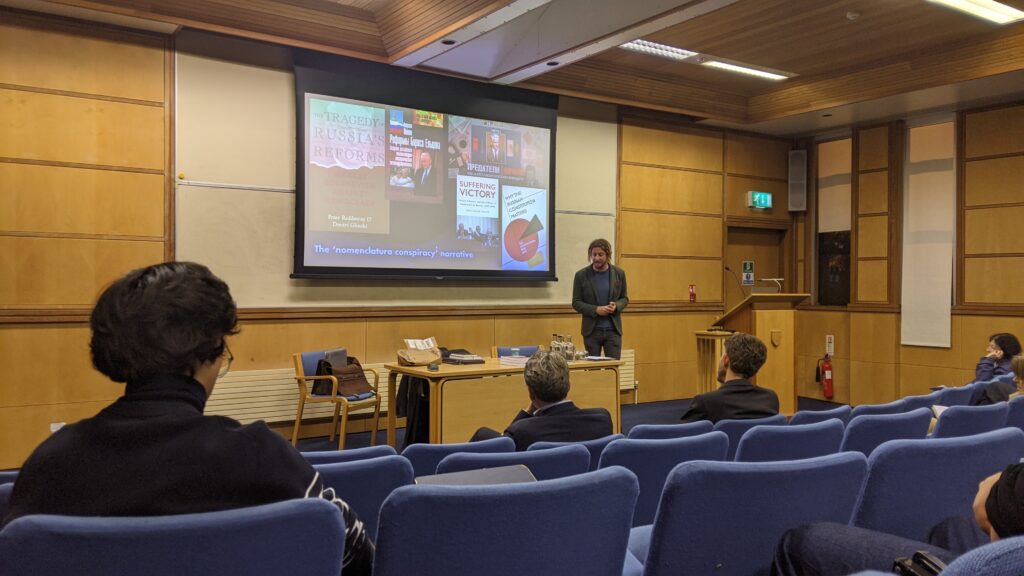
One of the striking things was the attempt to present Chicago School economics as something that grew naturally out of Russian experience. What was missing was any account of the international circulation of neoliberal ideas, the networks promoting them, and the ideological project that had been developing since the late 1940s. #Neoliberalism did not emerge from Russian soil, it had a history, a political purpose and powerful international connections.
The discussion of perestroika seemed equally uncomfortable. Liberalism was presented as having little or no role in the process, which was instead framed as purely Communist. But this leaves the central question hanging: how did market liberalism become such a powerful force in the transformation of the Soviet system?
Then there was the constitutional crisis, the bombing of parliament and the question of political responsibility. The impression he gives was that the liberals had clean hands. Anatoly Chubais was presented sympathetically, despite his central role in the “reforms” and upheavals of the period. The liberals helped bring Putin to power, then found themselves pushing back against the system they had helped create. The Chechen wars and the retreat of democratic liberalism formed part of this story, but the larger political responsibility seemed to dissolve into the narrative.
The Russian liberals were not simply neutral democrats caught in somebody else’s tragedy. They were also participants in a project of internal imperialism: a vision of modernization that treated Russian society as something to be managed, reorganised and disciplined from above. Chubais was described as a democrat while simultaneously expressing deep distrust of the Russian people. That contradiction deserves more judgement than it received in the talk
The comparison with China raised another uncomfortable question. Russia’s industrial development and social security were presented as obstacles to the transformation being attempted, while China’s large peasant population and overseas connections offered different conditions for market reform. But if the argument is that existing social protections made a country harder to reshape for the market, perhaps we should ask what kind of progress this version of liberalism actually represents.
At one point, a question about soviet algorithms prompted laughter in the room. Yet the wider discussion seemed to leave the basic assumptions of neoliberalism untouched. That was the most revealing part of the event for me. The room was bowing before the #deathcult, the belief that the market is the inevitable measure of progress, that societies must be remade in its image, and that the damage caused along the way is a regrettable but necessary price.
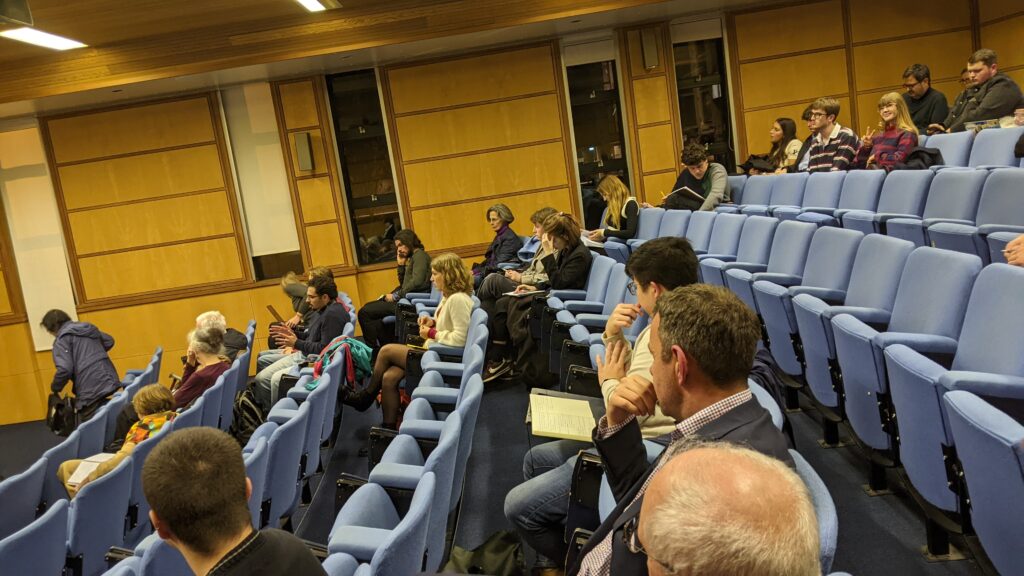
Nobody was willing to challenge the underlying framework directly, nobody in the room had any clothes on – the ideological assumptions were exposed – but the performance of respectable scholarship continued. Only one question near the end felt genuinely sane: an older woman asking something that cut through the comfortable narrative.
The tragedy is not that Soviet market economists failed in their quest to “civilise” Russia, it is more that the idea of civilizing a society through market discipline was part of the problem from the beginning. Liberalism presents itself as common sense, modernization and freedom. But when its advocates distrust the people they claim to liberate, excuse the violence of transformation, and treat social protections as barriers to progress, we should ask whose freedom is actually being served.
This is the wider problem with our worship of the #deathcult,turning blinded ideology into an unquestionable reality. Once that happens, the discussion examines every historical detail except the assumptions that hold the whole story together. We need to stop treating neoliberalism as the neutral destination of history. We need to examine the power behind it, the social damage it leaves behind, and the alternatives that have been pushed aside.
That means building from the grassroots, through open processes and shared power, rather than imagining that societies can be perfected by economists, markets and elitists who do not trust the people they govern. The question is not whether Russia was sufficiently civilised for the market, it is whether the market’s self-appointed civilisers were ever willing to recognize the people whose lives they were reshaping.
END.

@info
I was involved in the transition of Eastern Europe – including Russia – from the Soviet system to capitalism. I met some of the Ivy League MBAs advising the Yeltsin and early Putin governments – good capitalists that in fact had no idea how capitalism really worked – all believing that 'the market' once let loose would find its own equilibrium.
What they actually unleashed of course was oligarchy – and Putin. But far from realising their error, some in the West looked enviously at the easy making of vast fortunes amid the chaos. They saw oligarchy, saw 'disaster capitalism', and they liked it.
So I'd say western neoliberalism had a big hand in creating eastern oligarchy – which in turn encouraged western oligarchs, and taught them the 'disaster capitalism' lesson: fortunes can be made out of social breakdown.
Remote Reply
Original Comment URL
Your Profile
Why do I need to enter my profile?
This site is part of the ⁂ open social web, a network of interconnected social platforms (like Mastodon, Pixelfed, Friendica, and others). Unlike centralized social media, your account lives on a platform of your choice, and you can interact with people across different platforms.
By entering your profile, we can send you to your account where you can complete this action.