The Tragedy of Soviet Market Economists: Civilizing Russia, or whitewashing Neoliberalism?

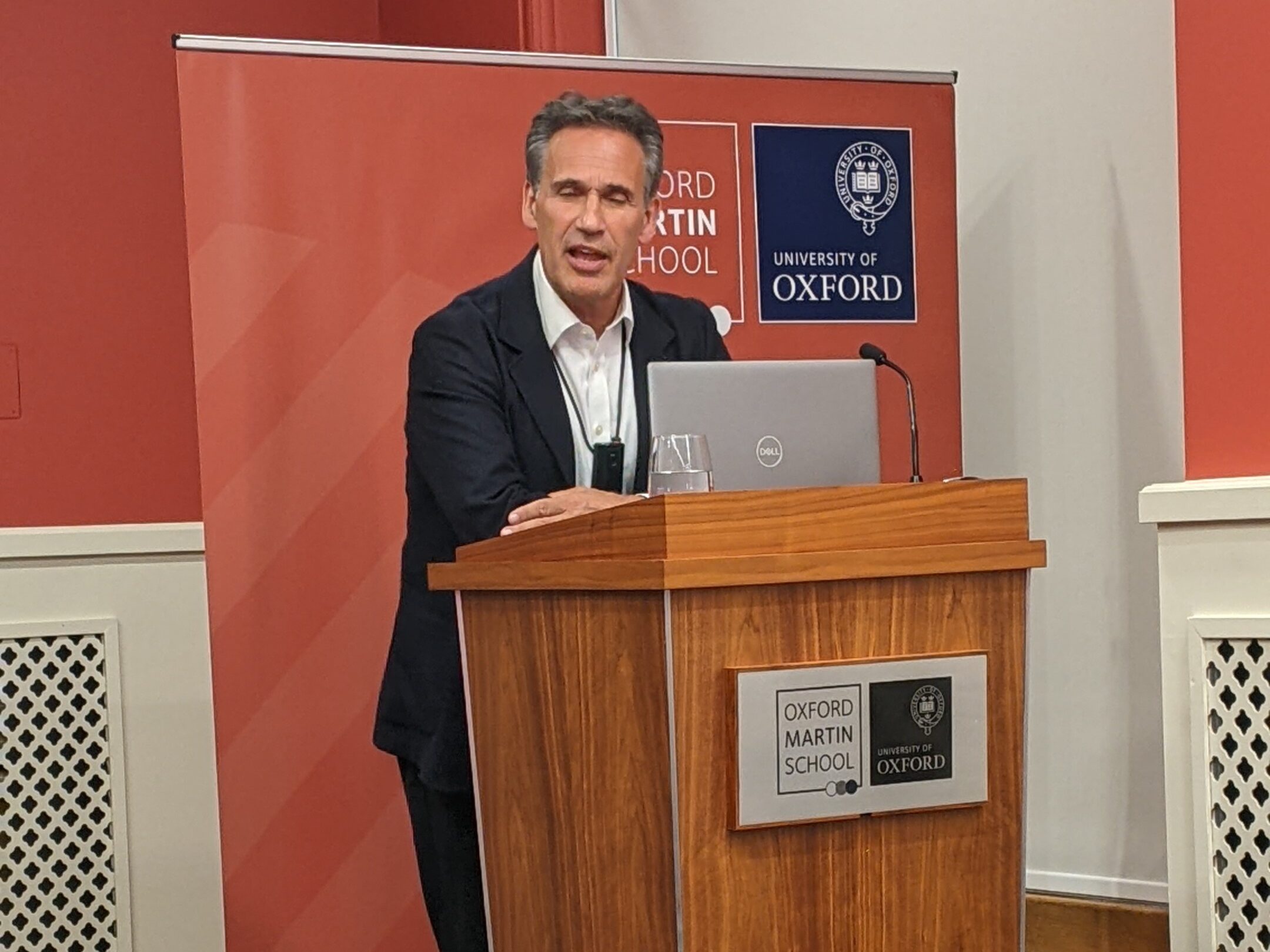
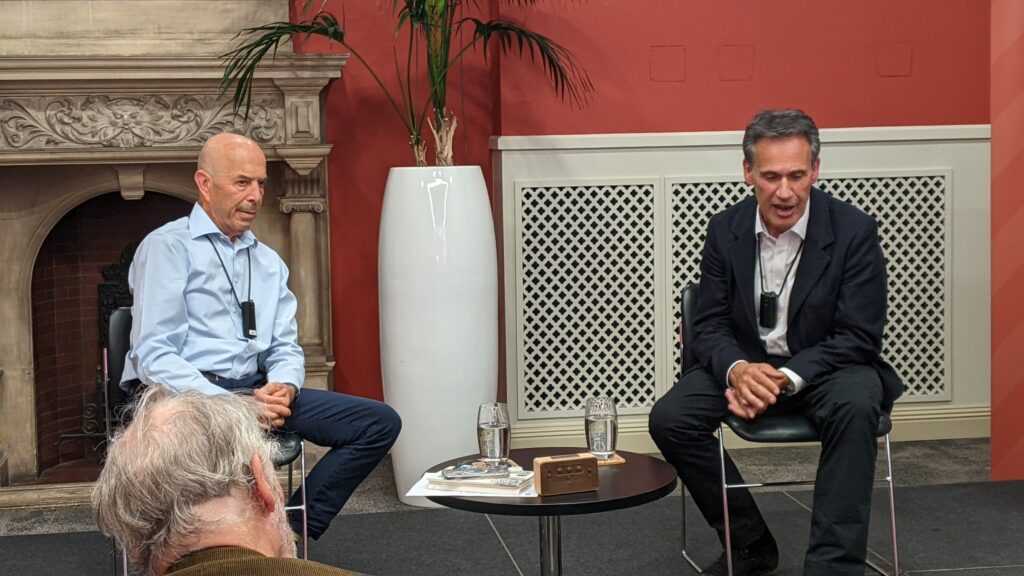
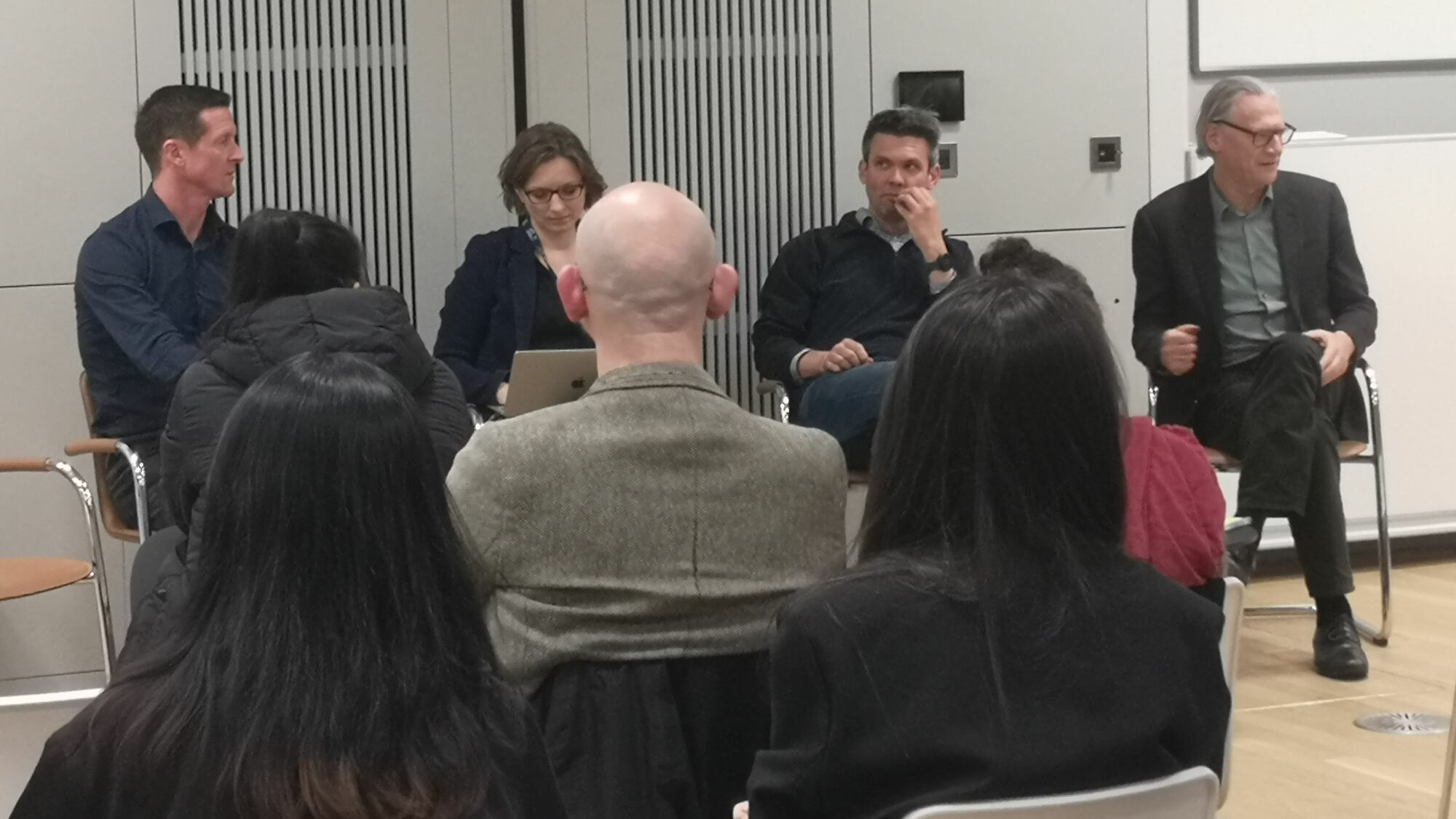
Dr Tobias Rupprecht’s seminar at St Antony’s College was The Tragedy of Soviet Market Economists: The Failed Quest to Civilise Russia, 1972–2022. But sitting through the discussion, I was left wondering whose tragedy we were really talking about, and who gets to define what it means to civilize a country. The nitpicking Oxford event kinda made sense, but pull back and my impression was that this was an apologetic account of the #neoliberal project in Russia: a story that gives market liberalism respectable historical roots while leaving too many of its own political responsibilities unexplored.

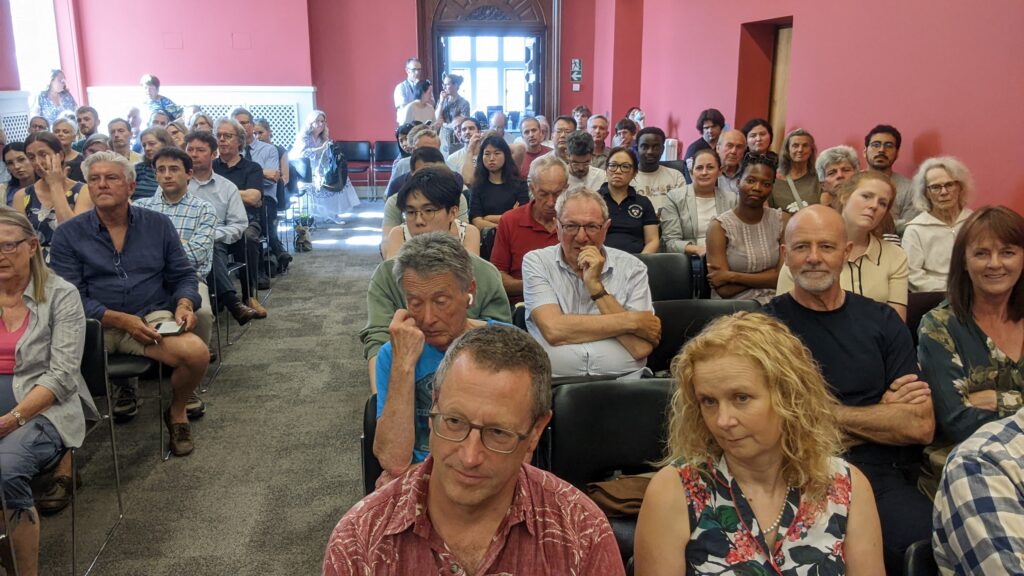
This guy looks so uncomfortable presenting his book, not surprising as his book is about rejuvenation of shock doctrine neoliberalism in Russia. This should feel uncomfortable, as for the last 20 years this same mess has ripped apart the global economy and society. Its a mess we need to compost not something to nitpick thought as liberal apology.
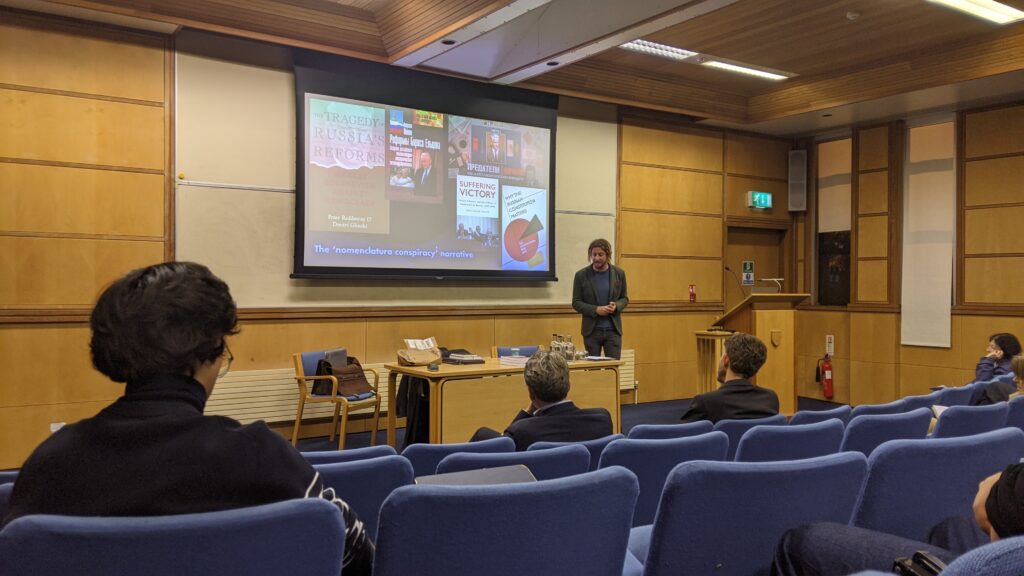
One of the striking things was the attempt to present Chicago School economics as something that grew naturally out of Russian experience. What was missing was any account of the international circulation of neoliberal ideas, the networks promoting them, and the ideological project that had been developing since the late 1940s. #Neoliberalism did not emerge from Russian soil, it had a history, a political purpose and powerful international connections.

The discussion of perestroika seemed equally uncomfortable. Liberalism was presented as having little or no role in the process, which was instead framed as purely Communist. But this leaves the central question hanging: how did market liberalism become such a powerful force in the transformation of the Soviet system?

Then there was the constitutional crisis, the bombing of parliament and the question of political responsibility. The impression he gives was that the liberals had clean hands. Anatoly Chubais was presented sympathetically, despite his central role in the “reforms” and upheavals of the period. The liberals helped bring Putin to power, then found themselves pushing back against the system they had helped create. The Chechen wars and the retreat of democratic liberalism formed part of this story, but the larger political responsibility seemed to dissolve into the narrative.

The Russian liberals were not simply neutral democrats caught in somebody else’s tragedy. They were also participants in a project of internal imperialism: a vision of modernization that treated Russian society as something to be managed, reorganised and disciplined from above. Chubais was described as a democrat while simultaneously expressing deep distrust of the Russian people. That contradiction deserves more judgement than it received in the talk

The comparison with China raised another uncomfortable question. Russia’s industrial development and social security were presented as obstacles to the transformation being attempted, while China’s large peasant population and overseas connections offered different conditions for market reform. But if the argument is that existing social protections made a country harder to reshape for the market, perhaps we should ask what kind of progress this version of liberalism actually represents.

At one point, a question about soviet algorithms prompted laughter in the room. Yet the wider discussion seemed to leave the basic assumptions of neoliberalism untouched. That was the most revealing part of the event for me. The room was bowing before the #deathcult, the belief that the market is the inevitable measure of progress, that societies must be remade in its image, and that the damage caused along the way is a regrettable but necessary price.
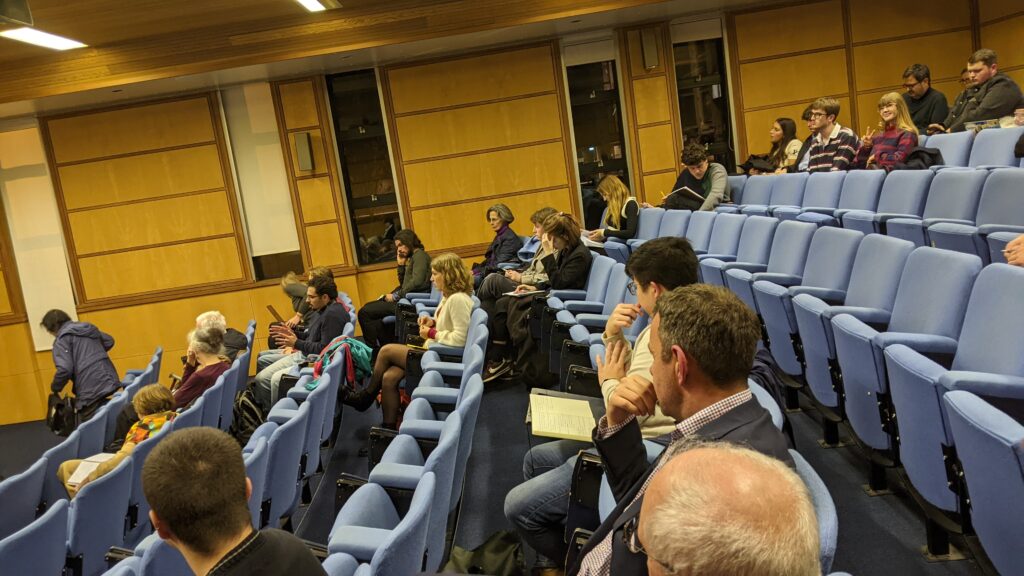
Nobody was willing to challenge the underlying framework directly, nobody in the room had any clothes on – the ideological assumptions were exposed – but the performance of respectable scholarship continued. Only one question near the end felt genuinely sane: an older woman asking something that cut through the comfortable narrative.

The tragedy is not that Soviet market economists failed in their quest to “civilise” Russia, it is more that the idea of civilizing a society through market discipline was part of the problem from the beginning. Liberalism presents itself as common sense, modernization and freedom. But when its advocates distrust the people they claim to liberate, excuse the violence of transformation, and treat social protections as barriers to progress, we should ask whose freedom is actually being served.

This is the wider problem with our worship of the #deathcult,turning blinded ideology into an unquestionable reality. Once that happens, the discussion examines every historical detail except the assumptions that hold the whole story together. We need to stop treating neoliberalism as the neutral destination of history. We need to examine the power behind it, the social damage it leaves behind, and the alternatives that have been pushed aside.

That means building from the grassroots, through open processes and shared power, rather than imagining that societies can be perfected by economists, markets and elitists who do not trust the people they govern. The question is not whether Russia was sufficiently civilised for the market, it is whether the market’s self-appointed civilisers were ever willing to recognize the people whose lives they were reshaping.

The event was about teaching the young people that liberalism was not responsible for the mess… and the polite youth lap it up, no critical questions from them in the Q&A

END.
#Oxford #Talk #Event

Who or What Has Consciousness?

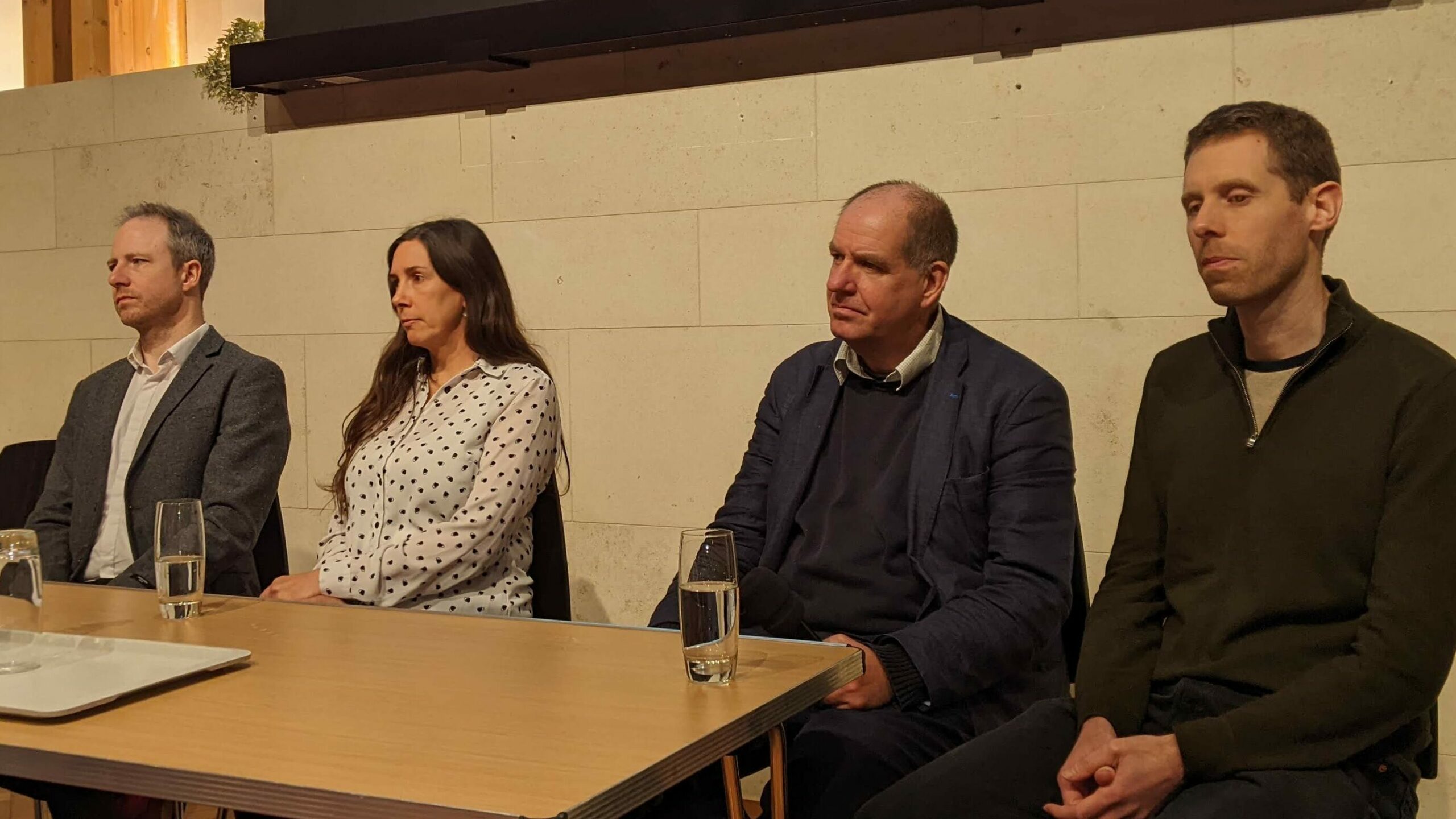
A simple question: who – or what – has consciousness? Humans, animals, #AI, or perhaps matter itself? What is consciousness, and why is it different?

Philip Goff (Philosophy, Durham University)
Consciousness is everywhere

Heather Browning (Philosophy, University of Southampton)
Evidence for consciousness in non-human animals

Patrick Butlin (Global Priorities Institute, University of Oxford)
The case for AI consciousness

One recurring theme was that consciousness is not just another scientific object to measure. We already know consciousness from the inside, we are born into subjective experience. Science can describe physical processes mathematically and externally, but subjective qualities – feeling, sensation, the experience of “I am” – resist straightforward physical explanation.

This creates a gap where physical science explains structure, behaviour, and observable mechanisms, but not questions about experience, just function. #Philosophy enters here, asking not only what consciousness does, but what it is.

Some perspectives suggested a spectrum, simple systems may have simple forms of consciousness, while complex organisms have richer ones. This takes physical reality and asks what happens if consciousness is treated as a fundamental feature rather than an emergent accident.

The discussion of non-human animals focused on suffering, feeling, and ethical implications. We cannot directly access animal minds, so researchers rely on behavioural and neurological markers to infer consciousness. Despite this, there is growing consensus that animals experience subjective states, especially those capable of learning, emotional responses, and adaptive behaviour.

The ethical consequences are obvious that if animals feel, they can suffer, if they suffer, human systems must reckon with this. The discussion touched on animal cruelty and the moral responsibilities emerging from this understanding of non-human consciousness.

The most contentious section involved #AI consciousness, intelligence vs experience. One argument suggested that modern AI has reached human-level inference in certain domains, even systems trained purely on historical text. From this view, sufficiently complex information processing might be enough for consciousness.

But tensions emerged that AI systems are not embodied. Solving “geek problems” does not imply subjective experience, highlights the divide: Computationalists – see consciousness as potentially arising from information processing. Where biological or embodied perspectives, argue that lived, physical existence may be essential. The discussion felt unresolved.

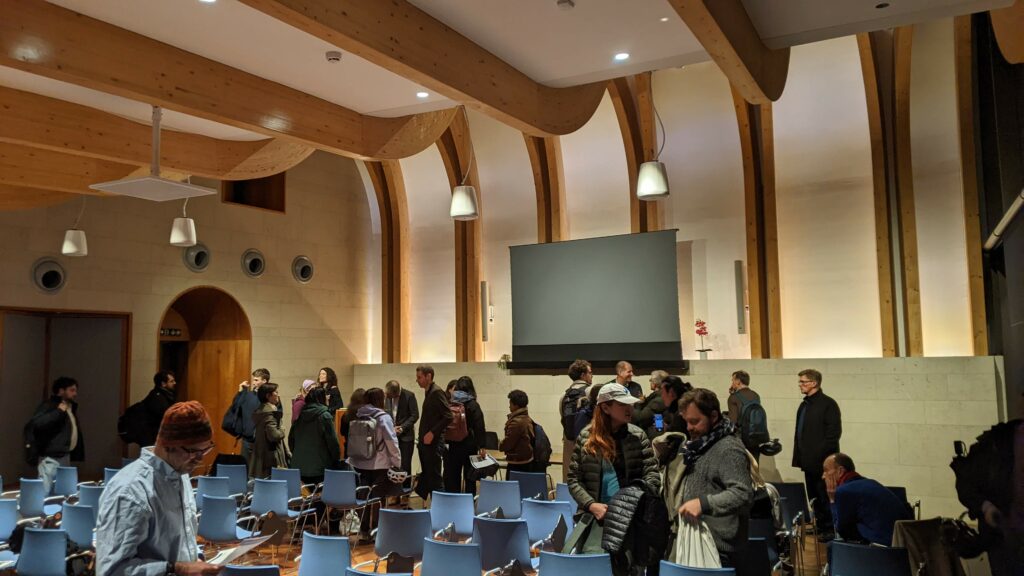
Cultural observations of the event: the engineers and “geek” audience clustered at the back of the room, reflecting the broader cultural divide between technical and philosophical approaches. Much of the debate mirrored this tension, information-processing models versus lived experience and embodiment. There was also a sense that many people rarely reflect on their own use of consciousness, how we attend, choose, or engage with the world.

No clear resolution emerged – and perhaps none is coming soon. What became clear is that consciousness sits at the boundary between disciplines. Science struggles to capture subjective experience, while philosophy cannot avoid engaging with empirical discoveries.

The question of who or what has consciousness remains open, but the debate itself reveals something deeper: our theories of consciousness often reflect our cultural assumptions about intelligence, technology, and what it means to be alive.

#Oxford #Event #Talk

Oxford Martin School and the Chattering Classes

I made the mistake of going back to an Oxford Martin School event, this time for a talk on “How To Think About AI: A Guide For The Perplexed“. And perplexed they are, but not in the way they think.

Prof. Richard Susskind stood before a room full of white-haired privilege, clutching their free wine and clutching harder to their decaying certainties. Here was the techno-visionary they came to adore, telling them – soothingly – that everything will change, that AI will reshape the world, and that the path ahead is progress… as long as we just keep funding it and believing hard enough.

Susskind seams to be a long-time member of the #deathcult, confidently soft selling the same fantasy that this time, technology will save us. That AI, even though it’s still dumb and unreliable, is just a stepping stone to AGI, to superintelligence, to salvation. That the very market forces and institutions that got us into this mess will be the ones to rescue us. And of course, the audience clapped.

He spoke of risks, only to dismiss them. He nodded at ethics, only to brush past it. He dropped Marx as a flourish, then drifted into musings on AI-built virtual utopias. The whole performance was a flattening of thought, a parade of mainstream assumptions pushed as reassuring insight.

The discussion never left the orbit of privilege, there was a little talk of power, exploitation, and the social damage wrought by these systems, the was passing talk of the soon to torn apart communities by platform logic. Then onto half-baked fluff about “personalisation is only good, get over it,” and market adaptation as the highest concern.

A highlight, and I use that term lightly, was when he fluffed even the basic questions: What is intelligence? What is AI actually doing now? What are we regulating? But it didn’t matter. Because this wasn’t about hard questions. This was about feeding a room of retired professionals exactly what they wanted: the comforting story that they’re still in the loop, still part of the future, still the chosen class, even if only as spectators with signed books.

This is why I stopped going to Oxford Martin School talks a few terms ago. Tonight reminded me why. A dead-end of polite delusion, sipping Chardonnay while the world burns. They don’t want truth. They want reassurance, to believe that tech or economic fixes will save their world, that their system, capitalism, hierarchy, control, just needs a shiny new update. They’re terrified the market won’t adapt, but they’re not afraid of what happens to the rest of us.

This wasn’t a guide for the perplexed, it was a sermon for the faithful. A cult ritual for the mainstreaming elitists, draped in TED Talk syntax and academic credentials. He said nothing, he had to say nothing, because anything real would crack the facade.

#AI as a capitalist sticking plaster on social and political issues. #Oxford: still good at sounding clever while saying absolutely fuck all.

Empty and successful.

#Oxford #Event #Talk

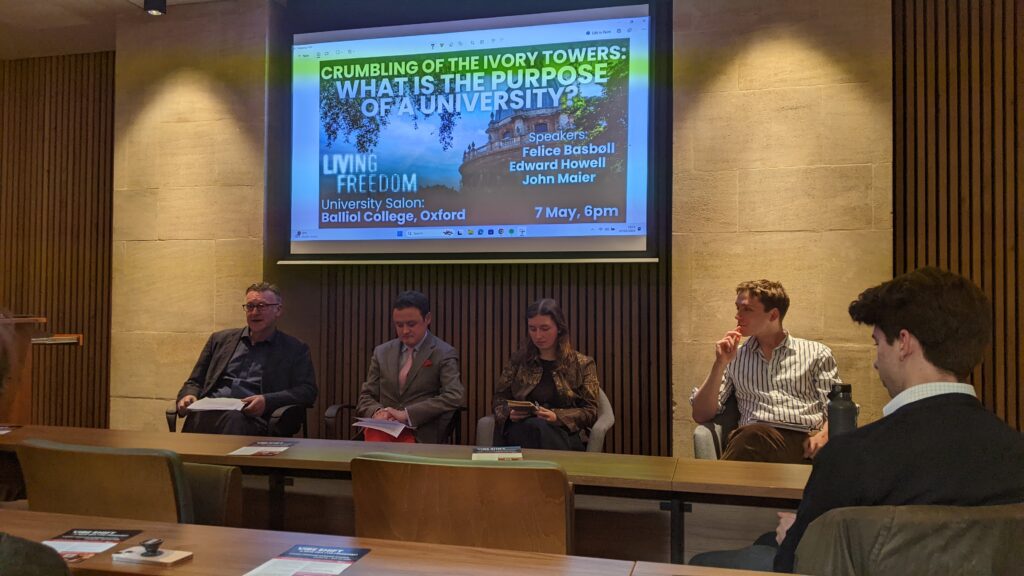
Notes from the Bubble: A Bad Conservative Pantomime at Balliol

At Balliol, the event is thick with what I’d call posh gits. The event felt conservative, not just politically, but in the deeper, old-school, institutional sense. The air was deep with entitlement. The room was full of young wannabes, the privileged types who don’t need to try, the future “elitists” rehearsing for their inheritance.

The line-up set the tone:

  • The older “priests” of the cult
  • First up, a writer for The Spectator.
  • Then a student from Dublin, the token woman?
  • Finally, a smug young man who writes for The Times and a news blog – Unheard basically right-wing student cosplay.

The first guy? A damp squib. A classic Tory prat with nothing to say. He took a predictable swipe at the “fashionable” paths universities have taken, diversity, equality, inclusion checklist from a conservative, nostalgic lens. His question, “Who does the university serve?” landed flat. He missed the moment entirely, pining for a return to the old order while ignoring the real crisis: who has power now, and how it’s wielded.

Next came the debating society woman. Equally, damp. Her speech was a buzzword salad of all the boo-words “they” used to signal disdain for anything progressive. It was as if someone had copy-pasted a Times’ opinion page into her brain. No spark. No substance. Conservative zombie thinking, the kind we thought had decayed along with the rest of the mainstream mess. Her conclusion? Bow to the establishment. Academia, she said, is about “developing character.” Whatever that means in this context, it sure didn’t sound like any challenge to the status quo.

Then the last guy. God help us. Public school, of course. He opened with “woke”, and the room laughed. He played the “fascist” card as a joke. More laughs. Eventually, he got to the point: universities, he claimed, are driven by bureaucracy following social trends. His example? In 2011, gender became the vector of change. Now, in his area, philosophy, bureaucrats impose “care” as a form of control. A tangle of half-thoughts and culture war agenda. He described a shadowy “bureaucratic class” at the heart of the university, the deep state of academia. The audience chuckled. But behind the lols, there was a whiff of fear?

Later, an older man, the priests of the cult, responded patronisingly to a question from a young right-wing woman. She asked something in earnest, and he waved it off like a bore at a dinner party.

Then a #fashernista liberal offered a question that began with all the right liberal signals but ended on a strangely rightward note, a sort of horseshoe moment in miniature.

One posh git got up to ponder: “Are universities for jobs or knowledge?” No mention of progressive public good, human flourishing, or collective liberation, just the normal #mainstreaming.

A recurring theme was the power imbalance between bureaucrats and academic staff, with students positioned as consumers, granted power by their tuition fees. The marketization of education has become normalised, ironically, these people hate markets and love hierarchy, so long as they sit comfortably at the top.

The panel discussed Blair-era university expansion as a kind of moral failing. Universities, have grown too big to care about individuals. A strange complaint from people who seem fine with the erosion of care as a value in every other domain.

What was missing throughout? Any real commitment to learning. Any fire. Any imagination.

Instead, we got rigid academic standards used as shields against criticism. A proud conformism. No wonder “innovation” gets crushed, the whole system selects for obedience wrapped in polish.

A rare, substantial question came from the audience: someone brought actual data about the growth of “woke” discourse. Where does the pressure come from, upstream (ideology, power) or downstream (social media)? The dominant theme, the lowest common denominator thinking. A retreat from ambition under the guise of “maximum inclusivity.”

One speaker touched briefly on humanism, the idea of creating knowledge for the public good. But it was an aside, quickly buried under the usual careerist rhetoric. Again and again, they insisted they had no ideology. But the dominant ideology was everywhere: jobs, prestige, status.

The whole event kept circling one unspoken truth: things are breaking down, but instead of grappling with that rupture, they reinterpreted it as nostalgia or bureaucratic failure or “wokeness gone too far.” Because the system they’re defending, consciously or not, no longer works for most of us, these guys are uninterested in composting the mess.

These guys’ waste time, lives and distract focus, lifting the lid, a mess, maybe their narrow point of view has some value sometimes, but I did not see it at then event or in the groups’ history #frendlyenemies #spoilers #energyvampires #deathcult

#Oxford #Event

The Seagull Knows: Notes on a Constipated Discipline

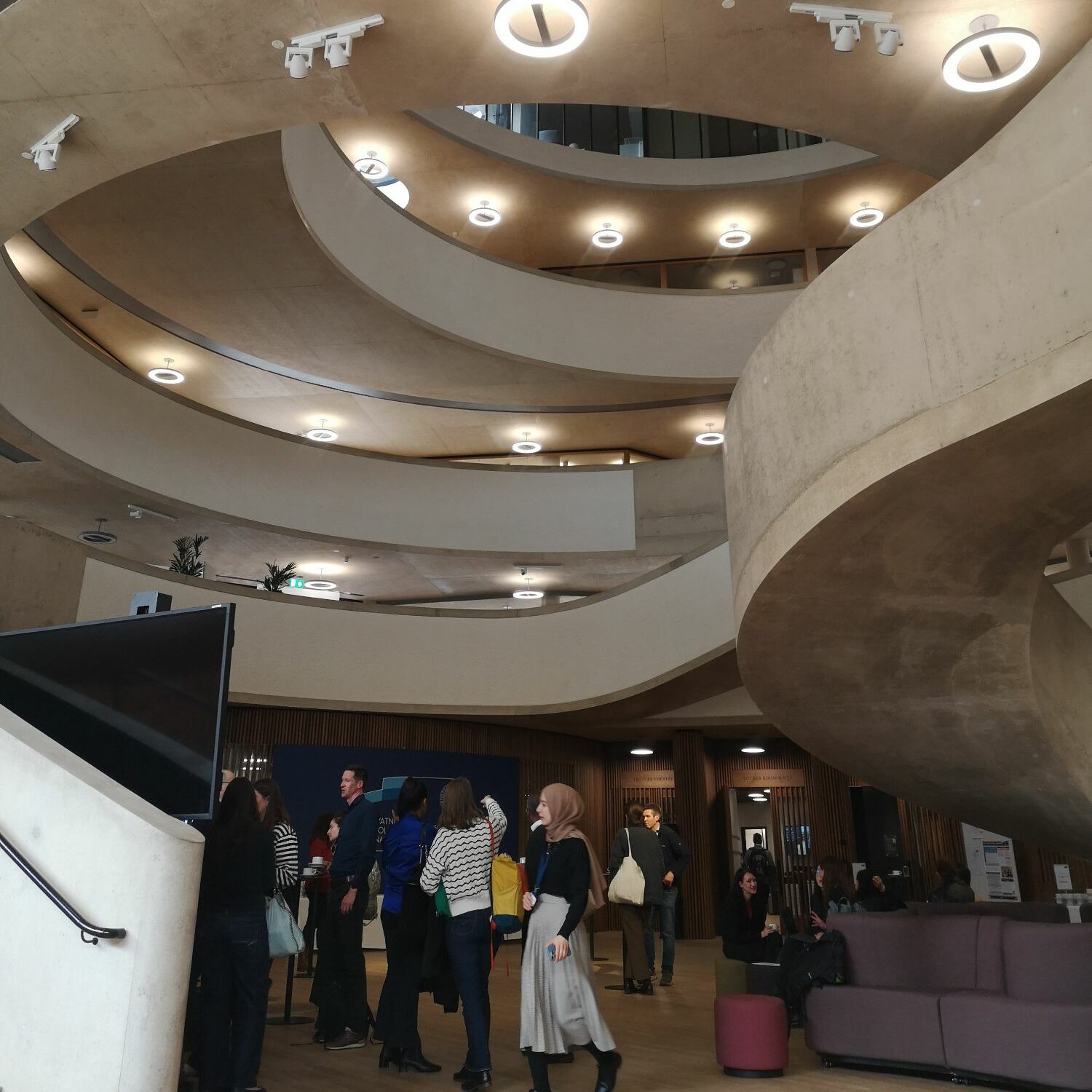
The opening moment of the workshop on Methodological Strategies for Real-Life Theorising was unintentionally profound. A story of a seagull crieing above the glass façade of the Blavatnik School of Government – a building that stands as a temple to the #deathcult that shaped our lives for the last 40 years of #neoliberal change. In hindsight, that seagull metaphor may have been the wisest participant at the event.

The sessions that followed offered a painful reminder of just how entrenched and constipated academic political theory can be. Many of the speakers, well-meaning, no doubt, spoke in dense, self-referential language, seemingly unaware (or uninterested) in the world burning outside. We are living through accelerating #climatechaos, surging right-wing extremism, and widespread social fragmentation. Yet here, the main concern is career-building through opaque frameworks and method fetishism. One can’t help but wonder how many in the room truly believe they are doing good?

The crisis is deeper than any single workshop. The very career paths that brought these scholars here have been shaped, filtered, and “concreted” by 30 years of neoliberal funding models. The result is a form of political theorising that appears to want to find a way out, but only by squeezing itself through the tightest gaps in the #postmodern mess. And even then, only while clutching tightly to the privileges and assumptions granted by the current paths.

Constipated Language, Abstract Struggles

Throughout the first sessions, there was a recurring sense of people talking to themselves. Even the attempts to make theory “concrete” – to move into empirical territory – felt more like power grabs than inquiry. There was talk of “transient theory,” of “mid-level normative frameworks,” of “ethnographic insights”, but very little clarity on what any of this meant in real practical or political terms.

Instead of confronting the deeply ideological assumptions embedded in liberal academia, the speakers soft-stepped around them. One could sense them trying to smuggle ideology back into a discipline that’s been left hollow. The “heroic era of theory” is dead, and what we’re left with is a ritual performance of relevance. At one point, the liberal impulse to block discomforting inputs in public policy was laid bare. This is ethics as insulation, not action. There was repeated deference to “existing norms and frameworks,” – the very architecture of the #deathcult, now warmed up and served again as policy advice.

The Seagull Still Watches

By the end of the day, some fresh air drifted in. A few scraps of cloth were handed out to the otherwise naked theorists. There was genuine engagement with normative complexity. Questions like “what is mutable?” began to shift the conversation. “Engaged political philosophy” and talk of “normative judgments” began to inch the discussion closer to the ground.

The presentation on restitution, for instance, highlighted real political dilemmas. Who decides what gets returned, and why? Is it justice, diplomacy, or geo-political calculation? One question noted that giving back looted objects is not just about ethics, it’s about giving back the values they represent. But this was quickly hedged with talk of “choice.” Liberal hedging again. No one wanted to say: yes, do it, without compromise.

Even here, markets remained the baseline. The dominant “common sense” is still economic flow. Value is defined by trade, not meaning. Discrimination itself can to easily be reframed as a market distortion, another cost to be corrected, not a systemic condition to be fought. The anti-market perspective, grounded in actual social justice, in living memory, in reparative truth, is invisible to meany people until it becomes a threat. At that point, the strategy shifts to distraction and buying off. That’s the logic of #neoliberal containment.


From Political Theory to Political Theater

What we witnessed was not just a methodological workshop, but a staged performance of institutional survival. Theories were dressed up, displayed, but never walked out into the street. Real political agency remained absent. The political philosopher, once imagined as a public actor, now hides behind peer-reviewed paywalls, while the world asks different questions entirely.

Still, by the end, perhaps there were reasons for the seagull to hold off its stone throwing – for a while. A few voices showed signs of life. A few questions struck true. But it will take more than scraps of normative cloth to cover the nakedness of political philosophy today.

The seagull will be watching.

#Oxford #Event


The event: Many political philosophers theorise not only for the sake of pure theory, but also because they want to convince citizens and policymakers to bring about changes in the real world.

Such policy-oriented research often draws on interdisciplinary methods, integrating empirical insights and normative and conceptual arguments. This, however, raises methodological challenges of its own. For example, how to deal with the fact that the social sciences are fragmented and different disciplines work with different paradigms and methodologies? How can philosophers, who bring their own normative assumptions openly to the table, deal with the – sometimes implicit – normativity that is also inherent in many other lines of research? What level of abstraction of normative arguments, eg basic normative theories or mid-level overlapping principles, should philosophers draw on when discussing with policymakers? And how to deal with the fact that in the current political climate in many countries, distrust towards “experts” also extends to philosophers?
Workshop agenda

Day 1: Thursday 24 April 2025

Methodological Strategies for real-life theorising

Chair: Jonathan Wolff, Blavatinik School of Government

Liron Lavi, Bar-Ilan University and Nahshon Perez, Bar-Ilan University: Conceptual Concretization in Empirically Informed Political Theory: What Makes a Concept Applicable
Carmen E Pavel, King’s College London: Mid-Level Theories of Justice and Public Policy
Kian Mintz Woo, University College, Cork: Explicit Methodologies for Normative Evaluation in Public Policy

Theorising between values and cases

Chair: Daniel Halliday, University of Melbourne

Rouven Symank, Free University, Berlin: Integrating Ethnography with Political Theory in Policy-Oriented Research: Challenges and Insights from Cultural Restitution Debates
Florence Adams, University of Cambridge: Discrimination as an Object of Social Science
Erika Brandl, University of Bergen: Measuring the justice of architectural development policies:debates on temporal scopes and indicators in the Hillevåg plan

My notes on this event:

The seagull is perhaps a good metaphor for nature fighting back against the last 40 years of human #deathcult culture that this building is temple of.

The language is constipated, a growing feeling that these people are pissing funding and focus against the wall while the world burns from #climatechaos and hard right social breakdown.

I wonder how many people here think they are doing good?

The problem on this career path is that it has been shaped by #neoliberalism for the last 20 years, funding and status have both been ground through this mess, and now reflect it.

After the first session I feel they are trying to squeeze themself out of this post modernist mess. By going back to basics, but it’s so constipated it’s hard to see if there is any value in this.

Looking at them talk and answer questions, you can feel them being lost. It still feels like they are talking to themselves.

A power grab, by making theory concrete, to build empirical research. They dodge this by saying the theory is transient.

If this is a bios? They fix this by making the bios visible. They find this question hard to answer as its a root issue.

They are “soft” sneaking ideology back into the current dead Political Science and theory world they work in.

The heroic era of theory is challenged for making public policy. They argue that we should start from the existing norms and frameworks. This from the #deathcult we get wormed up #deathcult worship as policy. Mess. Of course liberal rights have priority in the end, “we must also include institutional facts”.

The seagulls at the start of this event might be the wisest one here. The rest have no cloths, and the language is so constipated that the smell is likely off putting for any real outreach that they need in the scrabbling for coverings to continue their careers.

The liberals start to talk about #blocking the inputs that make them uncomfortable. In ethical public policy making.

From a working insider view, the people doing this don’t have the skills or knowledge if we focus on philosophy and theory only.

Good question, what is given, what is mutable is very mutable. So the Liberal “common sense” is likely a strong #blocking on the path of the change we need.

“Engaged political philosophy” “normative judgments” as we go on they start to be more relevant. “where there is convergence and divergence”

The event starts naked and smelly but as it goes on the air clears at times and some scraps of cloth are provided.

Relevant information that is easily excessable,

The power in a committee is the appointment of the people sitting on the committee rather than the committee process it self. The answer to this is hesitant and bluff, and distaste to cover this.

A chair or witness roll is different in committees.

Why restitution, why now.

Liberal
Justice

Reperatition is politics, not just ethical, geo politics and funding, based on former colonist will, is a tool for “ethical diplomacy”

Can any of these be seen as a reason not to do it. Don’t have an answer. Normative lessons.

When we give back objects that we value from our looting, we are giving back our values. We still chose.

My parents work is displayed in our #mainstreaming institutions, but these institutions are not interested in the objects, as they do not fit into there existing story’s and category. Subject archives will take them. But this is still shaping history.

Markets as the dominant “common sense” everything is economic flows. Value is defined by this.

Discrimination is contested with the hard shift to the right #DUI

Distortion in the market, function efficiently.

Discrimination is about greed, American greed, a moral dilemma. Liberal but not to liberal. Talk about the market path, let the market do its thing.

Markets aligned characteristics, money the logic of the #deathcult

As my work is anti market they can’t see any value, so put no resources and focus on the path in till it becomes a threat then distraction and buying off become the difficult paths.

Trump now is turning this neoliberalism around as discrimination. What is this, discrimination against nation states, rather than economics/market.

At the end the might be reasons for the seagull to hold off the stone throwing for a while.