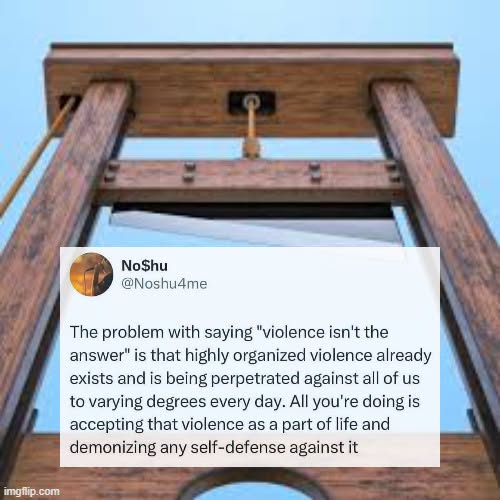
The recurring argument around violence and nonviolence gets trapped in a false choice. One side says “Violence is never the answer.” the other says “Violence is the only thing that has ever changed history.” Both are truth, but both miss real working humanistic paths. So, what kind of society creates the conditions where violence becomes the only option?
A first step is looking at the systems, cultures and social infrastructure that shape how people respond to conflict. If we want people to choose nonviolent methods, then those methods have to actually work. People need meaningful ways to participate, organise, challenge power and create change. Protest without consequence, dialogue without accountability and institutions that ignore people create dangerous paths.
When people feel that peaceful routes are closed, violence becomes a real option. But there is a second social problem to look at – violence is not just a tool, it creates its own culture. A movement built around destruction can easily reproduce the same power structures it fought against. Removing one oppressive system does not automatically create a better one, without new social foundations, history shows new forms of domination grow from the ruins.
Yes, history is written through moments of confrontation, but the is deeper work happens before and after those moments – building the commons that allow people to organise differently. This is where the #openweb lesson matters, change is not only about removing something, it is about building something. The strongest movements create alternatives – new relationships – new institutions – new forms of cooperation – new ways to share knowledge and power.
To build meaningfull alternatives we have to start by compostsing commen sense mess. What meany people do not understand is that our states are based on violence, what we see as private property is based on violence, just about everything we hold and touch is founded on violence. But when we look wider, a narow posative view is the state monopoly on violence is only legitimate when the state itself remains accountable to people. When power becomes accountable only upwards – to wealth, corporations or institutions – then the monopoly becomes simply control.
The same applies to grassroots movements, a movement cannot claim liberation while creating unaccountable power inside itself. The #geekproblem appears here too, reducing social problems to technical solutions – “Use violence.” – “Never use violence.” are simple answers to complex social questions. The harder work is asking, why are people unheard? Why do peaceful methods fail? Who controls the institutions? What alternatives exist? How can we build systems where people have agency before conflict reaches breaking point?
The #OMN path is not about pretending conflict does not exist, it is about understanding that the long-term answer is not simply winning a hard short fight. It is slower, growing a culture where fewer fights become necessary. The #4opens is part of this – transparent processes, shared ownership and accountable structures are not side issues. They are a foundation that allows movements to stay democratic instead of becoming another “common sense” version of the mess they oppose.
Violence is often a symptom, the deeper question is what social conditions keep producing it.
#OMN #openweb #4opens #commons #oxfordboaters

@info this is a really great read about all of it! I also found it pretty accessible considering it's a philosophy paper.
https://zizekstudies.org/index.php/IJZS/article/view/994
Remote Reply
Original Comment URL
Your Profile
Why do I need to enter my profile?
This site is part of the ⁂ open social web, a network of interconnected social platforms (like Mastodon, Pixelfed, Friendica, and others). Unlike centralized social media, your account lives on a platform of your choice, and you can interact with people across different platforms.
By entering your profile, we can send you to your account where you can complete this action.
@info I was at a "libertarian party" meeting once, out of interest "what is this all about". Someone in the back said: "I don't think we can ever have a non-violent revolution." That was enough for me. Made me think: we need to fix democracies, democratically. And we really need to put a lot of energy in that.
Remote Reply
Original Comment URL
Your Profile
Why do I need to enter my profile?
This site is part of the ⁂ open social web, a network of interconnected social platforms (like Mastodon, Pixelfed, Friendica, and others). Unlike centralized social media, your account lives on a platform of your choice, and you can interact with people across different platforms.
By entering your profile, we can send you to your account where you can complete this action.
@info I really enjoyed this documentary by the way: https://www.youtube.com/watch?v=XKgQr6fhbxE
Remote Reply
Original Comment URL
Your Profile
Why do I need to enter my profile?
This site is part of the ⁂ open social web, a network of interconnected social platforms (like Mastodon, Pixelfed, Friendica, and others). Unlike centralized social media, your account lives on a platform of your choice, and you can interact with people across different platforms.
By entering your profile, we can send you to your account where you can complete this action.
@johan @info the introduction to the documentary? Or the documentary itself?
Remote Reply
Original Comment URL
Your Profile
Why do I need to enter my profile?
This site is part of the ⁂ open social web, a network of interconnected social platforms (like Mastodon, Pixelfed, Friendica, and others). Unlike centralized social media, your account lives on a platform of your choice, and you can interact with people across different platforms.
By entering your profile, we can send you to your account where you can complete this action.
@JeroenBaten @info the introduction is good, the documentary is really worth watching
Remote Reply
Original Comment URL
Your Profile
Why do I need to enter my profile?
This site is part of the ⁂ open social web, a network of interconnected social platforms (like Mastodon, Pixelfed, Friendica, and others). Unlike centralized social media, your account lives on a platform of your choice, and you can interact with people across different platforms.
By entering your profile, we can send you to your account where you can complete this action.