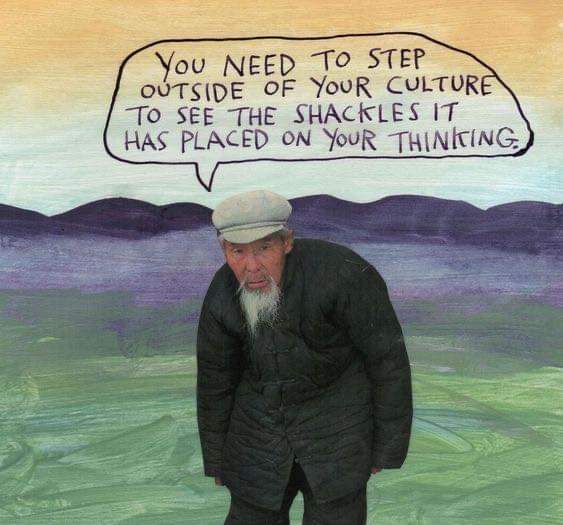
One of the important ideas in the sociology of science is also one of the easiest to misunderstand: knowledge is socially produced. This does not mean that scientists simply make things up, it means something much more practical. Science is a human activity, it requires people, institutions, money, equipment, archives, universities, laboratories, communities and time. What we choose to investigate – and what we choose not to investigate – is therefore shaped by society.
That means there is another side to the politics of knowledge, we construct knowledge, but we can also construct ignorance. This is the idea of agnotology: the study of how ignorance is produced, maintained and as we see todays messy world, deliberately manufactured. Yes, this should be common sense, that the consequence of science is unavoidable selectivity: we look here rather than there, and every decision to investigate one thing means that something else receives less attention.
The important question is therefore not – what do we know? It is also, what don’t we know, why don’t we know it, and who benefits from that ignorance? Science does not happen outside society, there is a persistent #fashernista fantasy that science exists somewhere above politics and society. In this common sense fantasy, scientists simply follow the evidence, eventually discovering the truth. Any gaps in knowledge are assumed to be temporary, eventually somebody will get around to researching the missing pieces and the picture will become complete.
But our current capitalist science doesn’t work like that, as research needs resources, someone has to decide what gets funded, has to establish institutions and employ researchers. Someone has to maintain archives and databases. Someone has to decide which questions are legitimate enough to investigate. This means that the social organisation of knowledge is itself part of the knowledge system. Science is not an abstract ideal, as meany people treat it, but a human practice made up of institutions, resources and people. Political forces influence the scientific ecosystem without needing to dictate the results of individual experiments.
This matters – you don’t need to falsify scientific evidence to manipulate science, you can simply make sure that the research never happens. The politics of the missing, lets look at an example, imagine two possible worlds.
- In one, researchers spend twenty years investigating a particular health problem. Thousands of people contribute data. Universities train specialists. Public institutions maintain long-term datasets. Researchers develop treatments, identify risks and improve policy.
- In another, funding disappears. The research programme closes. The datasets are deleted. Researchers move into other fields. Young academics decide there is no career in the subject. Communities become reluctant to participate because they no longer trust the institutions.
Nobody has announced “we have banned this knowledge”, but the knowledge disappears anyway. This is one of the most powerful things about agnotology. Ignorance does not have to be created by a giant conspiracy, it can emerge through apparently ordinary administrative decisions: funding priorities, institutional closures, data deletion, censorship, intimidation, restructuring and changes in what counts as a legitimate research question. Over time, the result becomes material.
Scientific knowledge is cumulative, new work depends upon old work, archives and datasets. Remove the foundations and you don’t simply lose yesterday’s knowledge – you make tomorrow’s knowledge harder to produce. The archive is political infrastructure – this is where the #OMN path becomes important. We often think of archives as passive things, as librarys siting somewhere, a database sits on a server, a government website publishes information, a research paper exists in a journal. But these things are infrastructure, if the infrastructure disappears, access to knowledge disappears with it.
This is why #makinghistory matters – society needs the ability to remember itself, not just the official history or whatever survives inside corporate platforms or that happens to remain profitable. We need distributed, community-controlled records of what happened, what people experienced, what institutions did, what communities built and what was subsequently removed. That is media infrastructure, but it is also social memory infrastructure – closed systems make forgetting easy, sometimes this is deliberate, often it isn’t.
The social record becomes fragile, is one of the problems with concentrating so much of our communication inside a small number of commercial platforms. We have allowed a huge amount of collective memory to become dependent on organisations whose primary responsibility is not to society but to their own narrow institutional interests. That is not the resilient information system we need today in the era of #climatechaos.
The #openweb is a memory machine – the alternative isn’t that everything needs to be permanently preserved forever, that would be another form of technological fundamentalism. The point is to create distributed capacity, multiple archives, multiple publishers, multiple communities, institutions. Multiple ways of finding and verifying information, multiple copies, open formats, standards, source and proces. This is what the #4opens approach is trying to get at, not simply technical principles, they are social protections.
- Open Data means information can remain accessible.
- Open Source means the tools themselves can be inspected and maintained.
- Open Standards mean that information doesn’t have to remain trapped inside one company’s technical ecosystem.
- Open Process means that decisions can be challenged rather than disappearing behind institutional walls.
Together these create a technical architecture of social resilience.
Then we have the danger of the “no data, no problem” argument, is a particularly nasty political trick that follows from manufactured ignorance. First, prevent the research, then point to the lack of research as evidence that the problem isn’t real No evidence.”, “No consensus.”, “More research is needed.”, “We simply don’t know.” Sometimes those statements are reasonable, but they can also become circular.
If you systematically prevent people from collecting the evidence, you cannot then use the absence of evidence as proof that nothing is happening. The rhetorical pattern is that the assumption that if something were true, science would already have conclusively demonstrated it. But a lack of evidence can also result from social forces preventing researchers from doing the work in the first place. This matters far beyond any single political issue, it applies to climate research, poverty, housing, public health, marginalised communities, the effects of technology. It applies to almost anything where powerful interests might prefer that certain questions remain unanswered.
Information needs communities, is another lesson – knowledge doesn’t survive simply because somebody writes it down. It survives because communities care enough to maintain it, institutions train people, maintain archives, provide context. Researchers build upon previous work, journalists document events, activists preserve evidence, technologists maintain infrastructure, historians connect fragments together. This is a social ecosystem and when you break enough parts of it, knowledge starts disappearing.
That is why the #OMN isn’t simply about making another publishing platform, the larger idea is to build infrastructure for collective knowledge production and memory. Publishing is one part, metadata another, moderation, trust, archives, federation are all parts. The ability to edit, correct, contextualise and preserve information needs to work together.
The #openweb gives us a possibility that centralised media never really delivered: a network where different communities maintain their own spaces while still communicating with one another. That creates disagreement without requiring isolation, creates diversity without requiring fragmentation and it gives us a chance to build something much more resilient than the current model of a handful of corporate databases surrounded by billions of users. From information to social truth, is a political question.
This is the reason I keep coming back to #makinghistory – if somebody deletes a webpage, we should have copy, if a community documents an event, that record should not depend upon one #dotcons corporation continuing to host it. If an organisation changes its story, there should be an accessible historical record. If a government removes information, communities should be able to preserve what was orgionaly published.
If today’s activists disappear, tomorrow’s activists should still be able to understand what they did. If a research project closes, the work should not simply evaporate. This doesn’t mean believing every archive is automatically true – archives need context, metadata, discussion, provenance and criticism. In fact, that is exactly the point – the answer to bad information is not less information, it is better social infrastructure for comparing, contextualising and challenging information.
There is a tendency to think of technology as neutral plumbing, but the plumbing determines what can flow through it. A centralised system encourages centralised memory – a closed system encourages institutional dependency – a disposable platform encourages disposable history. Were open systems create the possibility of continuity beyond any single organisation. What we do with those #4opens possibilities is a social question, it is why #OMN, #MakingHistory, #Indymediaback, #OGB and the wider #4opens approach belong together. They are different pieces of the same argument.
That is the danger of manufactured ignorance, and why preserving the #openweb is not a technical hobby, it is part of preserving our collective ability to think.

#OMN #MakingHistory #Indymediaback #OGB #4opens #openweb #FOSS #media #archives #knowledge #agnotology #commons
