One of the simplest lessons from revolutionary politics is that power should stay with the people doing the work, not with a permanent party, bureaucracy, or managerial class. This has strong relevance for the #OMN project’s first step.
A clear second step is needed, one that moves beyond reformism as an end point, not a rejection of reforms outright. Winning better wages, shorter working hours, stronger rights, and better conditions matters. These are how people develop confidence, solidarity, and an understanding of their collective power. The problem arises when reform becomes the destination, rather than a deeper process of social change.
When movements become satisfied with managing the existing system, the system itself becomes invisible. Language changes, structures become professionalised, leaders become representatives, activists become stakeholders, and participation becomes consultation. Eventually, the movement is managing the symptoms of the system it originally wanted to change and challenge.
Reform is a means of building collective power, not an excuse to abandon the possibility of fundamental change. We’re not interested in building better communications infrastructure to serve existing power structures. Our path is changing who has meaningful power over media, information, and governance.
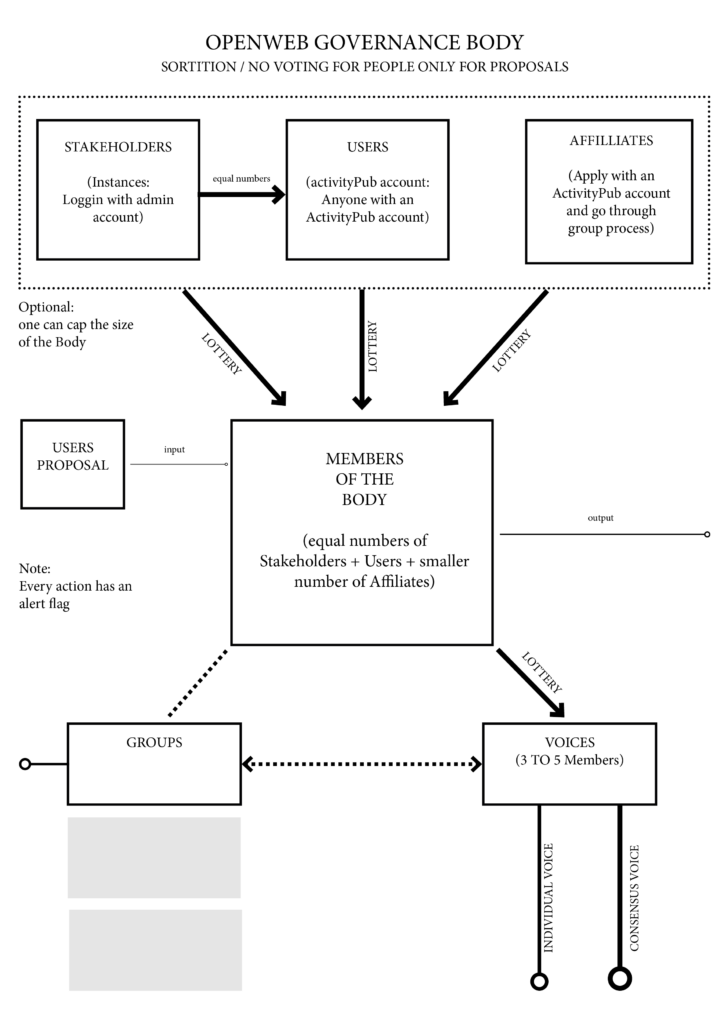
This is an old story, moving from representation to participation – council communism. The alternative paths explored were the workers’ council, a project like the #OGB, where power wasn’t handed to a permanent party leadership.
In our 21st-century digital version, delegates are sorted, held accountable, and recallable. Governance bodies federate together without becoming subordinate to a permanent central authority. To grow spaces were the question is not – who represents us? The question isn’t who represents us, but how people participating in something retain meaningful control.
A very different starting point from the current mainstreaming.
The #OMN social tech project is built from this federation, not centralisation. People and groups participate locally while remaining connected to bigger networks through #4opens standards and shared protocols. A local group is autonomous while participating in a wider network. #OGB ideas like recallability, transparency, open process, and distributed decision-making become practical, not just theoretical.
For the #OMN, the daily struggle and larger transformation are connected, reform is a means of building collective power, not an excuse to abandon the possibility of fundamental change. On this path, we are not interested in building better communications infrastructure so that the existing power structures can communicate more efficiently. Our path is changing who has meaningful power over media, information and eventually governance.
But, yes, there is a temptation to romanticise grassroots movements, we should resist this, as the historically these paths declined for good reasons. They were to frequently divided by factional disputes, ideological arguments and organisational conflicts. We should not need to repeat how suspicion of bureaucracy sometimes became suspicion of organisation itself.
To heavy structure creates problems, but to light structure also creates problems, if you build no durable structures, somebody else eventually fills the vacuum. Romantic anti-authoritarian intentions do not automatically produce democratic outcomes, a group can reject formal hierarchy while developing powerful informal hierarchies. A movement can reject leaders while allowing a few confident voices to dominate discussions. An organisation can demand decentralisation while becoming impossible for ordinary people to participate in, and can become so fragmented that cooperation becomes harder than centralisation. This is one of the most important lessons, that shapes the #OMN.
Decentralisation needs usable governance, that is not to abandon structure, but make structures that remain accountable to the people using them. That means keeping governance simple enough to understand, open enough to inspect and flexible enough to change. It means separating coordination from ownership, by making sortition temporary and contestable.
This is where the #OGB idea becomes important, It allows people to disagree without turning every disagreement into a schism, and build processes that can survive this disagreement. The path is governance that can become something communities can actually do, rather than something handed over to specialists.
Then we need the #4opens as a defence against capture, it is not simply a technical preference, they are social safeguards. Together, they make it harder for power to hide/disappear into a black box. Openness creates places where hierarchy can be seen, challenged and, when necessary, bypassed. We need this to mediate the mess of everyday elitist vanguards that claims to speak for us, but the balance is, neither do we want a collection of isolated individuals pretending that society does not require organisation – the trap of #stupidindividualism. People need shared infrastructure, shared knowledge, shared processes and ways of making decisions together, to hold commons in place.
With the #OGB people participate directly, delegate where useful, contest decisions, fork when necessary and reconnect when possible. That makes low-energy structures more flexible than both the traditional party or the centralised platform. Democracy cannot simply be postponed until after the revolution as people learn collective power by exercising it. When they make mistakes they argue and experiment, change their minds to find what works through participation. Democracy is therefore not just a mechanism for selecting leaders, it is part of the process through which people become capable of governing themselves
We need useful historical lesson about keeping power close to participation. As when a party, committee, NGO, platform or the normal technical elitists begin making decisions on behalf of everyone else, the movement’s own capacity for self-government begins to atrophy. The #OGB simply keeps delegation recallable and infrastructure federated, processes visible and standards open. To keep governance simple enough for ordinary people to use.
And, critically, we need to grow enough structure that disagreement does not automatically destroy the organisation. This is the balance we are looking for, not bureaucracy – not chaos. Not permanent leadership – not isolated individualism. But, native grassroots federated, participatory, accountable organisation. Please – don’t forget anti-authoritarian intent is not enough, without workable governance, openness and trust, decentralised movements can still fragment, stagnate or recreate informal elitists.
The #OMN path is about building the infrastructure to hold those two truths together. Power to the participants, structure without hierarchy, federation without centralisation, governance without a ruling class. That is the path from old political arguments towards more practical working commons paths.
