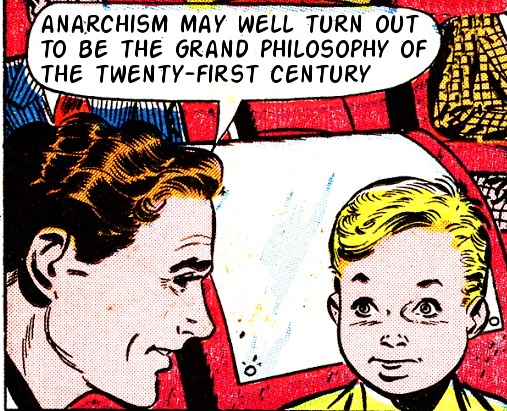
Anarchism, in #OMN language, is not chaos. It’s the long historic struggle to build social paths growing trust, mutual responsibility, and shared power instead of fear, hierarchy, and extraction.
At its root, anarchist economics is simply the idea that people should have more direct control over the things that affect their lives. Workplaces, media, communities, land, tools, and infrastructure should be held more in common or managed cooperatively by the people actually using them, not owned by distant states, corporations, landlords, or bureaucratic classes.
This is the opposite of the current #deathcult path where power concentrates upward into institutions that claim ownership over everything while the majority are reduced to consumers, tenants, workers, and data sources. The important distinction is between use and ownership.
In capitalist logic, ownership means control without participation. You can own land you never touch. Own housing you never live in. Own platforms you never contribute to. Own factories you never work in. Then extract rent, profit, interest, and power from the people who actually do the labour. This is the normalised logic of the #closedweb and #neoliberalism.
In anarchist and mutualist thinking, possession comes from use and participation. If you use something, care for it, maintain it, and contribute to it, then you have a natural relationship with it. This is a living social process rather than an abstract legal claim enforced through violence or bureaucracy. That’s actually how many healthy human systems worked historically before everything became financialized and enclosed.
The #openweb originally functioned much closer to this model. People built websites because they needed them. Communities moderated spaces because they cared about them. Developers shared code because collaboration worked better than enclosure. Infrastructure was often maintained through trust networks, volunteer labour, and shared responsibility.
The problem is that over time the #dotcons enclosed this commons. Social relationships became platforms, sharing became monetized content, participation became engagement metrics, human communities became extractable data flows. This is why the #4opens matter:Open data. Open source. Open standards. Open process. These are not abstract technical values, they are practical social tools for preventing enclosure and concentration of power. Without them, projects quietly drift toward hidden hierarchy and soft authoritarianism even when they use radical language.
This is also why thinking about the #geekproblem matters, too much alt-tech still thinks freedom comes primarily from technical architecture while ignoring social power. But history shows that purely technical fixes usually reproduce the same social hierarchies in new forms. The problem is not only bad code, it is social relations. A decentralized system can still become socially authoritarian. An open protocol can still become culturally closed. A cooperative can still become dominated by informal elitists. A “horizontal” project can still be controlled by hidden networks of influence. That’s why anarchist economics focuses so heavily on mutual aid, federation, and self-management.
Mutual aid is simply people organizing together directly to meet shared needs without waiting for permission from markets or states. Food sharing, community defence, free software, skill swaps, radical media, housing networks, protest kitchens, neighbourhood repair groups, grassroots publishing. These are not side projects, they are the foundations of another economy already existing inside the shell of the old one.
Projects like #Indymedia worked because they embedded technology inside living social networks and shared political cultures. The value was not just the publishing software, it came from trust relationships, collective process, and common purpose. This is the same path #OMN is trying to reboot for the #openweb era. Not by inventing endless new startups and pointless platforms, chasing #fashernista tech trends or feeding the #NGO funding machine.
But by rebuilding commons infrastructure that people can actually use, shape, and govern together. The goal is not perfect ideology, the goal is reducing domination. Less extraction, hierarchy, enclosure, passive consumption. More participation, transparency, shared responsibility and more collective agency.
The irony is that this is often more practical than capitalism itself. Mutual aid networks regularly respond faster than states during disasters. Open-source infrastructure powers huge parts of the internet. Informal community care keeps millions alive under collapsing systems. The future probably won’t arrive as one giant revolution, it grows more like compost.
Small living networks.
Shared tools.
Open processes.
Federated trust.
Commons infrastructure.
That’s the real anarchist economy in practice, messy, human, relational, and alive.
