Why you should help

The internet’s public square is privatised, algorithmically controlled for “engagement” over any idea of truth, and placed under the control of a handful of American corporations with no accountability to European citizens or values. The #Fediverse is the most credible existing alternative – but it lacks the shared infrastructure to function as a native commons for news and media. #OMN builds that infrastructure: trust-based, community-controlled, transparent, reversible, and owned by nobody. At €45,000 for a proof of concept, it is one of the cheapest possible investments in the long-term health of European digital public life. If it works – and the technical and social groundwork suggests it will – it becomes the plumbing for a Fediverse that can actually be used to serve democratic societies rather than more #techshit alongside the current #dotcons platforms that undermine them.

Why this matters – because the #WWW was stolen – Designed as commons at CERN, decentralised, open, nobody in charge. What we have today is instead is five American corporations controlling the information diet of billions of people. Facebook decides what news you see. YouTube’s algorithm decides which voices get amplified. Twitter/X decides who gets banned. None of these decisions are transparent, accountable, or reversible. They are made by private entities in pursuit of control, advertising revenue and engagement metrics – not truth, not public interest, not democracy.

The #Fediverse exists as a rejection of this, it’s the largest real functioning alternative to corporate social media, with millions of people on thousands of servers, federated together, nobody owning the whole thing. It works. It’s growing. But it has a weakness: it’s kinda fragmented at the commons layer. There’s no shared infrastructure for how news and media actually flows across the network in any trustworthy and coherent way.

That’s the gap #OMN fills, but why? Most people don’t think about internet infrastructure. They think about whether they can trust what they read. Whether the news they see is real. Whether the platform they’re on is working for them or selling them. Whether they can do anything when something goes wrong.

Right now the answer to all of those is: it depends entirely on decisions made by people you’ll never meet, for reasons you’ll never know. OMN proposes something different. If your community trusts a source, a trust flow, you see it. If they don’t, you don’t. And that decision is yours, reversible, transparent, locally controlled.

For a journalist in a small country trying to get independent news out, this is the difference between having infrastructure that works for them and being at the mercy of a platform that can deplatform them overnight. For a community archive trying to keep historical memory alive and accessible, this is the difference between dependence on Google’s goodwill and owning your own distribution. For an ordinary person trying to figure out what’s true, this is the difference between an algorithm designed to maximise your outrage and a network shaped by people you actually trust.

Bureaucracies fund things slowly, in ways that often serve existing power structures rather than challenging them. But digital sovereignty is an existential European concern. The EU has spent years trying to regulate American platforms – GDPR, the Digital Services Act, the Digital Markets Act – and the platforms have responded with compliance theatre, token gestures, and armies of lawyers. Regulation of concentrated private power is a losing path. The only actual answer is to build the alternative infrastructure so that people have somewhere else to go. That’s what the NGI Commons Fund is for and what #OMN does.

The EU should not only be funding products, it needs to fund commons infrastructure – the plumbing that nobody owns and everyone can use. Like funding roads rather than funding a logistics company. The outputs are open source, meaning any European media organisation, any local community, any public institution can pick this up and use it. No lock-in. No dependency on a vendor who will be acquired or shut down.

It’s cheap, with the second stage scaling across Europe with institutional partners, building on European strengths. The Fediverse is disproportionately European. Mastodon was built by a German developer. The culture of digital commons, open standards, and public interest technology is stronger in Europe than anywhere else. This project is native to that tradition. It’s not asking Europe to compete with Silicon Valley on Silicon Valley’s terms – it’s asking Europe to build the alternative on its own terms.

The problem #OMN solves is getting worse, not better. Disinformation, algorithmic radicalisation, platform capture of public discourse – these are not abstract threats. They are actively destabilising European democracies. Funding the technical infrastructure for trustworthy, community-controlled information flows is not a nice-to-have. It is digital public health infrastructure.

#KISS


Thematic call: NGI Zero Commons Fund

Organisation: Open Media Network (unincorporated community project, fiscal hosting in Belgium via OpenCollective) Country: United Kingdom General Project Information Proposal name: Trust-Based Media Flows for the Fediverse (#OMN) Website / wiki: https://unite.openworlds.info/Open-Media-Network/Open-Media-Network

Abstract

Can you explain the whole project and its expected outcome(s)?

The Open Media Network (#OMN) is a protocol-driven, federated media infrastructure built on top of ActivityPub and the Emissary codebase (emissary.dev). It addresses a real gap in the current Fediverse: while platforms like Mastodon, PeerTube, and Lemmy are federated at the instance level, there is little coherent cross-platform layer for trust-based content flows, moderation, or news aggregation. Each instance operates largely as its own silo, moderation is hierarchical and per-server, and there is no shared commons model for media distribution across the ecosystem. #OMN proposes a minimal, compostable interaction model – the Five Functions (#5F): Publish, Subscribe, Moderate, Rollback, and Edit Metadata – implemented as a flow layer on top of existing Fediverse infrastructure. Content moves through the network as objects flowing through pipes and holding tanks, filtered and shaped by trust relationships between nodes rather than by opaque algorithms or centralised authority.

The central R&D question is: can trust-based moderation and distribution flows replace algorithmic amplification in a federated news ecosystem? Expected outcomes of this first-stage grant: By Month 3: A technical specification of the flow architecture; a prototype flow service routing ActivityPub objects between two instances; documentation of existing Fediverse flow patterns; early integration with one platform (likely PeerTube). By Month 6: A cross-platform prototype connecting at least two Fediverse systems; a working demonstration of trust-based moderation flows; a public code repository and documentation; and a user-facing prototype via the #makinghistory test environment (https://unite.openworlds.info/Open-Media-Network/MakingHistory). All outputs will be released under recognised open source licences. The project follows the #4opens framework: open data, open source, open standards, and open process.

Have you been involved with projects or organisations relevant to this project before?

Yes. The project lead, Hamish Campbell, has over 40 years of experience in grassroots media and technology, including early involvement with Indymedia – the pioneering open publishing news network – and more than 8 years working directly with the Fediverse and ActivityPub community. The #OMN conceptual framework has been developed over this time and is documented extensively in the project wiki, SocialHub, and at https://hamishcampbell.com. Developer Michael has contributed to #OMN concepts and logic for 10 years and is currently building the #makinghistory reference implementation. Ben, the core developer of Emissary, brings specific expertise in the codebase that will form the technical foundation of the project. Alex brings potential DAT/distributed storage support, and IKA will work on testing and rollout.

Requested Support Requested Amount: €45,000

Explain what the requested budget will be used for. Does the project have other funding sources, both past and present? A breakdown in the main tasks with associated effort is appreciated. Make rates explicit. The budget covers a lean, seed-stage proof of concept with no prior external funding. There are currently no other funding sources. The budget breakdown can be found in the attached PDF (funding). Roles: Hamish Campbell (project lead, coordination, documentation, community engagement) and Michael Saunders (primary development, UX, system logic). Additional contributors (Ben, Alex, IKA) are contributing on a voluntary/community basis during this seed phase. Work packages and approximate effort: WP1 Research & Specification (Months 1–2, ~25% of effort): Architecture design, gap analysis of existing Fediverse tools and flows (PeerTube, Lemmy, Mastodon), and documentation of trust-flow patterns. Output: Technical design document. WP2 Core Development (Months 2–5, ~45% of effort): Flow service implementation on top of Emissary; ActivityPub integration for the #5F model; and a trust-based moderation layer extending Emissary’s existing block/flag capabilities. Output: Working prototype codebase. WP3 UX & Prototype (Months 3–5, ~20% of effort): #makinghistory user interface; dual-layer UX (simple and advanced modes); and WCAG 2.1 accessibility compliance. Output: Testable user prototype. WP4 Testing & Documentation (Months 5–6, ~10% of effort): Community testing and iteration; public documentation and reports; and an open knowledge base of what works and what fails. Output: Public documentation, reports, and reusable design patterns. LINK PDF and wiki

Compare your own project with existing or historical efforts.

The closest existing efforts are: Mastodon’s built-in moderation tools: per-instance block lists and the Fediblock community blocklist. These are instance-level tools – they do not create cross-platform trust flows or shared content aggregation. #OMN operates at the network layer, not the instance layer. Fediseer: a trust registry allowing instances to vouch for each other. Fediseer addresses instance-level reputation but does not implement content flow logic, rollback, or metadata editing as network functions. #OMN builds a compostable flow model on top of the kind of trust signals that Fediseer represents. GNU Social / Friendica: older federated social platforms with some aggregation capability. These predate ActivityPub’s consolidation as the dominant standard and do not address the cross-platform news/media commons use case. Indymedia (1999–2010s): the historical precedent for open publishing federated media. Within the wider project, #OMN explicitly revives and modernises the Indymedia model for the ActivityPub era via the #indymediaback reference implementation, addressing the unfinished work of that tradition. The #makinghistory project grows from, and shares, this same established workflow. Bonfire networks: likely related, but unclear in scope and function. Attempts to install and use it have not clarified its approach. It may be trying to address similar problems, but this remains uncertain. The key difference of #OMN: it is not building a new platform. It is building a protocol-level flow layer that works across existing Fediverse platforms, implementing trust-based content propagation as commons infrastructure rather than as a product. See included PDFs.

What are significant technical challenges you expect to solve during the project?

  1. Trust flow implementation: Designing and implementing a data model for trust relationships between federated nodes that is lightweight, compostable, and expressible via or alongside ActivityPub. Trust is local and subjective – the system must allow different communities to apply different trust filters to the same content flow without requiring global consensus.
  2. Rollback across federated state: Implementing the rollback function (re-evaluating and reshaping historical content visibility) in a distributed system where content has already propagated to multiple nodes. This requires a time-aware, local re-indexing approach rather than a global delete mechanism.
  3. Cross-platform content normalisation: Aggregating content objects from Mastodon (short-form social), PeerTube (video), and Lemmy (forum) into a common JSON-LD content model with a consistent trust trail, despite these platforms having different ActivityPub implementations and object schemas.
  4. Search actors as push feeds: Implementing the “content finds you” model – where a defined search query becomes a persistent ActivityPub actor that pushes matching new content to subscribers – requires extending Emissary’s existing subscribable search engine capability.

Describe the ecosystem of the project, and how you will engage with relevant actors and promote the outcomes.

The primary ecosystem is the Fediverse: the network of federated, open-source social platforms running ActivityPub, including Mastodon, PeerTube, Lemmy, Friendica, and many others. This ecosystem has grown substantially (estimated 10+ million active users across thousands of instances) but remains technically fragmented at the commons/media layer. The project builds directly on the Emissary codebase (https://emissary.dev), an existing ActivityPub-native Go application. Engagement with the Emissary community is embedded in the team through Ben’s mentoring role.

Wider ecosystem engagement:

The project will contribute design patterns and documentation back to the broader Fediverse developer community via public code repositories, the project wiki, and events. The #makinghistory test phase connects us to existing archives such as Bishupsgate, Maydyroom, the Peace Museum, and the Campbell Family Archive, providing access to extensive datasets as well as outreach to their administrators and users. The five community events included in the budget are specifically designed to recruit contributors, gather real-world feedback, and expand the network of participating nodes.

Promotion of outcomes:

Outcomes will be shared through the Fediverse itself (maintaining an active presence on ActivityPub-native platforms and legacy social media), via open-licensed documentation, and through NGI/NLnet networks and events. This first-stage grant is explicitly designed as a seed and proof-of-concept phase, with a larger second-stage proposal planned to deliver a fully production-ready system once the core architecture is validated.

See attached PDFs.
Powered by Forgejo


Would like to thank all the meany people who helped with this.

Composting the confusion: A critical response to the misreading of the #Openweb

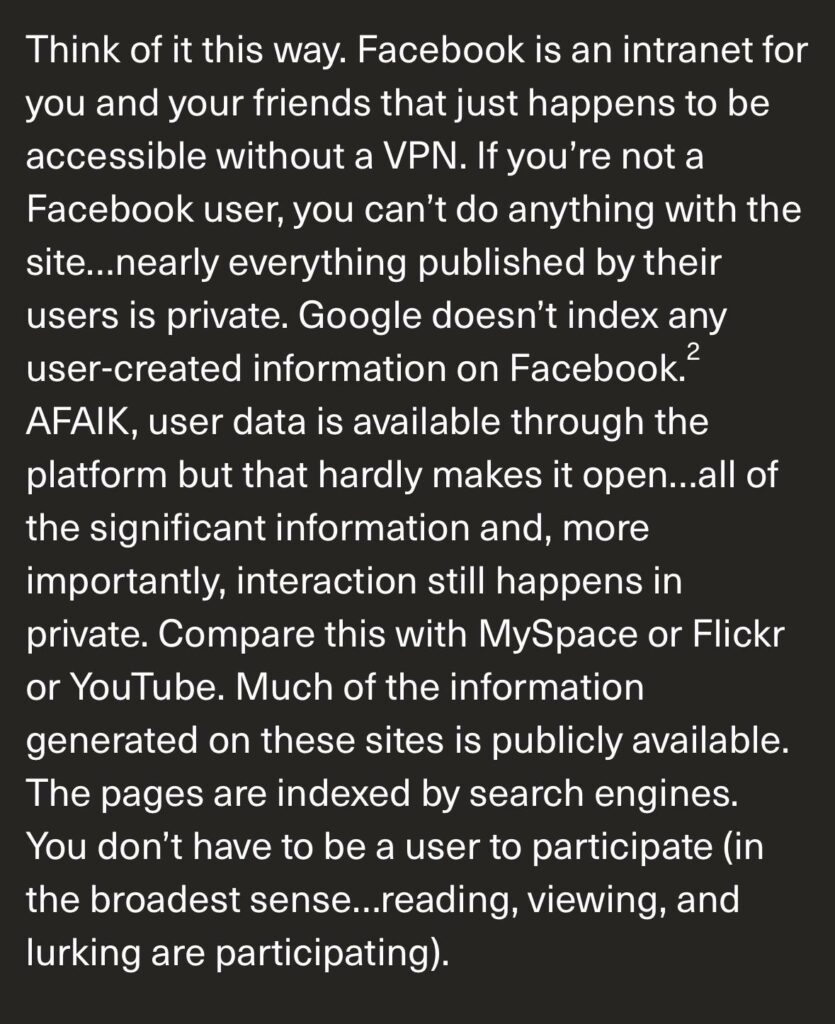
“It’s fascinating to see how the #OpenWeb ideology was formed in the late aughts... Open Web evangelists criticizing early Facebook for being too private is an incredible heap of irony.”
— [Someone missing the point entirely]

Let’s be clear, this is a historical and political mess, and one worth composting. The original #openweb vision, was wide, from the original European social vs the American libertarian, the person quoted is taking the view from inside the #blinded USA path rather than the original #WWW #mainstreaming of the more native social European path.

The idea on both paths was never about exposing personal data, that’s a strawman born of today’s #dotcons-common-sense, where everything gets flattened into privacy = good, openness = bad. It’s a deeply ahistorical take, infected by the post-Snowden wave of #encryptionism mess that conflates liberation with hiding, and assumes the only threat is surveillance by “them,” never enclosure by “us.”

Yes, the original more native #4opens path – Open Data, Open Source, Open Standards, Open Process – is still a radical project rooted in trust, transparency, and collective power. It is about creating shared public spaces and protocols to collaborate, self-organize, and break the silos, both big, built by tech monopolies and small built by our own #encryptionists dogmas. This original path draws from traditions of anarchist publishing and autonomous tech. And yes, it explicitly distinguished between publishing and privacy.

Early Facebook wasn’t “too private.” It was already a walled garden – a corporate trap disguised as a community. The real critique from #openweb folks was that it centralized control, commodified interaction, and locked users in. That’s why people built alternatives like #Indymedia, #RSS networks, (sudo)federated blogging, and early #P2P social tools.

To say the openweb led to surveillance capitalism is like blaming bicycles for car crashes. What happened wasn’t in any way openness going too far, it was openness being abandoned, subsumed, and bastardized by closed platforms under the guise of “convenience” and “safety.” And now, people are rewriting history to serve the logic of today’s bloated encryption silos and #NGO-funded moderation paths. This is not just wrong, it’s dangerous, because without remembering what native open tech looked like, we’ll keep mistaking the problem for the solution.

So yes, this quote we started with, and the worldview it represents, is a mess. But we don’t throw it in the fire, we compost it, break it down, extract the nutrients, and grow something better from the rot. The #openweb was never about exposing people, it was about building shared power. Don’t confuse this in any way with the platforms that sold us out, and don’t mistake critique for irony when it’s actually prophecy.

Don’t push prat thinking, please.

Enclosure of the open web was a crime

This spirit of the early internet and #WWW – sharing, remixing, collectively creating – is the heart of what we call the #openweb. It wasn’t perfect, but it was a space of possibilities, commons, where you could take what you needed and leave something behind, hyperlink by hyperlink. The tools were open – #RSS feeds, #XMPP and #indymedia were built to bridge between ideas and movements, not the walls of monetized algorithmic sludge we have today.

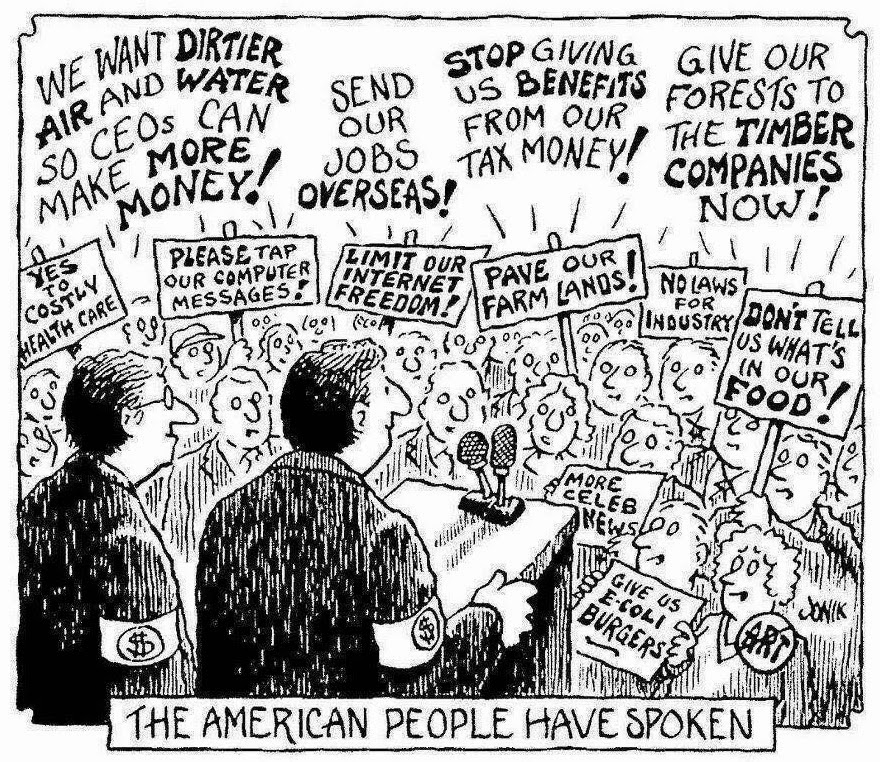
But the #dotcons came, they fenced in the wild garden, what we’re living through now is a digital version of the enclosure of the commons, a #neoliberal land grab dressed in Silicon Valley T-shirts. Just like in 16th-century England, they drew arbitrary lines around our #4opens shared land (data, conversation, culture), declared it private property, and shut the gates. And we, the people, got algorithmic slop in return.

The comparison isn’t metaphor – it’s literal – just as the landed gentry stole the commons to fuel the industrial revolution, the tech gentry stole our digital commons to feed surveillance capitalism. They did it through legalese, marketing BS, and brute force. We were left outside the firewalls, told to be thankful for “free” services while they harvested our metadata to sell back consumerism as advertisements and social control.

The #techbros didn’t invent this theft, they just updated the tools, the same ideological mess that displaced peasants from their land now displaces communities from their networks and platforms, killing independent sites, closing APIs, and locking away archives behind paywalls. Twitter’s 2023 shutdown of free API access? A textbook enclosure. Hundreds of # fashionista grassroots tools and bots vanished overnight, #Techshit at its most brazen.

And then there’s #RSS – the veins of the old web. Stabbed slowly, first by Facebook, then by Google. For the #fashionistas, the blade fell hardest in 2013 with the death of Google Reader, a quiet coup that pushed most of us into the fenced-off gardens of algorithmic consumption we live so much of our lives in today. The commons didn’t just vanish; it was actively destroyed, under the smog of monetization, “engagement,” and corporate “safety.”

It is useful for us to see this in a simple way, this isn’t #progress, it’s theft, the kind that wears the mask of legitimacy because lawyers and lobbyists made it look neat on paper. The reality is old, it’s a #classwar fought with code instead of clubs, and it’s won because we lost our memory of what common “land” even looked like.

But not everything is lost. The #Fediverse, the #OMN (Open Media Network) still plants seeds in the cracks. #Wikidata, #OpenStreetMap, the #ActivityPub protocol, these are digital hedgerows that survived the scorched earth. They are messy, collaborative, and unmonetized. That’s their strength, that’s what the #fashionistas to often don’t get – they can’t sell what they can’t own.

A story by Cory Doctorow – Masque of the Red Death

The #geekproblem here is fatal, in both the grassroots and the #dotcons, too many technologists are blind to the politics in their code. In the #mainstreaming, they build better tools for corporations that destroy the commons, over and over again. The solution? For the grassroots coders, compost the #techshit, seed something else, and reclaim what was always ours. Let’s help lift the lid on the #dotcons mess, our own unthinking #fashernistras, #NGO geeks call the internet, it is simply a thin veneer on top of what is actually ours, the #openweb

Let’s stop being polite about this as the #closedweb is a crime scene. The #dotcons platforms we rely on are bonfires of common culture, feeding the engines of the next wave of control. If we don’t remember how we got here, we can’t step out of this mess. It’s time to say it plain: The privatized web is a #deathcult, and only a #4opens reboot can bring life back.

An article: https://johl.io/blog/enclosures-and-the-open-web

What am I doing now?

People ask, so It’s good to remind my self about this, my journey of working to compost this mess goes back a long way, as you can see from the snapshots of history I’ve written about here: https://hamishcampbell.com/?s=history. It’s a light touch on nearly 30 years of work. It all started with the Sinclair Spectrum, where I was part of a development team working on games and applications. I was also one of the first wave of users of the #WWW when it arrived at the computer centre in Oxford. For the last two decades, I’ve been at the heart of grassroots #openweb activism, working on countless projects—some flourished, many did not.

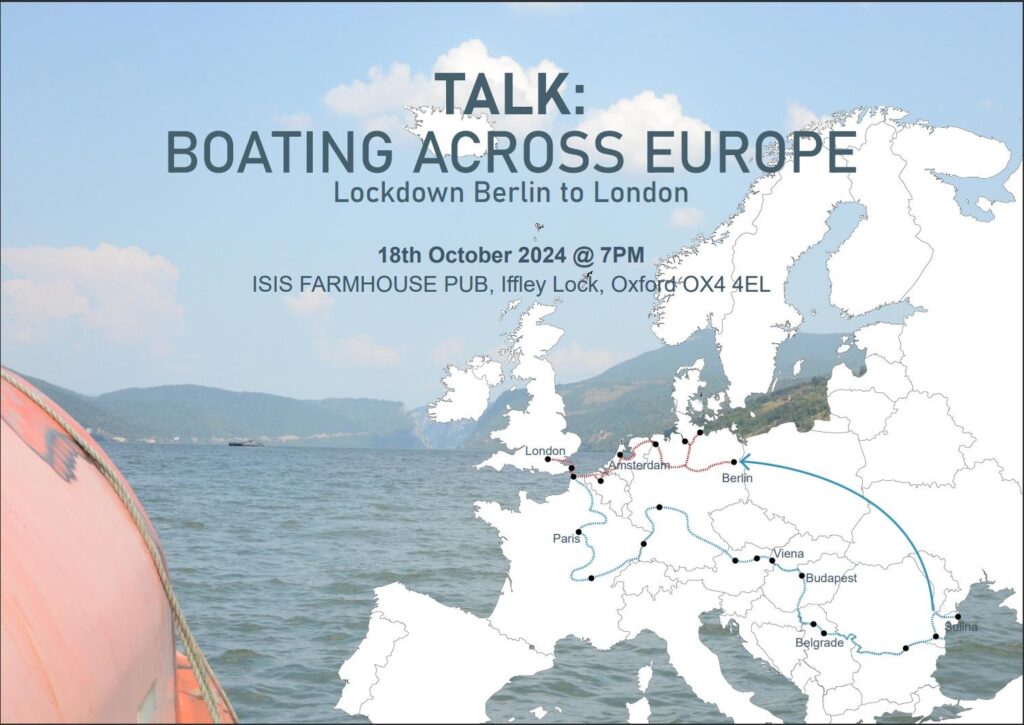
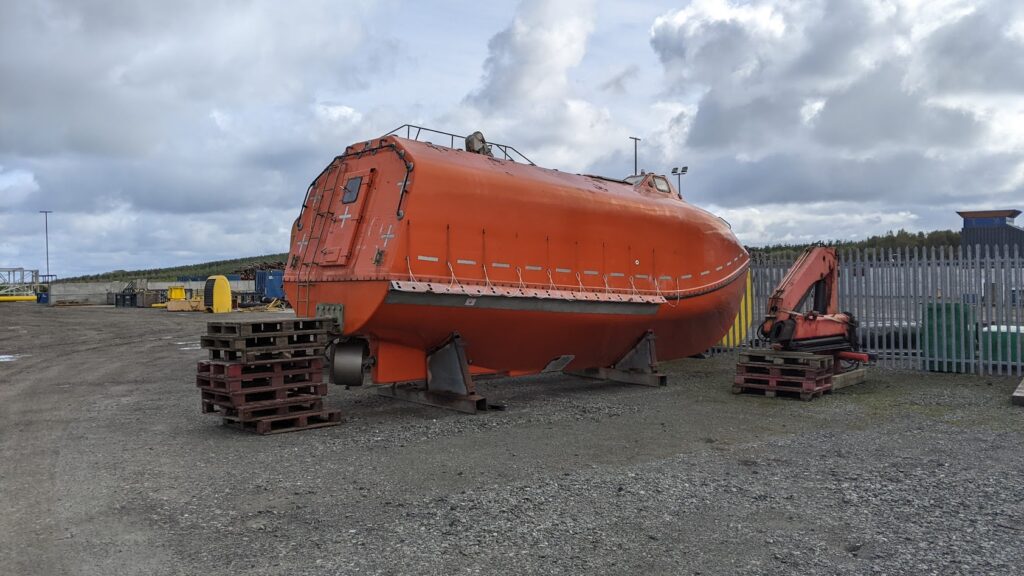
Ten years ago, I bought a lifeboat and sailed away, attempting to step back from the endless noise. But, as the world is round, I’ve come full circle and find myself back in the fray. And yes, it’s still a mess.

It’s important to keep asking questions, and one that comes up often is, “What are you doing now?” It’s easy to list the things I’ve done, but what’s happening right now? Currently, I’m in conversations with people about responsibility within the #openweb, though I’m not sure how much is really being heard. Still, it’s worth trying.

In practical terms, all the recent projects I’ve worked on are on standby for now. The most relevant one to this #SocialWebFoundation conversation is the #OGB (Open Governance Body), which you can learn more about here: https://unite.openworlds.info/Open-Media-Network/openwebgovernancebody. The quotes from this project remain telling, especially in light of today’s struggles: https://hamishcampbell.com/corporate-presence-in-the-fediverse/, deeply relevant as we discuss the corporate encroachments we face today.

On the personal side, I’m fitting out a bigger lifeboat. If we keep making this mess, we may all end up needing one to survive the tide of #climatechaos. As for tech, maybe I’m entering the grumpy old man stage, but I increasingly feel that the next generation should stop creating more #techshit. It’s time for shovels and composting—the messy, necessary work of turning the rot into fertile ground for something better.


On the subject: We talked about this here, What would a fediverse “governance” body look like? And then here Working and thinking on “native” #openweb aproches to governance and agen here where the conversation goes off the rails OGB Means Open Governance Body

A video on the ogb project that came out of us outreaching AP to the EU, the last time we did manage to herd the “cats” for a good outcome.

OGB video

This is a “native” path that we know will work to both empower “us” and disempower “them” it’s easy and simple and native.

The #SWF would have a voice, they simply become an affiliate stakeholder, like meany others.

I don’t have the focus to push this any more, so it will need a crew.

The conversation continues here

Mess making is a breakdown in communication – ideas please

Interesting #mainstreaming look, that bypasses the grassroots it’s actually talking about, this is a common issue with academic writing, am at Oxford this winter so have every day “organic” expirence of this.

For governance, we have a widely discussed project on this forum that is “native” to address all the issues outline in the article Open-Media-Network/openwebgovernancebody: ON STANDBY due to waiting for funding – (OGB) This is a space for working through Governance of horizontal projects – using #KISS online tools. – openwebgovernancebody – Open Media Network 4

Then for fighting the capture we have an “organic” path the #4opens if used is a strong defence Home – 4opens – Open Media Network

So to sum up, what we need is for “us” the collective to get up from our knees and become the change we would like to see. This is actually not a hard thing to do “Never doubt that a small group of thoughtful, committed, citizens can change the world. Indeed, it is the only thing that ever has.”

——————————————————————-

Continuing the discussion from Can This Platform Survive? Governance Challenges for the Fediverse 2:

Dear @hamishcampbell,

although we already had this discussion several times, you keep posting external links to your website every time you have an opportunity to do so, which is quite a lot, since you are very attentive to responding to any new topic with such links.

What it achieves is that your posts rarely bring anything to the conversation and rather look out of place, and barely get any response. Do you realize that all these links have rel="nofollow" attached to them, which means no search engine will index them in relation to this site?

I’m reacting to this specific message because you, being in Oxford, could have made a much better contribution by summarizing the findings of this paper rather than waving your opinion as a pretext to add two more links to your site.

Should I resort to simply unlinking all such references to it so you have an incentive to bring more useful comments? You have been warned repeatedly that your posting style feels spammy, and I would not like to have to kick you out, because when you want you can make interesting contributions. But most of the time, I feel that it’s a waste of time.

What do others think?

  • Use the mute feature on this user
  • Flag posts as spam
  • Unlink openworlds.info
  • Leave Hamish alone

——————————————————-

#ragecircle the assumption this is spamming is troubling, and we likely need to look at this assumption? What would be the mod process to start this?

Linking is how ideas are addressed on the openweb

UPDATE: to be clear, this is a mod question here, please can the mods address it, thanks.

————————————————————————

This conversation is getting beyond silly, here is what Is Link Spam: Definition and Types of Link Spamming – Kontely link spamming is.

It SHOULD be obvious the post is not doing any of these things.

I would like the current mods, on this open and community driven forum, to stop this please.

And I ask, repeat (and the risk of this being seen as SPAM) for the 3ed time, can we get some process put in place to mediate mod behaver, thanks.

I think this space is increasingly lacking Legitimacy (political) – Wikipedia it was the subject of the post in question. This is a difference of social/tech path of me and the two mods, not some something to be pushed out of view, thanks.

Please stop this.


https://socialhub.activitypub.rocks/t/can-this-platform-survive-governance-challenges-for-the-fediverse/3727/6?u=hamishcampbell

This mess making from our mods is bringing the lack of https://en.wikipedia.org/wiki/Legitimacy_(political) in this “community site” into view. This is the subject of the original post

I call the subject post #mainstreaming to describe that it’s a reflective post of the chatting classes, not to say this has no value, just it’s not “native” to the grassroots internet some of us want to build.

Then link this to my personal experience, I have 20 years of dealing with this of mess making in #openweb tech/funding so have a lot to say on this PS. this link is not SPAMMING take note, it’s a weblink so you can fallow it to find out more about what I am talking about, if you are interested in clicking on the link.

Next link to the about page of a project that directly addresses the issue the original post is about, with context. I post a link rather than simply copy and past the intro, as this is how the #WWW is supposed to work.

Then I describe how we can fight affectively to push the grassroots “native” internet some of us would like to see, and link to a tool that can be used to affect the needed change. Native to the WWW people can click on the link if interested.

Finally, there is a bit of a spike in the tail, that yes is indirectly pointing at our mods and an inclination on this forum. Take NOTE this is done in a polite way without naming names, so no issue with the CVP etc.

Ok, I understand you don’t like this aproch, this has been made clear the last few years, what exactly is wrong with these posts mods #KISS

The #hashtags embody a story and world-view

My use of #hashtags is confusing a lot of people, good to have some signal in the noise on this subject https://en.wikipedia.org/wiki/Hypertext I am using them in the way the #WWW was designed to use them #KISS

The #hashtags embody a story and world-view that are rooted in a progressive and critical perspective on technology and society. They highlight the negative impact of neoliberalism (#deathcult) and consumer capitalism (#fashionista) on society, and promote the original ideals of the World Wide Web and internet culture (#openweb). The #closedweb hashtag critiques the for-profit internet and its social consequences, while the #4opens promote the principles of transparency, collaboration, and sharing in open-source development.

The #geekproblem hashtag draws attention to the cultural movement of geeks, who can become blinded by their own technical knowledge and fail to consider the broader social implications of their work (#techshit). The #encryptionists hashtag critiques the dominant belief among some geeks that all solutions need more encryption, which can lead to a desire for total control and artificial scarcity.

Overall, these hashtags are interlocking to tell a wide-ranging story and world-view that advocates for a more humane, collaborative, and transparent path in technology and society. The #nothingnew hashtag raises whether new technological projects are needed, or whether we should focus on improving existing ones. The #techchurn hashtag refers to the technological outcome of the #geekproblem, which can lead to a constant cycle of new projects that do not address underlying social issues. Finally, the #OMN and #indymediaback hashtags promote the idea of an open media network and the rebooting of the altmedia project that was once the size of traditional media on the #openweb. The #OGB hashtag represents the need for open governance and the power of the community to make decisions collectively.

It’s simple #KISS, so please try not to react like a prat about this, thanks.

A fresh look at #openweb history

For people who like buzzwords

The World Wide Web is a system of interlinked hypertext documents that is accessed through the Internet. #Web01, #Web02, and #Web03 are terms that are used to refer to different generations or phases of the World Wide Web (#WWW).

#Web01 refers to the early days of the World Wide Web, when it was first introduced in the late 1980s and early 1990s. During this time, the web was primarily used for academic scientific, #NGO’s hobbyists and activists purposes and less yet widely adopted by the public.

#Web02 refers to the growth and expansion of the World Wide Web during the late 1990s and early 2000s, as the web became more accessible and user-friendly, and was increasingly adopted for commercial purposes. This era saw the rise of #dotcons, characterized by the growth of social media, mobile devices, and cloud computing. The web had become increasingly interactive and interconnected, and has become a critical tool for communication, misinformation, social control and commerce.

#Web03 was a waste of space, focus and money by the #Encryptionists who in bed with the scammers produced meany still born tech children in the last 10 years.

#Web01.5 refer to an intermediate stage between Web01 and Web02, marking a transition between the early and more experimental phase of the web and its more widespread commercial adoption. Web01.5 refers to a time when the web was still growing and evolving, but had already become more accessible and user-friendly, and was being adopted for more diverse purposes. With #mastodon and the #fedivers over the last 5 years, we are rebooting this web01.5 stage.

outreaching ActivityPub to the EU – draft

This was an interesting process playing a role to do the document – outreaching ActivityPub to the EU https://pad.public.cat/p/ngi0-ec-activitypub-liaison-presentation-2021-04-19#/13

Good to get an outcome from this:

  1. #activertypub as a cross-platform standard for #dotcons who operate in EU
  2. funding to further this – we would need democratic structures in the #fedivers style to make this real rather than a Eurocratic/power politics dead-end structures.
  3. Is the path with a good outcome – I have been involved in a number of groups/projects that have received Eurocratic money and the outcome has always been sub optional not to say a compleat disaster. I have seen no/little thinking to mediate this outcome.

So on balance good to do this BUT we do need not to go down unrealistic paths.

Am trying to shift the focus so that the story is more “interesting” and “representative” ActivityPub in the EU sense is a movement as much as a standard – standards by themselves have little/no value. If the story comes from the standard it is easy to ignore, and it will be ignored. A movement, with a bit of jingoism (the ActivityPub speck is maybe largely a European thing?) is an easer story to tell/hear.

Good points, the #fedivers while having a good community, as individuals we do tend to act like cats.

Prepping the presentation is going to be a “herding cats” so best to concentrate on #KISS and focus on the ordnance – what do they need to hear.

The second day we can reveal the all to human delight (and worry this brings)


Like the focus on European as this is true – the #Fediverse mirrors the federated European dream and clearly moves away the US tech imperialism (soft power) of the #dotcons something that is a #EU agender.

My thoughts/feelings are pragmatic on a good outcome.

We have a clash of languages and assumptions for example “surveillance capitalism” and the “social dilemma” both come from inside business and Silicon Valley thinking – so they are not good examples to use for an ActivtityPub presentation which itself is COUNTER Silicon Valley thinking and has its own way of expressing these issues. Just use natural descriptive language instead of quoting the terms.

I don’t have an issue with web01 and web02 yes they are not correct, but they do communicate.


The first question is why – It’s a good fit both strategically, in challenging the big US tech corporations dominance and tactically, in it being simple to implement and open to innovation as it is outside of anyone group control and agendas.

But we are unready as a community if a big institution like the EU takes up ActivityPub you can see this in what happened to RSS when it was taken up by the NYT.

#activertypub like #RSS and the #www came out of grassroots movements, they bring world views with them its WHY THEY WORK. Yes the world view are in part incompatible with #mainstreaming, so the is a strong burocratic desire to hide these world views and then push them out of view/existence.

Why work with big vertical organizations like the EU – The bridges, allow our careerists and wona get statues crew a way to cross over to the mainstream to feed. By doing this they strengthen the bridge by adding mainstream value to the bridges.

Then the refuges from the mainstream shitpile have an easy path to get to alternatives gardens when the stink becomes too much to live with.

The bridge shifts out “problems” and “brings” in resources, expirence and skills to build real alternatives.

We need bridges to the mainstream to build alternatives.

Though the process will likely not go well. When dealing with power politics/vertical orgs in the end the grassroots is ALWAYS shafted – it’s the normal outcome they can’t help this behaver. So we need to keep the bridges in place no matter how bad there behaver is, keep calm and carry on – their behaver is shit to shovel for compost to plant seeds to grow a better world.

Am thinking we need more structears “from chaos comes order” rather than “order over chaos” its trust or control.

In the internal process. It’s interesting that people coming into non #mainstreaming projects and spaces then push “common sense” #mainstreaming ways of working and outcomes can’t see that they are creating a problem.

You then inevitably get Clouds of smoke to cover up the mess. When it clears everyone is covered in soot. it’s not a good look for anyone.

We need ideas on how to mediate this without going down the #mainstreaming paths.

https://socialhub.activitypub.rocks/t/webinar-with-the-european-commission-and-ap-community/1507/179

https://socialhub.activitypub.rocks/t/meeting-notes-for-prep-call-ec-webinar-19-april/1567

https://socialhub.activitypub.rocks/t/outreaching-activitypub-to-the-eu-are-we-ready/1589/11


I am visiting my parents who are of the newspaper reading age

Published Date 2/4/12 5:03 PM

I am visiting my parents who are of the newspaper reading age, it’s an interesting revelation/reminder to me of something I have known for a long time. That the people in newspapers are trailing edge, their thoughts and opinions are a week old, their news stale even before it is printed on paper.

#WWW, #IP based news is gatekeeper frictionless, instant as it happens and its up to you to build your own network of connections. If you haven’t done this then you are back in the world of gatekeeper flow and even lower “quality” news world. The IP world is not a panacea for lack of action on your part, it’s just an opening of possibility that you can build a news flows that is not gatekeepered and/or a week old.