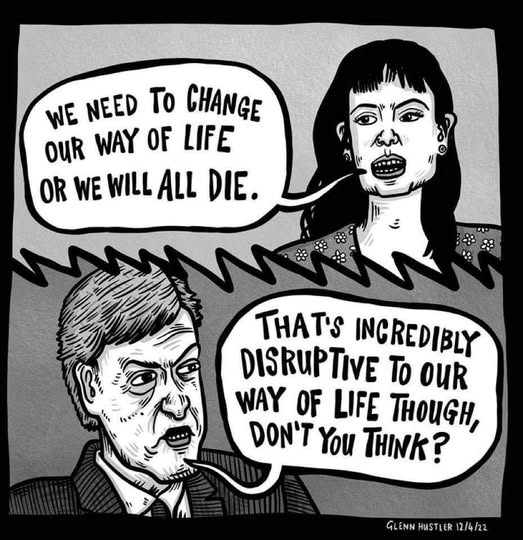
This summer, heat, fires, the soon to come winter floods and insurance withdrawals will make #climatechaos harder to treat as something happening somewhere else. For years, climate breakdown was framed as an activist issue, something discussed by environmental groups while mainstream politics carried on with business as usual. That is changing, people are experiencing the consequences: extreme heat, flooding, damaged homes, rising insurance costs, failing infrastructure and growing uncertainty about what the next few years will look like. The #climatecrisis is moving into everyday life, so how do we live through what is already locked in?
Once the consequences of a warmer world are being experienced everywhere, adaptation becomes an unavoidable path. That means practical changes will finally start to happen such as resilient building standards, flood planning, water management, food systems, energy resilience, heat protection and changes to where and how we build.
But there is a danger in treating adaptation as purely a technical problem, we might redesign buildings, strengthen flood defences, change planning regulations. We can develop better warning systems – but who controls these systems? Who decides what gets protected? Who gets information when something goes wrong? Who maintains the infrastructure? Who remembers what happened last time? And who gets left behind? These are social and political questions.
The missing infrastructure is where the #OMN native path becomes important. Surviving #climatechaos isn’t only about physical infrastructure, it is also about information infrastructure and community infrastructure. During crisis, people need reliable information to know what is happening locally, they need to know who needs help, to know which transport links are closed, where resources are available, what services are operating and what communities are doing. They need ways to communicate when normal paths fail.
And afterwards, they need a record of what happened, this is why the #openweb matters, a resilient society cannot depend entirely on #closedweb privately owned platforms whose responsibility is to the current #nastyfew shareholders and advertisers. It is basic that the #dotcons are not resilience infrastructure – Facebook, Google, X, TikTok and the other #dotcons distribute information, and misinformation very quickly, but speed isn’t the same thing as resilience.
These current #closedweb digital systems are designed around control, engagement, advertising, data extraction and platform addiction. They are dangerous to use when important information will disappear into algorithmic feeds. It should be becoming obverse that communities cannot keep being dependent on proprietary services, as accounts can be suspended, interfaces can change, companies can change their business models, services will disappear.
And the information itself is often difficult to preserve, connect or reuse outside these #closedweb platforms. That is a terrible foundation for a society increasingly dealing with environmental disruption. This is why the #OMN focuses on the #deathcult story, in part to highlight it isn’t simply a collection of bad corporations. The current mess is about the way of organising society around short-term extraction, profit before resilience, growth before sustainability, competition before cooperation. Private ownership comes before the commons, and immediate financial returns are prioritised over the ability of communities to survive any long-term disruption.
In this mess, climate adaptation within this risks becoming another market, those who can afford resilience buy it, those who can’t are left exposed. Insurance withdraws from risky areas, property values become tied to climate risk. Private companies decide which infrastructure is commercially viable, the result is adaptation as another form of inequality.
To compost this mess we need #KISS social adaptation too – The alternative isn’t to reject technology – It is to change what technology is for. The #4opens provide a useful starting point: Open Data – Open Source – Open Standards – Open Process. These principles make it easier for communities to share information, build on each other’s work and maintain infrastructure without being locked into one corporation. The #openweb gives us the technical culture for this, #Federation allows different communities to remain independent while still communicating. Open standards allow systems to interoperate. Open data allows information to remain useful beyond one platform. And open process allows communities to understand and participate in decisions affecting them.
There is another important piece: memory, when a flood happens, people document it. When a heatwave hits, people record what happened, when infrastructure fails, somebody usually knows why. But much of this grassroots knowledge disappears into #dotcons social-media feeds. A few years later, we start again from scratch. This is why #openweb projects such as #MakingHistory matter. We need living community archives that connect events, places, people, media and responses over time. The archive becomes part of resilience, knowing what happened last time helps communities prepare for the next time.
Moving beyond the current #NGO pointlessness – we need to grow projects like the OMN as shovels, to clear the #techshit mess to grow grassroots infrastructure for publishing, sharing, moderating and preserving information. But yes, the technology is only part of it, the deeper goal is to help communities build trusted information networks that are not dependent on the current #dotcons. A resilient media system should allow people to – publish locally – discover relevant information –
share between communities – moderate collectively – preserve important records – correct mistakes – maintain metadata – and keep historical context. This becomes especially important when normal systems are under pressure as the #mainstreaming is only seeing half the problem. But yes, the mainstream conversation is beginning to understand climate adaptation matters, but adaptation cannot be reduced to flood barriers, new building codes or air-conditioning.
We also need to ask whether the social systems surrounding those technologies are resilient. Can communities cooperate? Can people trust the information they receive? Can knowledge move between organisations? Can local experience become shared knowledge? Can communities govern their own infrastructure? Can we preserve memory? These questions are still largely outside the mainstream climate conversation. They shouldn’t be, the next wave of #climatechaos will test not only our physical infrastructure but our social infrastructure. The challenge is therefore twofold – build the physical systems that help us survive the changing climate – build the open, collective information systems that help communities understand and organise that survival.
The first is increasingly #mainstreaming, the second is where the #openweb, #4opens, #OMN, #OGB and #MakingHistory have something important to contribute. We do need #KISS more resilient communities, and resilient communities need infrastructure they can actually trust and control.
#OMN #openweb #4opens #MakingHistory #OGB #IndymediaBack #climatechaos #deathcult #dotcons #resilience
