This summer #climatechaos

This summer, heat, fires, the soon to come winter floods and insurance withdrawals will make #climatechaos harder to treat as something happening somewhere else. For years, climate breakdown was framed as an activist issue, something discussed by environmental groups while mainstream politics carried on with business as usual. That is changing, people are experiencing the consequences: extreme heat, flooding, damaged homes, rising insurance costs, failing infrastructure and growing uncertainty about what the next few years will look like. The #climatecrisis is moving into everyday life, so how do we live through what is already locked in?

Once the consequences of a warmer world are being experienced everywhere, adaptation becomes an unavoidable path. That means practical changes will finally start to happen such as resilient building standards, flood planning, water management, food systems, energy resilience, heat protection and changes to where and how we build.

But there is a danger in treating adaptation as purely a technical problem, we might redesign buildings, strengthen flood defences, change planning regulations. We can develop better warning systems – but who controls these systems? Who decides what gets protected? Who gets information when something goes wrong? Who maintains the infrastructure? Who remembers what happened last time? And who gets left behind? These are social and political questions.

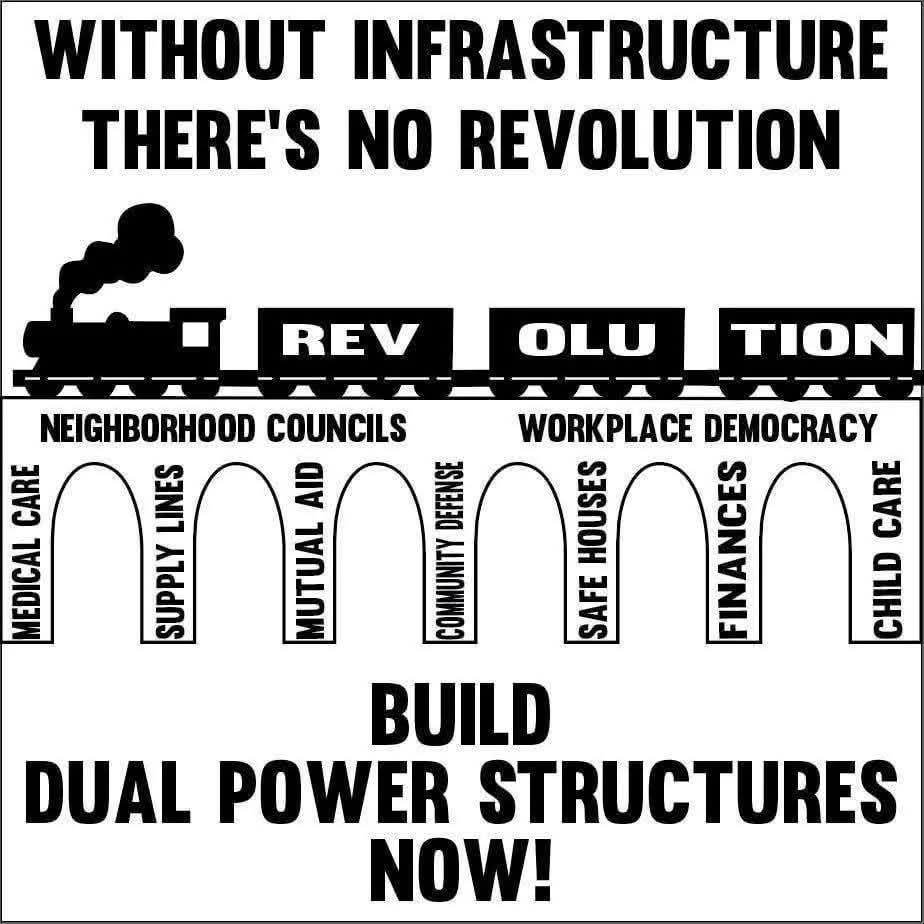
The missing infrastructure is where the #OMN native path becomes important. Surviving #climatechaos isn’t only about physical infrastructure, it is also about information infrastructure and community infrastructure. During crisis, people need reliable information to know what is happening locally, they need to know who needs help, to know which transport links are closed, where resources are available, what services are operating and what communities are doing. They need ways to communicate when normal paths fail.

And afterwards, they need a record of what happened, this is why the #openweb matters, a resilient society cannot depend entirely on #closedweb privately owned platforms whose responsibility is to the current #nastyfew shareholders and advertisers. It is basic that the #dotcons are not resilience infrastructure – Facebook, Google, X, TikTok and the other #dotcons distribute information, and misinformation very quickly, but speed isn’t the same thing as resilience.

These current #closedweb digital systems are designed around control, engagement, advertising, data extraction and platform addiction. They are dangerous to use when important information will disappear into algorithmic feeds. It should be becoming obverse that communities cannot keep being dependent on proprietary services, as accounts can be suspended, interfaces can change, companies can change their business models, services will disappear.

And the information itself is often difficult to preserve, connect or reuse outside these #closedweb platforms. That is a terrible foundation for a society increasingly dealing with environmental disruption. This is why the #OMN focuses on the #deathcult story, in part to highlight it isn’t simply a collection of bad corporations. The current mess is about the way of organising society around short-term extraction, profit before resilience, growth before sustainability, competition before cooperation. Private ownership comes before the commons, and immediate financial returns are prioritised over the ability of communities to survive any long-term disruption.

In this mess, climate adaptation within this risks becoming another market, those who can afford resilience buy it, those who can’t are left exposed. Insurance withdraws from risky areas, property values become tied to climate risk. Private companies decide which infrastructure is commercially viable, the result is adaptation as another form of inequality.

To compost this mess we need #KISS social adaptation too – The alternative isn’t to reject technology – It is to change what technology is for. The provide a useful starting point: Open Data – Open Source – Open Standards – Open Process. These principles make it easier for communities to share information, build on each other’s work and maintain infrastructure without being locked into one corporation. The #openweb gives us the technical culture for this, #Federation allows different communities to remain independent while still communicating. Open standards allow systems to interoperate. Open data allows information to remain useful beyond one platform. And open process allows communities to understand and participate in decisions affecting them.

There is another important piece: memory, when a flood happens, people document it. When a heatwave hits, people record what happened, when infrastructure fails, somebody usually knows why. But much of this grassroots knowledge disappears into #dotcons social-media feeds. A few years later, we start again from scratch. This is why #openweb projects such as #MakingHistory matter. We need living community archives that connect events, places, people, media and responses over time. The archive becomes part of resilience, knowing what happened last time helps communities prepare for the next time.

Moving beyond the current #NGO pointlessness – we need to grow projects like the OMN as shovels, to clear the #techshit mess to grow grassroots infrastructure for publishing, sharing, moderating and preserving information. But yes, the technology is only part of it, the deeper goal is to help communities build trusted information networks that are not dependent on the current #dotcons. A resilient media system should allow people to – publish locally – discover relevant information –
share between communities – moderate collectively – preserve important records – correct mistakes – maintain metadata – and keep historical context. This becomes especially important when normal systems are under pressure as the #mainstreaming is only seeing half the problem. But yes, the mainstream conversation is beginning to understand climate adaptation matters, but adaptation cannot be reduced to flood barriers, new building codes or air-conditioning.

We also need to ask whether the social systems surrounding those technologies are resilient. Can communities cooperate? Can people trust the information they receive? Can knowledge move between organisations? Can local experience become shared knowledge? Can communities govern their own infrastructure? Can we preserve memory? These questions are still largely outside the mainstream climate conversation. They shouldn’t be, the next wave of #climatechaos will test not only our physical infrastructure but our social infrastructure. The challenge is therefore twofold – build the physical systems that help us survive the changing climate – build the open, collective information systems that help communities understand and organise that survival.

The first is increasingly #mainstreaming, the second is where the #openweb, , #OMN, #OGB and #MakingHistory have something important to contribute. We do need #KISS more resilient communities, and resilient communities need infrastructure they can actually trust and control.

#OMN #openweb #MakingHistory #OGB #IndymediaBack #climatechaos #deathcult #dotcons #resilience

The dogma of one path: why alternatives, diversity and linking matter more

This toot sparked off some thinking – A blinded assumption of modern Western liberalism has been that there is an automatic connection between free enterprise, liberal democracy and economic and technological progress. The story was simple that open markets create wealth, wealth creates a middle class, the middle class creates democracy, technology and progress naturally follow the same path. This became more than an economic theory, it became a “common sense” worldview – a belief that every successful society would eventually converge on the same path (this nasty mess is 50 years of #deathcult worshipping).

The assumption was that countries like China would either fail to catch up, or that if they did catch up economically, they would inevitably become more like the West politically. That assumption has now been challenged in the #mainstreaming thinking, not only by China’s rise, but also by the internal crisis of Western systems themselves. The rise of oligarchic politics, authoritarian movements, and the return of far-right nationalism inside liberal democracies has exposed something uncomfortable:

What we learned in the past and what we are learning today is that capitalism does not automatically produce democracy and that economic power can concentrate into forms that undermine democracy. The history of the early 20th century already showed this pattern, that in periods of crisis, concentrated wealth and political instability produce authoritarian outcomes rather than democratic renewal. It should by now be easy to see that the #mainstreaming mythology was always more fragile than it appeared.

The blindness of a single story – The problem was not only that the West misunderstood China. The deeper problem was the inability to imagine different paths. The dominant “common sense” story said “There is one successful model, everyone else is either behind or secretly becoming like us.”

This made it difficult to see what was actually happening. China’s development strategy did not emerge from copying one simple Western formula. It drew from multiple sources, one influence was the experience of the Soviet Union’s industrialisation. The Soviet five-year plans brutally transformed an agricultural society into an industrial power. The human costs were enormous, but the speed of industrial growth challenged Western assumptions during the 20th century.

The shock of events like the launch of Sputnik was not only technological, it was the fear that a different economic and organisational path was capable of producing rapid scientific and industrial progress. A second influence came from observing East Asian development, countries often presented as examples of “free market success” were much more complicated. South Korea’s industrial rise had strong state direction, industrial planning, protected markets, and coordinated investment. Singapore – often misunderstood in Western political debates – developed through a path of authoritarian public ownership, state planning, and strategic intervention.

The lesson is not that one system is automatically superior, the lesson is that reality is always messier than blinded invisible ideology. Successful societies have always borrowed, adapted, experimented, and mixed approaches.

The danger is the belief that there must be one correct path. This is the same cultural problem we see across technology, politics, and social organising. A single dominant path becomes so normal that alternatives appear impossible. But societies are not machines, they are ecosystems, they grow through relationships, institutions, culture, trust, experimentation, and shared knowledge. Diversity is not weakness, the value of alternatives is not simply that one alternative will “win”. The value is that diversity creates resilience.

A forest with one species is fragile, a network with one path is fragile, a society with one accepted model is fragile. Different communities, different approaches, and different experiments create the possibility of learning. This is one of the core lessons of the #openweb. The power does not come from control, the power comes from linking different nodes together.

federation works because diversity is a feature, different servers, different communities, different cultures – connected through shared protocols. The alternative is the #closedweb model: one platform, one algorithm, one owner, one business logic – that is efficient for control, but fragile for society.

The future needs linking, not convergence. The mistake of much modern politics is searching for the final answer. The better question is, how do we create systems where many answers can coexist, communicate, and improve each other?

This is the #OMN approach, of not replacing one dominant ideology with another, to create another closed system, But building networks where alternatives can exist, connect, and evolve.

To come back to china, the lesson from history is not “capitalism failed” or “state planning succeeded”. The lesson is that no single path owns progress. Human creativity comes from diversity, the future will not be built by everyone becoming the same. It will be built by creating the conditions where different paths can connect, learn, and grow.

OMN #openweb #alternatives #federation #diversity #nothingnew

What can we learn, what can we do?

People need to understand that the tension between different approaches to activism highlights the need for creative synthesis in our current broad social and ecological crises.

  1. Fluffy vs. #Spiky is about a Diversity of Tactics. The idea that both working within the system (#fluffy) and challenging it directly (#spiky) are necessary to creating a robust and adaptive movement. On this native path, building “common ground” is crucial, but the left’s fragmentation under decades of #neoliberalism and #postmodernism has left it standing waist deep in a metaphorical swamp. Moving anywhere requires reclaiming a grounded, shared space – intellectually, socially, and ecologically.
  2. Revisiting #Modernism, to return to modernist thinking – despite its flaws -can offer clarity and purpose, emphasizing structure, progress, and shared goals. Balancing this with the experimental potential of socialism and anarchism, especially on a distributed scale (enabled by #federation and #P2P technologies), creates room for growth outside the mainstream.
  3. Liberal Social Democracy, yes, is a step back because while the goal may lie in more radical transformations. Maybe a return to liberal social democracy could serve as a stepping stone away from the creeping threat of fascism. This pragmatic approach might help to stabilize the ground for further progress.
  4. Deathcult vs. #Lifecult is a Cultural Meta-Narrative. The #deathcult metaphor encapsulates a culture driven by greed, materialism, and ecological destruction. The #lifecult offers a messy but hopeful alternative, grounded in values like ecology, social justice, and collective care. The process of “composting” – transforming negative aspects into fertile ground – is a powerful metaphor for this shift.
  5. The Role of Undercurrents True hope lies in the grassroots undercurrents of social movements that always challenge #mainstreaming culture to provide alternative narratives. These undercurrents, messy as they may be, are where transformative potential resides. A focus on “life-affirming values” helps to communicate with those who may be entrenched in rationality or blinded by the logic of the #deathcult.

Suggestions, focus on finding shared values between different activist approaches to grow solidarity while respecting diversity of tactics. Encourage scalable experimentation with alternative economic and social models, with federation and P2P tech. Storytelling using metaphors like #deathcult and #lifecult to reframe conversations and make complex issues relatable and actionable. Education and agitation to challenge apathy and #stupidindividualism by helping people reconnect with collective action and shared purpose. Thinking in an ecology of movements, can be helpful. . On this, recognize the importance of both reformist (#fluffy) and radical (#spiky) approaches as complementary rather than contradictory.

And most importantly, please try not to be a #blocking prat, thanks.