One of the biggest problems we face isn’t technology, politics or even money. It’s #stupidindividualism. By this I don’t mean individual freedom, freedom matters. I mean the habit of seeing every issue only through “my” immediate circumstances, with no memory of how we got here and no thought for the wider community. A small example from Oxford boaters illustrates this perfectly.
The generator argument – A discussion recently started about extending generator hours beyond the long-standing 8am–8pm convention. To new boaters this probably looks harmless “Why not be a bit more flexible?” “Surely we can make our own rules?” “My situation is different.” All perfectly reasonable, if you don’t know the history. But memory matters – ten to fifteen years ago, before cheap solar panels transformed life afloat, generator noise was one of the biggest causes of conflict on the waterways. Not occasional disagreement, years of arguments, neighbour against neighbour, boater against boater, and worst of all for our communities boaters against people living ashore.
There were shouting matches, threats, even physical fights. Eventually a rough consensus emerged across waterways: 8am–8pm, it wasn’t perfect, it wasn’t law, it wasn’t even enforceable. It was simply a social compromise that people understood. Then solar arrived, people needed to run engines far less, the conflict quieten down as technology reduced the pressure while the social convention remained.
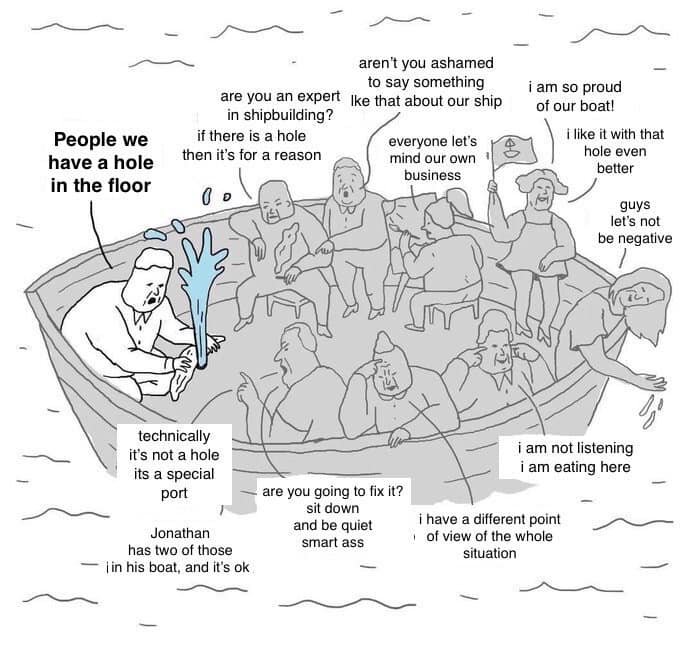
So why now reopen old wounds? Today people who never lived through those years, only see today’s circumstances. “My train gets in after eight.” “My batteries are low.” “There’s no housing nearby.” “My case is different.” Individually, every point makes sense. Collectively, they recreate the conditions that produced years of conflict. This is what #stupidindividualism looks like, every individual argument is reasonable, the collective outcome is a disaster.
This is about social infrastructure, the 8–8 convention isn’t really about generators, it’s about preserving social peace. It is community infrastructure, like, slowing down when passing moored boats, like helping someone through a lock, like not running a noisy stinky engine outside someone’s bedroom late at night. These customs aren’t primarily technical rules, they’re social technology to reduce friction before it starts.
Hard rules aren’t the answer, ironically, if we destroy informal agreements, people respond by demanding formal enforcement. This is exactly what happened in parts of London – Places that once relied on neighbourly agreement eventually became rule-heavy, regulated pay moorings because communities could no longer manage themselves. Conflict produced more bureaucracy, more bureaucracy produced less freedom, the cycle repeats.
This is why we need to keep talking – to composting conflict – the challenge isn’t to pretend disagreements don’t exist, more it is to stop turning small disagreement into a community-wide battles. Most issues can be solved by talking to your neighbours, emergencies happen, people can be understanding, courtesy works better than enforcement, but courtesy works when people understand the history that produced it, without that memory, every generation all to easily starts the same fights again.
The problem isn’t really about generators, it’s about forgetting that communities inherit solutions as well as problems. When we ignore the reasons those solutions exist, we spend years recreating conflicts that were already settled. That’s the cost of #stupidindividualism, we mistake inherited social infrastructure for arbitrary restriction so we tear it down. And eventually we discover – again – that rebuilding trust is far harder than preserving it.

This is a pattern well beyond #Oxfordboaters, it’s visible across the #openweb, activist organising, and politics generally. We inherit social norms that emerged through hard experience, then we dismiss them as unnecessary because we don’t know their history, to then end up recreating the conflicts those norms evolved to prevent. That’s why preserving collective memory is just as important as preserving freedom. Without memory, every generation repeats the same mistakes. With it, we can spend our energy building something better instead of refighting old battles.
In #OMN terms for the hashtag story this is #blocking. So the #CoCo (very bad name) is about “good conduct” rather than regulation. Let’s look at existing regulation to start from:
CRT: Terms and Conditions (which have legal force because of s.43 of the Transport Act 1962) 10.9.2 “… [you must] not use any electricity generator … between 8pm and 8am, unless you are moored in isolation, out of earshot of other people…”
EA Byelaws: General Construct 63(m) “use any … or any other electrical equipment … resulting in the … transmission of any noise … in such manner to give reasonable cause for annoyance to any person in upon or about the river or the banks or the towpaths thereof or adjacent land of the Authority.”
Memory matters – is why I oppose extending the generator stink, smoke and noise hours to 10pm. Not because there will never be exceptions. Life afloat is full of exceptions, and genuine emergencies should always be treated as such. But making the exception into the new normal needlessly reopens old wounds. We already know where that path leads because we’ve walked it before. Years of conflict finally settled into a workable compromise. Forgetting that history means we’ll end up repeating it.
Memory matters, boating isn’t simply about living on a boat. It’s about adapting your behaviour to live well alongside other boaters. Shared customs are part of that adaptation. They’re how communities survive without drowning in rules and enforcement. Yes, there are people whose work patterns make 8pm inconvenient, that inconvenience is real. But solving every individual problem by burning more diesel isn’t a direction that makes sense, socially or environmentally. The world is moving away from fossil fuels, not towards them. And we have bigger battles ahead, we will have to defend our right to use solid-fuel stoves over the coming years. If we normalise running noisy, smelly generators later into the evening, we weaken our position before those fights begin.
The point of the Code of Conduct (bad name, but I can compromise) isn’t simply to satisfy landowners or avoid complaints. It’s to make us better neighbours and a stronger community. That’s how we slow the pressure towards more regulation, more enforcement, and eventually fewer places where people can live afloat.
Sometimes it feels almost as though there is a conspiracy to stop us coming together around simple, common-sense solutions. I don’t actually think that’s what’s happening, I think it’s something more ordinary, and more dangerous. It’s a collective fuck-up, people naturally focus on their own immediate needs and lose sight of the bigger picture. That’s #stupidindividualism again.
The simple question is whether extending generator hours is the least damaging way of meeting those needs. Could we think more creatively? Portable battery packs. Shared charging. Better solar. Community support for people with difficult work patterns.
The first question shouldn’t be, “How do we burn diesel for another two hours?” It should be, “How do we solve this with the least noise, fumes, conflict and fossil fuel?” That’s the direction the world is moving, whether we like it or not. The hardest thing in any community is lifting our eyes from today’s inconvenience to tomorrow’s consequences.
Some have suggested making the Code of Conduct deliberately vague “Boaters agree to keep noise to a minimum and respect their neighbours.” That sounds attractive, until you remember why communities write things down in the first place. Vague agreements don’t resolve recurring conflicts; they postpone them. Every new disagreement starts from zero, every new arrival has to renegotiate the same issue, every argument becomes personal because there’s no shared understanding to fall back on. A simple, well-understood convention can hold a community together for years. A vague aspiration might last a season before the same arguments begin again. This isn’t about winning an argument, it’s about composting conflict instead of continually producing it.
We need to focus on the wider picture, not because everyone has to agree, but because if we keep reopening settled questions without finding better solutions, we’ll spend the next decade refighting the last one. That’s not community, that’s just making more mess, and we already have enough of that. #KISS
