It’s important to be honest about the messy world we’re working in. Just about every so-called “alternative tech” or #opensocialweb event, especially the ones run under #NGO banners, ends up riddled with institutional parasites. They talk endlessly about ethics, governance, decentralisation, and community, but their real role is to capture energy rather than release it. The value produced in these spaces is minimal, a few worthwhile corridor conversations, maybe a useful contact or two, but structurally they overwhelmingly reproduce the status quo rather than challenge it.
What we’re watching is the #mainstreaming of dissent itself. Change gets reshaped into something passive, safe, marketable, and grant-friendly. The focus shifts from building to branding, from autonomy to funding cycles, the result – performative process replacing meaningful action.
At the same time, many people inside these spaces are so used to the #feudalism baked into current #FOSS governance models – gatekeepers, toxic meritocracy, invisible hierarchies, and endless procedural blocking – that they struggle to imagine moving beyond them. Instead of recognising the limits of these structures, they double down on them, in practice, becoming a culture of #blocking disguised as principled caution.
This is why the #OGB project (Open Governance Body) takes a radically different path of build it permissionlessly and let it loose. No waiting for approval, no begging institutions for funding, no asking gatekeepers to validate the work before it can begin. Just creating space where people can actually do things together, openly and socially. If something works, people will use it and build on it. If it fails, we compost it and try another approach. What matters is breaking out of the dead ritual cycle of conferences, grant applications, strategy decks, and carefully managed “community engagement”.
The insight we need is that there is a much larger group of people beyond the usual tech and activist circles who can be empowered by technology – if the structures are simple, social, and human enough. Most people do not want to spend their lives fighting inside issue trackers, governance debates, or foundation politics. They want tools that help them cooperate, share resources, build resilience, and support each other in practical ways.
The technical side matters, of course. The tools need to exist. But many of the ideas already exist. What has been missing is a path that does not instantly collapse back into control, capture, and institutional inertia.
That’s why #OGB follows a #KISS approach. It is not about designing perfect systems. It is about creating simple enough structures that communities can actually pick them up, use them, and evolve them over time. Living processes rather than frozen frameworks. Something grounded enough to function socially instead of becoming another endless GitHub argument or abandoned grant proposal.
And honestly, people are up shit creek without a paddle right now. Most of what gets presented as “innovation” or “solutions” is simply more #techshit wrapped in cleaner UX and polished #fashionista language. If we want people to find different ways forward, we need to build different places for them to stand. That means creating tech ecosystems rooted in social trust, creativity, mutual aid, and practical autonomy – not more extractive platforms or professionalised NGOs performing change while maintaining dependency.
There is also the deeper cultural problem of apathy and laissez-faire fatalism. People know the system is failing, but many no longer believe meaningful change is possible. Decades of neoliberalism and #deathcult politics have trained people to internalise defeat before they even begin. This means we need to design structures that can survive low energy, inconsistency, and uneven participation. Systems that do not depend on constant enthusiasm or perfect behaviour to keep functioning. Systems that can hold space through both momentum and exhaustion.
This is where there is real room for creativity and care – not just in what we build, but in how we build it, and who we build it with. Not glossy pitch decks not self-promoting conferences, not another round of empty institutional networking. Compost piles and messy gardens are a better metaphor.
Things that live.
Things that adapt.
Things that root themselves in everyday needs.
Things that people can actually inhabit together.
That is the path worth building.
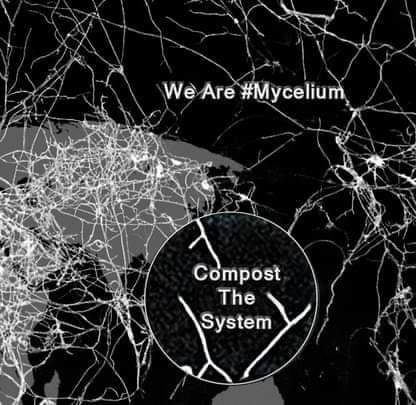
The #OGB project is just one shovel. But there are others. Pick one up, the ground’s ready.
