Let’s be clear about something, the commons are not an academic concept waiting to be discovered by economists or policy wonks, not a diagram in a textbook, not something that needs a queen, a government, or a management consultant to bring into existence. The commons are what people have always done when they are left alone to organise their own survival with neighbours they trust.
Peasants managing grazing land across medieval Europe. Indigenous communities stewarding water, forest and fishery for generations. Canal boat communities building informal mutual aid along waterways. Squatters running collective houses. Hackers building free software together. #Indymedia collectives publishing grassroots news from the bottom up. The digital commons – open source, creative commons, the #fediverse, the #openweb – already existing right now, built by thousands of ordinary people, not by any institution.
This is worth saying clearly because the #mainstreaming story about the commons almost always starts in the wrong place – with Garrett Hardin’s 1968 “tragedy of the commons” paper, which blamed collective ownership for environmental destruction and was used for decades to justify privatisation. The paper was ideologically loaded, historically illiterate, and largely wrong.
On the other side of mainstreaming we have Elinor Ostrom who spent her privileged career documenting why, eventually winning a Nobel Prize for showing that communities routinely manage commons successfully under the right social conditions. Her work, it is full of peasants, fishers, farmers and irrigators, not governments or corporations, let’s try and balance pointing at the top by point to the source
The real tragedy is not the commons. It is what #neoliberalism does to the social fabric that makes commons possible. As I have been arguing for years at hamishcampbell.com, the #deathcult worship of the 1980s and 1990s didn’t just privatise assets – it broke the institutions and the relationships that made collective stewardship possible. Hyper-individualism doesn’t just make people selfish, it makes cooperation feel unnatural, even threatening. That is not an accident. It is, as he puts it, a classic divide-and-control strategy.
The path back is not top-down – it never was – it is horizontal, rooted in trust, built through repeated small acts of mutual accountability. It is turning stress and conflict into commons culture rather than mutual destruction. It is rebuilding journalism as a commons rather than a product. It is composting “digital sovereignty” branding and just actually building working commons tech instead. The #4opens – open process, open data, open standards, open licences – are not abstract technical principles, they are social trust infrastructure, the modern grounding the commons grows from.
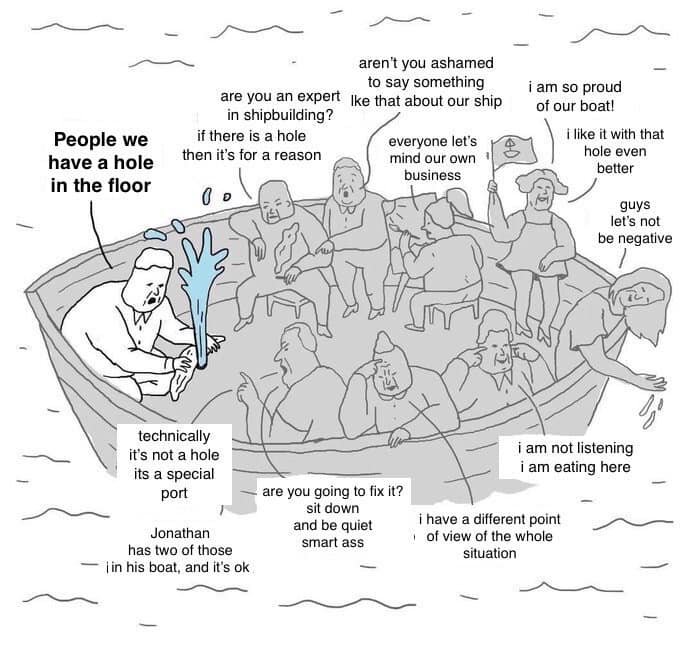
Thatcher said there is no such thing as society – the commons, everywhere it has ever worked, is the practical, lived refutation of that claim. Not a government programme, not a think tank report. Peasants. Boaters. Coders. Neighbours. People organising their own lives together, horizontally, with accountability to each other.
That is where we start, that is where we always started.
#OMN #commons #openweb #4opens #neoliberalism #deathcult #stupidindividualism #BuildingAlternatives
