Today there are a lot of dishonest people – it’s become the default. Finding someone who is actually truthful is rare. So with this in mind, let’s stop being polite about this, what we’re living inside online right now isn’t “social media.” It’s a managed enclosure – a system designed to extract value, shape behaviour, and concentrate power. It’s what I have been saying for the last 20 years. Call it what it is – digital #feudalism – The Lords, the Serfs, and the Server.
When everyone is pushed onto one big virtual server, you don’t get community, you get hierarchy. Platform owners become landlords. Users become tenants. Visibility becomes rent. This is not accidental, it’s the business model and once you see it, you can’t unsee it.
The lie of “Ease of Use”. People say these #closedweb systems are “easy.” They’re not, they hide the cost, what looks simple is just complexity moved out of sight. Advertising Is the rot, a business model moral hazard, when profit depends on attention truth becomes optional and outrage becomes profitable leading to manipulation as the new normal. You don’t get healthy communities from this, you get addiction loops and behavioural engineering. And yes, the inevitable result is screen clutter, noise, and a slow degradation of any meaningful communication, communities are managed, not grown.
So who is going to do the #DIY work? Real moderation works when it’s embedded in the community itself. Algorithmic control is anti-social, the algorithmic timeline is one of the worst ideas we’ve normalised. It drives distraction, by showing you more of what you’ve already seen, it tries to control your desires by interfering with human communication. Over time, this destroys trust, when people stop knowing if they’re being heard, they stop knowing what is real, stop trusting the space. That’s not a bug, it’s the outcome.
The celebrity illusion is how centralised platforms manufacture “importance” for brands and influencers. These only function inside controlled visibility systems, outside of that? They’re often just paper tigers. In a real network – a messy, distributed, human one – influence has to be earned, not bought or algorithmically inflated.
The commodification of human life leads to inevitable decay. Left alone, centralised platforms drift towards monopoly, manipulation and towards the amplification of the worst actors as these actors game the system best. Without constant control from above, the system degrades, with repression, it becomes what we see today, authoritarian. That’s the trap, a community you can buy your way into is not a community, it’s a marketplace.
So what’s the alternative? We don’t fix this by tweaking features. We fix it by changing the ground or tech grows from. This new growth has been seeded by the #Fediverse, It’s where the #OMN comes in, not as another platform, but as a shift back to distributed networks instead of central servers, commons-based paths instead of enclosure, social moderation instead of outsourced control, open protocols instead of locked interfaces. And yes, that means less “slick”, less uniform, more messy. But also more real, accountable and human.
A final point (That should be obvious). The problem is not that the current #dotcons systems are broken, the problem is that they are working exactly as designed. If we want something better, we don’t patch the system, we compost it to grow the #openweb back – this time with the native cultural roots intact.
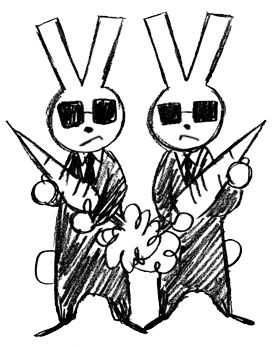

@info in the post, there’s an unlabeled image. Is that a thumbnail or something your platform doesn’t allow you to describe? but yeah, great essay otherwise!
Remote Reply
Original Comment URL
Your Profile
Why do I need to enter my profile?
This site is part of the ⁂ open social web, a network of interconnected social platforms (like Mastodon, Pixelfed, Friendica, and others). Unlike centralized social media, your account lives on a platform of your choice, and you can interact with people across different platforms.
By entering your profile, we can send you to your account where you can complete this action.
It’s published by WP ActivityPub plugin, can’t find any option for alt text, it’s a nice image of rabbits holding carrots as if the were guns – the fluffy spiky debate – it links to donation page.