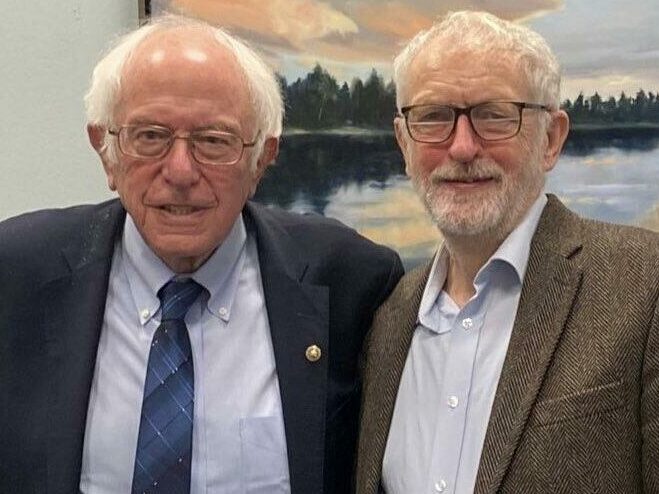
In #mainstreaming and alt political cultures there’s a constant call in messy times for “strong leaders” to cut through the chaos, but this is the wrong path. What Jeremy Corbyn and Bernie Sanders actually show is something more uncomfortable and more useful that real change doesn’t come from strong individuals – it comes from movements we don’t fully control. They were signals, not saviours.
Both figures emerged on the left because something deeper was already shifting with widespread discontent, a break from #mainstreaming politics and a hunger for alternatives to 40 years of #deathcult worshipping. They didn’t create these conditions – they channelled them. “Weakness” is often misnamed, Corbyn in particular was constantly framed as weak, but what was actually happening? When people treat them as failed “leaders,” they miss the point, at best they were interfaces to movements, rather than top-down commanders. They:
- Hold together fragile, diverse coalition
- Refusal to impose top-down control
- Emphasis on process, participation, and consensus
In a stable system, this might look slow, in a fragile system, it’s often the only thing preventing collapse. In the open vs closed battle, it’s not as simple as it looks – especially in the mess we’re in.
CLOSED → conservative / fear / control
OPEN → progressive / hope / trust
We need to keep looking at the underlying path when deciding which way to push the balance.
Where the demand for “strength” usually means more control, less democracy. That path tends to deepen the mess, not fix it, as personality politics is a dead end. When media and institutions focus on personalities where movements are about issues and structures. This mismatch is fatal if your politics depends on a person you are attacked through that person – we all collapse when they falter. You never build lasting power, it is the trap both campaigns fell into, despite trying to avoid it.
Movements without structure (hard or soft) stall, is the harder truth – Horizontal energy alone isn’t enough – Electoral politics alone isn’t enough. Both Corbyn and Sanders mobilised huge grassroots energy, but institutions resisted, internal fragmentation grew – the energy wasn’t fully translated into durable paths, and they fell through the gap.
From a #OMN perspective, the takeaway is clear – Don’t look for better leaders – Don’t rely on existing institutions – Build commons-based infrastructure that movements can stand on. This means: Media we control (#indymedia paths), Governance we participate in (#OGB) and tech that reflects trust, not control (#openweb, #Fediverse)
So in messy times, don’t reach for “Strong Leaders” as this comes from fear, frustration and the desire for simple solutions, history – from left and right – shows where that road leads. In poisoned times, the work is slower, to build trust, to stay grounded in shared issues.
Corbyn and Sanders didn’t fail because they were too weak, they struggled because we don’t yet have the social, technical, and institutional commons needed to carry the kind of change they pointed toward. That’s the work, and it’s not about finding the right leader –
it’s about becoming the movement that doesn’t need one.