This is a new 32W panel which is more than my older 25W panel, and runs a bigger laptop
Rugged folding 32.2W solar panel. 18 to 20VDC open circuit voltage. Current 2.4A in full sun. Cigarette socket connector. 16″ X 10″ folded; 14″ X 44″ unfolded. 1 1/2 inches thick folded. 6 pound 4 oz weight. Eyelets at each corner and at panel middle to allow mounting or suspension with rope or bungee cords. Very durable and rugged. Ripstop camouflage nylon enclosure. Take this panel anywhere. No glass. Advantages over thin film: open circuit voltage 18-22VDC (thin film tends to be 15 to 16VDC, as panel heats in sun or if in hot climates voltage for thin film panels drops and you may not charge efficiently or at all). Also thin panels are much less efficient. Substantially larger area for comparable outputs.
This is a 7AH lead acid battery, it is used as a voltage buffer and as a reservoir of power. The cables are a 240v inverter, AA battery charger, Volt meter.
This is a much bigger laptop (14.1″ and i5 proceser) than my usual solar setup, we can eather charger OR power but not both at the same time.
Simple automated hyper-local advertising to sustain open projects – the new digital sweetshop window.
2. Is anyone doing something like this now and how is your project different?
There are many automated advertising projects, but none for video that are as embedded in the communities they come from. It’s craigslist for video, google adwords for the alternative.
3. Describe the network with which you intend to build or work.
visionOntv creates and trains highly productive hyper-local video news communities, e.g Merseyside Street Reporters Network. These will be the exemplars. Then we expand to sites already embedding our media players and partner with aggregating hubs, followed by local blogs and business websites. The adverts follow the content.
4. Why will it work?
Simplicity and automation: to make an ad, you add an image, title and link to a webpage. You can then choose tags. If the tags are in wide demand they will cost an amount of money, which will initially be very low. These are then served in between content based on user/video geo-location, content tag, and user tags. The viewer will therefore have a close relationship with the ads. The project is built from the bottom up, and has a psychological understanding of peoples’ sense of belonging.
5. Who is working on it?
6. What part of the project have you already built?
visionOntv has 18,000 videos aggregated already, with much of the metadata required. As for local news, Merseyside Street Reporters Network is currently aggregating nearly 500 videos from a single UK city. There is therefore an existing database of curated and tagged geo-located films to hang noticeboard posts off. Beginning with these nodes which we control, we can test solutions to UI / security / spam etc issues. We can also rapidly show a practical outcome.
7. How would you sustain the project after the funding expires?
As a distributed project, it has very low running costs. It is a network for income-generation. The key thing is to push the network out and sustain it through the growth phase. We will use flattr as a partial funding model to help with this.
A river that needs crossing political and tech blogs – On the political side, there is arrogance and ignorance, on the geek side there is naivety and over- complexity
My videos are on these two youtube channels visionontv3,832,876 views and undercurrents 22,689,976 views
A river that needs crossing political and tech blogs – On the political side, there is arrogance and ignorance, on the geek side there is naivety and over- complexity
My videos are on these two youtube channels visionontv3,832,876 views and undercurrents 22,689,976 views
A common database of media metadata exchanged by RSS in and out, using open industrial standards and neutral unbranded widgets.
Is anyone doing something like this now, and how is your project different?
There are many aggregators of news (eg http://daveriver.scripting.com/, or http://ignoregon.com) but they aggregate with whole #RSS feeds not tags, and new tag feeds cannot be created out of them. Closed-source project #vodpod works by tag only as a premium feature.
Describe the network with which you intend to build or work.
visionOntv (a project for distributing social change video) already smart-aggregates 18,000 videos by RSS. Working with this already curated database, we can build an exemplar node with de facto open standards. The project is a distributed database of the human-moderated metadata of user-generated subject areas, making the choice of this exemplar database appropriate.
Why will it work?
Aims to build a big network, but starts small.
Has multiple redundancy by sharing data via RSS in/out.
Incentives for users
They can publish once on their own site, and the content appears on a range of other appropriate subject sites.
No single hub, no single owner, but rather a horizontal network of nodes. Every node can be a hub (an aggregator). This social/psychological understanding of the need to give people ownership means the project can spread easily.
Spam is user-policed out of networks.
Open industrial standards
RSS and atom are used as the database exchange format, as it is almost universally implemented. The leveraging of existing open standards means that 3/4 of the web can already talk to it. Thus, we can build a scalable, common, decentralised database.
We implement both of the real-time RSS standards PubSubHubbub and RSSCloud
End-users view videos through auto-updating video player widgets driven by boolean logic.
In the future, it would be possible to radically decentralise where the content is itself hosted, using p2p media-serving in parallel with traditional corporate streaming.
Who is working on it?
What part of the project have you already built?
We already have the content and much of the metadata for exemplar node visionOntv. There is a database of 18,000 curated and tagged films. Beginning with this node which we control, we can test solutions to UI / security / spam etc issues. And have a practical outcome with embedded media players. We already have one on every page of UK based New Internationalist magazine’s site, http://newinternationalist.org
How would you sustain the project after the funding expires?
#Flattr is implemented on every page. As a distributed project, it has very low running costs. It would be up to the individual nodes to solve this for themselves. We have a test micro-(hyperlocal) advertising model for funding the visionOntv node.
UPDATE: This project is the seed for the current #OMN project
Am testing out a load of solar gear in my back garden, have a old 17AH lead acid battery from a UPS, trying to find out if it will hold a charge. You have to keep batteries topped up with power otherwise they deteriorate over time.
UPDATE: it did not hold a charge I had to go out and buy a new battery from maplins, which works fine.
UPDATE2: I damaged the new battery so have to replace that, by charging it with out a charge controller, was using a volt meter to keep an eye on its level manually, but it only took one time forgetting and leaving it out in the sun to damage the battery – get a charge controller as human beings are prone to fail (:
Have you always wondered why IMC sites have the horrendous go away this site is dangerous message in most web browsers. Its because of this:
—– START Explanation from ****, **** —–
Security is a two-way street. When I go to a web site I have to prove to the web site that it’s really me before the web site gives me access to anything private or restricted (such as access to my email). The most common way that is done is via a login in which I provide a username and a password. Because I supply the correct password, the server knows it really is me, because I’m the only one who knows my password.
But how do I know that the server I’m going to really is the server I want to go to? Just because I type https://docs.indymedia.org/ into my browser, doesn’t mean that the server really is the Indymedia server that I think it is. Any number of things can happen via the Internet between my computer and the server I’m connecting to that might fool my computer into thinking I’m connecting to docs.indymedia.org when in fact I’m connecting to someone else’s server specifically setup to look like the Indymedia server. If that were to happen, I might type in my username and password on this stranger’s server that is acting like docs.indymedia.org, essentially handing over my identity to a stranger.
The purpose of security certificates is to ensure that the site I’m connecting to really is the one run by Indymedia.
Unfortunately, the technology for setting up this system is fundamentally flawed. It works like this:
* most major browsers, even free/open source ones like Firefox, are pre-configured to trust a pre-defined set of for-profit corporations to verify the identity of all web sites on the Internet.
* web site maintainers are expected to pay $75 or so to these corporations in exchange for a digital certificate verifying that we are who we say we are.
* once this digital certificate is installed on the web server, browsers will access the secure web site without any errors.
If you don’t pay $75 for the certificate, then most people will get a security error. There’s a word for a setup like this. It’s called a “racket.”
Rather than play this racket, Indymedia uses cacert.org to sign it’s security certificates. cacert is a nonprofit organization that signs certificates for free. cacert is not pre-installed on most browsers, however, you can install it by following the directions here: http://wiki.cacert.org/BrowserClients If you install the cacert certificate, your browser will automatically trust all indymedia web sites that have been signed by cacert, so you will no longer get any error messages when you access them. However, in addition, your browser will trust *all* web sites signed by cacert (which could be a good thing or a bad thing depending on how cautious you are).
—– END Explanation —–
So, this addresses the “problem” that many of us experienced for many years. Its actually a nice opportunity for political education!
However, my understanding is that since last summer, even this explanation won’t completely address the problem with the global site… I consulted with a few people offlist before responding to this because I didn’t want to add to the confusion. It appears that our security certificate for the global server has explicitly been revoked – see: https://lists.indymedia.org/pipermail/imc-tech/2011-June/0602-g4.html It appears that this may have taken place in conjunction with the conflicts in the UK group. So, even if you import the cacert certificate to your browser (following the instructions below), you may still get a problem connecting to the site. I’m not sure if this means that we can never again have a viable certificate through cacert or whether we have to purchase one from the racket that **** refers to?
A river that needs crossing political and tech blogs – On the political side, there is arrogance and ignorance, on the geek side there is naivety and over- complexity
My videos are on these two youtube channels visionontv3,832,876 views and undercurrents 22,689,976 views
A river that needs crossing political and tech blogs – On the political side, there is arrogance and ignorance, on the geek side there is naivety and over- complexity
My videos are on these two youtube channels visionontv3,832,876 views and undercurrents 22,689,976 views
A river that needs crossing political and tech blogs – On the political side, there is arrogance and ignorance, on the geek side there is naivety and over- complexity
My videos are on these two youtube channels visionontv3,832,876 views and undercurrents 22,689,976 views
This is a video response to Dave Winer’s post on Scripting News about why he has turned off commenting on his blog.
Winer was using the comment platform Disqus and discussed with the developers to have some options implemented. He got frustrated at the end when he realised he could never get from them the right functionalities and turned off the comments.
At visionOntv we have ideas about how to deal with comments and we’ll give practical proposals very soon in the videos to come.
Meanwhile we’d like to hear from you on this subject. Is it still a blog if no comments are allowed? Where is the conversation and debate then supposed to happen? What solutions have you tried on your blogs? Are you using an external comment platform or any form of moderation? And do you have a specific strategy for Youtube comments to bypass the daily abuse, auto-promotion and trolling?
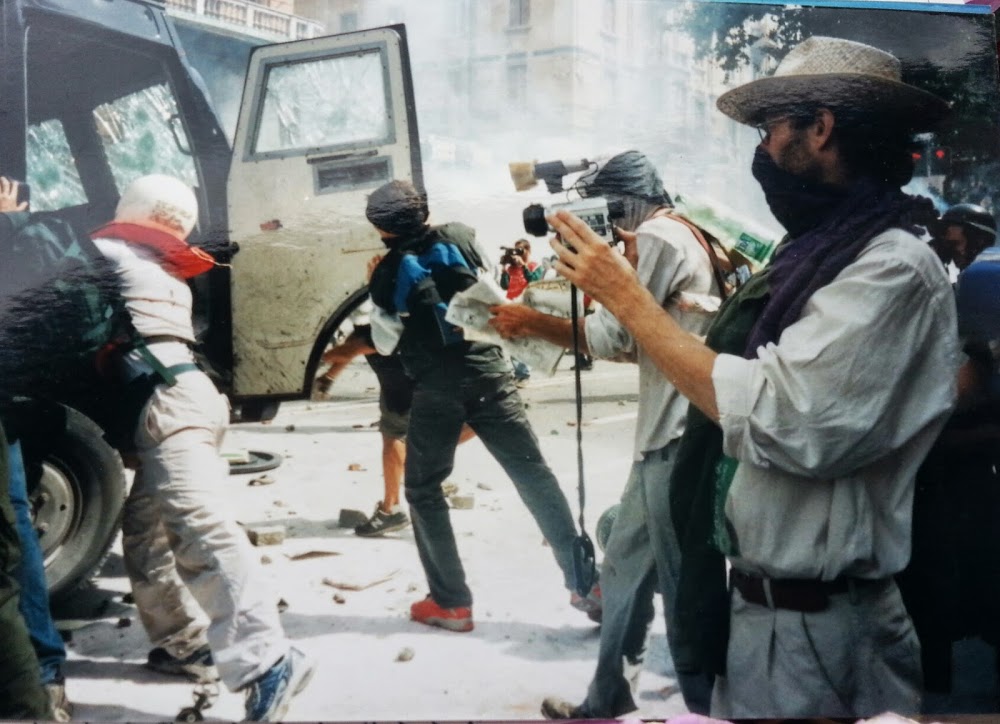
The Genoa G8 Summit protests, held from July 18 to 22, 2001, were a turning point in the global justice movement. More than 200,000 people converged on the medieval port city to block the summit and challenge the concentrated power of the world’s richest nations. A gathering of the priests of the #deathcult, grinding the planet into dust for profit.
For many of us, the G8 represented everything wrong with the world: an unelected body shaping economic and social policy for billions without legitimacy, accountability, or consent. We traveled to Genoa not as isolated activists but as a flowing living ecosystem of movements, anarchists, trade unionists, farmers, climate campaigners, media collectives, migrants’ rights groups, students, pacifists, the lot. We were there to resist and to build alternatives in the cracks protest pushes wider.
Arriving in a besieged city, Genoa a few days before the demonstrations to help set up the Media Center, for grassroots reporting. Genoa, though, felt nothing like a holiday town. Police were everywhere. Riot vans on street corners. Helicopters thudding overhead. The protest convergence center was being built on the beach; just 100 yards away from the stadium, where police forces were massing in their thousands. Walking around felt like moving inside a tightening fist.
We slept in the camper van that first night, tucked beside a half-built marquee. At dawn, we joined the organisers at the Diaz school, the building that housed both the Genoa Social Forum and the Media Centre.
We requisition two PCs from other rooms, installed video editing softwer, and turned them into the only two shared editing stations in the building. One was upgraded with a new hard drive and FireWire card for DV footage, not that it mattered, because it broke on day two and never recovered. The analogue capture system we had brought did most of the work that went online.
On one of our first reporting trips, filming outside the police barracks beside the convergence centre, we were detained by undercover cops. More arrived. Then more. Ten or twelve by the end. They demanded our tapes. I refused. They checked our documents, questioned us for hours, and released us without charge. I secretly filmed some of them; two would resurface later outside the IMC on the night of the raid.
Driving around the city to document the expanding “red zone” – the militarised area blocking off the summit – we were detained twice more. Civil rights meant nothing here. The police behaved like a sovereign power unto themselves. That Orwellian twinge – the sense that you are inside a lawless machine – grew stronger every day.
When the city turned red, one protester, Carlo Giuliani, was shot dead by police. Fear rippled across the city. The #IMC became a space threaded with arguments about what to do. People drifted away, hour by hour, some deciding the risks were too great. By midnight the centre had half emptied.
Then the screams came: “THE POLICE ARE COMING!”
Looking out the window, I saw nothing at first. Panic surged anyway, people barricading doors, grabbing bags, racing up staircases. Marion moved the archive tapes to the hiding place I’d scouted earlier: the water tower on the roof.
From the rooftop I filmed carabinieri smashing into the building next door, the Diaz Pertini school, with vans and sledgehammers. Chairs were used to break windows. Tables became battering rams. It was happening fast, shockingly fast. Then I saw them entering our stairwell.
The Diaz Raid: Running for our lives. I headed downstairs to check if the Media Center itself was being stormed. Turning the stairwell corner, I came face-to-face with a fully armoured carabiniere charging upward, truncheon raised, panting with adrenaline. I spun and bolted. Two flights up, shouting, “They’re in the building!” I sprinted to the roof and slipped into the tower.
Inside the darkness, I whispered for Marion. No answer. I crept through the corridor of water tanks, lit only by the IR beam from my camera. Finally, a small, terrified voice: “Turn the light off.” She had hidden behind the last tank, clutching tapes and equipment.
For hours, three, maybe four, we lay silent as the helicopter’s spotlight swept the windows. Police boots thudded across the roof. Below us, the city echoed with screams, crashes, and the chanted word “ASSASSINI.”
When the helicopter finally left, we emerged. The rooftop was scattered with stunned survivors. Downstairs, the destruction was total. Computers smashed. Hard drives ripped out. Doors hanging loose. The walls of the Diaz school across the street were painted with blood. Skin and hair stuck to corners. Piles of clothing soaked red. People moving like ghosts.
The Carabinieri had left their calling card.
What happened inside that school, was not policing. It was torture, humiliation, and fascist ritual. Ninety-three sleeping demonstrators were beaten so badly that the floors resembled a slaughterhouse. People hiding under tables or sleeping in bags were clubbed unconscious. A 65-year-old woman’s arm was broken. One student needed surgery for brain bleeding. Others had their teeth kicked out. One officer cut clumps of hair from victims as trophies.
Those who survived were taken to Bolzaneto detention centre, where the abuse continued: beatings, stress positions, pepper spray, threats of rape, and forced chants of “Viva il Duce!” and “Viva Pinochet!” A systematic, organised brutality. This wasn’t loss of control, it was ideology.
Aftermath: Truth in the Ruins. The Italian state tried to bury it all. But survivors, lawyers, journalists, and prosecutors fought for years. The European Court of Human Rights eventually ruled that Italy had committed grave human rights violations. But almost none of the officers served jail time. Politicians escaped entirely.
The police weren’t out of control. They were following a logic, the logic of protecting elitists power against democratic dissent. The logic of the #deathcult. The logic that treats people as obstacles, not citizens. Genoa showed the world what happens when movements gain too much momentum: the mask drops.
And still, in that chaos, seeds were planted – #indymedia, #OMN, the global justice movement, the early #openweb – messy, hopeful, compost for future uprisings.