This comes up again and again, in every horizontal movement that survives longer than a moment. Nobody gets to speak for a commons just because they feel inspired, loud, organised, or early. In healthy horizontal culture, legitimacy comes from process, not from individual initiative. This is as true for Rainbow as it is for #OMN, the #openweb, or any federated public space.
In “native” Rainbow culture, you don’t “call” a gathering on your own. Not because individuals are bad, but because individual authority is exactly what destroys non-hierarchical spaces. Gatherings only have legitimacy when they emerge from an open, inclusive council, a process that anyone affected can see, join, and influence.
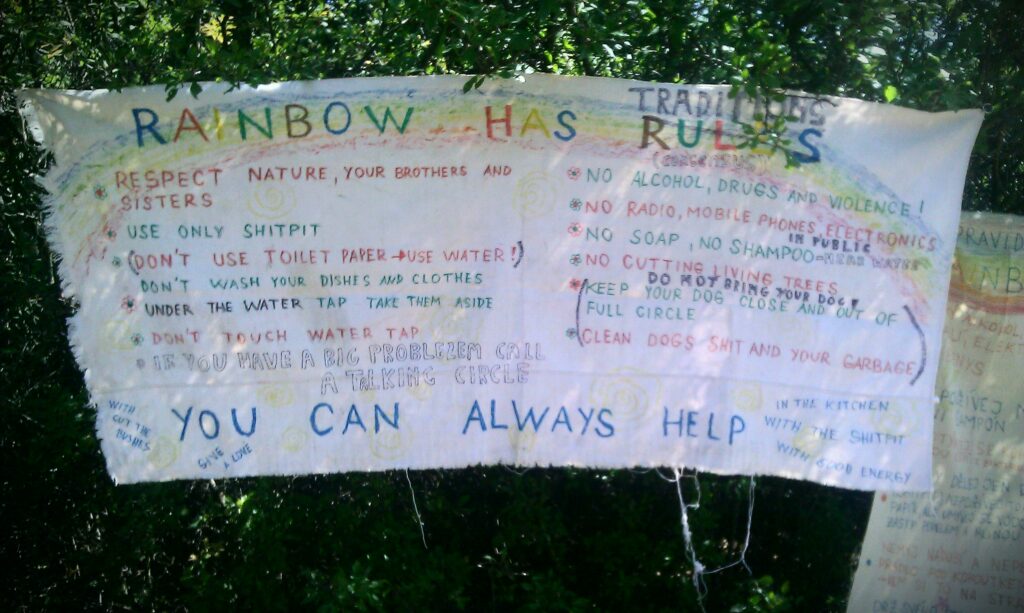
People can scout locations, talk to locals, seed conversations, suggest ideas. All of that is valuable. None of it confers the right to represent the whole network. That boundary exists for a reason. Without it, you get hierarchy-by-default, confusion, misrepresentation, and reputation damage. When unilateral calls fail – and many do – it’s not just personal embarrassment, it poisons the commons. Outsiders can’t tell the difference between a real gathering and a made-up one, and trust erodes.
Council Is not a formality, it’s the safeguard, A real council isn’t a checkbox. It’s a space where people with lived experience of the culture can speak, be challenged, and listen. Traditionally this happens within existing gatherings, because that’s where diversity of voices actually exists.
Yes, in US gatherings, sometimes people talk about “three experienced people” as a minimum. That’s not an ideal. That’s an emergency fallback when the wider process has broken down. Three inexperienced people do not make a council. Not because newcomers are excluded, but because they don’t yet carry the collective memory of what works, what breaks, and who pays the price when mistakes are made.
This is basic #4opens thinking: open process, open participation, visible decision-making, accountability to the wider community. If you skip this, you’re not being radical – you’re being careless.
Inclusiveness is the test, the real measure of legitimacy is who was invited, a council that: meets in secret, is announced too late for others to attend, chooses inaccessible locations, excludes people due to personal conflict or political discomfort… is not legitimate. Full stop.
Horizontal culture cannot survive cliques, factions, or quiet exclusions. That’s how “informal power” replaces explicit hierarchy – the worst of both worlds. This isn’t about being nice. It’s about building processes that can hold disagreement without splitting. That’s what keeps a movement alive across decades.
Unilateral action breaks trust. Calling a gathering without a council, without visible support, without shared buy-in, isn’t just “doing your own thing.” It actively undermines the commons.
When fake or failed calls happen: travellers waste time and resources, local communities get confused or hostile, land managers lose trust, the whole network looks disorganised. The criticism here isn’t personal. It’s structural. Representation carries responsibility, and responsibility requires process.
Why this matters beyond Rainbow? This isn’t a niche cultural rule. It’s a universal horizontal principle. The same logic applies to: federated media (#OMN), grassroots tech, open governance (#OGB), the #fediverse, consensus-based organising everywhere

Openness beats secrecy.
Process beats personality.
Consensus beats authority.
Commons beat egos.
Council isn’t “governance theater.” It’s the cultural glue that replaces hierarchy. Without it, everything grassroots can very easily drift toward control, capture, and collapse. With it, you get continuity without leaders, coherence without command, and trust without enforcement.
That’s the path the #OMN is on. Not platforms, not figureheads, not “calls” from above. Just open process, visible legitimacy, and shared responsibility.

@info I’ve seen some really great work on people running infrastructure in more open ways recently although it more as an extension of art practice. But first time I’d been excited seeing something in a while and like actually a lot of the work was in creating methods of communication that although enabled by the stack have to be curated and practiced by people.
Remote Reply
Original Comment URL
Your Profile
Why do I need to enter my profile?
This site is part of the ⁂ open social web, a network of interconnected social platforms (like Mastodon, Pixelfed, Friendica, and others). Unlike centralized social media, your account lives on a platform of your choice, and you can interact with people across different platforms.
By entering your profile, we can send you to your account where you can complete this action.
Yep, it is a path we can realistically take – Q. how to gather people and resources to push this path wider?