Individual fear scales into collective outcomes, when people act mainly from fear, they tend to choose control, isolation, and short-term protection, and those choices accumulate into worse social paths. It’s useful to look at this as the balance between fear/control and trust/open in #openweb thinking.
So the question becomes – how do we reduce fear enough that people act more cooperatively? We can try some grounded ways to make this to work.
Build Real Social Support
Fear grows when people feel alone and powerless, it shrinks when people feel supported and connected. Historically, societies with strong collective structures – unions, cooperatives, community groups, local media, commons infrastructure – tend to show lower social anxiety and higher trust. What helps is strong local communities with shared institutions people actually control through mutual aid and cooperative structures. When people know others have their back, they are less likely to act defensively.
Reduce Information Panic
Traditional and #dotcons media systems amplify fear, because fear drives attention and engagement. Constant exposure to crisis narratives makes people feel the world is collapsing even when their local reality may be more stable. To counter this we need slower, contextual media, local reporting and shared storytelling in flows in media systems not driven by advertising attention metrics. This is the place where the #OMN fits: if communities control their own media infrastructure, the incentives shift away from panic amplification.
Increase Agency
Fear grows when people feel they cannot influence outcomes, when people have real participation in decisions, fear tends to drop and responsibility rises. So when people help shape the systems, they no longer see it purely as something happening to them.
Create Stable Material Conditions
A lot of fear is simply economic insecurity, worrying about housing, food, healthcare, or work, their nervous systems remain in threat mode. In that state, cooperation becomes much harder.
Encourage Contact Between Groups
Fear comes from distance and misunderstanding, interacting across social, political and cultural differences in real life, fear tends to decrease. Shared projects and cooperation help more than debate. This is why collective building projects (community media, shared infrastructure, local initiatives) can be powerful: people work together rather than just argue.
Normalize Courage Instead of Panic
Fear spreads socially, but confidence spreads socially too, when people see others acting constructively – organizing, building alternatives, cooperating – it changes what feels possible. Visible examples of working alternatives matter because they shift the emotional landscape from “Everything is collapsing.” to “We can actually build something better.”
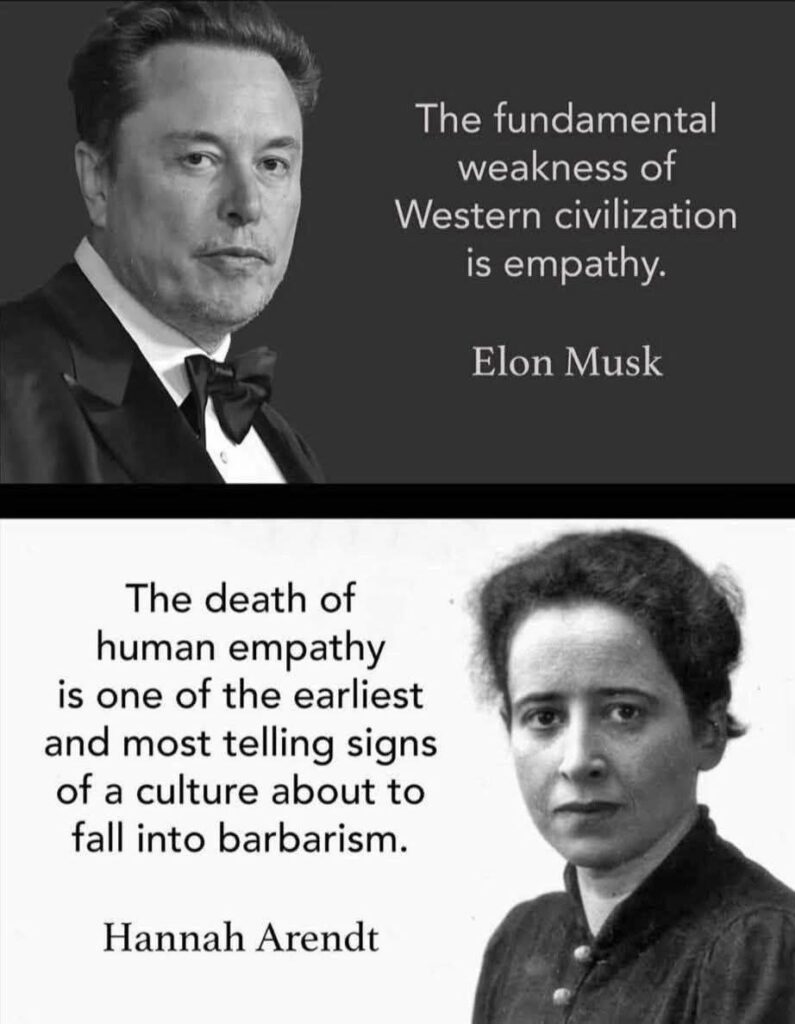
The idea we need to balance is fear itself is not the enemy, in moderation it is a normal protective response. The problem comes when systems, like much of today’s personal and social mess exploit fear to maintain control. When that happens, fear multiplies and becomes self-reinforcing. Reducing fear at scale usually requires: stronger communities, trustworthy “native” institutions using #4opens communication to drive real participation in building visible alternatives.
In short: build systems that reward trust instead of systems that profit from fear. That is one reason projects like #openweb infrastructure of the #OMN matter. They are not just technical tools, they are about building communication spaces that encourage cooperation instead of panic.

@info I have been saying exactly that in my AI Ethics talk… 🙂 https://www.feilner-it.net/files/KI-Ethik2025.pdf
Remote Reply
Original Comment URL
Your Profile
Why do I need to enter my profile?
This site is part of the ⁂ open social web, a network of interconnected social platforms (like Mastodon, Pixelfed, Friendica, and others). Unlike centralized social media, your account lives on a platform of your choice, and you can interact with people across different platforms.
By entering your profile, we can send you to your account where you can complete this action.