The individual, their freedom, and their capacity for reason are products of social relationships, not independent origins. Society is not built from isolated individuals; individuals arise from shared culture, history, and collective life. As society grows richer and more humane, individuals gain the conditions needed for deeper development and freedom emerges from this shared foundation.
What’s really at stake is power. The shift has to be away from private ownership and toward the commons – not just in licensing, but in governance, culture, and decision-making. The whole #OMN project is grounded in this understanding. It’s about building shared infrastructure that people can actually use, shape, and grow trust.
One of the great ironies of many “alternative” spaces is that people believe they’re resisting power, yet by locking everything down – secret decisions, closed processes, gatekeeping – they end up recreating the systems they claim to oppose. The result is stasis, nothing moves or grows, everything fragments.
Paranoia is one of the biggest blocking forces in alt-tech and radical spaces. It breeds mistrust, isolation, and internal sabotage, making collective action almost impossible. Some caution is necessary, we’re not naïve, but when paranoia becomes the default posture, it hardens into control. At that point, it stops being defensive and starts being corrupting.
The #4opens is a direct antidote to this. Transparency punctures paranoia. When decisions, processes, and networks are open, there’s less space for suspicion to fester. Trust isn’t built through secrecy or technical cleverness; it’s built through visible, accountable practice over time. Open process beats “good intentions” every time.
This is also why letting technical people make final product decisions is a mistake, overemphasizing technology then underplaying the social problems we’re actually trying to solve. We end up designing better mousetraps without ever asking whether we’re even trying to catch mice. Tech becomes the point, rather than a tool.
This is where the #fashernista problem kicks in, being seen to hold the correct stance replaces doing the work. But staying “right” while nothing changes is another form of failure. If we want alternatives that function, we have to move past paranoia, reopen flows, and accept that trust is something you build, not something you secure with walls.
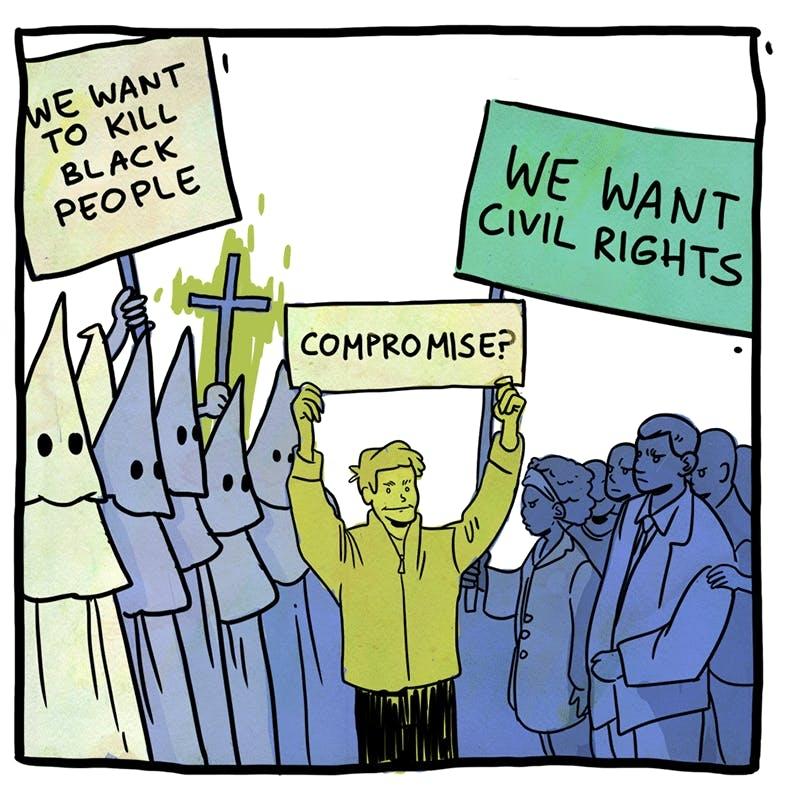
The uncomfortable truth is that it’s easy to be “right” in theory. It’s much harder to take part in the compromises that building anything real requires. Most people prefer the comfort of ideological purity over the messiness of collective practice, especially when dealing with complex social truths. That’s the trap.
#OMN is often critiqued as if it were a finished system, a moral framework, or an alternative economy. It is none of those things. We need to be clear about scope, sequence, and intent if discussion is going to move forward instead of circling the same ground.
#OMN is a commons-first, tool-building project. It exists to create shared infrastructure, processes, and cultural practices that can grow non-extractive media and communication. It prioritizes shared ownership, open process (#4opens), and reducing capture in order to build the needed public-first infrastructure. It’s about creating conditions, not declaring outcomes.
It’s an early-phase project, an affinity-building space to create tools and governance to reconnect fragmented activist and media histories. It is not claiming to already provide economic survivability, stable long-term livelihoods, or a full replacement for existing systems. Confusing the step with the destination is the root of most disagreement.
It’s grounded in lived historical practice. #OMN grows out of more than 30 years of real projects – Indymedia, grassroots media, squatting and DIY cultures, trust-based networks – and a clear view of where #NGO-driven paths have failed. This history matters. The path is not speculative theory, it’s an attempt to compost what worked, acknowledge what failed, and try again with better tools.
That’s based on a simple historical reality, society does not pay people to challenge itself. Early change is driven by passion, not wages, and support structures emerge after commons exist, not before. This isn’t a moral claim, it’s an observation drawn from experience. #OMN is also a space where tone is a process tool. Friction is used to slow things down, open space for challenge, and form affinity where none yet exists. This is messy by design, not a finished social contract.
We don’t set out to solve how everyone is paid, how risk is evenly distributed, or how long-term security is guaranteed. These are unsolved problems, not denied ones. #OMN exists because these tools do not yet exist, so expecting it to already provide them misunderstands its scope and phase. Participation is voluntary, alignment is practical, not moral. Funding may be used tactically, but OMN is not structured around chasing it.
This is not a safe, smooth, or finished space. The path is unfinished, uneven, and sometimes uncomfortable. If a project has to be safe, stable, and fully funded before it can exist, it will never challenge anything.
The core misunderstanding is that the #OMN is judged for failing to deliver something it has never claimed to already be. What we are doing is building the tools that make survivability possible later, without reproducing the failures that keep repeating. That work is slow, messy, and incomplete – because it has to be.
The shared path is a practical response to repeated historical failure. It is not a promise, a moral demand, or a finished alternative. If you judge a seed by whether it is already a tree, you will never grow anything.
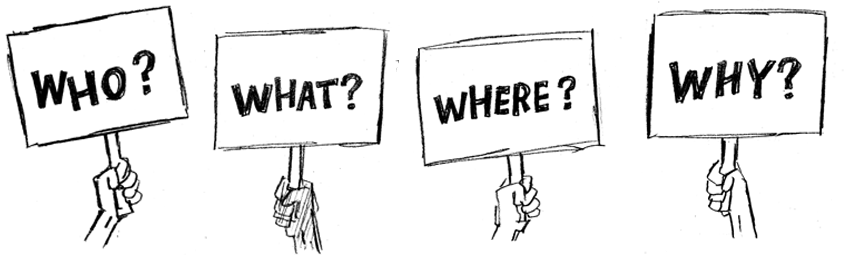
Why groups matter, in our “common sense” we like to pretend society is made up of strong, independent individuals who freely choose everything about their lives. That story is comforting, but it’s also mostly false, humans are group creatures first. People don’t start as individuals. We are born into families, cultures, languages, histories. Our values, assumptions, and sense of what’s “normal” are learned socially long before we ever get a chance to reflect on them. Groups aren’t an add-on to human life – they’re the foundation.
Individual identity is hard work, as modern culture tells us we must be ourselves, define our own path, build a unique identity. But doing that alone is exhausting, being an “individual” means constant self-definition, self-presentation, self-justification. You’re never finished as you’re always proving who you are, to employers, platforms, institutions, and peers.
That permanent uncertainty is what people mean when they talk about burnout, anxiety, and imposter syndrome. Groups reduce that pressure, as belonging to a group shares the load, with values, purpose, norms, responsibility. You don’t have to invent everything from scratch, you’re part of something that existed before you and will continue after you. This isn’t about conformity, it’s about being human, support and continuity.
The current #deathcult myth of pure individual freedom, where individuals are fully free and self-made #KISS serves power. When people are isolated, all problems look personal instead of structural, failure feels like a moral flaw and collective solutions disappear. You can’t organise if everyone thinks and acts as if they’re alone.
Healthy groups vs. toxic groups, yep, groups aren’t automatically good. Some are rigid, exclusionary and authoritarian. Healthy groups are porous and open to change, allow disagreement, are based on trust, not fear and exist to serve their members, not control them. The solution to bad groups isn’t no groups – it’s better ones.
Why this matters for media and the web? The #openweb wasn’t built by isolated individuals chasing personal brands. It grew out of horizontal’ish communities, shared tools, and mutual aid. What broke it, was pushing of individual status, platforms replacing communities then metrics replacing relationships. Projects like #OMN are about rebuilding group-based publishing, shared infrastructure, and collective voice, not amplifying lone influencers.
In short, (stupid) Individualism puts people in a permanent liminal state – alone, unstable, competing. Groups give people grounding, belonging, continuity, and the ability to act together. If we want social change, resilient media, and a future beyond the current mess, we on balance don’t need better individuals, we need better groups.
I proposed a long time ago that #openweb is a less tribal, more expansive framing than #fediverse socially and technically. It’s also #nothingnew, which is honestly a breath of fresh air. We can (and should) use both terms, but if we want meaningful change and challenge to the #mainstreaming mess, we need to foreground the more generic one.
Predictably, this gets pushback from two directions: the non-political #FOSS crowd, and the mainstreaming crew. And yes, when you bring #NGO behaviour into the #fediverse, there’s going to be friction. Try being #openweb-native on this, please.
People are going to keep doing self- and socially-destructive things. That’s a human problem, not a branding one. But the language we choose does shape how we respond to it.
One of the reasons we use a #4opens process is to balance the reality that people often arrive with strong opinions before understanding the history, context, or existing work. The process isn’t there to exclude anyone, it’s there to slow things down just enough so people can orient themselves before trying to reshape what already exists.
At the moment this only works partially, because some people still interpret being asked to explore existing materials as dismissal. For example “You have sent me on a ride through Mastodon posts and two repos while not providing direct answers.”
What may feel like dismissal is actually part of a #DIY open process. The intention is to encourage people to engage with the work already done so conversations can move forward from shared context rather than restarting the same debates repeatedly.
Similarly: “Why assume blog archaeology is the right approach instead of presenting everything in a more processed way?” In grassroots projects, documentation is often messy, organic, and evolving rather than packaged into clean summaries. Exploring this material isn’t busywork, it’s a way to understand the social and historical layers that shape the project. Without that grounding, discussions can unintentionally repeat old loops to propose changes that have already been explored.
And when people say: “Most people don’t have time or energy for this.” That’s a real constraint, but it also highlights the core challenge. Open, collective projects rely on participants investing some effort to understand shared context. Without that, the burden shifts onto existing contributors to repeatedly re-explain the basics, which keeps stalling progress.
The aim here is not gatekeeping or dismissal. It’s #KISS: keep the process simple, open, and grounded in shared effort. If something needs improving – documentation, summaries, onboarding – the most constructive path in a #DIY culture is to step in and help build that improvement together.

3 thoughts on “The uncomfortable path”