In the traditional media and our social reflection of this – “Belief in markets”, is theological thinking disguised as economics. The market is a god, and economists its priesthood. Modern economic discourse treats “the Market” as: omniscient (“the market knows best”), omnipotent (“there is no alternative”), morally authoritative (“price signals reveal truth”), beyond democratic challenge (“don’t interfere, or you’ll anger it”)
It should be easy to understand this isn’t analysis, it’s faith. When something goes wrong, the response isn’t accountability, it’s ritual: austerity, deregulation, labour discipline, “tightening belts”. This working class suffering becomes a necessary sacrifice to restore god’s favor. That’s why at the #OMN we called it the #deathcult – normal people are expected to suffer and die, quietly, so the economic system can live.
Priests, temples, and worshippers, religions have hierarchy, in this mainstream one: Central bankers are high priests, rating agencies are oracles, think tanks are seminaries, media pundits are evangelists, platforms are temples, metrics are scripture. It’s all theological thinking all the way down, surface disguised as economics
The closer you are to god (capital, liquidity, investment flows), the more authority you’re granted. Those far away – workers, communities, the climate – are treated as abstractions, “externalities”. And, like all priesthoods, our elitists claim neutrality while enforcing doctrine.
Heresy is not allowed, questioning the market is treated at best as: naive, dangerous, emotional, “anti-growth”, “anti-business”, “unrealistic”. This mirrors religious heresy exactly. Then we have the last 40 years of #posttruth, once belief replaces evidence, language becomes performative, words are used to signal loyalty, not to describe reality.
This matters for the #openweb and #OMN as the current path, the #dotcons are the digital expression of this religion, encoding market theology into infrastructure with engagement replaces meaning, growth replaces health, metrics replace judgment, extraction replaces relationship. This is why reform inside platforms fails, you’re not tweaking a tool, you’re challenging a faith system.
The #openweb threatens this religion because it decentralises authority, reintroduces human judgment, values trust over metrics, treats technology as means, not destiny. That’s apostasy and why “fairer worship” isn’t liberation, it’s at most progressive #mainstreaming that wants more inclusive access to the temple, fairer distribution of sacrifices, representation among the priests. That has real short-term value, yes, but it never questions the altar itself.
The #OMN position is different, it focused on stand up, walking out, building something else. So what would a post-religious economics look like? Signal thinking, not worship, markets as tools, not gods, economics as a social science, not divine law. Values decided democratically, not revealed by price. Survival and care as nonnegotiable, growth as optional, not sacred. This aligns directly with our insistence on balancing social value and personal value.
This framing cuts through the mess, calling it religion, we break the spell. People can see faith masquerading as fact, priests masquerading as experts, sacrifice masquerading as necessity, they can no longer pretend this is “just how the world works”. That’s why this language, hashtag story matters. It’s not rhetorical excess – it’s diagnosis. And diagnosis is the first step to composting the #deathcult and planting something that can actually keep people alive.
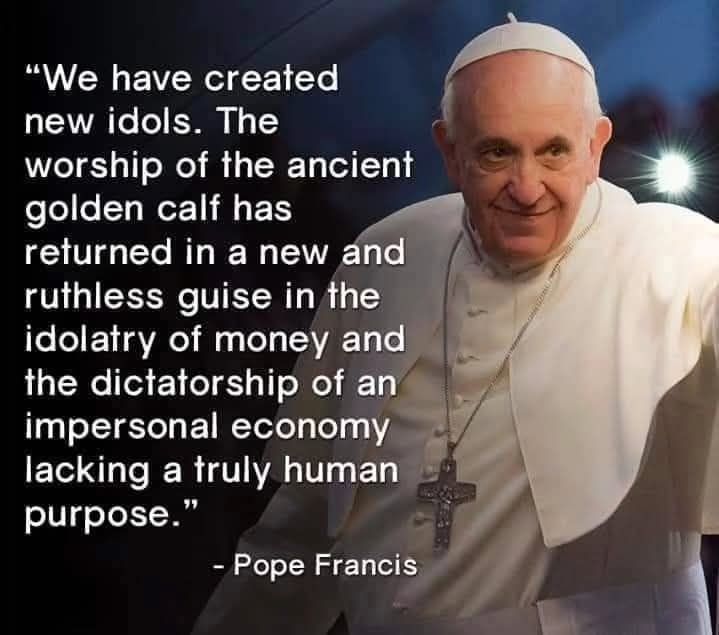

This tracks with my thinking and that of an important source for the Techno Anarchist Manifesto. #OMN #technoAnarchism
https://battalion.mobileatom.net/techno-anarchist-manifesto/#problem
Remote Reply
Original Comment URL
Your Profile
Why do I need to enter my profile?
This site is part of the ⁂ open social web, a network of interconnected social platforms (like Mastodon, Pixelfed, Friendica, and others). Unlike centralized social media, your account lives on a platform of your choice, and you can interact with people across different platforms.
By entering your profile, we can send you to your account where you can complete this action.