To be fully human is to be empowered to live a meaningful life within society.
To be rendered sub-human is to be forced into powerlessness outside of it.
We are not isolated individuals who later “join” society. We are social creators, we make meaning together, and that meaning only exists where people have the power to act, to speak, and to shape the world around them. Remove that power, and what remains is survival, not life.
From this perspective, there is really only one political question that matters: How is power shared inside society? Every political ideology is, at its core, an answer to this question – even when it pretends to be about markets, morals, tradition, or efficiency.
Invisible power today lives in metadata. In the digital age, social power increasingly resides in metadata: who is visible, who is connected, who is amplified, who is silenced, who is predicted, who is categorised, who is excluded.
Metadata determines access to work, housing, speech, legitimacy, mobility, and safety. It shapes behaviour not by force alone, but by nudging, filtering, ranking, and erasing. Control metadata, and you control society’s nervous system.
At present, there are four broad answers to the question of who should hold this power.
- Capitalism: Metadata for the #Dotcons
Capitalism seeks to privatise metadata into the hands of corporations – the #dotcons. Platforms harvest social data, enclose it, and convert it into profit and leverage. In turn, capital uses this leverage to shape governments, laws, and public discourse.
This is why fascism is coming back into fashion. Once corporations control social coordination, the state becomes an enforcement arm rather than a democratic counterweight. Surveillance, repression, and exclusion follow naturally. This is not a failure of capitalism; it is its logical outcome.
- State Communism: Metadata for the Government
Chinese-style state communism takes the opposite approach but reaches a similar destination. Metadata is centralised in the hands of the state, which uses it to discipline capital and population alike.
This is the command economy rebuilt with digital tools – total visibility, behavioural scoring, and algorithmic governance at scale. Capital is controlled, but society is tightly managed. Power flows vertically. Dissent becomes data noise to be corrected.
- Liberalism: Metadata for the Individual
Liberalism proposes a third answer: metadata should belong to the individual. Each person owns their data, controls their privacy, and participates in a market of informed choice.
This vision rests on a mythic past that never existed – a free market of equals making rational decisions with perfect information. In practice, individuals cannot meaningfully manage complex data systems alone. Power does not disappear; it simply re-aggregates through contracts, platforms, and inequality.
Individualised data ownership becomes another abstraction that fails to challenge structural power.
- Anarchism: Metadata for the Commons
So what does anarchism want? This is where #4opens and the Open Media Network (#OMN) enter the picture. Anarchism does not seek to privatise metadata to corporations, centralise it in the state, or atomise it to individuals. It seeks to socialise metadata into the commons, governed openly, transparently, and collectively.
Power is shared horizontally, not concentrated vertically. Metadata becomes a tool for coordination, care, and accountability – not domination. Communities can see how systems work, adapt them, and challenge them without asking permission.
This is not utopian. It is infrastructural. It is about building systems that make cooperation easier than coercion.
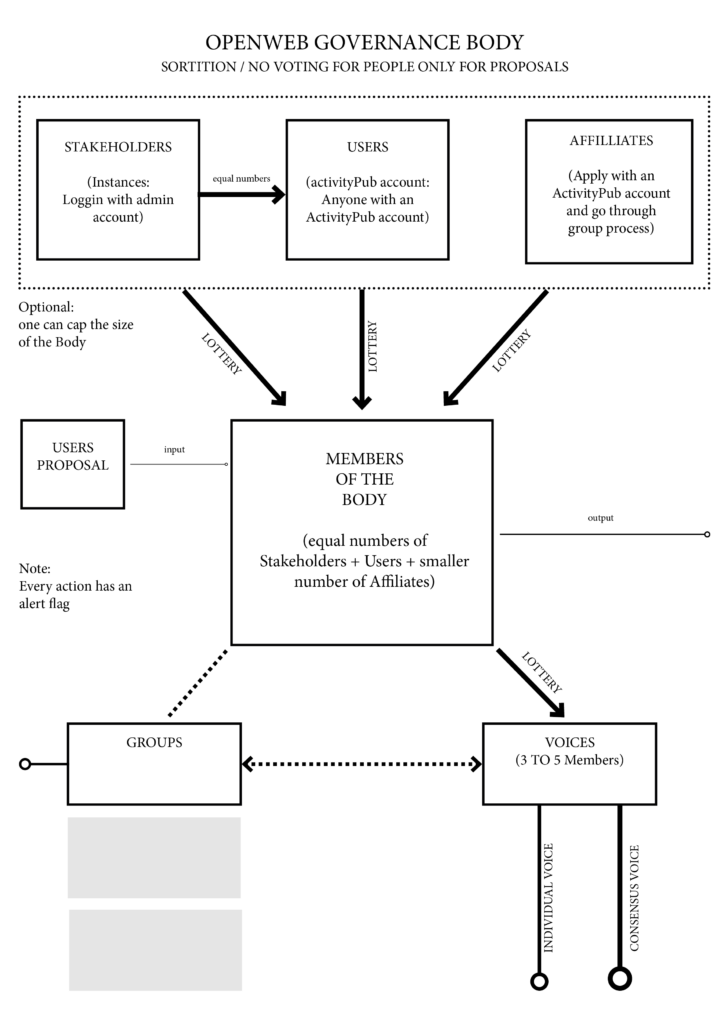
The real choice is not “AI vs humans,” or “state vs market.” It is about who controls the metadata that shapes our lives. Do we accept systems that render us powerless spectators? Or do we build shared infrastructures that keep us fully human – capable of meaning, agency, and collective action?
#OMN is not a finished answer. It is an attempt to walk this last path seriously, in practice, not just theory. Because to be human is not just to exist, it is to have power together.
