From a #mainstreaming point of view, what people call “piracy” is not a simple moral failure, it’s rather a signal of systemic #dotcons failure. Again and again, across decades, people have shown a simple truth: When access is fair, affordable, and humane, people pay. When systems become extractive, people route around them.
This is not new, not edgy, it’s basic social behaviour. Before the Internet: we had Informal commons, cassette copying, vinyl bootlegs, tape trading networks, these were not experienced as “theft” by the people who did this – they were social distribution systems, low-scale, trust-based, culturally embedded, limited by friction. They existed alongside markets, artists still toured, labels still made money, culture still flowed.
This was a pre-digital common, tolerated because it couldn’t scale enough to threaten capital. Then came the first native digital implementation. Napster originally wasn’t thought of as a crime, but was turned into a real fork in the road when Napster didn’t invent piracy, it simply removed friction and exposed the contradiction.
Napster was an early, messy, accidental example of what open distribution could have become if shaped by public-interest values rather than VC mess. What panicked the industry wasn’t copying – it was loss of control. Two paths were possible:
- Adapt to abundance, treat sharing as promotion, build fair access + fair reward, except that copying is native to digital culture.
- Reassert artificial scarcity, lawfare, DRM, surveillance, platform capture.
They chose the second, before they shift to the working subscription “solution” This turned into a temporary truce in the that #dotcons streaming worked, briefly, because it aligned with human behaviour: convenience, simplicity, predictable cost, “good enough” access. This reduced piracy, not because people became more ethical, but because the service stopped being so hostile. This is crucial, piracy goes down when #mainstreaming systems respect users.
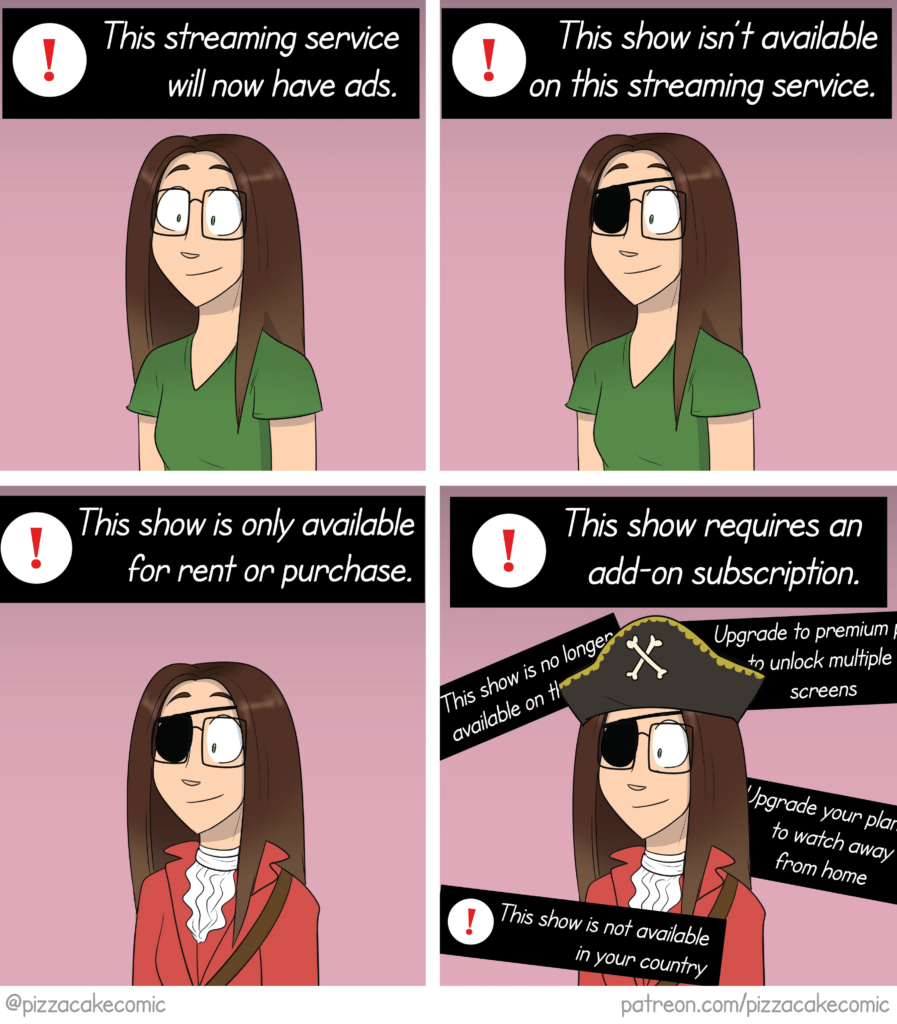
Though this did not last, the pushing of the #dotcons (#enshittification) broke the social contract, now we’re seeing a piracy resurgence – due to legitimacy collapse. Platforms: fragmented access, raised prices, removed ownership, revoked sharing, erased archives and locked culture behind licences. The normal mess that you don’t own culture any more, you rent permission until it’s revoked.
People don’t won’t this enclosure of culture and memory “if buying isn’t owning, pirating isn’t stealing” isn’t only edgy internet logic, it’s a commons’ logic. It says: ownership has been broken, legitimacy has been lost, people are reclaiming agency informally. This is exactly how commons historically re-emerge, outside broken institutions, not through them. So from any seasonable mainstreaming view, Piracy Isn’t Anti-Artist – It’s Anti-Bullshit, a service problem, it’s what happens when distribution is controlled instead of shared.
Where #OMN fits, the Open Media Network is not about simply justifying piracy. It’s about removing the need for it by rebuilding: public-first distribution, shared infrastructure, local publishing, federated archives, cultural memory that can’t be revoked, trust instead of DRM, access without enclosure, communing.
Culture needs to be: easy to access, hard to erase, socially rooted, economically plural, governed in the open. When those conditions exist, piracy fades into the background, not because people are policed, but because the system stops being abusive.
Piracy Is the smoke – enclosure Is the fire – the historical arc looks like this:
informal sharing → tolerated
digital abundance → panic
platform compromise → temporary calm
enclosure + extraction → rebellion
From this view, people aren’t becoming criminals, they’re disobedient consumers because consumption has become hostile. What people need to see in this mess is that Piracy isn’t the future, it’s a warning flare. The future is rebuilding open, shared, accountable media infrastructure so that: artists are supported, culture persists, access is normal, and people don’t have to choose between legality and dignity. That’s not nostalgia, it’s the unfinished business from the original #openweb.
And yes, it needs to happen #OMN