Recently I’ve been doing media interviews – one mainstream piece for a #boatingeurope article coming out in traditional media, and another for the Cherwell student paper in Oxford focused more on biography. Both journalists said the same thing: “It was surprisingly hard to find information about you online.”
Around the same time, a boater friend told me something similar. After finally discovering my YouTube channels – which contain thousands of videos and millions of views – they commented that it had taken real effort to find them.
That got me thinking about the subject of memory online and the #dotcons silent blocking of our native cultures. I took it for granted that people could easily find my work with a simple web search as for years my work, there is a lot, was easily discoverable through a simple Google search. But I had also noticed something quietly changing, I had gradually disappeared from the front pages of many searches. Old links were rotting. Connections between projects were becoming harder to trace.
So I decided to dig.
Testing different search engines
I started with “alternative” search engines.
Brave search https://search.brave.com/search?q=hamishcampbell&source=web
Results: 6 out of the first 9 results were clearly about me. Strong signal, good context.
Mojeek https://www.mojeek.com/search?q=hamishcampbell
Results: All first-page results were relevant. This felt similar to how search engines used to behave years ago – linking together projects, history, and context.
Bing https://www.bing.com/search?q=hamishcampbell
Results: 7 relevant results on the first page, 4 unrelated. Not perfect, but still reasonably discoverable.
Then I tried Google again
With some hesitation, I went back to the default mainstream search engine.
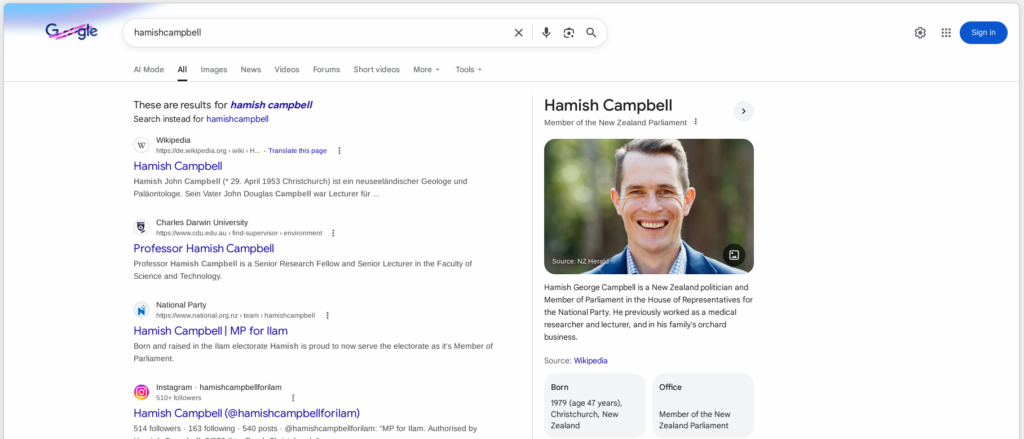
https://www.google.com/search?q=hamishcampbell
What I found was troubling. Searching for “hamish campbell” (with a space automatically added): NO results on the first page. Only one link on the second page to my site. None of my wider online presence appeared at all, no connected accounts or historical references anywhere. Only after clicking the link “search instead for hamishcampbell” (without the space) did the result improve slightly – but still showed only internal pages from my own site as link 5 none of the broader network of projects, media, and accounts I’ve built over decades.
What the people had said to me was true, in practical terms in the default mainstream search experience, I am now largely invisible.
What this reveals about the changing web
This isn’t a story of one person’s visibility, it reflects a dysfunctional shift in how discovery works. Older search models emphasised linking between sources, context and historical continuity, distributed identity across the web. Newer models emphasise platform-contained identity, engagement signals controlled by corporate ecosystems and algorithmic filtering based on opaque commercial criteria. This shift weakens the connective tissue of the #openweb. Instead of a web made from links, we get silos made from platforms.
A kinda random view on this https://www.impactlab.com/2025/07/19/the-death-of-google-search/ for people who like links.
Link rot and historical amnesia
Another issue is link rot. Projects built across independent websites, forums, mailing lists, and early social platforms slowly lose visibility as sites shut down, algorithms deprioritise older content and corporate platforms become default discovery gateways. The result is a quiet rewriting of history. Not through censorship – but through absence. If something cannot be found easily, for most people, it effectively does not exist.
Personal visibility vs structural invisibility
This isn’t about ego or personal branding, it matters because grassroots history lives through networks of links and references. When those links disappear from discovery, movements lose continuity, new participants cannot learn from past experiments and alternative culture appears smaller and weaker than it actually is. This strengthens the illusion that the #dotcons are the only viable digital ecosystem.
Why this matters for the #openweb and #OMN
The #OMN project exists partly because of this problem. We need infrastructures that treat media and identity as shared commons rather than platform assets, preserve link histories and support federated discovery rather than centralised closed ranking. Search should reflect networks of meaning, not just commercial algorithmic popularity. The old web worked because links mattered, today’s platforms profit by obscuring these links.
What we can learn
A few practical lessons are we need to maintain independent websites as roots of identity, and cross-link projects deliberately, links are memory. Support alternative search engines and indexing projects to build discovery into open protocols rather than proprietary platforms.
Most importantly, don’t assume the #dotcons #closedweb remembers you. If we don’t actively maintain open linking structures, the history of grassroots media disappears from any mainstream visibility. And rebuilding that memory is one of the core tasks of the #openweb reboot.
UPDATE; I did the test searches unlogged in, tor browser, to be as neutral as possible. I get very different results unanonymized, generally much worse. You will get different “personalised” results in your algorismic search. Post them in the comments please.
