Part of the shitty mess we’re in comes from the failure of #DIY culture and the rise of #stupidindividualism as the common sense path. #stupidindividualism is completely unscalable in social terms. It fragments, isolates, and exhausts. That isn’t accidental, it’s a classic divide-and-control strategy of the #deathcult. And we need to consciously step away, and away, and far away from this.
An example, over the last 20 years, I’ve answered the same questions individually, over and over. But the point of #DIY culture was never one-to-one hand-holding. You don’t need to stress personal connections just to begin. The hashtags are links – they exist to let you start the process yourself.
You can do this by #KISS following the flow, not by demanding individual explanations. Click the #hashtag links. Read the background posts. Trace the project history. Use a search engine. Learn how the process works before pulling people into one-on-one clarification. This is basic #DIY practice, grounded in the #4opens.
You need a second example, looking back, remember how many of our activist friends ran workshops on how to use #dotcons social media as a campaign tool? How to organise activism through corporate platforms? While this was happening, our own independent media was being ripped apart internally, ossified by process, and then abandoned by the same #fashionista activists.
This mess is the devil child of #postmodernism and #neoliberalism, all surface, no grounding, all individual expression, no shared responsibility. We know the names and URLs of many of the people who did this. It’s the legacy we’re dealing with. Our projects like #indymediaback exists because of this history.
If you’re serious about changing society, you have to think your way past this common sense #blocking. That means rebuilding collective pathways, shared knowledge, and common processes, not endlessly repeating the same individual conversations. The tools are here. The links are here. The work starts when we stop pretending this is a personal problem and recognise it as a social one.
Capitalism grew from historical processes rooted in enclosure, extraction, and the exploitation of people and nature. Liberal politics stabilise rather than challenge this, while promoting forms of (stupid)individualism that fragment collective power, making it harder for people to organise together against entrenched control.
The individual, their freedom, and their capacity for reason are products of social relationships, not independent origins. Society is not built from isolated individuals; individuals grow from shared culture, history, and collective life. As society grows richer and more humane, individuals gain the conditions needed for deeper development – and real freedom emerges from this shared foundation.
To be fully human is to be empowered to live a meaningful life within society.
To be rendered sub-human is to be forced into powerlessness outside of it.
We are not isolated individuals who later “join” society. We are social creators. We make meaning together, and that meaning only exists where people have the power to act, to speak, and to shape the world around them. Remove that power, and what remains is survival, not life.
From this perspective, there is really only one political question that matters: How is power shared inside society? Every political ideology is, at its core, an answer to this question – even when it pretends to be about markets, morals, tradition, or efficiency.
Invisible power today lives in metadata. In the digital age, social power increasingly resides in metadata: who is visible, who is connected, who is amplified, who is silenced, who is predicted, who is categorised, who is excluded.
Metadata determines access to work, housing, speech, legitimacy, mobility, and safety. It shapes behaviour not by force alone, but by nudging, filtering, ranking, and erasing. Control metadata, and you control society’s nervous system.
At present, there are four broad answers to the question of who should hold this power.
Capitalism seeks to privatise metadata into the hands of corporations – the #dotcons. Platforms harvest social data, enclose it, and convert it into profit and leverage. In turn, capital uses this leverage to shape governments, laws, and public discourse.
This is why fascism is coming back into fashion. Once corporations control social coordination, the state becomes an enforcement arm rather than a democratic counterweight. Surveillance, repression, and exclusion follow naturally. This is not a failure of capitalism; it is its logical outcome.
State Communism: Metadata for the Government
Chinese-style state communism takes the opposite approach but reaches a similar destination. Metadata is centralised in the hands of the state, which uses it to discipline capital and population alike.
This is the command economy rebuilt with digital tools – total visibility, behavioural scoring, and algorithmic governance at scale. Capital is controlled, but society is tightly managed. Power flows vertically. Dissent becomes data noise to be corrected.
Liberalism: Metadata for the Individual
Liberalism proposes a third answer: metadata should belong to the individual. Each person owns their data, controls their privacy, and participates in a market of informed choice.
This vision rests on a mythic past that never existed – a free market of equals making rational decisions with perfect information. In practice, individuals cannot meaningfully manage complex data systems alone. Power does not disappear; it simply re-aggregates through contracts, platforms, and inequality.
Individualised data ownership becomes another abstraction that fails to challenge structural power.
Anarchism: Metadata for the Commons
So what does anarchism want? This is where #4opens and the Open Media Network (#OMN) enter the picture. Anarchism does not seek to privatise metadata to corporations, centralise it in the state, or atomise it to individuals. It seeks to socialise metadata into the commons, governed openly, transparently, and collectively.
Power is shared horizontally, not concentrated vertically. Metadata becomes a tool for coordination, care, and accountability – not domination. Communities can see how systems work, adapt them, and challenge them without asking permission.
This is not utopian. It is infrastructural. It is about building systems that make cooperation easier than coercion.
The real choice is not “AI vs humans,” or “state vs market.” It is about who controls the metadata that shapes our lives. Do we accept systems that render us powerless spectators? Or do we build shared infrastructures that keep us fully human – capable of meaning, agency, and collective action?
#OMN is not a finished answer. It is an attempt to walk this last path seriously, in practice, not just in theory. Because to be human is not just to exist, it is to have power together.
A cohesive manifesto is needed as the world we inherited is fractured. Wealth, power, and knowledge are concentrated in the hands of the #nastyfew: platform owners, data hoarders, and corporate monopolies who extract value from our work, our attention, and our trust. Democracy has been hollowed out, captured and controlled by algorithms that decide what is knowable, profitable, and even true. Ecology, community, and care are sacrificed on the #deathcult altar of growth and consumption.
In this mess, the Open Media Network (#OMN) is a #KISS project that exists to reclaim the digital commons, reshape society, and redefine what is possible when power, knowledge, and technology are returned to the people.
In the current #dotcons economy, access to infrastructure, information, and governance is rent-based and extractive. Communities pay to participate, and the surplus flows to distant shareholders.
The #4opens – open code, open governance, open data, open processes – upend this system. Putting tools of creation and coordination into grassroots democratic, collective stewardship. Value no longer flows automatically upward; it stays with the communities that generate it.
On this path, inequality stops being “natural.” Rich and poor are revealed as structural outcomes of enclosure and extraction. By reclaiming infrastructure as a commons, we recompose power, and inequality becomes a historical memory, not a permanent fact.
The logic of capitalism equates growth with progress, but infinite growth on a finite planet is impossible. Digital goods – knowledge, code, culture, and coordination – are non-rivalrous, replicable, and shareable. By moving value into open, digital abundance, the material basis of economic expansion shrinks.
This frees human effort to focus on ecological outcomes. Energy systems can localise, circular economies can flourish, and extraction-driven industries can shrink. Consumerism no longer masquerades as culture. Life becomes about care, collaboration, and sustainability. In a post-consumption economy, human needs are met without destroying the biosphere
What we need to compost is the closed, corporate networks, that, reduce people to metrics: clicks, views, and engagement scores, where connection is commodified, communities dissolve into attention economies. Moving to #4opens networks reverse this. Open, modifiable, and transparent paths and systems allow communities to rebuild trust, care, and reciprocity. Collaboration happens without permission, and relationships can persist across distance and time. Communities stop belonging to brands and start belonging to people. Social infrastructure becomes a tool for power and resilience rather than extraction.
The capitalist world naturalised exploitation, scarcity, and secrecy. Our “common sense” became a prison: work more, compete, hoard, distrust. The #4opens world undoes this conditioning. Open infrastructure and governance teach us that scarcity is artificial, cooperation is powerful, and secrecy serves control, not communities. Common sense is no longer what capitalism told us, it is what we collectively choose, this open thinking makes new realities possible.
The transitory shaping of privacy as we imagined it is gone, the #dotcons and surveillance states already see everything. Closed systems cannot protect us; secrecy is a lost battle. The solution is radical transparency. Open metadata, and commons-based governance shift power away from hidden extractors and toward the public. Privacy becomes collective control over visibility: who sees what, and with what accountability. In this world, transparency is justice, and knowledge is a tool of liberation.
In a #4opens world, exchange is no longer driven solely by money. Scarcity loses its grip when knowledge, code, and infrastructure are freely shared. Value can be recognized, tracked, and distributed openly. We give not to accumulate, but to re-balance. Contribution is measured in social and ecological impact, not profit. Capitalism made money sacred; #4opens break that spell, opening paths to redistribute both material and social power.
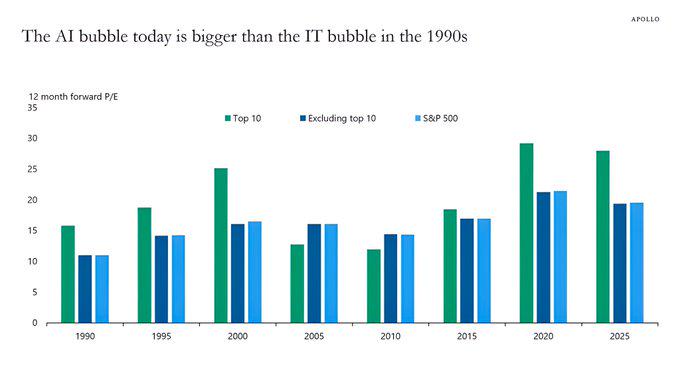
The next bubble, current #AI – #LLMs and ML #systems – is not intelligent. There is no path from these tools to general intelligence. What exists is pattern-matching, statistical correlation, and corporate extraction of public knowledge. But handing locked-up data to corporate systems strengthens anti-democracy structures. Instead of enabling “innovation”, it reinforces surveillance, centralisation, and algorithmic control. Real intelligence is collective, embodied, and social. True change and challenge emerges not from hype bubbles or closed corporate labs, but from communities building shared knowledge and infrastructure in the open.
Fascism vs. Cooperation – Fascism treats collaboration as weakness, hierarchy as inevitable, and domination as the only path to power. It cannot be trusted and cannot survive in open, cooperative networks. The #OMN path is the opposite: power through participation, resilience through trust, and flourishing through shared infrastructure. Communities that cooperate can sustain themselves, adapt, and grow, while isolationist, extractive paths, systems and tools wither. Cooperation is not optional, it is the foundation of any path to security, survival, and progress.
The choice before us, the world we inherited, is extractive, enclosed, and unsustainable. But the tools to reclaim power, knowledge, and community already exist. In #FOSS, the #4opens – applied to infrastructure, governance, culture, and knowledge – allow us to reduce inequality structurally, not through charity, but with rebuilding social trust and care, aligning human activity with ecological limits to make knowledge a public good, not a corporate asset.
Open Media Network is not a platform. It is a social path, to a world where power is distributed, knowledge is shared, and society is governed by the people who live in it. We are not asking for permission. We are building the commons, the question is not whether we can succeed, the question is whether we will choose to. History will remember what we did in this moment.
Why do we need to be this change and challange – when the vertical stack is captured, this is not simply a “shift to the right” in technology, ideas, or voting patterns. It is something deeper and far more dangerous: the capture of institutions themselves, the state as infrastructure. What we are witnessing is the hard right learning how to weaponise liberal, vertical systems against the values those systems claime to uphold.
This capture runs all the way down the stack. From the #dotcons to national governments and regulatory bodies; from university chancellors to local councils; from courts to media regulators. Structures that were designed – at least rhetorically – to mediate power are being repurposed as tools of repression, exclusion, and control.
Crucially, this is done using the language and procedures of liberalism itself: law and order, efficiency, neutral administration, security, common sense. The shell remains liberal. The content is no longer so.
Vertical systems are inherently brittle. They concentrate authority, normalise hierarchy, and rely on trust in institutions rather than participation in decision-making. When functioning well, they can stabilise society. When captured, they become perfect instruments for authoritarianism.
Once the hard right gains control of vertical institutions, it does not need to abolish democracy outright. Instead, it quietly redefines who counts, who is heard, and who is excluded. Algorithms are shaped. Funding rules tightened. Governance boards reshuffled. Enforcement priorities rewritten. Dissent is hollowed out while everything is insisted to be “within the rules.”
Universities become compliance factories. Local councils become enforcement arms. NGOs are defunded or disciplined. Media becomes “responsible.” Protest becomes “extremism.” This is not a breakdown of the liberal system, it is the system functioning as designed, but for different ends.
A dangerous illusion persists: that when the political pendulum swings back, these systems can simply be “returned to normal.” History tells us otherwise. Once vertical systems are captured, they are extremely difficult to bring back to any liberal-centrist path. Rules have been rewritten. Personnel replaced. Norms broken. Trust eroded. Appeals to fairness or precedent no longer land, because the system’s function has shifted from mediation to domination.
This is why “defending institutions” on its own is not enough. Institutions built on vertical authority cannot defend themselves once their legitimacy has been repurposed. At that point, asking them to save democracy is like asking a locked door to open itself from the outside.
Why horizontal power matters, and grassroots, federated power stops being a nice idea and becomes a necessary tool of change. Horizontal systems – commons-based networks, federated media, open governance, mutual aid, cooperative infrastructure – do not depend on permission from captured institutions. They distribute power, knowledge, and coordination across communities instead of concentrating it at the top.
In #OMN terms, this is about balancing power, not fantasising about purity, collapse, or revolution-as-spectacle. When vertical power becomes hostile, horizontal power provides resilience. It creates parallel capacities for communication, care, legitimacy, and collective action.
Federated systems are harder to capture because they have no single choke point. They can route around repression. They can survive attacks. They can continue to function even when formal institutions turn against the people they claim to represent.
We should be clear-eyed about where this leads. When vertical systems are captured and horizontal power is absent, pressure builds. History shows the likely outcomes: civil unrest, civil war, or international intervention. These are not abstract risks. They are structural consequences of power being monopolised without legitimacy.
Building horizontal power is not about accelerating conflict. It is about reducing the likelihood of catastrophic collapse by giving societies non-violent ways to rebalance power. When people have no voice, no access, and no agency, conflict becomes inevitable. When people can organise, communicate, and build alternatives, escalation can be resisted.
Its the strategic choice, the question is no longer whether horizontal power is desirable. The question is whether we build it before the remaining liberal structures are fully repurposed against us. The Open Media Network, the #4opens, federated governance, and open knowledge are not ideological luxuries. They are infrastructure for democratic survival in a world where vertical systems are increasingly hostile.
We are entering a period where balance – not dominance – will determine whether societies fracture or adapt. Horizontal power is what remains when the state forgets who it is meant to serve. Then the future will not be decided by who controls the top of the stack, but by whether people at the edges still have the means to organise, to speak, and to act together.
And that is a fight worth taking seriously, while there is still time.
Despite the constant #mainstreaming hype, the branding, and the trillions of dollars being poured into it, there is a simple reality that needs to be stated plainly: There is no intelligence in current “AI”, and there is no working path from today’s Large Language Models (#LLM) and Machine Learning (#ML) systems to anything resembling real, general intelligence.
What we are living through is not an intelligence revolution, it is a bubble – one we’ve seen many times before. The problem with this recurring mess is social, as a functioning democracy depends on the free flow of information. At its core, democracy is an information system, shared agreement that knowledge flows outward, to inform debate, shape collective decisions, and enable dissent. The wisdom of the many is meant to constrain the power of the few.
Over recent decades, we have done the opposite. We built ever more legal and digital locks to consolidate power in the hands of gatekeepers. Academic research, public data, scientific knowledge, and cultural memory have been locked behind paywalls and proprietary #dotcons platforms. The raw materials of our shared understanding, often created with public funding, have been enclosed, monetised, and sold back to the public for profit.
Now comes the next inversion. Under the banner of so-called #AI “training”, that same locked up knowledge has been handed wholesale to machines owned by a small number of corporations. These firms harvest, recombine, and extract value from it, while returning nothing to the commons. This is not a path to liberal “innovation”. It is the construction of anti-democratic, authoritarian power – and we do need to say this plainly.
A democracy that defers its knowledge to privately controlled algorithms becomes a spectator to its own already shaky governance. Knowledge is a public good, or democracy fails even harder than it already is.
Instead of knowledge flowing to the people, it flows upward into opaque black boxes. These closed custodians decide what is visible, what is profitable, and increasingly, what is treated as “truth”. This enclosure stacks neatly on top of twenty years of #dotcons social-control technologies, adding yet more layers of #techshit that we now need to compost.
Like the #dotcons before it, this was never really about copyright or efficiency. It is about whether knowledge is governed by openness or corporate capture, and therefore who knowledge is for. Knowledge is a #KISS prerequisite for any democratic path. A society cannot meaningfully debate science, policy, or justice if information is hidden behind paywalls and filtered through proprietary systems.
If we allow AI corporations to profit from mass appropriation of public knowledge while claiming immunity from accountability, we are choosing a future where access to understanding is governed by corporate power rather than democratic values.
How we treat knowledge – who can access it, who can build on it, and who is punished for sharing it – has become a direct test of our democratic commitments. We should be honest about what our current choices say about us in this ongoing mess.
The uncomfortable technical truth is this: general #AI is not going to emerge from current #LLM and ML systems – regardless of scale, compute, or investment. This has serious consequences. There is no coming step-change toward the “innovation” promised to investors, politicians, and corporate strategists, now or in any foreseeable future. The economic bubble beneath the hype matters because AI is currently propping up a fragile, fantasy economic reality. The return-on-investment investors are desperate for simply is not there.
So-called “AI agents”, beyond trivial and tightly constrained tasks, will default to being just more #dotcons tools of algorithmic control. Beyond that, thanks to the #geekproblem, they represent an escalating security nightmare, one in which attackers will always have the advantage over defenders, this #mainstreaming arms race will be endless and structurally unwinnable.
Yes, current #LLM systems do have useful applications, but they are narrow, specific, and limited. They do not justify the scale of capital being burned. There are no general-purpose deliverables coming to support the hype. At some point, the bubble will end – by explosion, implosion, or slow deflation.
What we can already predict, especially in the era of #climatechaos, is the lost opportunity cost. Vast financial, human, and institutional resources are being misallocated. When this collapses, the tech sector will be even more misshapen, and history suggests it will not be kind to workers, let alone the environment. This is the same old #deathcult pattern: speculation, enclosure, damage, and denial.
This moment is not about being “pro” or “anti” technology. It is about recognising that intelligence is social, contextual, embodied, and collective – and that no amount of #geekproblem statistical pattern-matching can replace that. It is about understanding that democracy cannot survive when knowledge is enclosed and mediated by #dotcons corporate capture beyond meaningful public control.
To recap: There is no intelligence in current #AI. There is no path to real AI from here. Pretending otherwise is not innovation – it is denial, producing yet more #techshit that we will eventually have to compost. Any sophist that argue otherwise need to be sacked if they arnt doing anything practical.
The only question is whether we use this moment to rebuild knowledge as a public good – or allow one more enclosure to harden around us. History – if it continues – will not be neutral about the answer.
There is a familiar voice resurfacing in today’s debates about the future of the web, its measured, reflective, earnest, often grey-bearded., and it has funding. These are the people who were there in the Web 2.0 era. The #Flickr builders. The early platform designers. The conference speakers who once talked about “community”, “social objects”, and “public infrastructure”. Many of them now occupy foundations, NGOs, advisory boards, and policy circles.
And they are doing something dangerous, as their thinking is too trapped inside capitalism. They are selling the #openweb reboot for a second time. Not maliciously. Not cynically. But from a place of deeply internalised capitalist thinking that they cannot – or will not – step outside.
The original Web 2.0 was built on a powerful lie, one many progressive people wanted to believe: That privately owned platforms could become public infrastructure. “social” media might actually mean social in a public, civic sense, that venture capital could somehow birth commons. As one of the original designers of Flickr puts it:
“We had sort of deluded ourselves into thinking in Web 2.0 that we were building public infrastructure.”
Yes. Exactly. But that delusion wasn’t accidental, it was structural, it came from trying to build public goods inside a system whose legal obligation is to maximise shareholder value. The moment scale arrived, the moment infrastructure emerged, the public was quietly enclosed. This wasn’t a failure of design, it was a failure of basic political economy.
The problem isn’t insight – it’s the frame – what makes the current moment frustrating isn’t that these voices lack insight. On the contrary: their analysis of algorithmic control, enclosure, loss of stewardship, and extractive business models is often sharp. The problem is where their thinking stops.
Again and again, the horizon of possibility remains trapped inside capitalism:
Regulation instead of abolition
Better governance instead of collective ownership
NGOs instead of grassroots power
“Public–private partnerships” instead of commons
Even when they correctly identify that platforms have become infrastructure, the proposed solutions remain managerial, institutional, and polite. The unspoken assumption is always the same, capitalism stays, “we” sand the sharp edges. This is the limit of their self-imposed view, and the danger we need to see is that this mirrors of the original sell-out and what makes this especially dangerous is that this thinking now takes up far more space than it deserves.
Just like in the Web 2.0 era, these voices dominate conferences, funding channels, policy conversations, and media narratives. Grassroots alternatives are marginalised as “naïve”, “unscalable”, or “too political”. This is abusive sidelining where the outcome at best is: Once again, we are told to be patient. Once again, we are told to trust institutions. Once again, the radical edges are smoothed away.
Different language, same enclosure. We see this agen with the #NGO trap and the illusion of stewardship, ones agen #foundations and #NGOs are presented as the solution. “Public product organisations”. “Stewardship entities”. Carefully designed governance models that still orbit state and capital power. The mess we need to see to compost is that NGOs are not the commons, they are buffers.
They absorb dissent, professionalise resistance, and translate radical demands into grant-safe language. They reproduce hierarchy while speaking the language of participation. This is not an accident, it is how capitalism metabolises critique.
This is why bridges keep collapsing, I have said my self: “Let’s build bridges. We need these people on side.” Yep, we’ve tried that, the problem is that when challenged – when the underlying mess is named – the response is not dialogue, its #blocking, muting, institutional silence, invitations withdrawn and funding evaporates.
This mess keeps tells us what we need to know, bridge-building only works when both sides are willing to move. When one side controls the platforms, the conferences, and the purse strings, “bridges” become assimilation pipelines.
So yes the path we need to take is compost, not deference, not cancellation, not personal attack. But refusing to let this thinking dominate the space again. Compost is how dead ideas become fertile ground for new growth. It is messy, uncomfortable, and necessary.
We don’t need another generation of politely regulated enclosures. We don’t need a warmed up Web 2.0, reboot with better language and worse outcomes.
We need:
Commons, not platforms
Collective ownership, not stewardship theatre
Grassroots infrastructure, not NGO mediation
We need the #4opens, not “ethical-ish” branding. The #openweb will not be rebooted by the same people, using the same frameworks, who helped bury it the first time.
If you want to bridge, comment and engage honestly.
There are meany online exchanges about software licences that can help to highlight the #geekproblem. Yep, these conversations can sound radical at first glance:
“Software licences won’t destroy capitalism, but if they can be even slightly annoying to capitalists in the meantime, I’ll take it.”
Fair. Nobody sensible thinks a licence clause will end capitalism. Making exploitation harder while working on the material conditions that allow it to exist is reasonable. But after this, the #geekproblem to often kicks in.
Very quickly, conversations collapses inward. Instead of asking what licences are for, or how they fit into a broader social strategy, we get trapped in internal debates about #GPL vs #AGPL, #FAANG legal departments, #FSF personalities, jurisdictional edge cases, and which licence is more “annoying”.
This is classic geek tunnel vision as the question shifts from power to mechanism, political outcomes to technical purity, and then collective strategy to individual preference and irritation. At this point, the original political intent is already lost.
Yes, saying “we should use licences that protect against FAANG abuses” doesn’t cut it. FAANGs aren’t a licensing problem, it’s a political and economic problem, they shouldn’t exist at all. Pouring huge amounts of energy into licence debates while quietly forgetting the actual goal of changing the social and economic conditions that make enclosure, extraction, and platform dominance possible.
This is why #FOSS needs to be socialised, licences are tools, not politics, they only matter insofar as they support collective power, shared infrastructure, and commons-based production. When they become identity markers, moral badges and endless argument fuel, they stop being useful and start becoming obstacles.
The #4opens framework exists to cut through this mess. Not to find the “perfect” licence, but to ask simpler, grounded questions:
Is the code open?
Is the process open?
Is the governance open?
Is the outcome open and reusable?
If those aren’t true, arguing about GPL vs AGPL is mostly noise.
The #dotcons cannot be fixed by clever licensing. And the #fashionistas endlessly flocking to new “ethical-ish” platforms aren’t helping either. What matters is building native, grassroots, public-first infrastructure, and keeping our eyes on that horizon.
So please, use licences tactically, sure. Make capital’s life harder where you can. But don’t confuse irritation with transformation. That confusion – mistaking technical manoeuvring for political progress – is the heart of the #geekproblem.
Long live the GPL, AGPL, or whatever works in context. But without social organisation, collective ownership, and open governance, they’re just paperwork in a burning world.
In the current #mainstreaming mess, liberalism – like its phonetically similar cousin libertarianism – isn’t a coherent political philosophy. It’s a bundle of aesthetics and vibes that a professional class has used as a moral identity. A sacred story: free expression, a “marketplace of ideas,” rational debate gently shepherding society toward progress. In theory, in practice, it’s bullshit – and what happened around Gaza exposed this brutally clearly.
For the last few hundred years, liberal states used police violence, infiltration, and false-flag tactics to reframe domestic protests they dislike as “riots.” The script rarely changes: protesters are framed as disorderly, violent, irresponsible, which then forces the state to respond with tear gas, batons, rubber bullets, and mounted charges. And, conveniently, these protests are almost always leftist, anti-capitalist, and anti-racist. A coincidence, if you’re feeling generous. What made liberalism tolerable to many wasn’t the absence of violence – it was the aesthetics of regret that accompanied it.
“If only they hadn’t violated the permit.” “If only they hadn’t broken that window.” “You made us do this.”
This performance preserved the illusion that repression was an unfortunate exception rather than a structural feature of liberal governance. With anti-genocide protests, that illusion collapsed. There was no regret, just open state violence. Something about criticising Israel short-circuited the liberal self-image across the political class – from presidents to mayors to university administrators. The aesthetics of principle vanished the moment those principles became inconvenient.
So the violence was let loose, publicly and unapologetically. And then they went further, in the so-called “liberal” West, speech itself was criminalised. Anti-Zionist and anti-genocide speech was redefined as illegal, then extremist, then terrorist. Careers were ended, students were expelled, workers were fired, and entire movements were placed under sanction. This from an ideology famous for repeating: “I disapprove of what you say, but I will defend to the death your right to say it.” Turns out that line was always branding, not belief.
If you look honestly at liberalism’s history, punishing speech isn’t an aberration – it’s a pattern. From the Red Scares to COINTELPRO to the violent suppression of student protests in the UK, liberal states have always crushed dissent when it threatened capital or empire. What’s new isn’t the repression. It’s how openly it’s now done, in an era of visible collapse.
To be clear, many good people, with good intentions, supported speech-regulating frameworks. Some limited, local improvements did come from this. But Gaza (and Trump II) stripped the illusion bare: these systems were never neutral, and they were never safe. When the state gets to define “hate speech,” it can define what we hate. When the state gets to define “terrorism,” it can define anyone as a terrorist.
Corporations followed smoothly, shifting definitions depending on who holds power. One day, it’s anti-genocide activists being fired. The next, it’s entire #DEI departments. Same tools, different targets. We need to say clearly: Anti-racist speech is not racist hate speech. Anti-genocide and anti-Zionist speech is not antisemitic.
The issue isn’t opposing hate. The issue is how quickly and comfortably liberals abandoned the full text of their own ideals the moment those ideals required material courage. This isn’t a Gaza-only problem, Gaza just stripped away the mask.
What we’re seeing, again, is a familiar: systems of oppression built with “good intentions” are repurposed into systems of repression under new management, same machinery, slightly different branding, same core users. That’s why this matters. Because the tools liberals built to “manage” society – to enforce compliance, regulate speech, and discipline dissent – are now being effortlessly redirected. And they will keep being redirected, because that’s what vertical systems do.
It’s almost like the current #mainstreaming isn’t how you liberate people. If you really want to understand how the actually-existing mess works, here’s the metaphor liberals refuse to face: You don’t deal with a mafia organisation by issuing fines per offence. You deal with it by dismantling the organisation – jailing leaders, seizing assets, and breaking the power structures entirely. Anything less is vibes, aesthetics, and the comforting fiction that this time the vertical system will behave itself.
Let’s look at a current issue that is in the news. The Americas have long been treated as a natural U.S. sphere of influence. From early Monroe Doctrine interventions to modern political pressure, the region has been viewed as a geopolitical backyard. Today, with Trump and MAGA pushing renewed U.S. dominance, countries in the region face stark choices: resist, align, or integrate into alternative power structures.
The elitist foreign policy message is blunt: secure U.S. primacy in its hemisphere. For Latin American nations, this translates into pressure on trade, security agreements, and political alignment. Economic coercion and direct military action ensures that Washington tolerates no rival power. Nations are either “on the table” with the U.S. or “on the menu.” As the resent actions in Venezuela shows this is not theoretical, the current geopolitical mess is actively pushing realignment. Latin America cannot afford to wait passively in Washington’s shadow, they must push to act as equal players in a multipolar world.
The driving force behind this renewed mess is Trump’s appeal to disruption. He promises to expose the “deep state,” hold elites accountable, and reveal connections the system would rather hide. Central to this narrative is the saga of Jeffrey Epstein, not merely a story of sexual scandal, but a window into systemic flaws in U.S. political and economic structures.
Trump’s supporters rallied around promises to release files, expose corruption, and challenge entrenched elites. Yet, frustration grew when these promises went unfulfilled. Why? Because the Republican and Democratic establishments are two faces of the same system, bound by shared economic interests, financial incentives, and structural constraints. Trump may disrupt in style, but the underlying power of money and influence remains dominant.
Observers liken Russia to “a giant gas station disguised as a state.” The U.S. is equally artificial: “a giant corporation packaged as a country.” Its factions – Wall Street, Silicon Valley, the military-industrial complex – function like corporate departments pursuing profit and influence above public welfare.
The Epstein case reveals two truths. First, the U.S. system forces actors to operate through illicit or extra-legal channels to achieve objectives. Second, these shadow networks persist, shifting focus from national survival to maximizing elite power at society’s expense. Epstein and his network were not anomalies; they reflect a collective ethos of the financial and political class, where mutual protection and the pursuit of power override accountability and any public interest. In practice, money dominates governance.
Trump’s struggles with Epstein files, and his unfulfilled promises, expose a messy reality: American political power is subordinate to financial power. The #MAGA base seeks disruption, but structural flaws – subordination to money, fragmented institutions, entrenched networks – ensure continuity, not change. The lesson is clear: individuals matter less than the systems that shape societies. Epstein is a mirror reflecting decades of dysfunction of unaccountable power, which always tries to find a way of self-preservation.
Historically, by the late 20th century, U.S. decision-making increasingly served elitist financial interests rather than any public welfare. Power is privatized, corporations, banks, and tech companies operated globally with more influence than elected officials. Media and entertainment reinforced the myth of American exceptionalism, masking the nasty rot we all smell today.
Fast-forward: infrastructure decays, inequality shapes democracy, and geopolitical overreach drains resources while sowing instability abroad. Financial dominance is a trap. What we are seeing now is that short-term advantage of prioritizing money over human welfare eventually fails socially, environmentally, and politically.
The structural mess in the U.S. – inefficiency, financial dominance, and overreach – doesn’t exist in isolation. It ripples globally, fuelling ecological collapse, social instability, and geopolitical crises. Global dominance built on US short-term advantage now amplifies globe systemic fragility. We face, climate disasters increase migration and resource conflicts; inequality that erodes collective response and political polarization and financial concentration block any meaningful reform.
So what can we do? For alternatives, the lesson is urgent: systems-first thinking is essential. Resilient infrastructure, distributed governance, and adaptive processes matter more than relying on individuals or short-term wins. Localized action paired with global awareness creates networks rooted in communities but informed by global interconnections. Transparency and accountability prevent shadow networks from embedding fragility.
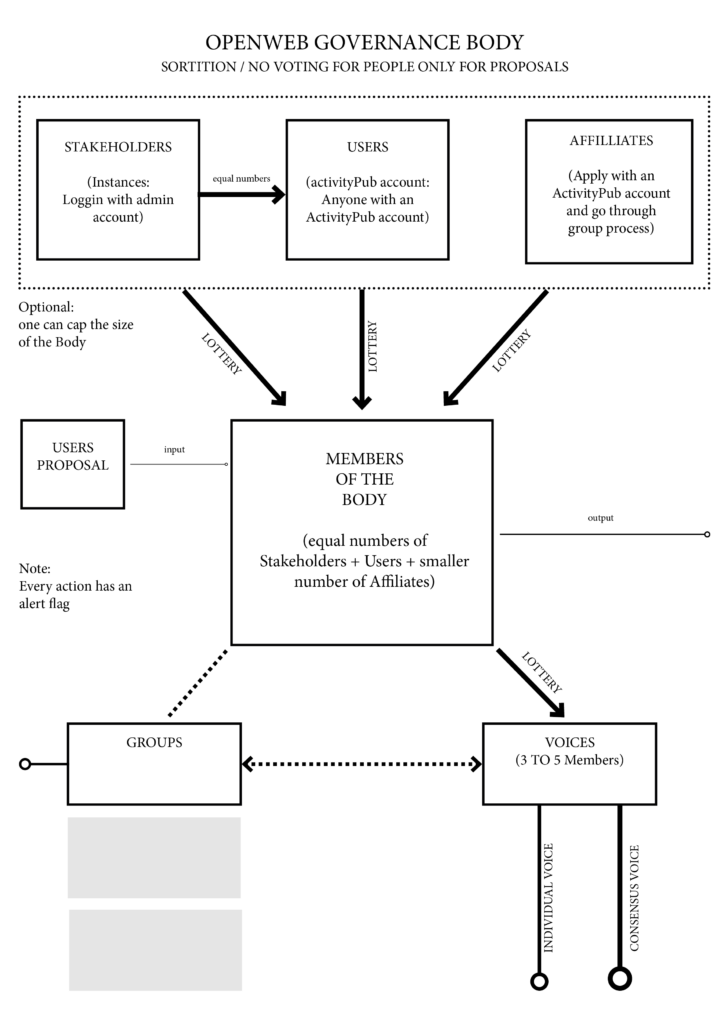
This is where movements like #OMN and frameworks like the Open Governance Body (#OGB) come into play. They model resilient, permissionless, decentralized networks:
Transparent decision-making ensures accountability without central policing.
Horizontal engagement with lightweight coordination outperforms rigid hierarchies under stress.
Decentralized media (#indymediaback) feeds local stories into federated networks, resisting co-option.
Iterative, adaptive growth – test, fail, adapt – turns mess into learning and redundancy, building resilience rather than fragility.
Practical principles for grassroots networks:
Distributed communication systems: Coordination survives disruption.
Layered decision-making: Local autonomy with broader coordination.
Resource buffers: Food, water, energy, knowledge accessible to communities.
Graceful degradation: Even if parts fails, the system endures. These networks are not utopian. They scale horizontally, embed ethics into their structures, and grow through “composting” rather than conquest by absorbing lessons from failure while remaining adaptable.
In short, we need to focus on what matters, not the surface mess of Epstein and daily #MAGA insanity, the Trump show is noise when we need to be focusing on signal.
The future belongs to paths and networks that embrace mess and nurture resilience, not centralizing powers clinging to short-term dominance. The work now is to create #KISS paths that survive – and even thrive – amid global crises.
Consensus matters – but it’s so hard – collective projects, media, activism and infrastructure require a minimum level of agreement about what the problem is. Not total agreement, but enough shared reality to coordinate sustainable action. Without some form of shared external social truth, progressive projects do not move at all, this is not always because people are malicious, but more often because they are no longer standing on any shared ground. This mess, is a problem, as it means needed paths keep being blocked.
We are living in a post-truth world, but that phrase hides the real problem. The deeper issue is that too meany people are fighting private battles inside their own heads – about identity, status, belonging, fear, and control – and then projecting those battles onto the social world around them. These internal conflicts are treated as universal truths, so when challenged, they harden rather than soften, this is the mess we need to compost. This is why so many conversations that should lead to collective action instead collapse into friction, blinded misunderstanding, and burnout.
In the absence of this, every proposal becomes personal: Critique feels like attack, needed structure feels like control, boundaries feel like exclusion. The result is paralysis disguised as debate, it is not accidental, it is the #dotcons cultural outcome of decades of individualisation, platform capitalism, and algorithmic amplification of conflict. This created mess blocks any progress, including an inability to talk clearly about why existing systems fail, what we have to put up with is constant triggering of defensiveness and rejection.
Two recurring patterns surface here, the “geek problem”: an over-focus on tools, optimisation, and abstract purity, detached from any useful lived social reality. The “fashionista problem”: an over-focus on language, image, and alignment with dominant narratives, avoiding any useful structural conflict. The problem is that if you don’t see these patterns, the current media ecosystem mess looks “natural” and inevitable. If you do see them, the need for something like #OMN becomes much more obvious, thus the hashtag story as a tool some people might understand this path
Why this keeps turning into conflict, it is not really about tone, vocabulary, or even definitions. It is about where responsibility sits, some people want problems softened so they feel welcoming. Others insist problems must be named clearly, or they cannot be solved. Both impulses sometimes come from good places. But when clarity is treated as hostility, and comfort is treated as progress, nothing moves. People disengage, energy drains away, the needed projects stall.
This is all mixed up in a Chicken-and-Egg trap. Outreach is hard because #OMN deliberately refuses to do certain things: It avoids central control, it avoids “common sense” corporate mediation, it avoids vague and easy “platform” path promises. This makes it difficult to write promotional text without either: Over-promising things that don’t exist, or explaining constraints that sound negative without context. To try and compost this chicken-and-egg problem, we need shared understanding to communicate simply, but we need communication to build shared understanding. Can you see the mess from this?
We use hashtags as scaffolding for the needed social truth, not as slogans, but as scaffolding, lightweight markers that point to recurring structural issues: #geekproblem#fashernista#dotcons#blocking are not insults. They are shorthand for patterns that otherwise take pages to explain. But, without shared context, they are still easily misread as personal attacks. Again we face #blocking.
So what can actually help? If #OMN is to happen, we need to change how we resolve these moments of friction. Collective projects do not grow by consensus with everyone, so we need to build shared language gradually, not defensively, social truth is cultivated, not imposed. A first step is #KISS stop treating discomfort as failure, discomfort is often the signal that something real is being touched.
The hard truth, is that no one is obliged to participate, nobody has to do anything. But collective alternatives do not appear by magic. They are built by people willing to sit with tension long enough to let something shared emerge. OMN is an attempt to do that, to move from affinity groups from isolated personal wars toward media commons where cooperation is once again possible.
The #blocking is real, but so is the way through it, if we stop mistaking friction for hostility, and clarity for aggression. The work is not to be nicer, it is to be collective again.
From a #mainstreaming point of view, what people call “piracy” is not a simple moral failure, it’s rather a signal of systemic #dotcons failure. Again and again, across decades, people have shown a simple truth: When access is fair, affordable, and humane, people pay. When systems become extractive, people route around them.
This is not new, not edgy, it’s basic social behaviour. Before the Internet: we had Informal commons, cassette copying, vinyl bootlegs, tape trading networks, these were not experienced as “theft” by the people who did this – they were social distribution systems, low-scale, trust-based, culturally embedded, limited by friction. They existed alongside markets, artists still toured, labels still made money, culture still flowed.
This was a pre-digital common, tolerated because it couldn’t scale enough to threaten capital. Then came the first native digital implementation. Napster originally wasn’t thought of as a crime, but was turned into a real fork in the road when Napster didn’t invent piracy, it simply removed friction and exposed the contradiction.
Napster was an early, messy, accidental example of what open distribution could have become if shaped by public-interest values rather than VC mess. What panicked the industry wasn’t copying – it was loss of control. Two paths were possible:
Adapt to abundance, treat sharing as promotion, build fair access + fair reward, except that copying is native to digital culture.
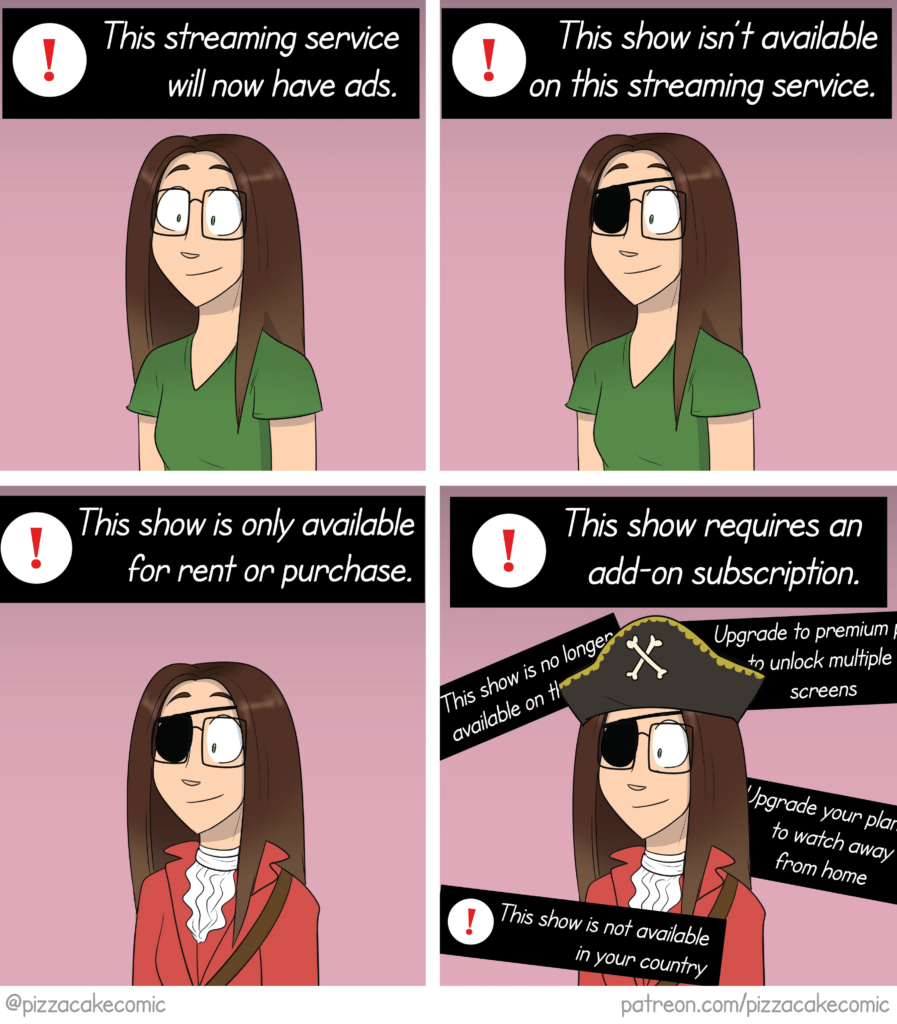
They chose the second, before they shift to the working subscription “solution” This turned into a temporary truce in the that #dotcons streaming worked, briefly, because it aligned with human behaviour: convenience, simplicity, predictable cost, “good enough” access. This reduced piracy, not because people became more ethical, but because the service stopped being so hostile. This is crucial, piracy goes down when #mainstreaming systems respect users.
Though this did not last, the pushing of the #dotcons (#enshittification) broke the social contract, now we’re seeing a piracy resurgence – due to legitimacy collapse. Platforms: fragmented access, raised prices, removed ownership, revoked sharing, erased archives and locked culture behind licences. The normal mess that you don’t own culture any more, you rent permission until it’s revoked.
People don’t won’t this enclosure of culture and memory “if buying isn’t owning, pirating isn’t stealing” isn’t only edgy internet logic, it’s a commons’ logic. It says: ownership has been broken, legitimacy has been lost, people are reclaiming agency informally. This is exactly how commons historically re-emerge, outside broken institutions, not through them. So from any seasonable mainstreaming view, Piracy Isn’t Anti-Artist – It’s Anti-Bullshit, a service problem, it’s what happens when distribution is controlled instead of shared.
Where #OMN fits, the Open Media Network is not about simply justifying piracy. It’s about removing the need for it by rebuilding: public-first distribution, shared infrastructure, local publishing, federated archives, cultural memory that can’t be revoked, trust instead of DRM, access without enclosure, communing.
Culture needs to be: easy to access, hard to erase, socially rooted, economically plural, governed in the open. When those conditions exist, piracy fades into the background, not because people are policed, but because the system stops being abusive.
Piracy Is the smoke – enclosure Is the fire – the historical arc looks like this:
informal sharing → tolerated
digital abundance → panic
platform compromise → temporary calm
enclosure + extraction → rebellion
From this view, people aren’t becoming criminals, they’re disobedient consumers because consumption has become hostile. What people need to see in this mess is that Piracy isn’t the future, it’s a warning flare. The future is rebuilding open, shared, accountable media infrastructure so that: artists are supported, culture persists, access is normal, and people don’t have to choose between legality and dignity. That’s not nostalgia, it’s the unfinished business from the original #openweb.
A path to do this is to step away from the #mainstreming mess. In 2024, the Nobel Prize in Economics was awarded to Daron Acemoglu, Simon Johnson, and James Robinson. The prize recognised their work on how institutions shape prosperity, most famously through their book Why Nations Fail. The timing matters, it matters a lot.
This award lands at exactly the moment we should be asking why Institutional Economics – the respectable face of #mainstreaming – has spent the last fifteen years pushing us to keep kneeling at the altar of the #deathcult of #neoliberalism.
For more than a decade after the 2008 financial crisis – a crisis that should have finished neoliberal economics for good – our liberal institutions quietly stepped in to rescue the doctrine. Not by defending it openly, but by reframing its failures. This wasn’t accidental. It’s central to the mess we’re living in now.
The 2008 crash began with the collapse of Lehman Brothers and rapidly spread from finance into the real economy. It triggered the largest global contraction since World War II. Advanced economies saw GDP falls of over 10%. In the US alone, more than $16 trillion in household wealth vanished.
The shock was so extreme that Queen Elizabeth II famously asked economists at the London School of Economics why nobody had seen it coming, the profession replied that it was a “failure of the collective imagination”. That answer was revealing and evasive. Because imagination hadn’t been lacking before the crash. Throughout the 1990s and early 2000s, #neoliberalism dominated economics. Its core beliefs were simple, absolute, and aggressively enforced:
Markets are efficient
Deregulation increases productivity
Financial innovation reduces risk
Macroeconomic instability has been solved
These ideas were institutionalised across universities, central banks, and international organisations. Nobel Prizes were handed out to models built on perfectly rational actors and self-correcting markets. Central bankers talked confidently about a “Great Moderation”: stable inflation, steady growth, forever.
Economics became “scientific”, self-referential, and closed to challenge. This wasn’t wisdom, it was a pile of shit built on mathematical abstraction – a classic #geekproblem – detached from lived social reality. Financial fantasies were celebrated. Subprime mortgages were reframed as inclusion. Mortgage-backed securities were said to spread risk. Collateralised debt obligations were hailed as marvels of modern finance.
They were, in reality, weapons of mass financial destruction. The #deathcult was warming up. When the system collapsed, neoliberal economics should have been held to account. No theory in modern history had failed so completely, so quickly, with such devastating consequences. Instead, it reinvented itself.
The first move was redefinition. Under the Obama administration, the US abandoned laissez-faire dogma overnight. Banks were declared “systemically important”. Corporations were bailed out. Trillions were injected into markets through quantitative easing. Socialism for the rich was revealed as normal.
This should have been the moment it became obvious that #neoliberalism was never about principles. It was always about power. Markets, models, and theories were tools – not truths – used to maintain capital’s dominance over society. But what we got was the normal mess of denial, spin, and fragmentation.
Once stability returned, denial followed. Economists claimed victory. The crisis was blamed on interest rates, oil prices, China’s savings – anything except the theory itself. The line became: “The models failed to predict the crisis, but the solutions worked.” That sleight of hand kept neoliberalism alive.
Instead of lifting our heads and walking away, we fell for the smoke and mirrors. The priesthood fragmented neoliberalism into subfields, and our #fashionista classes filled the space. Game theory analysed distressed financial institutions without asking why they were distressed. Behavioural economics blamed low-income borrowers’ “biases” while ignoring policies that made housing unaffordable. Feminist economics debated unpaid labour while leaving capital accumulation untouched.
Each critique was partial. Each acted as a distraction. None threatened the altar we were still collectively worshipping. The strongest shield, however, came from Institutional Economics – the respectable centre of #mainstreaming liberal thought.
Why, Why Nations Fail succeeds, it “common sense” argues that prosperity comes from “inclusive institutions” – markets, property rights, patents – supported by political institutions like democracy and the rule of law. “Extractive institutions”, we’re told, lead to stagnation.
This framework was easy to accept in the common-sense fog of the #fashionista class. It sounded critical while leaving capitalism intact. Weak, procedural democracy was sold as the mechanism that could tame markets.
What it ignored – completely – is that democracy inside highly unequal societies is easily captured by capital. Elections reproduce power relations far more often than they correct them. By declaring any market outcome produced through elections legitimate, the #nastyfew who this mess served grabbed and twisted “democratic” approval.
At a moment of global instability – Eurozone debt crises, austerity, mass unemployment – #mainstreaming economics offered a comforting story: the problem wasn’t capitalism, just “bad institutions”.
The reality on the ground, in Europe, austerity devastated entire societies. Greece lost over a quarter of its GDP. Youth unemployment passed 50%. Public assets were stripped. Debt increased. Today, a six-day work week is framed as “responsibility”.
In the United States, recovery was brutally unequal. Between 2009 and 2019, the top 1% captured 40% of all income growth. Asset prices exploded while wages stagnated. Private equity gutted industries. In the world of the #dotcons, gig work replaced stability. Neoliberalism didn’t retreat. It consolidated.
There was, however, a different path. China – worshipping a different cult – ignored neoliberal assumptions after 2008. Instead of monetary inflation, it pursued fiscal stimulus, infrastructure investment, R&D, and industrial policy. Growth remained high. Manufacturing expanded. Living standards improved. China became the world’s largest economy by purchasing power parity more than a decade ago.
Western institutions urged “liberalisation”, framed through #mainstreaming economics. Political reform was demanded – meaning access for Western capital. China refused. When China’s property bubble burst in 2021, contagion was contained. Capital was redirected into technology and manufacturing. Industrial dominance accelerated.
This success could not be acknowledged, so institutional economics reframed it as “extractive”, unsustainable, and destined to collapse. Yet the facts contradict the story. Inequality is far higher in the US. China’s overproduction lowers global prices and stabilises living standards. Without it, global inequality would already be politically explosive.
So why are we still stuck, #Neoliberalism survives not because it works, but because it controls the story of what is possible. It offers legitimacy without transformation, democracy without redistribution, reform without power shifts.
Worse, over the last forty years it has reshaped education, work, identity, and the value of human life itself. It trained people to see themselves as assets, competitors, and risks. It normalised insecurity and abstraction. That’s why we’re facing collapse now: a system that has exhausted its social, ecological, and moral foundations.
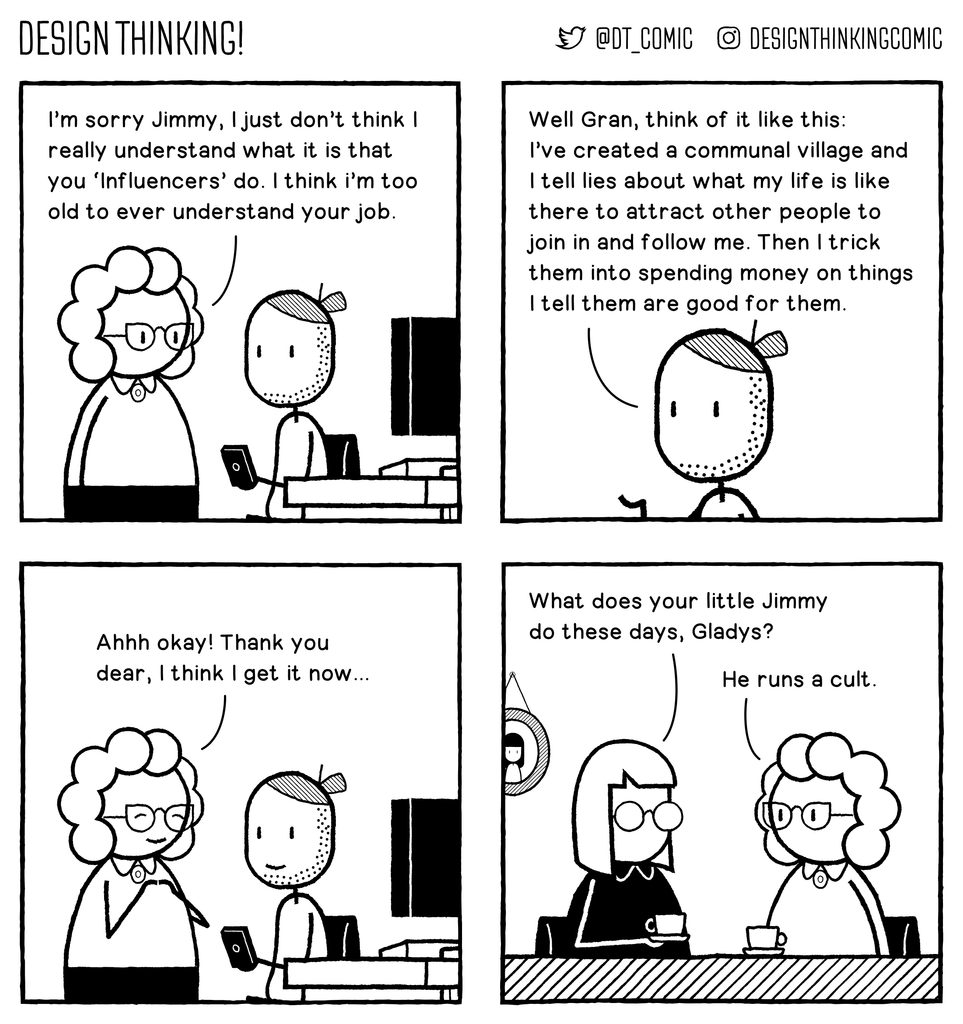
In our worship of the #deathcult, if you strip away the robes, chants, and charismatic leaders, what remains is behaviour, not belief. A destructive cult is not defined by how strange it sounds, but by what it does to bodies, lives, and futures. This matters because it breaks a common illusion: cults are judged by outcomes, not vibes.
So the real question for our #mainstreaming culture is simple: does this system produce harm through deliberate collective action? If the answer is yes, then whatever it calls itself – religion, nation, corporation, ideology – it is functioning as a destructive cult. Scale does not absolve cult behaviour. One of the biggest blocks to clear thinking is the assumption that cults are small or fringe. History shows the opposite: the most destructive cults are large, normalised, institutional, and framed as “common sense”.
When harm is routinised, bureaucratised, and abstracted, people stop recognising it as cult behaviour. Violence becomes “policy”. Death becomes an “externality”. Injury becomes a “necessary sacrifice”. This is why the #deathcult framing lands so sharply – it cuts through the language that hides responsibility.
Seen this way, our current #mainstreaming clearly qualifies. It knowingly produces mass injury and death, continues despite overwhelming evidence of harm, treats that harm as acceptable or unavoidable, and disciplines or excludes those who challenge its logic. At that point, it meets the functional definition of a destructive cult.
The justification doesn’t matter – profit, security, growth, markets, “realism”, inevitability. The outcomes are the same: climate collapse, preventable poverty, war, border violence, structural neglect. All normalised. All defended. All repeated. This is not accidental; it is deliberate action within a shared belief system.
People resist this #KISS framing because calling a system a cult feels offensive. It threatens identity, exposes complicity, and removes the comfort of neutrality. So instead, people argue about tone, civility, process, or “both sides”. These debates avoid the harder question: what are we part of that is actively harming people, and why do we keep participating?
This connects directly to the #OMN project. The Open Media Network is not about labelling individuals as evil. It is about withdrawing legitimacy from systems that normalise harm, and rebuilding media and social infrastructure that makes harm visible, allows challenge without erasure, documents action rather than just opinion, and restores collective memory.
When journalism collapses into PR and outrage, cults thrive. When media becomes operational again, cult logic weakens. The uncomfortable truth is that destructive cults are not defeated by exposing hypocrisy, debating beliefs, policing language, or demanding safety from discomfort. They are defeated by refusing participation, building parallel systems, making outcomes visible, and acting collectively outside their framing.
That is not comfortable. It is not safe. But it is how people stop being members of something that kills – and why the #deathcult framing matters.