Tension, Open and Closed Web

From its very minority creation, the spreading internet and World Wide Web has been shaped by two competing, often overlapping visions:

The collaborative, #openweb: Rooted in #DNA of post apocalyptical internet code and culture, this vision is of a network for collaboration, sharing, and free exchange of information. Built for use in a world of abundance of information, free as in free beer. Emphasizes , creativity, and collective creation, associated with “native geek culture” and what can be understood as radical/anarchist libertarian thinking.

The commercial, #closedweb: The approach of companies like Microsoft under Bill Gates, and late stage google, focuses on monetization and commercial viability of the internet. Fixated on fear of sustainability, profitability, and the economics of running online platforms in a scarcity based world.

The Internet inherent democratization and egalitarianism allows everyone to create and share content. However, this ideal clashes with the pushing of commercial control, to monetize user data and interactions. This #open path empowers people to distribute their work, share ideas, and bypass traditional gatekeepers. The web transforms education and information access to synthesizing vast resources needed for a different view of society. From the #closedweb prospective, you have fear, simply fear.

The #openweb remains a battleground between these feelings, of openness and the pushing of fear. While it has worked to democratized content creation and access, the existing economic models to sustain this ecosystem are a toxic mess. The ongoing tension shapes society both online and offline, yes it’s a mess.

Why we so often can’t see or do much about this mess is that our #geekproblem have disproportionate control over resources and decisions. This leads to blinded “#feudalism” that bypass democratic processes and accountability. This is equally a “problem” in grassroots #FOSS and corporate #dotcons, as they share the same mindset.

A part of the #openweb is a move to re-evaluate the relationship between “control”, wealth, power, and social change. But currently we have no clear way to talk about this issue from the limited, narrow “problem” in geek culture. So have little way to mediate the #closedweb of the groups who “succeed” in capitalist #mainstreaming, who are actually the worst equipped to solve the problems that the system creates.


UPDATE https://www.theregister.com/2024/10/25/opinion_open_washing/ this is playing out here.

What names to use?

From a grassroots #DIY tech perspective, most of our #openweb #fashionistas are part of the problem, not because they have much real-world impact – they don’t – but because they dominate the conversation and soak up the space needed for practical paths and projects. We need less #techshit and #techchurn, and more tools that communities use. The is a simple way to compost the noise and focus on what matters: building trust-based, working infrastructure.

A useful step for this is that words shape how we think, that if we can’t share, common meanings, we end up talking past each other, as ideology sits underneath all thinking, the dominant ideology becomes invisible as “common sense”, while alternatives are dismissed as unrealistic, extreme, or fringe. That’s how #mainstreaming works – it hides its own assumptions while demanding everyone else justify theirs.

If we want change, our job isn’t simply to oppose the mainstream, it’s to make better ideas become the new common sense. That’s why the current centrist agenda is such a dead end. It created many of the crises we’re now living through, yet it continues to defend the same assumptions that produced them. Pity won’t fix this, and hate only deepens the divide. We need practical paths that help people step outside this “common sense” trap.

This is where the comes in, it’s a simple framework that helps us compost the noise and focus on what matters: projects with open data, open source, open standards and – most importantly – open process. Together these build trust, which is the real foundation of any commons. The goal isn’t to win arguments, it’s to create working alternatives that people can use, improve and govern together. That’s how ideas stop being fringe and start becoming common sense.

The term #openweb describes a social/tech ecosystem for the internet rooted in decentralization, interoperability, and community-driven values. It embodies the – open data, open source, open standards, and open process. This stands in contrast to the #closedweb of the #dotcons, whose platforms are centralized and proprietary, and the broader #mainstreaming of the internet, which has a strong tendency to replicate closed, corporate models. The #openweb offers a fundamentally different vision for the future, both for the web and the society it shapes.

In this landscape, the #Fediverse is an example of decentralized networking. Built on the protocol #ActivityPub, it enables people and communities across different platforms to interact seamlessly. Codebases like #Mastodon, #PeerTube, and #Pixelfed serve as alternatives to corporate platforms, Twitter, YouTube, and Instagram, offering a more ethical, people-centric path for people to walk.

For more technical or geeky conversations, the term #web1.5 is useful. It acts as a buffer against the confusion and hype of #web3 and the #encryptionist obsession with blockchain-driven solutions that miss the social dimension.

When communicating with broader or more mainstream people, talking about the Fediverse can be tricky. In many cases, simply saying “Mastodon” is enough. As the most recognizable platform in the Fediverse, it serves as a useful gateway for those unfamiliar with decentralized technologies, yet curious to explore alternatives to Big Tech.

Ultimately, terminology should match context and audience. Whether you’re deep in conversation with fellow geeks or introducing someone new to decentralized spaces, choosing the right term can make all the difference in clarity and accessibility.

Of course, tribalism within these communities can sometimes make things harder than necessary. A gentle reminder applies here: don’t be a prat. Shared understanding matters more than gatekeeping.

Current messy thinking

Pushing defederation from #meta is not wrong in sentiment, the #dotcons are vile and cons. But is wrong from a practical sense. The #Fediverse and #ActivityPub are #openweb based on , this is a space where you do not have technical tools for stopping the #dotcons from taking the data, as the data in the end is in the open, unencrypted, in the database, in #RSS and in open flows.

The people who push the idea of closed are fighting for the #closedweb on a “native” #openweb platform. This makes no sense at all, incoherences everywhere, a lot of mess over the last 40 years that we need to compost.

There are likely good, useful motivation for unfederating from the #dotcons let’s be motivated by them please.

Who is making the shovel #OMN

Building trust in the #openweb

The #openweb is a framework for human-centric, decentralized technologies built on transparency and collaboration. Its success hinges on trust, and as a slogan suggests, “Technology’s job is to hold the trust in place.” This concept is woven into the #OMN and #OGB initiatives, which emphasize community-driven decision-making and adherence to the principles.

#OGB and consensus, decisions are valid when a wide group of engaged participants achieves consensus. This safeguards against the normal invisible authoritarian control, single individual find it hard to dominate because the collective create and validate the decisions. Trust groups, not individuals, are the seat of power, ensuring better decision-making and accountability.

The role of , open process, open data, open licences, and open standards—acts as “gatekeepers” for technological decisions. #Openprocess ensures inclusivity and transparency, blocking decisions that don’t involve public participation. #Opendata guarantees that shared information is accessible, reducing the potential for siloed control. #Openlicenses prevent restrictive ownership that could undermine collaboration. #Openstandards resist fragmentation and force adherence to balance collaborative practices and individual paths. This “soft, swishy” approach avoids rigid authoritarian structures while maintaining #KISS robust, “enforceable” values.

let’s look at challenges and strategies for #OMN combatting #mainstreaming “common sense” practices that erode grassroots values. By build strong defaults into projects and hardcode the principles to keep them central. To make this happen, let’s try and stay polite and inclusive during outreach, avoiding burnout and adding mess through conflict.

Dealing with #fahernistas and trust issues, a significant challenge arises from people and groups who appear trustworthy due to their #mainstreaming tactics but ultimately undermine the values of the #openweb. Coders and contributors need to align with #KISS social change goals, ensuring a grassroots and horizontal approach to development, this is basic.

To do this, we need to work on sustainability efforts by avoid overloading projects with unnecessary features, “How does this fit into the ?”. One path is to balance “friction” as a positive filter for misguided additions, while maintaining a welcoming environment for constructive collaboration.

Building a future beyond the #geekproblem, the “problem” originates from early open-source projects that #block the social dimensions of their technologies. By integrating the and prioritizing trust networks, the #openweb can (re)evolve into a human value network rather than a technological dead-end.

The #deathcult feeding off the decay of the #openweb perpetuates centralized and exploitative systems. All our activism is about, focusing on planting seeds for a grassroots rebirth, #nothingnew is a starting point, returning focus on modernist principles—clear goals, collective action, and systemic solutions—provides a foundation to grow #somethingnew.

The #openweb vs. #closedweb debate is not new, but it remains a critical narrative. By holding technology accountable to trust and community values, we create tools that empower rather than exploit. The #OMN and #OGB projects embody this path.

For those interested in coding for change, visit the OMN wiki and join the effort to make this vision a reality, please. Or you can donate some funding here if you don’t feel confident with tech path.

The mess we made with the #dotcons

The #dotcons are designed for greed and selfishness. Everything about them feeds this and, in turn, feeds off it. This negative path is hard-coded deep into their architecture. They cannot be fixed.

The rebooting of the #openweb is the good path we have taken. Copying worked well for the first step – it let us get moving. But for the next step, we need to move past the simple replication of the current #mainstreaming mess. We cannot reboot alternatives by simply copying #dotcons in #FOSS, as we have too often done in the #Fediverse.

The next step needs to be more native to the path we have started down. Let’s thank the people who copied. Let’s give them statues and security – they did us all a service. They deserve gratitude for this first step, not hatred. But we cannot stop there.

The mess of the #dotcons. Take the example of Twitter’s fall. What began as a #neoliberal platform – deregulated, market-driven, profit-focused – has slid into a space with growing fascist tendencies under Elon Musk. This is not an accident. It’s a stark reminder of the pitfalls of unchecked corporate #dotcons and their susceptibility to authoritarian capture.

Neoliberalism, with its emphasis on deregulation and market “solutions,” inevitably concentrates wealth and power into the hands of a #natsyfew. That concentration erodes democratic norms and opens the door to authoritarianism. Twitter is just one case of the intertwining of neoliberalism and fascism, underscores why we need vigilance: not only against economic inequality, but also against the erosion of the native #openweb projects we struggle so hard to build and sustain.

The trap of nostalgia, is in the reaction of neoliberal “common sense” to Twitter’s fascist turn – is instructive. Despite the platform’s descent, many #mainstreaming users still engage with it, clinging to nostalgia for its earlier, more liberal incarnation. This helps to highlight the tendency of #mainstreaming to adapt to life under oppressive regimes, out of self-preservation, habit, and a fear driven misguided sense of normalcy. It is a sobering reminder of the dangers of complacency and the urgency of resisting authoritarianism, especially in its early stages.

The lesson for the #openweb is easily found in this transformation of Twitter from neoliberalism to fascism – shows the interconnectedness of economic and political systems. It underlines the need for collective action to safeguard native #openweb values. By recognizing the warning signs of authoritarianism and refusing to normalize its spread, we prevent the erosion of the commons we are trying to grow.

The next stage of the reboot cannot be a mirror of the #dotcons. It must be different, open, grounded, messy, and alive.

The #dotcons and #closedweb of the last 20 years have clear problems:

  1. Centralization of Power: The dominating platforms in the #dotcons era are #closedweb, centralized, controlled by a handful of corporations.
  2. Monopolistic Practices: This dominance of a few major players led to monopolistic practices that stifled “native” #openweb culture. These monopolies limit people choice and hindered the development of alternative paths that could offer more diverse and community-centric life.
  3. Surveillance Capitalism: The #dotcons relies on business models built around surveillance capitalism, where data and metadata is harvested, monetized, and exploited for targeted advertising and social control without consent and transparency. This exploitation of people’s data undermines “society” and creates obvues ethical concerns.
  4. Filter Bubbles and Echo Chambers: The algorithms employed in the #dotcons are designed to prioritize content based on user engagement metrics, leading to the formation of filter bubbles and echo chambers. These push people to beliefs and preferences that limit exposure to diverse perspectives and contributing to growing and entrenching polarization and disinformation.
  5. Erosion of Public Discourse: The rise of social media in the #dotcons facilitated the spread of misinformation, hate, and extremist right ideologies. These platforms prioritized engagement and virality over the quality and accuracy of content, leading to the erosion of public spaces based on trust.
  6. Data Concerns: The collection and exploitation of user data by #dotcons raised significant concerns. People have limited to no control over their social data and metadata.
  7. Digital Divide: Access to the internet and digital technologies remained unevenly distributed during the #closedweb era, exacerbating social and economic inequalities. Due to resource constraints, marginalized communities, faced barriers to access our #openweb reboot, limiting their ability to participate in our native paths and thus the wider digital economy and society we need to build.

To sum up, the dominance of centralized platforms, surveillance capitalism, algorithmic biases, erosion of social norms, and inequalities have been some of the most pressing issues associated with the #dotcons and #closedweb over the last two decades. Balancing this mess we made requires continuing efforts to promote decentralization, and “native” #openweb culture and infrastructure. You can help with this by working on projects like #OMN #OGB #makinghistory and #indymediaback

Please donate here is you can https://opencollective.com/open-media-network to make this path happen.

This post is a reaction https://mastodon.ar.al/@aral/112098724636424845

We can work together?

The is occasional discussion surrounding the classification of different versions of the #web, such as #Web01, #Web02, #Web03, #Web04, or #Web05, this is not merely an academic exercise but an aspect of understanding the evolving nature of the digital landscape. However, the proliferation of these hashtags leads to confusion and contribute to the spread of fear, uncertainty, and doubt (#FUD) among users, people and communities.

In response to this confusion, proofer to use the hashtags #openweb and #closedweb which offer a clear and concise way to delineate between platforms that embrace openness, transparency, and community control (#openweb) and those that prioritize proprietary technology, centralized control, and lack transparency (#closedweb). By using these hashtags, we foster a better understanding of the ideological and technical underpinnings of different web platforms and paths.

Projects like #indymediaback and #OMN exemplify grassroots efforts to promote decentralized, community-controlled media and communication platforms. These initiatives can become vital in challenging the dominance of large corporations in shaping the digital paths and in offer an inclusive, diverse, and community-controlled approach to technology development.

At the heart of this discussion lies the #geekproblem, which highlights the tendency among technologically people to prioritize technical solutions without considering their broader social implications or the needs of ordinary people. By recognizing the #geekproblem, we begin to address the inherent biases and limitations of tech-centric paths to problem-solving and can then move to advocating for solutions that are inclusive and community-driven.

The solution to this “problem” lies in developing social tech that transcends the #geekproblem and focuses on the needs and perspectives of communities. This needs a diverse group of people in the development and decision-making process and promoting open-source code, open standards, open governance, and open data in technology development. By embracing this #KISS path and principles, we create a more equitable, transparent, and collaborative ecosystem.

However, this requires overcoming challenges, including the resistance of the status quo and the fear of change. By actively using the to judge projects, we challenge the prevailing narrative, call out pointless technologies, and compost the #techshit that contributes to the perpetuation of harmful social dynamics.

Moreover, it is essential to recognize that the struggle for a more sustainable future is inherently political. The dominance of large corporations and the perpetuation of #neoliberal ideologies pose significant barriers to any progress. Therefore, it is imperative to mobilize collective action and advocate for policies and initiatives that prioritize, balance the needs and well-being of communities over these profit-driven interests. Without this, the progressive tech dev will fall on barren ground.

In conclusion, the use of hashtags such as #openweb, #closedweb, and serves as powerful tools for organizing and mobilizing grassroots efforts to challenge the status quo. By embracing these hashtags and the values they represent, we work towards a future where technology serves the interests of the many rather than the few.

Let’s try harder, please.

The universal mandate of SSL – We need a pragmatic approach to #openweb security

The story around universal #SSL has been presents as a purely technical and inevitable improvement, make everything encrypted and the problem is solved. But technology is not separate from the social systems around it. SSL/TLS encryption improves security, the question here is not whether encryption is useful – it clearly is. The question is what happens when one technical approach is treated as a universal requirement, and what that tells us about the changing culture of the web.

The distinction matters because the original #openweb was built around accessibility, decentralization, linking, experimentation and the ability of ordinary people and communities to publish their own material. The #closedweb, by contrast, concentrates infrastructure, ownership and control in #dotcons platforms and technical institutions. From this view, the universalisation of SSL raises an interesting #openweb question – when does a useful security technology become part of the centralizing infrastructure?

This is where the #geekproblem enters, not as an argument against technical expertise, technical knowledge is essential. The problem comes when technical solutions are treated as if they exist outside social context – when a technically elegant answer becomes more important than accessibility, participation, resilience or the paths of ordinary people.

Universal SSL becomes an example of this thinking. For a technically confident organization, obtaining and maintaining certificates may be straightforward. For a small community project, #DIY server operator or someone trying to put a simple service onto the web, the accumulated requirements becomes another layer of technical knowledge, infrastructure and administration. Each individual requirement may appear reasonable, the cumulative effect can still be exclusionary.

There is also a deeper infrastructure question – security versus centralization. Modern web encryption depends on certificate authorities and a chain of trust. That creates powerful intermediaries between the person running a website and the person visiting it. Let’s Encrypt is an important part of this ecosystem and has made HTTPS certificates easier and cheaper to obtain. That is a genuine achievement.

But concentration still deserves scrutiny. If large parts of the web depend on a relatively small number of organizations and technical systems for establishing trust, then those systems become important points of power and potential failure. The isse is whether security has to mean centralization, a very #openweb question – that the more interesting issue is not SSL itself but the cultural shift – from voluntary tool to universal rule “This is a useful security tool.” to “Everything must work this way.”

Once a technical standard becomes mandatory through browsers, hosting providers, search engines, platforms and infrastructure, the choice is no longer being made by the person running the website. The web becomes easier for some people and harder for others, large #dotcons platforms absorb the complexity were the small community projects have to learn another system.

The corporate developer gets another abstraction layer, the DIY operator gets another thing that can break. This is how the #openweb slowly become a #closedweb without anyone explicitly deciding to close it. Nobody has to say “Ordinary people shouldn’t run websites.” instead, we simply keep adding requirements until doing so becomes difficult.

This is the problem for the fear-based path to security, were security is presented through fear: Hackers – Attack – .Surveillance – Identity theft – Compromise – Catastrophe. Yes, some of those threats are real, but fear paths produce a particular response: more control, more centralization and more dependence on trusted authorities. That is a conservative path to security, were the assumption becomes that safety comes from putting more infrastructure between ordinary people and the systems they use.

The #openweb asks a different question – can we create security through distributed trust, understandable systems and resilient communities rather than simply adding more layers of authority? That doesn’t mean abandoning encryption, it means refusing to treat encryption as the whole answer. A healthy #openweb needs encryption, it needs transparency, it needs understandable infrastructure with multiple paths to trust. It needs decentralization, it needs people who can actually participate – this is where the idea of trust becomes useful.

The #openweb needs systems that can fail locally without taking huge parts of the web down with them. Secure, open, understandable and resilient infrastructure that ordinary people and communities can use. We need to be able to ask – Who controls the infrastructure? Who gets to participate? Who gets excluded? Where are the points of failure? Who decides what counts as trusted? Can communities maintain their own systems? Can ordinary people understand enough of the infrastructure to control it? And what happens when the trusted intermediary fails?

These are not only technical questions, they are questions about power. The #openweb should not become a place where security means handing more control to increasingly centralized technical institutions. We need a different balance: encryption where it is useful, open standards wherever possible, decentralized infrastructure, transparent processes and multiple forms of community trust.

The criticism is of the assumption that one technical solution should become universal without considering the social and infrastructural consequences. Security should protect the #openweb, not become another mechanism for closing it down. That is the challenge and why the debate about universal #SSL is ultimately not just about SSL, it is about what kind of web we are building.

The problem with #openweb funding and the tools people use

#NGO Internet funding organizations often use #closedweb tools despite their stated commitment to openness and the Digital Commons. Some of these reasons highlight the contradictions:

* Familiarity and Convenience: Funding organizations and their staff are accustomed to using closed tools due to their prevalence in the industry. This is a non “native” aproch that seems natural to them.

* Security Concerns: Closed tools are perceived as more secure, especially when dealing with sensitive information and financial transactions. Funding organizations prioritize security over openness.

* Vendor Lock-In: Closed tools come bundled with proprietary services and platforms, leading to vendor lock-in. Once an organization becomes reliant on a particular closed tool, switching to open alternatives can be challenging and costly.

* Perceived Reliability: Closed tools are associated with established companies or brands who focues on a story of reliability and stability. Funding organizations feel more confident entrusting their operations to these tools, especially if they lack experience with open alternatives.

* Lack of Awareness: Despite their commitment to openness, funding organizations may not be aware of the availability or benefits of open tools. They may simply default to using closed tools out of habit or lack of knowledge about alternative options.

However, advocating for the use of open tools, such as #FOSS video streaming solutions and open collaboration platforms, aligns with the principles of openness and transparency promoted by funding organizations like #NGI. By encouraging the adoption of open tools at events and in everyday operations, organizations can demonstrate their commitment to fostering a more inclusive, accessible, and equitable #openweb.

We need to advocate for a more open-web native approach within the EU and beyond, ensuring that the internet remains a digital common that empowers people and promotes trust, collaboration, and innovation.

https://socialhub.activitypub.rocks/t/we-ask-that-ngi-use-native-approaches-and-tools-at-future-openweb-events/3728

Please share this thanks

Can This Platform Survive? Governance Challenges

A paper on the Fediverse by Thomas Struett, American University – School of Communication, Aram Sinnreich, American University – School of Communication, Patricia Aufderheide, American University – School of Communication, Rob Gehl, York University.

Interesting #mainstreaming look, that bypasses the grassroots it’s actually talking about, this is a common issue with academic writing, am at Oxford this winter so have everyday “organic” expirence of this.

For governance, we have a widely discussed project on that it is “native” to address all the issues outline in the article Open-Media-Network/openwebgovernancebody: ON STANDBY due to waiting for funding – (OGB) This is a space for working through Governance of horizontal projects – using #KISS online tools. – openwebgovernancebody – Open Media Network 4

Then for fighting the capture we have an “organic” path the if used is a strong defence Home – 4opens – Open Media Network

So to sum up, what we need is for “us” the collective to get up from our knees and become the change we would like to see. This is actually not a hard thing to do “Never doubt that a small group of thoughtful, committed, citizens can change the world. Indeed, it is the only thing that ever has.”

Let’s look at this PDF:

This thread and our failing in general in “governance” is to do with the fluffy and spiky debate, or much more obviously the failing of this debate to actually be held in place.

“Potential benefits of the fediverse are at risk of being subverted, either by commercial
competitors or through structural dysfunction.”

Dealing with both commercial and structural dysfunction here.

Commercial – funding has shifted from distributed to centralized over the last few years, this is driving core dysfunctions – interesting and useful subject to discus.

Structural – we have not moved anywhere towards “native” governance approaches, this is building crises Legitimacy (political) – Wikipedia

“hold promise as human-scale, democratically-run platforms for civil discourse within and between these groups of users.”

We aspire to this, but with no democracy in any formal or informal sense. And secondly we lack “groups of users” as the coding being copies of #dotcons are strongly “individualized” which pushed our #mainstreaming “common sense” over this openweb “native” space.

“challenges inherent to distributed governance, commercial platform capture, inclusive
access, moderation at scale, reputational assaults by commercial competitors, and the tacitly
neoliberal techno-Romanticism familiar from previous digital innovations. ”

The is a long working (activist) history of mediating these problems that we are ignoring here. A first step to addressing this is the fluffy spiky debate being held in place #KISS

“Developers, entrepreneurs, institutions, and users of these technologies
must also work collectively and proactively to help the fediverse avoid these historical threats
and maximize its civic potential.”

This is the bit we need to talk more about, as it’s key to not fucking up agen.

“However, the fediverse is more than a technical system; it is also a political structure (Mansoux
& Roscam Abbing, 2020). ”

On this currently, we are seeing Legitimacy (political) – Wikipedia failing.

“the structure of platform governance and moderation is both reflective of and integral to the
functioning of democratic processes in digital networks, and much of the proverbial “devil in the
details” comes down to arcane and obscure questions about transparency, control, and
information flow at any given chokepoint or sociotechnical layer.”

This is why link to the , and it’s use to judge if a project or group are “native” or not – to make transparent in groups and most impotently OUT-GROUPS. A technical/social membrane, as this quote say “devil in the details”

“1. Distributed governance failures
Previous decentralized social platforms have sometimes failed to deliver on their civic potential
because of challenges emerging from the governance process: the norms, institutions, and
technologies that determine who gets to say what to whom, under which circumstances,”

This is the subject of responses to this thried, illustrating the issues, so think of it as the spiky in the fluffy spiky debate. Notice, we are currently failing to hold this debate in place.

“it introduces other risks that must be addressed and mitigated, including new threats such as accountability and liability crises, forking… Corporate actors may also exploit these challenges, by posing themselves as solutions to distributed governance frictions (Marshall, 2006).”

This is likely in part one of the underling issues we are not talking about here.

“Examples of distributed platforms falling prey to these governance challenges in the past are
legion”

We have much to learn and address on this, I talk about this a lot as it’s a key subject we need to move away from “common sense” approaches. Yes this is seen as spiky, but it’s needed, let’s hold this debate open please.

“Not all platform governance is alike. Though corporate platforms emulate traditional media
structures by centralizing power (Napoli & Caplan, 2017), the fediverse has a more distributed
governance structure. This decentralization is not just an aspect of the underlying software but also a core tenet of the governance philosophy of the fediverse itself.”

This is a subject I talk about a lot and have been working on for the last few years with the ogb as a “native” approache. In general, these “native” approaches are still being #blocked by #mainstreaming “common sense” approaches. This needs to change if the openweb reboot is not to wither and die.

“Benjamin Mako Hill (2018) describes this corporate capture of OSS projects as “strategic closedness.””

This is in easy view with a lot of our tech and fashionable crew pushing #closedweb ideas as “common sense” verse “native” openweb approaches. This is a problem with no obverse solutions, the project is one way to mediate this insolvable/unspoken issue that is everywhere in our dev crew.

“2. Commercial capture
Another challenge that has undermined the health and strength of previous decentralized or
open platforms is commercial capture. Proprietary, value-added features that enhance the user
experience are used to bring more users onto the platform, ”

We currently have few tools to push this back, our strongest tool is likely our “culture” but this itself is fractured, full of infighting and unspoken. Speaking this out load while creating tension is likely nessersery for any good outcome. Hiding from this is #fail

“This means that only a continuing commitment to interoperability by developers, and not merely the existence of an open technological standard, can ensure an open ecosystem within the fediverse.”

It’s social/political NOT a technical problem, so our current fixation on ONLY tech and avoidance of the social/political is a easy to see and act on #fail

“Eternal September is not that new users simply need to be taught the social norms of the space they are joining, but that norms policing is a form of gatekeeping that can exclude new and more diverse users from joining.”

This is both true and a #fashernista problem, we need a better path, this should be easy, it’s not.

“it is important to critique calls for technological approaches to user-friendliness, which are often couched in rhetoric of democratization of technology, while simultaneously undermining decentralized
power relations… making the platform easier to join and use,
while also limiting users’ agency to make choices about the underlying infrastructure that will
best foster their communities”

We are going to see this from every side for and agenst, we need a balances’ path through this mess, we are not currently talking about this path, we need to.

“the fediverse currently relies on the goodwill of countless volunteer moderators and self-funded instances, this goodwill can’t last indefinitely, and a workable approach to funding and compensation has yet to emerge.”

This one is a can of worms, the current “best” solution is to keep instances small and voluntary run, our ongoing disagreements on this path is likely to continue to do damage… one path out of this is legitimate “governance”.

“The reputational anti-halo is already cropping up in discourse about the fediverse and Mastodon, which have been tainted by their uses among the “alt-right” (Makuch, 2019) and for child abuse (Thiel & DiResta, 2023).”

This comes down to voice and power, as “libertarian cats” we have little of either… it’s a bad path to stay on, what path would be better and more “native” is a good question to talk about.

“techno-Romanticism works to obscure the labor, networks, and institutions that are key to supporting technological development while elevating the simplistic view of the great men of history… the fediverse is particularly vulnerable to techno-Romanticism”

This is an endemic issue, and most people are chasing the tech equivalent of the American dream that they will become the top dev… this is not a native approach to the openweb, but it’s currently a dominating view. This is mess making.

“Technical language and the assumption of baseline technical expertise may also present unintended obstacles to adoption. Conversely, the fediverse also faces the threat that the rhetoric of “user friendliness” will justify the curtailing of user agency, or re-centralization of the network… messy, and continuous practice of maintaining a healthy and inclusive space for civic discourse…

Techno-Romantism’s utopian discourse poses a threat to the fediverse because it distracts from the importance of social action in the development of technology… discussion about how to
identify them and limit their impact, is a critical step toward reaching those civic and
technosocial goals together.”

In conclusion, the roadmap for the fediverse’s future must transcend the confines of technicality and delve deep into the socio-political fabric. Holding the fluffy-spiky debate firm, nurturing ‘native’ approaches, mitigating commercial capture, addressing governance challenges, and fostering a culture of inclusivity and sustainability—these constitute the keystones for nurturing the true potential of the fediverse.

Signal to noise on the #FBI seazing a database of a fediverse instance

https://kolektiva.social/@admin/110637031574056150

The #Fediverse is all #4opens so should not be used for anything that should be P2P encrypted. It’s important to keep this clear to users by not focused on the fig leaf of “hardening” security as the is non. It’s a very successful #OMN open media network, and it’s value lies in this.

Peoples pushing this are often not seeing the point that it’s designed #4opens this is why it works.

Both paths have value, but they are different.

And the push a different project (#closedweb) which is fine. But not a #OMN maybe they would be better off working on bridges as companion projects.

Good to think about this mess they talk about as it is not solved by more tech, we already have most of what we need.

* Open media is #4opens based on trust, the current ActivityPub is a relatively #KISS good example of this.

* Privacy is encrypted p2p chat, which there are meany good #UX mature #FOSS projects you can find

The change we need is social, getting people to use the different approaches for different needs, this is surprisingly difficult.

Bridges while dangerous are needed here, it’s good to talk about this in the sense of “security”.

https://newdesigncongress.org/en/pub/this-is-fine

This text reads like a vanguards path, based on #mainstreaming reading and narrow #geekproblem thinking. It’s missing the paths that hold value in #4opens horizontal activist paths we are building. But yes, we are getting lost in the growing #fediverse and the wider spread of #openweb  reboot diversity projects.

What it does highlight is the need for social and political thinking is needed, the is value there.

It’s hard to stress how “nave” meany devs on the #fediverse

#openweb #4opens is about building human trust, hard security is a very slightly overlapping but easy to see different path for building non “trust” based connections.

Some surprisingly hard to build bridges might help with this ongoing mess.

Can you see any of this feedback?

The #hashtags embody a story and world-view

My use of #hashtags is confusing a lot of people, good to have some signal in the noise on this subject https://en.wikipedia.org/wiki/Hypertext I am using them in the way the #WWW was designed to use them #KISS

The #hashtags embody a story and world-view that are rooted in a progressive and critical perspective on technology and society. They highlight the negative impact of neoliberalism (#deathcult) and consumer capitalism (#fashionista) on society, and promote the original ideals of the World Wide Web and internet culture (#openweb). The #closedweb hashtag critiques the for-profit internet and its social consequences, while the promote the principles of transparency, collaboration, and sharing in open-source development.

The #geekproblem hashtag draws attention to the cultural movement of geeks, who can become blinded by their own technical knowledge and fail to consider the broader social implications of their work (#techshit). The #encryptionists hashtag critiques the dominant belief among some geeks that all solutions need more encryption, which can lead to a desire for total control and artificial scarcity.

Overall, these hashtags are interlocking to tell a wide-ranging story and world-view that advocates for a more humane, collaborative, and transparent path in technology and society. The #nothingnew hashtag raises whether new technological projects are needed, or whether we should focus on improving existing ones. The #techchurn hashtag refers to the technological outcome of the #geekproblem, which can lead to a constant cycle of new projects that do not address underlying social issues. Finally, the #OMN and #indymediaback hashtags promote the idea of an open media network and the rebooting of the altmedia project that was once the size of traditional media on the #openweb. The #OGB hashtag represents the need for open governance and the power of the community to make decisions collectively.

It’s simple #KISS, so please try not to react like a prat about this, thanks.

Anarchist economics

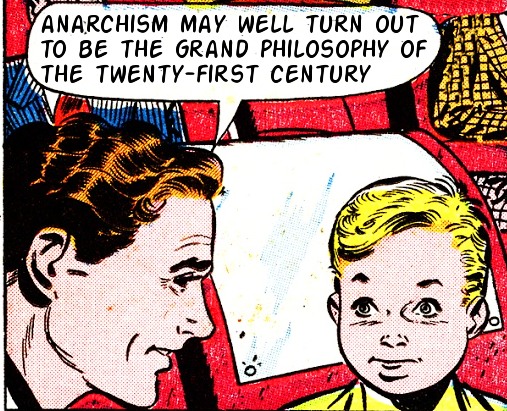
Anarchism, in #OMN language, is not chaos. It’s the long historic struggle to build social paths growing trust, mutual responsibility, and shared power instead of fear, hierarchy, and extraction.

At its root, anarchist economics is simply the idea that people should have more direct control over the things that affect their lives. Workplaces, media, communities, land, tools, and infrastructure should be held more in common or managed cooperatively by the people actually using them, not owned by distant states, corporations, landlords, or bureaucratic classes.

This is the opposite of the current #deathcult path where power concentrates upward into institutions that claim ownership over everything while the majority are reduced to consumers, tenants, workers, and data sources. The important distinction is between use and ownership.

In capitalist logic, ownership means control without participation. You can own land you never touch. Own housing you never live in. Own platforms you never contribute to. Own factories you never work in. Then extract rent, profit, interest, and power from the people who actually do the labour. This is the normalised logic of the #closedweb and #neoliberalism.

In anarchist and mutualist thinking, possession comes from use and participation. If you use something, care for it, maintain it, and contribute to it, then you have a natural relationship with it. This is a living social process rather than an abstract legal claim enforced through violence or bureaucracy. That’s actually how many healthy human systems worked historically before everything became financialized and enclosed.

The #openweb originally functioned much closer to this model. People built websites because they needed them. Communities moderated spaces because they cared about them. Developers shared code because collaboration worked better than enclosure. Infrastructure was often maintained through trust networks, volunteer labour, and shared responsibility.

The problem is that over time the #dotcons enclosed this commons. Social relationships became platforms, sharing became monetized content, participation became engagement metrics, human communities became extractable data flows. This is why the matter:Open data. Open source. Open standards. Open process. These are not abstract technical values, they are practical social tools for preventing enclosure and concentration of power. Without them, projects quietly drift toward hidden hierarchy and soft authoritarianism even when they use radical language.

This is also why thinking about the #geekproblem matters, too much alt-tech still thinks freedom comes primarily from technical architecture while ignoring social power. But history shows that purely technical fixes usually reproduce the same social hierarchies in new forms. The problem is not only bad code, it is social relations. A decentralized system can still become socially authoritarian. An open protocol can still become culturally closed. A cooperative can still become dominated by informal elitists. A “horizontal” project can still be controlled by hidden networks of influence. That’s why anarchist economics focuses so heavily on mutual aid, federation, and self-management.

Mutual aid is simply people organizing together directly to meet shared needs without waiting for permission from markets or states. Food sharing, community defence, free software, skill swaps, radical media, housing networks, protest kitchens, neighbourhood repair groups, grassroots publishing. These are not side projects, they are the foundations of another economy already existing inside the shell of the old one.

Projects like #Indymedia worked because they embedded technology inside living social networks and shared political cultures. The value was not just the publishing software, it came from trust relationships, collective process, and common purpose. This is the same path #OMN is trying to reboot for the #openweb era. Not by inventing endless new startups and pointless platforms, chasing #fashernista tech trends or feeding the #NGO funding machine.

But by rebuilding commons infrastructure that people can actually use, shape, and govern together. The goal is not perfect ideology, the goal is reducing domination. Less extraction, hierarchy, enclosure, passive consumption. More participation, transparency, shared responsibility and more collective agency.

The irony is that this is often more practical than capitalism itself. Mutual aid networks regularly respond faster than states during disasters. Open-source infrastructure powers huge parts of the internet. Informal community care keeps millions alive under collapsing systems. The future probably won’t arrive as one giant revolution, it grows more like compost.

Small living networks.
Shared tools.
Open processes.
Federated trust.
Commons infrastructure.

That’s the real anarchist economy in practice, messy, human, relational, and alive.