The social change/challenge project of an organic intellectual is an act of love and a gift economy, each toot and each hashtag is a gift. The #OMN hashtag story is designed to make people who often unconsciously worship the #deathcult (an obvious metaphor for #neoliberalism) and have internalized the last 40 years of the dead philosophy of #postmodernism uncomfortable.
The idea is that from these small openings, people can try to step outside this mess and challenge the status quo. To build the #OMN, we are looking for the tiny minority who can still think outside this mess and are willing to challenge the #mainstreaming narrative. The project is a call to action for those who want to create a more equitable and just society.
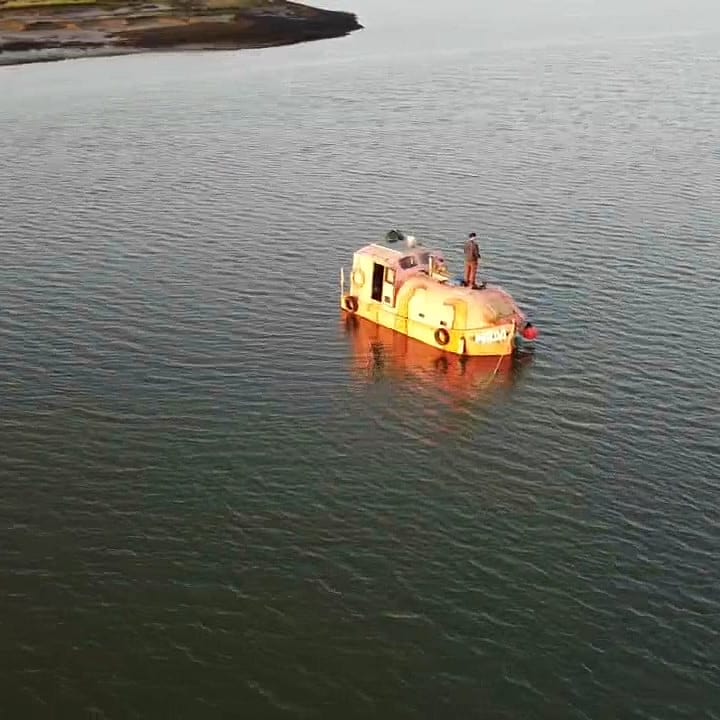
#boatingeurope at anchor for a few days on the Medway. Metaphorically, am taking the piss outa #stupidindividualism. The reality picture would have 4–5 boats rafted up with a disparate crew having a barbi.
The social change/challenge project of an organic intellectual is an act of love, a gift economy, each toot, each hashtag is a gift. The #OMN hashtag story is designed to make people who (often unconsciously) worship the #deathcult (an obvious metaphor for #neoliberalism) and have internalized the last 40 years of (the dead philosophy) #postmodernism uncomfortable. From these small openings, they can try to step outside this mess.
To build the #OMN we are looking for the tiny minority who can still think outside this mess, is this you?
A balancing of spiky/fluffy to see and act outside the current #mainstreaming mess.
We need to build “bounded” projects because we live in the era of the #deathcult based on the dead ideologies of post-modernism and #neoliberalism. Both deny the possibility of the world we want to build, so “common sense” is not our friend.
The “boundaries” of #4opens and #PGA keep focus vs this “common sense”, we are lost without something like these “historical” working bounders.
The #OMN are building tools for the “other” that’s us. “Them” are hostile, especially if they don’t understand who “they” are, this is #mainstreaming liberals, and right wing crew.
#PGA is about, horizontal paths giving us a shared space of practice, understanding and working for “politics” and the #4opens gives us the same for tech.
They together create the boundary for us to focus. Without this boundary we have a tendency to fight and create mess. So it’s a soft/pours “us” and “them” to provide focuses and direction. In a bad sense, it is the badges of the tribe, in a better sense, it’s the banners we fly at our gatherings, but this starts to sound a bit nationalist, so let’s not do this…
The subject of “branding”, flags, banners is a real balance, they have power… And we need power in horizontal movements.
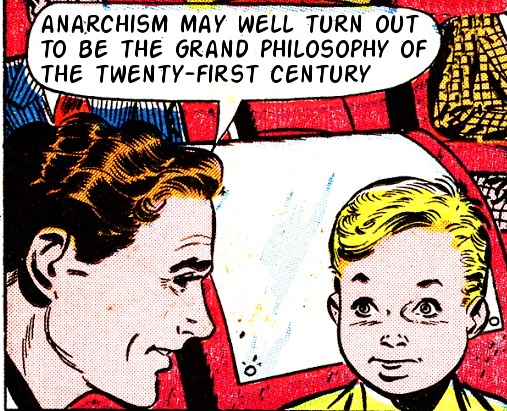
Anarchism, in #OMN language, is not chaos. It’s the long historic struggle to build social paths growing trust, mutual responsibility, and shared power instead of fear, hierarchy, and extraction.
At its root, anarchist economics is simply the idea that people should have more direct control over the things that affect their lives. Workplaces, media, communities, land, tools, and infrastructure should be held more in common or managed cooperatively by the people actually using them, not owned by distant states, corporations, landlords, or bureaucratic classes.
This is the opposite of the current #deathcult path where power concentrates upward into institutions that claim ownership over everything while the majority are reduced to consumers, tenants, workers, and data sources. The important distinction is between use and ownership.
In capitalist logic, ownership means control without participation. You can own land you never touch. Own housing you never live in. Own platforms you never contribute to. Own factories you never work in. Then extract rent, profit, interest, and power from the people who actually do the labour. This is the normalised logic of the #closedweb and #neoliberalism.
In anarchist and mutualist thinking, possession comes from use and participation. If you use something, care for it, maintain it, and contribute to it, then you have a natural relationship with it. This is a living social process rather than an abstract legal claim enforced through violence or bureaucracy. That’s actually how many healthy human systems worked historically before everything became financialized and enclosed.
The #openweb originally functioned much closer to this model. People built websites because they needed them. Communities moderated spaces because they cared about them. Developers shared code because collaboration worked better than enclosure. Infrastructure was often maintained through trust networks, volunteer labour, and shared responsibility.
The problem is that over time the #dotcons enclosed this commons. Social relationships became platforms, sharing became monetized content, participation became engagement metrics, human communities became extractable data flows. This is why the #4opens matter:Open data. Open source. Open standards. Open process. These are not abstract technical values, they are practical social tools for preventing enclosure and concentration of power. Without them, projects quietly drift toward hidden hierarchy and soft authoritarianism even when they use radical language.
This is also why thinking about the #geekproblem matters, too much alt-tech still thinks freedom comes primarily from technical architecture while ignoring social power. But history shows that purely technical fixes usually reproduce the same social hierarchies in new forms. The problem is not only bad code, it is social relations. A decentralized system can still become socially authoritarian. An open protocol can still become culturally closed. A cooperative can still become dominated by informal elitists. A “horizontal” project can still be controlled by hidden networks of influence. That’s why anarchist economics focuses so heavily on mutual aid, federation, and self-management.
Mutual aid is simply people organizing together directly to meet shared needs without waiting for permission from markets or states. Food sharing, community defence, free software, skill swaps, radical media, housing networks, protest kitchens, neighbourhood repair groups, grassroots publishing. These are not side projects, they are the foundations of another economy already existing inside the shell of the old one.
Projects like #Indymedia worked because they embedded technology inside living social networks and shared political cultures. The value was not just the publishing software, it came from trust relationships, collective process, and common purpose. This is the same path #OMN is trying to reboot for the #openweb era. Not by inventing endless new startups and pointless platforms, chasing #fashernista tech trends or feeding the #NGO funding machine.
But by rebuilding commons infrastructure that people can actually use, shape, and govern together. The goal is not perfect ideology, the goal is reducing domination. Less extraction, hierarchy, enclosure, passive consumption. More participation, transparency, shared responsibility and more collective agency.
The irony is that this is often more practical than capitalism itself. Mutual aid networks regularly respond faster than states during disasters. Open-source infrastructure powers huge parts of the internet. Informal community care keeps millions alive under collapsing systems. The future probably won’t arrive as one giant revolution, it grows more like compost.
Small living networks. Shared tools. Open processes. Federated trust. Commons infrastructure.
That’s the real anarchist economy in practice, messy, human, relational, and alive.
Anti-capitalism is a political movement that challenges the current economic system, it is based on the understanding that capitalism is unjust and creates inequality, concentrates power in the hands of the few and nasty corporations, and exploits workers and resources for profit.
One alternative to capitalism proposed by anti-capitalists is socialism. Socialism advocates for public or direct worker ownership and control of the means of production, as well as an equal distribution of resources and an egalitarian method of compensation. This would lead to a society where all people have access to resources and decision-making power.
Socialists argue that capitalism unfairly concentrates power and derives wealth through exploitation. That capitalism generates wasteful industries and practices that exist only to create demand for products, which contributes to environmental degradation and the overconsumption of resources. Socialists contend that private ownership of the means of production imposes a tremendous waste of material resources.
Anarchism and libertarian socialism are two closely related ideologies that share a common goal of creating a stateless, classless society, organized along democratic and egalitarian principles. Both of these ideologies have their roots in the 19th century, when the Industrial Revolution was transforming society and capitalism was becoming the dominant economic system.
At its core, anarchism is a philosophy that rejects all forms of hierarchical authority, including the state, capitalism, and organized religion. Anarchists believe that people are capable of governing themselves through direct democracy and voluntary cooperation, without the need for a centralized authority to tell them what to do. Anarchists reject the idea of private property, which they view as a tool of oppression that allows a privileged few to control the resources and means of production that are necessary for life.
Libertarian socialism is a more specific form of anarchism that emphasizes the importance of collective ownership and control of the means of production. Libertarian socialists believe that workers should control their workplaces, and that economic decision-making should be decentralized and democratic. They reject the idea of a vanguard party or a centralized authority that would guide the revolution or manage the economy after the revolution.
One of the central criticisms of capitalism from the anarchist and libertarian socialist perspective is the concept of wage slavery. This refers to the idea that workers are not truly free because they depend on wages to survive, and because their labour is exploited by capitalists who profit from their work. Their lives being dictated by the market and a small group of wealthy individuals.
Anarchism and libertarian socialism have a rich history of theory and practice. In the 19th and early 20th centuries, anarchism was associated with militant activism, such as the Haymarket Affair in Chicago in 1886, which resulted in the execution of several anarchist labour organizers. The anarchist movement was also involved in the Spanish Civil War, where anarchist militias fought against fascist forces.
In more recent years, anarchism and libertarian socialism have experienced a resurgence of interest, particularly among young people who are disillusioned with the current political and economic paths. Some contemporary anarchist and libertarian socialist movements include the antiglobalization movement of the last 30 years, Zapatista movement in Mexico, the Rojava Revolution in Syria.
These movements offer a powerful critique of capitalism and state power, and they provide a living visions of a world where people are free to govern themselves, work collectively to meet their needs, and create a more sustainable and equitable world.
Marxism is a social, economic, and political theory developed by Karl Marx in the mid-19th century. It argues that capitalism is an unjust and unstable system that will be replaced by socialism. Marxism sees capitalism as a historical stage that was once progressive, but has now become stagnant due to internal contradictions. Marx claimed that the capitalist mode of production creates a class struggle between the bourgeoisie, who own the means of production, and the proletariat, who must sell their labour to survive.
Marx believed that the contradictions inherent in capitalism would eventually lead to a political revolution, where the proletariat would overthrow the bourgeoisie and establish a socialist society. In this society, the means of production would be owned by the workers, and wealth would be distributed more equally.
Contemporary anti-capitalist movements are often influenced by Marxist thought. Anti-globalization and alter-globalization movements also criticize capitalism, particularly #neoliberalism and pro-corporate policies that have spread internationally.
However, the visablierty of anti-capitalism has shrunk since the end of the Cold War and the globalization of capitalism. Postmodern philosophers pushed the mess, of identitie politics. Many on the left have shifted their focus to multiculturalism and partisan culture war issues, leading to capitalist realism – the idea that capitalism is the only viable political and economic system.
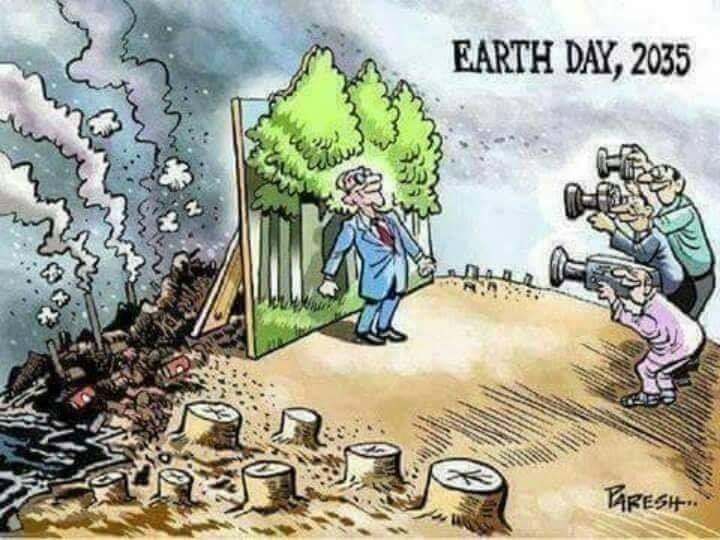
The hashtag #deathcult is a charged but precise characterisation of #neoliberalism – the political and economic ideology that has dominated the last four decades, fetishising free markets, deregulation, privatisation, and minimal government intervention while relentlessly prioritising short-term profit over collective and ecological well-being.
The term was coined by Hamish Campbell (hamishcampbell.com) out of long experience in protest movements, crystallising at the founding of Extinction Rebellion (XR) – the global environmental movement known for nonviolent direct action and civil disobedience in response to the climate and biodiversity crisis.
#XR gave the idea a public face, but the underlying diagnosis is older. What the hashtag names is a system that knowingly drives ecosystems toward collapse, accelerates mass extinction, and courts food and water shortages, displacement, and conflict – all while calling this “economic growth.” That is not negligence. That is a cult logic: sacrifice the living world on the altar of quarterly returns. Neoliberalism’s defenders argue it delivers prosperity and individual freedom. Its record tells a different story: widening inequality, gutted public services, eroded workers’ rights, and a culture of greed that subordinates the common good to narrow private gain. The #deathcult hashtag story names what that trajectory actually leads to, not as hyperbole, but as a straightforward description of the destination.
The hashtag is for those who recognise that an ideology placing profit above the survival of communities and ecosystems isn’t just mistaken, it’s dangerous.
For decades, European social democracy has stood as a counterweight to the relentless logic of capitalism, proving that societies can thrive when they prioritize people and planet over profit. Yet in recent years, these ideals have been swept away by the rise of #neoliberalism and the slow creep of corporate capture. For some people it’s worth revisited the core principles, not as relics of a bygone era, but as seeds for the future? Let’s look at potential benefits of this approach, and why reclaiming its best elements might be help in rebuilding our world in the face of #climatechaos and growing inequality.
Reduced income inequality by challenging the hoarders of wealth, Social democracy actively fights against the extreme wealth inequality that fuels the #deathcult path of capitalism. By implementing progressive taxation on the ultra-rich and corporations, wealth redistribution to fund public services and social programs, outs limits on wealth accumulation to prevent runaway hoarding. This old #mainstreaming path treats wealth not as a private treasure, but as a collective resource. It challenges the idea that billionaires should exist at all while millions live in poverty, and asserts that the role of the state is to level the playing field, not deepen the divides.
Improved standard of living, a life of dignity for all, not only trying to mitigate suffering, this works to actively uplift people’s quality of life through: Universal healthcare that prioritizes public well-being over profit. Free or affordable education as a path to empowerment. Robust public services like transport, libraries, and childcare. By ensuring everyone has access to the essentials for a good life, social democracy shows that collective care leads to individual flourishing. It breaks the narrative that people must “earn” the right to exist and replaces it with the belief that dignity is a human right.
Stronger safety nets with protection from capitalist precarity, where markets rule, people are left vulnerable to constant boom-and-bust cycles. Social democracy disrupts this instability by creating social safety nets that catch people when they fall. Unemployment benefits to prevent destitution during job loss, Disability and sickness support for those unable to work, Public pensions to ensure people can retire in dignity. These policies directly challenge the capitalist threat that without endless labour, people deserve to suffer. Instead, they affirm the belief that societies are strongest when no one is left behind.
Greater economic security with power to the workers, social democracy strengthens workers’ rights and provides economic stability: Job protections & fair dismissal laws, living wage policies tied to actual living costs, Support for unions & collective bargaining. This redistribution of power away from corporate greed towards the workers who actually produce value is a radical shift from the top-down hierarchies of capitalism. It proves that economies don’t need to run on exploitation, they can be collaborative systems where workers share in the prosperity they create.
Increased political representation by reclaiming democracy, deepened democracy where people have a real say in how their societies function through, proportional representation to ensure every vote counts, publicly funded elections to reduce corporate influence, citizen assemblies and referenda for direct democracy. This expands democracy beyond just voting every few years, empowering people to shape the decisions that shape and impact their lives. It challenges the idea that politics is the domain of #nastyfew elitists and replaces it with the radical belief that people can and should govern themselves.
Environmental protection by defending the future from #climatechaos. Social democracy recognizes that the health of the planet is inseparable from the well-being of people. That’s why this path champions investment in renewable energy & public green infrastructure, strict environmental regulations & corporate accountability, sustainable development policies that balance human and ecological needs. Rather than treating nature as a resource to be exploited, this path sees the environment as a common inheritance that must be preserved for future generations. It directly challenges the short-termism of capitalism, which sacrifices the future for the sake of immediate profits.
Investment in public goods for the collective good, instead of pouring public money into private profit machines, social democracy reinvests in the public commons through infrastructure development for sustainable transport and energy, public research & innovation for collective progress, cultural and community spaces to foster connection and creativity. This long-term public investment shows that societies thrive when they share resources, not when they sell them off to the highest bidder. It dismantles the myth that privatization is more “efficient”, and proves that public ownership can build lasting prosperity.
What this means for radical media and the #openweb, The principles of solidarity, collective ownership, and democratic control, overlap the values that grassroots projects like the #OMN and #indymediaback embody. But instead of waiting for governments to catch up, we can start building these systems and paths now. Decentralized media platforms to break corporate control of information, open-source technologies governed by communities, not corporations, digital commons where people can share, learn, and organize freely.
The #4opens already provide the blueprint for a more democratic and sustainable digital ecosystem. It’s an easy path that by combining the best aspects of the older #mainstreaming social democracy with the “new” power of decentralized tech, we can bypass broken #deathcult institutions and start creating the future from the ground up. The old story of social democracy showed us a path, now it’s time to take it further http://hamishcampbell.com
#Neoliberalism is an economic and political ideology that advocates for free market capitalism and limited government intervention in the economy. Some criticism:
* Income inequality: neoliberal policies lead to greater income inequality, as the wealthy are able to capture a larger share of the economic gains and the less well-off are left behind.
* Financial instability: Neoliberal policies lead to financial instability, as seen in the 2008 global financial crisis. The deregulation of financial markets and the increased reliance on debt-fueled growth creates financial bubbles and subsequent crashes.
* Environmental degradation: The emphasis on economic growth leads to environmental degradation, as companies and countries prioritize short-term profits over sustainability and the health of the planet.
* Loss of public goods and services: Neoliberal policies lead to cuts in government spending on public goods and services, such as education, healthcare, and social safety nets. This has a negative impact on the most basic social needs and goods in society.
* Reduced political and economic power for labour movements: Neoliberal policies result in a reduction of the bargaining power of labour, leading to declining wages and job security for workers.
The #nothingnew hashtag is a simple #KISS project of rejecting the “common sense” #neoliberalism and #postmodernism of the last 40 years to reboot social change/challenge from the original modernist path to then moving to build #somethingnew
The #geekproblem hashtag is a complex view of the other hashtags. In this, we need to take the “problem” out of “geek”. The need for CONTROL is a problem of balance in modernism. Mix in #deathcult worshipping and the power of technology over the last 40 years, and you understand the “problem”. This is not #KISS
For the last 40 years, we have had #neoliberalism pushed into every part of our living human and natural world. This was designed to disintegrate the social democratic 20th century consensus and replace it with a 19th century market fundamentalism. This has successfully and obviously pushed selfish over selfless. Over the last 20 years, this fundamentalism pushes social democratic norms out of the internet and #openweb and replace these values with powerful tools for social control based on market logic of “want to be” powerful individuals and capital agenda.
You rarely get anywhere by simply renaming things. All you do is lose the historical thried and then recreate the same mess. #Stupidindividualism is often the motivation for this, and it’s a big sin in the liberals and “post politics” crew.
A metaphor that individualism makes us stupid and that to live outside a balance of individualistic vs community is stupid. Yes, it’s an aspect of liberalism and capitalism and at an extreme with #neoliberalism.
#deathcult worshippers is another metaphor for (invisible) neoliberalism.
All the metaphors (used as #hashtags) are aspects of liberalism and very critical of neoliberalism. The idea is to make #mainstreaming thinking dirty.
The hashtags work if a community/affinity group of people use them without falling into the sin of #stupidindividualism of course 😉
If you miss my point, please go back and reread, don’t drop back into sin 😉