#climatechaos requires radical work

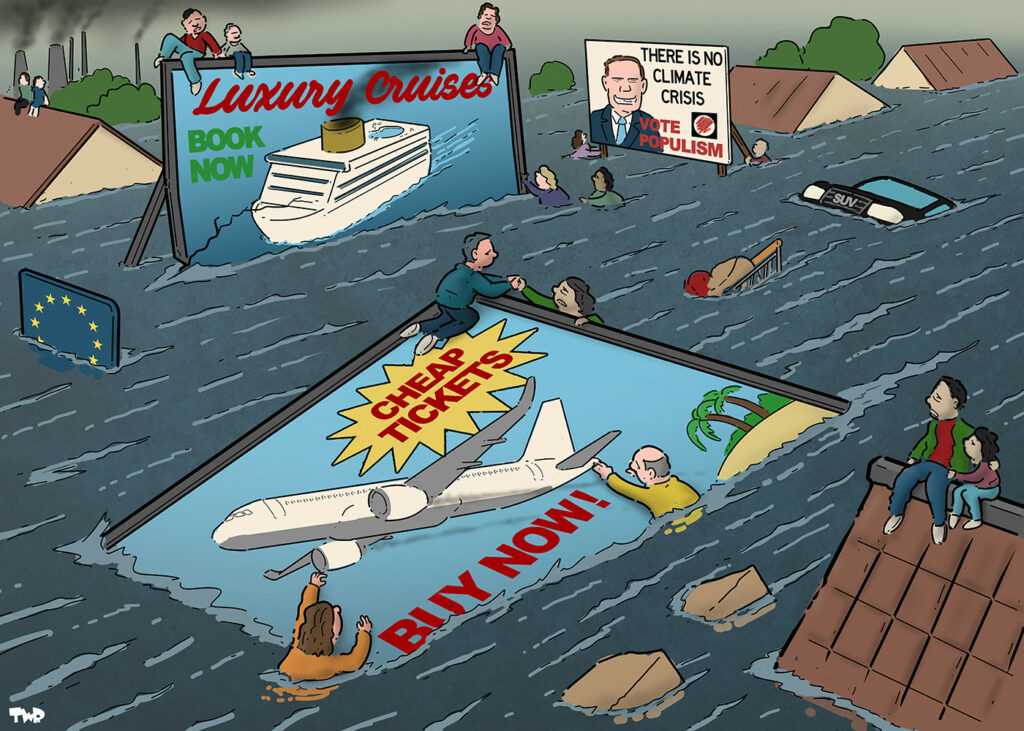
The Seven Stages of climate denial:

1. It’s not real
2. It’s not us
3. It’s not that bad
4. We have time 
5. It’s too expensive to fix
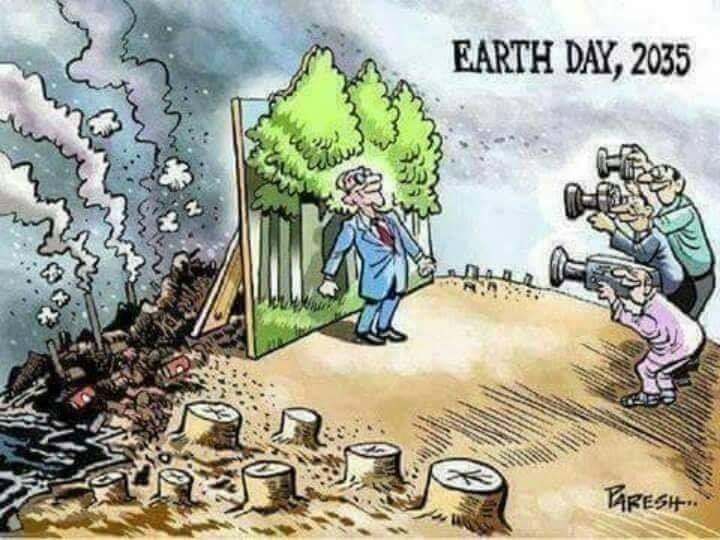
6. Here’s a fake solution
7. It’s too late: you should have warned us earlier

Looking back you can see that trolls use all of these stages to deny the reality of #climatechange. With this in mind, it’s worth looking at the climate crisis and its broader implications for our liberals:

Understanding the Crisis

  1. Climate Change Impacts:
    • Primary Effects: The direct environmental impacts such as floods, storms, and droughts, species loss.
    • Secondary Effects: These encompass the broader impacts like social breakdown, mass migration, fiscal crises, and conflicts and wars.

Soft Problem: Infrastructure Response

To affect the primary effects of climate change, we need to:

  1. Invest in Resilient Infrastructure:
    • Develop, diversify and upgrade infrastructure to withstand extreme weather events.
    • Implement sustainable urban planning and disaster preparedness programs.
  2. Promote Environmental Stewardship:
    • Encourage policies that protect natural ecosystems and biodiversity.
    • Support renewable down scaling with energy sources and totally end reliance on fossil fuels.

Hard Problem: State Stability and Security

Addressing the secondary effects involves:

  1. Economic and Social Policies:
    • Develop political and economic policies that buffer against fiscal crises caused by climate change.
    • Strengthen social safety nets to support communities impacted by environmental changes.
  2. Global Cooperation:
    • Foster international collaboration to facilitate the mass migration and sharing of resources.
    • Support global peacekeeping efforts to hold justice in place and prevent conflicts exacerbated by climate stressors.

Accountability and Legal Action

Prosecuting the #nastyfew is a start, individuals and groups for their direct roles in the climate crisis involves several considerations:

  1. Legal Frameworks:
    • Establish clear legal standards for environmental crimes and corporate responsibility.
    • Develop international agreements to hold entities accountable for environmental damage.
  2. Ethical Considerations:
    • Ensure that legal actions are grounded in social justice and fairness.
    • Avoid simple scapegoating and ensure that those prosecuted are responsible for significant harm.
  3. Focus on Prevention:
    • Prioritize measures that prevent future harm alongside punitive actions for though who are found responsible.
    • Promote corporate and governmental accountability through regulations and incentives for sustainable practices and well as impotently building real alternatives.

Moving Forward

To effectively address the #climatecrisis and its security implications, a wide approach is needed:

  1. Promote Public Awareness and Engagement:
    • Educate the public on the causes and effects of #climatechange.
    • Encourage community involvement in real sustainability initiatives.
  2. Policy and Governance:
    • Advocate for robust climate policies at national and international levels.
    • Ensure that climate action is integrated into broader progressive security and economic strategies.
  3. Innovation and Adaptation:
    • Invest in research and development of soft and hard technologies for climate mitigation and adaptation.
    • Encourage the needed adaptive practices in agriculture, industry, and urban development.
  4. Ethical Leadership:
    • Foster community leadership outside the current #mainstreaming agendas, that prioritize long-term sustainability and ethical governance.
    • Promote #4opens transparency and accountability in society and climate-related decision-making.

We do need to see that addressing the #climatecrisis needs radical and balanced paths that combines immediate action with long-term planning, prominent legal accountability with widened ethical governance, and national efforts with wider global cooperation. By working and focusing on these areas, we try to work towards a sustainable future.

For a #mainstreaming view of this https://www.cbsnews.com/news/pope-francis-urges-action-on-climate-change-its-a-road-to-death/


On this subject: The #EU Eurocracy are hopelessly incompetent on progressive social and tech issues – it’s our job to help them be less incompetent as best we can. The other, radical native path is more dangerous, to get rid of them, the dangers with this, which we are seeing, is the right-wing will take their place. This applies to changing most #mainstreaming institutions and people, so we are left with “challenge” as the safe path.

Why European Social Democracy for some people is a path to a just and sustainable future

For decades, European social democracy has stood as a counterweight to the relentless logic of capitalism, proving that societies can thrive when they prioritize people and planet over profit. Yet in recent years, these ideals have been swept away by the rise of #neoliberalism and the slow creep of corporate capture. For some people it’s worth revisited the core principles, not as relics of a bygone era, but as seeds for the future? Let’s look at potential benefits of this approach, and why reclaiming its best elements might be help in rebuilding our world in the face of #climatechaos and growing inequality.

Reduced income inequality by challenging the hoarders of wealth, Social democracy actively fights against the extreme wealth inequality that fuels the #deathcult path of capitalism. By implementing progressive taxation on the ultra-rich and corporations, wealth redistribution to fund public services and social programs, outs limits on wealth accumulation to prevent runaway hoarding. This old #mainstreaming path treats wealth not as a private treasure, but as a collective resource. It challenges the idea that billionaires should exist at all while millions live in poverty, and asserts that the role of the state is to level the playing field, not deepen the divides.

Improved standard of living, a life of dignity for all, not only trying to mitigate suffering, this works to actively uplift people’s quality of life through: Universal healthcare that prioritizes public well-being over profit. Free or affordable education as a path to empowerment. Robust public services like transport, libraries, and childcare. By ensuring everyone has access to the essentials for a good life, social democracy shows that collective care leads to individual flourishing. It breaks the narrative that people must “earn” the right to exist and replaces it with the belief that dignity is a human right.

Stronger safety nets with protection from capitalist precarity, where markets rule, people are left vulnerable to constant boom-and-bust cycles. Social democracy disrupts this instability by creating social safety nets that catch people when they fall. Unemployment benefits to prevent destitution during job loss, Disability and sickness support for those unable to work, Public pensions to ensure people can retire in dignity. These policies directly challenge the capitalist threat that without endless labour, people deserve to suffer. Instead, they affirm the belief that societies are strongest when no one is left behind.

Greater economic security with power to the workers, social democracy strengthens workers’ rights and provides economic stability: Job protections & fair dismissal laws, living wage policies tied to actual living costs, Support for unions & collective bargaining. This redistribution of power away from corporate greed towards the workers who actually produce value is a radical shift from the top-down hierarchies of capitalism. It proves that economies don’t need to run on exploitation, they can be collaborative systems where workers share in the prosperity they create.

Increased political representation by reclaiming democracy, deepened democracy where people have a real say in how their societies function through, proportional representation to ensure every vote counts, publicly funded elections to reduce corporate influence, citizen assemblies and referenda for direct democracy. This expands democracy beyond just voting every few years, empowering people to shape the decisions that shape and impact their lives. It challenges the idea that politics is the domain of #nastyfew elitists and replaces it with the radical belief that people can and should govern themselves.

Environmental protection by defending the future from #climatechaos. Social democracy recognizes that the health of the planet is inseparable from the well-being of people. That’s why this path champions investment in renewable energy & public green infrastructure, strict environmental regulations & corporate accountability, sustainable development policies that balance human and ecological needs. Rather than treating nature as a resource to be exploited, this path sees the environment as a common inheritance that must be preserved for future generations. It directly challenges the short-termism of capitalism, which sacrifices the future for the sake of immediate profits.

Investment in public goods for the collective good, instead of pouring public money into private profit machines, social democracy reinvests in the public commons through infrastructure development for sustainable transport and energy, public research & innovation for collective progress, cultural and community spaces to foster connection and creativity. This long-term public investment shows that societies thrive when they share resources, not when they sell them off to the highest bidder. It dismantles the myth that privatization is more “efficient”, and proves that public ownership can build lasting prosperity.

What this means for radical media and the #openweb, The principles of solidarity, collective ownership, and democratic control, overlap the values that grassroots projects like the #OMN and #indymediaback embody. But instead of waiting for governments to catch up, we can start building these systems and paths now. Decentralized media platforms to break corporate control of information, open-source technologies governed by communities, not corporations, digital commons where people can share, learn, and organize freely.

The #4opens already provide the blueprint for a more democratic and sustainable digital ecosystem. It’s an easy path that by combining the best aspects of the older #mainstreaming social democracy with the “new” power of decentralized tech, we can bypass broken #deathcult institutions and start creating the future from the ground up. The old story of social democracy showed us a path, now it’s time to take it further http://hamishcampbell.com

#SocialDemocracy #WorkersRights #PublicGood #ClimateJustice #OpenWeb #ReclaimTheFuture


People BLOCKING the needed process, or simply ignore it

If you keep doing the same thing, there will be the same outcome. Different worldviews produce different processes, and sometimes entirely different outcomes. This is the core lesson people miss when they treat radical #openweb projects like just another app or fluffy #NGO pitch deck.

All the #OMN projects grow from a different worldview – that comes from the lived traditions of the commons, the early Internet, and grassroots organising. It’s a worldview that has already worked: from the early #indymedia network the global voice to the anti-globalisation movements, to the early #wikis and #blogospheres that built collaborative knowledge before #closedsocialmedia captured it, to #Fediverse platforms like Mastodon continue to prove federation can scale without #dotcons corporate control. These are working proofs that decentralised, transparent, and trust-based systems do build society. They have scaling limits – yes – but these limits are part of their strength: they push diversity, autonomy, and accountability at human scale.

The challenge now is that most people entering the tech and activist spaces have no knowledge of this lineage, or worse, have knowledge of only one half of it. Developers who understand federation but not community process end up building silos with nice APIs. Activists who understand horizontal organising but not open standards end up trapped inside Facebook groups, Google Docs, and Slack workspaces – all walled gardens that feed the #nastyfew systems they claim to oppose.

When people have no grounding in subcultures, that underpins our civil rights, free software, and creative commons, they apply their all-knowing #mainstreaming “common sense.” They block the processes that make trust possible, dismiss open governance as messy, and treat openness itself as a threat to control. The result is stagnation: yet another “platform for change” that centralises power, burns out volunteers, and silently collapses when the funding ends.

The #OMN is an answer to this trap. It’s not a single tool, but a shared soil, a technical and social framework designed to connect and compost all the half-built projects and forgotten ideas still scattered across the #openweb. By combining the social scaling limits of grassroots organising (trust, transparency, and accountability) with the technical scaling power of open protocols (ActivityPub, RSS etc.), we rebuild the conditions for a real public commons. The tools are already here, what’s missing is the cultural memory and the courage to use them.

Why do I call Facebook a #dotcons

Our #mainstreaming current online tools (for example #Facebook) were built out from the worst parts of human nature. The challenge facing us is can we build our tools from the best part of human nature (an example would be the #OMN) I think this is a nice challenge to have.

It’s interesting to think about what shapes the small part of the social flow you see on #failbook and see how other agenda’s dominate what you see as a “personal” experience.

2) The ego of the CEO and heads of engineering and marketing at Facebook.

3) The agenda’s of the investors in Facebook – this includes front company’s for the intelligence services of the US and many very rich people. (#nastyfew)

4) The agenda of the advertisers that pay Facebooks bills. The agenda’s that all the above do not want to push – this is semantically hidden by “we can’t sell adverts next to your content”. And they sell this to us as: “this is not social engineering”.

5) Anything published outside Facebook silo/portal is pushed down and things published inside Facebooks walls are pushed up. An example of this is that Youtube videos are not always embedded any-more, and that #failbook videos are and autoplay. (URLs are now down rated)

6) The people you friend on Facebook. But this is not unmediated the people who are a better fit to the first 5 points will be pushed more visible than people who do not, which will be pushed down out of view.

7) Your likes and interactions will help the algorithm chose from the “advert friendly content” in your wider feed and push these posts into your (personal) news feed.

8) Facebook is clever evil, the algorithm is elastic, you can push it and it will bend. Of course, evil cleaver wants you to do this because it learns how you push and how to push you back to shape the above first 5 points.

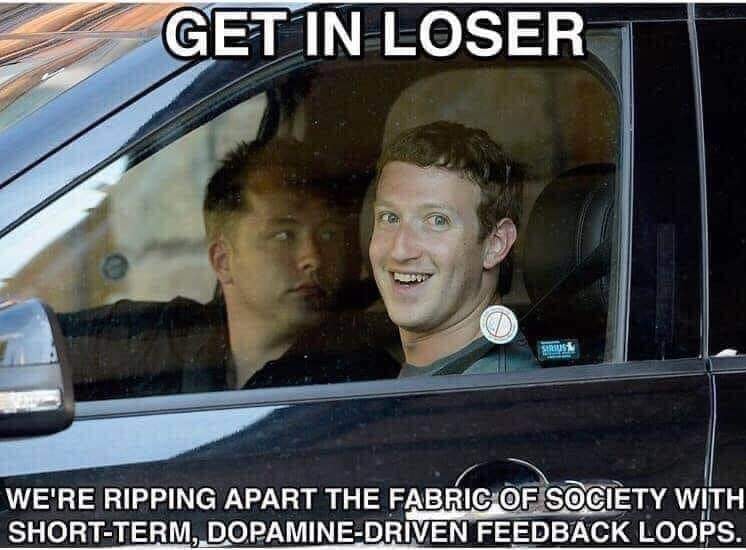
9) Clever Evil 2 that Facebook will also push though content that it cannot necessarily monetize, but has the intent to addict you to taking the phone out of your pocket to check every spare moment.

10) It’s not only about cats and family photos, it about reshaping the world so that #Trump and #Brexit can happen, and we are powerless to do anything about this. All we can do is empower the enemy by feeding it knowledge on how to empower Trumps and Brixets. Shake and repeat, shake and repeat, shake and repeat, shake and repeat.

Click, swipe…