Most people are parasites in our current #mainstreaming society, this is non-controversial view in the era of the #deathcult
Some examples:
Let’s look for a moment at our tech world, if we are generous 90% of people on the #openweb are parasites on this culture and tech space.
Maybe 9% are “native” but could do better, and the native 1% left are fractured. You can use a social tool like the #4opens to make this visible with little effort if you care.
This space is made of social tech, and at its core is #4opens culture, people and community.
If you are not generous, it’s more like 99% and fractions of the 1% left over. Let’s be truthful and try and bump this up to the generous view, please.
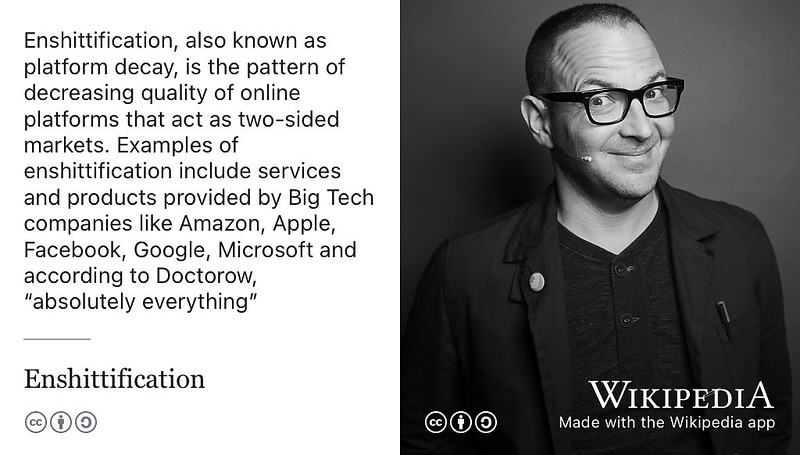
The term #enshittification, coined by Cory Doctorow, is a catchy way to describe the decline of digital platforms as they become exploitative and unusable. While it’s an effective pop term, it ultimately obscures the root causes of the problem.
For the past 20 years, I’ve used #dotcons to describe the same issue, but with a clearer critique of the systemic forces behind it. Unlike #enshittification, which frames the issue as an inevitable decline, #dotcons directly points to deliberate deception and enclosure of the #openweb by corporate interests.
Tech as a confidence trick, for over 30 years, the tech industry has been a confidence trick (see scam) dressed up as progress. The early internet was open, decentralized, and full of promise. But over time, corporate enclosures captured these open paths and turned them into walled gardens.
The dot-com boom (#dotcons) wasn’t about building a better web—it was about monetizing control. Liberal elitists and the public bought into this process, handing over control to Silicon Valley under the illusion that private corporations could be trusted with public digital infrastructure. The result? The death of the #openweb as #dotcons turned the internet into a system of surveillance, advertising, and data extraction.
Now, the same liberals who helped build this mess are using #enshittification to describe it, as if the problem is just an unfortunate trend rather than the predictable outcome of capitalism’s extractive logic. This is why #Enshittification misses the bigger picture, the problem, it shifts focus away from responsibility. It frames tech decline as an inevitable process, rather than a deliberate, profit-driven strategy.
🔹 Profit Motive and Diverging Interests, the core issue isn’t just “enshittification”—it’s the profit motive that drives platforms to exploit people. The interests of people and corporations are fundamentally opposed. People want stable, functional platforms; corporations want maximum profits, which means stripping away user benefits over time.
🔹 Lack of Accountability, by using a vague, abstract term, the real actors behind this decline—tech CEOs, venture capitalists, and #neoliberal policymakers—are let off the hook. The problem isn’t that platforms just get worse on their own; it’s that corporations actively degrade them to extract more profit.
🔹 The Liberal Blindspot. Liberals love talking about how things are bad, but they rarely examine how their own ideologies enabled these failures. It was liberal policies that deregulated Big Tech, liberal tech elitists who built the enclosures, and liberal “innovators” who sold out the #openweb. Now, they lament the decline without addressing why it happened in the first place.
🔹 A Call to Action – #Dotcons as a clearer critique as #dotcons isn’t just a description—it’s a call to action. It’s a critique of the corporate hijacking of the internet and a demand for accountability. Unlike #enshittification, which tells us “things got worse,” #dotcons reminds us who is responsible and why we need radical alternatives.
It’s time for critical thinking, using terms without deeper critique allows liberals to continue avoiding responsibility. If we want a better web, we need to stop pretending that this decline is just some natural cycle.
📌 The real issue is corporate control, profit extraction, and the enclosure of digital commons. 📌 The solution isn’t lamenting decline—it’s fighting back against #dotcons and rebuilding the #openweb.
So, let’s ditch vague buzzwords and focus on the real struggle, taking control from #dotcons tech monopolies and thus breaking the cycle of enclosure. And seriously, liberals, try thinking critically about this for once—without being prats about it.
The current move in #blocking of the #dotcons moving to the #openweb is not a real solution, it’s like we are putting our heads in the sand. We need to understand that our “native” projects are #4opens thus anyone, including the #dotcons can be a part of the #openweb in this it’s a good thing they are moving back to this space.
Feel free to block them, but pushing this path as a solution is both naive and self-defeating. We need to do better and build a healthy culture and a diverstay of tools, it’s always a fight, hiding in a cave wins no wars, and we are in a war.
Issues within the #Fediverse community regarding the handling of problematic behaviour or interactions on the platform. A breakdown of some points:
Problem with Blocking: That simply blocking users or instances (such as the #dotcons) is not an effective long-term solution to fostering a healthy and diverse community within the Fediverse. Blocking is “putting your head in the sand,” ignoring or isolating problematic elements doesn’t resolve underlying issues.
Advocating for Openness: Emphasizes that the Fediverse should remain true to its principles of openness (#4opens), which allow anyone, including controversial entities like the #dotcons, to participate. This openness is a positive aspect of the #openweb.
Building a Healthy Culture: Rather than relying on blocking, we need to advocate for actively building a healthy culture within the #Fediverse. This involves nurturing diversity of tools and fostering a community where constructive engagement and dialogue can thrive.
Need for Engagement and Solutions: The importance of proactive engagement and problem-solving. We need to warn against passivity (“hiding in a cave”) and encourages efforts to address challenges head-on to create a stronger and more resilient ecosystem.
Overall, a call for constructive action within the #Fediverse community, moving beyond simple blocking measures and focusing on building a robust and inclusive path that aligns with core values of openness and diversity. With an emphasis on proactive engagement, collective responsibility, and continuous improvement to create a healthier online and offline environment.
Pushing defederation from #meta is not wrong in sentiment, the #dotcons are vile and cons. But is wrong from a practical sense. The #Fediverse and #ActivityPub are #openweb based on #4opens, this is a space where you do not have technical tools for stopping the #dotcons from taking the data, as the data in the end is in the open, unencrypted, in the database, in #RSS and in open flows.
The people who push the idea of closed are fighting for the #closedweb on a “native” #openweb platform. This makes no sense at all, incoherences everywhere, a lot of mess over the last 40 years that we need to compost.
There are likely good, useful motivation for unfederating from the #dotcons let’s be motivated by them please.
Grassroots activism has undergone significant ups and downs over the past four decades, particularly within digital communication and organizing. This post provides an overview of the challenges and successes experienced by grassroots activists during this time period, focusing on the evolution of the #openweb and its eventual decline. It explores the ideological underpinnings of internet projects, the impact of funding and #mainstreaming efforts, and the shifting dynamics between open and closed systems. By spending a little time examining these trends, we can better understand the complex interplay between technology, ideology, and activism.
The rise of the open internet, was a surge of enthusiasm for #4opens and decentralized communication paths. Projects like early #indymedia, blogging platforms, wikis, and peer-to-peer networks flourished, driven by an ethos of democratization and empowerment. These offered people and grassroots movements opportunities to connect, collaborate, and mobilize on a global scale. The ideology of the #openweb, rooted in #4opens principles, captured the imaginations and real power of many activists seeking to challenge established power structures.
However, alongside the growth of #openweb projects, there were also significant challenges and tensions. The influx of funding from state, foundation, and #NGO sources brought both opportunities and risks. While funding provided vital resources for development and expansion, it also introduced pressures to conform to #mainstreaming norms and intrenched #geekproblem agendas. Additionally, as open internet projects gained popularity, they became susceptible to co-option and manipulation by corporate interests seeking to capitalize on the growing communities, to add them to there profit margins.
The fall of the openweb, despite early successes was not inevitable, the internet eventually faced a decline, marked by the erosion of its ideological foundations and the resurgence of closed, centralized platforms, the #dotcons. One factor in this decline was the failure of many openweb projects to align with the native ideology of the web itself. The pushing of non-native common sense, was damage. While some projects embraced trust-based anarchism and decentralized governance, others veered towards more hierarchical and exclusionary paths.
The rise of a new generation of technologists and entrepreneurs, shaped by #neoliberal ideologies of individualism and competition, led to a merging of open and closed paths. This shift towards closed platforms, controlled by a handful of corporate giants, undermined the diversity and resilience of the “native” open web. The very chaos that once protected the #openweb from vertical integration and monopolization was replaced by a homogenized landscape dominated by a few #dotcons we live in today.
So what are the current challenges and opportunities, in the face of these challenges, grassroots activists grapple with the complexities of a landscape that is hostile to their values and principles. The siloed nature of many media projects are a barrier to collective action and solidarity, limiting their impact and longevity. However, there are also opportunities for resistance and resilience, through the cultivation of networks like the Fediverse based on mutual aid and cooperation.
Conclusion, the trajectory of grassroots activism in the UK over the past four decades reflects the broader shifts and tensions within the #mainstreaming path. The rise and fall of the openweb mirrors the struggles of activists to carve out spaces for dissent and resistance in corporatized and surveilled environments. By using the #4opens to examining the ideological underpinnings of internet projects and exploring alternative paths in organizing, activists can work towards reclaiming the path of a more open and decentralized future if they focus better.
The #openweb is a framework for human-centric, decentralized technologies built on transparency and collaboration. Its success hinges on trust, and as a slogan suggests, “Technology’s job is to hold the trust in place.” This concept is woven into the #OMN and #OGB initiatives, which emphasize community-driven decision-making and adherence to the #4opens principles.
#OGB and consensus, decisions are valid when a wide group of engaged participants achieves consensus. This safeguards against the normal invisible authoritarian control, single individual find it hard to dominate because the collective create and validate the decisions. Trust groups, not individuals, are the seat of power, ensuring better decision-making and accountability.
The role of #4opens, open process, open data, open licences, and open standards—acts as “gatekeepers” for technological decisions. #Openprocess ensures inclusivity and transparency, blocking decisions that don’t involve public participation. #Opendata guarantees that shared information is accessible, reducing the potential for siloed control. #Openlicenses prevent restrictive ownership that could undermine collaboration. #Openstandards resist fragmentation and force adherence to balance collaborative practices and individual paths. This “soft, swishy” approach avoids rigid authoritarian structures while maintaining #KISS robust, “enforceable” values.
let’s look at challenges and strategies for #OMN combatting #mainstreaming “common sense” practices that erode grassroots values. By build strong defaults into projects and hardcode the #4opens principles to keep them central. To make this happen, let’s try and stay polite and inclusive during outreach, avoiding burnout and adding mess through conflict.
Dealing with #fahernistas and trust issues, a significant challenge arises from people and groups who appear trustworthy due to their #mainstreaming tactics but ultimately undermine the values of the #openweb. Coders and contributors need to align with #KISS social change goals, ensuring a grassroots and horizontal approach to development, this is basic.
To do this, we need to work on sustainability efforts by avoid overloading projects with unnecessary features, “How does this fit into the #4opens?”. One path is to balance “friction” as a positive filter for misguided additions, while maintaining a welcoming environment for constructive collaboration.
Building a future beyond the #geekproblem, the “problem” originates from early open-source projects that #block the social dimensions of their technologies. By integrating the #4opens and prioritizing trust networks, the #openweb can (re)evolve into a human value network rather than a technological dead-end.
The #deathcult feeding off the decay of the #openweb perpetuates centralized and exploitative systems. All our activism is about, focusing on planting seeds for a grassroots rebirth, #nothingnew is a starting point, returning focus on modernist principles—clear goals, collective action, and systemic solutions—provides a foundation to grow #somethingnew.
The #openweb vs. #closedweb debate is not new, but it remains a critical narrative. By holding technology accountable to trust and community values, we create tools that empower rather than exploit. The #OMN and #OGB projects embody this path.
For those interested in coding for change, visit the OMN wiki and join the effort to make this vision a reality, please. Or you can donate some funding here if you don’t feel confident with tech path.
[Opening Shot: A montage of radical historical photographs, documents, and footage representing social movements and political activism throughout history.]
Narrator: In a world where history is written by the victors, a new #openweb project emerges, aiming to democratize the process of archiving and storytelling. This is the story of #makeinghistory, a groundbreaking initiative within the Open Media Network (#OMN).
[Cut to Interview with Project Lead]
Project Lead: The #makeinghistory project is about empowering communities to take control of their own narratives. It’s about recognizing the importance of grassroots movements and ensuring that their stories are preserved and shared for generations to come.
[Cut to Footage of Archiving Process]
Narrator: The journey begins with the digitization of historical archives, like the #CampbellFamily archive, containing invaluable materials related to activism and political movements.
[Voiceover: Setting up the Application]
Narrator: The first step is setting up the application for #makeinghistory.
[Voiceover: Uploading Digital Files]
Narrator: Users create accounts and start uploading directories of digital files from the archives, adding basic metadata to organize the materials.
[Cut to Community Building]
Narrator: Building a community of users is essential. Family members, activists, and allies are invited to join the project, seeding an affinity group dedicated to preserving history.
[Voiceover: Column Structure]
Narrator: The application features columns like “new” and “recent,” along with others added by users, organizing the data based on boolean logic lists and hashtag based metadata.
[Voiceover: Data Interaction]
Narrator: Users actively interact with the data, organically adding metadata, information, and editing hashtags to categorize items effectively.
[Voiceover: Categorization]
Narrator: Through collaborative efforts, items move into category columns, creating cohesive narratives and facilitating engagement.
[Voiceover: Story Feature]
Narrator: The story feature transforms categorized, metadata-enriched data into cohesive narratives, providing overviews and linking multiple items and categories.
[Cut to Exhibition Setting]
Narrator: But the impact of #makeinghistory extends beyond digital platforms. In exhibition settings, visitors can participate in archiving and storytelling, creating a participatory space for engagement.
[Voiceover: Sharing History]
Narrator: The stories created through #makeinghistory are shared with the wider world, providing grassroots quality history in addition to normal traditional top-down narratives.
[Closing Shot: A group of people gathered around a digital display, discussing and engaging with historical materials.]
Narrator: Through #makeinghistory, people are reclaiming their stories, inspiring real and lasting social change by recognizing the power of history in driving progress.
Over the last four decades, post-modernism has emphasized subjectivity and questioned universal truths. Its aim was to deconstruct grand narratives and expose hidden power structures. While this brought critiques, it also contributed to increasingly fragmented worldviews, where shared reality became harder to establish and #fashionista truth was treated as entirely relative. This fragmentation has made it more difficult to build coherent social movements capable of addressing systemic problems.
Neo-liberalism
Neo-liberalism promoted deregulation, privatization, and market-driven policies as the dominant model for society. In practice, this has widened inequality, weakened labour rights, commodified public services, and concentrated wealth and power. Economic growth has too been pushed at the expense of social justice, democratic accountability, and ecological sustainability. Markets have become the only measure of value, while the commons and collective wellbeing have been pushed aside.
Identity Politics
Identity politics has played an important role in highlighting the experiences of marginalized communities and exposing forms of discrimination that were previously ignored. At the same time, when disconnected from broader social and economic analysis, it fragments collective action by encouraging movements to organize around separate identities rather than shared material interests. Institutions can also adopt the language of diversity and inclusion without addressing the deeper structures that reproduce inequality, turning radical ideas into only liberal symbolic gestures.
The Balanced Approach
Any real change and challenge project needs to respond to these challenges by rebuilding the commons through collective action rather than individual competition. We need to restart our thinking starts from the view that social, economic, technological, and ecological systems are interconnected, and that meaningful change requires addressing these #KISS relationships together.
A practical framework for this is the #4opens: open data, open source, open standards, and open process. These simply encourage “common sense” transparency, collaboration, and shared ownership while reducing opportunities for enclosure, monopoly, and co-option.
On the path we push – rather than rejecting identity or diversity, #OMN aims to place them within a broader politics of solidarity. Individual experiences matter, but lasting change depends on building communities capable of acting together across differences. This shifts the focus from representation alone toward creating institutions and infrastructures that empower people collectively.
The goal is not simply to critique post-modernism, neo-liberalism, or identity politics, but to compost their limitations into something more productive: in the tech path an #openweb built on trust, participation, shared governance, and the digital commons. In this sense, #OMN is both a technological and a social project, as it seeks to create practical tools that help communities organise, communicate, and govern themselves while remaining rooted in the values of the commons rather than the logic of markets or centralized control.
One thing that is missing from much of the unthinking #mainstreaming outreach and expansion is that the history of #ActivityPub and the #Fediverse is a grassroots collaboration, and an ongoing struggle between open and closed paths. To understand this history, we need to explore the origins of ActivityPub and its evolution within the broader #openweb movement.
ActivityPub emerged as a response to the limitations of early social media protocols like #OStatus, which powered platforms such as #StatusNet (later GNU-social). While OStatus enabled some level of federation, it lacked robust privacy features and limited conversation dynamics. This pushed developers to seek alternatives that could better support native social interactions.
The early drafts of ActivityPub, initially called #ActivityPump, were an ambitious attempt to build a flexible protocol supporting rich, decentralized communication. In tech OStatus, used XML, ActivityPump adopted JSON, a more modern, lightweight, and developer-friendly format. This shift made it easier for platforms to adopt and extend the protocol.
The transition to ActivityPub, the move from ActivityStreams 1.0 to ActivityStreams 2.0, and ultimately to ActivityPub, reflected the need for a more comprehensive standard. ActivityPub introduced server-to-server communication, enabling platforms to share activities, like posts and follows, across different instances. This innovation laid the foundation for true federation, where separate platforms could interact seamlessly.
Key projects helped shape this evolution. Pump.io, created by #EvanProdromou (the developer behind StatusNet), was an early experiment with ActivityStreams, though it never achieved widespread adoption. But these experiments were stepping stones that informed the development.
Next is the role of #Mastodon and the rise of the #Fediverse, Eugen Rochko’s decision to implement ActivityPub as Mastodon’s primary protocol catalyzed the growth of the Fediverse. Mastodon offered a #openweb “native” but familiar Twitter-like experience with federation baked in, its rise attracted a wave of people disillusioned by #dotcons social media.
As Mastodon grew, other platforms joined the ecosystem, #PeerTube for video, #Pixelfed for images, #WriteFreely for blogging, and meany more. Each new platform enriched the Fediverse and reinforced the strength of the decentralized path.
There are challenges to openness, despite its successes, this journey of rebooting the #openweb with ActivityPub and the Fediverse hasn’t been without friction:
Commercial Capture: As the Fediverse gained traction, larger players began exploring it. #Threads’ integration with ActivityPub, for instance, raises concerns about whether the #dotcons might dilute the Fediverse’s grassroots ethos.
Technical Complexity: Implementing ActivityPub isn’t straightforward. the pushing of features like HTTP signatures for verifying interactions introduce technical hurdles that can create compatibility issues between platforms.
Centralization Drift: Even within the Fediverse, centralizing tendencies continue. Mastodon’s continuing dominance has concentrated influence, raising questions about how to prevent decentralized paths from replicating the “common sense” patterns of the #dotcons.
There is a constant need for guarding this open future, in which we need to balance the outreaching to the #mainstreaming with caring and supporting the native grassroots that created the value in the first place.
Looking forward, the future of ActivityPub and the Fediverse hinges on collective action. We need to resist the “common sense” commercial co-option from both friends and enemies to expand into building tools that make decentralized tech more accessible #OMN
The promise of the #Fediverse isn’t simply technological, it’s cultural and political. It’s about reclaiming the internet as public commons, where communities thrive on their own terms. On this path, by staying rooted in collaboration and community care, we ensure the Fediverse remains a beacon of hope in increasingly enclosed digital paths.
The #fediverse, promises decentralized social networking and democratic governance, stands as a light of hope for a native #openweb. However, as it navigates the terrain of politics, technology, and human behaviour, it faces challenges that threaten to undermine its #4opens civic potential. In this post, we delve into these challenges and explore potential pathways to realize the promise of the #fediverse.
At the heart of the fediverse lies the tension between its potential benefits and the risks of subversion by commercial interests and structural dysfunction. Commercial capture, driven by the allure of proprietary features and enhanced user experiences, poses a threat to the “open and decentralized nature of the fediverse native culture”. The current shift from distributed funding models to centralized and #NGO ones exacerbates this challenge, leading to a concentration of power and influence in the hands of a few people and entities. To counter this trend, developers, producers, institutions, and users can collectively work to uphold the #4opens principles of interoperability and openness.
Structural dysfunction, characterized by a lack of native governance approaches and a reliance on #DIY moderators and self-funded instances, poses another challenge. Without a “native” structure for governance, the fediverse risks succumbing to governance failures and reputational assaults. To address these issues, there is a pressing need to develop democratic governance structures (like the #OGB) that empower people and ensure accountability and transparency at every level of decision-making.
The fediverse is more than just a technical system; it is also a political structure. As such, it requires a nuanced understanding of the socio-political dynamics that shape its development and governance. Techno-Romanticism, which elevates simplistic views of technological progress and overlooks the labour and networks that underpin it, poses a threat to the fediverse’s sustainability. By fostering a culture of critical engagement and social action, we can mitigate this, to ensure that the Fediverse remains a space for civic discourse and collective action.
In summing up, nurturing the potential of the Fediverse requires a multifaceted approach that transcends technical considerations and delves deep into the socio-political paths. By addressing issues of commercial capture, governance dysfunction, and techno-Romanticism, we pave the way for a native inclusive, democratic, and sustainable Fediverse as an #openweb native network.
The #geekproblem is about the challenges and limitations that grow from the dominance of a particular “problem” geek culture in technology industry’s and #FOSS movements. This is characterized by a strong emphasis on technical expertise, at the expense of social, ethical, and democratic considerations. The geek culture pushes technical solutions and innovations over social paths, leading to problems in the development and deployment of #openweb technology.
Technical Bias: Geek “problem” culture favours technical solutions to problems without considering the broader social context or implications. This results in the development of technologies that are inhuman, inaccessible, exclusionary, and often harmful.
Meritocracy: Geek”problem” culture operates on the principle of meritocracy, where individuals are valued based on their technical skills and knowledge. This leads to the ignoring of voices and perspectives from non-technical backgrounds, contributing to a lack of diversity and inclusivity and functionality in #FOSS projects.
Lack of Empathy: The geek “problem” culture’s focus on technical excellence leads to a lack of empathy for people who are not as technically proficient. This results in user interfaces and experiences that are difficult to understand or navigate for non-technical people, further pushing digital divides and inequalities in the use of #FOSS code.
Resistance to Change: Geek “problem” culture is resistant to change, particularly when it comes to questioning established technical norms or practices. This resistance hinders progress in addressing social, ethical, and environmental challenges which require broader systemic changes beyond technical solutions.
Power Dynamics: The dominance of geek “problem” culture creates power imbalances within the tech industry, where certain individuals or groups hold disproportionate influence over decision-making processes. This results in the prioritization of technical interests over broader social or ethical concerns.
Overall, the #geekproblem highlights the need for a holistic approach to technology development based on the #4opens social, ethical, and democratic dimensions alongside technical considerations. Addressing the geekproblem requires challenging current social structures and promoting diversity, empathy, and more democratic decision-making within the development and #FOSS communities.
The influence of NGOs in social activism raises real concerns, particularly within an online landscape still dominated by centralised #dotcons platforms and gatekeepers. In contrast, the #openweb – rooted in the #4opens principles of decentralisation, open standards, and inclusivity – represents a more genuine path for progressive social change.
However, the rise of #NGO driven “slacktivism” exposes the limits of centralised activism. While petitions and social media campaigns can raise awareness, they lack depth and rarely drive meaningful change. This culture of low-effort engagement stands in stark contrast to the #openweb ethos, where people have the autonomy to participate, create, and take direct action without the constraints of gatekeepers.
A key concern is that NGOs, despite claiming to serve communities, often end up promoting their own interests and priorities. This marginalises “native” voices and disempower grassroots movements. As attention shifts back towards the #openweb, it becomes crucial to guard against this kind of NGO-style centralisation and ensure that power remains distributed across diverse communities.
To resist co-option, we need to hold onto its decentralised, community-grown structures. Building trust, collaboration, and maintaining native culture to keeping mediating spaces free from both corporate and institutional capture.
In conclusion, the #openweb and the #Fediverse are vital tools for grassroots activism and collective action. By resisting centralisation and embracing the #4opens, we help ensure these spaces remain progressive, participatory, and free.