Social change and the challenge that comes with activism is a messy but needed process to make happen. When we push against #mainstreaming, bad faith actors will come at us hard. Our best, often only, defence is sticking to good faith, telling our own stories, and holding onto process. Without this, the dominant narrative (which serves power) will drown out our voices.
The problem is we to often let, well-meaning people, wreck everything, in grassroots social movements, some of the biggest obstacles come from inside. People who believe they’re doing good will still do harm, sometimes more harm than outright bad actors. The worst ones often work the hardest. Why? They lack experience with #DIY culture. They unthinkingly worship the #deathcult. Not only that, but they confuse personal virtue with effective action. Shit stinks, but composting it makes flowers grow. The trick is to turn the mess into something socially productive instead of letting it rot everything.
Mediation is a core #OMN process, we need tools and processes that identify bad faith early (before it spreads), to turn well-meaning but harmful actors toward productive paths, filter out the worst behaviours without turning authoritarian. This is a social problem first, a tech problem second. The keeping of the fluffy spiky debate in place, balances most of this, then the is a role for good moderation, transparent process, and community accountability.
What holds this path steady? The #4opens is key to clear outreach, if democracy is survival, then in the digital era, you can’t have real democracy without the #4opens. This has to be at the root of our growing garden of ideas. We need to frame this in a way that connects to real-life impact with questions like: Why does this matter for democracy? How does it protect against the #deathcult? How does it help people step away from #dotcons?
The OMN project is on e path of building from the grassroots because we can’t rely on the “progressive” top-down crowd to do anything meaningful. We need to tell our own stories before we get drowned in their bad narratives. Making the #4opens process simple and clear for outreach is mediation as a core practice (not just a reaction). Turn bad energy into compost, rather than letting it poison the roots we grow from. Keep the focus on real democratic structures, without them, it’s just mess and bad chaos.
This isn’t easy, but it’s the work that needs to be done. Ideas?
With the hard shift to the right in US tech, Europe can no longer afford to sit idly by in tech development. The myth of neutrality has always been a convenient lie – if we don’t actively counterbalance this hard right shift – we risk watching the #FOSS and #openweb movements collapse, taking with them a core pillar of our democratic and digital future. These movements aren’t just about code; they are one of the foundations of a fair, open, and just society. So it should be easy to say now is the time to step up, not stand by.
For the past five years, I’ve been applying for funding for the #OMN native #openweb projects -projects rooted in real, grassroots needs rather than the normal hidden common sense corporate gatekeeping and academic abstraction. The problem? #NLnet and the wider #EU funding landscape lack people who can actually judge #FOSS projects in this real space. The results are predictable, at best we end up with:
Bureaucratic checklists
Conservative, incremental funding
Projects chosen based on who fills out forms best, not who builds the tech we actually need.
So the real question is has this changed? Because right now, I am seeing the same mistakes repeating. We have proposals:
#MakingHistory – Restoring a radical, federated approach to storytelling and digital archiving.
#IndymediaBack – Rebooting independent media with the lessons of past failures baked in.
#OGB (Open Governance Body) – A vital step toward decentralised, federated governance -something we desperately need to keep tech in the hands of communities, not corporations.
The #makeinghistory one is in process with #NLnet at the moment. These proposals should not be niche, should not be afterthoughts, they should be a part of the core of NGI funding strategy as the checks and balance on the bigger tech projects. That is if the EU is to be at all affective about counterbalancing the rightward shift in global tech.
So let’s ask again – Has #NLnet and the #EU stepped up this time? Are we funding the future, or are we just shuffling papers while the #deathcult eats our humanistic heritage and the last remains of the #openweb? The risk, as always, is that the funding just shifts to the next well-polished pitch deck, rather than the real, messy work of change. But hey, one can but prod – because without that, nothing moves at all.
UPDATE01: they did not last time
UPDATE02: the #makeinghistory is in at the moment, but not heard anything back, so not looking good for progressive European values in tech?
Open source was always political, the very idea of #FOSS was always a radical, left-leaning stance.
Let’s be honest, you’re giving away your labour. Not for profit, not for career points, but because you believe we’d all be better off together if we stopped rewriting the same bits of code in isolation and started building commons instead of empires.
That’s not apolitical – that’s solidarity.
The #openweb is not just about better software. It is about building a world where cooperation beats competition, where transparency outlasts control, and where freedom comes from sharing, not hoarding.
People forget this because the #dotcons spent twenty years repackaging #4opens code into the thin layer of closed platforms, wrapping our collective labour, covered in corporate branding, and calling it “innovation.” They turned our commons into their capital.
But the roots of the movement, the #4opens, the free software ethos, the hacker culture of mutual aid – were never neutral. They were radical acts of refusal. Refusal to sell out creativity. Refusal to turn knowledge into property. Refusal to let gatekeepers define what freedom means.
So yes, the open-source community is political. It always has been. Every act of collaboration is rebellion against the isolation and control of the #deathcult.
When you write open code, you’re not only solving problems – you’re composting capitalism. You’re proving that another way of working exists, that cooperation scales better than greed, and that shared tools make freer people.
That’s why projects like the #OMN (Open Media Network) matter. They’re not simply technical, they’re social, cultural, revolutionary. They remind us that freedom isn’t built on code alone, but on the courage to share, to trust, and to keep paths open when everything around us screams for control.
Open source is always political, it’s time we remembered what side it we are on.
To look at why this is important, we need to move outside the comfort zones of narrow #mainstreaming thinking. Let’s start by touching on the role of #protestcamps in direct action: protest camps are temporary activist spaces set up in public areas to bring attention to social, environmental, and political issues. These camps create a direct action environment where people gather, discuss, and demonstrate. They range from #fluffy (peaceful and symbolic) to #spiky (disruptive and confrontational), depending on the nature of the cause and the activists involved.
This raises the question of who uses these strategies and spaces, some examples of protest movements: #Occupy Movement – challenged economic inequality and corporate influence. #ClimateCamp – radical grassroots direct action movement to counter #climatechaos through awareness, policy pressure, and direct disruption. Climate camp was active in multiple countries, it peaked in the late 2000s and early 2010s, influencing both public debate and government action. #CriticalMass – decentralized cycling activism, founded in 1992, monthly mass bike rides to reclaim public space and challenge car culture.
These are all of grassroots politics, that operates from the bottom up, empowering people to engage directly rather than relying on mediating political parties or #NGO institutions. This long traditional path takes voice and enables change outside the #blocking power of traditional power structures, using disruptive tactics like strikes, sit-ins, and blockades.
Together, these provide the non #mainstreaming – democratic, practical paths to challenge authority, disrupt harmful policies, and drive real needed change. Let’s look at other examples, the debate around #XR (Extinction Rebellion), founded in 2018, #XR uses nonviolent civil disobedience to push governments to act on the #climatecrisis. The movement is divisive, some see it as #spiky, using direct action to force political change. Others argue it’s too #fluffy, adhering to liberal ideas of legality and non-violence, that limits its real radical potential. Whether #XR is a radical or liberal movement remains an active debate, but the impact it has had on public discourse and activism is undeniable. This debate itself, the living active fluffy/spiky debate is core to affective grassroots activism.
This is what we need to pass onto the current #4opens alternatives & horizontalist paths in tech, that to often, have the assumption that liberal legality alone will resolve systemic problems, that is an easy to see #geekproblem fantasy we need to focus on re-balancing. A path to do this is learning from the above history of activism, native #FOSS and #4opens structures, which, yes are not without challenges.
As we keep highlighting, activism isn’t separate from tech development, with the #FOSS traditions coming from tech activism from the start. Movements like #Indymedia, #Fediverse, and #OMN show that #FOSS paths can be built with social movements in mind. As in the end, if we don’t shape our own digital tools, they will be co-opted by #dotcons and restricted #mainstreaming “common sense”. The solution? Rebuild tech from the ground up, not just by resisting, but by actively creating the alternatives we want to see.
The Open Governance Body (#OGB) is a radical approach to decentralized governance, designed from the experience of the failures of existing governance models by combining activist organizing techniques with decentralized federated technology like #ActivityPub. It provides a very flexible governance framework that can be used across different communities, from local markets to the #Fediverse itself, creating a scalable and human-centric decision-making path.
Examples: Local Market Self-Governance: Stakeholders, such as vendors, customers, and authorities, can collaboratively make decisions without reliance on centralized institutions. Fediverse and Online Communities: Federated instances can adopt the #OGB for cooperative decision-making, ensuring grassroots control over digital spaces.
Why this path works, activist organizing as a foundation, social movements have driven radical change for centuries using decentralized, trust-based governance. The #Fediverse itself is a proof of this concept, it has demonstrated that federated, open-source technologies can scale without corporate control. Human-centric governance is built by merging these time-tested approaches, the #OGB fosters sustainable, non-hierarchical governance models rooted in #4opens values. This combination ensures adaptability and resilience against co-option by #mainstreaming forces.
Then we have permissionless rollout, the #OGB is designed to spread organically, self-initiated setup: Any individual or group can start an instance, onboard participants, and begin governance discussions. This will push network effect growth, as more people engage, the system scales naturally, shaping governance from the ground up. This bottom-up path challenges traditional top-down governance structures and paves the way for a more equitable #openweb. This needs supporting with more political paths, funding and support.
Using #RSS and #ActivityPub as core technologies offers significant advantages in grassroots politics:
Decentralization: Resistant to censorship and corporate control.
Interoperability: Enables seamless communication across platforms.
Transparency: Enhances accountability and public engagement.
Ownership & Autonomy: Empowers people to control their own data.
Accessibility: Breaks down barriers for marginalized voices.
The #Fediverse exemplifies this by offering a decentralized alternative to #dotcons. But the is still an often invisible ideological battle for the #openweb, the issues we aim to mediate is that programming is never neutral. Ideology inevitably shapes the systems we build. We see this in:
The Fediverse mirroring the #dotcons, many platforms unintentionally replicate centralized models rather than embracing true decentralization.
The risk of #mainstreaming takeover, without active resistance, corporate and NGO interests will attempt to co-opt the #openweb.
The #OMN as a counterforce, focused on linking alternative and grassroots media, the #OMN is part of a broader push to prevent the enclosure of the digital commons.
The #openweb needs to remain a space for radical inclusion and self-determination, free from corporate and direct state control. This challenging of the status quo needs real alternative paths, to get this we must critically examine the ideological underpinnings of our current world and ask:
#StupidIndividualism is the norm, but what would non-stupid individualism look like?
#Deathcult economics dominate, what would a non-neoliberal system look like?
Billions have been wasted on libertarian #Encryptionists fantasies, what’s next?
The answers to these #blocking forces lie in building, not just critiquing, alternative paths and structures that embody the change we wish to see. The #OGB and wider #OMN projects, and the #4opens framework are part of this effort to reclaim community, autonomy from the ground up.
There are a lot of mental health issues that are pushed over us in what remains of our open alt spaces, we need ways to mediate the damage, to help the people who spread this mess. The path of the #mainstreaming is corrosive to the alt cultures it feeds on. The cycle is always the same:
Radical ideas emerge → They are raw, open, and challenging.
Mainstreaming co-opts them → Dilutes them into something marketable.
They become performative → Used as branding by the #fashernista left, while the right weaponises the left’s discarded tools (like direct action).
The original movement is discredited → The real alternatives get buried under a mess of victimhood narratives, NGO bureaucracy, and “respectable” gatekeeping.
Composting this mess, one way is radical openness, but in a way that is intentional rather than naïve:
#4opens as a grounding principle → The more we expose the internal workings of a movement, the harder it is for power politics and NGO rot to take hold.
Affinity-based organising → Trust-based, decentralised, and responsive, avoiding the traps of rigid structures that get hijacked.
Resisting the urge to close → Every time a movement feels under attack, there’s a knee-jerk reaction to centralise and control. That’s how we lose.
Recognising how #dotcons manipulate OPEN/CLOSED → They’ve mastered open for them, closed for us, and turned it into a system of social control.
To take these step we need to admit we live in a gatekeepered world, yes the old media gatekeepers are gone, but what we have now is worse. The illusion of openness in the #dotcons masks a totalitarian model of control that makes traditional media censorship look almost quaint. Until we acknowledge that, every alt project will keep getting swallowed or broken from within.
The challenge for #OMN & #openweb is that we need to rebuild media and organising from a place of resilience, not just reaction. The #geekproblem, the #NGO mess, and the left’s failure to defend its own tools have left us in a weak position, but there’s still compost to grow something from. So, who’s ready to get their hands dirty?
Power in tech isn’t neutral, and our issue over the last 20 years is that we have allowed the #dotcons to hoarded and weaponised it. The answer to our failer isn’t to retreat or seek more “ethical” enclosures, it’s to reclaim our power through radical, commons-based networks like #indymediaback and the #OMN.
This argument is #nothingnew, we don’t need endless reinvention, we need continuity. The #openweb isn’t about mimicking #dotcons; it’s about breaking their privatisation model and returning power to collective hands. Hashtags, metadata, and federated networks help on this path, but the real strength is social, not just technical.
Examples of this: #Indymediaback isn’t just a project, it’s a continuation of a proven model that worked before the #dotcons stole the narrative. It was a social technological project embedded in radical movements, used real-world trust systems, and functioned outside of state/corporate control. Rebuilding it isn’t nostalgia; it’s a practical step toward rebalancing power.
We need ongoing arguments about power, opting out or running to “better” #dotcons just dodges the issue. Power is always there. The question is who holds it, and for what purpose? Right now, the #dotcons wield it for social control, profit, and policing. The #openweb flips that, if we build it as a “native” path.
The fight isn’t about making people “feel good” about tech choices, it’s about removing power from enclosures and putting it back into the commons. That’s the difference between real struggle and #fashernista ethics. The latter is comfortable. The former matters.
Paranoia is one of the biggest blockers in alt-tech and radical spaces. It breeds mistrust, isolation, and internal sabotage, making collective action impossible. While some caution is necessary, too much just feeds into stasis and control, mirroring the systems activists are trying to break away from.
The #4opens is a direct antidote to this. Transparency counters paranoia, when decisions, processes, and networks are open, there’s less space for suspicion to fester. Trust isn’t built by secrecy but by consistent, open, and accountable action.
The irony is that a lot of these paranoid actors think they’re resisting control, but by shutting everything down, they’re just self-sabotaging. The solution isn’t more walls—it’s more flows. The #4opens provides the framework to move past the paranoia blockade and rebuild trust in practice, not just theory.
The victimhood narrative is often a trap, weaponised by the right and co-opted by the #fashernista left to shut down alternatives. It can be used as a tool of control, not liberation. Composting the mess, in part, by refuse to play their game, victimhood, is in part real and in part is used to create moral authority without real action. If we engage on those terms, we just get dragged into performative battles.
Expose the power dynamics, by asking who benefits from this? In the negative sense, it’s often gatekeepers who want to control the narrative. NGOs do it for funding, #dotcons for engagement, and #mainstreaming activists for status. A path out of this is reclaiming direct action, which sadly meany in the left abandoned, and the right picked up. We need to take it back, not through reactionary purity politics, but by actually doing the work outside their controlled spaces. A healing path is shifting from identity to process, the current model is all about who is speaking, not what is being built. That’s a dead end. We need #4opens process-driven organising, not personality cults or gatekept “safe spaces.” Make failure visible, one of the biggest weapons against alt movements is pointing out their failures, while #mainstreaming projects hide their rot. If we embrace messy openness, we take that power away.
Breaking the cycle:
The right weaponises grievance → to mobilise.
The liberal left weaponises grievance → to control and suppress real challenge.
The alt-left needs to weaponise transparency → to break gatekeeping and rebuild trust.
So the question is: how do we make “openness” an effective tool in this? The #4opens is a step.
Many years ago, I wrote on my website sidebar: “A river that needs crossing—political and tech blogs: On the political side, there is arrogance and ignorance; on the geek side, there is naivety and over-complexity.” Decades later, we still to often find ourselves standing on opposite shores of this river, struggling to bridge the understanding gap between human-centric communities and the techno-centric mindset of the “geek class.” This divide is a core challenge for anyone invested in building a better, decentralised #openweb.
This battle isn’t just about technology—it’s a deeper, unspoken struggle between openness and control. It’s about whether our social networks and communities will empower human trust and collaboration, or continue to be shaped by closed systems that reduce people to passive users.
To touch on this, it’s worth looking at a tale of two projects: Diaspora vs Mastodon
The history of the #openweb provides stark lessons. Consider #Diaspora and #Mastodon, two decentralised platforms with very different outcomes.
Diaspora had significant funding, public attention, and a large team of coders. Yet, it failed completely. Why? It was built with a #FOSS closed mindset – trying to replicate the control features of corporate platforms but within a decentralised framework.
Mastodon, by contrast, had no funding, minimal publicity, and just one dedicated coder. It succeeded because it embraced openness – allowing communities to organically grow and evolve based on shared principles rather than top-down control.
The lesson is clear: projects rooted in openness thrive, while those built on closed fail.
The is why we focus on the #OMN path, human trust networks over algorithms. One of the core goals is to learn from these past successes and failures. From these focus on growing federated human communities by prioritising openness, trust, and collaboration over any technical “perfection.”
A counterintuitive path – Why Spam and “Bad Content” Matter. It might sound counterintuitive, but spam and irrelevant posts are a necessary part of building communities. Without the challenge of sorting and filtering content, there’s no reason for humans to reach out, form trust networks, and collaborate on moderation. Geeks often see spam as a technical problem to be solved with algorithms, but this approach misses where the real value is.
Algorithms centralise power, when we rely on black-box technology to handle content moderation, control shifts to the people who design and manage these “boxes”. This creates invisible hierarchies, as seen with #Failbook and other #dotcons platforms. By relying on human moderation and trust-building, communities become stronger and more self-sustaining. People are motivated to engage, connect, and contribute to a path they help shape.
Spam and low-quality content must flow into the network as part of the process, but the network itself should flush this out to organically push valuable content to the top through human effort. Of course there is a balance here, this decentralised approach keeps power in the hands of the community balanced with the coders. With this flow of data and metadata established, we put some working federated structure in place.
Scale through federation creates organic growth.
Base Sites: These are narrow, local, or subject-focused publishing sites where content creation happens. They are small and community-driven, and their true value lies in their specificity and grassroots community engagement.
Middle Sites: This aggregate content from the base sites, adding value by curating, tagging, and filtering. They act as the core of the network, sifting through content to ensure quality and relevance.
Top Sites: These are broad outreach platforms designed for #mainstreaming content. They are easy to set up and administer but add little original value. Instead, they highlight and amplify the best content from the base and middle layers. These sites are the change and challenge.
This structure reverses the traditional value pyramid, where top-down platforms dominate. In the #OMN model, the true value resides at the grassroots base, while the top merely reflects the collective effort below.
Moderation as a feature, not a problem, for the network to thrive, it must scale through human connections and trust, moderation is the fuel for building the trust networks we value.
Trusted Links: Content flows through trusted networks, where moderators ensure quality.
Moderation Levels: New contributors are moderated until trust is established. Over time, as trust builds, moderation becomes less/unnecessary.
Failure Modes: Without trust-building, sites will either become overwhelmed by irrelevant content or collapse under the weight of unmanageable workloads.
The only way to maintain a useful site is to build, either a large, healthy community with diverse moderators and administrators, or a small, focused group based on high-quality, trusted connections. Both outcomes are desirable and reinforce the decentralised ethos of the #OMN.
Why automation fails, the temptation to automate everything is a hallmark of the #geekproblem. While algorithms might make a network “technically” better, they erode the human element, which is the entire VALUE point of decentralisation. Automation creates middling-quality networks with mediocre outcomes, leading to Signal-to-Noise problems that, in the end, reduces motivation, if everything is automated, why bother forming trust networks and engaging deeply?
Less is more should be a guiding principle. By focusing on simplicity and human collaboration, the #OMN path avoids the pitfalls of over-engineering and maintains the integrity of its community-driven mission to build a better future. The #OMN isn’t just about technology; it’s about creating spaces where people can connect, collaborate, and build trust. It’s about empowering communities to take ownership of their networks and their narratives.
This road won’t be easy. We’ll need to fight against the inertia of the #dotcons and resist the urge to repeat the “common sense” mistakes of the last decade’s failed alt-tech projects. But by embracing the #4opens principles, we can create a web that serves people, not corporations. The tools are already here. The open internet still exists, for now. The choice is clear, build for humans, not for algorithms. Trust people, not black boxes. Decentralise, federate, and grow organically. The #OMN provides a roadmap – now it’s time to follow it.
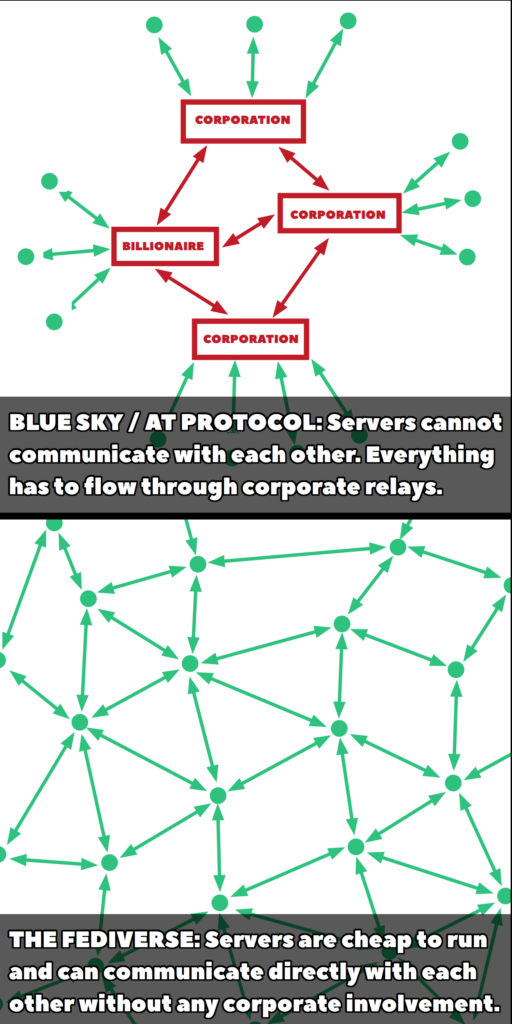
Bluesky comes out of a split lineage – #openweb roots, shaped by #dotcons incentives, with an #encryptionist upbringing.
As the #fashernista and #geekproblem “debate” over social media platforms intensifies, the choice between public, decentralised networks and corporate-controlled #dotcons has never been clearer. Let’s look at a simple example:
Mastodon is owned by no one and everyone (community-driven). Its structure is public non-profit. Number of distributed nodes are in the thousands (fully decentralised). Post length: 500 characters and more. Can edit? Yes. Mastodon represents the native #openweb. It’s built on decentralised principles, where people and communities own and control their spaces. There’s no central authority dictating rules or exploiting for profit.
Bluesky is owned by Venture Capitalists, Its structure is corporate for-profit. Number of “distributed” nodes: One (centralised in practice) Post length: 300 characters Can edit? No. Bluesky, despite its claims of decentralisation, is owned and operated as a for-profit venture. Its structure centralises power and prioritises profit over people’s control, offering a polished but limited alternative to #mainstreaming paths.
The choice between #Mastodon and #Bluesky reflects a broader conflict between decentralisation and #dotcons corporate control. It should, but often is not easy to see that networks like the #Fediverse are native to the #openweb where Bluesky is an interloper, though they are both #4opens. Projects like the #OMN, #4opens, and the #Fediverse itself, offering freedom, community ownership, and transparency. Bluesky, on the other hand, represents the same closed, profit-driven ethos of the #dotcons, repackaged in a new “shiny” wrapper.
When you choose a network, you’re not just choosing where to post, you’re choosing what kind of internet you want to build. The open, public internet is still within reach. The choice should be clear.
The web wasn’t built by solo tech geniuses, finance firms, or flashy luminaries making illusionary promises. It was grown by the collective time, energy, and creativity of millions of grassroots people and communities working together to create something greater than themselves. The internet as we know it emerged not from the top-down visions of elites, but from decentralised, collaborative efforts. This same collective energy will be what propels us into the next era of the #openweb, a web that remains true to its native principles of accessibility, freedom, and inclusivity.
For the last 20 years, however, we’ve been stuck in the corporate-controlled ecosystem of the #dotcons. Platforms like Meta, Google, and Amazon have dominated the landscape, turning the internet into a commodity to be bought, sold, and controlled. Their vision has led to the rise of the #closedweb, where profit and surveillance trump openness and collaboration. This #mainstreaming path is deeply concerning because it fundamentally contradicts what the web was meant to be, a space for sharing, learning, and connecting without the old gatekeepers.
There is a movement to reverse this trend, the #Fediverse, but like meany reboots it’s floundering as it grows through the inrushing of “common sense”. What we need is native #KISS foundations for a thriving #openweb, A path to this is to embrace the #4opens as guiding principles:
Open Data: Ensuring that information can be freely shared and reused.
Open Source: Building tools and platforms that anyone can access, modify, and improve.
Open Standards: Creating interoperable systems that work across platforms and communities.
Open Process: Making decisions transparently and inclusively to foster trust and collaboration.
This is a simple retelling of the #FOSS process with the addition of #openprocess as is used in the best projects, this is a part of the #nothingnew path we are on.
It’s not enough to critique the #dotcons, we need to actively build alternatives, the #Fediverse has already taken the first set on this path. The next step is focusing our energy on “native” projects like #OMN (Open Media Network), #IndyMediaBack, and #OGB (Open Governance Body), on this path we can create a decentralised, human-centred web that prioritises communities over corporations. These projects are not about recreating the same flawed systems in a slightly different guise; they’re about fundamentally rethinking how we engage with technology, governance, and communication. This rethink is #nothingnew as it’s copying the working structure of grassroots activism.
The time is now to come together and make history by working on these alternatives. The #openweb is not just an ideal; it’s a necessity for a sustainable, democratic future. Let’s reject the illusions of the #closedweb and instead build a web that truly belongs to everyone.
The billionaire problem, Elon Musk, tech oligarchs, and the #deathcult of wealth as a social path.
Elon Musk’s purchase of Twitter is emblematic of a larger issue: the unchecked power of tech oligarchs. These aren’t your run-of-the-mill millionaires; they’re part of a nasty few, the class that operates above the ultra-wealthy, shaping politics, economies, and societies to their inadequacy. While the myth is pushed that billionaires are brilliant innovators who work harder than everyone else, the reality is darker. Their actions reflect a destructive #deathcult mentality, hoarding resources, manipulating public discourse, and pushing harmful ideologies for personal gain and standing.
Let’s start with Musk himself. People think of him as the “SpaceX and Tesla guy,” (this is not true, but that’s another story) his behaviour since acquiring Twitter reveals his priorities. Musk purchased the platform for $43 billion, not as a business investment, but as a tool for propaganda to consolidate power and influence politics. To platforming far-right politics, by amplify propaganda and undermine the thin remaining democratic paths. From boosting bots that inflate the appearance of support for far-right ideologies to reinstating accounts that push hate speech, these actions directly impact global politics.
This control of Twitter, and most importantly the chattering classes that stay in this #dotcons, has silenced the little dissent left. Bot-driven disinformation spreading far-right ideologies isn’t accidental; it’s strategic manipulation of public opinion to push agendas. Like supporting trump and authoritarianism, spending over $250 million on Trump’s election campaigns.
Musk isn’t alone, tech oligarchs like Bezos and Zuckerberg are equally complicit in reshaping society to benefit themselves, at the now clear expense of the public. Bezos’s quiet Influence, unlike #Musk, #Bezos operates in the shadows, Amazon spends millions lobbying US politicians to block antitrust laws and maintain monopolies to exploits workers and maximise profit. His strategy is quieter but no less harmful. #Zuckerberg’s free speech farce, with the ending of liberal fact-checking on #Facebook under the guise of “free speech.” The result? A flood of bots spreading hate speech, disinformation, and simple propaganda. By prioritising profit over public responsibility, this #dotcons becomes another breeding ground for extremism.
The #feudalistic influence of tech princes and oligarchs has consequences that go far beyond social media with political manipulation, global meddling. This is no longer just about wealth, it’s about shaping geopolitical realities. This is going to accelerate the current climate and resource chaos. So why do meany of us keep bowing? There is a persistence of the billionaire myth, the idea that they’re smarter, harder-working, and more deserving, which keeps #mainstreaming people from challenging this power. But it should be obvious these aren’t self-made geniuses, they’re nasty inadequate opportunists thriving in a broken system. This isn’t just about Musk or any of the other nasty few billionaires. It’s about rejecting the #deathcult of greed and exploitation our socialites are based on. The rise of billionaires as political actors isn’t inevitable, it’s a symptom of a path that values unrestrained profit over people.
Where is this going, they crave #control, so they assume everyone else is out to control them. They weave #conspiracies to crush their enemies, so they see a world drowning in conspiracies against them. In the final stages, a fully rotted #ideologue can’t even see threats or weaknesses; their perception is warped by their own decayed #moralcompass. At this point, outside direct, action they are beyond reach. Every word we speak will be twisted against us. Every action we take will be seen as an attack #paranoia#fascist.
The #OMN has a vision for something better, decentralised, open, and community-driven governance. A world where power is distributed, not hoarded by a handful of deranged oligarchs. The challenge is to make this vision a real path, and to turn our distaste for the status quo into action for this change and challenge.
it helps to look at the world from different views: The “colour revolutions” have been a strategy of orchestrated regime change, typically pushed by powerful foreign actors, most often the United States. These operations are presented as grassroots democratic uprisings, but in reality, they are heavily funded, pre-planned, and driven by external interests. While the surface story is about promoting democracy and human rights, the outcomes almost always serve the economic and geopolitical priorities of the US and the global capitalist fuckwits.
Step 1: The first move is to weaken a target nation’s economy through sanctions, trade embargoes, and manipulation of international financial institutions. This creates widespread hardship, targeting ordinary citizens, to fuel discontent and unrest. Examples would be: Nicaragua, Chile, Venezuela etc. This erodes public trust in the government, creating the conditions for protest and rebellion.
Step 2: Media manipulation and propaganda, controlling the narrative is critical. The US uses propaganda to frame opposition figures as heroes and targeted governments as corrupt and authoritarian. This is achieved through CIA-backed media like Voice of America which spreads anti-government messaging, planted stories in western media to manufactures consent, that portrays regime change as a moral imperative while obscuring the external orchestration.
Step 3: Empower opposition movements, once public discontent is stoked, the US funds and equips opposition groups to act as the vanguard of regime change. These groups are often chosen for their willingness to align with US interests, regardless of their domestic popularity or legitimacy. Examples: The US recognised Juan Guaidó, a wildly unpopular opposition figure, as president despite his lack of electoral legitimacy in Venezuela. In Guatemala the CIA armed exiled opposition leaders to stage a coup against Jacobo Árbenz, using hired pilots to bomb Guatemala City and spread chaos. Through organisations like USAID and the National Endowment for Democracy (NED), the US provides financial and logistical support to opposition groups, ensuring they have the resources to disrupt and destabilise.
Step 4: Mobilise mass protests, to create the appearance of widespread popular dissent. These are often #astroturfed, with covert funding and guidance from foreign operatives. The symbolism of these movements, colours, slogans, and branded imagery, makes them easy for international media to amplify, framing them as democratic uprisings.
Step 5: Neutralise security forces, for regime change to succeed, a government’s security forces must be undermined. This is achieved through bribery, threats, or outright assassination. Examples: in Chile: The CIA orchestrated the assassination of General René Schneider, a constitutionalist who opposed a coup against Allende. This paved the way for Pinochet’s military takeover. In Guatemala, staged violence and disinformation campaigns created a climate of fear, allowing the US-backed military to seize power. By dividing and destabilising security forces, the US ensures that the government cannot effectively defend itself.
Step 6: Install pro-US leadership, the final step is consolidating power under a regime that aligns with US interests. This involves hand-picking leaders who prioritise corporate and geopolitical goals over their nation’s sovereignty. Examples, In Chile: after Allende’s overthrow, the US provided intelligence and resources to Pinochet’s dictatorship, ensuring compliance with American interests. In Guatemala the US installed a pro-American government to protect United Fruit Company’s monopoly and suppress land reform efforts. These new regimes are rarely democratic or stable, often descending into authoritarianism and neoliberal exploitation.
The consequences of colour revolutions, while sold as democracy-building efforts, the reality is generally far more destructive. Economic collapse from the sanctions and neoliberal reforms that devastate local economies, leading to poverty and inequality. Ongoing political instability with installed governments plagued by factionalism, corruption, and authoritarianism. Global distrust in the US’s repeated interference undermines credibility, in the end pushing nations towards alternative paths, the cycle then repeats, yes it’s a mess. These interventions normalise the erosion of sovereignty and democracy, leaving lasting scars on the nations they target.
There is a strong need for accountability, the US’s playbook for regime change, disguised as democracy promotion, is a tool of imperialism that pushes corporate and geopolitical interests over basic human rights and stability. It’s a path that thrives on economic hardship, media manipulation, and the subversion of local institutions.
A note on the side – the #OMN approach, grounded in decentralisation, #4opens principles, and collective action, offers a stark contrast. Rather than destabilising societies for profit, we grow resilient paths that empower communities and foster genuine self-determination #KISS
This is a #fluffy response to this thread, about people feeling that some of the discourse surrounding the #openweb is too black and white, and that this is going to increase with the current pushing to the right political reality. Yes, supporting the #openweb doesn’t automatically make you “left-wing” or a “Marxist,” just as using platforms like X or Meta products doesn’t necessarily make you “right-wing nut job” or an out right “fascist.” The world is full of different shades, oversimplifying these issues from the mythical centre grows the polarisation that the people are very likely arguing against.
Building a business on open technologies is not inherently wrong, building exploitative #dotcons is clearly wrong. There is value in the middle ground between commercial success and the native #openweb paths. The challenge is finding the balance and ensuring businesses side respects the #4opens principles our people’s web is built on. Of course, there are risks. Commercial companies working on open technologies often push too far and betray trust. Meta’s entry into the #fediverse, for example, raises suspicions for good reason. Their track record shows a consistent prioritisation of profit over people.
However, that doesn’t mean we should dismiss the idea of building a business around open tech entirely. It’s about trust, accountability, and balance. Being critical doesn’t mean rejecting something outright; it means scrutinising the motives and actions behind it. The same #4opens principle applies whether you’re evaluating a tech startup or a massive corporation.
The bigger political mess the people in the thread are talking about isn’t open vs. closed or left vs. right, it’s the utter mess our middling political class has made with its hard shift to the right. This polarisation isn’t actually coming from the left, as many people assume when they’re critical of “extremes.” It’s a result of the “centre” being dragged further and further over decades. The balance has been lost, and it’s no wonder people are scrambling to find footing in such unstable paths.
I talk about this subject often from a radical progressive left perspective on this site (http://hamishcampbell.com), and yes, it is a mess in every way. The centre path, the one that should hold things together, has veered so sharply that even moderate discussions feel like battles over extremes.
For meany people in the centre, a shift back to something like the Bretton Woods, 20th century social democracy from the era before Reagan and Thatcher pushed us onto our knees to worship the #deathcult for the last 40 years. We do maybe have room for small business owners and local enterprise, a capitalism built on community, not monopolistic greed. Smaller capitalists, smaller systems, more balance.
This balance, and the conversation the #openweb needs to reflect, the larger struggle for balance. The goal isn’t only to polarise or pick sides, it’s to find a progressive “native” way forward that incorporates the best of different perspectives. A diversity of ideas, from Marxist critiques to social entrepreneurial innovation, so long as they operate within the #4opens framework of trust, openness, and accountability.
Yes, it’s a mess, but the way out is through this, shovels and composting come to mind and hopefully hands #OMN