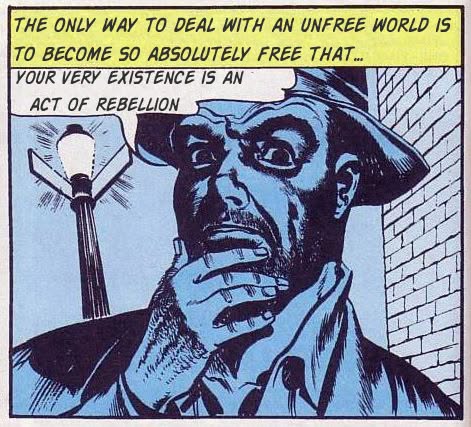
The current mess and tragedy is that the tools we need most are often the first things that stressed, messy, #elitist systems defund, discredit, and dismantle. Why? Because these tools threaten the psychological certainty that people cling to when the world feels unstable. The ability to sit with uncertainty, to question assumptions, to admit complexity. These are not weaknesses, they are survival tools.
Yes, this is a mess we need to compost, the #nothingnew path to work on this is about recovering tools we already know work: science’s methods, hypothesis testing, falsifiability, uncertainty management, peer review, and collective correction. These are cultural technologies for thinking beyond the current #blocking immediate tribal reactions. They are systems designed around humility – the understanding that reality is bigger than any one person’s story.
In #OMN terms projects like #indymediaback, #OGB and #makeinghistory are the toolkits that can help us escape psychological traps, not by removing fear, fear is part of being human, but by building social paths strong enough to keep working even when the humans walking them are scared.
Psychological safety only works in ecological surplus, long-term joined-up thinking requires this psychological safety, when we have a surplus, a system has enough resources, so that it can experiment, adapt, and invest in the future. When a system is stressed, like we are today everything collapses towards survival thinking and behaver. This is why stressed societies underinvest in care, research, education, community, and long-term thinking. They marginalise the people doing this work and punish institutions trying to protect it. One of the resigns why the prophet is often stoned.
The hard right’s politics of scarcity – real or manufactured – creates cognitive narrowing. As people feel under constant threat, attention focuses on immediate danger, planning horizons shrink, outsiders become threats, complexity becomes suspicious. Cultures shaped by generations of insecurity carry this short-term thinking into institutions, mythology, and identity. It becomes the “common sense” in that everyone unthinkingly believes in. After 50 years of worshipping the #deathcult of endless extraction, competition, growth and profit above everything else, our societys and ecologys are fragile. And this is exactly when collapse pressure increases, the things that looked inefficient during growth become survival-critical – Diversity – Redundancy – Resilience – Commons.
The #OMN approach has always been that messy diversity is not waste, rather a core to living survival. So why do people still block this to cling to the broken paths? Humans know they will die, it creates a deep existential pressure that cultures have always tried to manage. Worldviews, communities, identities and belief systems become anxiety buffers. When those are threatened, people do not always become more rational. Often they become more defensive, double down, they become more attached to the group that gives them meaning.
This is why authoritarian paths grow during periods of fear – stronger hierarchy, tighter in-groups, scapegoating, magical thinking, blinded rigidity. The response to uncertainty becomes control, but control is not the same as resilience. Were the #openweb alternative is to often pushed away, it becomes a challenge, to build cultures that can handle uncertainty without collapsing into fear. And why It’s so hard to grow the needed open processes, shared knowledge, trust networks, collective problem-solving, and spaces where disagreement can happen without destroying the commons.
And we have people to do this – the reserve army “problem” – Capitalism creates its own insecurity, it structurally requires a group of people who are not fully included in production. The unhoused, precariously employed, unemployed, migrants and marginalised communities. They are treated as failures of the system, but from a structural perspective, precarity is useful to the mainstreaming. A population living with insecurity disciplines everyone else, it tells workers to accept worse conditions, less power and less control. Because someone else can replace you.
The #4opens can be a part of composting this, not because openness magically fixes everything, but because transparency, participation, and accountability are tools for keeping power visible. The #OMN path is about growing these social technologies alongside existing technical ones. In this the work is not to pretend fear does not exist. The answer is to build paths where fear does not become the organising principle. So we have real social groups to compost authoritarian thinking, scarcity politics, scapegoating, magical solutions, and the idea that domination is the only realistic path.
The future needs different seeds, the precarity, #openweb, #OMN, #4opens and other commons-based paths are parts of that wider work. The question is not whether the old system can continue forever, it is what are we growing while it cannot?
There is a persistent myth pushed in our culture that intelligence – high IQ, academic credentials, elitist education – leads naturally to clear thinking. My organic experience suggests the opposite, what matters is disciplined, skeptical, freethinking curiosity. Without that, intelligence simply becomes a tool for defending whatever assumptions people already hold.
This is one of the reasons many academic environments produce people who are, bluntly, credulous. Not because they lack intelligence, but because the institutional structures around them reward conformity and reputation management far more than genuine curiosity.
Over the last two years I’ve been spending time in and around the university culture in Oxford, participating in discussions, events, and academic life. The experience has been instructive, if in the end frustrating. You would expect a place associated with University of Oxford to be a centre of open intellectual challenge. In practice, it feels like something else: a system that filters, polishes, and reproduces existing assumptions.
This is not universal, some of the hard scientific disciplines still cultivate a form of disciplined skepticism, experiments fail, evidence contradicts theory, so you are expected to question results. The process encourages a narrow but very real culture of doubt, but outside those narrow areas, skepticism to often fades.
Instead, you find intellectual fashion cycles building reputational alliances that push institutional caution based on #blinded ideological signalling. The result can be a strange mix of high intelligence and low #blocking curiosity. People who are good at working inside established frameworks, but much less comfortable questioning the foundations of privilege those frameworks rest on.
This matters for the #openweb and projects like #OMN. I got nowhere here as many of the institutions that might have supported open digital infrastructure – universities, NGOs, research centres – have shifted toward the same #deathcult#mainstreaming#blocking that dominates the wider tech world. Funding cycles shape research priorities, institutional partnerships shape acceptable ideas and career incentives shape what can safely be questioned.
So even where intelligence and resources exist, the culture of disciplined curiosity that drives the needed real innovation is thin if it exists at all. The irony is that the early internet grew out of exactly the same institutions, but with opposite culture. The original World Wide Web ecosystem, the hacker and #FOSS communities, and early grassroots media projects like #indymedia were built by people who combined technical curiosity with deep skepticism about centralised control.
They didn’t wait for institutional approval, they experimented, built #DIY tools that broke things and rebuilt them. That spirit is what projects like #OMN are trying to revive. The goal is not to outcompete corporate #dotcons platforms or impress #NGO academic institutions. The goal is simpler: to build open media infrastructure that communities can use based on small nodes, trust networks and open metadata flows. Simple tools that allow people to publish, share, and connect.
This is a working #KISS approach to rebuilding grassroots media. If the last twenty years of the web have taught us anything, it’s that intelligence alone doesn’t produce healthy systems. You can have brilliant engineers building platforms that clearly undermine democratic communication, it’s the mess that shapes the current #dotcons world.
What makes the difference is curiosity combined with skepticism, the willingness to question the structures that shape our digital lives. Without that, even the smartest institutions drift into the same patterns of credulity and conformity, which is why rebuilding the #openweb is not just a technical project, it’s a cultural one.
Why does it feel like so many people have become intolerant prats? A blunt observation: it increasingly feels like many people today are intolerant prats. And worse, this behaviour has started to feel normal. You see it everywhere. Online discussions collapse quickly into hostility. Small disagreements become unthinking moral #blocking were people retreat into camps where any challenge is treated as an attack.
This isn’t just a social media problem, though the #dotcons have certainly amplified it, it’s a deeper cultural shift. For decades the dominant systems shaping our culture have encouraged competition, individualism, and personal branding. The result is what I often call #stupidindividualism – a worldview where the individual ego becomes the centre of everything. In that environment, disagreement stops being part of learning and becomes a threat to identity, so people react defensively, aggressively or dismissively. What used to be debate becomes performance.
The platform problem is when the #dotcons platforms are designed to amplify this behaviour where algorithms reward outrage, tribal loyalty and moral signalling to push conflict to drive engagement. They do not reward patience, nuance, or curiosity, in other words, they are structurally optimised to turn ordinary people into worse versions of themselves. Over time this becomes cultural habit, people start to assume that hostility is normal conversation.
Another factor is the slow collapse of collective spaces. When communities interact face-to-face, or in smaller trust networks, people have to deal with each other as human beings. Relationships create friction but also accountability. In large anonymous digital environments, those social checks weaken. People become avatars and opinions rather than neighbours, this makes it much easier, “natural” to treat each other badly.
Why this matters for the #openweb. If we are trying to rebuild grassroots media and communication infrastructure, we need to recognise that these cultural habits have already spread into many communities, including the tech and activist spaces that should be alternatives. This is one reason projects fragment so easily as small disagreements spiral, people assume bad faith and thus trust collapses.
You end up with endless internal conflict instead of collective building. This isn’t just a personality problem, it’s the legacy of systems that reward attention and conflict rather than cooperation.
A different path can be grown in projects like #OMN which is partly about rebuilding infrastructure, but they are also about rebuilding culture. The idea is simple: smaller networks, trust-based publishing, open metadata flows and simple tools people can run themselves. A #KISS approach to communication infrastructure.
But technology alone doesn’t solve the deeper issue, what actually makes communities work is something much older and simpler: tolerance and curiosity. The ability to disagree without instantly turning disagreement into war. The ability to assume that the other person might have something worth hearing. Without those habits, no infrastructure – open or closed – will function well for long.
Composting the mess – the current online culture is a mess. A lot of the behaviour we see today is the product of twenty years of #dotcons platform design. But mess is also compost, it shows us clearly what doesn’t work. The next generation of the #openweb has an opportunity to build systems that encourage something better: slower conversation, local trust networks, collective responsibility, shared media infrastructure. Less shouting, more listening.
It won’t magically make people perfect. Some people will still be intolerant prats. But at least we won’t be running the entire communication system of society on platforms designed to encourage it.
This Oxford mess is a shadow of a larger mess. We were told the story of Prometheus: fire stolen from the gods and given to humans – our first real piece of technology. The myth asks a simple question: what do we do with power once we have it?
In democratic society why do we put up gig work and side hustles, endless surveillance platforms pushing algorithmic attention traps, housing crises and climate collapse all pushed by a handful of billionaires controlling huge parts of the economy. Why do we put up with What with the mess of technocratic oligarchy – a system where technological infrastructure concentrates power instead of distributing it?
The #mainstreaming mythology of the tech founder helped this happen. The “visionary genius” narrative around people like Bill Gates, Steve Jobs, Mark Zuckerberg, Jeff Bezos, Peter Thiel and Elon Musk turned corporate executives into cultural heroes. This mess is simply #KISS oligarchy with better marketing.
Even ancient thinkers warned about this. Plato and Aristotle described how societies cycle through forms of power, and how rule by the wealthy tends to serve the wealthy above everyone else. The irony is that many of today’s tech elitists think of themselves as the new aristocracy – the “smartest people in the room” guiding humanity forward.
Yet the future they’ve built is #techshit platform #feudalism with people monitored constantly, economic life mediated by a few #dotcons platforms. Infrastructure owned by private empires and democratic institutions bought out then sidelined.
The tragedy isn’t that technology failed, it is more that we let our technological imagination be captured by oligarchs. Prometheus gave humanity fire so we could build civilization together, not so a tiny #nastyfew tech CEOs can privatise the flame and sell back the light.
The real question isn’t whether technology will shape the future, it’s who controls it.
For progressive and radical people, the central political questions of our time is simple to ask but hard to answer – Why is it so difficult to rebuild the institutions that were destroyed in our #deathcult worship of the 1980s and 1990s? And more importantly why does the impossibility of rebuilding them make it so hard to change the needed balance of power in society? These question matters for working on the future of the society and most importantly the grassroots part of this: #openweb, grassroots media, and projects like #OMN.
The hollowing out of institutions, in the 20th century, politics used to be deeply institutional. People didn’t just express opinions, they joined organizations. If you marched in a protest, we usually marched as a member of something: a trade union, a political party, a civil rights organization or community association. These organizations formed the infrastructure of democracy, connecting everyday anger and hope to real power.
But beginning in the 1980s and 1990s, much of this infrastructure was deliberately dismantled. Union power was broken, mass political parties were hollowed out, and community organizations lost resources and influence. The result is the political landscape we inherit, a society with political anger but without any working political structures.
Today we live in what #fashionistas and academics call #hyperpolitics or what I call #stupidindividualism in the hashtag story. Yes, some people are more politically engaged than they were in the 1990s or early 2000s, more fluffy protests, #dotcons online political discussion, but this engagement is almost all unstructured in the old sense.
Millions may join a protest or share a political message in the #dotcons, yet very little, if any lasting organization emerges from this. This surface engagement creates a strange paradox of huge drifting mobilizations leading to little if any structural change. We can have the largest protests in history – yet the underlying power structures remain completely untouched.
Closed #dotcons social media lowered the cost of expression, but algorithmic ally shaped it into smoke and mirrors. Let’s take a moment to lift the lid on this #techshit mess, the role of media in this is complex, on the positive side, #closedweb platforms drastically reduced the cost of political expression.
Forty years ago, if you wanted to express a political opinion publicly you needed a newspaper, radio station, a public meeting or to stand in a square shouting. Now you can reach thousands of people instantly, but there is a downside that #dotcons smoke and mirror online engagement replaces the slow work of institution-building. Posting, sharing, and reacting can feel like participation, but it has little role in building the durable structures needed for any long-term change or challenge.
So why do the current hard right succeed without institutions? There is an uncomfortable asymmetry between left and right, the right carry out its agenda without building mass organizations, because it relys on existing #elitist power structures, wealthy donors, state institutions and traditional corporate media.
The left cannot rely on these, historically the left needed mass organizations because its power came from collective action – workers, communities, movements – without those structures, left politics becomes, mess, fragmented and reactive. This is why protest waves can be enormous but still fail to shift any real policy.
Then we have the #undeadleft problem where vertical left responds to this crisis with nostalgia, there imagination stops at rebuilding the mass political parties and institutions of the 20th century. But this is to often like trying to animate a corpse, even if you could recreate it, the environment has changed so much that it wouldn’t survive.
At the same time, the opposite response – abandoning institutions entirely to relying purely on digital networks – also fails. Purely online movements dissolve as quickly as they form. We need a #DIY hybrid path based on federated #4opens institutions like the tools we are building and rebooting with the #OMN projects.
Not rigid old institutions, not purely online networks, but something that seeds the in between. The path is not to create another platform, it is to expand #federated#p2p infrastructure for collective media and collective politics. The original #openweb worked because it supported networks of communities, independent publishers and grassroots movements. The corporate #dotcons replaced this with extractive platforms designed for profit and control.
On this path #KISS rebuilding the commons means rebuilding the social infrastructure of media, not just tools, but institutions and practices that persist to allow collective voices to organize. The simple truth, for real political change, we cannot rely on viral posts, temporary movements or algorithmic attention. We need structures that last, connect people, that turn energy into horizontal power. That work is slow, messy, and unfashionable, but like digging compost for a garden, it’s the only way anything grows.
A path to start to compost this #techshit is growing horizontal tools from the #Fediverse for real change (#OMN).
If the problem of our time is political energy without institutions, then the opportunity is clear, build new institutions native to the #openweb. Not simply recreate the rigid organizations of the 20th century, and not fall into the hollow performative politics of the #dotcons. Instead, we grow native horizontal digital tools to help people organize, coordinate, and act collectively. This is where the Fediverse and projects like #OMN matter.
The #Fediverse already proves that distributed infrastructure works, but right now it is mostly used for conversation. If we want meaningful change and challenge, we need to extend it into practical coordination and collective action, by build tools for organizing, not just talking
Current social media tools are built for attention and engagement, not organization. What we need to add to the mix is simple #4opens tools that help people form groups, coordinate action, share resources, document activity and most importantly maintain continuity over time (#makinghistory). The Fediverse already has #fashionista and #geekproblem pieces of this:
Mastodon / Pleroma → conversation

Mobilizon → events and gatherings

PeerTube → video publishing

PixelFed → visual storytelling

Lemmy / Kbin → community forums
These existing pieces can become seeds to be woven together into workflows for collective action. On this path we need to remember the goal is not more platforms, it’s practical ecosystems. For this to work a first step is rebuilding commons-based media. A core idea behind #OMN is returning to something like the #Indymedia publishing model, but rebuilt using modern federated tools. Instead of a single website, imagine distributed publishing nodes where local groups post reports, media is shared across networks, discussions happen across servers and archives remain accessible and most importantly meaningful.
This builds collective memory, something the algorithmic feeds of the #dotcons constantly destroy – Movements need memory to learn.
#makinghistory is the same code-base as this grassroots media project
One reason mass organizations collapsed is that participation became too heavy, people don’t want to “join a church” politically any more. So tools should allow different levels of engagement, casual participation, occasional contribution, active organizing with core stewardship. The #Fediverse naturally supports this because it allows loose affiliation rather than rigid membership. You don’t need permission from a central authority to participate.
To make this work we need to focus on infrastructure, not branding. A common #NGO trap in activist tech is building new branded platforms that compete with existing networks. That approach usually fails, the better path is infrastructure building based on protocols instead of platforms for #4opens interoperability instead of silos, tools that connect existing communities. This was the original power of the #openweb, protocols scale, platforms capture.
Keep the tech simple (#KISS), as the biggest barrier to grassroots technology is complexity, many promising projects fail because they become too technical for real communities to use. So the rule should always be KISS – Keep It Simple, Stupid. Tools should be installable easily, understandable by non-geeks and maintainable by small communities to grow resilience without large funding. If only developers can run the system, it will never become a movement infrastructure.
Compost the failures (#techshit) is another key idea, recognizing that the tech world constantly churns useful waste – old tools, failed platforms, abandoned code, all of this is #techshit that can be composted instead of chasing fashionable new tech, we reuse working ideas, simplify existing tools to combine proven approaches. The #openweb already solved many of these problems decades ago, sometimes progress means going back to what worked.
Build trust networks, as the most important layer isn’t technical – it’s social. Horizontal networks only function when there is trust and shared culture. The #Fediverse works because communities can federate with trusted peers, block hostile actors, build local norms. This allows networks to remain open but resilient – the challenge is nurturing communities of practice around the tools.
Grow slowly and organically, movements that scale too quickly often collapse. The better model is ecological growth with small nodes → connected networks → resilient ecosystems, just like compost turning into soil. The goal is not explosive growth, its sustainable infrastructure for collective action.
The real challenge is the biggest obstacle isn’t technology, it’s the #geekproblem – the gap between technical culture and social reality – too many tech projects assume that better tools automatically produce social change, but tools only matter when they are embedded in real communities and struggles.
The work of projects like #OMN is bridging that gap, shovels, not silver bullets, we don’t need magic platforms, we need shovels, tools that help people dig, build, connect, and organize together on the native #openweb. If we can do that, the Fediverse becomes more than an alternative social network, it becomes infrastructure for democratic power.