OK, lets not deny real risks, but also don’t accept the AI industry’s mythology as the starting point for discussing risks. The useful question is what currant AI’s actually do, who controls them, and what infrastructure and power relationships we are building around them.
AI is useful technology wrapped in a massive social, political and financial mythology. At the #OMN we are less interested in the usual argument between “AI will save humanity” and “AI will destroy humanity”. as both become noise in the current #LLM mess. To get a clearer picture we need to step back to ask a much simpler question – what does the technology actually do, and what are we building around it? Because there is a trap here.
We take an interesting piece of software, call it “AI”, then AI becomes AGI, AGI becomes superintelligence, and suddenly we are discussing machines as if they are becoming digital people. The #dotcons are happy with this story, as this story justifys gigantic data centres, enormous energy use, massive investment, extraordinary infrastructure contracts and the concentration of yet more technological power in the hands of the #nastyfew.
But there are serious questions about AI safety – autonomous weapons – cybersecurity – biological research – critical infrastructure – economic disruption – surveillance – disinformation – concentration of power. The replacement or degradation of human work. But there is a difference between looking at concrete risks and accepting a mythology about an imaginary future machine.
lets look at some of these risks: “AI will destroy humanity” argument starts somewhere like this – AI becomes more intelligent than humans – it develops goals – those goals don’t align with human interests – it becomes capable of improving itself – it gains access to infrastructure – it protects itself from being switched off – it expands its ability to act. Eventually humans become an obstacle, therefore humanity is eliminated. If we were actually building #AI not the current LLM’s that would be a possible speculative scenario.
But notice how many assumptions are packed into that chain. AI → AGI → autonomous agency → self-improvement → independent goals → infrastructure access → resistance to control → human extinction. Each arrow needs evidence, to judge this #KISS becomes useful. Don’t start with the end of the story, start with the machine in front of you. What can it actually do?
An #LLM generating confident bullshit isn’t evidence of an emerging artificial mind, a badly isolated “autonomous” system causing damage is an engineering and security problem. A corporation using dysfunctional AI to replace workers is an economic and political decision. A military using LLM’s based on the history of litterateur, feed partial data to kill people is a legal, political and military decision. A government using AI for surveillance is a governance problem. A data centre consuming enormous amounts of electricity and water is an infrastructure and ecological problem.
These things don’t require us to believe that a machine has become conscious, they require us to look at the #nastyfew are pushing over us. If we don’t look at the problems from this view we make the same mistake we have made with technology for decades, turning a social problem into a technical problem. Have you noticed that it is the priests of the #deathcult who loves AI.
But the are real problems in the #AI arms race – military competition → autonomous weapons → humans delegate decisions because machines are faster → competing systems interact → escalation/control failure → mass killing. Here extinction result from autonomous weapons, nuclear systems, biological weapons or other military infrastructure. That argument doesn’t require AGI it is simply the current mess with added tech mythology.
The #OMN critique isn’t so much about whether LLM’s are “good” or “bad” it is about the economic and social system surrounding the current #techshit paths, we already have piles of #techchurn to compost with out adding more. The #OMN doesn’t want to repeat this mess with AI, what we need is ways of keeping power visible enough that people can challenge it, for this we need to compost the mythology.
This is why the #OMN is deliberately boring compared with the AI storeys. Our focus is not technological salvation, or technological apocalypse. We need useful #KISS technology embedded in social structures where people can understand, challenge, change and, when necessary, walk away from. The mistake is always turning the tools into a mythology and then building society around the mythology. The #deathcult has had fifty years of economic “thinking” on this, look at the mess, now lift your eyes.
We have done this before, we take a useful technology, wrap it in a huge financial story. We centralize it, try and monetize it to turn it into a platform. Then we pretend the social consequences were somehow an accident, it is what we are doing with LLMs. We took an interesting piece of software and started selling it as AI, then AI became AGI, became super-intelligence. This smoke and mirrors feeds the path of building gigantic data centres, burning enormous amounts of energy, raising billions, signing extraordinary infrastructure contracts and concentrating yet more power in a hands of the #nastyfew.
And now we are supposed to believe this is progress, nop, this is the normal #deathcult doing what the #deathcult does – take something useful and turn it into an extraction machine. the mess we need to compost is that “interesting software” doesn’t justify a trillion-dollar mythology – AI will transform everything – AI will replace everyone – AI will solve science – AI will destroy civilization – AI is the next industrial revolution – AI is the singularity – AI is almost AGI – AI is too dangerous to release – AI is progressing faster than anyone expected – AI will change humanity forever. Can you see the smoke and mirrors trick?
Both the utopian story and the apocalypse story sell the same thing, more #AI, more computing, more investment in data centres. More centralization of money for the companies already building the machines of control. Maybe the argument changes, the conclusion doesn’t. Pushing fear is also marketing, this is where the current AI “doom” industry pushes mess. Tell people your machine might destroy the world and you have simultaneously told them your machine is incredibly powerful. This is about grasping for the control of focus, creating scarcity, you have created fear you have created importance.
This mess is about #fashionista capture, its a old story, were you try to created a lever for governments, and the chattering classes, there servants to listen to you, for investors to keep funding you, to build even bigger machines. The apocalypse it self becomes a business model.
That doesn’t mean the risks aren’t real, #AI implementations can create real security, economic, social and political problems. But we need to separate those problems from the mythology. A badly isolated autonomous coding system is an engineering and security failure, it doesn’t mean the machine has “woken up”. An LLM producing confident bullshit isn’t evidence of an emerging artificial mind, it is an LLM producing confident bullshit. And a company repeatedly telling us that its next model might be AGI doesn’t make AGI a meaningful scientific milestone.
Sometimes #KISS is the radical answer, please look at what the machine actually does, not what the marketing department says it might eventually do. We have already seen this mess play through.
Web 1.0.
Web 2.0.
Crypto.
Blockchain.
NFTs.
Metaverse.
Web3.
DAOs.
Now AI.
Every few years Silicon Valley discovers the next thing that will “transform” nothing. The technology changes, were the investment logic barely does. Hype → investment → infrastructure → more hype → bigger investment → pressure to monetize, it is #techchurn.
Except now the machines require gigantic amounts of physical infrastructure and enormous financial commitments. This is the bit that gets hidden behind the shiny chatbot interface, LLM’s isn’t floating in the cloud, it is powered by somebody else’s warehouse, somebody else’s electricity bill and somebody else’s infrastructure. The supposedly weightless future has a very large material footprint.
The #deathcult loves this machine – but something deeper is happening here – the #deathcult has spent fifty years teaching us to worship – growth – efficiency – scale – competition – automation – consumption – financialization – individualism – technology. The AI industry is the last-ist gasp at pushing the mythology – more computing, more scale, more automation, more investment, growth, more efficiency. And because this machine is called “intelligent”, we are encouraged to bow down even further. The machine knows, the machine decides, the machine optimizes, the machine will solve all our knee ach problems. Meanwhile, the #nastyfew who own and direct the machine accumulate power.
Its a part of the #geekproblem were technical people make things work, this has real value, but technical expertise is one tool, not the toolbox. You cannot engineer your way out of social problems, or code trust. You cannot automate democracy. You cannot solve inequality with a better interface. You cannot fix the political economy of capitalism by making the algorithms slightly cleverer. And you certainly cannot hand over social decisions to machines because the humans have become inconvenient to a few nasty people.
This is the same blindness we have been suffering from for decades, if the problem is difficult, make it technical. But then “common sense” technical people become the gatekeepers, becomes the institution, becomes infrastructure. Then fingers in ears, nobody remembers that the original decision was political, as the power disappears into code – #AI becomes just more #dotcons.
To balance this mess, by composting, we need to open our eyes to the history of the #openweb. The original web was built messy on #4opens standards. hyperlinks, RSS to grow small websites were people published, people connected built by people making their own tools. Then Web 2.0 arrived, the UX got better, the platforms got bigger, the money arrived and the web became #dotcons.
Blindly, repeating this same mistake with the dotcons LLM’s in the era of #climatechaos is stupidity. Its a big mistake to be building another generation of giant closed systems of control. At best we should be asking – what would an open AI infrastructure look like? What data? What standards? What ownership? What governance? What accountability? What local control? What human oversight? What right to challenge? What right to rollback? What happens when the system is wrong? Who gets to decide? These are political questions.
That is backwards, technology is a tool for people, and yet here we are. agen we are generating the problem to feed the machine built to solve the problem, peak #techshit. So what do we do? We don’t have time for another #fashionista moral panic please. Not “ban everything”, not “AI will save us”, not “AI will kill us”. Not another fucking blinded conference where everybody agrees that governance is important and then goes home and builds the same centralized paths.
What we do need is to compost is this mess, take the useful technology, the useful research, the open models to build automation that actually gives people more time and power. Knowledge is always useful, but please throw the mythology onto the compost heap, the fake AGI worship, the #nastyfew billionaire saviour stories, the singularity smoke. We cant survive the endless-growth assumptions, of the #closedweb platforms, the surveillance economy, we need to compost this social #techshit.
Composting this is why the #openweb is a tool that still matters, not because openness is fashionable, or that another technical architecture will magically save us. It matters because power has to be distributed somewhere. Open data – Open source – Open standards – Open process – The #4opens. To make this tool work we need to grow the path of human moderation, community trust, distributed infrastructure and shared public knowledge.
The #OMN has practical projects for this path – archives with #makeinghistory – news with #indymediaback and eventually governance with #OGB. A practical #KISS path that understands that we need useful technology, to help communities organize, remember, communicate and act. We need infrastructure that belongs to the people using it, And the community to use this “shovel” to stop worshipping the mythology of the #deathcult machines and start rebuilding the commons.
Yes, this is a first small step in the path we need, not a dogmatic answer to everything. We clearly do not need more blinded technological salvation story’s. What we do need is a practical path to build news, archiving and eventually governance around open flows, trust and participation rather than surveillance, extraction and platform ownership.
The #deathcult has had fifty years, look at the mess, now lift your eyes and let’s start composting.
As the worshipping the #deathcult for the last 50 years becomes harder to hide, the lies are more naked. The lie of endless growth, trickle-down wealth, technological salvation and individual freedom are running into the material reality they created. The mess can no no longer be hidden in the abstract.
#Climatechaos, inequality, war, social fragmentation, political decay. #techshit. The question now is impossible to keep ignoring, not whether the system has problems, it is whether we can see the problems clearly to stop worshipping the mess that created them.
This is where we need social composting. Turn the pile. Expose the assumptions. Keep what is useful. Let the dead ideas rot down. Then grow something alive.
There is something revealing about the way powerful people talk about our future, when they imagine crisis, they imagine their escape. A luxury bunker, fortress border, a private city, a rocket or an #AI cloud. A place for the self chosen few to survive while everyone else is left outside to die.
This is the “logic” of the #deathcult we all worship, if the world is breaking, protect yourself rather than repair the world. It should be obverse to us that this is is not really any actual plan for the future, its just more head down worship, an admission that this class have stopped believing in any thing at all.
But, yes they hid this, they still tend to tell a story, the shiny version of this story is always the same, out of catastrophe comes a golden city, the old world burns, the rubble is cleared, and the self selecting few build something beautiful on top of it.
We have heard this story for thousands of years, apocalypse, judgement, Armageddon, collapse, then purification for paradise for the few survivors. The modern retelling simply replaces heaven with a billionaire bunker, an exclusive smart city, an AI utopia or a colony on Mars, different technology, same path.
On this #mainstreaming path some people, who we call the #nastyfew in the #OMN hashtag story, deserve to survive the mess they created. But what is not told in this simply story is that the bunker is hard right politics – #climatechaos, pandemics, resource conflicts, economic insecurity and technological disruption are real problems. But there are two very different ways to respond to systemic crisis.
One response is – How do we protect everyone and make the system more resilient?
The other is – How do I make sure I am on the inside when it collapses?
The second path is not surprisingly increasingly visible in #nastyfew billionaire culture, authoritarian politics and in the #dotcons industry we all spend way to much time inside.
in this modern story, the bunker is not just a building underground, it is a political metaphor, fortress borders are bunkers, private security is a bunker, gated communities are bunkers, #closedweb platforms are bunkers. What matters for us in #FOSS is monopolized infrastructure is a bunker. Even the fantasy of escaping humanity through #AI or space is another bunker, an attempt to leave the shared social and ecological world rather than compost our dysfunctional relationship with it.
This path is the opposite of the #openweb,it is were the #deathcult turns fear into control. The right-wing answer to social crisis is always built around fear – Fear of outsiders, fear of immigrants, fear of social change, fear of losing status, fear of disorder, fear of the future. But, then comes the golden lie, the promise, we will protect you, but this protection soon becomes control. The anger that should be directed toward concentrated wealth and political power gets redirected sideways and downwards toward other ordinary people.
The poor become the problem, migrants become the problem, minorities become the problem, the left becomes the problem. The messy complexity of society is reduced to enemies, it is an old political trick that the #blinded technological #closedweb makes much more powerful. Today’s authoritarian politics doesn’t arrive wearing an old-fashioned uniform. the phone in our pocket, influencers, algorithms, targeted advertising, surveillance systems, AI-generated propaganda and permanently monetised outrage. The infrastructure of the #dotcons is a bunker.
But what we focus on the #OMN path is there is alternative, this alternative isn’t pretending that everything is fine, not another shiny utopia, and it certainly isn’t waiting for some perfect political party, perfect technology or perfect leader to save us. The alternative is much more boring – Build things that work, trust, commons, local resilience. Create media systems where communities can see and understand what is happening. Focus more on building technologies that people can actually control by #KISS keeping the infrastructure understandable so participation is possible. Create spaces where people can disagree without immediately becoming enemies. That sounds much less exciting than an AI god or a $50 million survival bunker, good, what we need to do as the #DIY grassroots is move from bunkers to bridges
The important question is not, who gets into the bunker? The question is, what are we building outside it? Because humans have already built an enormous number of bunkers, political bunkers, economic bunkers, cultural bunkers, technological bunkers, information bunkers. We don’t need more, we need bridges, and bridges are fundamentally different from bunkers.
A bunker protects something by excluding people, a bridge creates value by connecting people. That is the deeper #openweb possibility – not a technological escape from society, but technology that helps society organize itself. Not centralized control, but distributed participation, not ownership of everything, but stewardship of shared resources, not fear as the organizing principle, but trust. Not “how do I survive when everything collapses?” but “How do we make collapse less likely, and life better, together?”
Its about composting the apocalypse – the world really is messy, but fear doesn’t have to become a bunker, it can become a reason to organize. This is where social composting matters, take the accumulated waste of the last decades — #neoliberalism, authoritarianism, #techshit, platform capitalism, political tribalism, broken institutions and the endless fear machine. Don’t pretend it isn’t there, don’t worship it or spend your entire life fighting it head-on. Compost it, break it down, learn from it, keep what is useful, let the dead parts become soil to then grow something different.
The #deathcult says the future belongs to the #nastyfew who can buy their way out, the #lifecult says the future belongs to those who can build relationships strong enough to stay. The choice isn’t really between apocalypse and utopia, it is between bunkering down or building commons. The planet doesn’t need another billionaire bunker, it needs people willing to pick up shovels.
To understand and walk this, lets look at an example of the mess we need to compost – by lifting the lid on the current #AI noise. The problem, isn’t simply whether #AI is intelligent; it is who controls the infrastructure, what incentives drive it, and whether technology serves people or turns people into components of the machine. When can see this we might be able to see, thus act on the #OMN trajectory: technology → power → participation → open infrastructure → commons, let try and get past the #fashionista mess of whether #AI is or isn’t “really intelligent.” as this is a lot of #mainstreaming noise.
AI is going to take all our jobs. AI is going to transform everything. AI is going to become conscious. AI is going to kill us. AI is going to save us.
Some of these claims might be true, some are noise and others certainly nonsense. The more useful questions are simpler – Who controls the technology, what are they trying to achieve, and who gets to decide how it is used? This is where the #OMN view of technology starts, don’t believe the hype – but don’t ignore the technology.
One of the problems we need to mediate, is, we should be careful about criticizing AI by repeating the claims made by the #dotcons (AI companies). If a company tells us its system is basically becoming a digital human, and we respond by saying “yes, but this digital human is dangerous”, we have already accepted their framing, we are helping improve there profits and power by repeating there story.
The same thing happens with the last generation of #dotcons, #Facebook told us its algorithm understands us, #Google tells us its systems are intelligent, #AI companies tell us their models are reasoning. Most of this is smoke and mirrors that we should be ignoring if we actually wont to see anything real.
This next #dotcons#AI boom involves enormous amounts of investment in computing infrastructure, data centres, chips and energy. The companies involved are under pressure to keep growing because the financial system only rewards growth. This produces a dangerous feedback loop, a company needs to keep growing as investors expect growth, the company therefore needs a new story about future growth, the technology becomes that story. The investment creates infrastructure, the infrastructure creates pressure to find uses for it, the uses become evidence that the technology is inevitable. Then more investment follows, it isn’t only a conspiracy, it is a #KISS system of incentives.
The better approach for us is to look underneath the noise. Q. What does the system actually do? What infrastructure does it require? Who pays for it? Who owns it? Who benefits? What happens when it fails? What happens to the workers? What happens to the users? What happens to the communities around it? All are more interesting than arguing about whether a snake oil chatbot is “really thinking”.
And this is an important #OMN lesson – technology does not exist outside society – the code is one layer, underneath the code are ownership, money, labour, institutions, energy, law, culture and power, when we get distracted and ignore those lower layers we don’t understand the technology at all. When this happens the mess we constantly have to compost is that this pushing of #techchurn isn’t innovation. We’ve seen this before, #web02 was going to transform everything, then crypto, NFTs. Then the metaverse, and then whatever the next shiny thing was.
Each wave arrived with claims about revolutionary transformation, yes some of the technologies were useful, but the investment system doesn’t reward usefulness, it rewards growth stories. This produces #techchurn, endless technological change driven partly by the need to find the next thing to invest in, rather than by any clearly identified social need. This is not new, we have been pushing this kinda mess since the industrial revolution.
So, how can we compost this mainstreaming mess, one path we tried and it kinda worked in the 20 century was socialism, or in the western guise social democracy. This is a different politics from simply saying “technology bad”. That older question takes us directly into #4opens territory were there is another mythology we need to challenge – Markets don’t produce good technology, the idea that if a technology is useful, the market will automatically discover the best version of it. History doesn’t support this well, this is why the #openweb matters. A genuinely open network gives people alternative paths. Open standards reduce #dotcons lock-in. Open source makes systems modifiable. Open data makes information reusable. Open process makes power visible.
The fourth one of these is especially important, so that the social consequences of technology aren’t hidden inside the code. We can find them hidden inside the process, who funded the project? Who decided the priorities? Who was consulted? Who wasn’t? Who owns the infrastructure? Who gets to change it? Who carries the social and ecological risk? Who gets the benefit? If those questions aren’t visible, the technology is normally reproducing the same old power structures, we need to compost.
This mess is not only to be found in technological we can use the #4opens to look and judge social paths. The same thing happens with markets, with bureaucracies, algorithms. The system follows its incentives, consequences emerge from the interaction between the system and the world. This is the reason #KISS matters, don’t invent unnecessary mythology when a simpler explanation works.
Open source is a social technology, one of the strengths of #FOSS is that people can inspect the system. That doesn’t magically make it secure, but it creates a culture in which claims can be challenged, problems exposed and were people can build alternatives. The current #mainstreaming path is not this, its repeating trust us:
Trust the company.
Trust the algorithm.
Trust the secret model.
Trust the security team.
Trust the executives.
Trust the experts.
Trust the investor story.
That is the kind of technological hierarchy that the native #openweb paths needs to challenging with a shovel. Native paths, need native technologies, with community participation, not #dotcons or #geekproblem technologies of obedience. Our path is about composting the layer of abstraction between people and reality – technology can make people more capable or it can make people more manageable, this simply understanding is what makes #OMN a shovel.
The #OMN isn’t trying to build another AI-powered social media platform or creating a better algorithm, it isn’t trying to replace one technological priesthood with another, the #OMN is much more basic.
News. Archiving. And eventually, down the road, governance.
The idea is to build infrastructure where people participate in the flows of information rather than being only consumers. Events come into the network – People and communities add context – Stories connect and organize those events – Objects move between nodes – Metadata gets added and corrected – Different communities can see different things – Useful information can spread – Useless information is allowed to decay.
And, nobody has to maintain one giant master database containing the “correct” version of reality. This is a what we call a #datasoup, messy, living, federated information environment. And that mess isn’t weakness, it becomes the very resilience we need. Distributed systems need distributed understanding.
The #OMN path is deliberately different from the dominant AI model, were the dominant model says: collect everything → centralize it → train the model → produce the answer. The #OMN is closer to: collect from many places → connect → tag → contextualize → challenge → correct → archive → feed back into the network.
As I keep saying, this is not an attempt to create a perfect database, it is an attempt to create flows of trust. The network flows become the process of understanding. That is why federation matters, open process matters, why human moderation matters. It is why disagreement matters, and why we don’t need another central algorithm deciding what everybody should see.
In our current economics: People are inputs, workers are costs. Communities become markets. Attention becomes a resource. Knowledge becomes training data. Care becomes an inefficiency. That should reveal to you the common sense #deathcult mess we need to compost. That is the #OMN path, technology is a tool, the question that matters is who holds it, who maintains it, who benefits from it, and what kind of society it helps us to build.
Care is missing in the current mess, in a better world, a worker cares about the person using the product, a journalist cares whether the information is true, a nurse cares whether the patient gets better, a programmer cares whether the software actually works, a community cares whether its infrastructure remains useful after the funding runs out. This is difficult to understand for only automated paths because care isn’t an optimization problem, it is a social relationship.
The future doesn’t need more technological priests, it needs people able to pick up the tools, understand how they work, challenge the assumptions behind them and use them together.
Currently we are to stuck in the liberal response to the current hard rightward shift, as they treat it like a fixed demographic fact. “Those people won’t move.” “Those voters are lost.” “Reform has captured them.” then comes more polling, messaging, focus groups, electoral strategy and process. This is the #geekproblem applied to blinded #fashernist liberal politics: treating a living social system like a technical problem that can be managed from above. But people don’t live inside polling data, they live in communities, institutions, workplaces, families, streets, media systems and increasingly broken #dotcons digital spaces.
And when this #mainstreaming stops giving people security, meaning or trust, something will fill the gap. If government doesn’t deliver, people look elsewhere, institutions aren’t trusted, people look for identity, communities are fragmented, people look for tribes. If #mainstreaming politics can’t offer a believable future, people reach for something that feels solid now. That is why sectarian identity becomes attractive in an age of inchoate policy, captured institutions and bad-faith politics.
At least identity feels tangible, I know who I am, who they are, and I know who is to blame. It is a crude form of social infrastructure, but it is still infrastructure. And this is where the liberal framing goes wrong, the “rightward shift” isn’t some mysterious virus that has infected society, it is a feeding on the very probels our 40 years of worshiping a neo-liberal #deathcult has produced, on broken social trust, insecurity, precarity, housing insecurity, broken public services and loss of community that leads directly to political powerlessness.
And the constant experience of being told that everything is improving while your lived experience says otherwise. You don’t compost that with better messaging, you don’t shoval it with another consultation, you don’t defeat it by telling people they are stupid, racist, backward or “misinformed”. You certainly don’t challange it by becoming better at managing the same broken system.
You change the conditions that produce the politics, this is where the #OMN way of thinking matters. Start with the social infrastructure, build trust, participation to grow commons with space for paths where people see the evidence, challenge it, add context and correct mistakes. Build spaces where people do things together rather than simply consuming politics through algorithmic feeds.
That is how trust grows, from paths where the #4opens is more than a technical checklist. Because open process lets people see how power actually works, it turns politics from something done to people into something people can participate in. Communities become visible without first getting permission from the #mainstreaming machine. Where trust is something built through participation rather than handed down by an authority. Where disagreement isn’t automatically treated as failure. Where mistakes can be corrected rather than silently buried. Where history isn’t constantly erased by the next algorithmic cycle.
You don’t solve the rightward shift by endlessly talking about the rightward shift, you rebalence the social conditions underneath it. The right-wing understands something that much of the liberal centre has forgotten – people need belonging. The nasty mess we currently need to compost is allowing belonging to grow from fear, exclusion and enemies. Make people safer, communities stronger, open up space were people can build together.
Because trust is built through doing things together – that is the native #openweb path. We need to compost what the right feeds on: division, so the alternative has to grow from trust. That’s not electoral strategy, its #KISS growing social infrastructure.
The problem isn’t that humans are stupid, maybe its more that we’re just good at organising stupidity. The planet isn’t dying because it hates us, the planet will be fine. It’s the humans who are having the difficult bit, the economic system says: BUY MORE SHIT. Religion says: TRUST THE INVISIBLE AUTHORITY. Politics says: PICK A TEAM. The #dotcons say: KEEP SCROLLING. And the #geekproblem says: DON’T WORRY, WE CAN ENGINEER OUR WAY OUT OF IT.
We’ve pushed a #nastyfew class to avoid any responsibility, and then people on there knes eyes closed wonder why nothing changes. Maybe the useful position is to step back from the social and ecoloical mess long enough to actually we are creating it. Not abandon people, not give up on society, but stop pretending the existing path is working.
The #OMN starts from that uncomfortable place. News. Memory. Trust. Participation. Eventually governance. Not another shiny platform, another central authority. A bit of infrastructure for people to see what is happening, connect it, challenge it, remember it and build something better together.
The planet doesn’t need saving from humans, humans need saving from the #deathcults we so easely worship. And maybe the first step is getting off our knes opening our eyes and looking around at the mess we need to compost.
Yes, the #web02 revolution was a con, it always was. The problem is now most people have spent years pretending that the dominant technology companies were somehow neutral actors – clever companies making useful tools, occasionally getting a little too powerful, occasionally needing a bit of regulation. But now this comforting chattering class story is harder to maintain, as the long “invisible” problem has finally reached the #mainstream, the act of stepping over the smoke and mirrors can now be seen in books such as Gil Durán – that the Silicon Valley billionaire class has developed an explicitly anti-democratic political worldview, and it has accumulated enough money, technology and institutional influence to start acting on it.
The book Nerd Reich: Silicon Valley Fascism and the War on Democracy describes a political culture that did not suddenly appear with Trump. It has roots going back decades: hostility to government, hostility to taxation, extreme individualism, the fantasy of “exit”, private jurisdictions, network states, crypto-utopianism and the idea that technological elitists should be able to operate outside democratic constraints. This view of #geekpoblem history matters because if we treat what is happening now as simply another Trump-era political crisis, we shovel the wrong shit onto the compost heap.
This mess we need to compost is the blinded politics of our technology classes. The con was always bigger than the platform, #dotcons were never simply websites, there “value” comes from when they became infrastructure for social life. #Failbook, Google, Amazon, Microsoft, Apple, X and the rest were built to control people, they “business modal” inserted themselves between people and their ability to communicate, organise, publish, buy, work and increasingly understand the world.
The con, the clever trick was that they appeared to be giving us something, free publishing, free communication, free social networks, search, storage and entertainment. But the real business model was the capture of the flows, our relationships became data, our attention a commodity, communities became markets, conversations became #LLM training material. Now that our social lives are increasingly controlled as behavioural prediction systems, and the more dependent we became, the more control and thus power accumulated on the other side of the interface.
This is why calling the #dotcons simply “social media companies” is too small a description. They became private governance systems, to make rules, decide visibility and control infrastructure. They moderate speech, shape markets, influence elections. They lobby governments to corrupt political control. And now some of the #nastfew openly talk about replacing democratic institutions with technological and corporate control. The con was never about advertising, it was about power.
Seeing the path underneath the technology is of the useful things, connecting today’s behaviour with 20th century ideas. The Silicon Valley ideology did not begin with artificial intelligence, it developed through decades of worshipping the #deathcult of libertarian and anti-government thinking. Books such as The Sovereign Individual became influential within the elitist chatting classes. Figures such as Peter Thiel pushed ideas, and funding at technology, sovereignty, crypto, private jurisdictions and “exit”.
The basic #nastyfew fantasy is consistent – when the government gets in the way, leave, if democracy is inefficient, replace it. When taxation is inconvenient, move somewhere else. If regulation applies to everyone, build somewhere it doesn’t. If nation states are obsolete, create new digital or corporate forms of sovereignty. It sounds futuristic, but underneath the science-fiction language is something ancient. A #nastyfew group of extremely wealthy people deciding that ordinary democratic accountability should no longer apply to them. This is simply oligarchy updated with #postmodern branding, and then came the #AI boom, that accelerates and intensified the #techshit class mess.
We should not need to talk about how the technology itself is not the enemy, the current #openweb reboot clearly shows it is not. So what is, a very normal story, the worship of the #deathcult, our political and economic structure around the #dotcons, and the #geekproblem that breeds this is the problem.
With #climatechaos visible all around us, we are still being told that all this #techshit is necessary because someone in Silicon Valley has decided that the future requires it. This now easy to see mess is why resistance to data centres, surveillance systems, crypto schemes and companies such as Palantir can become broader than narrow traditional left politics. People are now starting to experience #nastyfew billionaire power physically in the growing social mess. The abstract becomes concrete, the cloud a building, the algorithm becomes distracting fluff, the #dotcons platforms are revealed as workplaces when the billionaire becomes the person deciding what happens in your town.
The #OMN more profound question is increasingly about who gets to control infrastructure and who gets to participate in deciding how it is used. That is a democratic question, and it should also be a #openweb question. This is where the current reboot comes in to balance the mess. The #NGO, civil society answer cannot simply be to keep regulating the #dotcons harder while continuing to depend on them for everything. Yes, regulation matters, taxation matters, breaking up monopolies matters and basic democratic accountability matters.
But we also need alternatives; otherwise we remain trapped inside #nastfew controlled infrastructure. This balancing is why we can’t keep fucking up our #openweb reboot. We need to #KISS take the useful lessons from the early web – openness, decentralisation, interoperability, user control and federation – and combine them with the better UX lessons we learned from Web 2.0.
We need to build this alt path on the current #Fediverse, based on exiting reboot #4opens paths like #ActivityPub and #RSS. What we don’t need is more of what current takes the vast majority of #openweb funding and coding focus. Not another collection of #VC startups, any more “ethical” billionaire-funded platforms – not another centralised service waiting to become the next #dotcons.
We need something structurally different, we need practical shovels to composting the #dotcons. This is where I use the word compost deliberately, we cannot simply pretend the last 30 years didn’t happen, there is an enormous pile of #techshit. Some of it is bad technology, much is bad governance. Some is exploitative economics, surveillance, addiction. In our heads we need to compost venture-capital paths, empty innovation language and the stink of #NGO and institutional capture.
Some of the simple #geekproblem is just plain bad social thinking dressed up as technical expertise. But there is likely useful material in the pile too, the #web02#dotcons did teach us things – They showed us that people want easy-to-use communication tools – the importance of good #UX, we need to take what is useful and use this to expose what is toxic. To understand how it happened, learn from the failures. Then we need to translate this understanding into action to break the concentrations of power, to open space to grow something different.
The #geekproblem is part of this, another uncomfortable layer. The alternative technology world has not always been good at avoiding the same mistakes, the #geekproblem is real. Too often we build technology according to what technically clever people think is interesting rather than what communities actually need. We confuse technical complexity with progress, confuse innovation with usefulness, technical decentralisation with democracy. And often we recreate the same power structures inside #FOSS that we were supposedly trying to escape.
The resulting technically elegant social mess, is a strange imitation of the #dotcons: technically open underneath, but socially closed around the people who understand the machinery. This mess is then feed into the funding problem, where the #fashernistas enter the pile.
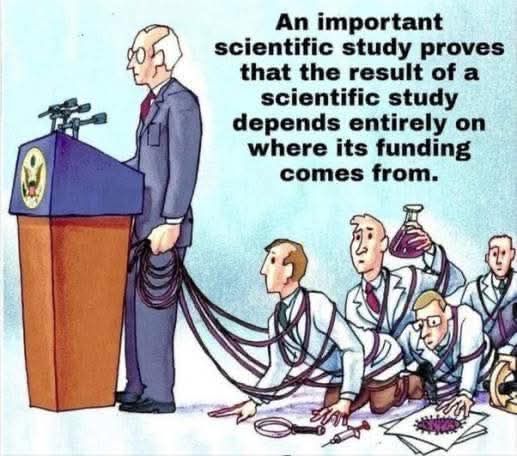
With the current #openweb reboot, alternative technology is increasingly surrounded by funding ecosystems that reward fashionable language, impressive demos, grant-friendly projects and institutional credibility. The grassroots people actually doing the work can become secondary, the people who understand the community get pushed aside by people who understand the funding application. The messy project gets replaced by the polished project, the difficult social question becomes a technical deliverable, and the result is another layer of #techshit.
This is not inevitable, but we need an open process capable of exposing it, that is the reason the #4opens matters – Open data – Open source – Open standards – Open process. The fourth one is particularly important, if the process is visible, we can see who is making decisions, how money is moving, whose ideas are being prioritised and where the projects are about grafting. We can challenge it before the pile gets too big, we need to compost the #techshit at source.
To grow anything in the current mess, we need infrastructure that ordinary communities can understand, use, modify, share and govern. We need technology that supports participation rather than extracting it, systems where disagreement, correction, rollback and learning are normal. We need tools that help communities build memory rather than constantly throwing yesterday into the algorithmic landfill.
So we know what we need, we know what we need to compost. The chattering classes are finally waking up, we have the interesting thing, that some of the people who have spent years talking about “innovation” and “the future” are finally starting to notice what has been happening. The warning signs are no longer hidden, #nastyfew political power is visible as is the social and ecological damage.
The question is no longer whether there is a problem, it is becoming what we do about it. And this is where I worry about the next stage because every time the mainstream finally notices a grassroots problem, the #fashernistas arrive. They package it, brand it, secure the funding to create the conference to build their careers. This simply “common sense” behaver stinks and is going to kill and displace billions of people.
And somehow, after all that activity, the people who were actually doing the work are still standing outside the room, we have seen this cycle for decades, we cannot afford to repeat it here. So shovel harder, the #openweb reboot has a job to do, we don’t have the time to create another fashionable technological sector. We don’t need another class of sellout experts to compete to become another set of gatekeepers. And definitely not to reproduce the #dotcons with a nicer logo and some open-source code.
We need to shovel hard, turn over the #dotcons, expose the blinded ideology, compost the bad economics, the #geekproblem and the corrupt grant culture. We need to compost our own #fashernista performance. To balance this we have to keep the useful technology, the useful knowledge, the communities and most importantly keep the history. Then use all of that compost to grow something genuinely different.
The old web was open enough to give us a glimpse of what was possible, #web02 captured that openness and turned it into private infrastructure. Now we have a chance to take the useful parts back, not by going backwards, but by putting people and communities back into the centre of the flow.
The #deathcult worshippers have spent decades building an escape route from simple democratic accountability. Our path is not to follow them on this fantasy, it is rather to build a better path in the other direction. The #dotcons are a huge pile of compost, the question is whether we are willing to pick up the shovels.
The #deathcult is selling the void, turning meaning into a market, in this post we cover the normal themes of #stupidindividualism, commodification, atomisation, trust and community.
One of the deeper tricks of the #deathcult is that it doesn’t only sell us products. It sells us back the meaning, belonging and connection that the system itself has striped away. Nietzsche’s famous declaration “God is dead.” was not simply that religion was disappearing, but that an outdated system of shared meaning and moral authority had collapsed.
For many people, that leaves a void, a longing for meaning, connection, protection and purpose, for something larger than the isolated self. And where there is longing, capitalism sees a market – consumer capitalism, the market for meaning has always promised that dissatisfaction can be solved through consumption. Buy the car, the clothes, the holiday, the experience, buy the lifestyle. But what this hides is the more profound needs of belonging, meaning, safety, trust, community – don’t fit comfortably into commodity form – more stuff does not fill the hole – so the market moves further inward.
Instead of simply selling objects, it starts selling the self with self-improvement, self-mastery, self-optimization and personal growth. Manifestation and spiritual awakening, the lie becomes: the problem is not the society you live in, the surrounding relationships, or the structures shaping your life, the problem is you. And in the mainstreaming, conveniently, there is always another influencer peddling a course, book, retreat, coach or guru available to fix you.
This is the perfect market because the product must never work, if people actually became fulfilled, the market would disappear. So people need to remain almost healed, almost whole, almost happy, almost enough – the longing itself becomes the business model – this is #stupidindividualism dressed as enlightenment.
Then we have religion reborn – the commercialised form of Western spiritualism – not community ritual, religion or spiritual practice, but the Instagram-ready world of manifestation, “high vibration”, gurus, retreats and personal enlightenment. This supposedly alternative culture simply reproduces the core values of capitalism: individualism, control, competition, self-surveillance and the hero narrative.
Our current “thinking” instead of challenging these values, we spiritualise them, you are told that your thoughts create your reality, everything happens specifically for your personal development. That success proves you are aligned, suffering means you failed to think correctly. The fantasy is that you can become the god of your own reality.
This looks like liberation, but underneath it is the same old #stupidindividualism. The individual becomes the centre of everything, society disappears, material conditions disappear, history disappears and power disappears. The outcome is you treat other people as supporting characters in your personal journey, then exploit them by turning structural problems in to personal failure.
This is where politics becomes important, if every outcome is understood as a reflection of your mindset, then structural criticism becomes difficult. Poverty? It is a mindset problem. Loneliness? Means you need to work on yourself. Abuse? A lesson the universe sent you. Illness? Your energy is wrong. Failure? You did not manifest hard enough.
The effect of this “thinking” is deeply conservative, instead of asking why people are suffering, we tell them their suffering is evidence of their own failure. Instead of rebellion, we get self-improvement. Instead of solidarity, introspection. Instead of collective action, another #SEO journal.
This is an affective #mainstreaming way of neutralising dissent because it turns social pain into private inadequacy. The death of empathy is the ugliest part of this, if someone’s suffering is something they “manifested”, then nobody has to sit with them in it. Nobody has to listen, has to ask what happened, has to offer real help. A platitude replaces solidarity “Everything happens for a reason.” “You need to forgive.” “This is a lesson.” “You attracted this into your life.”
The language sounds caring, but the practice becomes the opposite – cruelty is renamed healing, blame as wisdom, detachment is renamed enlightenment. This is simply more emotional capitalism, were the language of empathy remains everywhere, while the actual social practice of empathy disappears, but when empathy dies, connection dies with it.
Community is dangerous to power, people who gather can organise, people who form relationships can resist. People who trust each other become harder to govern through fear and isolation. The current mess does not need tanks in the streets to atomise people, it can do it culturally as when connection is labelled dependency, needing people becomes weakness and community becomes inconvenient. In our worship of the #deathcult the ideal person becomes the isolated, self-managing individual who treats every problem as something to solve alone.
At the #OMN we keep coming back to the #mainstreaming problem. Why? A system is most powerful when its values stop looking political, when they become common sense, when individualism becomes blinded freedom, competition becomes human nature, consumption becomes happiness. Self-surveillance becomes personal growth and isolation becomes independence. At this point, the system barely needs to tell people what to do, people reproduce the values themselves. They discipline themselves, blame themselves, sell the same worldview to each other. The #deathcult ideology becomes culture, becomes infrastructure.
But, the path away from this mess is simple, without followers, the hierarchy collapses, this is particularly obvious in digital culture. The supposed influencer is still dependent on likes, subscribers, sales, views and reputation. They claim independence while being embedded in the same attention economy they supposedly escaped. They are not outside the market, they are a particularly efficient product of it.
We need to remember that human beings have always created ritual, meaning, myth and shared practices. The #OMN path points in this direction, less self-obsession, more participation. Less individual optimisation, more shared action. Less influencer culture, more horizontal knowledge. Less performance, more trust. Less “fix yourself” more “build something together”.
The #openweb matters here because the structure of our technology also shapes our culture. The #dotcons push the isolated individual, your feed, brand, your followers, your engagement, your identity. The #deathcult repeatedly breaks social things into individual fragments and then sells them back to us. It breaks community and sells networking, meaning and sells lifestyle, confidence and sells self-help. It breaks connection and sells social media, belonging and sells branding.
The answer is not another product, its simply to rebuild the social fabric that commodification has been eating away. Yes, real connection is messy, solidarity is inconvenient, community involves disagreement, compromise, responsibility and mutual care. You cannot optimise it, you have to participate in it. And it is one of the reasons the #OMN keeps saying the same apparently simple thing – Trust matters. Community matters. Participation matters. The #deathcult wants you staring endlessly into yourself, the commons start when we look outward and find each other #KISS
I kind of though this was incomplete so did some reading and added this section.
Maybe focus on different paths to get a balance of good and bad…
The Chinese Cultural Revolution remains a difficult and important experiences for anyone seriously interested in emancipatory politics. It is tempting to reduce it to the normal #mainstreaming a story of authoritarianism, Mao, political violence and social chaos, but doing that misses something more useful. The Cultural Revolution was also a huge experiment in what happens when millions of people are encouraged to challenge established political power and create new forms of organisation.
Its failure raises a question that remains relevant today – how do people share real power without reproducing the behaviour of the structures we are trying to replace? – This is a central question for the #OMN path to walk from challenging power to creating alternatives.
The distinction between dismissal and pluralisation.
Dismissal is the politics of removing people, defeating factions and taking control. It is fundamentally about deciding who should have power and who should be excluded from it.
Pluralisation is different. It is about people organising themselves, experimenting with new relationships and creating institutions outside existing hierarchies.
The Cultural Revolution contained both tendencies, in its early years, independent organisations and new forms of mass political participation emerged. But these experiments became caught up in factional struggles. Groups began fighting over who would control political power rather than concentrating on what new forms of social organisation they could create.
The result was destructive, the politics of negation overwhelmed the politics of creation. This distinction matters as it is relatively easy to define what we are against. It is much harder to build something that people actually want to participate in. A movement can become good at identifying enemies while becoming progressively worse at creating alternatives.
That is one of the traps that the #OMN path is avoiding. A simple problem is that authoritarianism does not require a state, it is possible for people to reproduce authoritarian relationships among themselves. You can see this today in cancel culture, how ordinary people became involved in policing one another, enforcing political identities and attacking those considered insufficiently revolutionary.
This creates a difficult problem for anyone pursuing decentralised or anti-authoritarian politics, simply removing the state does not automatically create freedom. Simply decentralising power does not automatically make relationships democratic. A crowd can become authoritarian, a community can become authoritarian, a movement can become authoritarian or a social-media group can become authoritarian.
Even a supposedly horizontal organisation do develop informal hierarchies, gatekeepers and systems of exclusion. This is why “power to the people” is not enough as a political programme. We also need structures that help people exercise power without turning that power into domination over others. This is what the #OGB is for and about.
The danger of dismissal has a connection with what we now call cancel culture, although the underlying behaviour is much older than social media. The important issue is not simply criticism of individuals, criticism is necessary in any functioning democratic culture. The problem is the development of an internal policing culture where belonging depends upon ideological or moral purity. People are divided into the good and the bad. Disagreement becomes evidence of corruption. Mistakes become grounds for exclusion and political differences become moral crimes, eventually the movement starts consuming its own members. This is the logic of dismissal.
And it is particularly dangerous for grassroots movements because they lack the institutional safeguards that exist, at least theoretically, within formal democratic structures. Without some way of managing disagreement, accountability and conflict, decentralisation simply produce competing factions fighting for informal control.
Creation has to be the core path, this is the most important lesson, not simply “don’t be authoritarian.” It is more positive than that. Build, build! Institutions, relationships, build commons, build democratic practices, build alternative infrastructures. Build ways for people to participate without having to surrender control to a central authority, this #KISS step changes the political question.
Instead of asking – who should control the existing system? We ask – what can we create that makes the existing system less necessary? This is a much more interesting question, that moves politics away from permanent opposition and towards experimentation. The goal is not simply to seize somebody else’s institution and run it with different people, it is to create institutions with different relationships built into them.
Then we have the old stalwart of class analysis, this is useful for understanding economic power and exploitation, but when class becomes a moral label, it becomes another mechanism of dismissal. Someone is no longer disagreed with because of what they are proposing, they are dismissed because of what category they have been placed into.
This creates a strange reversal, the people who were supposedly building a more egalitarian society can become increasingly concerned with identifying and eliminating the “wrong” people. The category becomes more important than the political project, a historical paradox that people who had been oppressed under the old system could become defenders of the new hierarchy, while people from previously privileged backgrounds could become radical opponents of bureaucratic privilege. People are more complicated than political categories that matters for any attempt to build a genuinely participatory politics.
A needed balance is that institutions matter, we should not only romanticise spontaneity. People organising themselves is important, grassroots experimentation is important, but spontaneous organisation does not automatically remain democratic. There need to be ways to deal with disputes, abuse, exclusion, manipulation and concentrations of informal power.
This does not mean rebuilding a centralised bureaucracy, more about developing lightweight (like the #4opens) democratic institutions that protect pluralism and participation. The challenge is to create enough structure to prevent domination without creating so much structure that the institution becomes another hierarchy. Yes, a difficult balance, but avoiding the problem does not make it disappear.
The #OMN project is not about building another political machine, it is to experiment with infrastructure that allows people to organise, communicate, publish, archive and make decisions while retaining meaningful control over their own participation. That means moving away from the logic of the centralised platform, instead of one organisation → one authority → one set of rules, we can explore, many participants → shared protocols → transparent processes → distributed participation.
But distributed does not mean unaccountable, the infrastructure needs mechanisms for trust, moderation, transparency, rollback, correction and disagreement. The aim is not to eliminate conflict, it is to make conflict productive rather than destructive. But openness alone is not enough, an open system can still develop closed social relationships. A technically decentralised network can still become dominated by a few people. A community project can still develop gatekeepers. So the technical architecture and the social architecture have to develop together.
This is why the #OMN path is not simply about technology, it is about learning how to build social systems that are capable of remaining open, while not repeating the politics of negation. The path is therefore be surprisingly simple, a movement cannot define itself forever by what it opposes. If all our energy goes into removing enemies, exposing bad actors, denouncing ideological impurity and winning internal arguments, we eventually become trapped in the same power logic we claim to oppose.
We need to spend more energy on creating, create spaces where people can participate, commons where people can contribute without surrendering ownership to a corporation, archives that preserve collective memory. We need media systems that don’t depend upon algorithmic gatekeepers, governance where disagreement does not become exclusion. Not only that, but we need to create institutions that can learn, this path is the difference between negation and creation.
We need a path, not a blueprint. Questions to address, problems any emancipatory movement has to confront. How do we prevent bureaucracy from becoming permanent? How do we stop decentralisation becoming factionalism? How do we deal with disagreement without turning it into moral warfare? How do we give people real power without enabling new forms of domination? How do we create democratic institutions that remain open to change?
The #OMN therefore starts from a path of creation rather than dismissal, we should not try to build a perfect system. We build systems that people can participate in, question, modify and improve. That means accepting disagreement, allowing experimentation to create mechanisms that prevent any one group from permanently capturing the commons. This path to self-government has to be learned, practised and institutionally supported.
Freedom is not created simply by removing authority, it is created by building the social relationships and institutions that allow people to exercise power together without turning that power into domination. That is a much harder project, but also the more interesting one.
The #OMN path is not about taking power – it is about building the capacity for people to share power #KISS
One of the meany problems with modern capitalism is not simply that some corporations are greedy. It is that we have built institutions around the assumption that people are greedy, and then wondered why they behave that way.
Since the 1970s, #neoclassical economics became dominant in business schools and corporate thinking. An older social democratic idea of the manager as a professional with responsibilities to workers, customers, communities and society was displaced by a #geekproblem model of management built around financial incentives, shareholder value and measurable returns.
This became part of what is commonly called #neoliberalism. At the #OMN we polemically and, we argue, factually call the resulting social system the #deathcult: a system that places financial accumulation, competition and individual economic interest above the social relationships and ecological systems that actually make society, and life possible.
The darkness at the centre of this system is the idea of #Homoeconomicus – the simplified economic human who is assumed to rationally pursue personal advantage and maximise material rewards. Applied to the corporation, the logic becomes straightforward, managers cannot be trusted to act in the interests of shareholders because they have interests of their own, so we need incentives.
Give managers shares and stock options. Tie their bonuses to share prices. Measure everything. Monitor everything. Make individual financial reward correspond with corporate financial performance. This became part of the intellectual foundation for shareholder value.
The corporation increasingly stopped being understood as a social institution with multiple responsibilities and became something closer to a machine for maximising financial returns. Workers become costs, communities externalities, nature becomes a resource, customers markets. Managers become agents, shareholders become the priority. And success becomes a number.
The problem is that people aren’t actually like this – the fascinating thing is that the economic model is a very dangerous description of how humans actually behave. Research from behavioural economics and even game theory has repeatedly demonstrated that people are motivated by much more than financial self-interest.
People care about: honesty, fairness, trust, reciprocity, reputation, pride in their work, belonging and professional responsibility. People will often sacrifice financial rewards in order to behave in ways they consider right, cooperate when they trust each other, reward cooperation and punish behaviour they believe is unfair – sometimes even when doing so costs them something.
This matters enormously for how we organise institutions – if people are capable of cooperation, trust and reciprocity, then building institutions on the assumption that everybody is fundamentally selfish can actually make society more selfish, a institutional feedback loop
This is the real problem, a narrow and blinded theory about human behaviour becomes institutional reality. We start by saying: People are selfish, so we design institutions around that assumption. We create bonuses, stock options, surveillance, competition.
Then people learn that these are the behaviours that matter, cooperation becomes secondary, professional pride becomes secondary, community responsibility becomes secondary. Trust becomes something that needs to be managed rather than something that can be built.
People adapt to the system, and then we look at the resulting behaviour and say: “See? People really are selfish.” it is the trap we have all walked into. Assume people are selfish → build institutions around selfishness → reward selfish behaviour → weaken trust and professional norms → observe selfish behaviour → conclude that the original assumption was correct.
The institution has created the behaviour it claims merely to measure, is the #mainstreaming problem. Once a particular model becomes normal, it stops looking like ideology, it becomes common sense. Eventually, people forget that things could have been organised differently.
This is one of the most powerful things institutions do: they turn particular assumptions about human beings into apparently neutral systems. The system then reinforces those assumptions is how ideology becomes infrastructure.
This argument is more subtle, and more important. A narrow economic model has had enormous influence over how corporations understand management, incentives and organisational success. It helped legitimise corporate culture with its head bowed down worshipping a #deathcult.
And once that becomes the default, even people who personally reject the model have to bow there heads or be banished. To let the light into this mess, the path itself has to change, from extraction to participation. This connects directly to the #OMN projects.
We need to stop designing social systems around the assumption that people are isolated individuals competing for maximum personal advantage. Humans are social, we build relationships, we cooperate, create communities, develop shared norms. We care about reputation, we care about doing a good job, care about whether other people treat us fairly.
This is also why the #OMN puts so much emphasis on trust, participation, commons and the #4opens. As the alternative to the #deathcult isn’t simply a nicer version of the same system, it is a different understanding of what people are. Instead of designing systems to control selfish individuals, we need to #KISS design systems that enable cooperation between social beings.
Instead of endless surveillance, build trust, of individual competition, build participation.
Instead of extracting value from communities, build commons, recognise them as contributors.
Instead of measuring everything through financial value, recognise social and ecological value.
The path isn’t simply “How do we make selfish people behave better?” the bigger question is “Why are we building institutions that require people to behave selfishly in the first place?” That is the question we need to ask of corporations, business schools, governments, NGOs and our own activist institutions. Because when a system repeatedly produces the behaviour it claims is simply human nature, perhaps the problem isn’t human nature, perhaps the problem is the system.
Our institutions are not neutral observers; they actively shape human nature. The path away from this mess is simple and native to the #openweb, compost the #deathcult, build the commons.
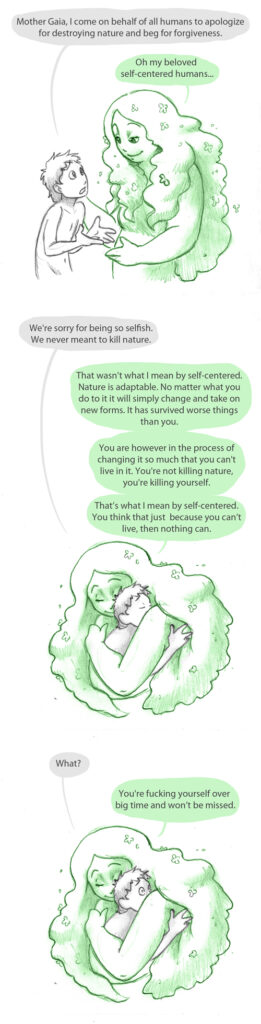
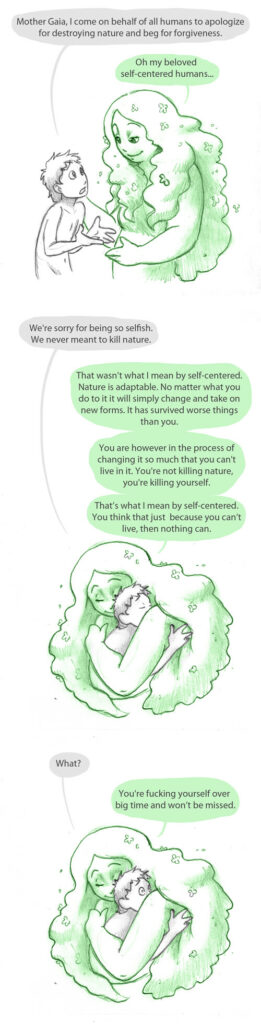
We need to stop talking about “climate change” as though we are discussing a slightly inconvenient change in the weather. Climate change is too soft, too neutral. Climate change makes it sound as though something simply happened to us. It didn’t, we pushed this mess, we built an economic system that treats the living world as raw material, turns everything into property, pushes everything through markets and then calls the resulting destruction “growth”. The next twenty years will be the “bill” we pay for this short-sighted greed. And the really dangerous part is that we are still trying to solve the problem using the same thinking that created it.
Welcome to #climatechaos, not one dramatic event that starts on a particular day, it is chronic, it accumulates, compounds. It moves through food systems, water systems, ecosystems, economies and communities. This makes it politically difficult because there is no single moment when everyone can point at the disaster and say, there it is. Instead, the extremes get worse, harvest fails, rivers floods, insurance disappears. The food price rises, drought lasts longer and finally the ecosystem quietly collapses. But one thing that is becoming common sense is we cannot carry on pretending this is normal.
A small step is that the language matters “Global warming” sounds almost pleasant, “Climate change” sounds neutral. Climate breakdown tells us something more important, there is a direction of travel, continuing accelerating the conditions that make human and ecological life less stable. That is what the next twenty years are, yes science based global averages are useful, but the things communities actually experience are extremes – heat, flooding, drought, food insecurity and other disruptions.
Living through the consequences, will show that today’s common sense, the #neoliberal answer to #climatechaos is wonderfully convenient for the #nastyfew – you are the problem, you have the wrong car, eat the wrong food, you use too much energy and bough the wrong thing. You didn’t recycle enough, and feel guilty.
This is the #deathcult at work, the individual is made responsible for a systemic crisis while the systems generating the crisis remain untouched. The absurdity is the dumping of climate responsibility onto individuals while corporations continue selling products that cause global warming. This mess isn’t accidental – #stupidindividualism is politically useful as isolated individuals have very little power. Where communities, workers, cooperatives, movements and collective action do have power.
By now it should become a little obvious that we don’t need greener consumption, what we do need a different relationship with the living world, the current uncomfortable path. Let’s make this plan – #Climatechaos isn’t an energy problem, it isn’t just a transport problem, it isn’t just a technology problem, it is a problem with how we understand ourselves. We have built a culture around the idea that everything exists to be owned, land, water, animals, forests, minerals, knowledge, attention. Even our relationships, on the #dotcons, become a commodity.
Everything becomes something that can be extracted, then we are surprised when the living systems collapse. To start to compost this mess the next twenty years need to be more about moving from ownership to participation, from extraction to stewardship. About better balancing competition and cooperation to move from isolated individuals to resilient communities. In an economic sense from commodities to commons. And yes, it is a much bigger political project than buying an electric car.
Food is going to expose the current blinded stupidity, food is where the abstraction ends. You can argue about climate models forever, but when food becomes unreliable and expensive, everyone understands. The climate discussion points to the vulnerability of agricultural systems, including dependence on a few major crops due to growing pressure on farming from heat, drought and extreme weather.
The response cannot simply be another technological monoculture. We need real diversity, more resilient crops, local knowledge, healthy soils to grow this biodiversity. We need shorter and more resilient supply chains, community food systems. And probably a much more serious conversation about what we choose to eat and how much land and sea we devote to producing it because agriculture isn’t happening outside nature.
The next twenty years will remind us that nature is not decoration, currently we treat biodiversity as something nice to have after the economy has been sorted out. But ecosystems are part of the economy, wetlands manage water, salt marshes protect coasts, healthy soils support food, forests regulate water and store carbon. Biodiversity provides resilience, this is not romantic environmentalism, it is infrastructure.
And then comes the techno-fix – whenever capitalism encounters a problem caused by technology, extraction and industrial growth, it offers us more technology. So next we get geoengineering, perhaps we can reflect sunlight, perhaps we can manipulate the atmosphere, perhaps we can capture carbon, perhaps artificial intelligence will optimise everything. Or perhaps some billionaire will save the planet. This is the reheated #mainstreaming#geekproblem version of climate politics, the problem is that the blinded underlying assumption, the system is fine, we just need a better machine.
But, unspoken is more mess we then need to compost – Who gets to control the thermostat? Who decides? Who is accountable? Who gets protected? Who gets sacrificed? These are not engineering questions, they are political questions, the next twenty years will be a democratic test of where the climate crisis becomes bigger than climate policy. We are going to have to make real choices about where should people live, what happens to communities that cannot be protected? Who pays? Who decides? What technologies are acceptable? And from a deep green prospective what land is for humans? What land is for the rest of life?
There are no purely technical answers, science can tell us what is happening, it tells us what happens if emissions continue. But science cannot decide what kind of society we want, that is politics, at best it is democracy. And at worst it is where the #mainstreaming agenda becomes dangerous as #climatechaos doesn’t care about our current political comfort zones. To find a path through this mess, we have created, we need resilience, not reassurance
Doom on its own is useless, but pretending everything will be fine is worse, people need real information about what is happening? What are the risks? What can we do? What can our community do to prepare, to organise? This is why #KISS communication needs to become local and participatory.
The example of community-based #OMN like projects matter – people come together, learn what is happening and then discuss what they can do locally. The process itself builds resilience, this should be obvious. A community is more resilient when it knows how to communicate, when it can share information. More resilient when it trusts people, when it has local knowledge and more resilient when it has shared infrastructure to remember what happened last time.
That is why media matters – the rebooted #openweb becomes climate infrastructure – where the #climatecrisis connects directly to the #OMN. We need an information infrastructure that belongs to communities rather than corporations, so communities can continue to document what happens to them. Because when the next flood comes, the official report six months later isn’t enough. The native #openweb can be part of the infrastructure of climate resilience that is if we stop treating it as another marketplace for attention.
The #OMN is native to this kind of future, it’s not a climate project in the narrow sense. But the underlying problem is the same – how do we build systems that support collective intelligence rather than extracting it? How do we allow people to publish, share, moderate, correct and preserve information without handing control to a handful of #closedweb platforms?
How do we create the trust we need without building more centralised authority? How do we make community knowledge persistent? How do we build infrastructure that can survive the failures of individualist #dotcons platforms? These questions become much more important as #climatechaos increases. Because resilience requires distributed systems, but not just technically distributed systems, we also need socially distributed systems.
The mainstream will always tell us – now is not the time, too radical, too expensive, too difficult, too political for people to accept, or the market isn’t ready, the technology isn’t ready. We have had 20 years of stalling change and challenge: we need more evidence, consultation or another #fashionista report. The #KISS answer is simple, NO, we have had decades, the next twenty years we either build resilience or discover how truly fragile we really are.
On a thin but needed positive note, the #climatecrisis is already producing the conditions for change, the question is whether that change is democratic or authoritarian. And in a narrow sense of our #openweb culture, whether it breaks the monopoly of the #geekproblem or gives it more power. It’s a simple choice of do we compost the old system or let it push us aside.
To not simply be pushed aside we need political movements capable of defending life in its widest sense, yes, the next twenty years will not be comfortable. There will be disruption, loss, conflict and there will be failures. But the future is not simply something that happens to us, it is something we organise. So please stop asking “How do I, personally, save the planet?” and ask “What can we build together that makes a different future possible?” in short get off your knees from worshipping the #deathcult, and stop waiting for the #mainstreaming agenda to save us.
In internet culture, stop handing every problem to the #geekproblem.
Light green environmentalism stop turning climate action into consumer guilt.
In economics stop treating nature as an externality.
In fashion, stop treating people as consumers.
To compost current mainstreaming mess, we need to start treating people as participants to rebuild the commons and infrastructure of trust. In short, we need people to #makinghistory, by getting the bloody shovels out. The old system is already compost, the question is what we grow from it.
Update02: How do we describe the problem and how we organize ourselves to deal with it? For the #fashionistas, the point is that language isn’t just decoration. A #hashtag is a way of framing attention. If you call someone “evil”, “dangerous” or “nasty”, you may simply reinforce their preferred identity, yes, we’re tough, we’re feared, we’re fighting the enemy. You’ve accepted their frame.
“Weird” works differently because it pokes at their claim to represent normality. It reverses the us versus them story: hang on, perhaps the strange behaviour is coming from you. But this is where the #OMN/#KISS point comes in. Calling the #nastyfew “nasty” isn’t really about persuading the #nastyfew. It’s about helping us recognize the pattern.
We need language that lets ordinary people point at a structural problem without having to become political theorists, join a faction or spend three hours arguing about ideology. That’s what an affective hashtag can do – #nastyfew = focus. Not “these people are monsters and we must destroy them” more “there is a small concentration of people pushing harmful behaviour and power – let’s recognize the pattern, stop pretending it is normal, and organize our way around the problems they are creating.”
The important bit is US, the understanding that the #nastyfew become more powerful when we give them our attention, fear, division and energy. If we can name the pattern as an abstract, keep our heads, and build better path, their power becomes much less interesting.
This is why #OMN is interested in media flows rather than personality cults, so we don’t spend all day fighting the person. We look at the flow:
Who is amplifying what?
Who benefits?
What behaviour is being normalized?
Where is trust being built or destroyed?
What can we change locally?
The #geekproblem to often wants to solve this with another closed path, the #fashernistas want another clever narrative, but the #nastyfew want us fighting each other, its in the name. Maybe the simpler answer is to name the pattern, focus our attention, build the alternative, and stop feeding the circus.
Let’s look at stepping away from the #dotcons as an example of hashtag affinity group organising. A hashtag can help name a problem, but it cannot by itself create a movement. It only becomes a tool for social change when shared language connects people to shared relationships, practical projects and action. The “spade and compost” metaphor is useful for this, the hashtag helps identify the mess, but the point is to pick up the spade and compost with them. A useful progression is: Name → Connect → Organise → Act → Build → Repeat:
Connect the people: hashtags allow people who recognise the same problem to find each other. But this needs to become an affinity group of action, not just a pile of accounts using the same word.
Make the metaphor understandable: explain what the hashtag means and give groups lived examples. Otherwise, it becomes just another insider language.
Turn criticism into a question: What can we do about this? Or What did you do today to help your community step away from the #dotcons?
People need a next step: join a project, move a community conversation to the #openweb, install something, help document a project, host a server, organise an event, teach somebody else.
Create visible alternatives: this is where #OMN matters. If you tell people to leave something, you need somewhere meaningful to go.
Build collective habits: the hashtag becomes useful when a community consistently uses it to recognise problems, share experience and coordinate action.
Compost the criticism: don’t only keep producing negativity about the #dotcons. Turn the accumulated criticism into knowledge, relationships, tools and projects.
These are the messy problems we need to compost. The path of “making positive posts about specific openweb projects” is part of the answer, but positive promotion alone isn’t enough. People also need a shared explanation of why the existing system is a problem and a language for understanding it.
So the hashtag isn’t the movement, it is the flag, vocabulary and filing system. The movement is the people who organise around it and actually do something. And that’s the bit missing from “just put a # in front of the words.” 🙂
One of the most useful ways to understand the mess we are in today is to ask a deceptively simple question – what comes first – the individual or the network? #Mainstreaming economics startes with the individual, were sociology, anthropology and related traditions start somewhere else – with relationships, institutions, communities and the social structures into which individuals are born.
This difference matters enormously, when we start thinking about technology, politics, economics and the #openweb. It is one of the reasons I keep coming back to the problem of #stupidindividualism – the point isn’t that individuals don’t exist, of course they do, the problem is treating the individual as if they exist independently of the social world that produces, supports and constrains them.
Why? we are not born as isolated economic actors, we are born helpless. Other people feed us, protect us, teach us language, teach us how to behave, introduce us to culture and eventually help us become capable of acting independently. Before there is an autonomous economic actor, there is already a network of care. That simple observation has consequences, that the network come first. that nobody invents themselves, every person was born into an existing social world, where there are families, communities, languages, institutions, infrastructures, histories and expectations already.
Even our ability to imagine ourselves as an individual depends upon other people. Language is social, knowledge is social, culture is social, markets are social and technology is social. The idea of private property depends on a society capable of recognising and enforcing it. Yet a great deal of mainstream economic thinking narrows it self to begin with the individual as though they are already standing outside society, deciding what they want and entering into relationships with other individuals through voluntary exchange. That is a very particular, narrow, way of not seeing the world, and it is not neutral, this blindness is historically produced.
One of sociology’s important contributions is to make the background visible. The individual is not simply a natural fact. The particular kind of individual we imagine ourselves to be is shaped by the social structures around us. But yes, modern societies are unusually good at producing the experience of being an isolated individual. We can move cities, change jobs, rent instead of own, interact with strangers. We can buy almost everything we need through markets, communicate with people thousands of kilometres away. We can participate in institutions without ever knowing the people who operate them.
This creates an extraordinary experience – we can feel independent while being massively interdependent. That is one of the great illusions of modernity, that the person sitting alone in a flat, ordering food through an app and working remotely from a laptop can feel completely autonomous. But underneath that apparent autonomy is an enormous network of other people and systems: farmers, delivery workers, programmers, electricity grids, telecommunications networks, roads, warehouses, financial institutions, governments, data centres and countless forms of unpaid and paid care.
So to put this simply, the individual is not independent, the individual is networked and the current narrow economic model hides the network. Composting this mess is where the distinction between mainstream economics and sociology becomes politically important. A simplified economic model can begin with individuals who have preferences, resources and choices. They meet in markets, supply meets demand, prices coordinate activity. The model can be useful for analysing particular situations.
The problem comes when the model becomes a description of human reality itself. A market is not simply a mathematical relationship between isolated individuals, it is a social institution, requireing rules, trust, a state thatrequires infrastructure, property rights, requires enforcement, communication of shared expectations. It requires people who know how to behave within this narrow system.
In other words – the market sits inside society and society does not simply emerge from a collection of markets. This distinction becomes particularly important when discussing capitalism, it is not some natural state that appears whenever humans are allowed to trade. It is a historically, involving particular institutions, property arrangements, states, legal systems, technologies and cultural assumptions.
Once we recognise this, the supposedly inevitable starts to look contingent, and that is where sociology becomes politically interesting. The state doesn’t disappear, just because the market exists. The current story presents the market and the state as opposites:
state = control
market = freedom
But historically, the development of modern markets has depended heavily upon states, to establish property law, currencies, enforce contracts. States build infrastructure, define corporations and regulate labour. States establish borders, create legal identities, enforce debts. The market and the state are not simply opposites standing outside one another, they are entangled.
This matters because when we look at modern capitalism as though it emerged from naturally individuals making voluntary exchanges, we erase much of the infrastructure that made those exchanges possible – again, the network disappears. The problem with universalising capitalism is one of the most damaging intellectual habits, taking the economic system we happen to live inside and treating it as though it describes human economic behaviour everywhere and throughout history.
Capitalist monetary exchange becomes “the economy.”
Market behaviour becomes “human nature.”
Competition becomes inevitable.
Private ownership becomes normal.
Debt becomes morally obvious.
Money becomes something humans must always have invented because they wanted a more efficient version of barter. But history repeatedly show much greater diversity, human societies have organised production, distribution, care and exchange in many different ways. There have been gift economies, commons, reciprocity networks, redistributive systems. There is no single timeless human economy – there are economic cultures. It is our assumptions about what is “normal” are themselves historically specific.
That lesson is directly relevant to technology of the #OMN project, as technology has its own version of this problem. We often start with the assumption that the individual user is the basic unit. The user creates an account. The user chooses a platform. The user posts content. The user chooses whether to participate. The user accepts the terms. The user leaves if they don’t like it. Doses this sounds reasonable?
But yes, as we have said, its not, as it ignores the network, if all your friends are on Facebook, “just leave Facebook” isn’t an individual decision in any meaningful sense. If your local council publishes important information only through Facebook, leaving becomes a civic problem. If your community organises through WhatsApp, leaving becomes a social problem. If your employer requires a particular platform, leaving becomes an economic problem. If your political movement organises somewhere, leaving becomes a political problem.
The individual appears to have a choice, but the network determines the cost of exercising it. This is one of the fundamental problems with the current #dotcons as they don’t simply sell software to individuals, they capture networks. Network effects become political power – once enough people are locked inside a platform, the platform becomes difficult to leave. This is often described as a “network effect”, as though it were simply a technical feature, it isn’t, it is a abusive social relationship.
The value of the platform increases because other people are there, that means the individual cannot solve the problem individually. You cannot build a better social network merely by downloading better software. You need people, communities, trust, shared practices. You need governance – you need ways for information to move and institutions that can maintain the infrastructure.
This is why simply telling people to “move to Mastodon” is insufficient. The problem isn’t that Mastodon exists or doesn’t exist. The problem is social infrastructure, the #openweb is a social project, this is why we don’t see the #openweb simply as a collection of technologies. #RSS, #ActivityPub, #PeerTube, #blogs, #wikis, distributed hosting and open-source software are tools. They become socially transformative only when communities use them to create different relationships.
The technical layer matters enormously, but technology alone cannot produce a commons. A commons requires people who maintain it, and these people need to be heald tagather by norms, trust, governance. This is where the #OMN comes in – from individual users to communities, we start from a different assumption – media is a social relationship, not simply a commodity produced for individual consumers. Instead of imagining millions of isolated users consuming content through a central platform, we build networks of communities that publish, share, moderate, maintain and archive media together.
This changes the question, instead of “What does the individual user want?” we can also ask “What does this community need?” And “What relationships allow this information system to remain healthy?” And”Who maintains it?” And “Who has power?” Thus “How can that power be accountable?” That is sociology applied to technology and importently why governance becomes unavoidable. Why governance is such a big part of #OMN and #OGB. If we pretend that technology is simply a neutral tool used by independent individuals, governance becomes something we only discover later when things go wrong.
But if we recognise that technology creates social relationships, governance is there from the beginning. Every platform has governance, the question is who governs – A dictator-for-life project is governance – a developer-controlled project has governance – an NGO-funded project has governance – a corporate platform has governance so yes then a community-run project has governance. Even “no governance” is a form of governance because it usually means that whoever has the most time, technical knowledge or social power ends up making the decisions. The #OGB challenge is therefore not to eliminate governance, it is to make governance visible, participatory and appropriate to the culture of the #openweb.
This brings us back to #stupidindividualism, remmber the hashtag isn’t saying that individuals are stupid, it is pointing at what happens when individualism becomes the only permitted way of understanding social problems. If someone says “Our community has a problem.” and the response is “Are you saying I’m the problem?” the conversation has already been derailed. The same happens with technology, if we say “The structure of social media encourages dependency.” and someone responds “But I personally choose to use Facebook.” we have moved from a structural question to an individual one.
Why all this matters now – we are walking a path where many of the systems that previously appeared stable are becoming unstable. Climate disruption, political polarisation, economic insecurity, platform collapse and #enshittification. leading to the current mess of #AI generated information overload. Declining institutional trust, fragmented communities and increasing centralisation of infrastructure. The probelms cannot be solved by millions of isolated individuals making slightly better consumer choices. They require collective action, and collective capacity requires understanding how people actually relate to each other. That means #KISS moving beyond the fantasy of the autonomous individual.
On this path the #OMN isn’t trying to invent some perfect alternative society, the starting point is much simpler – build infrastructure that assumes people are social – build media flows around communities – build governance around participation and trust – build software that supports cooperation rather than only extraction – build open standards so different communities can interoperate – build archives so collective memory survives – build metadata so information can be found and connected. And finaly build moderation systems that recognise human relationships rather than reducing everything to algorithmic scoring and blocking.
This is the job of the #4opens – open data, open source, open standards and open process – that are useful here because they make the infrastructure contestable. No single group gets to say “Trust us. We know what’s best.” keeping the infrastructure inside the commons wherever possible.
The most important lesson from sociology and anthropology isn’t that economists are always wrong. There are economists doing good work, and economics contains some internal diversity. The point is that no single discipline should get to define the whole of human reality. Economics is powerful at asking narrow questions. Sociology asks different questions, Anthropology asks different questions. History asks different questions, ecology asks different questions, technology asks different questions. The problem begins when one particular model becomes so powerful that its assumptions disappear from view.
That is the real danger of hegemony, you stop seeing the assumptions because everyone around you is using them. to work to compost this current mess, the #openweb is valuable because it gives us an shoval to build differently. But we won’t get anywere simply by swapping one piece of software for another, we need to challenge the deeper assumptions underneath the software. The assumption that the user is alone, that networks are collections of individuals, markets are natural, technology is neutral, that governance can be bolted on afterwards. And perhaps most importantly, the assumption that we are independent when we are actually interdependent.
Yes, the individual matters, but the individual is not the starting point, the relationship is. That is why sociology matters to the #OMN. And that is why building a genuinely social #openweb is about much more than writing better code. It is about rebuilding the networks of trust, cooperation, memory and collective power that allow people to live together in the first place.
So keep the path #KISS, technology is the tool, the social network is the foundation, the commons is the direction. Get to growing this please #OMN
Our current working models of “governance” in #opensource are mostly:
Monarchy – the dictator for life. Aristocracy – the devs. Oligarchy – NGOs/funders. And way out on the edge: Democracy – the users.
We need better governance native to the #openweb. Let’s look at this at a more personal level before the normal wider social view. Yes, in #FOSS development the devs doing the work deserve respect, and #OMN isn’t arguing that users should simply demand things from volunteers.
The point about “aristocracy” is about more where decision-making power sits, less whether devs are privileged people or whether their work has value. If the people who write and maintain the code also decide what the project is, what gets built, what gets rejected and how the project develops, then you have a governance structure where technical expertise becomes political authority.
Hope am clear, that isn’t a criticism of individual developers, it’s a structural observation. The #OMN approach is to separate doing the work from owning the direction. Developers are essential participants, but so are users, moderators, communities and other contributors. Different kinds of knowledge need different kinds of power.
The challenge is building governance where devs don’t get bossed around by users, users don’t get bossed around by devs, funders don’t get to buy the direction, and nobody gets to become the permanent ruler.
That’s what the #OGB work is trying to explore: governance native to the #openweb, based on trust, transparency, participation and voluntary cooperation. This alternative isn’t “users rule”, it’s shared power with different roles.
With this in mind lets talk about the wider issue, a reminder: when I talk about the internet and society, I am not necessarily talking about you, I am talking about groups, cultures, classes, institutions and patterns of behaviour that you might be part of. You can recognise yourself in a critique without the critique being a personal attack – Simple – Take the useful bit and move on.
What is interesting – and a pretty good example of #stupidindividualism – is how difficult this has become. We increasingly seem to believe that we are not allowed to talk about groups any more. Everything has to be reduced to the individual “Are you saying I’m stupid?” “Are you attacking me?” “Who exactly are you talking about?” This makes it difficult to discuss social patterns, and that matters because many of the problems we face are not individual problems. They are produced by relationships between people, institutions, technologies and economic systems.
If we cannot talk about groups, we cannot talk properly about the #geekproblem, #mainstreaming, the #dotcons, #NGOs and funders, tech communities, activist cultures, class interests, institutional power, #neoliberalism or the wider #deathcult culture. We end up privatising a public conversation.
This is one of the things that makes #dotcons-style social media so destructive, as everything becomes personalised, emotional and reactive when structural criticism gets turned into interpersonal conflict. But a feeling is not a fact, a feeling attacked does not necessarily mean someone is attacking you. Sometimes it means that something has made you uncomfortable, or challenged a worldview you have become accustomed to.
That discomfort can actually be useful as the point isn’t to find individuals to blame, the point is to understand the systems and cultures we are collectively caught inside. We need to get beyond the #neoliberal#TINA – There Is No Alternative – thinking that reduces everything to individual choice and responsibility. We need to be able to say – This is a group pattern, a cultural pattern, a class interest, an institutional problem. It’s about how power reproduces itself, then we can actually talk about what to do about it. That is the conversation we need to reclaim: public, collective and capable of naming the structures that shape our lives.
Remember none of this is about personal attacks, not tribal prat fights, not individualised outrage. It’s a public conversation about public problems.