NGIFORUM2025 is timidly touching sense

It’s good to see events like #NGIFORUM2025 as it’s trying to be on the path of the #Fediverse and the wider #openweb reboot which are real forces for social good, messy, hopeful, and grounded in decades of grassroots digital culture, which we do need to support. BUT we also need to speak honestly, as these spaces are not healthy by default.

Too often, they are co-opted by #NGO and institutional actors who bring with them a dangerous kind of “common sense”, what I’ve long described as the parasite class. We see this clearly at #NGIFORUM and similar #NGO events. Despite the energy and good intentions, the dominant framing is stuck in a narrow, #neoliberal logic:

  • More funding for shiny #techfixes.
  • Token gestures to social issues.
  • Endless discussion about scalability, compliance, branding, and “the market.”
  • Panels where “on-topic” needs reality-checking and “off-topic” is often the path to sense.

This is not the #openweb native path, and what we need is more shovels and composting, to grow the real grassroots native paths, with open projects from the messy soil of lived social experience. Not more polished “innovation theatre.” And crucially: we need to bring activism back into these spaces – not as token #fashernista crap, but as lived, rooted practice. We need to embed activist tech into the core of these events, not leave it in the hallway as is the current norm.

Because let’s be honest, too much of what’s being showcased is just more #techshit to compost. Take the role of NGI funding (Next Generation Internet): It could be a powerful tool to fund the future of a people-powered web. But right now? It’s structured to reward isolated hard tech with narrow deliverables, and punish anything messy, social, or disruptive. That’s upside-down.

The development side of open-source should be anti-commercial – in its process, not necessarily in its usage. That means public funding should support the huge social layer that keeps FOSS and #openweb projects alive:

  • Community organising.
  • UX design from lived needs, not compliance charts.
  • Onboarding and trust-building.
  • Accessibility work.
  • Documenting process for reuse and remix.

But currently these parts are entirely unfunded, and that is pushing us into the arms of the parasite class’s of all types. We are walking backward into the future, again, projects without people, users, and support are dead projects. No matter how elegant the codebase is.

One thing that the event brings up is that we need to shift policy, national governments and #EU to actively intervene in the monopolies running the current internet. Both mobile and fixed-line networks need to be opened up to allow for grassroots, peer-to-peer, and local hosting paths to flourish. The current centralised infrastructure is a block to the native #openweb, and we can’t “build better” on broken foundations.

The also needs to be a cultural shift, to unblock the #geekproblem. This is not a call-out – it’s a call-in. The feedback is there, i’ve personally been working on this issue for over a decade, what we’ve seen is a cycle: Working in a small way… failing in a big way… repeating.

It’s not personal, it is structural. And we can do better, if we compost the fear of doing things differently. A practical example, we need more points that are currently deemed “off-topic.”
Because what’s “on-topic” in these spaces is just branding and polite theatre. And that’s exactly how the #dotcons rose to dominance in the first place.

We are at risk of simply recreating their culture in softer tones. Let’s not do that. Let’s take a breath and reflect on what we’re actually building, it’s not a rhetorical question. This is not abstract.

Because if we keep defaulting to #neoliberal “common sense,” if we ignore the reality of climate collapse, digital authoritarianism, and infrastructure lock-in, then we’re just dancing around the edges of a very real #deathcult.

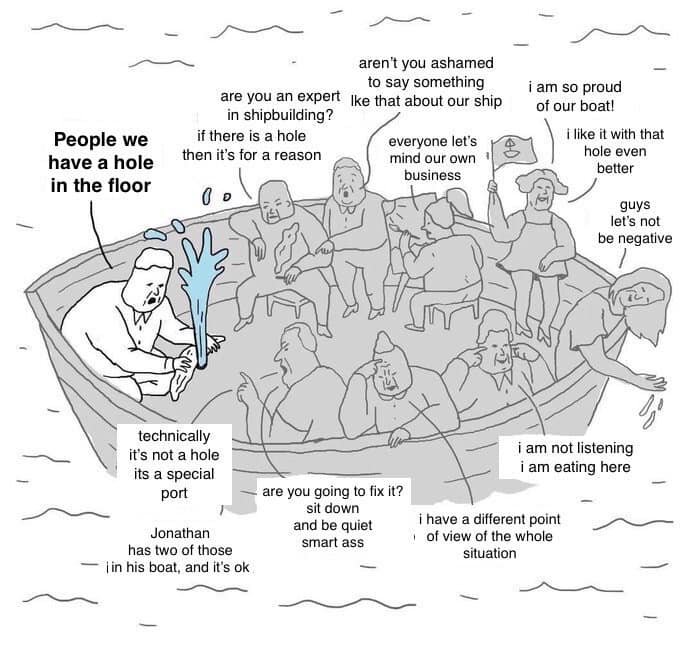
Let’s do the real work, let’s dig, plant, compost, and build trust. Let’s reclaim the tools and shape the #openweb around care, not control. Because anything less? It is just another empty panel on a sinking ship.

“All authority is quite degrading. It degrades those who exercise it, and degrades those over whom it is exercised.”
— Oscar Wilde

#Fediverse #OMN #4opens #commonsnotplatforms #mutualaid #socialroots #trustnotcontrol #KISS #NGIFORUM2025 #NGIforum #nlnet

The future depends on us using the power we still have

The #openweb holds a quiet kind of power – messy, distributed, human. But I keep wondering: are people now too afraid to use that power? The sad truth is, many always were. Power isn’t something most of us are raised to understand, let alone wield in any collective way. For decades, we’ve been taught to outsource power, to institutions, to markets, to influencers. But the cracks are everywhere now, and there’s less room to pretend.

What we’re facing now isn’t theoretical, the hard right is not just consolidating power, they’re weaponizing it. They’ve successfully atomized progressive movements, through culture wars, #AI manipulation, and economic precarity, they’ve made sure many can’t even think collectively, let alone act.

And where is this leading? Let’s be blunt. They are on track to kill billions of people and vast swathes of nature over the next 100 years. This isn’t hyperbole. It’s baked into the political economy of climate collapse, border militarization, and resurgent fascism. #XR and other movements have been sounding the alarm for years, but the line just keeps going straight… into oblivion.

And yet… There is still hope. Hope doesn’t mean passive optimism, it means seeing that the little power we still have matters. That using it, no matter how small or local or chaotic, is the path we urgently need to take.

  • When we build on the #openweb instead of feeding the #dotcons, that’s power.
  • When we organize locally, build mutual aid, and share resources without gatekeepers, that’s power.
  • When we link, when we write, when we resist the urge to block and shame and instead connect and amplify, that’s power.

Yes, none of this is perfect, it’s not about purity, it’s about action. And that action doesn’t need to scale overnight. It just needs to grow, slow, messy, rooted. Because here’s the thing the right knows and the left forgets: Power isn’t given. It’s taken, built, and – at best – shared.

So let’s stop waiting for permission, stop fearing the imperfections. The future depends on us using the power we still have – to make more.

Let’s grow it, seed by seed.

It’s becoming a problem

It’s becoming a problem. When people start asking, “Is @_elena the first genuine superstar of the Fediverse?” – we should all pause. This isn’t idle praise, it’s the reproduction of celebrity culture, liberal imperialism, and vertical hierarchy in a space that explicitly set out to reject those structures.

Have you ever thought – just for a moment – that this might be the completely WRONG path for a horizontal network like the #Fediverse? Yes, we need mess. Yes, we need experimentation. But this? This is #mainstreaming in its most seductive form, a soft power grab, hiding behind friendly faces and growing marketing gloss.

Both #pubconf2025 and #fediforum, and the people who attend them, are becoming a showroom for this liberal capture, promoting star-making and platforming over community process and open governance. It’s an “open” mirror of the conference-industrial complex, repackaged for the #dotcons-weary.

We’ve seen this before: #NGOs turned movements into funding funnels. Influencers replaced organizers. Polite panels replaced fourm-level solidarity. It’s been happening here the last few years. But we do need to remember, the Fediverse isn’t a playground for fame, it’s a commons, to distribute power – not concentrate it. We don’t need to unthinkingly push people down the superstars’ path. We need peers, comrades, care, conflict resolution, and actual shared infrastructure.

So let’s be honest, if you’re pushing “the first superstar of the Fediverse,” you’re not pushing decentralization, you’re pushing brand culture, mainstreaming logic, and attention economies repackaged for liberal feels. That’s not radical. That’s not native, it’s not what we came here to build.

Let’s compost this celebrity logic before it roots too deep. Let’s stay messy, collaborative, and resist the temptation to crown anyone. Because if we don’t? We’re just rebuilding the same old pyramids – with slightly alt avatars.


Maybe we need to look agen at the more #mainstreaming #dotcons path. The not-so-subtle message we need to remember on social media: Dictators hate to be ignored. Especially on their “special days” – birthdays, elections, court appearances, or orchestrated spectacles. These moments are designed to dominate the media cycle and, by extension, the social media algorithms.

They thrive on attention, and whether that attention is praise or outrage, it fuels their visibility and power. Here’s the social tech they exploit:

  • When you doomscroll their face, the algorithm sees interest.
  • When you post disgust, the algorithm sees engagement.
  • When you argue with trolls, you’re boosting the signal of the original post.
  • When you call them names, it still centres them.

That’s the #dotcons feedback loop, engagement is king, and dictators know how to play that game. Let’s break this circle, on these days, do something different:

  • Share stories of local mutual aid.
  • Link to historical context that exposes the long game of these power grabs.
  • Boost voices that decentralize attention, not concentrate it.
  • Post about books, direct action, food sovereignty, climate organizing, and tools for collective autonomy.
  • Highlight grassroots projects like #OMN, which are building sustainable, decentralized alternatives.

This is how we take the air out of #mainstreaming fires. Starve the algorithm and feed the resistance. Focus on things that actually matter, remember: not engaging is a strategy. Ignore the circus. Build the commons.

#KISS

Why does any of this matter?

Because power matters, and power is never given – it’s taken, built, and at its best, shared. That’s why we care. That’s why the #Fediverse matters.

Let’s rewind: Private property wasn’t born from reason or consensus. It came from someone with a club drawing a line in the sand and saying:

“Cross this, and I’ll kill you.”

That’s the origin of power in the current #mainstreaming paths – violence, enclosure, and exclusion. This is not the foundation of the #Fediverse.

The Fediverse flows from a different source, built in open, social webs, where the lines we draw are “blowing in the wind.” Yes, a lot of people don’t get this. That’s why they try to jam it back into old models: branding, control, platforms, “governance,” and “best practices.” They want order. They want power they can hold.

But here’s the thing, There is such a thing as society, and we need to build tools that reflect this, not deny it. The beauty, and challenge, of the #Fediverse is that there is no central governance.
And that’s a good thing. Because it means we aren’t trapped by legacy systems of control. We don’t have to fit into the broken economies and top-down paths that dominate the “real” outside world.

The Fediverse was born from the “cats” of libertarianism and anarchism (without the [O]). And in this space, we have the radical opportunity to build different, native paths, based in trust, mutual aid, and the #4opens. But to keep building this, we have to compost the mess pushing: People pushing “common sense” corporate-style governance are part of the problem, they want to tame the wild, they want hierarchy where there should be networks, they want control where we need flow.

To be native to the Fediverse, we have to stop importing “common sense” control systems. Instead, we must use code – and culture – to build native #openweb society. Tools that empower. Processes that are messy, open, federated, and yes, hard to define. Organizing for community empowerment need to embed anti “common sense” in the same way the Fediverse is anti-enclosure. Because if we forget this… We don’t build a better web, we just recreate the old one with new colours. Let’s not just repeat history, let’s not draw new hard lines in the sand with the same threat of old clubs. A step away from this is to build bridges, not borders.

In the current global mess, it would be helpful to talk about the #PR industrial-scale air freshener being sprayed to mask the stench of collapse. An example, while Gaza burns and genocide unfolds in real time, too many on the soft left are busy sniffing their own ideological asses.

“Oh, but they used a plane once…”

“Oh, that project isn’t perfect, so let’s not support it at all…”

“Oh, their anti-Nazi message is just a header image. That’s clearly useless propaganda…”

This is troll logic. This is #psyop brainrot, it’s weaponized idealism used to undermine action.

“Sure, they’re doing good - but not perfect. So discredit, disengage, demoralize.”

It’s the tactic troll farms use on the #dotcons to feed manipulative, because it appeals to insecure egos and a culture soaked in #stupidindividualism, where the look of moral “purity” is more important than building power, solidarity, or impact.

And too many fall for it, because they don’t see it for what it is: A feedback loop that leads nowhere. A stalling tactic. A demobilizer. It’s not accidental, it’s designed to stop us acting.
It’s strategic passivity masquerading as moral high ground.

“Don’t link to that, it’s not flawless.”
“Don’t share that resource, the font is ugly.”
“Don’t support that campaign, they once took a selfie on a plane.”

Are you serious? While people are being murdered by states, you’re sniffing out aesthetic imperfections? Here’s #KISS:

Nobody wins by demanding perfection.

Nobody builds movements by tearing down every action.

Nobody helps anyone by blocking solidarity and smearing efforts.

We need to focus attention, not fragment it. We need to act in coalitions, not purity circles, we need to smell the rot, not cover it with ideological air freshener. Because this isn’t a game, it is about #powerpolatics, and how it’s wielded or lost. And while you troll your own side for imaginary infractions, the fascists are laughing – and organizing.

Please, please try and STOP being a prat, thanks.

When we block thinking, it’s pratish #dotcons behaviour

Anyone still building their career only in the #dotcons is either an idiot or a parasite. Because when you tie yourself to platforms owned by the #deathcult, you’re feeding the very machine that eats your freedom, your data, your culture. The #openweb is the commons. It’s messy, imperfect, but it’s ours. Stop polishing the cage. Start building the garden.

We’re living through a cultural shift. The #Fediverse, the #openweb, and grassroots tech projects like #OMN were born to challenge the values of the corporate web, not to reproduce them.
But what are we doing instead? We’re seeing people attacked simply for linking to context and history. Linking is native to the #openweb. Attacking people for linking? That’s native to #dotcons. Take this example: When we post links to hamishcampbell.com, a site with over 20 years of radical media history, no tracking, no ads, no monetization, some people respond with hostility, instead of engaging, they block, slur, and accuse.

Why? Sometimes It’s because the link was shared on a #dotcons platform? Because it challenges their gatekeeping norms? It’s absurd. The truth is simple: #KISS – Keep It Simple, Stupid.
This site is part of a long history of grassroots movements. No one is selling anything. No one is farming clicks. Yet bitter, shrinking cliques still push to block it. That kind of behaviour? It’s at best compost – something to shovel through as we grow better soil.

If you don’t get why this matters, start here: Why linking on the open web matters. Not linking is a dangerous cultural regression. The act of linking is a kind of mutual aid: it’s memory, solidarity, and a way to keep the commons visible. When you attack people for linking, you’re actively damaging the infrastructure we need to resist the #deathcult of #neoliberal capitalism, doing this is the problem, in no way any solution.

Here’s another angle worth reading: CrimethInc on mutual aid vs. charity. Mutual aid is not charity. Linking is not self-promotion. These are fundamental ideas. The #Fediverse is built on these values, it thrives when people share freely. But when we import #blocking behaviour and #dotcons paranoia, we replace trust with fear. We end up with closed circles, bad vibes, and petty gatekeeping.

The act of linking is how we build shared infrastructure. This is how we win. So please: Let’s stop slurring people for sharing knowledge. Let’s stop policing links with fear. Let’s link more, think more, and rebuild grassroots, networked culture rooted in trust, rather than control. Because without this? We’re just another branded platform, with nicer avatars and the same old decay underneath.

The Fediverse is opening, but there is a cost

With the #Fediverse gaining #mainstreaming attention, we’re entering a familiar cycle, with the influx of well-funded #NGO-branded projects trying to “fix” the #openweb by reshaping it in their own narrowing and to often blinded dead end paths.

Take this year’s #chatteringclass event, #FediForum. Alongside breathless praise, last years focus on #Threads joining the #opensocialweb space, we’re seeing the launch of shiny new tools: #BonfireSocial, #Channelorg, #Bounce. That promise innovation and ecosystem growth, but look closer, lift the lid, and you’ll see the #NGO pattern: branding over substance, silos in disguise, and a creeping return of the mini #dotcons under new, friendlier wrappers.

Let’s take Channel.org, On the surface, it looks like a #mainstreaming version of the #OMN project #indymediaback – community news channels, a grassroots publishing model, maybe even respectful federation. But scratch that surface and the cracks show quickly:

  • The default feeds are anaemic #NGO fodder
  • The orgs list reads like a who’s who of liberal foundations, with the usual hidden gatekeeping logic behind the scenes.
  • And it’s yet another “pay or pray” model: either be a professional #NGO or get nudged out.

In short, it’s likely just more #techshit to compost. A well-polished box built to contain, not empower. A place where “participation” is narrow and boring. This isn’t to say there’s zero value. There will be overlap with what we’re doing in grassroots projects like the #OMN and #indymediaback spaces. But experience tells us, these projects rarely cooperate. They prefer to rebuild from scratch, with branding and compliance hardcoded. They see networks as products to manage, not native cultures to nurture. In the end they sell out, it happens, and will keep happening.

And the result? A growing layer of parasites attaching to the living Fediverse, the familiar smell of funding cycles, strategy decks, and locked-down roadmaps. We’ve seen this before. We know where it leads. The real question isn’t what’s new? It’s what’s native?

What we don’t need is more branded reboot of the same paths, what we do need is more funded and sustainable grounded, messy, radically open alternatives. We need deep roots in social movement history, not just more nice UX. We need resourced paths that resist capture, and refuses to turn community into product.

That’s the path we’re on at the #OMN, so if the #NGO track wants to build parallel paths, fine. Just don’t expect us to be polite about this mess making, we’ve already walked that road too many times. Live and let live, compost #techshit and build real alternatives #KISS

You know your getting big when parasites like this start to attach… salt and branding irons come to mind.

Governance, the mess of AI tech-fix paths

Seminar Reflection: Philosophy, AI, and Innovation – Week 6
Topic: AI Deliberation at Scale
Speakers: Chris Summerfield (Oxford & AI Safety Institute), MH Tessler (Google DeepMind)
Key texts: Jürgen Habermas, The Structural Transformation of the Public Sphere (excerpt) and Summerfield et al., “AI Can Help Humans Find Common Ground in Democratic Deliberation”

This seminar focus is on scaling democratic deliberation via AI. The example proposal is the #HabermasMachine a test projects to facilitate large-scale consensus using #LLMs (Large Language Models). The framing, unsurprisingly, is drawn from the elitist tech sector – Google DeepMind and Oxford – with a focus on “safety” and “moderation” over human messiness and agency.

The problem we face is that this #techshit path might work, but for who is the question, what kind of “public sphere” is this #AI recreating, and who holds the power to shape it? These are strongly top-down, technocratic proposals, rooted in a narrow utilitarian logic. The underlying assumption is that human decision-making is flawed and must be mediated, and ultimately managed, by algorithmic systems. Consensus is determined not through lived human to human dialogue or, as I like to say – mess, but through an AI that quietly nudges discussions to centrist consensuses.

There is no meaningful eye-to-eye group interaction in this project, no room for DIY, #bottom up agency. Participants become data points in a system that claims to “listen,” but acts through elitist mediation. It is consensus without community, and safety without solidarity. What’s missing is the power of mess, the presenter ignores this central question: Can we build messy, human-scale deliberation that doesn’t rely on top-down interventions?

Projects like this are not grassroots governance, rather it’s governance-by-black-box, mainstreaming by design, the incentive model is telling: ideas that align with the status quo or dominant narratives are rewarded with more money. Consensus is guided not by grassroots engagement or dissenting voices, but by what the algorithm (and its funders) consider “productive.” This is the quiet suffocating hand of #mainstreaming, cloaked in neutral code.

#TechFixes paths like this are about stability at all costs, yet we live in a time when stability is the problem, with #ClimateChaos threatening billions, the demand is for transformation, not moderation.

This is AI as intermediary, not a facilitator of the commons paths we need. Transparency? Not here, no one knows how the #AI reaches consensus. The models are proprietary, the tweaks are political, and the outcomes are mediated by those already in power. The system becomes an unaccountable broker, not of truth, but of what power is willing to hear.

We need to be wary of any system that claims to represent us without us being meaningfully involved. This is a curated spectacle of consensus, delivered by machines, funded by corporations, and mediated by invisible hands. What we need is human to human projects like the #OGB, not tech managed consensus. This #mainstreaming path isn’t compost. It’s simply more #techshit to be composted, mess is a feature, not a bug.

In the #OMN (Open Media Network), we explore paths rooted in trust, openness, and peer-to-peer process. Not asking for power to listen, but taking space to act. We compost the mess; we don’t pretend it can be sanitized by top-down coding.

#Oxford #AI #techshit #dotcons

The story: power, truth, and walking the fun path

Our powerlessness feeds our desire to hate. This is not a personal failing – it’s a social design flaw. A social problem built on alienation and distraction will funnel frustration into polarisation. That’s why the controversy-driven algorithms of the #dotcons (corporate social media platforms) are not just annoying, but actively harmful. They feed on our despair, and we, often unknowingly, feed on the drama they serve back to us.

It’s a closed loop of spectacle and spite, profitable to the #nastyfew but corrosive to us, the meany. An extractive business model built on social breakdown. And yet, many of us know this. So why do we stay? Because stepping away from this mess is hard. It takes more than wishful thinking. It takes movement, not only that, but it takes organising. It takes the kind of networked activism and lived alternatives the Open Media Network (#OMN) has been building and trying to seed for the last ten years

Let us not overlook vital things, because of the bulk of trifles confronting us.

Truth isn’t declared, it’s built. #Postmodernism taught us that truth is slippery. That’s fine, but in the hands of #mainstreaming culture, that slipperiness has become a tool of endless distraction and decay. People say things like they are true because they feel true. They build tech platforms because they believe in them. They sell movements as brands because it looks like change. But let’s be honest: wishing something into truth does not make it true.

What makes things true is collective struggle, shared purpose, and concrete acts of solidarity. A load of social work, grounded activism, and careful trust-building make something true. This is the hard path, but it’s also the only one worth walking, and when we do it together with joy it’s the happy path.

Pettiness separates; breadth unites. Let us be broad and big.

The #geekproblem, again, is too often a part of this mess. Writing code is seen as a kind of truth declaration. “Look, it runs! So it must be real!” But a thing that compiles is not the same as a thing that lives. Tech without community is a corpse. For anything to matter, you need people. And to keep people, you need some rough-and-ready PR. You need actual engagement. You need trust, time, and probably a bit of music and food too. We can’t engineer our way out of this crisis. We have to organise our way out.

The #Lifecult vs. the #Deathcult. What we’re up against isn’t just bad ideas, it’s a worship of stability, spectacle, and control, the illusion of movement through aesthetic alone, no real challenge to the dominant system. It feels warm. It promises safety. But it leaves no room for difference, contradiction, or rebellion, this is inside our “cults”.

It requires less mental effort to condemn than to think

This is why we don’t need worship, we need practical action. Change and challenge are not side effects of our projects – they are the sharp point. We don’t do this work to be liked, we do it because there is no other way to make things true. And if we do this together, it becomes fun and meaningful – we create social “truth”.

Working with the #Eurocrats (and other impossible people). Let’s talk about the institutions. The #EU. Local governments. #NGOs. Big tech “allies.” They are hopelessly incompetent when it comes to grassroots tech and progressive social change. But here’s the thing, they will not go away on their own. If we don’t push, the right-wing will step in and push harder. That’s mess is already happening.

Revolution is but thought carried into action.

So we take the harder path, we show up, try to guide. We keep the door open even when it slams in our face. And yes, it’s exhausting. We’ve tried to work with #mainstreaming people. Many are unbelievably vile, and worst of all, they have no idea they’re behaving badly. They don’t see their role in the decay. They don’t see the crisis, because the spectacle of control makes everything look fine.

Yes, the current #mainstreaming is a mess. A deep, systemic, soul-grinding mess. But we see it, and we are not powerless, refusing the mess is about rebuilding the commons. We don’t need to put up with it, that’s what #OMN is for. That’s what projects like #indymediaback, #OGB (Open Governance Body), and the broader #openweb movement are trying to hold space for.

We don’t need more hype. We need slow, messy, grounded work:

  • Listen more than we preach.
  • Read each other’s code, politics, and history before rewriting.
  • Talk about our failures honestly.
  • Grow media and networks that are native to community, not layered on top like #dotcons digital colonialism.
  • Build up our own cultures of care and collaboration in the #openweb to replace the dying ones.

This is fun, not a strategy of purity or perfection, it’s a strategy of survival, and even joy.
Ideas? Responses? This is not a closed story, it’s a beginning. If you’re reading this and feeling the weight of it, good. That’s where we start from. But let’s not stop there. Come build, talk, and argue. Come plant seeds, come help make the mess into compost.

All the quotes are from Emma Goldman

Telegram messaging app is dieing

Telegram partnering with Elon’s #AI to distribute #Grok inside chats is a clear line crossed. This matters because private data ≠ training fodder, bringing Grok (or any #LLM) into messaging apps opens the door to pervasive data harvesting and normalization of surveillance.

This is an example of platform drift: Telegram was always sketchy (proprietary, central control, opaque funding), but this is active betrayal of its user base, especially those in repressive regions who relied on it.

Any #LLM like Grok in chats = always-on observer: Even if “optional,” it becomes a trojan horse for ambient monitoring and a normalization vector for AI-injected communication.

“Would be better if we had not spent 20 years building our lives and societies around them first.”

That’s the #openweb lesson in a sentence, that the #dotcons will kill themselves. This is what we mean by “use and abuse” of these platforms which have been driven by centralization, adtech, and data extraction, that they inevitably destroy the trust that made them popular. It’s entropy baked into their #DNA. As Doctorow calls this #enshitification, the tragedy is how much time, emotion, and culture we invested in them – only to have to scramble for alternatives once they inevitably betray us.

What to do now, first step, remove data from your account then delete telegram app, not just for principle, but for your own safety. Move to alternatives – #Signal for encrypted, centralized messaging (trusted but closed server). There are other more #geekproblem options in the #FOSS world but like #XMPP, #RetroShare, or good old email+GPG can work too, but they can be isolating, so stick to #signal if you’re at all #mainstreaming.

Then the second step, build parallel #4opens paths by supporting and develop alt infrastructure like the #Fediverse (Mastodon, Lemmy, etc.), #OMN (Open Media Network – decentralized media), XMPP and #p2p-first protocols, #DAT/#Hypercore, #IPFS, or #Nostr etc.

Yeah, things will get worse before they get better, what we’re seeing now is the terminal phase of the #dotcons era. These companies are devouring themselves and will eventually collapse under the weight of their contradictions. The question is, will we have built anything to replace them?

If not, authoritarian tech (like Elon’s empire) fills the void. That’s why we rebuild the “native” #openweb, even if it’s slow, messy, and underground. That’s why projects like #OMN and #Fediverse matter. If you’re reading this, you’re early to the rebuild, welcome, let’s do better this time.

The false continuity

What we have now is context collapse and the false continuity of liberalism. Academic and policy discussions assume that the current liberal framework will somehow persist, that the road ahead is bumpy but ultimately paved. But climate science, geopolitics, and resource decline say otherwise. That the liberal “centre” cannot hold under these pressures. Equatorial regions, facing escalating #climatecollapse, are the canary in the coal mine, they are slipping into post-political spaces where governance becomes a matter of force and survival, not policy and debate. Think Mad Max, not Davos. And this future isn’t “far away” – it’s already visible in countries facing water wars, crop failures, and climate migration.

Politics is moving from fantasy to fracture. We need real discussion about the actual future political paths, not the illusion of stability. And those futures will likely be led, or torn apart, by two poles: The hard right, using fear, control, and militarized borders. The progressive left, if it can organize around collective care, resilience, and radical democracy. This tension will define the coming decades.

The Tragedy of the Commons is a poplar right wing story where context matters, Yes, Garrett Hardin’s “Tragedy of the Commons” is ideologically flawed. He was wrong in assuming people can’t manage shared resources. But, and this is crucial, he is right within the logic of capitalism. That’s the tragic part. In a system built on extraction and competition, the commons are often destroyed, not by individuals acting rationally, but by structures rewarding private accumulation and punishing restraint. So in the context of our current #mainstreaming society, the “tragedy” metaphor is useful, not as a universal truth, but as a diagnosis of system failure. Use it carefully. Use it critically. But use it.

One path out of this mess is not to react to #mainstreaming – redirect It – when we react to #mainstreaming with outrage or purity, we feed the spectacle. Instead, we should build and walk our own paths. An alternative path, rooted in care, diversity, and solidarity, slowly force the mainstream to shift, not because we begged it to, but because we created a viable, compelling, and active outside. Think Fediverse vs Twitter. Mastodon didn’t shout at Elon. It just existed, and now journalists and their #mainstreaming assumptions are paying attention.

This leads on to monsters, Fluff, and Spikes, a note on social repression. In any radical space, when you scratch the fluff, spikes come out. This is not a personal failure, it’s a universal human problem, repression, both internal and external. The goal is not to eliminate conflict, but to mediate it through shared values. Respect for diversity, and the desire to debate with respect, is not a weakness. It’s how we build bridges across difference. Radical change without respect just breeds new hierarchies. Real strength is soft-spiked, compassionate, but uncompromising.

Then the next step is “Use and abuse” is a good strategy for dealing with the #dotcons while they continue to dominate our digital and social infrastructure. Why? Because refusing to engage with these platforms outright is the equivalent of shouting into the void – or living in a cave. And caves, while romantic to a certain type of purist, are never effective social solutions.

The truth is this #dotcons are still where the #mainstreaming people live, and mainstream attention is power, even if borrowed. As radicals or progressives, using their platforms to push counter-narratives, while simultaneously undermining their legitimacy and building our own independent infrastructure, is both necessary and strategic. Think of it as exiting from within by using their reach to grow the seeds of your use alt-path.

KISS: Keep It Simple (and Strategic). We don’t need more complexity. We need clarity and cohesion. Use the tools at hand (yes, even the dirty ones). Build better ones. Mediate conflict. Focus on real outcomes. And remember: purity politics is a luxury. Survival and solidarity are not.

A few steps, to become real challenge and challenge, not just a #fashionista wanker (this is a metaphor for non-productive). phhwww… best not to become a prat about this.

Maybe we don’t then get the guillotine out…

Because current #mainstreaming, centrism, comfy pointless political “maturity” worked out so well, the last time we had a hard shift to the far right in the 1930s. Those “well-meaning” liberals at the time were patted on the back for their reasoned takes and rewarded for their civility right before it ended in a world war. That’s the dirty compost of history we’re all standing in today.

Fast-forward 100 years and today’s centrist are pretending not to smell the rot, their “middle path” has been disintegrating for the last 40 years. The old #mainstreaming legacy parties are crumbling into irrelevance, the dried leaves of the 40 years of #neoliberal wind. In the US, the corporate Democrats are led by animated corpses propped up by PR necromancy, while the #MAGA right eats their roting corpses, dresses in their cloth and steals their path, and without a blink of “common sense” gets away with calling it a revolution.

Meanwhile, people, the compost for real change, are screaming about inequality, rent, inflation, broken healthcare, unusable digital #dotcons infrastructure, and corporate theft of public services. But centrists hear all this and mutter: “Hmm, interesting. Now what could the problem be?” Western centrists stare into the rising far-right tide and scratch their heads, “shocked” that a decade of ignoring propaganda and letting fascists organize on #dotcons led to… #fascism. A real surprise outcome… Who knew that letting lies shout louder than truth in the “free market of ideas” might be a real problem?

Into that empty vacuum steps the hard right, waving ethnic nationalism and promising a future soaked in nostalgia and fear. What we need to say clearly is this is just another side of the same #nastyfew elitists hoarding wealth while selling fascism to the angry and disillusioned.

The only serious force that still tries to push back? The #fashernista fragmented, much-smeared left. In Germany, in France, even in the UK (before being gutted by #NGO centrists). What do our liberal centrists do? They blow smoke and mirrors, equating the left with the right: “One wants to redistribute wealth and build homes; the other wants to criminalize poor people and deport anyone not white. Clearly, both are equally extreme.” This is simply more mess to compost

So what’s the current centrist path? Steal the far right’s policies – but do it “sensibly.” In the UK, Starmer’s “Labour” has become Farage’s reform UK in a red tie. Deportations, austerity, privatisation, all served with a smug banal centrist grin. The outcome, voters, seeing no real alternative, just go for the real fascists instead of the fake centrist “liberal” remix. More mess to compost.

Macron did the same in France by burned his own coalition to stop any shift to the left, claiming they’re just as bad as Le Pen’s mess. Why? Because one side wants public housing and the other wants a racial purge. Yes the same.

So, why won’t centrists move left? The answer is simple, billionaires fund the centre. The left wants to tax them, so the rich choose death – not their own, of course, but ours. A sacrifice the 1% #nastyfew are happy to make from both the right and the “centre”. This is more than mess to compost, the old solution was a guillotine, do we have a different path this time?

Another alt centrist path? Imagine if grassroots parties dared to compost the past instead of embalming it. Imagine if they moved left, rebuilt public services, reversed neoliberal theft, and honoured the postwar social contract, you work, you live with dignity. This is in part what the #OMN is about: composting the #deathcult, seeding native projects with #4opens, growing radical alternatives in the cracks.

What everyone can now see is that the old centre is collapsing. What comes next? People urgently need to see is that we don’t need to move right with the claps of the centre, what we do need is to dig down, get messy, and grow something new – rooted, trust-based, and open. Because we’re not choosing between liberal decay and fascist fire. We’re making compost. And from compost, the future grows.

Maybe we don’t then get the guillotine out…

The Mess – If You Don’t Value Things, You Destroy Them

For roughly 200 years, we’ve lived inside – and many of us under – a single system: global capitalism. In this system, value is not measured by care, connection, or collective wellbeing, but by market logic, if something cannot be priced, scaled, or exploited within that logic, it is treated as waste. This has a brutal consequence, that, if you do not actively value alternatives, you will “accidentally” destroy them. This applies to technology, culture, nature, and community alike.

In tech, this shows up as misplaced value. People keep using #mainstreaming tools – the platforms and apps of the #dotcons – not because they’re good, but because they’re easy, familiar, and socially reinforced, its habit masquerades as neutrality. But this behaviour actively erodes the alternatives we’ve built, draining energy from projects like #visionontv, #OMN, #OGB, and #indymediaback. It recentralises power, breaks human-scale governance, and reinforces #stupidindividualism.

This is where the balance between social change and technological change becomes critical. Social change without technology stalls. Technological change without social grounding fails, or worse, causes harm. The #OMN projects, and especially the #OGB, exist to bridge this gap.

The #OGB isn’t dogmatic, no single ideology owns it. That’s its strength, it’s a balanced framework that many groups could accept – if a committed few would actually implement it. But implementation is hard, because we’re surrounded by BLOCKING. #BLOCKING and the #deathcult are everywhere, including inside us. We all block, liberals block radical alternatives, dogmatists block flexible, balanced ones. Most people block anything that complicates their worldview or demands responsibility.

After forty years of #neoliberalism, this #deathcult logic has soaked deep into us. It fuels a vicious cycle of #stupidindividualism. Without community ownership and shared vision, our tools rot. Projects collapse into power struggles. People retreat into passivity or purity spirals. “Personal freedom” becomes a hollow slogan that accelerates collective collapse.

The loop looks like this: Individualism → Disconnection → Destruction → Fear → More individualism. Breaking this loop is messy. It has to be messy. That’s why we must reclaim ownership of our #openweb infrastructure. We need democratic instincts, not polished #PR, not market-driven clarity. We need to take the #KISS path – Keep It Simple, Stupid – precisely because simplicity is the hardest thing to sustain in a world of endless distraction.

And yes, this involves you, many people are passive, disengaged, even stupid, not because they’re bad, but because the system rewards disinterest and punishes care. Many can’t even see the problem because they’re fully submerged in it. That’s the real trap, is the invisible #BLOCK.

That’s what #OMN and #OGB are trying to push through. So yes, I’m pointing the finger at you. But I’m also inviting you: to build, to grow, to compost the myths we’ve been fed and cultivate something more real, more collective, more human #KISS

#Neoliberalism is in everything we look at, everything we touch. We should feel distaste when we see it, and revulsion when we handle it. That discomfort matters. Without it, nothing changes.

This may get unpleasant.

It probably needs to.