This site is both a personal journal and a platform for broader discussions, this is a path that reflects a deep engagement in grassroots media, #4opens technology, and the mess we make with #neoliberalism and consumer culture. This tapestry of reflections, critiques, and ideas centred around technology, media, activism, and society is what you make of it, what are your thought-provoking, intersections of technology, society, and activism? It’s also outlining concrete projects to make the change and challenge we talk about here happen.
Open Media and Decentralization: a strong advocate for open media networks and decentralized paths.
Critique of Neoliberalism: our worship of the #deathcult leads to social and ecological decay.
Technology and Society: The impact of technology on society, especially the role of big tech companies (“#dotcons”) in shaping our lives.
Activism and Social Change: Deeply rooted in activism and social movements.
Hashtags and Digital Story’s: Hashtags are a feature to weave complex narratives and critique of the current digital mess. Hashtags like #deathcult, #openweb, #4opens, and #geekproblem are central to discussions.
Personal Reflections and Metaphors: Personal anecdotes and metaphors convey points to make the posts accessible and relatable, to help compost “#techshit” into fertile ground for new ideas and social change.
The primary purpose of the site is to challenge the “common sense” status quo and inspire people to think, and more importantly act differently about both technology and society, to provoke thought and then action. Candid, reflective, and polemical, not shying away from prodding #mainstreaming perspectives and offering alternatives grounded in experience. The flow of hashtags, metaphors, add a layer of depth to posts, inviting people to think critically by linking the issues. Whether you’re a technologist, activist, or simply interested, please take the time to read and then join the weaving to knit the compelling narrative on the importance of open, community-driven media and technology to grow a different world.
What our #fashionistas do in the #dotcons and the #openweb are a problem we need to work to compost. With this in mind, we do need to talk about useful tools we are underusing. Hashtags are ubiquitous online, at best they categorize content to find and join conversations on topics. The problem with current #fashionista hashtag usage is they reinforce individualism over collective action. This is #neoliberal “common sense” and the pushing of domination of #dotcons, prioritizing profit rather than any needed change and challenge.
There is a working path out of this mess. Serendipity is about the occurrence of events by chance, this provides a beneficially fresh perspective on hashtag use. By implementing hashtags in a way that fosters unexpected connections and discoveries, it transforms how they function as social tools. Yes, misspelled hashtags result in fragmented conversations, making it difficult for people to engage in coherent discussions. However, embracing these variations also leads to a more inclusive and dynamic categorization system. By allowing for misspelled hashtags to be recognized and grouped with their counterparts, we create a more robust and forgiving serendipity path.
In a federated system like the #Fediverse, and what is envisioned for the Open Media Network (#OMN), there is a tension between universal truths and messy, subjective truths. A federated path values diversity and decentralization, allowing for meany perspectives to coexist. This aligns with the concept of serendipity, where the focus is on connections and discoveries rather than rigid categorization.
This is the value in the OMN, which address these issues by implementing word grouping flows, where different spellings or variations of hashtags can be grouped together to build cohesive category flows. This approach makes misspelled hashtags functional, thus addressing some of the fragmentation caused by individualistic usage. But the OMN project faces significant challenges in securing funding and overcoming “common sense” internal and external obstacles. The difficulty in obtaining #FOSS funding highlights the broader issue of support for projects that prioritize open, decentralized, and community-focused paths.
The use of hashtags is a progressive and critical perspective on technology and society. Think about neoliberalism (#deathcult) and consumer capitalism (#fashernista), promoting the ideals of the open web (#openweb) against the for-profit internet (#closedweb#dotcons). The interlocking hashtags tells a story that advocates, transparency, collaboration, and sharing in open-source development (#4opens).
Example Meanings:
#deathcult: Neoliberalism and its detrimental social and ecological impacts.
#fashernista: The trivialization of serious issues through consumerism and fashion.
#openweb: The original horizontal path of the World Wide Web.
#closedweb: The pre- and post-open web internet dominated by for-profit control.
#4opens: Principles of transparency, collaboration, and sharing in open-source, #FOSS development.
#geekproblem: The cultural issues within the tech community, a strong tendency towards control and determinism.
#techshit and #techchurn: The negative consequences of constant new technological projects that fail to address any social issues.
#nothingnew: The question whether new projects are needed or if existing ones should be improved.
#OGB: Open governance and the power of community lead decision-making.
For hashtags to be effective tools we need for social change, we need to shift the balance from individualistic to collectivist. This requires tech systems that accommodate human error and diversity of expression, while maintaining coherence and building community. The #OMN has a promising approach by grouping variations of hashtags, but it faces significant challenges in implementation and support due to current blocking of any funding and coding resources.
Please, let’s embrace a serendipitous view of hashtag to enrich conversations in the era of the #deathcult.
Design for Abuse: The #AP protocol is vulnerable to abuse, particularly in terms of Distributed Denial of Service (#DDOS) attacks.
Push-Based Model: The push-based notification model leads to overloading servers, especially when a popular account generates a large amount of activity.
Harassment Concerns: There is a perceived inadequacy in control issues to address the worry of harassment, with issues like the inability to disable replies not being implemented.
Need for Defensive Model: A #geekproblem call for abandoning the working “native” #openweb path and push a “native” #closedweb path, with a complete overhaul of the protocol to incorporate defensive measures from the outset.
The Critique
From an #openweb and #4opens perspective, the critique highlights a different mindset that is clearly incompatible with the current path. But yes, there are questions about the balance between openness and security. Let’s not get lost in the #geekproblem and look at them:
Design for Abuse
Critique: The assertion that the protocol is designed for abuse is an overstatement, but it highlights genuine vulnerabilities. The open “trust” based nature of #ActivityPub and the #Fediverse, promotes decentralization and federation, but can indeed be exploited by malicious actors, people do brake “trust”. Transparency in code is crucial. Vulnerabilities should be openly discussed and addressed through community collaboration, most can be fixed by social norms rather than hardcoding. Data sharing is core, there should be as little as possible “private data” to abuse. Protocols should work with slow revisions to improved community feedback. Decision-making processes around security, should be based on social rather than coding, #openprocess is a core part of this.
Push-Based Model
Critique : The push-based model can indeed lead to server overloads. Popular accounts generating a lot of traffic can unintentionally cause DDOS-like situations. This is a normal lossy part of the “native” #openweb, we should work on this. Implementing caching strategies and lossy notification systems should be developed and tested within the community. Efficient data handling techniques should balance ease of hosting and speed of application, with ease of hosting first. Exploring hybrid models (push/pull) with RSS backup can lead to more resilient protocols use. Real time is less important than the app keeps working. Part of this is about ensuring that changes to the protocol are hard and slow, with debate and consensus.
Harassment Concerns
Critique : The constant talking about harassment tools and features such as disabling replies is a concern. Yes open networks are just that open, it’s the social norms of federation that make them a safe space, we need to build up our communes of trust. Developing robust moderation tools and anti-harassment features should balance with building strong social instances, who in the end do the work, be very careful of #closedweb paths in coding these features. Socialise data on harassment patterns helps to improve trust based moderation tools. The stories we tell and the way we work for moderation and anti-abuse measures should be developed collaboratively. Including diverse voices in the social decision-making process for instances is crucial.
Need for Defensive Model
Critique: Starting with a defensive model is the wrong path. Many security and abuse issues can be mitigated with a trust-first approach. A good culture should be built into the core from the beginning, with active community involvement. Developing norms of behaver through community consensus helps build a more resilient system.
Conclusion
The #closedweb path tries to raise points about vulnerabilities and shortcomings of the current #ActivityPub and #Mastodon implementations. From an #openweb and #4opens perspective, the solution lies not in suggesting we abandon the native path and implemented protocol but in addressing these issues through open, collaborative, and transparent social processes. By leveraging the strengths of the #4opens framework, the community can work to create resilient, and user-friendly networks that are already on the successful native #openweb path.
This is as much a social issue as it is a technical one, it matters for how we think about online culture and more importantly haw our “common sense” misinterprets the paths we need to take. Since its creation, the internet and World Wide Web have been shaped by two competing and overlapping paths:
It is based on trust, and progressive left paths. Rooted in the DNA of internet code and culture, we see the web as a platform for collaboration, sharing, and the free exchange of information. Built for use in a world where information is abundant and free, embodying the ethos of “free as in free beer.”
The #OpenWeb emphasizes the #4opens: open source, open data, open standards, and open process. It walks the path of creativity and collective creation, and is closely associated with “native geek culture” alongside radical/anarchist libertarian thinking. Social interactions are visible, promoting accountability and collective decision-making. Examples include public forums, open-source projects, and community assemblies.
This is the dark side of our encryptionist culture. On the other side, we have the approach of companies like Microsoft under Bill Gates and late-stage Google, that focus on the monetization and commercial viability of the internet. This vision is fixated on control for profitability, and the economics of running online platforms in a world based on artificial scarcity
The #ClosedWeb pushes interactions to private, monetized paths with the illusion of privacy and confidentiality are necessary. This approach seeks to lock down information and interactions, creating walled gardens that can be controlled and monetized.
The Internet’s “native” Potential
The inherent democratization and egalitarianism of the internet allow people to create and share content. However, this ideal clashes with commercial interests that push for control to monetize user data and interactions.
Interconnectedness: Technology reflects human values and structures.
Empowerment: The internet empowers people to distribute their work, share ideas, and bypass traditional power politics gatekeepers.
Education and Information: The web transforms education and information access, linking vast resources to walking the path to a different society.
From the #ClosedWeb perspective, the dominant emotion is fear:
Fear of sustainability: Concerns about how to maintain and profit from online platforms.
Fear of losing control: Worries about people having too much freedom, undermining business models and #mainstreaming dogmas.
The Battleground for Openness
The #OpenWeb remains a battleground between the paths of openness and the pushing of fear. While it has democratized content creation and access, the economic models sustaining this ecosystem are often a toxic mess. This tension shapes society both online and offline, creating a complex and messy landscape to find a sustainable path.
One barrier to addressing these issues is the #GeekProblem. On the web, those with technical expertise and control over resources bypass democratic processes and accountability, leading to a kind of “feudalism.” This problem is equally present in grassroots #FOSS (Free and Open Source Software) communities and corporate #dotcons (dot-com companies), as both share the same #geekproblem mindsets regarding control and authority.
A part of the #openweb path involves re-evaluating the relationship between control, wealth, power, and social change in both technology and wider society. Currently, we lack clear ways to discuss the “problem” in geek culture, making it difficult to mediate the #closedweb problem. This is a growing issue, as groups who succeed in a capitalism are the worst equipped to solve the problems that the system creates.
The struggle between these visions is ongoing. For the #openweb to thrive, there must be a concerted effort to address the underlying hard-coded paths of control and power within both the open and closed paths. By acknowledging and working on these problems, we maintain the internet’s potential as a force for democratization, creativity, and the needed social change.
Open Systems: Emphasize transparency, inclusiveness, and shared power. Social interactions in open systems are visible, allowing for accountability and collective decision-making. Examples include public forums, open-source projects, and community assemblies.
Closed Systems: Reserved for private interactions, where privacy and confidentiality are necessary. Examples include personal conversations, private messages, and some business dealings.
The real fear of Closed Systems
Isolation and Control: Closed systems isolate people and groups, enabling power to exert disproportionate influence without any meaningful oversight. This leads to abuses of power, lack of accountability, and the perpetuation of harmful practices.
Stifling Innovation and Collaboration: When information and resources are locked away, collaboration is harder, and serendipity to build the trust for horizontal working suffers. Open systems encourage the sharing of ideas and collective problem-solving, driving trust and humane creativity.
Historical examples
Diaspora vs. RSS Networks:
Diaspora: Promoted as a closed network, provide a privacy-focused alternative to Facebook. However, its closed nature limited its adoption and integration with existing #openweb web ecosystems.
The 10-Year Gap: The decade-long gap between the initial promise of open standards like RSS and their reinvention (e.g., ActivityPub) underscores the challenges of maintaining momentum and community support for open systems. This gap is a huge-lost opportunity.
RSS and ActivityPub: Open standards, facilitate interoperability and decentralized communication. The resurgence of interest in these technologies (e.g., ActivityPub) highlights the value of open systems to building trust based networks.
Ideological Perspectives
Conservatism: Emphasizes stability, tradition, and supports hierarchical structures. In the context of the #openweb, conservatives argue for maintaining closed systems to preserve order and control.
Liberalism: Advocates for individual freedoms and freespeech ideals. Liberals support open communication systems as they align with values, but have a need for closed systems to facilitate the capitalist economics they so love.
Anarchism: Promotes the dismantling of hierarchical structures and champions radical #4opens with decentralization. Anarchists advocate for fully open systems, minimizing any form of “hard” centralized control.
Questions to Consider
Balancing Openness and Privacy: How can we design systems that maximize openness while respecting some privacy and confidentiality?
Sustaining Open Systems: What mechanisms can ensure the longevity and resilience of open systems, preventing them from being overshadowed by closed, proprietary alternatives?
Addressing the #GeekProblem: How can we engage technologists and developers in conversations about the sociopolitical implications of their work, encouraging a commitment to the open path?
Navigating Ideological Differences: How can we bridge ideological gaps to create a shared vision for the #openweb, recognizing the diverse motivations and concerns of different political and social groups?
The discussion about open versus closed is not only technical but rooted in sociopolitical ideologies and ideas of human nature. By understanding these perspectives and implications, we can advocate for the #openweb, to build up this vibrant, inclusive, and innovative space. This needs a thoughtful consideration of historical contexts, current challenges, and future possibilities, always with an eye toward preserving the #4opens that make our internet beneficial for society, not just the few greedy monsters that are destroying what we value, life.
How can we have this conversation without the normal “prat behaver” is a hard path to find.
From its very minority creation, the spreading internet and World Wide Web has been shaped by two competing, often overlapping visions:
The collaborative, #openweb: Rooted in #DNA of post apocalyptical internet code and culture, this vision is of a network for collaboration, sharing, and free exchange of information. Built for use in a world of abundance of information, free as in free beer. Emphasizes #4opens, creativity, and collective creation, associated with “native geek culture” and what can be understood as radical/anarchist libertarian thinking.
The commercial, #closedweb: The approach of companies like Microsoft under Bill Gates, and late stage google, focuses on monetization and commercial viability of the internet. Fixated on fear of sustainability, profitability, and the economics of running online platforms in a scarcity based world.
The Internet inherent democratization and egalitarianism allows everyone to create and share content. However, this ideal clashes with the pushing of commercial control, to monetize user data and interactions. This #open path empowers people to distribute their work, share ideas, and bypass traditional gatekeepers. The web transforms education and information access to synthesizing vast resources needed for a different view of society. From the #closedweb prospective, you have fear, simply fear.
The #openweb remains a battleground between these feelings, of openness and the pushing of fear. While it has worked to democratized content creation and access, the existing economic models to sustain this ecosystem are a toxic mess. The ongoing tension shapes society both online and offline, yes it’s a mess.
Why we so often can’t see or do much about this mess is that our #geekproblem have disproportionate control over resources and decisions. This leads to blinded “#feudalism” that bypass democratic processes and accountability. This is equally a “problem” in grassroots #FOSS and corporate #dotcons, as they share the same mindset.
A part of the #openweb is a move to re-evaluate the relationship between “control”, wealth, power, and social change. But currently we have no clear way to talk about this issue from the limited, narrow “problem” in geek culture. So have little way to mediate the #closedweb of the groups who “succeed” in capitalist #mainstreaming, who are actually the worst equipped to solve the problems that the system creates.
In the #openweb of digital innovation, there is a culture revered for its ingenuity and technical prowess – the hackers of old. Yet, beneath the surface of their achievements lays a problem, one that has led to the downfall of many social tech endeavours: the #geekproblem.
In the early days, hackers were pioneers, pushing the boundaries of what was possible, though as their influence grew, so too did the imbalance within their communities. The projects that thrived, that embodied the principles of openness and collaboration (#4opens), were not only the work of these geeks, but wider diverse affinity groups where social leadership was core.
The projects that flourished had strong social guidance, with the geeks playing one part in the larger diversity. This was a healthy dynamic, with different perspectives and different skills, complemented each other to further common social goals.
However, over time tragedy grew when the geeks seized control of the foundations and the #fashernistas, with their penchant for superficial trends, hijacked the facade. With the geeks at the helm and the fashionistas dictating the direction, the once vibrant projects slowly over time withered and died.
The demise of the #openweb was not a sudden event, this slow and steady decline was orchestrated by those who valued personal agendas and status over collective progress. The geeks, blinded by their technical prowess, failed to recognize the importance of social partnerships, while the fashionistas, eager to climb the ladder of #mainstreaming success, sold out the principles they once claimed to champion.
And so, the legacy of the #openweb was tarnished, its promise of democratized access and decentralized trust, betrayed by those who prioritized their own blinded interests over the “native” common good. Yet, amidst this wreckage, a glimmer of hope remains – a reminder that progressive tech lies not in the hands of the few, but in the collective efforts of all who dare to dream of a better, more humanist world. Let’s try not to make the same mistakes with our current #web1.5 reboot in the #Fediverse, please.
To avoid repeating this mess we need to mediate the tragic reality that within our #fashionista circles, there exists a pervasive sense of hopelessness, a destructive force that accompanies their every endeavour. Their relentless pursuit of trends and their blind devotion to the #deathcult have left a trail of destruction in their wake.
We need to actually use the #4opens project, as a beacon of hope amidst this chaos, a reminder that there is another way forward. Not doing this is leading us on the path to failure, contributing to the ever-growing piles of #techshit.
There’s much to be learned from this cycle of destruction and renewal. It’s time to embrace the lessons of the past and walk a better path, one guided not by the whims of #fashionistas or the allure of the #deathcult please.
The crypto mess talking about governance https://medium.com/@lawrencelundy/no-such-thing-as-decentralised-governance-2a6c6f97382f Lawrence Lundy-Bryan’s perspective on decentralized governance is a reminder that while we aspire to decentralization to break free from oppressive authorities, we should recognize the need for some form of governance. Keep in mind, the key is to establish a type of “central” authority that is accessible and allows for direct participation in governance.
This is a project that comes from proven practices, an effective path for countless activist groups worldwide over centuries. This approach, outlined in detail, offers a balanced perspective, ensuring acceptance across ideological spectrums. Overcoming initial resistance from both narrow-minded liberals and dogmatic #geekproblem factions is essential to overcome for implementing this approach.
The #OGB (Open Governance Body) is a balanced approach, appealing to a wide range of groups and serving as a bridge between diverse perspectives. Overcoming resistance and gaining acceptance of projects like the #OGB is a proven path to advancing grassroots tech and activism effectively in the era of #climatechaos
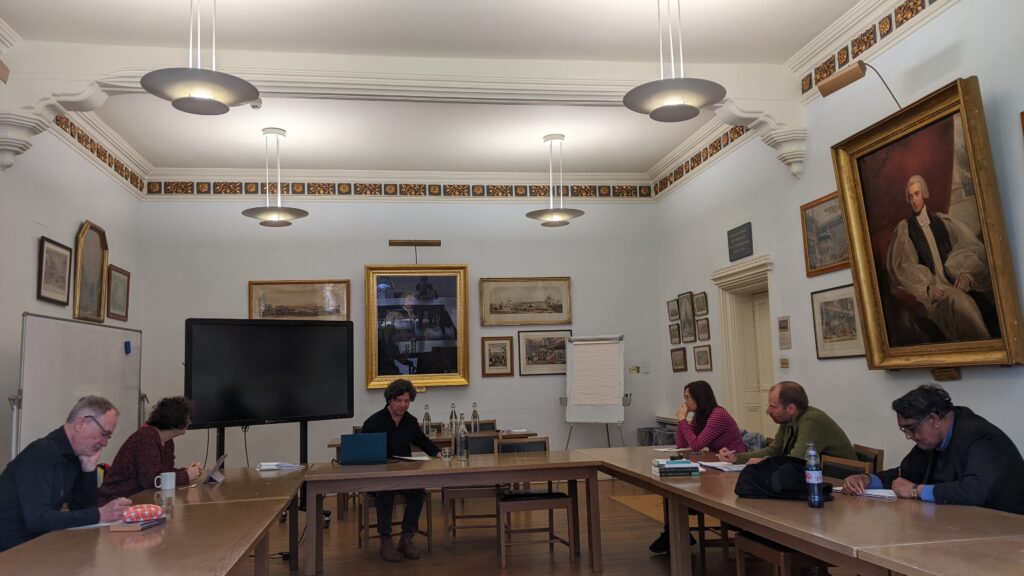
14:00-15:00: Nick Stevenson (Nottingham): Democratic Socialism, Degrowth and the Commons: Raymond Williams, Marxism, and the Anthropocene
15:00-16:00: Martin Crook (UWE Bristol): Marx and the Ecocide – Genocide Nexus
16:00-16:30: coffee break
16:30-17:30: Esther Leslie (Birkbeck):
Marx between Fire Theft and Theft for Fire: On Land
(and Everything Else) as Social Product
17:30-18:00: Conclusions by the organisers Laura Langone (Oxford/Verona) and Bernhard Malkmus (Oxford)
This event is organised by Dr Laura Langone, Visiting Marie Skłodowska-Curie Postdoctoral Researcher at the University of Oxford’s Sub-Faculty of German and funded through Dr Langone’s MSCA FUNDS
NOTES from – Marx and nature
Surface time of capitalism, discipline and exchange, exploitation. This is always a revolutionary time.
The time of labour
Deep time, geographic, sea trade roots have lasted thousands of years, with a few new ones the big canals and coming up through the melting ice.
Eastry’s, brackish water, delves into queer humanitarians.
Environmental time meeting the human time of #climatechaos industrialisation, the ghrate accelerations, profits and tax. We do not yet live on the high sea.
Ships are never far from land when at sea, a confined and highracical workspace. Your life world is the same as your work world. Seafarer are pricernares of logistics on boats.
Next speaker
The inventured of economic growth in socialist thinking, Stalin pushed this, catchup and overtake the west. An organisation that become economised, over politics, state capitalism. Technocratic.
———————————————————
I come from an academic background, but I would call my self now a more Organic intellectual
This often invokes fear in academics. Our fear of this kind of knowledge is very modern, we live in fear filled times.
* live on a boat in the “commons” of the waterways, one of the last parts of Europe that have this pre-modern vagrant life.
* But work in technology, where techno fetishism is endemic amongst what I call the #geekproblem
– In the nortical terms the captain and crew, as was sead earlier a master and slave relationship is core to this thinking with the coder as master and the computer as slave – us the users, digital surfs – our role is to fill the information flows with “content” to facilitate harvests data and attention for control of the (#geekproblem) masters and profit of the capitalists.
These people, who increasingly run and control large parts of our lives, are very hard to talk to, it’s my job to do this, and I find it increasingly difficult to cross this tech/social divide.
In technology this is taking us back to pre-modern social relationship of feudalism.
How would Max think of these issues?
—————————–
Boat life – I moor to university land on water controlled by a government agency EU that used to be enforced by the local counceal – they are in dispute on who has responsibility to nobody is taking control, so I live outside the laws in tempery “commons” this a lot of this on the waterways.
———————
Growth ideology was invented in the 17th century
———————-
Willions an English eco-socialist, radicalising the UK labour movement, self-management tradition
post-modernism raises its head as in everything is socially constructed in modern sociology. Inherent materialism rejects this path.
Rejecting the Green New Deal as a pro capitalist path.
The politics of place, European Union and Brexit rejecting globalisation
Worry about the legacy of Marxism
In the margarines the is a real issue of scale and for social change we need to scale up.
A British socialist vs a communist approach.
————————–
The #OGB is a balance approach, so no dogmatic group will except it. If a small group of people implemented the #OGB the majority of groups would expect it as it bridges the groups. We have to get this past this initial blocking of the dogmatists.
—————————-
neo-liberalism of climate change
Lemkin the annihilation of a group – genocide – the end of a social group.
Imperialism is a form of genocide, the imperative to expand.
Eco- criminogenic of capitalism
The human race is the indigigumes people and neoliberal capitalism is pushing genocide over them in the next 100 years. Capitalism might continue without the bulk of current humanity.
In Australia only modes of production that are useful to the capitalist state are keeps all the rest are exterminated, by bureaucracy or more forceful means. Exclusion from the means of production.
Extreme energy – is going to push the mess into every corner – driving #climatechaos
————————
The event was interesting, but had its moments of sectarianism and had thinking about the issues based on Marx, but no path to take or much of a sniff of a path out of the current mess.
———-
The small genocide of the boater community is a small example
The neoliberal pushing of #climatechaos will genocide large parts of humanity over the next 50 years in the service of an idealogical that might survive this mess, but our cultures and meany of our peoples will not.
Sheep devouring men – the clearances. Indiganalerty.
—————–
Marx and nature,
Plant has a natural and an industrial meaning.
Unattractive work, the factory syteam of labour separating human labour from their selves, alienated labour.
The Irish famine, sol exhaustion, British imperialism in Ireland.
One thing I do on this site is to use the #OMN hashtag story to address the challenges and opportunities in the tech world, particularly in mediating the #geekproblem, this involves leveraging the power of storytelling, community engagement, and strategic advocacy as pats to compost the mess we find our selves in.
In the #geekproblem, there are two distinct paths. One path leads to the geeks who won’t code for changing human nature; they are consumed by the #deathcult, kneeling in reverence to it. The other path leads to those who stand tall, observing the world and crafting tools to compost the #techshit created by the first group. The rest are useless #blocking, whinging or both.
#OMN (Open Media Network): This represents a vision and workable path to an open, decentralized media network that empowers people and communities by giving them control over content creation and distribution.
The GeekProblem: This refers to the social and cultural issues within the tech community, such as elitism, lack of diversity, and communication barriers between technologists and the broader public. Rooted in the need for control.
Craft a compelling story around #OMN that highlights the #4opens potential to democratize media, enhance transparency, and grow collaboration.
Emphasize how #OMN can be used to mediate the #geekproblem by creating more inclusive and accessible technology environments.
Engage the Community:
Use the hashtag #OMN to build a community around the progressive tech vision. Encourage contributions from diverse people, including those who have been marginalized in the tech world.
Host online discussions, webinars, and collaborative projects to foster a sense of belonging and shared purpose.
Highlight Success Stories:
Showcase examples of successful #OMN implementations and how they can have positive social impacts on communities.
Share stories of people and groups who have mediated the #geekproblem by adopting open, inclusive practices.
Create Educational Content:
Develop and distribute resources that explain the principles of #OMN and how they can be applied to solve real-world problems.
Offer tutorials, case studies, and best practices to help people understand and implement #OMN concepts.
Promote Open Dialogue:
Facilitate discussions about the challenges within the tech community, using #OMN as a framework for finding solutions.
Encourage honest conversations about elitism, diversity, and inclusivity, and how these issues can be addressed through open networks.
Advocate for Policy Changes:
Work with policymakers and industry leaders to promote policies that support #4opens and decentralized media paths and networks.
Advocate for regulations that encourage more transparency, user control, and ethical practices in the tech industry.
Collaborate with Organizations:
Partner with organizations that share the vision of #OMN and inclusive tech culture.
Leverage these partnerships to amplify the message and reach a wider audience.
Measure and Share Impact:
Collect feedback and data on the impact of #OMN initiatives and share these findings with the community.
Use this data to refine strategies and demonstrate the tangible benefits of adopting the #OMN approach.
Create spaces where non-technical people feel welcome and valued in tech discussions.
Encourage mentorship programs to help bridge the gap between experienced technologists and newcomers.
Promote Diversity: Support initiatives that aim to increase diversity in tech education and employment.
Enhance Communication:
Develop tools and platforms within the #OMN framework that facilitate clear and accessible communication, like #indymediaback
Encourage technologists to use plain language and avoid jargon when interacting with broader audiences.
Address Elitism:
Challenge the culture of elitism by promoting values of #CC collaboration and shared learning.
Recognize and reward contributions that enhance the community rather than individual prestige.
By this strategic using the #OMN hashtag story, the wider tech community can mediate the #geekproblem and push the meaningful change we need. This approach fosters a more inclusive, collaborative, and open tech culture, benefiting both the #mainstreaming and Alt-society.
A “native” path to composting the tech mess lies in understanding and addressing the underlying issues. A breakdown of a social tech path:
Explore Relevant #OMN Hashtags: Look into hashtags like #geekproblem and #fashernista to find discussions and insights that address the problems you’re facing. These hashtags can provide valuable perspectives and solutions if you use them based on collective experience.
Investigate OGB: Check out the URL https://hamishcampbell.com/outreaching-the-ogb-what-is-the-project/ with #OGB (Open Governance Body) to access project descriptions and learn about initiatives aimed at addressing the challenges you are encountering. While the coding site may be temporarily down, the project descriptions can still offer valuable insights.
Understand the 4opens: Familiarize yourself with the concept of #4opens, which serves as a framework for addressing many of the issues present in the tech ecosystem. The 4opens provide principles for building more open, transparent, and inclusive digital platforms.
By delving into these #OMN resources and frameworks, you gain a deeper understanding of the issues and discover pathways toward solutions. Collaborating with others who share goals and values amplifies the impact of efforts in improving the tech landscape.
Too often, I find myself in conversations that revolve around the intersection of technology and social issues, with one view emphasizing the importance of practical solutions to real-world problems, while the other highlights the underlying social dynamics that shape the technological landscapes these so-called “solutions” are often supposed to address.
On one side, there are those who prioritize pragmatic, immediate problem-solving. They want concrete fixes for specific issues and are often impatient with broader discussions around ethics, power structures, and social impact. For example, they might advocate for encrypted communication platforms as a straightforward defence against surveillance, without considering how these tools unintentionally foster isolated, fragmented communities, or how the #encryptionist mindset reinforce the individualism that makes collective action harder.
This mindset tends to dismiss systemic critiques, like the argument that contemporary code is shaped by capitalist structures that inherently promote profit over people. Think of how open-source projects get co-opted by corporations (#dotcons) to reduce costs while extracting free labour from developers. The “easy fix” of simply licensing code as open might seem like a solution, but without addressing the exploitative dynamics, it to often end up reinforcing the problems they think they are solving.
On the other side, you have those who argue that technological problems are inherently social problems. They believe you can’t build meaningful tech without addressing the human dynamics that shape its development and use. For example, decentralized social media platforms like #Mastodon or #PeerTube are built to resist the control of big tech monopolies, but if the culture within these platforms mirrors the same paths and thinking of the orgional #dotcons, then the tech itself fails to be a strongly alternative. The #geekproblem shows up here when developers dismiss social considerations as irrelevant or secondary to technical design, leading to platforms that are hostile to non-technical users and communities with different values.
Take the example of the Fediverse: while it offers a more open, decentralized alternative to Twitter or YouTube, many instances end up replicating the same patterns of gatekeeping and fragmentation. Without intentional social processes and governance, like the kind explored in projects like the #OGB (Open Governance Body), the tech alone isn’t enough to shift the power dynamics at all.
To sum up, this ongoing conversation highlights the complex relationship between technology and society. We need to move beyond the constant back-and-forth between quick-fix pragmatism and endless critique, and instead build projects, process and practices that balance immediate action with a deeper understanding of social paths. It’s not about rejecting practical solutions, but about recognizing that real change, that posses real challenge, comes from embedding social responsibility, collective governance, and human-centred design into every layer of the technology we create.
The path requires both shovels and soil, practical tools to dig through the mess, and rich compost from decades of social struggles to nourish truly transformative alternatives. It’s time to break this cycle of mess-making and start growing tech that serves communities, not just individual “users” or feeding back into #dotcons interests.