In part, the current challenges faced by the #openweb and grassroots reboot movements can be traced back to two cultural and structural problems: the influence of #fashernistas and the deeply ingrained #geekproblem. Both of these contribute to active blocking of meaningful change, hindering the progress needed for an openweb reboot. To walk this “native” landscape effectively, it’s needed to understand these barriers and how they block change and challenge.
The fashernistas and their echo chambers, the term refers to a subset of people who are highly engaged in performative discussions, centred on trending topics and social posturing without substantive engagement in grassroots real world problem-solving. While they are adept at identifying and amplifying transient issues, their conversations stay within insular bubbles. This creates a cycle where attention and focus are pulled toward repetitive discourse that never leads to any outcomes.
This taking up space with little and most often no follow-through is detrimental. Fashernistas thrive in spaces where the appearance of awareness is valued over the hard, real, messy action that is needed. In this #manstraming bubble, dialogue is focused on social capital—who knows what, who said what—rather than collaborative problem-solving. The result? The conversation around the openweb becomes cluttered, attention splinters, and meaningful action is overshadowed by a constant churn of noise.
The role of #fahernistas in blocking change is their ability to dominate platforms and narratives. This domination becomes active blocking when their presence leaves little room for discussions rooted in genuine collaboration and open progress. They inadvertently (or sometimes deliberately) creates environments where the needed ideas and radical challenges to the status quo struggle to gain traction, let along attention. If the openweb is to flourish, this culture of self-referential chatter needs to be mediated.
The #geekproblem is a different barrier, which is the cultural divide within tech communities that leans heavily toward deterministic, technical solutions at the expense of accessible, inclusive approaches. The geekproblem manifests when developers and technologists become gatekeepers, framing issues in ways that reinforce their control, preserving existing narrow structures rather than opening them up for collective problem-solving.
For example, in the #openweb and #fediverse projects, the drive for good #UX runs parallel to an implicit exclusivity of bad UX dressed in “privacy”, “security”, “safety” etc. Technical jargon, complex onboarding processes, and a lack of user-friendly interfaces are a barrier to entry and community building. This exclusivity prevents the broader range of participants from engaging meaningfully, turning potentially revolutionary spaces into “specialized” silos, that reinforce this very #blindness.
#fashernistas and #geekproblem interact and often work in unintentional tandem. While the former distracts and fractures attention with endless (pointless, narrow and repeating) discourse, the latter locks down practical pathways for change through gatekeeping and technological insularity. The result is a failing “native” path, where critical mass, and the needed community, fails to grow—one part is too busy talking, and the other is too busy coding in isolation. The broader culture of the #openweb suffers as a consequence, making the needed change far more difficult to achieve than it needs to be.
The solution lies in finding a balance that mediates between the superficiality of fashernistas and the closed nature of the geekproblem. This involves, promoting diverse voices, so that the #openweb aren’t monopolized by any tiny group. Building bridges between projects and communities, to facilitate communication between technical experts and those involved in creating actionable steps that align with #4opens paths we need to take. Developing a culture that values tangible outcomes and collaborative input over performative dialogue and gatekeeping. Amplifying onboarding, by making entry points into #opentech accessible, so people outside traditional tech ghettoes can contribute meaningfully.
The path we need for the openweb, is more than only technological solutions; it needs a culture shift. Both fashernistas and those contributing to the geekproblem need to recognize their roles and adjust their approaches, for the #openweb to thrive. The has been to meany years of pratish behaver in the paths we need, it’s pastime for #KISS focus. The current moment presents a fresh opportunity for change. With the fediverse and platforms like mastodon growing exponentially, there is a path to free the native spirit of the internet as a collaborative, #openspace with trust, transparency, and action as core motivators. Let’s try and make this work, and not squandered it by letting the voices of the few block the work we need to do.
We need to try and make the inrushing #mainstreaming agenda more functional in the #openweb reboot, how do we do this? One way is to strengthen community governance with native decentralized decision-making frameworks that involve more voices from the grassroots, like the #OGB project. This is self empowering, as tools based on federated models (like those used in the #Fediverse) empower people to participation in decision-making processes rather than normal top-down dictates.
But this is going to be very hard without developing a supportive ecosystem for builders with funding beyond the #fashernistas. To make this happen we need to shift funding mechanisms toward projects that align with the values of the #4opens (open data, open standards, open source, and open process). This means supporting those who build with the public good in mind, not pointless flashy, trendy ideas, and tech fashions. Empower developers with a community focus by highlighting projects that prioritize #UX and community needs rather than only tech novelty. Encourage #FOSS governance practices that are transparent and inclusive. Foster this inclusivity by bridging the current silos with cross-community dialogues, to facilitates discussions that bring together different paths in alt-tech, civic tech, and grassroots movements for cross-pollinate ideas and useful paths to take.
Ensure that platforms and networks being built do not simply cater to niche tech communities but are accessible and usable by the wider public, thus focus on practical relevance. This helps to empower people to understand the importance of decentralized tech and how it benefits them directly. We need to do this to break down the barriers posed by the #geekproblem and demystifies participation in the #openweb paths. A strong part of this is organizing hands-on workshops that engage people in contributing to shaping the projects.
We can’t do this without accept that failures are part of the process. Instead of discarding what doesn’t work, use these experiences as compost – breaking down what failed and learning from it to build stronger, more functional initiatives. This plays a role in shifting cultural narratives to challenge and change the storeys around the #openweb and wider #openculture to include cooperative problem-solving and mutual respect. Shifting the focus from tech utopianism to realistic, impactful change.
This process is about building tech paths that are adaptable and capable of evolving with peoples needs and global conditions, including #climatechaos and hard right socio-political shifts that are accelerating. A part of this is support for meany small tech paths that link and flow information and communities.
In this rebooting of the #openweb it becomes a part of a shifting #mainstreaming to better tolerate and promote messy participatory governance, redirect funding to genuine, community-oriented projects, and championing inclusive, sustainable paths. The composting analogy is usefull as it emphasizes learning from past mistakes and continuously building resilient, inclusive solutions #KISS
A test, that we need to actively push is to look at people and projects to see if they link, a basic part is the act of linking, which goes far beyond a simple convenience; it forms the backbone of an interconnected, accessible, and transparent internet. Yet, many people overlook its importance or misunderstand its role, especially when transitioning from #dotcons (corporate-controlled platforms) to #openweb environments. To sustain the promise of an open, people-driven internet, we need to recognize and actively engage with the practice of sharing non-mainstream links #KISS
But yes we do need to mediate the current mess, don’t feed the trolls, keeps coming to mind, when looking at the liberal #mainstreaming #X influx, this is like waves washing on the shore, be the shore not the wave.
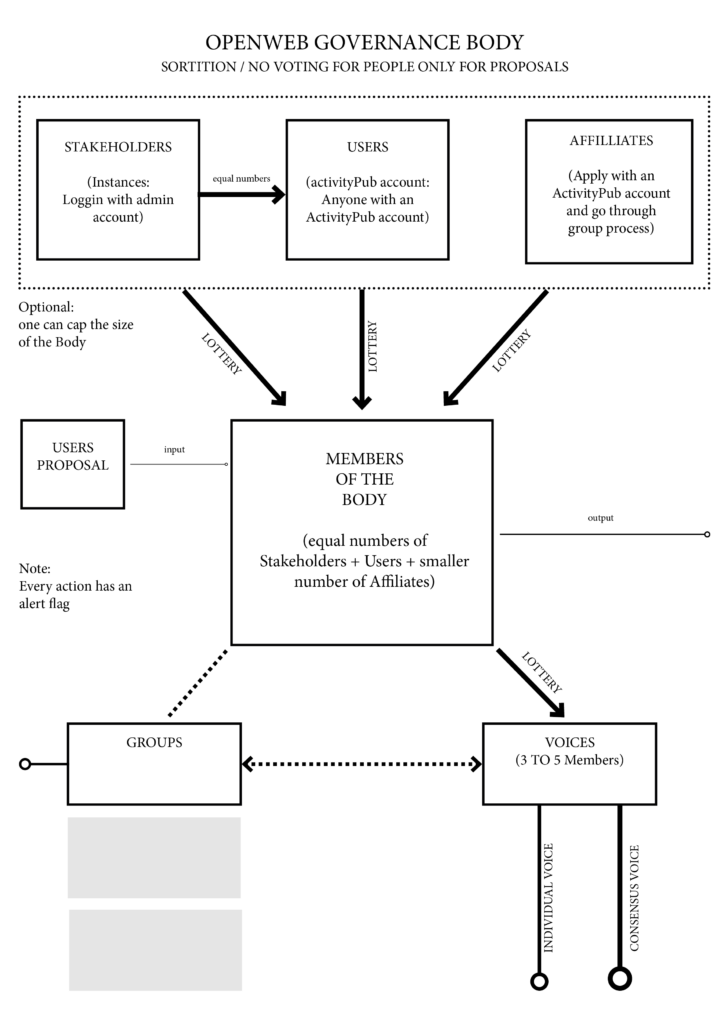
Governance both horizontal, federated and #FOSS native is a hot subject at the moment. It’s a good time for people to look at this. Over the last 5 years we have been developing the outline of the native Open Governance Body (#OGB) project is an innovative approach for developing native #FOSS governance, grounded in years of on-the-ground organizing and community-oriented technology like the #Fediverse and #ActivityPub protocols. This initiative emerged from a #4opens social process, aiming to create a governance path that is genuinely open, transparent, and collaborative. The project particularly focuses on involving developers who are not only skilled technically but who also prioritize community collaboration and user experience (#UX)—a challenging yet needed requirement for success in a horizontal, scalable tech paths.
The OGB leverages ActivityPub, the protocol powering decentralized social platforms like Mastodon, to create structures that are adaptable to scale horizontally. To make this project happen, we need outreach to finding developers who can operate within a community-first structure. This means finding those with technical skill in FOSS and ActivityPub, but who are also committed to open, horizontal collaboration and can engage constructively with non-technical communities and paths. Often, highly technical projects attract developers who prefer isolated, independent work, so highlighting the collaborative nature of the OGB from the start is important.
For those interested in making a meaningful impact on #openweb governance and who can commit to community-entered development, the #OGB project is a compelling opportunity to be a part of the change and challenge we need.
Communities don’t adopt digital technologies—they adopt #KISS tools. People don’t think about TCP/IP or HTTP when browsing the web, or SMTP when sending emails. Similarly, they don’t think about #ActivityPub when using the #Fediverse. They interact with intuitive tools that simplify these layers.
One of the toughest challenges in grassroots #DIY tech is creating #FOSS tools that align with #4opens standards while offering good #UX. This isn’t just a technical issue; it’s a deeply social and political one.
The ongoing difficulty in having this conversation within #openweb and #FOSS spaces is part of the wider mess we’re in. We need to work collectively to compost this mess, what we can call the #geekproblem.
SocialHub has often tried to bridge this conversation, but there have been failures along the way. How can we do better moving forward?
Let’s start with mastodon, the complexity of (default) privacy settings leads to public conversations inadvertently shifting into private spaces, this is a UX problem, but it also points to a larger issue with how we handle communication, trust, and governance on decentralized platforms. This raises a question, are we on the right path? Confusing privacy settings are disempowering, the defaults in “safety first” platforms like Mastodon do push users toward privatized conversations, which are not comeatable with #4opens media paths, of transparency and public dialogue. Yes, this is a subtle, but it matters, it’s an important #UX issue, exacerbated by the complexities of decentralized platforms and different peoples preferences for engagement.
UPDATE: it’s about inheriting the settings of the thread, all my posts are #4opens as this is the core project, it’s unusual to send a DM or other setting though do this a little when needed. When having a public conversation and suddenly find this happening in a non-public space, at no point did I agree to this move, but it happens, due to others settings, it should default to one side public, my settings, and one side (semi) private the other person’s settings, as on my side it is VERY much a #4opens public conversation, it’s a form of data corruption for this privatisation to keep happening… a mess I have to fix by republishing my side as a separate post – sub optional and bad #UX
This is in part the push for #mainstreaming, both inside and outside, alternative platforms, creates pressure toward conformity and centralization. This push undermines the grassroots nature of media networks like the Fediverse. In the end, we move towards the same governance and behavioural issues seen in #dotcons, corporate social media platforms. Left-wing and progressives people and organisations need to resist these pressures to/by fostering a #4opens culture of diversity, and mutual aid.
Moving beyond this social tech mess, a culture of empathy and understanding is needed for mediating trolling behaviour. Listen before judging, then make judgements based on sound open process, so people have the space to change their paths if they can. A mindset of curiosity and openness, rather than rigid ideological adherence is needed for this to work, metaphors are fertile seeds to bring conversation into this path, creates spaces where different perspectives can be heard and discussed constructively.
A first step is to be “intolerant of intolerance” with #4opens as a guide. The problem is that this is a right-wing path https://en.wikipedia.org/wiki/Paradox_of_tolerance so we add the #4opens, ethics, to turn this to the left/progressive #KISS path.
The #openweb has always been, under the surface, built on strong communities rooted in mutual aid to provide a buffer against the toxic effects of trolling and infighting. When people feel connected to a shared mission, they are less likely to engage in destructive behavior. The strength of grassroots movements grows from their ability to offer this solidarity and care as an affective path of change and challenge. You acturly can’t have one without the other, in this, conflict in moderation can be healthy or not.
We need structural social solutions to governance, the work on the #OMN and #OGB is a promising step toward creating decentralized, open governance that can mediate trolling and other negative behaviors.
“the rule of an enlightened “philosopher-king” (cf. Noocracy) is preferable to the tyranny of majority” is unthinkingly in #FOSS governance paths. Much of the trolling comes from this unthinking. By embedding #4opens trust, transparency, and community in the working path of these networks, we create environments that push collaboration and experimentation, rather than pointless ongoing conflicts.
Navigating these challenges: online governance, trolling, and common sense privacy is no small step. However, with #4opens, a focus on mutual aid, and a commitment to progressive, decentralized governance, it’s possible to create a healthier, more resilient online and offline progressive communities. The work done through the #OMN and #OGB projects reflects this path where spaces (online or offline) are inclusive, productive, and capable of handling the messes that inevitably arise in all “open” communities.
This “public first” path of the #OMN faces steep hurdles without the need of support, focus, and funding. Achieving diversity in these spaces requires more than just a philosophical commitment, it needs active engagement from a variety of voices, technical expertise, and resources to push the project into wider use.
The current #fashionista dominant “safe first” path in projects like Mastodon does create a certain type of functionality, but it also stifles innovation and radical potential by prioritizing safety in ways that ultimately encourage more privatized interactions. We do need to step beyond this, for grassroots, #openweb movements to thrive, they need both tech development and community support that embraces complexity rather than pushing toward deadened conservative #mainstreaming defaults.
Ideas please to pull in the necessary dev focus and resources to make the public-first #OMN a reality? Can we build ways to attract contributors outside traditional #blockeing funding paths?
A fresh look at this path. The #openweb is a decentralized, people-centric internet that contrasts sharply with the centralized #closedweb being pushed by major #dotcons platforms. The openweb is founded on principles of openness, transparency, and community empowerment, it is not just about technology, but also about fostering a different kind of social relationship online, one that is rooted in collaboration, diversity, and mutual aid.
Core Principles:
Decentralization: Unlike the centralized structure of the pre Internet silos and current app based dotcons paths, where a few companies control vast swathes of our space, the openweb promotes a distributed architecture where no single entity has overarching control, it’s a “commons” for all of us.
The openweb is built that people and communities have more control their data, metadate and online experiences. It rejects the practice of data extraction and surveillance that is prevalent on the current corporate platforms.
Transparency and Openness, the openweb embraces openness in all its forms—open source software, open standards, open data, and open processes. This transparency ensures that technology is accountable and accessible, fostering trust based on the #4opens which is a simple core path we need to take.
Community and collaboration, the current openweb reboot is about people coming together to create, share, and collaborate. It moves away from the competitive, profit-driven nature of the dotcons and towards a more cooperative, community-oriented approach where diverse voices can contribute and be heard.
Interoperability is core to this space, this means “native” tools and protocols that allow different systems to communicate and work together, reducing dependence on any one company or technology stack.
Resistance to mainstreaming and #deathcult mentality, it needs strong resistants to the push towards #mainstreaming and the #deathcult mentality to mediate the relentless profit-seeking and homogenization. To hold to the path of celebrating diversity, alternative thinking, and radical approaches to building online communities.
Not a copy of the #dotcons, while some openweb projects have attempted to replicate the features of the major platforms (like Facebook or Twitter) in open-source form, the openweb vision goes further. To create something fundamentally different, not just a #FOSS (Free and Open Source Software) version of existing corporate models.
Not a walled garden, the #openweb opposes the concept of walled gardens, closed environments that limit people expression and force them to live within controlled ecosystems. It promotes open standards and protocols that allow people to move freely, based on trust, to connect across different spaces.
How can you become a part of this and contribute to building the #openweb
Support and use Open-Source Tools, contribute, what you can, to open-source alternatives that respect people.
Promote interoperable solutions by advocate for tools and technologies that work together seamlessly. Encourage developers to use open standards to ensure their software can communicate across different networks.
Educate and advocate by raise awareness about the problems with the current #dotcons path and the benefits of a decentralized, people controlled web. Share knowledge and resources to help more people transition too good #UX openweb alternatives.
Build community led networks, this need to focus on developing code that prioritize community needs and values over profit. Encourage collaborative governance models where people and communities have a say in how platforms are run and developed.
Experiment with new networks, to look beyond simply copying existing platforms and think creatively about what a genuinely #4opens people centred internet could look like. Explore new forms of social interaction, data sharing, and content creation that are native to this path.
The #openweb path is about “composting the mess” created by the #dotcons, taking what is broken or harmful in our current digital environment and transforming it into something healthy and sustainable. This means acknowledging the flaws in the current system and actively working to build something better. This path is a tool for empowerment, creativity, and connection, rather than exploitation and control, are you ready to pick up the shovel and start composting the mess? The path is here, and it’s open to to people willing to take part in this humanistic adventure in social technology.
If you are interested in outreaching this #openweb reboot on the #dotcons to bring more people in, there is a group on Reddit for this outreach https://www.reddit.com/r/openweb/ had to set up a new group as the post doing this are being removed from other subject groups, yes it’s a mess, but outreach to hand hold people stepping away from the #dotcons matters, thanks for your help in this path.
We need to look and care for the current #openweb reboot, as it needs to be used as a core tool for social change and challenge. The #Fediverse, short for Federated Universe, is a part of the #openweb made of human connections through #4opens computer networks. At best, its value is not a collection of software packages, but much more about the flows of human community that builds relationships across diverse groups and regions. Imagine the Fediverse as a web of communities, each represented as a node. These nodes are not defined by the software they use, but by the people and groups that form them:
Affinity Groups in Activism: communities of action and social movements
Local Governments: Municipalities using the Fediverse to communicate with residents, share public announcements, and gather feedback.
Universities: Academic institutions fostering collaboration among students, faculty, and researchers, enabling the sharing of resources and knowledge.
Families: Family members staying connected, sharing updates, photos, and maintaining family bonds regardless of geographical distances.
Friend Groups: Friends interacting and sharing moments in a pseudo private, ad-free space, organizing events, and maintaining their social ties.
Companies: Businesses collaborating internally and with their customers, providing customer support, and sharing company news.
Interests: People and communities expressing themselves, sharing their thoughts, hobbies, and connecting with like-minded individuals and communities around the world.
Why this as value is that these communities interact seamlessly across the #openweb, regardless of the specific codebase they grow in. Yes it’s important to understand the good #UX of the software that makes these connections possible plays a part, and that each of these nodes use a common protocol, #ActivityPub, to communicate, forming the backbone of “native” #openweb flows. This #4opens interoperability allows people on one codebase to interact with users on another, creating a unified, yet decentralized, social network.
“The Fediverse isn’t about connecting software packages. It’s about connecting communities and people. If you make a Fediverse explainer, try to show some real communities as the nodes in the network, rather than using software packages and their logos. Companies, local governments, universities, families, friend groups, individuals. You can explain what software makes those networks possible in your next slide.” https://mastodon.social/deck/@evan@cosocial.ca/112847724644046695
Though, what meany in our #fashernista and #geekproblem paths miss is this thrives because of the human element. It’s about the people who use these platforms to connect, share, and build spaces that reflect their values and needs. It’s the people and the communities of use that make this real, not simply the tech and the small number of people who code it, let’s talk about the wider groups rather than the few #KISS
What needs composting is that we have an undeclared #stupidindividualism battle pushing to destroy this in numerous ways, we do need to push this back into balance, while holding out a hand to bring people over. Yes, it a step, don’t be scared.
And please try not to be a prat about this, thanks.
The questioning over state funding of Free and Open Source Software (FOSS) and open-source initiatives revolves around invisible ideological debates about benefits and drawbacks. Let’s look at this from a few specific examples: #NLnet, #NGI, and the European Union (#EU), to understanding the implications and effectiveness of this funding path.
The #NLnet Foundation is a notable example of an organization that provides funding to open-source projects. Supported by private and public funds, including significant contributions from the #EU, NLnet focuses on promoting a free, open, and secure internet.
The #NGI initiative, funded by the #EU, aims to shape the development of the internet of tomorrow. By supporting a range of open-source projects, NGI tries to foster innovation, privacy, and security. It emphasizes human-concentric technology, ensuring that the future internet respects humanistic values and needs.
The #EU has been a significant proponent of FOSS, providing funding through programs such as Horizon 2020 and Horizon Europe. The EU’s supports digital sovereignty, reduce dependency on non-European technologies through promoting open standards.
The is some democratization as these state-funded FOSS projects ensure software is accessible to wider groups, thus reducing the digital divide. For instance, NGI-funded projects are supposed to focus on inclusivity and user empowerment. At best, this transparency brings public overview to these processes.
There are some economic benefits and cost savings in using and supporting FOSS instead of expensive proprietary software. Funding initiatives like NGI stimulate innovation by allowing developers to build upon existing open-source projects, fostering a collaborative environment. Though, there are unspoken issues of sustainability in a pure capitalist path, thus the question of balance in state funding.
Open-source software allows for independent security audits, reducing the risk of vulnerabilities. The EU’s investment in secure communication tools underlines this advantage. Reducing reliance on a few large proprietaries #dotcons software vendors enhances national security and control. The EU’s support for open-source projects aims to bolster humanistic digital sovereignty.
For example, #NLnet’s diverse (though #geekproblem) funding portfolio highlights this limited community-driven development. The collaboration between public institutions, the private sector, and community contributors helps #NGI projects bring together diverse stakeholders to work on common goals. #FOSS projects thrive on community contributions, leading to continuous improvement and support and thus in theory community needs, though due to the dogmatic #geekproblem this is currently failing.
Funding Continuity: Projects become dependent on government funding, which currently is not stable or continuous. For example, sudden policy shifts in the EU affect long-term project sustainability. Without a sustainable funding, FOSS projects struggle with long-term maintenance and support.
Most #FOSS projects are too idiosyncratic to meet quality #UX standards. Thus, the current #geekproblem dominated process means that state funding inadvertently support meany unusable and thus pointless, subpar projects. Effective diversity and oversight of these mechanisms are crucial to mitigate this failing path.
Government involvement leads to bureaucracy, slowing down and ossifying development cycles, currently we do not work though this path well, The balance between oversight, diversity and agility is critical. With the #EU path this is a huge problem leading to almost all the current funding bring poured down the drain.
For #mainstreaming capitalism the issue of “Market Distortion”, the idea of competition raises the issue of state funding distorting “market” dogmas to disadvantage private companies and startups that don’t receive government support. For instance, EU funding can overshadow smaller #dotcons, capitalist thinking sees this as a risk that government-backed projects might stifle innovation by shaping the market landscape.
Political and ideological biases influence which projects receive funding, this is currently pushing a #blocking of the needed “native” #openweb path. How to move past this to ensuring diversity and “impartiality” in funding decisions need real work. How can we shift this “common sense” focus that government priorities do not align with the wider needs of the #openweb community and end-users. Aligning funding priorities with community needs is needed to address this concern, how can we make this happen with funding like #NLnet and #NGI?
To sum up, #NLnet are doing some good work, but this is focused on feeding the #geekproblem and building #fashionista careers, evern then on balance they do a better job than most. Then the wider #NGI funding is going into the #dotcons and #NGO mess, thus being poured directly down the drain. Over all, it’s fantastic that the #EU is funding the #openweb even if it is doing it very badly by funding very little that is native or useful.
Conclusion, state funding for FOSS and open-source initiatives, in our examples #NLnet, #NGI, and the #EU, has potential for creating real change and challenge, but this path presents both opportunities and challenges. When implemented thoughtfully, it can foster “native” paths, innovation, reduce costs, and enhance community and security to challenge the current worshipping of the #deathcults by our widespread use of the #dotcons. The question is the will and understanding to balancing this path to ensures that state funding positively contributes to the #4opens FOSS ecosystem, driving forward a free, open digital future or just leads to the capitalistic criticism of waste and distortion? At best and at worst, we see some real change and a lot of poring funding down the drain to feed some #geekproblem and build the careers of a few #fashernistas
The is much to compost in the current mess, can we get funding for shovels please #OMN
This is so obverse that we should not need to talk about it, but we do. In the United States, propaganda is intertwined with consumerism. Edward Bernays working in the US can be seen as the father of modern propaganda, he believed that humans were driven by instincts and animal desires. His work was used to harness these instincts through advertisements (propaganda) to create inner desires within people, to feed consumerism, which, his god, corporations could then satisfy with their products. This as become known as the “engineering of consent” which at the time he created to #block the growing social change and challenge, this “sweet, sickly mess” was pushed, and still is, to keep society aligned with the #mainstreaming social control.
This strategy you can find in plain language in his books, it clearly shows the path of advertising and propaganda to push corporate and political goals. The objects advertised and sold were used as symbols of government propaganda, for example, the American Department of State funded exhibits at the Museum of Modern Art to showcase American consumerism as a symbol of progress and superiority over communism. This legacy of propaganda is alive and flowing in all our disasters addiction to #dotcons that shape perceptions and dictate behaviour and algorithmically manipulate and control us. This hardened mess, has played a core role in building up the technology which shaped our collective consciousness over the last 20 years. This sticky “sweet and addictive” digital intervention pulled us off the social disruptive “native” path of anarchy, of the #openweb our society were pellmell tumbling down.
So, how do we get outside this mess? When the power of design in propaganda lies in its ability to convey meaning in symbolic, abstract terms that go beyond words. Whether through #dotcons#UX pushing overt displays of authority or subtle bureaucratic defaults, design influences our thoughts and perceptions, hiding brutal truths behind a veil of ordinary, boring bureaucracy. As we navigate the digital world around us, it helps to remain curious and question the narratives our “common sense” paths serve, if we are to push change, challenge we need to recognize the responsibility that comes with the digital power.
“An important distinction is slowly being uncovered about the definition of the term “#Fediverse.” Who is it that gets to decide what this place is? How are we being represented?”
The lack of discussion about the nature of the space the #fediverse occupies raises questions about representation and identity within this #openweb “native” network.
Ownership by Communities: The Fediverse offers a way to build the internet by and for communities, in contrast to centralized #dotcons social networks that push monetization over community well-being. By decentralizing governance, the Fediverse empowers people to take control of their online spaces and relationships.
Audience and Adoption: The Fediverse is valuable for those who are hostile and disillusioned with monetized social networks and seek ways to connect with real change/challenge comunertys. While some are eager to explore alternatives, others face limitations or challenges in transitioning. Nonetheless, the slow growth of communities is essential for digging and building a strong “native” foundation for #openweb decentralized networking.
Governance and Community: A key distinction in the Fediverse lies in its shared governance model, where people have a say in how their communities are shaped. This contrasts with centralized social networks, where governance decisions are made by a central authority that does not align in any meaningful way with community interests. People are drawn to the alt path for its emphasis on inclusivity and agency, allowing both individuals and social groups to express themselves without fear of censorship or out group coercion.
Coexistence with Centralized Networks: The Fediverse does not require people to opt out of centralized social networks entirely. Instead, people can maintain connections on both networks while stepping away to decentralized networking. This allows people to become familiar with the #openweb culture and its advantages.
Website Design and Accessibility: With the foundational #4opens principles, the focus shifts to website design that reflects these values. Accessibility, both in terms of physical access and cultural understanding, need to become prioritized to ensure that the platform is both inclusive and user-friendly, in sharp contrast to too much of the bad #UX history of existing #FOSS coding.
The Fediverse represents a shift towards community-driven, decentralized networking, offering an alternative to #dotcons. It prioritizes people’s and community agency, inclusivity, and accessibility, to create spaces to connect and express difference and similarity.
Let’s reboot the #openweb as a start, we can try calling this #web1.5
On the subject of activism, “don’t be a prat” is a good start.
#P2P projects keep failing socially because adoption is tiny. The #Fediverse succeeds socially because it keeps social #UX familiar. The path forward is a half-step strategy: bridge #fediverse + #p2p in real, usable ways until decentralised clients are socially relevant.
We need: Bridges & killer apps, seamless UX that makes federated + p2p content feel like one stream. A server that reads from both channels without making the user care about protocols.
A. what is happening with protocols:
* The #nostr crew are the children of #web3 mess, they are a bit reformed, let’s see. * Then the #BlueSky are the reformed children of the #dotcons * The #fediverse is the child of the #openweb * #dat is a child of the #geekproblem if it is reformed or not, you can maybe tell me? * #SSB was a wild child, now sickly/lonely with the #fashionable kids gathering round #nostr * #p2p was the poster child of the era of the #openweb it was caught in the quicksand of legal issues, the shadow that was left was eclipsed by “free to use” #dotcons Now finds it hard to come back due to mobile devices not having an IP address, thus most people not actually able to use p2p reliably.
Q. ssb has technical shortcomings. It cant sparsely replicate data and verify it. It needs to download all data ever created by a user to verify, which makes it infeasible for many use cases. The main underlying data format is also hard to fix and leads to performance bottlenecks. The main founder moved on and it seems most ssb people are also looking for a new home. dat’s time has not yet started as it approached things from a much more fundamental perspective. The initial vision was “git for any kind of data”, which means “version control for any kind of data” (peer to peer). The stack only now reached maturity to build proper tools on top of it. You have the dat-ecosystem with 2-3 dozen projects. You have the holepunch/pears project which built a phenomenal “never on a server” desktop/mobile p2p video conferencing messenger with built in file sharing. The app works flawless on mobile and is called https://keet.io Also https://dat-ecosystem.org just now released it’s new website. The https://pears.com runtime will be live in 5 days from now on the 14th of February for anyone to start hacking on p2p apps and some time later, the plan is to integrate it into the dat-ecosystem website, so anyone can start using p2p from within dat-cosystem page (which is an open source static website anyone can fork to get to the same) …no back ends required. pears 🍐will only start working on the 14th of february. You can set a reminder. The revolution starts then 🙂
A. will have a look, there are a few new #p2p projects reaching use at mo – the issue is none of them link to each other and likely thus non inter-op. This is the #geekproblem
Q. I don’t think there are any mature projects out there other than dat and ipfs. The former made by open source devs, self funded with a bit of help from public funding bodies, while the latter is the poster child of venture capitalists and got gazillions from investors. It’s the “big tech” of p2p. Then you have a few less general purpose p2p projects which popped into existence in the last few years, but both dat and ipfs go back all the way to 2013 and it takes a lot to get things smooth and stable and support all use cases and get enough critical adoption and nodes to make the p2p network work. That is why dat-ecosystem has a lot of existing projects that work and why it is reliable to build on top of it. I do think the new more recent p2p projects in research state might become mature as well, but it will easily take them a few more years. Many of those newer projects have people working on them part time only or focus on really special use cases and only time will tell if their approaches will bring something new to the table or not. 2024 will definitely be the year of dat, especially after February 14th, when pears.com goes live. This has been years in the making. What started 2013 as (git for data) will now finally become it’s own independent p2p runtime. Goodbye nodejs & co. …and soon goodbye github & npm 🙂
A. https://holepunch.to/ its a very sparse website with no company info or #4opens process – it looks and feels like meany #dotcons if these projects do not link to each other or inter-op then they will fail like the hundreds I have seen fail over the last 20 years of this mess making. it’s a problem we can’t keep doing this shit, but we do. #4opens is a shovel to help compost this, can you do a write-up for these projects please.
Q. dat-ecosystem is a 501c3 It’s Code for Science and Society And it is https://opencollective.com/dat And it is governed by a Manifesto. It is all on the website next to the “Info” button in the upper left corner. If you mean pears.com ….that will change on February 14th I didn’t mention holepunch. Holepunch is just one of the many dat-ecosystem projects. It is special, because one of the core developers of dat started it after he got a lot of funding and is currently maintaining many of the important code that powers dat and the dat-ecosystem projects. But it doesn’t matter too much. The stack is open source under MIT and Apache 2.0 License for anyone to use. If holepunch would ever decide to stop maintaining the stack (which we do not think), dat-ecosystem can find other maintainers.
A. they are the owners of https://keet.io always look for ownership in #dotcons 🙂 a few of the ones I have been looking at over the last few years https://www.eff.org/deep…/2023/12/meet-spritely-and-veilid and the was a another one funded by NLNET they recently whent live, but can’t find the link. None of them link or interop, not even bridges. This is the #geekproblem
Q. Spritely is a great project. It embraces the ocap security model (Object Capabilities). It does apply it in lisp/scheme, which is a great fit with GNU Guix. Their foundation is led by Randy Farmer. Randy Farmer co-created Habitat with Chip Morningstar (an MMORPG) in the 1980s. Chip Morningstar works with Mark Miller (Mentor of Christine Lemmer Webber). Their project is called “Agoric”, which is a blockchain projcet funded by Salesforce. They have their own Token and build a “Market Place”. They as well work with ocap security model (but in JavaScript). The JavaScript ocap version is what is known as SES and Endojs. They regularly talk to make sure things are interoperable. Ocap security is also what dat-ecosystem is embracing to pair it with peer to peer and bring it to the post-web. A version of the web not dominated anymore by big tech and big standard bodies.
#Veilid is a young and interesting project as well with a focus on anonymity over performance. This is a great use case that needs support, but dat was always about performance and any size of data and anonymity and privacy at all costs. I’m not saying that is an unimportant use case, but there are plenty of solutions for extreme cases where anonymity and privacy are at utmost importance. What is vastly more important imho is to have a p2p technology able to replace mainstream big tech services such as youtube, facebook, instagram, tiktok, google & co. because it won’t help us if we have a special niche technology that cant actually tackle big tech and surveillance capitalism but gives people some way to hide from it. …we need it too, but we also need a foundation on which to actually outcompete big tech imho.
Keet is a closed source peer to peer messenger & video conferencing app (might be open source in the future) and it is built on top of the dat stack. The dat stack is very modular and in it’s core consists of a few main modules. – hypercore, hyprebee & hyperdrive – hyperdht & hyperswarm – autobase Those modules are maintained by holepunch, an organisation started by one of the core dat developers afte rreceiving a lot of funding to develop keet and now the pear runtime, which will be open source and public under https://pears.com after February 14th 2024 (Valentine’s Day ❤) Keet itself is one of many apps, all part of the dat-ecosystem. Most projects are open source, but not all, but they are all built on top of the MIT/Apache licenses p2p stack, which started as `dat` in 2013 and matured many years ago. The stack is battle tested and really works. Of course – we all want everything open source and one day we might find a model, but if some closed source apps help bring in funding, it benefits the open source core. Basically, you can think of “keet” as some fancy UI/UX on top of the open source software stack. Now sure – would be sweet if the UI/UX was open source as well, but then again, it’s not essential and until we transition into fully automated luxury Communism or whatever else works, something pays the bills and enables the open source core to be maintained 🙂 At least it works without any “Cloud Landlords”. No servers, never on a server. No more cloud lords, a.k.a. Big Tech or #dotcons
A. The best we have currently is #ActivityPub DIY federated – this is community based (but fails in code to actually be this) which in meany ways is complemtery to #p2p based approaches – they are better together and if the can bridge or interop this is MUCH better, the #OMN is native to this.
Q. Yes. dat is very low level. It would be cool to see somebody implement an activity pub based tool on top of it. One dat-ecosystem project did it for nostr, but no activity pub yet. I’m personally more interested into a desktop, terminal, version controlled data and software packages. “Social” tools are just one type of tools to built on top of the more fundamental p2p network and p2p system infrastructure. I do think dat is good for laying these foundations, but “social” tools are a layer that dat as a stack will probably never focus on, but instead dat-ecosystem projects will hopefully take on that challenge 🙂
A. Some people are community based federated (the start of this conversation) others are individual, the #p2p world you talk about. This is not a fight they are both valid. As you say what we don’t won’t is more #dotcons 🙂 Good conversation on the state of #p2p I used to be much more involved in this side, but it failed with the move to #dotcons so got re-engaged when ActivityPub came alone the rebooting of web 1.5 😉 are you happy for me to copy this to my blog, can credit you or just use AQ anonymous format?
Q. any way you want. I dont think p2p has failed. the p2p of the past was naive kids playing and it took a decade of adults and all the law enforcement they had at their disposal to bring it down and despite that torrents still run and even the piratebay continues to operate, although heavily censored. Back then it was a few devs and a majority of users. This time p2p is back and will enter mainstream open source developers after February 14th 2024 (5 days now). This empowers an entire generation and anyone who wants to dive into p2p to build any kind of tool. What was once hard and reserved to a few will be available to everyone. We might see another nodejs/npm movement. It loads a bit slow, but load this and check “all time” This is the largest open source ecosystem humanity has ever experienced. http://www.modulecounts.com/ And while npm/github have been hijacked by microsoft, we will claw it all back soon Btw. regarding Spritely and the backstory behind OCap, even though extremely technical in description, here is a summary of the work by Mark Miller et. al. https://erights.org/history/index.html https://en.wikipedia.org/wiki/Mark_S._Miller > Miller has returned to this issue repeatedly since the Agoric Open Systems Papers from 1988 Mark Miller is Christine Lemmer Webbers Mentor. He works with Chip Morningstar (who with Randy Farmer did Habitat in the 80s) Randy Farmer is Executive Director of the Spritely Institute. Agoric is the Cosmos Framework based Blockchain now. https://agoric.com/team
A. Interesting to look back at all this stuff, reminds me I had dinner with https://en.wikipedia.org/wiki/Ted_Nelson in Oxford 20 years ago, he was a little eccentric with a clip on digital recording device, every convention had to be record. good to catch up with history https://www.youtube.com/watch?v=h-t405_JAJA that is more relevant today.
Q. Yes – peer to peer is hard. Not as a user, it is actually easy enough, but as a developer. Building p2p is not taught anywhere and there aren’t online learning resources the same way you can learn how to set up your react app, etc… This will change after February 14th 2024 when the pears.com runtime is released. It is powered by the same p2p stack that developed with dat since 2013. If anyone of you is a developer or has friends who are, you are all invited to dip your toes into the dat water 😛 …and start a new p2p project and join the dat-ecosystem 🙂 It will get quite easy in 4 days from now and it will again get a lot easier in the coming weeks when more examples and docs are publishes and others build as well. The Storyline around Mark Miller, Randy Farmer & Chip Morningstar is totally separate from it, but it is also important, because it is what powers 1. the Spritely project and Christine Lemmer Webber 2. the Agoric Blockchain Project backed by Salesforce 3. the Ethereum Metamask Wallet and Co. It also influences the big standards bodies and I see it two fold. It’s a story about philosophy, values and vision driven by the specific people in it. It is also a story about “object capabilities” which is a powerful perspective on security and will enable and inform a lot of p2p interaction which without would require some sort of centralized servers, but with ocap can do it on it’s own p2p
A lightly edited conversation between Hamish Campbell (A) and Alexander Praetorius (Q)
The #Fediverse is all #4opens so should not be used for anything that should be P2P encrypted. It’s important to keep this clear to users by not focused on the fig leaf of “hardening” security as the is non. It’s a very successful #OMN open media network, and it’s value lies in this.
Peoples pushing this are often not seeing the point that it’s designed #4opens this is why it works.
Both paths have value, but they are different.
And the push a different project (#closedweb) which is fine. But not a #OMN maybe they would be better off working on bridges as companion projects.
Good to think about this mess they talk about as it is not solved by more tech, we already have most of what we need.
* Open media is #4opens based on trust, the current ActivityPub is a relatively #KISS good example of this.
* Privacy is encrypted p2p chat, which there are meany good #UX mature #FOSS projects you can find
The change we need is social, getting people to use the different approaches for different needs, this is surprisingly difficult.
Bridges while dangerous are needed here, it’s good to talk about this in the sense of “security”.
This text reads like a vanguards path, based on #mainstreaming reading and narrow #geekproblem thinking. It’s missing the paths that hold value in #4opens horizontal activist paths we are building. But yes, we are getting lost in the growing #fediverse and the wider spread of #openweb reboot diversity projects.
What it does highlight is the need for social and political thinking is needed, the is value there.
It’s hard to stress how “nave” meany devs on the #fediverse
#openweb#4opens is about building human trust, hard security is a very slightly overlapping but easy to see different path for building non “trust” based connections.
Some surprisingly hard to build bridges might help with this ongoing mess.