Currently we are to stuck in the liberal response to the current hard rightward shift, as they treat it like a fixed demographic fact. “Those people won’t move.” “Those voters are lost.” “Reform has captured them.” then comes more polling, messaging, focus groups, electoral strategy and process. This is the #geekproblem applied to blinded #fashernist liberal politics: treating a living social system like a technical problem that can be managed from above. But people don’t live inside polling data, they live in communities, institutions, workplaces, families, streets, media systems and increasingly broken #dotcons digital spaces.
And when this #mainstreaming stops giving people security, meaning or trust, something will fill the gap. If government doesn’t deliver, people look elsewhere, institutions aren’t trusted, people look for identity, communities are fragmented, people look for tribes. If #mainstreaming politics can’t offer a believable future, people reach for something that feels solid now. That is why sectarian identity becomes attractive in an age of inchoate policy, captured institutions and bad-faith politics.
At least identity feels tangible, I know who I am, who they are, and I know who is to blame. It is a crude form of social infrastructure, but it is still infrastructure. And this is where the liberal framing goes wrong, the “rightward shift” isn’t some mysterious virus that has infected society, it is a feeding on the very probels our 40 years of worshiping a neo-liberal #deathcult has produced, on broken social trust, insecurity, precarity, housing insecurity, broken public services and loss of community that leads directly to political powerlessness.
And the constant experience of being told that everything is improving while your lived experience says otherwise. You don’t compost that with better messaging, you don’t shoval it with another consultation, you don’t defeat it by telling people they are stupid, racist, backward or “misinformed”. You certainly don’t challange it by becoming better at managing the same broken system.
You change the conditions that produce the politics, this is where the #OMN way of thinking matters. Start with the social infrastructure, build trust, participation to grow commons with space for paths where people see the evidence, challenge it, add context and correct mistakes. Build spaces where people do things together rather than simply consuming politics through algorithmic feeds.
That is how trust grows, from paths where the #4opens is more than a technical checklist. Because open process lets people see how power actually works, it turns politics from something done to people into something people can participate in. Communities become visible without first getting permission from the #mainstreaming machine. Where trust is something built through participation rather than handed down by an authority. Where disagreement isn’t automatically treated as failure. Where mistakes can be corrected rather than silently buried. Where history isn’t constantly erased by the next algorithmic cycle.
You don’t solve the rightward shift by endlessly talking about the rightward shift, you rebalence the social conditions underneath it. The right-wing understands something that much of the liberal centre has forgotten – people need belonging. The nasty mess we currently need to compost is allowing belonging to grow from fear, exclusion and enemies. Make people safer, communities stronger, open up space were people can build together.
Because trust is built through doing things together – that is the native #openweb path. We need to compost what the right feeds on: division, so the alternative has to grow from trust. That’s not electoral strategy, its #KISS growing social infrastructure.
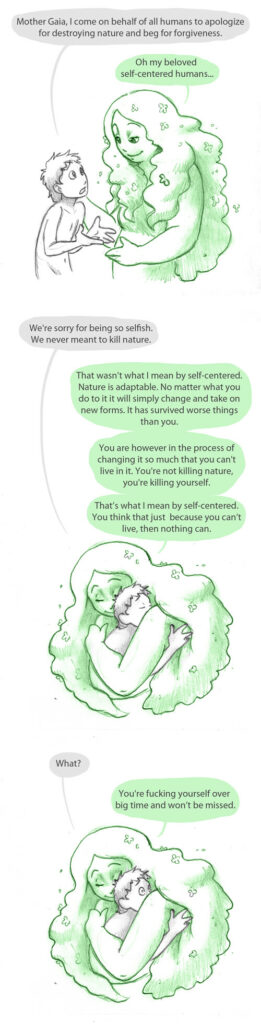
The problem isn’t that humans are stupid, maybe its more that we’re just good at organising stupidity. The planet isn’t dying because it hates us, the planet will be fine. It’s the humans who are having the difficult bit, the economic system says: BUY MORE SHIT. Religion says: TRUST THE INVISIBLE AUTHORITY. Politics says: PICK A TEAM. The #dotcons say: KEEP SCROLLING. And the #geekproblem says: DON’T WORRY, WE CAN ENGINEER OUR WAY OUT OF IT.
We’ve pushed a #nastyfew class to avoid any responsibility, and then people on there knes eyes closed wonder why nothing changes. Maybe the useful position is to step back from the social and ecoloical mess long enough to actually we are creating it. Not abandon people, not give up on society, but stop pretending the existing path is working.
The #OMN starts from that uncomfortable place. News. Memory. Trust. Participation. Eventually governance. Not another shiny platform, another central authority. A bit of infrastructure for people to see what is happening, connect it, challenge it, remember it and build something better together.
The planet doesn’t need saving from humans, humans need saving from the #deathcults we so easely worship. And maybe the first step is getting off our knes opening our eyes and looking around at the mess we need to compost.
#OMN #openweb #4opens #commons #FOSS #dotcons #geekproblem #deathcult #KISS