We get round the mods as kings by being open for users to become mods after they have been around for a bit.
My over all thoughts/process on modding in a horizontal/federated network, how we work at the 5 instance #OMN
A clear #KISS project statement, with a “don’t be a dick” rider on the end.
If they are drive by SPAM/obtusely a troll/right wing just remove the account, the #OMN is a progressive radical media project.
If a normal user or unshore. Then warn first, discuss second as long as polite, kick on next clear braking of statement/being a dick – BUT do not BAN
you can use the escalating silencing etc, but we have not found this worth wile for good outcomes.
They are free to rejoin, if this continues, discuss if useful, when/if they repeat being a dick/brake statement then BAN (if they are a USER rather than just a drive by we get a ruff mod consensus before doing this)
They can appeal to the mods, who might or might not listen – they are free to set up an account else were on the #Fediverse.
#SocialHub is a community-driven space that seeks to promote #activertypub, working with new models of governance and organization that empower communities. It is part of the larger #fediverse, which is a network of decentralized social media platforms that do not conform to traditional hierarchies and power structures.
The #OGB project, which is come from #SocialHub, aims to develop a more decentralized and autonomous model of governance by leveraging open-source technologies and building on existing fediverse infrastructure. The project seeks to find a balance between structure and flexibility, with a focus on involving community members in decision-making and empowering them to “natively” shape their digital spaces.
The project is guided by the principles of the #4opens, which emphasize openness, transparency, and inclusivity. However, there is a need to resist the urge to impose traditional liberal solutions and instead embrace original thinking that is native to the #fediverse and #openweb.
The project is still in development and seeks coding input to build this community best practice grassroots producer governance model to help focus on sustainable, inclusive, and equitable. Lets keep project focus on separating off-topic threads, discussions from mainstream dogmas and “common sense” to prevent trolling and maintain focus.
There are hundreds (over the last 20 years likely thousands) of news, aggregation sites. It’s a common #dotcons model to enclose the “commons” people see free content and think I can capture that. The problem is news content looks like it’s free, but that’s because it’s “free” to spread, but it’s VERY expensive in human (and thus money) to produce the content. This side is never addressed in these failed tech projects.
We currently have #traditionalmedia all round the world pushing to be paid for aggregation and even search of their “product”. At #OMN and #indymediaback, we get round these issues as we add “value” by the #DIY labour of the meany people involved in the shared “commons” space. We are producing rather than “stealing” in the #mainstreaming view.
It’s normal that the top-down news aggregators are seen as parasites, and the bootem up aggregators as adding value. For a few years of #indymedia growth, #traditionalmedia was using #indymedia as a “news” source, this shaped the #mainstreaming agenda, adding value to both paths.
When the #openweb we were building was ripped apart by internal and external pressers and agenders, the #DIY value was captured by the #dotcons such as #Facebook and later #Twitter (when it left it’s open’ish path).
The first step away from the current mess is to recreate the “commons” to bring the value back from the #dotcons capture, this should be more possible now as we are building from the #Fediverse where this has already happened. What we do with this recreated “commons” is up to meany different groups/people, but let’s hold the #4opens and #PGA strongly in place to stop “common sense” enclosing attempts, which are constant pointless damage we need to work around.
To sum up, a key part of the #OMN is to recreate the data “commons” then it’s up to meany other groups to find useful things to do with this free to use non-commercial value. And yes lots of people will see the stupid path of enclosing this to capture the value for themselves, this is damage.
In capitalism, any non-owned value is seen as an opportunity to capture, enclosed and profit from. This is why we have copyleft licences in code, which is visibly failing and why we extend this to the #4opens to fail less 😉
This all comes down to the question of what we value. And for meany people, this is a blindness.
White Lies About Security and Privacy in the Fediverse
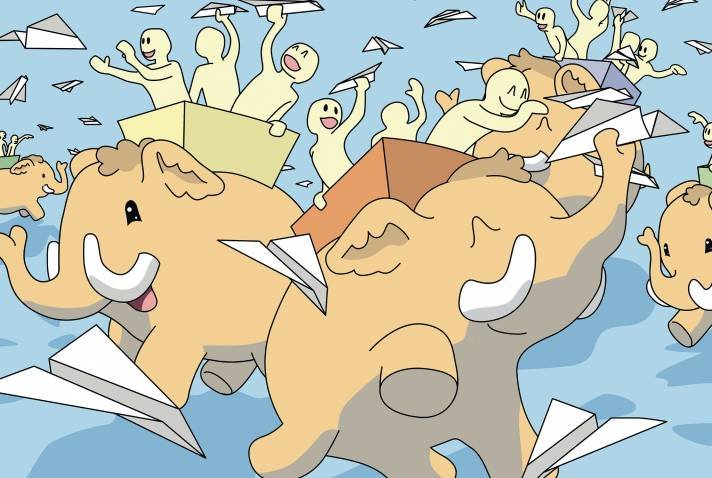
We’re told small white lies about security and privacy to boot up #Mastodon. But the truth is, this #openweb tech is about dancing elephants throwing paper planes as a security/privacy model.
Yes, this is simply not the right tool for the “common sense” privacy and control needs the #geekproblem have. In reality, there’s already a wealth of mature, privacy-focused tech out there built specifically for that path.
Enclosing the “commons” is a dark chapter in history for native societies, and we risk repeating this mistake if we misunderstand the political roots of decentralized social media.
Let’s pause and check the unspoken/unthinking political aspect of this. Much of the desire to retrofit heavy privacy into the #Fediverse comes from #mainstreaming liberalism, which frames everything through fear and control. But the Fediverse wasn’t born from that path, it emerged from a trust-based, anarchistic culture.
At its core, social media is:
Social (one-to-many)
Media (sharing news and events)
It’s an inherently public activity.
On the other hand, encrypted chat (one-on-one or in small groups) is an inherently private activity.
The #dotcons messily mix these two spheres together, but only because their centralized architecture makes it possible (and profitable). Of course, this is a black lie, since these platforms don’t actually respect the privacy they promise. Their entire business model depends on violating it.
In the decentralized #openweb, public and private spaces have generally been separate and tidy, and that’s a good thing. But lately, some online discussions feel like an attempt to deliberately blur these lines, reproducing the #mainstreaming model under the guise of “common sense”, to take the same failed path we’ve been trapped in for 20 years.
We don’t need to reproduce the mess. We can have the best of both worlds:
Public, federated social media built around the #4opens
Private, encrypted communication for individuals and groups in P2P chat
Let’s keep our focus on the true nature of social media and build tools that respect both public and private spheres, without falling back into the traps of the #deathcult.
The #OGB project, stands for Open Governance Body. It is an initiative to create a governance body for the #fediverse, a network of decentralized social platforms that use the ActivityPub protocol.
activism.openworlds.info is a #fediverse instance that hosts activists and social movements. It uses Mastodon, a decentralized microblogging platform that allows users to post messages, follow other users and interact with them. The website is part of the Open Media Network #OMN, a project that aims to compost tech for a better world.
https://campaign.openworlds.info website is another fediverse instance that hosts people, organisations and groups working on or supporting progressive social change. It also uses Mastodon, a decentralized microblogging platform that allows users to post messages, follow other users and interact with them. The website is administered by info@visionon.tv.
Hamishcampbell.com this website, a filmmaker and activist who is interested in horizontal socialist economics and #openmedia projects. Showcases work and ideas as well as videos and campaigns. Am a part of the Open Media Network (#OMN), a grassroots initiative to nurture a #4opens decentralized and federated network of media platforms that share common #PGA values and principles
The visionontv project is a part of the Open Media Network (#OMN), which is a grassroots initiative to create a decentralized and federated network of media platforms that share common values and principles. Creating an internet distribution channel for alternative news, covering topics such as social movements, environmental issues, human rights and more.
The #openweb has become an integral part of our daily lives, with almost every aspect of our existence now touched by it. However, over the years, concerns have grown about the centralized nature of the internet and the power politics this creates. The rise of social media giants such as Facebook, Twitter, and Google has brought this issue to the fore. These platforms, #dotcons, are centralized and controlled by a handful of powerful corporations, which poses a significant threat to user privacy and freedom of expression.
In response to this, a disparate group of committed libertarian “cats” from the Fediverse community decided to take #directaction to promote decentralized and #openweb models of the Fediverse to the European Union (#EU). The Fediverse is a collection of decentralized social networking platforms that use the ActivityPub protocol to interconnect with each other.
The Fediverse crew participated in EU events, conferences, engaged with policy-makers. They explained the benefits of decentralized and autonomous models of the #openweb and how they can shape a more humane online world. As a result, a minority of people in the #EU became interested in these technologies and began to adopt them in a soft rollout of “official” instances.
The huge growth of Mastodon, one of the most popular social networking platforms in the Fediverse, due to the #Twittermigration attracted a diverse and vibrant community of users from across the EU and the world. This growth helped to validate the importance of decentralized internet and its potential to shape a more humane world.
From this seed, today, ActivityPub, Fediverse, and Mastodon continue to grow to becoming important players in the EU’s efforts to promote a more humane internet. The unspoken grassroots outreach and community-building efforts by the #Fediverse “cats” have empowered us, and helped to shift the EU closer to being what they say they are.
The story of the mouse and the elephant making friends is a reminder that even the most Eurocratic and ossified institutions can embrace radical grassroots movements. The Fediverse “cats” have shown that by working together, we can be a part of the change we would like to see. The #openweb is a powerful tool, and it is up to us to use it.
In conclusion, the efforts of the Fediverse community to promote decentralized and autonomous models of the internet in the EU have been successful. Our outreach and advocacy have helped to shift the EU closer to promoting a more humane internet, and the growth of platforms such as Mastodon has validated the importance of these models. This change and challenge is up to us., please don’t step back and let “them” take over shaping this path.
Looking at failures offers lessons: the importance of balancing sustainability with integrity, the necessity of regenerating core culture in growing communities, and the need for healthy conflict resolution to prevent ideological capture. In each case, the projects burned bright for a time, flashes of what’s possible when people come together to build outside the #mainstreaming. But without tending to the human side of organizing, even the most vibrant initiatives unravel.
The #VillageButty project was a vital social hub for London’s boater community, a floating space where people gathered, share stories, and maintain the traditions of life on the waterways. It served as a beacon of #boaterculture, offering a place for community events, music, and collective organizing. However, the project’s survival depended on a delicate balance: generating enough income to sustain itself while remaining true to its grassroots ethos. Commercializing too much risked alienating the people it was meant to serve, while staying purely community-driven made it financially precarious. We struggled to navigate this tension. Attempts to expand and bring in outside funding diluted the project’s identity, and without enough internal cohesion, the balance tipped. The Butty lost its anchor, and despite the clear need for such a space, we failed to keep as a centre of the #Londonboater community.
The #LondonHackspace was a cornerstone of the DIY and maker scene, a living example of what can be achieved through collective skill-sharing and open collaboration. Initially stewarded by an invisible affinity group, people who quietly maintained the space and nurtured its culture, it flourished as a haven for experimentation and tech creativity. But success came with growing pains. As membership surged, the core collective was overwhelmed, leading to burnout and disengagement. The influx of new members diluted the shared values that had held the space together. Without that core cultural glue, informal trust-based governance gave way to rigid bureaucracy. Conflict, once mediated through affinity bonds, spilled out in toxic online discussions, poisoning real-world interactions. The space itself became drained of energy, losing its spark. It became a lesson in how scale can crush solidarity if care isn’t taken to regenerate the social fabric that makes spaces like this thrive. It failed.
The #HiveDalston started as a promising experiment in community space, a potential sanctuary for grassroots organizing, creative expression, and radical thought. The idea was to create an open, collaborative environment, but without a shared vision or clear conflict-resolution practices, ideological fractures emerged. Political differences, personal agendas, and unspoken tensions built up over time, eventually boiling over. Instead of addressing the underlying issues, one faction seized control, remolding the project in their image. What was meant to be a space for collective liberation became just another battleground, mirroring the very dynamics it had hoped to disrupt. The Hive became a cautionary tale of how personal politics and a lack of structural care can fracture communities. We failed.
This story is about a group of libertarian #Fediverse “cats” who convinced one of the largest and most bureaucratic institutions, the European Union, to embrace decentralized and #openweb technologies. Through outreach efforts, EU-sponsored events and advocating to policy-makers, they raised awareness of the benefits of decentralized models of the internet and the positive impact this has on creating a more equitable and sustainable online environment for European citizens.
As the #Fediverse, #Mastodon, and #ActivityPub continues to rapidly grow in popularity, the #openweb cultural values at the heart of this outreach have been validated. Through continued grassroots community building and outreach efforts, radical activist have the potential to empower users and promote an inclusive, equitable, and sustainable online environment for all of us.
The Federated Web, or #Fediverse, is a decentralized #openweb project that allows people to communicate and share content across different servers.
* Decentralization: In a centralized platform, all data is stored and controlled by a single entity, which can lead to issues such as censorship, data breaches, and loss of control over data. In a half decentralized network like the Fediverse, no single entity controls all the network or the data.
* Privacy: Fediverse platforms generally place a strong emphasis on privacy and security, this is always a white lie, as it’s a #4opens project.
* Freedom of expression: In the Fediverse, there is no centralized authority that can censor content, so people have greater freedom of expression and can express themselves with less fear of censorship.
* Control over data: In the Fediverse, users have some control over their data and can choose to move it from one platform to another if they choose to do so.
* Customization: Fediverse platforms can be customized to suit the needs and preferences of uses, allowing for a more community infrastructure use.
The #OGB is focused on decentralized and autonomous models of governance for the #fediverse and #openweb groups. It aims to resist the imposition of traditional top down power structures and promote social change and challenge by involving community members in decision-making and empowering them to shape their “producer” communities.
The project will leverage existing open-source technologies and the #fediverse infrastructure, and will balance structure and flexibility to promote creativity, innovation, and sustainability. The project has three main subjects of discussion: 1) the tradition of working activist grassroots organizing, 2) the use of technological federation and ActivityPub, and 3) original thinking for grassroots #openweb producer governance. The project is bound by the #4opens and #PGA principles and will be conducted using #KISS online tools.
#ActivityPub is a protocol for decentralized social networking that is based on #openweb standards. It provides client and server APIs for creating, exchanging, and receiving content, as well as notifications and other activities. The protocol uses the #ActivityStreams vocabulary and defines key concepts such as Actors (profiles), Objects (content), Inbox, and Outbox to facilitate communication and interaction between users in a decentralized network.
Mastodon is a free, #4opens, decentralized microblogging platform that is part of the #Fediverse.
The outreach of these technologies to the European Union started as a way to promote alternative models of the internet that were more inclusive, equitable, and empowering for users. The EU was seen as a natural fit due to its commitment to promoting human rights, privacy, and data protection online.
The outreach effort focused on raising awareness of the benefits of decentralized and #openweb models of the internet and how these technologies could be used to create a more equitable and sustainable “native” European online environment. The libertarian “cats” of the #fediverse participating in EU-sponsored events, such as hackathons and tech conferences, as well as engaging with policy-makers and stakeholders through direct outreach and advocacy campaigns.
As the outreach effort continued, a minority of people in the #EU became interested in these technologies and began to adopt them in a soft rollout of “official” services. The Fediverse and Mastodon rapidly grew in popularity due to the #twittermigration, attracting a diverse and vibrant community of users from across the EU. This growth helped to validate the importance of decentralized and autonomous European model of the internet.
Today, ActivityPub, Fediverse, and Mastodon continue to be important players in the EU’s efforts to promote a more decentralized and autonomous internet. Through continued grassroots outreach and community-building efforts, these technologies can empower users and citizens to create a more inclusive, equitable, and sustainable online environment for all.
UPDATE: the cats who made this happen scattered and the fallow up did not happen.
Your page layout is driven by desktop. Nowadays, people think mobile first.
The rollback: an interesting idea.
A. Yep it’s the #nothingnew part of the project, the original IMC was ripped apart buy internal arguments and bad process, so we are rebooting the project before this happened so making minimal changes outa the box of UX and process, the needed changes can then come FROM “consensus” of the fresh crew running the rebooted instances.
The mobile expirence is swipe sideways to each of the menu items as columns. This is a reasonable compromise, as the original project had no mobile interface.
This is an example https://indymedia.hs2rebellion.earth/users/news you have to click past the SSL error to see the site, on mobile a single column interface, but the swiping is not implemented, so you have to click on the menu at the top. This test site is a RSS/AP aggregator #indymediaback
Q. Well, that is interesting. Seeing something is so much more impressive than just a video. What is the software platform? What web server are you using? It is pretty easy to do https. Is anyone actually using the software?
A. sadly, the 2-year working project was killed off by covid just as we were going to start the outreach at protest camps. The codebase is now abandoned, was based on epycion, but dev on this folk is now stopped/blocked.
What we had is a good expirence though, Imagen if the swiping worked. The RSS and AP side works for input, the AP output does not work, none of the tagging was implemented on these rollout test sites, we are still running 3 but needs a committed crew to restart #indymediaback
Was 6 months work for 3 people to put this working code together #DIY and a wider collective to do the work on the text and process to bring the original #indymeda back in the spirit of #nothingnew but the stress of dev and covid broke this as we were getting close to test rollout, been dormant since then.
We need to chose a new codebase and find a coding crew, most of the hard work is done, all the existing design, process and outreach text is in place to push this out agen as the “news” part of the #fediverse
But its another year of nonpaid #openweb work… phwww… fighting agenst the pointlessness of the #mainstreaming is a hard sell, even though it’s blatantly and obviously needed.