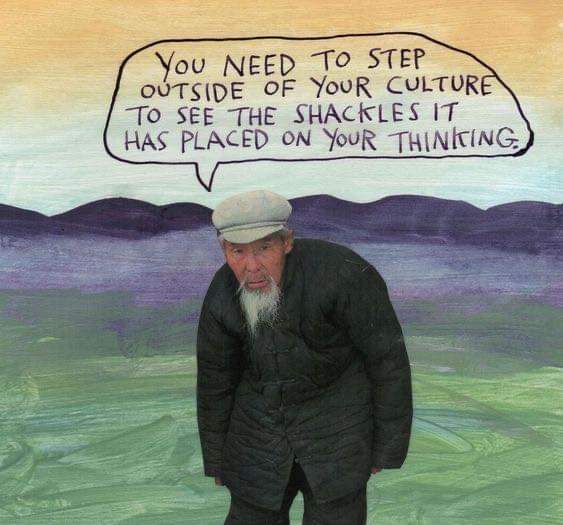
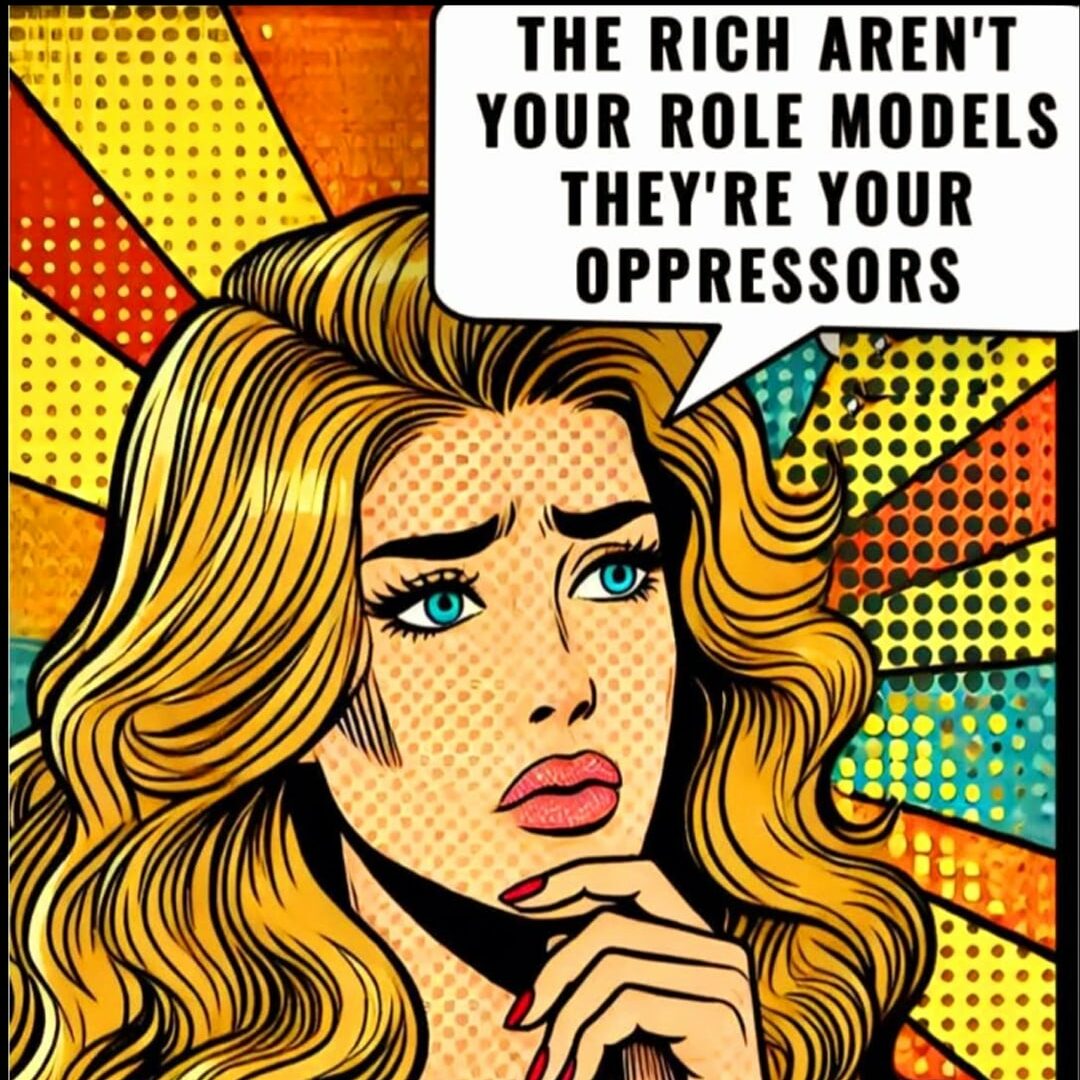
Normal is the mess of walking around in a toxic story and calling this common sense

Forty years of hard indoctrination doesn’t just fade away. It has to be dug up, held in our hands, recognised for what it is, and composted. If we don’t do this, we have no hope – none – of moving away from the accelerating mess that’s already killing millions and is on track to kill billions. Hobbes’ “nasty, brutish and short” isn’t a warning anymore; it’s a weather report.

Mainstream thinking feels normal because we’ve lived inside it for a generation and a half. But “normal” is a trick. Normal is the smell of rot covered with flowers. Normal is the daily worship of the #deathcult: competition as virtue, greed as destiny, extraction as progress, (stupid)individualism as freedom. Normal is the mess of walking around in a toxic story and calling it common sense.

A useful social activism path is to make this “common sense” story feel dirty, polluted, contaminated. Because it is, everything we touch – our institutions, our media, our language – is soaked in the residue of #neoliberalism. The indoctrination runs deep enough that we police ourselves long before any authority needs to step in. We repeat the slogans: There is no alternative. Don’t be unrealistic. Be responsible. Trust the experts. Let the market decide.

And that’s why we need to dig, turn over the dead soil so something else can grow. We need to break the spell and remind people that doubt, imagination, and collective action used to be normal too, before they were systematically stripped away.

Composting isn’t about purity or escape, it’s about transformation. Taking the poisoned narratives, breaking them down, mixing them with lived experience, adding the oxygen of open discourse, and letting something organic and grounded emerge. Something native, that belongs to us.

The #OMN, the #openweb, the #fediverse, grassroots media – these aren’t personal hobbies. They’re the tools we use to use, and can use agen to compost forty years of damage, to open spaces where new stories can sprout. To let people speak without being filtered through corporate interests and #NGO gatekeeping, rebuilding trust, messiness, solidarity, and actual democracy.

Because the mainstream isn’t just wrong – it’s killing us. And the longer we pretend it’s clean, the faster the rot spreads. Its past time to get our hands dirty, time to compost the #deathcult to grow something worth living in.

If you’re looking to do affective activism – activism that moves people, shifts culture, and builds real change – then you need to start from lived reality, not from academic distance.

The academic histories of our movements aren’t useless, but they are strongly second-hand and often shaped by #fashernista thinking: polished narratives, fashionable theory, safely detached accounts. They smooth over the mess, the conflict, the creativity, the failures, everything that actually matters when you’re trying to build power from below.

What we do need are more minority views from the people who were there. Not just the dominant stories, not just the tidy retellings, but the perspectives that expose the actual tensions inside our organising:

open vs closed

process vs control

serendipity vs bureaucracy

These are the real power that shaped our victories and our collapses. Take #indymedia. From my experience, it began open, horizontal, serendipitous – messy in all the productive ways. And it died closed, formal, bureaucratic – captured by the very forms it was created to resist. This is not a critique of individuals; it’s a plain, structural story. And it’s the kind of story we must use if we want to reboot anything today.

This is exactly why we have the #4opens: openness of code, data, process, and community. It’s a simple but powerful way to mediate these recurring problems. It keeps us grounded in transparency rather than personality, in shared pathways rather than gatekeeping, in public good rather than private control.

If any of this reads like a personal criticism, it isn’t. It’s a reminder that the future depends on honest memory, not sanitised mythology. To build the next wave – #OMN, #openweb, new grassroots media – we need our own histories, told by us, in our own messy, contradictory, living voices. That’s the compost the next movement grows from.

Why the #OMN works with #ActivityPub – And why we need a bridge to #p2p

Let’s look at this. #ActivityPub is not a product. It’s not even really a “protocol” in the narrow, rigid sense that vertical tech likes to imagine. ActivityPub is a shared vocabulary, a public language for moving meaning and connection across the #openweb. It gives you nouns and verbs, and the community defines the grammar through lived use.

This is why the #OMN works with ActivityPub, a metadata and meaning layer, not a platform, flows, not silos. ActivityPub is the widely deployed #4opens protocol that treats publishing as a flow, a conversation.

Unlike the more vertical stacks (#ATProto is a good example), ActivityPub doesn’t force a worldview. It doesn’t tell you, “this is how your network must be structured.” It doesn’t enforce hierarchy or lock you into one interpretation of identity, authority, or workflow. It’s a #KISS path – here’s a shared language, verbs for publishing and receiving, express objects, updates, relationships. The rest is up to the commons

This flexibility is exactly why the #OMN can become a part of this flow. ActivityPub, with #FAP process, is already evolving this way – not through top-down committees, but by developers and users defining new grammar for shared needs. Quote posts, permissions, object types, and many other extensions are emerging organically. This is horizontal protocol evolution, which aligns well with the #OMN path.

To mediate the #geekproblem trying to break this path. We need to say clearly why we don’t want an “ActivityPub 2.0”. A clean break is a vertical move, it reproduces the #techcurn cycle: throw away the compost, start another shiny stack, burn everything down every five years because fashion demands it. It’s the #fashernista mindset applied to protocols.

For the #OMN, we need continuity, evolving the commons, not abandoning it. ActivityPub works because it’s an accretion protocol, not a replacement protocol. We extend it, we add grammar, we build bridges, we compost the broken bits. This is the #nothingnew ethos: repair, adapt, extend, don’t rewrite reality every cycle.

This is fine up to a point, but still too much – Central points of failure – Which is fine for much of the #fediverse. But the #OMN isn’t only for well-resourced servers, it’s for change and challenge. Activists on the ground, communities without reliable hosting, people under surveillance, low-resource groups, offline-first publishing, pop-up networks, autonomous movements that cannot rely on central infrastructure.

For this layer, we need true #p2p protocols. This is where #DAT, #Hypercore, and similar tools matter – not as replacements, but as bridges. These are needed for resilient metadata flows, where stories, tags, and meaning travel across networks even when the networks are broken.

We need to understand why both matter, It’s because they do different things. ActivityPub gives us: wide distribution, discoverability, moderation structures, federation, slow-moving cultural infrastructure. We add to this what #p2p gives us: autonomy, resilience, offline survival, local-first publishing, anti-censorship pathways,

The #OMN’s job is to bridge these layers, same metadata vocabulary, same hashtag meaning system, same open processes. Two different transport layers depending on the need. Think of it like the compost metaphor: ActivityPub is the shared soil bed. #p2p is the mycelium running underneath, keeping it alive when storms hit.

This matters, we don’t want just another Fediverse, we don’t want just another p2p experiment. We need a living ecosystem that can: publish everywhere, survive disconnection, resist capture, remain open, remain public, remain messy, remain ours. ActivityPub gives us the public commons, p2p gives us the underground root network. The #OMN ties them together through shared metadata, hashtags, practices, and governance.

Compost, not silos, ecosystems, not empires. Federation on the surface, peer-to-peer underneath. This is the #OMN path.

At best, the old #mainstreaming was about equality in worshipping the #deathcult

The old #mainstreaming was only in a limited way about freedom, so we now need to focus on more on what it was about, equality in obedience. Equality in our blinded worship of the #deathcult: growth, consumption, competition, endless mess on a dying planet.

That’s why #fashernista liberal progressivism is always a dead end problem, it plays radical, says radical, but composts nothing. At best, it sells rebellion as a lifestyle. It’s equality inside the system, not about freedom from it.

We’ve seen this play out a thousand times. Movements rise, fresh and alive, then get polished into campaigns, reports, and consultancy slides. Grassroots becomes “stakeholder.” Vision becomes “strategy.” Change becomes “branding.” All form, no compost. All language, no shared life.

Any real change, living change, means turning the dead weight of institutions, egos, and fear into fertile soil. It’s messy, collective, risky. It doesn’t ask permission. It doesn’t chase funding and #NGO approval. It grows because it has to.

That’s what the #OMN (Open Media Network) path is about – composting the old #techshit, the #dotcons, and the NGO decay into something living again. Media that belongs to no one but serves everyone, built on the #4opens.

So the real question is simple. What does real change and challenge look like to you? How do we build it together, in the open, without falling back into the same polite obedience that killed everything before?

The #OMN and the #4opens aren’t abstract ideas, they’re tools for action. If we’re serious about composting the old world into something living, we need hands in the soil, not just words in the air. Here’s how people can start now, from wherever they stand:

#FOSS coding: Build the #openweb, not the #closedweb. Work on #Fediverse tools – join existing native #fashernista projects like Mastodon, PeerTube, Mobilizon, Funkwhale, or the more useful #OMN itself. Fix bugs, improve UI, write docs, or just help test and report issues.

Use the #4opens in practice: No private repos, no hoarding, public decision-making, everyone can use it. Compost old code: take abandoned projects and adapt them. Don’t build shiny new tech for ego points, fix what’s already here. If you’re practical, run small community servers: self-host media, blogs, Fedi instances. Learn how networks breathe.

Then we have social activism, keep it social, messy, and grounded. Form local affinity groups around #openweb media – film nights, repair cafés, public jams. Document everything: record protests, community stories, forgotten spaces.

The next #Indymedia starts with people saying this matters. Challenge control where you see it growing – in meetings, projects, #NGOs, progressive spaces. Ask: is this open? Who holds power here? What’s being hidden? Compost negativity: don’t waste energy on flame wars. Turn frustration into content, conversation, and code.

Avoid the #NGO trap – don’t let money dictate the mission. Use micro-funding and co-ops:
OpenCollective, Liberapay, cooperative hosting. Keep the process/books open: publish budgets, donations, and decisions publicly (#4opens). Value labour differently, not everything needs to be paid. Shared work and mutual aid count as real economy.

Bridging to #NGOs and Institutions but don’t get eaten. Engage, but on your terms, use the #4opens as a boundary tool. If an #NGO don’t work openly, walk away. Offer bridges, not control. Help NGOs learn openness, federate, don’t integrate.

Bring culture into the conversation. Explain why open process and transparency are political acts, not technical choices. Stay autonomous: The moment an institution starts setting your agenda, compost it.

Build the commons, not empires. Everything we do should feed back into the collective soil.
* If you build a tool, make it usable by others.
* If you make media, licence it open.
* If you host something, teach others how to host too.

This is how we win: not through scale, but through replication. Small, self-organizing, composting networks connected through trust. Remember, revolution isn’t about blowing up the system. It’s about composting what’s dead, sharing what’s alive, and keeping the soil open for what’s next.

#openweb #nothingnew #techshit #OMN #fashernista #mainstreaming #deathcult

A Tolkien view of #OMN

A central thesis of Tolkien’s books is that evil provides the means of its own defeat. Sauron forged the One Ring that destroyed him. Shelob impaled herself on Sam’s blade. Smaug exposed his belly to Bilbo and revealed the weak point that brought him down. Tolkien’s world is full of this pattern: the seed of destruction lies buried inside the will to dominate. Power over others always carries its own undoing.

But there’s a second truth, less often spoken. Good must still act. The Ring did not cast itself into the fires of Mount Doom, it had to be carried, inch by inch, through the mud and terror, by two small Hobbits who refused to give up. Shelob could only fall because Sam held his arm firm when it would have been easier to drop the blade. Smaug was slain not by fate, but by the hand that fired the black arrow.

Even when evil weakens itself, the act of courage still has to be taken. The small people still have to step up. And there’s a third lesson here, one that feels painfully relevant to our time: good only loses when it surrenders to hopelessness. Denethor’s despair nearly doomed Minas Tirith.
Frodo would have fallen without Sam’s stubborn love. Bilbo’s small act of faith. In Tolkien’s world, hope is not naïve optimism, it’s an act of defiance.

In our current #closedweb Mordor, we see a similar pattern. The #dotcons – Facebook, Google, X, TikTok – are our modern Mordor. Their empire of control looks invincible, but the same logic applies: the seed of their undoing lies within their design. They rely on enclosure, makes them brittle. They feed on attention, makes them hollow. They claim to connect, yet they isolate. Their power depends on us believing there is no alternative. The moment we act otherwise, the “Ring” begins to crack.

This is where the #OMN (Open Media Network) is about, it’s the Hobbits of the #openweb, a simple idea built around trust, openness, and shared meaning, the values that the #mainstreaming web abandoned in their push for scale and profit. The #OMN path is not glamorous, it’s messy, human, and small in the best possible way, it’s the hobbit path.

While the lords of code build towers of algorithms and surveillance, the #OMN builds compost – small, fertile spaces for stories, community, and resistance to grow. Each node, each local server, each trust-based network is another Hobbiton – small, grounded, but vital to the health of the wider networked world.

And like Tolkien’s hobbits, the people carrying these projects are not heroes in the conventional sense. They’re tinkerers, storytellers, boat-dwellers, coders, gardeners – ordinary people who refuse to give in to despair.

The weakness of the Ring, is the weakness of Mordor – and of our #dotcons empires – is that they depend entirely on compliance. Their control works only as long as we feed it: our attention, our data, our labour. The act of reclaiming media, even on a small scale, is an act of resistance, the equivalent of carrying the Ring toward Mount Doom.

But again: it doesn’t happen automatically, we have to act, have to keep building, sharing, teaching, mediating – before the co-option machine moves in, before the #fashernista crowd turns the work into branding and drains it of meaning.

This is the role of projects like #OMN, #indymediaback, #4opens, and the broader #openweb ecosystem. They’re not just technical projects, they’re moral ones. They remind us that good requires persistence, that hope is work, and that defeat only comes when we stop trying.

Evil destroys itself, yes, but only if someone carries the Ring. The systems of enclosure, surveillance, and monetized despair will fall apart on their own contradictions, but only if enough of us are walking the long, muddy road toward something better.

That’s what the #OMN is for: a space to hold hope, to act before hopelessness takes root, to build the commons even when it feels impossible. And like Tolkien’s world, we won’t win through strength, but through endurance, through small acts done together, with trust.

Because the web – like Middle-Earth – is worth saving.

The #OMN is a simple project

Composting the #techshit is about:

  • Raw waste → The constant flood of mainstreaming, broken promises of #dotcons, bad-faith #NGO capture, shallow “innovation theatre.” This is the smelly mess we are swimming in.
  • Shovel work → Activists and communities don’t just sit in the mess. We turn it over, exposing the rot, adding oxygen. This is critique, transparency, and the #4opens in action.
  • Aeration → Sunlight + openness turns stink into something useful. Lies are exposed, corruption made visible, hidden power structures dragged out.
  • Soil of change → The same waste that poisoned us becomes fertile ground for new growth, but only if we do the work of turning it. This is how trust-based networks sprout, how #OMN emerges.

What it means in practice

  • Don’t delete the shit – we compost it. Bad actors, bad processes, and bad tech are made visible and contextualized.
  • Don’t hoard the shit – silos just trap the stink. Share, federate, distribute — so communities can add their own oxygen.
  • Don’t wallow in the shit – critique alone is not enough. The point is to grow fertile alternatives.

The composting metaphor says: yes, we’re drowning in #techshit, but we have the tools to turn it into the soil for something humane, resilient, and alive. #KISS

The #OMN is a simple project. But simplicity is deceptive, what makes it difficult for many #fashernista and #mainstreaming people is not the code, not the servers, not even the logistics.
The difficulty is that the #OMN is rooted in a different path of human nature.

It isn’t designed to fit the old path of #stupidindividualism. It isn’t built to serve the greed of #dotcons. It isn’t here to bend the knee to the #deathcult.

The #OMN is designed as a transition tool, a bridge to a different path, commons, trust, a living path. Once people arrive, they can build what they like. That’s why the #OMN isn’t just tech, it’s a toolkit for social change and challenge.

#KISS. Keep it simple. Keep it real. I’ve been building this bridge for 20 years, agenst a strong counter flows, we were all pushed off the path when we handed our voices to the #dotcons. When #openweb culture gave way to #stupidindividualism, I was ready to give up.

So I bought a boat and sailed away. #boatingeurope. Not a metaphor – survival. But then came the ActivityPub reboot. The #openweb with the #Fediverse rose again. I came back. Because there was hope. There still is.

And now – five years into this reboot – we face the next predictable crisis: #mainstreaming, the sell-outs, the “respectable voices”, the NGO parasites. It’s normal. It happens to every alt project. And now it’s happening here.

The solution? Compost the mess. Not to attack individuals – most of them aren’t important. What matters are the paths they push us down. Because their “common sense” is the true danger. These are the paths that turn living networks into dusty, dry creeks.

That’s why I keep writing the #hashtag stories: to make these hidden paths visible. So we can see what’s going on. So we can choose differently. Compost the #techshit to grow something real.

I started by saying the #OMN is a simple project, let’s illustrate this with the #OMN Process

  1. Gather

People, projects, and content come together.

Anyone can publish by trust, share, and tag media.

Use open standards (#4opens, #openweb).

No gatekeepers, just openness mediated by trust.

  1. Describe

Content is enriched with metadata -tags, descriptions.

Human-readable and machine-readable.

Stories are linked by meaning, not silos.

  1. Share

Feeds are syndicated (via RSS, ActivityPub, etc.).

Content flows across the network.

Local projects display, remix, and reframe.

  1. Distribute

Decentralized hosting: many small servers, not one #dotcons.

Mirroring + redundancy = resilience.

No central point of failure.

  1. Contextualize

Communities add their perspective, framing, and translation.

Different views can co-exist on the same story.

Keeps the commons diverse and contested, not controlled.

  1. Compost

Bad ideas, #mainstreaming, and #NGO co-option are made visible.

Instead of only deleting, we contextualize and critique.

This “compost” becomes fertile ground for better growth.

  1. Grow

New media projects emerge from the toolkit.

Each can shape the #OMN path to fit their community.

A living, adaptive commons.

Principles in practice, KISS → tools stay simple, human-readable, small pieces that fit together. #4opens → open data, open code, open process, open standards. Trust-based networks → rooted in commons, not control. Resilience → many weak ties are stronger than one big silo.

The #OMN is not an app you install. It’s a set of processes + tools to move us from isolation to commons, from #dotcons back to #openweb.

https://unite.openworlds.info/Open-Media-Network

Building Alt/Grassroots Media Networks to Challenge and Widen Traditional Media

The current ecosystem of alternative and grassroots media is too narrow in its imagination of what media could, and should, be. There’s a persistent naivety or, in some cases, a self-serving dishonesty. Many of the most “successful” progressive media groups continue to mimic #traditionalmedia without understanding, or addressing, the fact that they do not control their distribution. In effect, they’re renting space in someone else’s empire.

This is not just a mistake. It’s the same mistake that corporate media has been making for years: relying entirely on the #dotcons, especially Google/Meta/Facebook, to reach people. The algorithms shape the message. The gatekeepers never disappeared, they were replaced by code, powered by ad dollars.

Where are we now? Most grassroots and alt-media outlets do have websites, which means they technically sit on the #openweb. But their sites rarely, if ever, link to other alt-media projects. Despite the rhetoric of solidarity, there is little visible network of mutual support, not even basic hyperlinking between allies.

They podcast, another foot in the #openweb. Yet their outreach and engagement still happen inside #silos like Spotify, YouTube, and Apple Podcasts. In practice, this reinforces the #deathcult’s control of visibility. You can’t build a new world inside the structures of the old, not if the old is designed to undermine you. Why is this mess happening? Two dominant forces are shaping this failure:

  1. On the big scale, we have the #Fashernista embrace of the #dotcons

Many alt-media producers came of age inside the mainstream tech stack. They built their platforms and careers inside the same closed systems they claim to challenge. Their political commitments might be radical, but their infrastructure choices are entirely conventional. This is the liberal, capitalist version of #mainstreaming – reform, not replacement.

  1. On the small scale, #Encryptionist obsession and the #geekproblem

At the other extreme, we have alt-tech projects so obsessed with privacy and control that they create pointless parallel networks that no one uses. They fetishize encryption and “clean standards” over actual human use. The result is tech that is “safe” but irrelevant, drifting into a shrinking ghetto of #stupidindividualism. This is the libertarian version of #mainstreaming – escape, not engagement.

The has been practical work on the ground, over the last years an #openweb tech revolution built around ActivityPub and Fediverse, with projects like Mastodon, which in theory is guided by the #4opens. Yet, despite this, we still hit a wall of self-interest, naivety, and careerist short-termism from the media groups and meany individuals inside this movement.

What can we do? The web is made of links, the #openweb dies without them. If alt/grassroots media want to be part of the solution, they must start acting like a network. A simple step is to start linking to each other. Publicly. Repeatedly. On websites. On blogs. On Fediverse accounts. Use hashtags. Use lists. Tag each other. Cross-publish when relevant. This one act can change the ecosystem.

To solidify this, it’s past time for a new alt-media reboot, a small crew of linked-up, working examples that can pull others onto a sustainable, #openweb path. A real, living network of trust and mutual visibility. If we can show what’s possible, by doing it, we might begin to shift the culture. Let’s find the hopeful, grounded people to help shovel this forward.

If you’re interested in building the open media commons, join the #OMN conversation at https://unite.openworlds.info/explore/organizations to “Make the world you want to see.” or splash some dosh here https://opencollective.com/open-media-network we will make good use of it


The #OMN really complex? It’s not in the code – it’s in us. Let’s be blunt:

The Outside Threats:

The #dotcons (Facebook, Google, Amazon, etc.)

Surveillance capitalism

Attention farming

Closed distribution algorithms

Platform lock-in

The Internal Saboteurs:

Encryptionist geeks obsessed with crypto but forgetting human users

NGO social media managers who talk community but build silos

Process vampires who kill projects by committee

Fashionistas who follow hype cycles and abandon working tools for shiny vaporware

The #OMN is native to none of these tribes. That’s its strength. But also why it’s often ignored or misunderstood. No permissions, no gatekeeping, no central database. It just works. That’s the #KISS principle: Keep It Simple, Stupid.

None of the usual suspects like this: Geeks: Don’t like using old tools like RSS or thinking socially. Politicos: Prefer being seen at the cutting edge, even if it leads nowhere. NGOs: Want measurable outcomes, not messy grassroots growth. But we need to stop building castles in the sky. Start building bridges instead.

The real block? The mental model of our tech and political culture. We’re still thinking in terms of silos, ownership, and control.

Talking about the mess we’re in

We’re living in an age of permanent crisis, there’s no going back to “normal.” Stop waiting for it. Let’s just STOP worshipping the #deathcult as a first step away from this mess. The trap we’re in, neoliberalism, or the #deathcult, isn’t optional. It’s systemic. You don’t get to opt out unless you’re rich enough to buy an island… and even then, it’s a fantasy.

But metaphors have value. #deathcult is a metaphor, yes, and a sharp, useful one. It’s a name for the dominant ideology of the last 40 years: neoliberalism, where markets are sacred, society is optional, and #climatecollapse is just another economic opportunity.

We use hashtags like #deathcult, #fashernista, #climatechaos, #stupidindividualism not to confuse, but to bring dry, academic critique into emotional, accessible terms. They’re #KISS, Keep It Simple, Stupid. They cut through the noise, if you let them.

Want an example? I lived a metaphor, ten years ago, I bought a lifeboat and sailed away. Not into isolation, but into reflection. For the last five years, I’ve lived outside most laws and norms. Not because I think that’s the answer, but because it’s one place to plant seeds for better ones.

But the boat, like the #nastyfews islands, isn’t freedom. It’s a metaphor. A stopgap. A reminder that we can step sideways, temporarily, to prepare for change, but only IF we come back and build together.

Power is always social. There is no “DIY freedom” that doesn’t end in loneliness or failure. You are powerless until you engage with others, to build trust and accountability. This is what the #OMN is about. It’s not individual exit, it’s collective entry.

So, talk in metaphors. Use the hashtags. Share the language. Together, they tell a story. But only if you join in.

  • No more waiting for heroes.
  • No more worshipping broken systems.
  • No more technocratic denial.
  • It’s time to compost the old world and plant something new.

Why most radical tech is pointless, and why #indymediaback isn’t

Almost everything built in today’s alt-radical tech scene is, bluntly, pointless. Despite good intentions, most of it ends up feeding the endless cycle of #fashernista churn, flashy new platforms, bleeding-edge protocols, or encrypted communication tools nobody uses, built by isolated teams disconnected from real-world needs or history. This is the #geekproblem: a culture where novelty is fetishized, and social usefulness is an afterthought, if it appears at all.

Examples:

  • Secure scrolling tools: Every few months we see new chat apps, usually cryptographic fortresses with no communities. No one’s asking what these tools are for beyond vague abstractions like “privacy” or “freedom.” Tools without context.
  • Peer-to-peer silos: Projects like Secure Scuttlebutt (SSB) or many DAT spin-offs build entirely new social ecosystems that demand complete buy-in, rather than integrate into existing networks. What results is islands of lonely idealists yelling into empty timelines.
  • Protocol over people: Many Fediverse projects argue endlessly over specs like #ActivityPub or #Nostr, often prioritizing purity over pragmatism. What good is a protocol if no one actually uses it beyond a few devs congratulating themselves?

Why #indymediaback isn’t a pointless tech project, it offers something truly different. It is not “new.” It doesn’t pretend to invent a whole new ecosystem. It is an act of digital memory, a revival of the still-needed infrastructure that once helped build radical networks globally. #Indymedia worked. It published resistance. It distributed power. It was embedded in real communities and real movements. This is #nothingnew done right.

The #nothingnew approach mediates against the churn by reusing workflows, social trust, and existing cultural practices. It doesn’t ignore tech, it grounds tech. Examples:

#indymediaback uses simple publish-form-comment workflows, already familiar. No #AI, no #blockchain, no obscure identity layer. Just people posting and curating stories.

It connects to existing radical spaces: housing co-ops, street kitchens, climate camps—places where digital tools are needed right now, and where the point isn’t building a unicorn startup but having a place to publish the truth when the cops are lying again.

Why copying #dotcons isn’t enough, in the #fediverse we so far have replicate Twitter, YouTube, and Instagram — Mastodon, PeerTube, PixelFed. This is useful, to a point. But all code is ideology. Copying capitalist infrastructure dose smuggle in capitalist logic. Copying invites the #deathcult right back in through the side door.

indymediaback avoids this trap. It doesn’t replicate any#dotcons logic or UX patterns. It revives a publishing common that worked before Silicon Valley captured this path. And more importantly, it’s embedded in a set of radical social practices: the #PGA hallmarks, the #4opens, and the messy, beautiful legacy of grassroots movements who already knew how to organize.

The value of #indymediaback isn’t just in tech. It’s in trust-based social continuity, the hidden glue of any working movement. Without this, you don’t have a radical tech project. You have a ghost repo on GitHub. That’s the central point, without real community, without continuity, without trust, radical tech is a dead end.

This is the carrot and stick we need now. If you care about the #openweb as a human value network, not just a protocol playground, you have to build things people can use today, and that people want to use, not because it’s encrypted or federated, but because it serves a purpose they already have.

This is where the wider #OMN (Open Media Network) comes in. It’s not another protocol war. It’s a shovel to compost the inhuman mess we’ve inherited. It’s a framework built with the #4opens, to grow digital commons that don’t depend on VC, control freaks, or fashion. It’s where we build bridges between radical tech projects, rather than isolate ourselves in yet another Git-based castle.

In short, it’s a path of people over product, process over platform. We don’t need more “solutions.” We need to stop being prats, pick up the tools we already have, and start rebuilding.

Food for thought, and action.

NGIFORUM2025 is timidly touching sense

It’s good to see events like #NGIFORUM2025 as it’s trying to be on the path of the #Fediverse and the wider #openweb reboot which are real forces for social good, messy, hopeful, and grounded in decades of grassroots digital culture, which we do need to support. BUT we also need to speak honestly, as these spaces are not healthy by default.

Too often, they are co-opted by #NGO and institutional actors who bring with them a dangerous kind of “common sense”, what I’ve long described as the parasite class. We see this clearly at #NGIFORUM and similar #NGO events. Despite the energy and good intentions, the dominant framing is stuck in a narrow, #neoliberal logic:

  • More funding for shiny #techfixes.
  • Token gestures to social issues.
  • Endless discussion about scalability, compliance, branding, and “the market.”
  • Panels where “on-topic” needs reality-checking and “off-topic” is often the path to sense.

This is not the #openweb native path, and what we need is more shovels and composting, to grow the real grassroots native paths, with open projects from the messy soil of lived social experience. Not more polished “innovation theatre.” And crucially: we need to bring activism back into these spaces – not as token #fashernista crap, but as lived, rooted practice. We need to embed activist tech into the core of these events, not leave it in the hallway as is the current norm.

Because let’s be honest, too much of what’s being showcased is just more #techshit to compost. Take the role of NGI funding (Next Generation Internet): It could be a powerful tool to fund the future of a people-powered web. But right now? It’s structured to reward isolated hard tech with narrow deliverables, and punish anything messy, social, or disruptive. That’s upside-down.

The development side of open-source should be anti-commercial – in its process, not necessarily in its usage. That means public funding should support the huge social layer that keeps FOSS and #openweb projects alive:

  • Community organising.
  • UX design from lived needs, not compliance charts.
  • Onboarding and trust-building.
  • Accessibility work.
  • Documenting process for reuse and remix.

But currently these parts are entirely unfunded, and that is pushing us into the arms of the parasite class’s of all types. We are walking backward into the future, again, projects without people, users, and support are dead projects. No matter how elegant the codebase is.

One thing that the event brings up is that we need to shift policy, national governments and #EU to actively intervene in the monopolies running the current internet. Both mobile and fixed-line networks need to be opened up to allow for grassroots, peer-to-peer, and local hosting paths to flourish. The current centralised infrastructure is a block to the native #openweb, and we can’t “build better” on broken foundations.

The also needs to be a cultural shift, to unblock the #geekproblem. This is not a call-out – it’s a call-in. The feedback is there, i’ve personally been working on this issue for over a decade, what we’ve seen is a cycle: Working in a small way… failing in a big way… repeating.

It’s not personal, it is structural. And we can do better, if we compost the fear of doing things differently. A practical example, we need more points that are currently deemed “off-topic.”
Because what’s “on-topic” in these spaces is just branding and polite theatre. And that’s exactly how the #dotcons rose to dominance in the first place.

We are at risk of simply recreating their culture in softer tones. Let’s not do that. Let’s take a breath and reflect on what we’re actually building, it’s not a rhetorical question. This is not abstract.

Because if we keep defaulting to #neoliberal “common sense,” if we ignore the reality of climate collapse, digital authoritarianism, and infrastructure lock-in, then we’re just dancing around the edges of a very real #deathcult.

Let’s do the real work, let’s dig, plant, compost, and build trust. Let’s reclaim the tools and shape the #openweb around care, not control. Because anything less? It is just another empty panel on a sinking ship.

“All authority is quite degrading. It degrades those who exercise it, and degrades those over whom it is exercised.”
— Oscar Wilde

#Fediverse #OMN #4opens #commonsnotplatforms #mutualaid #socialroots #trustnotcontrol #KISS #NGIFORUM2025 #NGIforum #nlnet

Maybe we don’t then get the guillotine out…

Because current #mainstreaming, centrism, comfy pointless political “maturity” worked out so well, the last time we had a hard shift to the far right in the 1930s. Those “well-meaning” liberals at the time were patted on the back for their reasoned takes and rewarded for their civility right before it ended in a world war. That’s the dirty compost of history we’re all standing in today.

Fast-forward 100 years and today’s centrist are pretending not to smell the rot, their “middle path” has been disintegrating for the last 40 years. The old #mainstreaming legacy parties are crumbling into irrelevance, the dried leaves of the 40 years of #neoliberal wind. In the US, the corporate Democrats are led by animated corpses propped up by PR necromancy, while the #MAGA right eats their roting corpses, dresses in their cloth and steals their path, and without a blink of “common sense” gets away with calling it a revolution.

Meanwhile, people, the compost for real change, are screaming about inequality, rent, inflation, broken healthcare, unusable digital #dotcons infrastructure, and corporate theft of public services. But centrists hear all this and mutter: “Hmm, interesting. Now what could the problem be?” Western centrists stare into the rising far-right tide and scratch their heads, “shocked” that a decade of ignoring propaganda and letting fascists organize on #dotcons led to… #fascism. A real surprise outcome… Who knew that letting lies shout louder than truth in the “free market of ideas” might be a real problem?

Into that empty vacuum steps the hard right, waving ethnic nationalism and promising a future soaked in nostalgia and fear. What we need to say clearly is this is just another side of the same #nastyfew elitists hoarding wealth while selling fascism to the angry and disillusioned.

The only serious force that still tries to push back? The #fashernista fragmented, much-smeared left. In Germany, in France, even in the UK (before being gutted by #NGO centrists). What do our liberal centrists do? They blow smoke and mirrors, equating the left with the right: “One wants to redistribute wealth and build homes; the other wants to criminalize poor people and deport anyone not white. Clearly, both are equally extreme.” This is simply more mess to compost

So what’s the current centrist path? Steal the far right’s policies – but do it “sensibly.” In the UK, Starmer’s “Labour” has become Farage’s reform UK in a red tie. Deportations, austerity, privatisation, all served with a smug banal centrist grin. The outcome, voters, seeing no real alternative, just go for the real fascists instead of the fake centrist “liberal” remix. More mess to compost.

Macron did the same in France by burned his own coalition to stop any shift to the left, claiming they’re just as bad as Le Pen’s mess. Why? Because one side wants public housing and the other wants a racial purge. Yes the same.

So, why won’t centrists move left? The answer is simple, billionaires fund the centre. The left wants to tax them, so the rich choose death – not their own, of course, but ours. A sacrifice the 1% #nastyfew are happy to make from both the right and the “centre”. This is more than mess to compost, the old solution was a guillotine, do we have a different path this time?

Another alt centrist path? Imagine if grassroots parties dared to compost the past instead of embalming it. Imagine if they moved left, rebuilt public services, reversed neoliberal theft, and honoured the postwar social contract, you work, you live with dignity. This is in part what the #OMN is about: composting the #deathcult, seeding native projects with #4opens, growing radical alternatives in the cracks.

What everyone can now see is that the old centre is collapsing. What comes next? People urgently need to see is that we don’t need to move right with the claps of the centre, what we do need is to dig down, get messy, and grow something new – rooted, trust-based, and open. Because we’re not choosing between liberal decay and fascist fire. We’re making compost. And from compost, the future grows.

Maybe we don’t then get the guillotine out…

Composting the reboot funding

Dear Michiel,

At this point, it’s hard not to notice a pattern. You’ve received clear, thoughtful proposals aligned with your calls – yet no real engagement, year after year. I’ve said this gently before: your call-out text needs to be composted. If you’re not funding alternative, open, activist infrastructure – just say that. Don’t lead people on.

Look forward to seeing what did get funded – I’ll be writing something on that soon https://hamishcampbell.com/?s=nlnet

A post on why this kind of institutional #geekproblem push needs compost: https://hamishcampbell.com/we-need-to-compost-the-current-culture-of-lying/

Hamish

Not surprised. This is probably the 10th time we’ve applied to the #NLnet / #NGI fund over the years. Just heard back: our proposals for #OGB (Open Governance Body), #indymediaback, and #MakeingHistory were not selected – again.

“We are very sorry that we cannot offer you support for your good efforts.”

Sure, I, appreciate the polite brush-off again. But after so many rejections for solid, urgently needed tech projects that actually fit the funding goals, it’s time to name what’s really going on.

That there’s no #mainstreaming support for grassroots alternative, activist-rooted #openweb infrastructure. These projects aren’t pointless and inoffensive enough, not wrapped in shiny #NGO-speak, and don’t fit the comfy (in)circles of #geekproblem “innovative” funding. But they are native, they are needed, and they work – if you actually want a humane, federated, public-interest net that the funding outreach text says you do.

Time and again, we’re told these projects are “not selected” – Meanwhile, funding continues to flow toward a few good minority projects, a few #mainstreaming #fashernista alt tech projects, but the most goes to, minority interest, academic paths or closed bureaucratic #geekproblem circles, recycling the same stale stack of status quo ideas in slick/pointless packaging.

On balance, this is VERY much not building the #openweb – it’s way too often pushing #NGO and geek hobby paths or building another layer of the #closedweb under a friendlier mask. Yes, the is some small good done with this tech funding, it supports the big #dotcons copying Fediverse projects, no bad thing. But on the question of balance, we can see the lies.

We’re not discouraged. We’re composting this – as ever – into the next push. And yes, we’ll keep applying in till they change the text of the invites, so our projects are not the perfect fit they are now. Not because we believe the system works, but because we need to document the process if it works, well more when it doesn’t work, sadly. Composting lies is a part of the #openweb reboot.

If you do want to support native, trust-based, grassroots tech building, outside the NGO bubble, chip in here: https://opencollective.com/open-media-network or help to make this institutional funding work as it says it does.

A look at this narrow #NGO and #geekproblem point of view

The essence of the #geekproblem is its narrow, self-referential logic. Here’s a #spiky, pointed, prody view of the narrow track of thinking that defines the #geekproblem in the context of an #openweb reboot:

“There is no Emperor, King, or Priest in the Fediverse’s feudalism.”

The illusion is that it’s all flat – no power structures, just pure meritocracy. If you’re already a priest or acolyte, there’s no need to ask. You just do:

  • Want a new app? Code it.
  • Want a new protocol? Spec and ship it.
  • Want a new UX? Design it and deploy.

And if you can’t do it yourself? Then you kneel before the alternative establishment and pray.
Or, as they prefer to say, advocate.

This is both a critique of the (hidden) hierarchies and a mirror held up to the myths of autonomy and openness in the current #Fediverse culture. There’s a real power structure – it just doesn’t wear a crown, but if you look it’s VERY visible, people choose not to look, this is the #techshit mess we make and need to balance with healthy grassroots composting.

What would a #fluffy view of this look like?

What we need is useful compost layer’s for growing native projects

Compost, not illusions, is a first step – A radical look at “light green” tech – For a second step we need a useful compost layer for growing native projects, like the #OMN. What we currently have in most so-called “green technology” promoted through #mainstreaming and #fashernista narratives is not ecological in substance – it’s performative environmentalism, built on omission, distortion, and branding. To help make sense of this mess, let’s use the lenses of the #4opens, the #geekproblem, and the broader #openweb.

The mess is “green” as branding, not substance. Most of today’s #mainstreaming “green” tech, like, electric vehicles (EVs), solar panels, wind turbines – is “green” in aesthetics, not in impact. These are products sold as solutions, but they’re too often rooted in the same extractive, centralized, and opaque paths and systems that caused the problems in the first place. This is the heart of the lie we need to compost, as the needed social change cannot grow from toxic soil, no matter how glossy and plastic the flower appears. If we ignore the roots, we get more illusions.

Watch this critique: The True Cost of Green Tech (YouTube)

The #OMN critique is to move past the false solutions and the broken paths. Yes, light green solutions pushed by institutions and NGOs aren’t inherently bad technologies – but their production, distribution, and governance models are deeply flawed. They violate every principle of the #4opens:

  • Open data: No honest accounting of full lifecycle impacts.
  • Open source: Dominated by proprietary, locked-in systems.
  • Open process: Controlled by corporations and states, with no meaningful public input.
  • Open standards: Sacrificed for monopolistic vertical integration (e.g., Tesla).

The result is more #techshit – waste and violence hidden behind shiny #PR branding. Even our weak #NGOs point out the brutal costs: resource extraction (cobalt, lithium, rare earths), labour exploitation (child and Uyghur forced labour), and environmental dumping. These costs are buried beneath greenwashed PR aesthetics, making them palatable to consumers but invisible to our shared, and needed critique.

The #geekproblem, the “problem” in much geek culture, is tech as saviour, this is the belief that technology itself is inherently progressive. This takes us down the paths where proposed “fixes” like nuclear follow the same flawed paths: centralized, capital-intensive, top-down systems cloaked in the language of innovation. It’s new wrapping, same old crap.

This is not a path to climate justice. It’s a continuation of the #deathcult – digital colonialism powered by extraction, slavery, and silence. No genuine social or ecological transformation can grow from this poisoned foundation. Where the real cost of “green” tech is not just ignored, it’s deliberately silenced. This silence isn’t accidental; it’s structural. The narrative that we can “buy better things” and consume our way out of crisis is a pacifying lie. It sells comfort, not change.

True ecological technology must be social first. It should grow from transformation, not transaction. We need to compost the lies to grow real alternatives. We must compost the #mainstreaming myths-this is the role of #hashtag stories.

There are meany paths to take, the one I focus on is reclaiming small-scale, peer-produced infrastructure. Using the #4opens to demand transparency, accountability, and participation. Solar panels and EVs have a role, but only when embedded in a radically #degrowth paths: Open governance (#OGB), local, decentralized production (right to repair, community assembly), circular economy (reuse, repurpose, recycle), humanism as non-negotiable (no slavery, no offshoring of harm). It’s a simple, not to say old-fashioned idea of humanistic progress, maybe we can do this better this time, I hope.

Conclusion, please #KISS the illusions goodbye, build the compost heap. Now also, please remember, we are not against technology – we’re against the lies that accompany it. As long as we keep lying about the nature of change, we cannot begin the real work. We need fertile ground – a compost layer for native projects like the #OMN – to push openness and cultivate the genuine ecological thinking we need to grow. It’s way past time for people to lift their heads from worshipping the #deathcult and stop being prats about this.