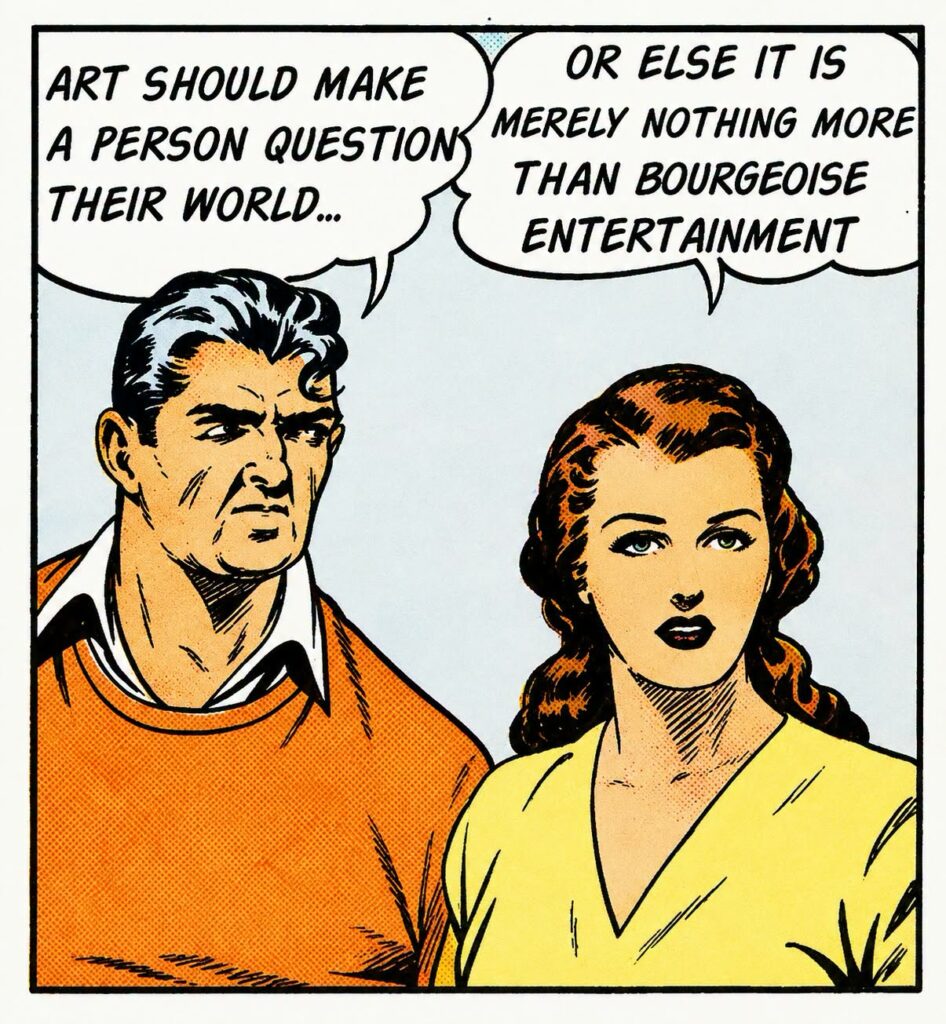
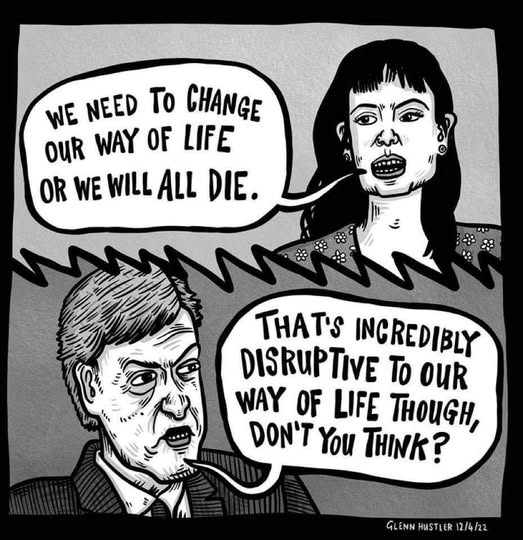
At best, the old #mainstreaming was about equality in worshipping the #deathcult

The old #mainstreaming was only in a limited way about freedom, so we now need to focus on more on what it was about, equality in obedience. Equality in our blinded worship of the #deathcult: growth, consumption, competition, endless mess on a dying planet.

That’s why #fashernista liberal progressivism is always a dead end problem, it plays radical, says radical, but composts nothing. At best, it sells rebellion as a lifestyle. It’s equality inside the system, not about freedom from it.

We’ve seen this play out a thousand times. Movements rise, fresh and alive, then get polished into campaigns, reports, and consultancy slides. Grassroots becomes “stakeholder.” Vision becomes “strategy.” Change becomes “branding.” All form, no compost. All language, no shared life.

Any real change, living change, means turning the dead weight of institutions, egos, and fear into fertile soil. It’s messy, collective, risky. It doesn’t ask permission. It doesn’t chase funding and #NGO approval. It grows because it has to.

That’s what the #OMN (Open Media Network) path is about – composting the old #techshit, the #dotcons, and the NGO decay into something living again. Media that belongs to no one but serves everyone, built on the #4opens.

So the real question is simple. What does real change and challenge look like to you? How do we build it together, in the open, without falling back into the same polite obedience that killed everything before?

The #OMN and the #4opens aren’t abstract ideas, they’re tools for action. If we’re serious about composting the old world into something living, we need hands in the soil, not just words in the air. Here’s how people can start now, from wherever they stand:

#FOSS coding: Build the #openweb, not the #closedweb. Work on #Fediverse tools – join existing native #fashernista projects like Mastodon, PeerTube, Mobilizon, Funkwhale, or the more useful #OMN itself. Fix bugs, improve UI, write docs, or just help test and report issues.

Use the #4opens in practice: No private repos, no hoarding, public decision-making, everyone can use it. Compost old code: take abandoned projects and adapt them. Don’t build shiny new tech for ego points, fix what’s already here. If you’re practical, run small community servers: self-host media, blogs, Fedi instances. Learn how networks breathe.

Then we have social activism, keep it social, messy, and grounded. Form local affinity groups around #openweb media – film nights, repair cafés, public jams. Document everything: record protests, community stories, forgotten spaces.

The next #Indymedia starts with people saying this matters. Challenge control where you see it growing – in meetings, projects, #NGOs, progressive spaces. Ask: is this open? Who holds power here? What’s being hidden? Compost negativity: don’t waste energy on flame wars. Turn frustration into content, conversation, and code.

Avoid the #NGO trap – don’t let money dictate the mission. Use micro-funding and co-ops:
OpenCollective, Liberapay, cooperative hosting. Keep the process/books open: publish budgets, donations, and decisions publicly (#4opens). Value labour differently, not everything needs to be paid. Shared work and mutual aid count as real economy.

Bridging to #NGOs and Institutions but don’t get eaten. Engage, but on your terms, use the #4opens as a boundary tool. If an #NGO don’t work openly, walk away. Offer bridges, not control. Help NGOs learn openness, federate, don’t integrate.

Bring culture into the conversation. Explain why open process and transparency are political acts, not technical choices. Stay autonomous: The moment an institution starts setting your agenda, compost it.

Build the commons, not empires. Everything we do should feed back into the collective soil.
* If you build a tool, make it usable by others.
* If you make media, licence it open.
* If you host something, teach others how to host too.

This is how we win: not through scale, but through replication. Small, self-organizing, composting networks connected through trust. Remember, revolution isn’t about blowing up the system. It’s about composting what’s dead, sharing what’s alive, and keeping the soil open for what’s next.

#openweb #nothingnew #techshit #OMN #fashernista #mainstreaming #deathcult

The Blockchain Socialist: Self-Destruction as Theory

The Blockchain Socialist podcast is the deluded self-destructive talking about the deluded self-destructive in tech. It’s a mirror of our time: intellectuals dissecting the ruins while still worshipping the same #deathcult gods that caused the collapse.

I am listening to an example of this Urbit – about a hardcoded, reactionary tech dream of order built on decentralization, doomed from the start. Not only because the code is bad, but because the culture is. Control disguised as liberation. Hierarchy dressed up as protocol.

This pointless conversation, like so many in the blockchain mess, shows the core #geekproblem: A culture so desperate to escape (old)capitalism that it rebuilds it, line by line, in smart contracts and hard tech algorithms. The people of the blinded tech #deathcult feed on this delusion. Which rewards cleverness over care, abstraction over community, and always, always mistakes power for freedom.

If we want a real alternative, it won’t come from this technocratic dystopias or tokenized cooperation. It will come from composting this mess, from projects grounded in the #4opens, from the living soil of the #openweb, from people who choose the path of trust over control.

Listen to this chattering on the dark enlightenment if you must, but listen as you’d watch decay: as part of the cycle. The old world breaking down so something new can grow.

#OMN #geekproblem #techshit #nothingnew #deathcult

The Open Media Network: Composting the Dead Systems

#FOSS and open source is always political. Let’s say that out loud, because it’s easy to forget. The very idea of open collaboration, of sharing code, ideas, and stories freely, was never a neutral stance. It was, and remains, a radical act of refusal. Refusal to privatize creativity. Refusal to turn cooperation into competition. Refusal to let the #deathcult of neoliberalism define what freedom means.

From the early days of free software and the #4opens, to the #openweb and #Indymedia, the roots of our digital commons grew from solidarity. People gave their labour not for profit or prestige, but because they believed we’d all be better off together, if we stopped rewriting the same bits of code in isolation and started building commons instead of empires.

That’s not apolitical – that’s revolutionary. But over time, the #dotcons wrapped this labour in corporate branding, turning our shared tools into their private profit. They renamed exploitation “innovation.” They turned our commons into capital. The result? A generation of good minds submitting to stupid ones. Of strength and courage strangled by envy, greed for power, and fear of change.

People see their talent, their work, their lives wasted, buried under managerial control, compliance, and hierarchy. This is not just a technical story; it’s a moral one. We need to work to stop this “common sense” apathetic path of waste. The #deathcult is the slow deletion of memory, looking back:

  • Think of #Indymedia – once a global blaze of collaborative media freedom, later smothered by internal bureaucracy and external hostility.
  • Think of #visionOntv’s attempt to reboot on #PeerTube – an echo of that radical history, only to see ten years of grassroots video quietly unfunded, deleted, shadowbanned, “de-prioritized.”

Bureaucrats, NGOs, “leaders” are all terrified of what real openness might unleash. That’s what the suffocation of freedom looks like today, not yet jackboots, but the slow deletion of memory. The #deathcult doesn’t need to crush rebellion outright; it just needs to keep people afraid. It thrives on fear and hierarchy – the illusion that safety comes from control.

They call it “stability.” But as Ursula K. Le Guin warned in The Dispossessed, obedience doesn’t create stability – it creates death. The capitalist world of Urras ran on obedience. The anarchist world of Anarres survived on trust and mutual responsibility. We face that same choice today, every day: control or change, Urras or Anarres, death or life.

The path we need to take is composting the #closedweb. The natural world already knows what we’ve forgotten: compost happens.

When something dies, it breaks down.
From that decay, new life takes root.

The same is true of culture and technology. The #closedweb and #dotcons are already rotting, bloated with ads, surveillance, and fear. For 20 years, they’ve trapped our creativity and turned every act of sharing into data extraction. We don’t need more “innovation” in this rot. We need composting.

That’s what the #OMN – the Open Media Network – is for. To take what’s broken and turn it back into living soil. A simple, federated network built on the #4opens – open data, open process, open code, open standards – to grow grassroots media ecology. Not as a static structure, but as a breathing, evolving commons. Because revolution is not only destruction – it’s also renewal. It’s the composting of the dead so that the living can grow.

Choosing life, choosing change. Stands for the living side of that choice – open, messy, collective, and grounded. It can’t offer safety or stability. It can push growth, courage over comfort, collaboration over control.

As Le Guin wrote:

“You cannot buy the revolution.
You cannot make the revolution.
You can only be the revolution.”

Let’s be it, compost the dead systems and make space for what’s next, act on remembrance, rebellion, and renewal please.

Change is Freedom, Change is Life

You don’t get transformative change by building according to the incentives of the dominant system. A post inspired by rereading Ursula K. Le Guin’s The Dispossessed: An Ambiguous Utopia as part of the Utopia Reading Group in #Oxford

“There’s a point, around the age of twenty, when you have to choose whether to be like everybody else the rest of your life, or to make a virtue of your peculiarities.”
— Ursula K. Le Guin, The Dispossessed

Most people choose the easy path: they find a nice, safe hierarchy and settle in. They obey the rules, repeat the slogans, and mistake obedience for belonging. They stop thinking for themselves. They stop changing.

But change is freedom. Change is life.

Le Guin’s The Dispossessed captures the tension perfectly – between the anarchic, cooperative world of Anarres and the closed, hierarchical planet of Urras. It’s not only a science-fiction metaphor; it’s the current mirror of the #openweb we refuse to look into. The “open” world we imagine is already all around us, fragile, fragile seedlings buried beneath layers of control, ego, and fear.

This is the mess we need to compost, we see it every day. Talented people watching their work and lives being wasted. Good minds submitting to stupid ones. Strength and courage strangled by envy, greed for power, fear of change.

Looking back at web history, think of how #Indymedia burned bright for a moment, then was strangled by internal control and external hostility. Think of how the second reboot – visionOntv on PeerTube – tried to keep that radical history alive, only to collapse again under neglect, lack of support, and the dominance of #dotcons platforms. Ten years of grassroots videos deleted, shadowbanned, or “de-prioritized.” That’s oftern what the suffocation of freedom looks like, not jackboots, but the slow deletion of memory.

Everywhere, the potential for something living and new gets buried under the weight of control. When a grassroots project loses its edge because it’s easier to fit into “funding priorities.” When energy turns to exhaustion, creativity to compliance, rebellion to report-writing. This is the logic of the #deathcult – the slow suffocation of change.

The #deathcult thrives on fear and hierarchy, the illusion that safety comes from control.
It’s not that people don’t care, it’s that the system teaches them not to. Managers, bureaucrats, “leaders” are all terrified of what real openness might unleash.

The banality of obedience. Le Guin warned us that the danger of obedience is not stability, it’s death. Urras, the rich capitalist world, runs on obedience. Anarres, the poor anarchist moon, survives on mutual responsibility.

You can’t get transformative change by operating according to the incentives of that system.
That’s why NGO culture and corporate-funded “innovation” projects always fail the real test.
They replicate the very control structures they claim to challenge.

The composting of culture, the natural world understands what our institutions forget: compost happens whether you want it to or not. What’s dead breaks down, and from that decay, new life takes root.

The same is true for culture and technology. The #dotcons and #closedweb platforms trap creativity and channel it into profit. They turn every act of sharing into data extraction, every connection into surveillance. They turn good minds into “content” and living movements into metrics.

We don’t need more “innovation” within this rot, we need composting. That’s what the #OMN (Open Media Network) is for, taking what’s broken and turning it back into living soil.
A simple, federated network built on the #4opens to grow real, grassroots media again, not as a static structure, but as a breathing, evolving commons.

Revolution is not destruction; it’s renewal. It’s the composting of the dead so that the living may grow. Revolution is our obligation, our hope of evolution.

Choosing life over control, to choose change is to choose life. To cling to control is to choose decay. The #OMN is one path to life, open, messy, collective. The alternative is more of what we already have: talent wasted, good minds ground down, courage strangled.

Le Guin’s lesson still stands:
“You cannot buy the revolution.
You cannot make the revolution.
You can only be the revolution.”

Let’s be that change. Let’s compost the dead systems, and make space for what’s next.

#4opens #openweb #OMN #nothingnew #techshit #deathcult #TheDispossessed #UtopiaReadingGroup

How fascism actually works

How can we get people to see that #Fascism isn’t only about goose-stepping soldiers or dictators shouting from balconies – that’s the cartoon version. The current danger sits much closer to home. Fascism is the extreme end of a spectrum that runs right through our everyday lives: hierarchy, obedience, control, and fear dressed up as “common sense.”

It’s an old story of the #nastyfew controlling the many through managed fear. A dictator doesn’t rise from nowhere, they’re made possible by the people who go along quietly. Not because they’re zealots, but because they’re scared of losing their jobs, their status, their comfort, their lazy thinking.

That’s the quiet machinery of fascism: not just one man with a plan, but a whole system of compliance. Teachers, engineers, clerks, journalists, in the 1930s most joined the Nazi Party not out of belief, but because they had to in order to work. It wasn’t terror of death that ruled them, but terror of being left out.

And this hasn’t gone away, it’s still the mess we swim in. The #deathcult of #neoliberalism runs on the same fuel. The #NGO world, the corporate #dotcons, the mainstream media, all are built on quiet obedience and careerist cowardice. “Don’t speak up, you’ll lose your funding, your platform, your relevance.”

As Upton Sinclair said: “It’s difficult to get a man to understand something when his salary depends on him not understanding it.” That’s how evil becomes banal, not in the villains, but in the everyday silences that pushes systems over all of us.

So when people say, “I can’t speak up, I’ll lose my job,” I get it. But understand what that means, it’s the same mechanism that built the worst social systems in history. The real question is what happens after the first person speaks out. Because there always has to be a second, and a third. That’s how the wall cracks – not with one heroic act, but with collective courage.

This is what we’re trying to nurture with the #OMN – a network built not on fear or control, but of trust and openness. #4opens is our inoculation against fascism in tech. These are not only tech slogans, they’re social tools for courage, for rebuilding collective strength.

We need to compost the rot of obedience, turn it into soil for something alive again. The first one through the door often takes a hit, yes – but the rest of us can’t just stand there watching. Freedom isn’t found in silence or safety. It’s found in trust, in solidarity, in messy, shared action. We either move through that door together – or we stay in the dark alone.

Freedom is not mine or yours. It’s ours, or it isn’t freedom at all

The illusion of modern society is that freedom is only individualistic, when our freedom is in truth interconnected with the well-being of everyone. This is one of the central pushes of the #deathcult – the mess of #neoliberalism we still live and work inside. It tells us that we are free as consumers, that choice equals’ liberation, and that personal success is the highest form of virtue.

But this is a hollow freedom. What kind of liberty exists when every interaction is transactional, every space is owned, and every so-called “community” is just a market segment waiting to be monetized? We experience this every day. The #dotcons sell us “empowerment” through sharing, but it’s sharing inside a cage. Their platforms reduce human connection to engagement metrics and ad revenue. Every “like” is data for their shareholders, not any gesture of solidarity.

The #NGO world isn’t much better. It preaches collective change and “amplifying voices,” yet operates like any other corporation, brand-driven, risk-averse, allergic to the messy, unpredictable reality of grassroots organising. Instead of networks of solidarity, they build vertical hierarchies of control. The people they claim to represent become “beneficiaries,” not participants.

Even in the alt-tech and “decentralised” spaces, this same illusion creeps in. Too often, we see projects confusing personal control with collective freedom, endless talk about privacy and autonomy without any grounding in social trust. A federation of silos is still a field of fences if the people behind them don’t share any values, practices, and care.

Real freedom isn’t about escaping others; it’s about building with them. The #openweb once embodied this, a commons of creativity, trust, and shared #FOSS tools. It wasn’t perfect, but it worked because people shared more than data; they shared intentions. The current #4opens are social principles first, technical structures second, path back to this.

25 years ago, seeded from the undercurrents video collective, we built #indymedia from this soil. Affinity groups came together to tell stories from the streets – direct, unfiltered, alive. You could see and touch it: the cables, the battered servers, the faces in the room lit by CRT monitors and endless tea. It wasn’t about perfection or control; it was about social connection.

Now we are knee-deep in mess, and need shovels to composting the Illusion, the challenge is to compost this #mainstreaming, to turn the rotting soil of #stupidindividualism into fertile ground. This is the work of the #OMN (Open Media Network): to regrow grassroots media not as a brand, not as a product, but as a living ecosystem of stories, links, and local action. Each part feeding the other. Each voice linked, not owned.

Where #dotcons feed on data extraction, we feed on compost, the messy remains of failed systems and burnt-out movements, broken down, rotted, turned into nourishment for the next cycle. Because our freedom doesn’t live in the self, it lives in the network, in the commons, in the trust between people, in the code and culture we share.

The individual without community is not free, only adrift. The collective without openness is not strong, only captured. Freedom is not mine or yours. It’s ours, or it isn’t freedom at all.

In the #mainstreamin tech path, this is a useful step:

Rebuilding Grassroots Media – Back to the Soil

From my point of view, it needs to start from the raw truth: There is currently no functioning grassroots media. Not in any coherent sense. Before we talk about video, storytelling and digital tools, we have to answer the most basic question, one that most people have forgotten to ask: What is grassroots media?

It’s not “content creation.”
It’s not “influencer culture.”
It’s not another #NGO-funded project selling “voices from below” to tick a box for a funder’s annual report.

Grassroots media is the messy, local, real-world network of people using simple tools to speak, share, and act together, outside institutional control.
It’s about agency, not branding.
It’s about trust, not reach.
It’s about doing, not performing.

This is the core almost everyone skips, and it’s why so much “independent media” ends up feeling like a watered-down copy of the mainstream it was meant to replace.

Building networks, not platforms. If we want living, breathing alternatives, we need to think like ecosystem builders, not tech entrepreneurs. Balance means deliberately prioritising the roots – where stories grow from – to counter the dominance of traditional and #NGO media that always speak from above.

The corporate #dotcons – Facebook, YouTube, TikTok, X, all of them – have poisoned the soil. Their logic is control, enclosure, and profit extraction. We can’t reform them, but we can compost them. Use what’s left of their infrastructure tactically. KISS – keep it simple, use and abuse what remains as compost to fertilise the new.

We need to dig back into the living history of #DIY media culture, those messy, chaotic, beautiful experiments that worked, to where and when media grown from social trust, not algorithmic metrics. Back in the day, it used to work because it was grounded in the #openweb a culture built on openness, transparency, federation, and collaboration. What we call the #4opens.

The #OMN (Open Media Network) path is about rediscovering that soil and replanting in it.
Building federated, trust-based, messy, human networks of media again. It’s not about replacing corporate platforms with shinier tech. It’s about rebuilding the culture of open media, the relationships, the ethics, the shared practice of truth-telling and collaboration.

Because if we don’t grow our own grassroots media again, someone else will sell it back to us in plastic wrap.

Extreme liberalism is the outcome of #postmodernism, the rot at the heart of the current “progressive” mess. It’s what happens when shared stories are replaced by (non) individual narrative, and meaning dissolves into (non) individual performance.

Our current #fashernistas swim in this thin soup, they call it “diversity,” “empowerment,” “innovation,” but it’s a dysfunctional mess, with marketing dressed as virtue. The problem we need to compost is that every attempt to make something that works – collective, rooted, accountable – gets drowned in an endless tide of self-expression and identity management.

Postmodernism was supposed to liberate us from hierarchy and dogma. But it left us atomised, trapped in their #dotcons feeds, without any shared compass. Out of that vacuum came the extreme liberalism of the last 20 years we think as “progressive”: the cult of the individual, the religion of choice, and the morality of markets. It’s the #KISS polite face of the #deathcult, its neoliberalism with a rainbow filter.

The #openweb – through the #4opens – is a path out of this swamp. It’s not about the illusion of freedom sold by #dotcons, or the grant-funded “activism” of the #NGO class. It’s about activist trust-based openness: code, data, governance, and process dogmatically open, that people and community can build, see and shape.

The #OMN (Open Media Network) grows from this ground. It’s not another brand or a platform – it’s a garden for messy, local, grassroots media to regrow. It starts from compost: the failures, the blocks, the burned-out projects. From that, we build something living again.

To move at all on this, we have to compost #postmodernism, keep its healthy scepticism, but drop the self-absorption. Keep openness, but return to shared meaning. Truth matters. Trust matters. The network needs to feed the commons, not the “individual” play-acting ego.

The #IR view of how to survive in a hostile world

The Changing Character of War programme at #Oxford is discussing Patrick Porter’s new book How to Survive a Hostile World from Stanford University Press. Porter argues for realism – what I’d call the “lawful evil” path of international relations – as the right response in an age of war, economic dislocation, and climate crisis.

The panel includes: Prof. Patrick Porter (Birmingham), Dr. Susan B. Martin (King’s College London), Dr. Jeanne Morefield (Oxford), Dr. David Blagden (Exeter), and Dr. Seán Molloy (Kent).

Porter tackles three standard critiques of realism – that it’s immoral, unrealistic, and provincial – and flips them. He insists realism is moral because it defends the polity where no higher law exists, realistic because it reflects how human groups actually behave, and universal because it can apply beyond the Euro-Atlantic world.

But this is Oxford #IR, so don’t expect much challenge. Realism here really means: how to manage decline without admitting it. It’s hard to argue for realism in an era of #climatechaos and the global hard-right shift. If the state is the “rational actor,” that actor is already captured, elitists circling the wagons while “strongman politics” gets rebranded as “stability.” Expect talk of “peace through strength,” the same logic that once drove Japan before WWII and now drives Israel. They’ll all agree they hate the liberal imperialism of the past 20 years – Afghanistan, Iraq, Libya – while quietly defending the same machinery that made it possible.

The deeper question, what’s the optimal flock size for survival in a hostile world? will be avoided, because that would mean admitting that what really matters to them isn’t the state at all, but the tribe: class, in-group, and out-group. Realism today is an ideology for managing collapse, not preventing it. If we want a liveable world and culture, we have to move beyond this toward post-capitalist, trust-based cooperation, not another round of “lawful evil” geopolitics.

By serious academic standards, realism is a “degenerating research program.” Every time reality disproves it, the theory just bolts on new excuses, a patchwork of “yes, but” footnotes that never die. Lacking moral grounding, it hides behind “pragmatism” while refusing to say what’s good or bad. “That’s just how the world works,” they say, mistaking description for wisdom.

Realists claim they see the world as it is: power, conflict, survival. But even within their own logic, it’s full of contradictions, empire pretending to be restraint, militarism dressed as reason. Realism doesn’t always mean war, but it always means preparing for one. For them, the state is sacred and indivisible – the only actor that matters – which is why their worldview drips with Eurocentrism and state worship.

In truth, realism isn’t wrong so much as exhausted: a worldview for a dying world that can’t imagine anything beyond power. In the age of #climatechaos and #deathcult politics, we need a new grounding – trust, cooperation, transparency (#4opens) – rather than fear and force.

Realism is international relations for adult teenagers who never grew up – still desperate to make their childhood world of heroes, villains, and empires real.

It’s how humans have always lived – together

For 200 years, capitalism, for the last 40 years #neoliberalism, taught us that we’re isolated individuals who compete to survive. But any real view of our actual history – and our biology – say the opposite: we’re interdependent, social, and ecological beings. For almost all species time before the current mess, we thrived through commons-based systems, shared forests, grazing lands, rivers, and community knowledge. Villages maintained open wells, fishermen shared tidal calendars, and guilds protected collective craft standards. Cooperation, not competition, is what allowed us to endure.

This is why now alt tech, matters, it is about rediscovering, what makes us human, the digital form of that is commoning online. Just as medieval commons were fenced off during enclosure, our early digital commons were captured by #dotcons. Rebuilding the #openweb is the act of reclaiming that shared ground, not nostalgia, but in the era of #climatechaos and hard right shift its #KISS survival.

What we need to compost is our own-shared memory. The commons are missing from today’s “common sense”. The idea that people can manage shared resources together has vanished from public imagination. Yet the commons is the older, more adaptive, and far more humane way of organizing.

In tech, the #Fediverse shows this in action, thousands of community run servers cooperating through a shared protocol, ActivityPub. Projects like #PeerTube, #Pixelfed, or #Funkwhale replace enclosure with federation, showing that open paths can scale through trust rather than control. Alt tech, built on open protocols and co-governance, is simply the digital commons rebooted, a network of networks where no one owns the whole.

We need much more resources and focus pushed into this real grassroots path of reclaiming the means of communication, in the 1990s and early 2000s, the internet was all ready a commons: decentralized, people-driven, and impactful. Early #Indymedia collectives covered protests outside mainstream #blocking narratives. #4opens email lists and wikis built movements across borders. Then capital pushed in, WE let the #nastyfew of #Facebook, #Google etc privatize our collective infrastructure, turning participation into surveillance and creativity into content.

Alt tech projects like the #OMN (Open Media Network), Mastodon, and wider #Fediverse are attempts to rebuild what we keep forgetting, this time, protected by #4opens shield to build shared governance. This path is not a nostalgic throwback, but living/acting paths for post-capitalist communication we need in the growing era of social backdown.

It’s not only “tech” – it’s social trust infrastructure. A common is not only software; it’s the culture of cooperation that surrounds it, shared values, mutual aid, and relational ethics, you can’t “code” trust into hardware, as the last decade of #blockchain and #AI mess proves. Smart contracts failed to make people honest; they just automated mistrust, it’s on going #geekproblem blindness we need to be working to compost.

What works, the resilience, comes from people, not algorithms. Through frameworks like the #4opens: open data, open code, open standards, open process. We can build transparency and accountability into the social layer of the network. Trust is a practice, not a protocol #KISS

We need a future that’s better, not just less bad. The #deathcult story – neoliberalism’s great myth – says “there is no alternative.” Alt tech is the alternative, working proof that cooperation scales, that people build shared infrastructure without extraction and less coercion. Look at LibreOffice, Wikipedia, Linux, or the #Fediverse, all imperfect, collaborative systems built on trust, not profit. They are real-world examples of how collective will outperform the normal deadened paths of corporate hierarchy.

Alt tech gives us believable hope, which is the only real antidote to despair and apathy. The ground for grassroots power is in pushing change and challenge. If the liberal state and #dotcons won’t reform, we need to be building parallel structures that work differently.
Projects like the #OGB (Open Governance Body) experiment with federated, transparent decision-making. The #OMN builds tools to connect grassroots media in trust networks, bypassing gatekeepers entirely. Together they form a scaffolding of a working commons, capable of hosting culture, not only control.

Healing the social media wound? We need to compost the lie of #dotcons which spent the last 20 years turning us into consumers and outrage machines. The shovel we need is affinity groups rebuilding social tech around self-governance, interoperability, and most importantly trust to reclaim the human side of the internet. Imagine the world different, feeds that empower communities, not advertisers, tools that nurture relationships, not metrics, platforms that amplify context, not conflict.

This is the work of making the internet human again, working together on the path of alt tech matters because it’s not about gadgets; it’s about freedom, community, and survival. It’s our path to remembering that the #openweb, like the Earth itself, belongs to everyone, or it belongs to no one. And every time we build a shared tool, or hold open a door, we remind the world that cooperation is not naïve, it’s our oldest #KISS technology.

A cross-cultural conversation on this subject

UPDATE: I haven’t touched on two other #4opens projects here, so let’s tap them at the end: #Nostr is a “me-too” project stuck in the #geekproblem loop, it won’t go anywhere until it learns to value community as a building block. #Bluesky, on the other hand, is already drifting into the hands of VC-funded #fluffy elitists who turn every commons into a brand. It’s a very likely a dead-end for real change or challenge, which is why the #mainstreaming #blocking #NGO and #fashionista crowds flock to it.

UPDATE 02: Digesting the comments. For the past 10,000 years of agriculture, 500+ years of Euro-colonialism, 200+ years of #capitalism, and 95 years of #neoliberalism (45 officially declared as such), the #nastyfew practicing control through production have dominated everyone else. Capitalism, as described in Capital, grew wherever it could. By the late 19th century, labour organised and fought back. Social democracy transformed the capitalist state so effectively that capitalist development stalled by the 1930s.

The response? A reorganisation of capital, using anti-communism as its rallying cry (WWII, NATO, Korea, Vietnam) to defeat social democracy and retake control of the state. By the 1980s, “they” felt secure enough to brand reform itself as a product: #Neoliberalism. I’m simplifying, of course – this is for the #hashtagStory outreach, so it can become a #KISS tool people can actually use. Clarifications and deeper dives you can find in the comments 🙂

Now, about this idea that “capitalism told us we’re isolated individuals competing to survive.” It’s partly true, but not in the way people think. Capitalism depends on interdependence, we work together to produce, but in a way that isolates us socially and politically. That’s the contradiction: interdependence turned into alienation. It’s the mess in our heads that recreates these bad social structures, the inner factory of control. That’s what we have to compost.

In the end, it’s not just social control, it’s social destruction. As we rush deeper into #climatechaos and the global hard-right turn, it’s clearer than ever: the ideology of separation keeps power safe and people powerless. I know this isn’t #mainstreaming liberal logic, that’s the point. We have to think differently.

And for context, I’m not speaking from the sidelines – I’ve got an MA in politics and 30 years of hands-on work in grassroots #openweb tech. Isolation is social control, see #stupidindividualism. Let’s keep this grounded and not turn it into trolling, yeah?

So how can people try not to be prats about this conversation?

In alt tech there are lots of people doing good, and they are, but this is blinded shifting to doing “good” head down worshipping the #deathcult, this would be kinda OK if they held the bridge to a wider view of “good” but they don’t, they block and obscure there #blocking, this is bad, very bad as in the end the “good” they say they do, is just more mess we need to compost.

The real solution is always to respect and build from the fluffy/spiky debate, not bury it under politeness or pretend blindly it doesn’t matter. #Fluffy brings empathy, care, and bridge-building – vital social glue. #Spiky brings clarity, honesty, and challenge – the fire that keeps things real. Both are needed if a project is to stay alive and #4opens. The moment one side silences the other, the culture starts to rot. The second-best path, if balance isn’t yet possible, is to shift the #NGO-style fluffy language – soften its domination reflex – so it stops sounding like control disguised as kindness. This is where care can evolve into openness rather than enclosure.

The worst outcome is what we’ve already seen too often: blinded narrowness, the slow creep of civility politics that smothers dissent while smiling at best and ignoring then #blocking at worst. It’s silent damage, and it killed #SocialHub, turning what could have been a commons into a small irrelevant gated forum of insiders. You can’t maintain trust by excluding the spiky voices; you can only maintain a hollow sham.

So how can people try not to be prats about this conversation? Start by listening across difference. Don’t pathologize conflict; compost it. Assume that critique is care, not attack. Drop the impulse to manage or “align” others – those are imperial moves. Instead, nurture space for spikiness within shared trust. The goal isn’t harmony, it’s living balance – a federation of tones, not a choir of compliance.

UPDATE: my feeling and experience of this is that these types of people will with blindness destroy what they say they value for the security of what they say they don’t value. The next generation will likely repeat this mess, and the compost will likely rot, as will our environment because little real change or challenge comes from the narrow blinded path this group push. Yes it’s a hopeless mess, ideas to change and challenge this please?

PS. I would like to be proved wrong, this is a real opportunity for a nice group of people to do the right thing.

Admit the mess – don’t polish it. Stop pretending everything’s fine. The blindness comes from politeness and professionalised façades – people smiling while quietly blocking change. Naming the rot is the first act of care. #4opens starts with open process, not spin.

Reignite the spiky energy. Spikiness is honesty, critique, fire – not aggression. Without that spark, the culture flatlines into #NGO sludge. Invite spiky voices back with trust, not fear. Build cultures that can handle disagreement as fuel, not threat.

Rebuild from affinity, not hierarchy. Instead of “leadership” and “representation,” think federation – small, rooted, overlapping networks of trust. The #OGB model (Open Governance Body) can be a path: shared stewardship, visible processes, no invisible power.

Compost the infective NGOs. Use what’s useful (resources, access, tools) but don’t let them define the frame. Their language and logic are imperial – centralising, sanitising. Translate their “professional” talk into commons language: from “impact metrics” to “shared meaning,” from “alignment” to “affinity.”

Re-root culture in lived practice. The grassroots aren’t a romantic idea – they’re the only working base. Real change comes from where people actually do things together, not from panels or “stakeholder dialogues.” Focus energy there, make it visible, and let legitimacy flow upward again.

Make openness the discipline. Openness isn’t chaos; it’s a discipline of trust. The #4opens – open data, open process, open source, open access – are the anti-imperial charter. If a group can’t work by them, they’re not #openweb; they’re enclosure with good PR.

Keep it #KISS simple. Most of the blindness hides in overcomplication – endless frameworks, metrics, governance layers. Keep it small, human, and understandable. Simplicity keeps power honest.

The #AI bubble might be nastier than the Dot.com crash

The path the #mainstreaming in tech is taking is clear. #AI is fashion, the valuations are absurd, the cost structures unsustainable, and the hype cycle feels like it’s already outpacing reality.

We’ve been here before, dot.com déjà vu. The #dotcons bubble of 2000 was built on fake demand and fantasy valuations. Venture capital flooded into half-baked platforms that promised to “reinvent” everything, while the effect was to hollow out and enclose the native #openweb. When the bubble burst, it wasn’t just investors who lost, the damage was social, cultural, and technological, it’s the mess we are in today.

The AI bubble, 2025 edition, we’re watching the same movie again, only bigger and nastier. This time, the hype engine is driven by press releases and corporate lobbying, amplified by blinded compliant media desperate to see the next miracle story. Every company claims they’re solving “the biggest problem” with AI. But lift the lid, the rhetoric, and what remains? Business models that don’t add value, expensive wrappers around existing tools. Unsustainable costs – GPU farms burning cash and carbon in equal measure. Speculation over substance, #nastyfew investors betting on domination rather than usefulness.

Why this round may be worse, at least the #dotcons bubble left some infrastructure we could build on: fibre, hosting, and the spread of the web itself. The #AI bubble looks different, as it centralises power even further in the hands of a few #dotcons. Accelerates #climatechaos through energy-intensive training runs and datacentre inflation. It undermines our flawed democracies, trust in media and knowledge with floods of synthetic content.

https://www.youtube.com/watch?v=6e1Tqc_rWeQ
The ending to this video is a shocker, but not unsepreising when you look at the context of the video.

Instead of building open, federated, useful tools, we’re watching another round of #techshit enclosure, hype and money funnelling into projects that can’t last, but which will leave more #techshit scorched-earth legacy when they collapse. The #dotcons crash was messy, the AI crash could be toxic.

What can people do to walk away from this mess? How do you help with the #OMN and #4opens? The AI bubble shows what happens when tech is built on the normal hype, enclosure, and extraction on the #dotcons path. The #OMN is the opposite of this. It’s about building trust-based, federated networks where media, knowledge, and tools aren’t just another asset class to be bought and sold. The #4opens are the activist #FOSS antidote to bubble logic:

  • Open Data – No black boxes. If #AI is going to be part of any future, the training data, biases, and methods must be transparent, not locked up by Google, OpenAI, or Microsoft.
  • Open Code – Instead of closed, centralised data sets and platforms that extract rent, we need free/libre code anyone can run, fork, and improve.
  • Open Standards – The current AI mess is about silos and monopolies. Federated standards (like ActivityPub for social) are how we work to keep diversity alive and break enclosure.
  • Open Process – The opposite of corporate secrecy and hype. Decisions need to be made in the open, accountable to communities, not hidden boardrooms or PR cycles.

The #AI bubble is the normal every day #deathcult logic of the #dotcons playing out again: extract, enclose, collapse, repeat. The #OMN and #4opens give us a way to compost this mess into something more fertile. From enclosure → to federation. From secrecy → to openness. From hype cycles → to slow, messy, sustainable growth.

If we don’t actively build and defend this needed native path, we’ll be left cleaning up another round of collapse, only this time with more concentration of power, more environmental damage, and a deeper erosion of trust. The choice is simple: do we keep betting on bubbles, or do we build commons?

And the path is #KISS, so people please don’t be a prat about this, thanks.

YouTube and the #deathcult of “Independent” Media

Over the last ten years, we’ve all been spending more and more time on #YouTube. And maybe you’ve noticed something strange: many of the channels you once thought of as independent are no longer independent at all. They’ve been quietly bought up by private equity firms with billions in backing from SoftBank, Amazon, Disney, Goldman Sachs, Blackstone – the usual #mainstreaming priests of the #deathcult.

Channels like Task & Purpose, Vice, Veritasium, Donut Media, Simple History, Economics Explained, The Drive, and History Hit are already part of the buyout wave. Some of the biggest names in our worship of “creator culture” – CocoMelon, Colin and Samir, The Theorists, Dude Perfect – too. And that’s just the ones who admitted it. There’s no law requiring disclosure.

Capitalism has a logic, that creators are commodities. “Independent” YouTubers once worked on tiny budgets – a camera, editing software, a couple of friends – to reach millions. They were messy, risky, sometimes radical. Capital sees something else: predictable cashflow, brand expansion, safe investment. But these operations are fragile. They depend on one platform (#YouTube), one personality, and an algorithm that can erase a career overnight. Normally, this risk would scare off capitalists. But with $12 trillion sloshing around private equity in the US alone, they’ve run out of businesses to buy. YouTube channels are the new frontier.

This is how grasping control kills creativity, when capitalism takes over, the overhead explodes. Analysts, strategists, managers, lawyers all need their cut. That means: more ads, more sponsorships, more merch, safer, algorithm-friendly content, the same formula cloned across every channel in the for profit portfolio. This “roll-up” logic flattens everything into old-school TV. Risk disappears, the spark that made YouTube compelling at first is smothered by business strategy. We’re already seeing it with channels like Veritasium, slowly shifting away from Derek Muller to reduce “keyman risk.” Once a personality becomes a liability, the accountants start grooming replacements.

Old school #traditionalmedia tried to counter te first wave of #dotcons social media by throwing money at “new media” outfits like Vice, Buzzfeed, Mashable, and Vox. They burned cash, collapsed, and left nothing but layoffs. The new approach is simpler: don’t build, just buy. Disney doesn’t need to grow the next Vice; it just needs to buy a handful of YouTube channels and tell shareholders it’s “ready for the future.”

The same #deathcult logic applies to this, appease shareholders first, audiences last. The cost is paid by viewers, the result for us – #dotcons friendly content becomes blander and safer, sponsorships dominate, but direct support (merch, memberships) dries up, because who wants to fund faceless #nastyfew agendas? “Creators” burn out, and vanish, replaced by interchangeable hosts or locked down with non-compete contracts. It’s the industrialisation of #fashionista “independent culture”.

There is a history to this, and #openweb parallels, we’ve seen this story before, in the 90s, independent radio stations were bought out by Clear Channel, homogenising the airwaves. In the 2000s, blogs were enclosed by Facebook, Google, and Twitter, killing off messy but vibrant grassroots media. Even movements like Occupy or Extinction Rebellion felt the same pressures: a burst of openness and creativity, followed by co-option, #NGO capture, and fragmentation under managed dissent. The lesson is always the same: once capital steps in, the mess is tidied away, and any possibility of change and challenge dies.

I have seen this on the #dotcons platforms we use as backups and hook for the #openweb native projects, our visionontv YouTube loses a video or two every month to not advertising friendly, copyright strike for clear fair use etc.

The #OMN Lesson, YouTube is repeating the same pattern we’ve seen across the #closedweb: a few years of openness and experimentation, followed by enclosure, consolidation, and financialisation. Capitalism cannot tolerate risk, it cannot tolerate diversity, it needs control, predictability, and growth at all costs. And that is the death of any real grassroots media.

The #OMN path is the opposite. We need federated, messy, trust-based networks where media is not just another asset class. Media must be inherently open – created, shared, and remixed under the #4opens. If we don’t build and defend this, the future of online culture is already sold out.