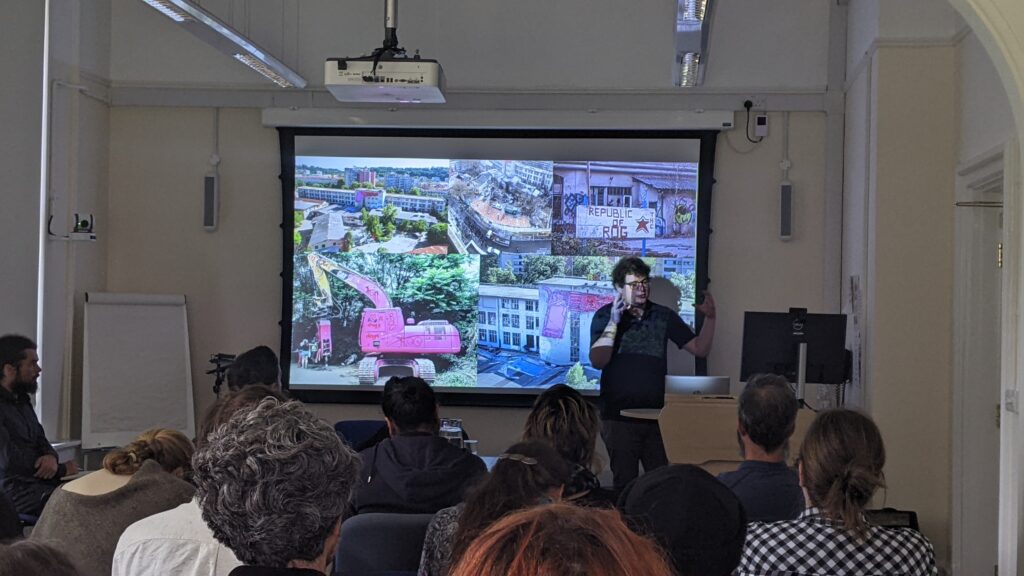
“Irregular” #migrants moving along the Western #Balkan Migration Route aspire to competing visions of Europe, and Europeanness, and along their journeys they encounter multiple competing, overlapping, or intersecting political projects. Drawing on fieldwork conducted in #Slovenia since 2021, this presentation will explore how various imaginaries of Europe are instantiated in the wake of Yugoslav socialism, EU integration, and an ongoing “migration crisis.”
Fun workshop on the European activist times, interesting, but not sure if much use on the subject of immigration.
#Academics, playing the determination game, is long and dull and more about statues games. As with most of these events the subject is scanned over and all the knowledge is in these statues, definition games rather than the subject itself, it’s a meta conversation.
Friendly parasite’s, sometimes it’s useful for activism to have same #mainstreaming to point at when talking to authorities. But the issue is the normal, academics talk to #fashionistas not the people who get stuff done, so it’s a caricature you end up pointing to, but one the “authorities” can relate to, a useful mess. That becomes a real problem when this becomes the history of the movement. A bad feedback loop that we keep repeating, and we are in now
In the #openweb of digital innovation, there is a culture revered for its ingenuity and technical prowess – the hackers of old. Yet, beneath the surface of their achievements lays a problem, one that has led to the downfall of many social tech endeavours: the #geekproblem.
In the early days, hackers were pioneers, pushing the boundaries of what was possible, though as their influence grew, so too did the imbalance within their communities. The projects that thrived, that embodied the principles of openness and collaboration (#4opens), were not only the work of these geeks, but wider diverse affinity groups where social leadership was core.
The projects that flourished had strong social guidance, with the geeks playing one part in the larger diversity. This was a healthy dynamic, with different perspectives and different skills, complemented each other to further common social goals.
However, over time tragedy grew when the geeks seized control of the foundations and the #fashernistas, with their penchant for superficial trends, hijacked the facade. With the geeks at the helm and the fashionistas dictating the direction, the once vibrant projects slowly over time withered and died.
The demise of the #openweb was not a sudden event, this slow and steady decline was orchestrated by those who valued personal agendas and status over collective progress. The geeks, blinded by their technical prowess, failed to recognize the importance of social partnerships, while the fashionistas, eager to climb the ladder of #mainstreaming success, sold out the principles they once claimed to champion.
And so, the legacy of the #openweb was tarnished, its promise of democratized access and decentralized trust, betrayed by those who prioritized their own blinded interests over the “native” common good. Yet, amidst this wreckage, a glimmer of hope remains – a reminder that progressive tech lies not in the hands of the few, but in the collective efforts of all who dare to dream of a better, more humanist world. Let’s try not to make the same mistakes with our current #web1.5 reboot in the #Fediverse, please.
To avoid repeating this mess we need to mediate the tragic reality that within our #fashionista circles, there exists a pervasive sense of hopelessness, a destructive force that accompanies their every endeavour. Their relentless pursuit of trends and their blind devotion to the #deathcult have left a trail of destruction in their wake.
We need to actually use the #4opens project, as a beacon of hope amidst this chaos, a reminder that there is another way forward. Not doing this is leading us on the path to failure, contributing to the ever-growing piles of #techshit.
There’s much to be learned from this cycle of destruction and renewal. It’s time to embrace the lessons of the past and walk a better path, one guided not by the whims of #fashionistas or the allure of the #deathcult please.
The problem of #fashionistas in activism is the pushing of style and appearance over substance and meaningful action. These people are concerned with projecting a limited image or brand of activism, rather than engaging in the actual, messy effect of social change. This poses challenges to the efficacy and integrity of real grassroots movements:
Superficiality over Substance: Fashionistas prioritize surface-level aesthetics and trends over substantive analysis and action. They focus on creating a visually appealing image of activism, such as through trendy protest attire or social media posts, rather than engaging in on the ground deep-rooted grassroots activism that addresses real issues.
Performative Activism: Fashionistas engage in performative activism, where their actions are about signalling commitment to a cause rather than making contributions. Participating in protests or events primarily for photo opportunities and social media validation, rather than working towards on the ground change.
Exclusionary Practices: The emphasis on fashion and style creates barriers to participation for people who do not conform to slavish aesthetic norms. This marginalizes people from diverse backgrounds, experiences, and identities who do not fit into the narrow standards set by fashionistas within the movement.
Distraction from Core Issues: When activism becomes focused on appearances and trends, it detracts from the issues and objectives of the movement. Attention and resources are diverted to superficial aspects of activism, rather than towards addressing the causes of injustice and inequality.
Reinforcement of Consumer Culture: The influence of fashionistas reinforces consumerist attitudes and behaviours. This involves promoting consumer-driven solutions to social problems and aligning activism with commercial brands and products, rather than challenging the structures of capitalism and exploitation.
Dilution of Message and Impact: Activism that prioritizes style over substance dilutes the movement’s message and impact. When the emphasis is placed on spectacle and aesthetics, the underlying principles and goals of the movement become obscured and watered down, leading to reduced effectiveness in achieving meaningful change.
Mediating the problem of fashionistas in activism movements requires a commitment to centring authenticity, inclusivity, and meaningful action, a culture of critical reflection, accountability, and solidarity. By prioritizing substance over style, activists work to building resilient, impactful, and inclusive movements. Best not to be one of the prats on this path, please.
The hashtag #fashionistas” typically describes individuals or groups who adopt trends or ideologies in activism, for the sake of appearance or to align themselves with what is currently popular or socially acceptable. In the realm of activism, this phenomenon to often manifests in the behaviour of #NGOs and advocacy organizations who prioritize “chasing the buzzword” over meaningful action.
The problem with “fashionistas” in activism, particularly among NGOs, is the mess they push:
* Superficial Engagement: NGOs adopt trendy causes or issues without any understanding or committing to them. This results in superficial engagement with complex social problems, leading to tokenistic gestures rather than any real substantive change.
* Lack of Authenticity: When prioritize appearing progressive by aligning with popular movements without commitment to the cause, this undermines trust and authenticity within the community.
* Mainstreaming: prioritize activism that is palatable to #mainstreaming audiences and funders, sacrificing radical or grassroots voices in the process. This mainstreaming tendency dilutes the effectiveness of activism and reinforces existing power structures.
* Misaligned Priorities: By chasing buzzwords and trends #fashernistas divert resources and attention away from pressing issues that are less visible or popular but more important. This perpetuate injustice and inequality in actavist communities.
* Reactive Rather Than Proactive: #Fashionista activism is reactive, responding to the latest trend or crisis rather than addressing systemic issues in a sustained and strategic manner. This leads to short-term gains but fails to create lasting change.
* Rectonery: Adopting trends without a commitment to the underlying values and principles leads to performative activism or “rectonery” – actions that serve to maintain the status quo rather than challenging oppressive systems.
To address the problems of fashionista activism, we need for NGOs and advocacy that prioritize authenticity, long-term commitment, and meaningful engagement with the communities they are a part of. This involves centring the voices of active grassroots groups, challenging #mainstreaming narratives, and pursuing paths that address root causes rather than superficial symptoms. By doing so, activists can work towards creating genuine, transformative change and challenge rather than blindly simply following the latest trend.
The mess we make, people often destroy things they love, not from hate, more from possession. Let’s look at a few projects on this path to critique the short fall of potential due to a lack of connectivity and maturity
The distributed cooperative organisation project on https://anagora.org while it aims to provide organizational tools for cooperative, commons-oriented, and feminist economic forms, it lacks the necessary links and connections to be in any way truly effective.
http://disco.coop/manifesto/ the same mess, this is the #fashionista view of the 20-year-old #OMN project, it is full of teenage focus and might be interesting if it LINKED, but it does not, flight and scatter to the wind, more to compost.
The #DisCO (Distributed Cooperative Organisations) manifesto at disco.coop is the same project run by #fashionistas
https://two.compost.digital/ This is the #NGO # fashionista view of the 20-year-old #OMN project, it is full of teenage focus and might be interesting if it LINKED, but it does not, flight and scatter to the wind, more to compost.
The COMPOST digital magazine (two.compost.digital) is also in similar terms, #NGO and #fashernista path, with no affective linking.
These projects are all #blocking by occupying space. In this #fashernista path, we do need to see how possessiveness leads to unintended destruction of things we cherish. This reflects a common path of human nature, where love and possession become intertwined, with negative consequences.
“Flight and scatter to the wind, more to compost” these projects, despite their intentions, ultimately dissipate or break down without achieving any goals. The use of “compost” as a metaphor that suggests that in their failure, these projects might contribute to future growth or development in unexpected ways. The hashtag “#blocking” is a way too express this ineffective approaches.
Our “common sense” paths are often bad:
This path of possession can easily lead to bad paths in alt organising. Abuse of power, when leadership positions within a cooperative become possessive of their authority, this then lead to corrupt practices and mismanagement, misappropriation of resources, even fraud. The desire to maintain control and cover up misdeeds leads to the destruction of records and falsification of information. Erosion of cooperative principles grow when peoples interests overshadow collective goals, this then destroys the ethos of cooperation. Then trying to fix this becomes much harder with resistance to transparency, and over control of information. This all leads naturally to conflict and retaliation, destructive actions against those who challenge them.
How possessiveness in different forms undermines the collaborative nature of cooperatives, leading to the destruction of trust, resources, and the organisation’s integrity.
#fediverse is an accidental#openweb reboot – largely driven by the #fashionistas. Which means – it’s like herding cats – hard to move, hard to align, not a bad thing, not a good thing – just the reality.
If we want to move beyond the mess, one path is #OGB – grassroots, #DIY, producer-led governance.
If not, then we live (and die) with the chaos. And do what we can to stop people bowing down to the #deathcult. Because even holding that line matters, if we want to keep the #openweb alive.
The issue around funding and its impact on grassroots and radical projects. The balance between maintaining integrity and openness while navigating external funding is a difficult one. The #4opens provide a guiding framework, but the challenge remains to implement these in ways that avoid the corruption and failure which is normal for the #NGO funding models.
Running projects on minimal funding forces a degree of focus and prioritization that can be beneficial, but, it also comes with limitations. Trust-based models, like those from the direct action movement in the 1990s, show that alternative funding approaches can work, but they require strong social structures, trust, and transparency.
Finding ways to mediate this tension between the potential of funding and the risks it brings is key. What do people think of a more formalized version of those trust-based funding models, could they work today within the #openweb or #OMN?
We start with the assumption that 90-100% of funding on this subject is simply pored down the drain, most of it into pointless NGO projects and #fashernista individuals “careers”. The best#openweb funders I have found recently https://nlnet.nl/ who have money from NGI Zero which is from the EU
* https://unite.openworlds.info/Open-Media-Network/Open-Media-Network/wiki Simple #OMN is a standards based political software framework to build #KISS and #4opens grassroots semantic web of trust links and flows. We do this by outlining a human understandable workflow and then building apps for real-world use. We are agnostic on the underling technology and programming as long as it is #4opens based.
As far back as 1982, fossil fuel executives knew they were trading a few…
Q. I notice you have used the #deathcult hashtag a few times recently on posts about capitalism, neo-liberalism and green consumerism, so I thought I would look it up. Wikipedia says that Death Cult may refer to an early name for the British rock band The Cult or a compilation album featuring all the songs from Death Cult. Under “See also” it links to the Southeastern Ceremonial Complex (also known as the Southern Death Cult), and to Southern Death Cult as yet another name for the band. Finally it says it is used as a synonym for the term “destructive cult”.
Destructive cults are described in the Wikipedia entry for Cult as “groups whose members have, through deliberate action, physically injured or killed other members of their own group or other people”. John Gordon Clark cited totalitarian systems of governance and an emphasis on money making as characteristics of a destructive cult.
A. good research, am trying to get #XR beyond liberalism were #deathcult solutions are discussed with out a thought. A step.
Q. Hamish just loves a hashtag! Once he gets his hands on one he uses it until it falls apart.
A. The idea is to spread um so that they join the mainstream discussion and then becomes the mainstream. Simple idea, very hard for #stupidindividualism#fashernistas to actually do anything so simple. Much like #stepaway from the #dotcons is simple #OMN One can but keep trying, while sailing away on a lifeboat #boatingeurope
Q. I am beginning to suspect you are getting money each time you mention one of these 😉
A. Sadly not, though when I recommend stuff on my blog I anyway put an affiliate link, more outa curiosity to see if it works than any income. Think the is a little money in a paypal account which I have lost the PW and can’t reset die to old phone number 😉
A. #hashtags click on um, search the web with um, use them to create conversations across the #dotcons and out onto the #openweb it’s a little stepaway that is easy to do. It’s a shame about #stupidindividualism#fashionistas that they can’t be a part of this #stepaway its basic stuff.
A. Of course neoliberal Capitalism was always a #deathcult just now with #XR it’s kinda ok to say this. A good example to give people is the Irish potato famine, as we are likely to repeat this soon with climate change hitting industrial agriculture. We really don’t want to be in the dogmatic neoliberal world when this hits as were then, lots of death and despair to go around.
“Thrown into the mix are the US Evangelical Christians who are waiting for Armageddon, the End Times, and the Second coming of Christ, and who welcome climate change catastrophe as a confirmation of their twisted beliefs.
The only time – to my knowledge – that I was ever unfriended on Facebook was by an Evangelical Christian Zionist, now living in the USA, who was offended by my posts showing The Israeli military bombing the hell out of civilians in Gaza. It confused me at the time, but I only recently found out that Jews returning to Israel is also a ‘sign’ of the approaching End Times for those Christian Fundamentalists.
It really is a death cult. US Republicanism, especially in its Christian Fundamentalist form, is a death cult of the most dangerous kind, and is without doubt the greatest obstacle to the continued existence of life on Planet Earth.”