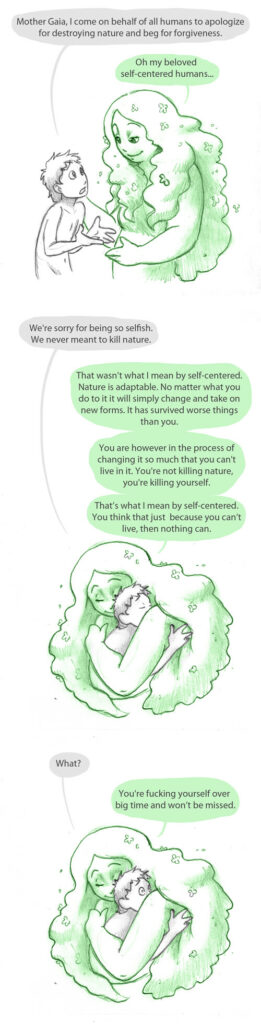
For 200 years, capitalism, for the last 40 years #neoliberalism, taught us that we’re isolated individuals who compete to survive. But any real view of our actual history – and our biology – say the opposite: we’re interdependent, social, and ecological beings. For almost all species time before the current mess, we thrived through commons-based systems, shared forests, grazing lands, rivers, and community knowledge. Villages maintained open wells, fishermen shared tidal calendars, and guilds protected collective craft standards. Cooperation, not competition, is what allowed us to endure.
This is why now alt tech, matters, it is about rediscovering, what makes us human, the digital form of that is commoning online. Just as medieval commons were fenced off during enclosure, our early digital commons were captured by #dotcons. Rebuilding the #openweb is the act of reclaiming that shared ground, not nostalgia, but in the era of #climatechaos and hard right shift its #KISS survival.
What we need to compost is our own-shared memory. The commons are missing from today’s “common sense”. The idea that people can manage shared resources together has vanished from public imagination. Yet the commons is the older, more adaptive, and far more humane way of organizing.
In tech, the #Fediverse shows this in action, thousands of community run servers cooperating through a shared protocol, ActivityPub. Projects like #PeerTube, #Pixelfed, or #Funkwhale replace enclosure with federation, showing that open paths can scale through trust rather than control. Alt tech, built on open protocols and co-governance, is simply the digital commons rebooted, a network of networks where no one owns the whole.
We need much more resources and focus pushed into this real grassroots path of reclaiming the means of communication, in the 1990s and early 2000s, the internet was all ready a commons: decentralized, people-driven, and impactful. Early #Indymedia collectives covered protests outside mainstream #blocking narratives. #4opens email lists and wikis built movements across borders. Then capital pushed in, WE let the #nastyfew of #Facebook, #Google etc privatize our collective infrastructure, turning participation into surveillance and creativity into content.
Alt tech projects like the #OMN (Open Media Network), Mastodon, and wider #Fediverse are attempts to rebuild what we keep forgetting, this time, protected by #4opens shield to build shared governance. This path is not a nostalgic throwback, but living/acting paths for post-capitalist communication we need in the growing era of social backdown.
It’s not only “tech” – it’s social trust infrastructure. A common is not only software; it’s the culture of cooperation that surrounds it, shared values, mutual aid, and relational ethics, you can’t “code” trust into hardware, as the last decade of #blockchain and #AI mess proves. Smart contracts failed to make people honest; they just automated mistrust, it’s on going #geekproblem blindness we need to be working to compost.
What works, the resilience, comes from people, not algorithms. Through frameworks like the #4opens: open data, open code, open standards, open process. We can build transparency and accountability into the social layer of the network. Trust is a practice, not a protocol #KISS
We need a future that’s better, not just less bad. The #deathcult story – neoliberalism’s great myth – says “there is no alternative.” Alt tech is the alternative, working proof that cooperation scales, that people build shared infrastructure without extraction and less coercion. Look at LibreOffice, Wikipedia, Linux, or the #Fediverse, all imperfect, collaborative systems built on trust, not profit. They are real-world examples of how collective will outperform the normal deadened paths of corporate hierarchy.
Alt tech gives us believable hope, which is the only real antidote to despair and apathy. The ground for grassroots power is in pushing change and challenge. If the liberal state and #dotcons won’t reform, we need to be building parallel structures that work differently. Projects like the #OGB (Open Governance Body) experiment with federated, transparent decision-making. The #OMN builds tools to connect grassroots media in trust networks, bypassing gatekeepers entirely. Together they form a scaffolding of a working commons, capable of hosting culture, not only control.
Healing the social media wound? We need to compost the lie of #dotcons which spent the last 20 years turning us into consumers and outrage machines. The shovel we need is affinity groups rebuilding social tech around self-governance, interoperability, and most importantly trust to reclaim the human side of the internet. Imagine the world different, feeds that empower communities, not advertisers, tools that nurture relationships, not metrics, platforms that amplify context, not conflict.
This is the work of making the internet human again, working together on the path of alt tech matters because it’s not about gadgets; it’s about freedom, community, and survival. It’s our path to remembering that the #openweb, like the Earth itself, belongs to everyone, or it belongs to no one. And every time we build a shared tool, or hold open a door, we remind the world that cooperation is not naïve, it’s our oldest #KISS technology.
A cross-cultural conversation on this subject
UPDATE: I haven’t touched on two other #4opens projects here, so let’s tap them at the end: #Nostr is a “me-too” project stuck in the #geekproblem loop, it won’t go anywhere until it learns to value community as a building block. #Bluesky, on the other hand, is already drifting into the hands of VC-funded #fluffy elitists who turn every commons into a brand. It’s a very likely a dead-end for real change or challenge, which is why the #mainstreaming#blocking#NGO and #fashionista crowds flock to it.
UPDATE 02: Digesting the comments. For the past 10,000 years of agriculture, 500+ years of Euro-colonialism, 200+ years of #capitalism, and 95 years of #neoliberalism (45 officially declared as such), the #nastyfew practicing control through production have dominated everyone else. Capitalism, as described in Capital, grew wherever it could. By the late 19th century, labour organised and fought back. Social democracy transformed the capitalist state so effectively that capitalist development stalled by the 1930s.
The response? A reorganisation of capital, using anti-communism as its rallying cry (WWII, NATO, Korea, Vietnam) to defeat social democracy and retake control of the state. By the 1980s, “they” felt secure enough to brand reform itself as a product: #Neoliberalism. I’m simplifying, of course – this is for the #hashtagStory outreach, so it can become a #KISS tool people can actually use. Clarifications and deeper dives you can find in the comments 🙂
Now, about this idea that “capitalism told us we’re isolated individuals competing to survive.” It’s partly true, but not in the way people think. Capitalism depends on interdependence, we work together to produce, but in a way that isolates us socially and politically. That’s the contradiction: interdependence turned into alienation. It’s the mess in our heads that recreates these bad social structures, the inner factory of control. That’s what we have to compost.
In the end, it’s not just social control, it’s social destruction. As we rush deeper into #climatechaos and the global hard-right turn, it’s clearer than ever: the ideology of separation keeps power safe and people powerless. I know this isn’t #mainstreaming liberal logic, that’s the point. We have to think differently.
And for context, I’m not speaking from the sidelines – I’ve got an MA in politics and 30 years of hands-on work in grassroots #openweb tech. Isolation is social control, see #stupidindividualism. Let’s keep this grounded and not turn it into trolling, yeah?
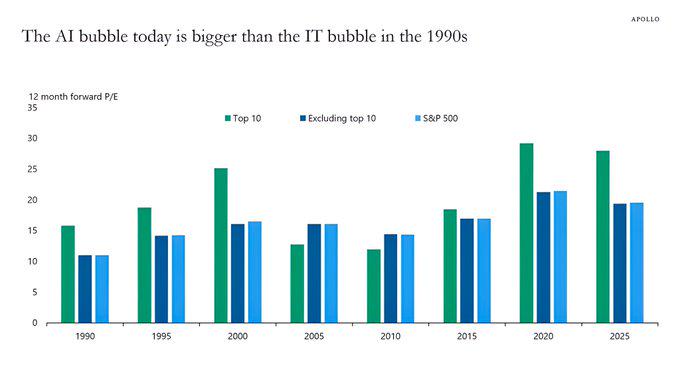
The path the #mainstreaming in tech is taking is clear. #AI is fashion, the valuations are absurd, the cost structures unsustainable, and the hype cycle feels like it’s already outpacing reality.
We’ve been here before, dot.com déjà vu. The #dotcons bubble of 2000 was built on fake demand and fantasy valuations. Venture capital flooded into half-baked platforms that promised to “reinvent” everything, while the effect was to hollow out and enclose the native #openweb. When the bubble burst, it wasn’t just investors who lost, the damage was social, cultural, and technological, it’s the mess we are in today.
The AI bubble, 2025 edition, we’re watching the same movie again, only bigger and nastier. This time, the hype engine is driven by press releases and corporate lobbying, amplified by blinded compliant media desperate to see the next miracle story. Every company claims they’re solving “the biggest problem” with AI. But lift the lid, the rhetoric, and what remains? Business models that don’t add value, expensive wrappers around existing tools. Unsustainable costs – GPU farms burning cash and carbon in equal measure. Speculation over substance, #nastyfew investors betting on domination rather than usefulness.
Why this round may be worse, at least the #dotcons bubble left some infrastructure we could build on: fibre, hosting, and the spread of the web itself. The #AI bubble looks different, as it centralises power even further in the hands of a few #dotcons. Accelerates #climatechaos through energy-intensive training runs and datacentre inflation. It undermines our flawed democracies, trust in media and knowledge with floods of synthetic content.
https://www.youtube.com/watch?v=6e1Tqc_rWeQ
The ending to this video is a shocker, but not unsepreising when you look at the context of the video.
Instead of building open, federated, useful tools, we’re watching another round of #techshit enclosure, hype and money funnelling into projects that can’t last, but which will leave more #techshit scorched-earth legacy when they collapse. The #dotcons crash was messy, the AI crash could be toxic.
What can people do to walk away from this mess? How do you help with the #OMN and #4opens? The AI bubble shows what happens when tech is built on the normal hype, enclosure, and extraction on the #dotcons path. The #OMN is the opposite of this. It’s about building trust-based, federated networks where media, knowledge, and tools aren’t just another asset class to be bought and sold. The #4opens are the activist #FOSS antidote to bubble logic:
Open Data – No black boxes. If #AI is going to be part of any future, the training data, biases, and methods must be transparent, not locked up by Google, OpenAI, or Microsoft.
Open Code – Instead of closed, centralised data sets and platforms that extract rent, we need free/libre code anyone can run, fork, and improve.
Open Standards – The current AI mess is about silos and monopolies. Federated standards (like ActivityPub for social) are how we work to keep diversity alive and break enclosure.
Open Process – The opposite of corporate secrecy and hype. Decisions need to be made in the open, accountable to communities, not hidden boardrooms or PR cycles.
The #AI bubble is the normal every day #deathcult logic of the #dotcons playing out again: extract, enclose, collapse, repeat. The #OMN and #4opens give us a way to compost this mess into something more fertile. From enclosure → to federation. From secrecy → to openness. From hype cycles → to slow, messy, sustainable growth.
If we don’t actively build and defend this needed native path, we’ll be left cleaning up another round of collapse, only this time with more concentration of power, more environmental damage, and a deeper erosion of trust. The choice is simple: do we keep betting on bubbles, or do we build commons?
And the path is #KISS, so people please don’t be a prat about this, thanks.
Full film Fail Safe (1964) is a cultural mirror, from another age, that helps us think about the next ten years of mess. With technical systems out of human control. The film’s malfunctioning machines map directly onto today’s algorithmic governance (#dotcons, #AI, automated warfare). Once the chain starts, humans can’t pull back.
Leadership under impossible pressure. Henry Fonda’s president embodies the loneliness of decision-making when systems collapse. Compare that to our current leaders, who are weaker, more performative, and less willing to carry the weight of consequence.
The Professor’s logic vs. human life: Matthau’s cold “game theory” feels like the #neoliberal technocrat mindset – numbers over people, outcomes over ethics.
The unthinkable concessions of the ending forces us to imagine the price of avoiding total annihilation – not a win/lose game, but a choice between different forms of catastrophe. That’s climate politics, resource wars, pandemics, and #dotcons algorithm risk we face.
What lessons can we learn for the next decade? System fragility is the real enemy – climate systems, financial systems, digital platforms: one glitch, and collapse ripples out. We don’t have the principle modernism, Fonda’s gravitas – our current elitists class are hollowed out by #PR driven populism; when the crisis comes, trust won’t be there. The “Professor” mindset dominates – policy is still guided by “hard” data, models, metrics, and “rational actors,” even though reality has long escaped those dogmatic frames. Watching Fail Safe today is like watching the #deathcult’s worldview in black and white: centralized control, elitist decision-making, people as statistics.
What we need is open, collective mediation – instead of waiting for one lonely leader in a bunker, we need horizontal systems (#OMN, #openweb) that can act before catastrophe hardens. The #OMN and the #openweb reboot are the anti–Fail Safe projects: decentralize agency, mediate conflict before escalation, building trust outside fragile centralized systems. It’s a powerful film, because it frames the stakes not just as “politics” but as civilizational survival.
It’s a film of our times, what can we learn for the #openweb? In 1964, Sidney Lumet’s Fail Safe held its audience in terrified silence. A simple technical malfunction – a misread code – sent American bombers hurtling toward Moscow. No one could call them back. The world’s survival depended on one president’s unthinkable decision. It was fiction, but it spoke to a truth of the nuclear age: centralized systems, once in motion, cannot be controlled.
Sixty years later, we are in our own Fail Safe moment – but this time the system is digital. The malfunction, is #neoliberalism embedded in our algorithmic #dotcons pipelines. As we push more #AI moderation system, hallucinates flags, the error replicates at machine speed across platforms. What began as a technical hiccup hardens into policy. Governments, seeing chaos, step in “to restore order.” dictators empower security agencies to control networks, to stabilise their hold on power. Like the bomber wings in Fail Safe, the system escalates itself. Once the order is given, there is no recall code.
The #OMN alternative to this is #KISS we need to build is affinity groups on the #openweb – messy, small, federated – to keep our communities talking. Instead of one brittle command chain, thousands of small nodes exchange trust. Instead of a sinal voice, a new signal-to-noise ratio emerges. This slows the shift right. People can begin to rebuild, bottom-up.
Fail Safe ended in tragedy, with a president sacrificing New York to prevent global annihilation. It was a portrait of lonely leadership in a centralised system gone haywire.
Our age offers another path. The lesson is stark that In centralised systems, malfunction = collapse. In federated, mediated systems, failure = resilience. The #openweb reboot is not about nostalgia for old tech. It’s about building structures that can survive the malfunctions ahead. When the next ten years are defined by glitches, spirals, and breakdowns – and they will be – then the survival of our social fabric depends on embracing the horizontal path.
The nuclear age taught us that a single misread code could end the world. The algorithmic age is teaching us that the current glitch could end society.
The #openweb native path gives us more of a chance to be Fail Safe.
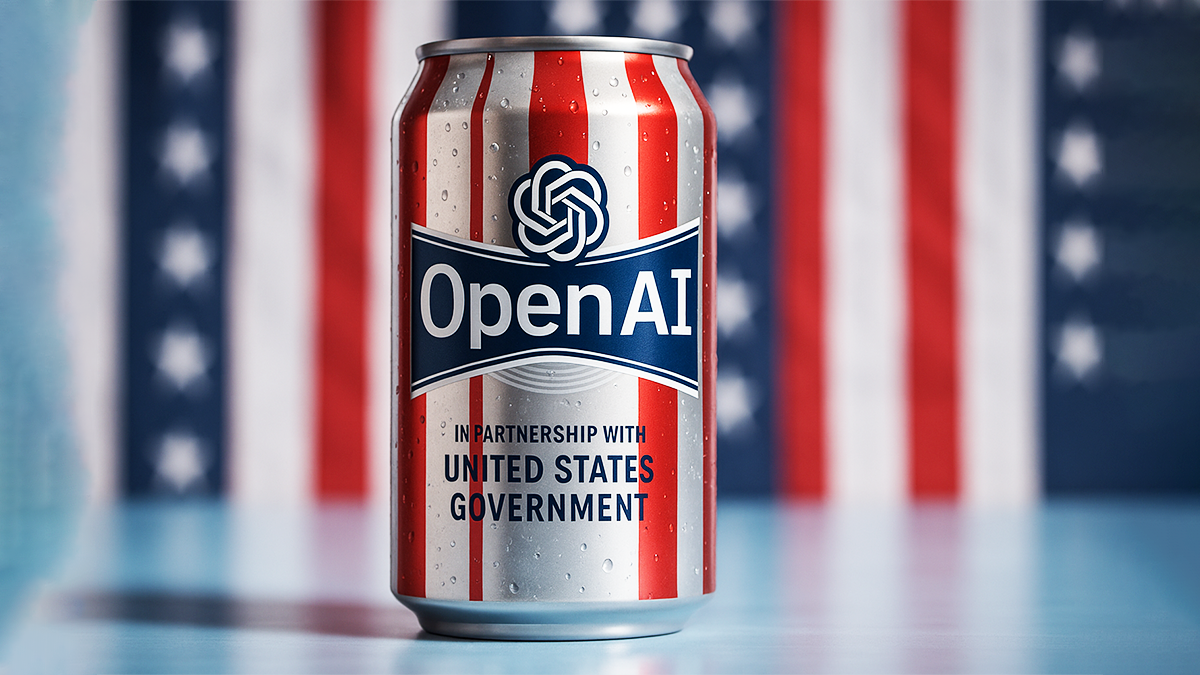
In the USA #techshit mess, #OpenAI is busy wrapping itself in the stars and stripes, pushing the fantasy of “democratic AI” while the democracy fig leaf is withering. This isn’t democracy – it’s branding. It’s the normal Silicon Valley laundering greed through the American imperialism.
The #nastyfew, Sam Altman, Larry Ellison, Masayoshi Son, and the Saudis will do fine. They’ll gorge on taxpayer, subsides, pouring billions down the drain, just like the political as normal boondoggles – the useless littoral ships, the Foxconn ghost factory. It’s all the same scam: shovel public money into private pockets, call it progress, leave wreckage behind.
This is the everyday #deathcult at work. The language of freedom and democracy as always been hollow, with the smoke and mirrors hiding corporate profit motives, sprayed in red, white, and blue gloss. They, the #nastyfew and their acolytes, were never building tools for people, they’re entrenching power, exporting Silicon Valley’s #dotcons extraction model under state sanction.
The rest of us? We get the surveillance, the climate wreckage, the bill. The only thing “democratic” about this current #AI path is how widely the costs will be socialized while the profits remain privatized.
What we don’t need is more Silicon Valley scams draped in flags. We don’t need “democratic AI” pushing billionaire control. What we do need is a living alternative: like the #OMN path.
The #OpenMediaNetwork isn’t built on subsidies for the #nastyfew, it’s built on trust, transparency, and tools for the many. It’s messy, human, and alive, rejecting the hollow language of branding and growing on the grounded: #4opens for media, code, governance, and community.
The #OMN path says: we don’t wait for corporations to drip-feed us “freedom” while chaining us with surveillance. We build our own networks. We create media that resists capture. We code grassroots protocols that put groups first, not extractive markets. We reclaim the #openweb as commons, not as the current shackled slave plantation.
This is the real “democracy” they are terrified about, and why they keep pushing their stage-managed branding “democracy” exercise. We need instead people creating together, federating, refusing capture, building resilience in the cracks of the failing empire. The #deathcult is extraction, distraction, and decay. The #OMN is life, connection, and power in our hands. The choice is simple. Which side are you on?
The #dotcons sell us lies. Shiny apps. Smooth words. Addictive feeds. It’s branded corporate greed wrapped in a digital addiction – the drug of distraction, sold to us as “connection.”
The #nastyfew billionaires gorge. They own the servers, the wires, the algorithms. They gorge on our clicks, our labour, our lives. And the rest of us pay.
We pay in surveillance. We pay in broken trust. We pay in climate wreckage, while their jets and data centres burn the sky. The bill is dumped in our laps. That’s the #deathcult we all worship.
But we have a choice. If we choose a different path, we don’t need their tools. We don’t need their lies. We don’t need their cages.
We build our own paths. Messy, raw, imperfect – but ours. That’s the #4opens. That’s the #OMN path.
Not for the market. For the people. Not top-down. Ground-up. Group-first. Trust-first. Messy, real, alive.
This is democracy they cannot script. This is media they cannot buy. This is the #openweb commons, we create together, not consume alone.
The choice is simple. Kneel to the #dotcons. Or rise up, and rebuild the #openweb.
It happens every time. A fresh grassroots project kicks off, chaotic, joyful, full of promise. The code is rough, the conversations messy, but the energy is real. People come together not for money or prestige, but because something needs doing and no one else will do it.
Then, they arrive, the careerists, the chancers, the opportunists who talk a good game of “community” and “values” while quietly positioning themselves for influence, funding, reputation. You know these people, they start “facilitating” things, pushing for “professionalism,” organising pointless panels, and – without fail – introduce hierarchical management logic dressed in pseudo-horizontal language.
Soon, the messy collective space becomes an application form, organic conversations shift to curated “working groups”, governance becomes gatekeeping, code becomes control.
Careerism is a cultural virus, OK, these people aren’t evil villains, they’re simply products of their environment, trained to extract value, shape narratives, and build CVs. But their impact is destructive, even if unintentional. What they bring with them is the #mainstreaming mindset, a default toward #NGO logic, safe liberalism, risk-aversion, and the slow suffocation of wild experimentation.
They start to block with niceness., they silence with process, they smother with “inclusivity” until there’s no air left to breathe. When people question this, then they start to become nasty, trolling, blocking and finally ignoring runs its predictable course…
Examples? Let’s name some very formiler patterns:
The Self-Appointed Spokesperson – Shows up late, speaks the loudest, builds a personal brand on the back of others’ labour.

The Grant-Whisperer – Always chasing the next funder, reshaping the project to fit what’s "deliverable" instead of what’s needed.

The Gatekeeping Ally – Claims to represent the marginalised, while shutting down dissent and complexity with soft authoritarianism.

The #NGO Zombie – Thinks every grassroots space needs a board, a charter, and a code of conduct before it needs trust or purpose.

The Pivot Junkie – Tries to steer the project toward startup land “just to be sustainable,” and ends up reinventing capitalism in #FOSS clothes.
These types thrive when horizontality lacks grounding. On the path we need to take, “cancel culture” is a cul-de-sac. Blocking them just makes them martyrs. Ignoring them lets them take over. The alternative? Compost them, let their bullshit rot in the open, call things what they are. Tech is political, values are not neutral. What to do? Compost, don’t cancel.
To reboot the #openweb and keep it rooted in the #4opens: Open Code, Open Data, Open Standards, Open Process. Rebooting needs resistance, we have to build spaces that are both porous and protected, we need, paths and spaces with membranes, not walls. Trust-based collectives with clear boundaries. If someone’s treating your community like a stepping stone, show them the compost bin. If someone’s building with care, humility, and rootedness, then share our tools with them.
This is not a purity test, it’s composting as culture, if something smells off, trust your nose. Because if we don’t get serious about this, the chancers will take over. They always do. Unless we make the path too muddy for them to walk it.
A core problem is that too many “open” tech projects try to model social relations after code workflows rather than shaping code to reflect healthy social processes. Ersatz writing, ersatz governance and the slow death of the #openweb. We’re living through a wave of fakery. The #AI hype machine spews endless streams of ersatz writing – grammatically perfect, stylistically smooth, and hollow. It feels like content but carries no lived experience, no rooted context, no risk. Unedited, it’s a shadow play of culture.
The same hollowness infects too many horizontal tech spaces. Here, we find ersatz governance – systems that borrow the forms of openness and collaboration, but replace the substance with tech bureaucracy. Instead of starting from lived social practice, they mimic software workflows: people reduced to issue tickets, trust replaced by “process,” culture swapped for sprint planning. The result is the same as with AI: the outputs are technically competent but socially dead.
When governance is reduced to process, the door swings open for the chancers, the careerists, and the #NGO climbers. They’re fluent in the language of inclusivity and consensus, but they’re not here to build, these people thrive in systems where nothing is anchored in lived trust or collective history. In such environments, appearances are reality, and they control the appearance.
The mirror needs to flip, healthy social production can inspire healthy code production, but trying to run human interaction like a Git repo produces brittle, alienating cultures. We see it in the #Fediverse right now: meetings full of procedure but no warmth; #PRs merged while communities fracture; polished governance documents for projects this pointlessness.
The #openweb was never meant to be safe for professional managers of openness. It was meant to be a living commons, messy, unpredictable, full of disagreements and breakthroughs. If we can root our governance in actual relationships rather than corporate abstractions, we can build tech that reflects community rather than forcing community to reflect tech. Otherwise, we’ll just have two hollow empires – AI’s Ersatz Writing on one side, and our own Ersatz Governance on the other – both looking open, both feeling dead.
Almost everything built in today’s alt-radical tech scene is, bluntly, pointless. Despite good intentions, most of it ends up feeding the endless cycle of #fashernista churn, flashy new platforms, bleeding-edge protocols, or encrypted communication tools nobody uses, built by isolated teams disconnected from real-world needs or history. This is the #geekproblem: a culture where novelty is fetishized, and social usefulness is an afterthought, if it appears at all.
Examples:
Secure scrolling tools: Every few months we see new chat apps, usually cryptographic fortresses with no communities. No one’s asking what these tools are for beyond vague abstractions like “privacy” or “freedom.” Tools without context.
Peer-to-peer silos: Projects like Secure Scuttlebutt (SSB) or many DAT spin-offs build entirely new social ecosystems that demand complete buy-in, rather than integrate into existing networks. What results is islands of lonely idealists yelling into empty timelines.
Protocol over people: Many Fediverse projects argue endlessly over specs like #ActivityPub or #Nostr, often prioritizing purity over pragmatism. What good is a protocol if no one actually uses it beyond a few devs congratulating themselves?
Why #indymediaback isn’t a pointless tech project, it offers something truly different. It is not “new.” It doesn’t pretend to invent a whole new ecosystem. It is an act of digital memory, a revival of the still-needed infrastructure that once helped build radical networks globally. #Indymedia worked. It published resistance. It distributed power. It was embedded in real communities and real movements. This is #nothingnew done right.
The #nothingnew approach mediates against the churn by reusing workflows, social trust, and existing cultural practices. It doesn’t ignore tech, it grounds tech. Examples:
#indymediaback uses simple publish-form-comment workflows, already familiar. No #AI, no #blockchain, no obscure identity layer. Just people posting and curating stories.

It connects to existing radical spaces: housing co-ops, street kitchens, climate camps—places where digital tools are needed right now, and where the point isn’t building a unicorn startup but having a place to publish the truth when the cops are lying again.
Why copying #dotcons isn’t enough, in the #fediverse we so far have replicate Twitter, YouTube, and Instagram — Mastodon, PeerTube, PixelFed. This is useful, to a point. But all code is ideology. Copying capitalist infrastructure dose smuggle in capitalist logic. Copying invites the #deathcult right back in through the side door.
indymediaback avoids this trap. It doesn’t replicate any#dotcons logic or UX patterns. It revives a publishing common that worked before Silicon Valley captured this path. And more importantly, it’s embedded in a set of radical social practices: the #PGA hallmarks, the #4opens, and the messy, beautiful legacy of grassroots movements who already knew how to organize.
The value of #indymediaback isn’t just in tech. It’s in trust-based social continuity, the hidden glue of any working movement. Without this, you don’t have a radical tech project. You have a ghost repo on GitHub. That’s the central point, without real community, without continuity, without trust, radical tech is a dead end.
This is the carrot and stick we need now. If you care about the #openweb as a human value network, not just a protocol playground, you have to build things people can use today, and that people want to use, not because it’s encrypted or federated, but because it serves a purpose they already have.
This is where the wider #OMN (Open Media Network) comes in. It’s not another protocol war. It’s a shovel to compost the inhuman mess we’ve inherited. It’s a framework built with the #4opens, to grow digital commons that don’t depend on VC, control freaks, or fashion. It’s where we build bridges between radical tech projects, rather than isolate ourselves in yet another Git-based castle.
In short, it’s a path of people over product, process over platform. We don’t need more “solutions.” We need to stop being prats, pick up the tools we already have, and start rebuilding.
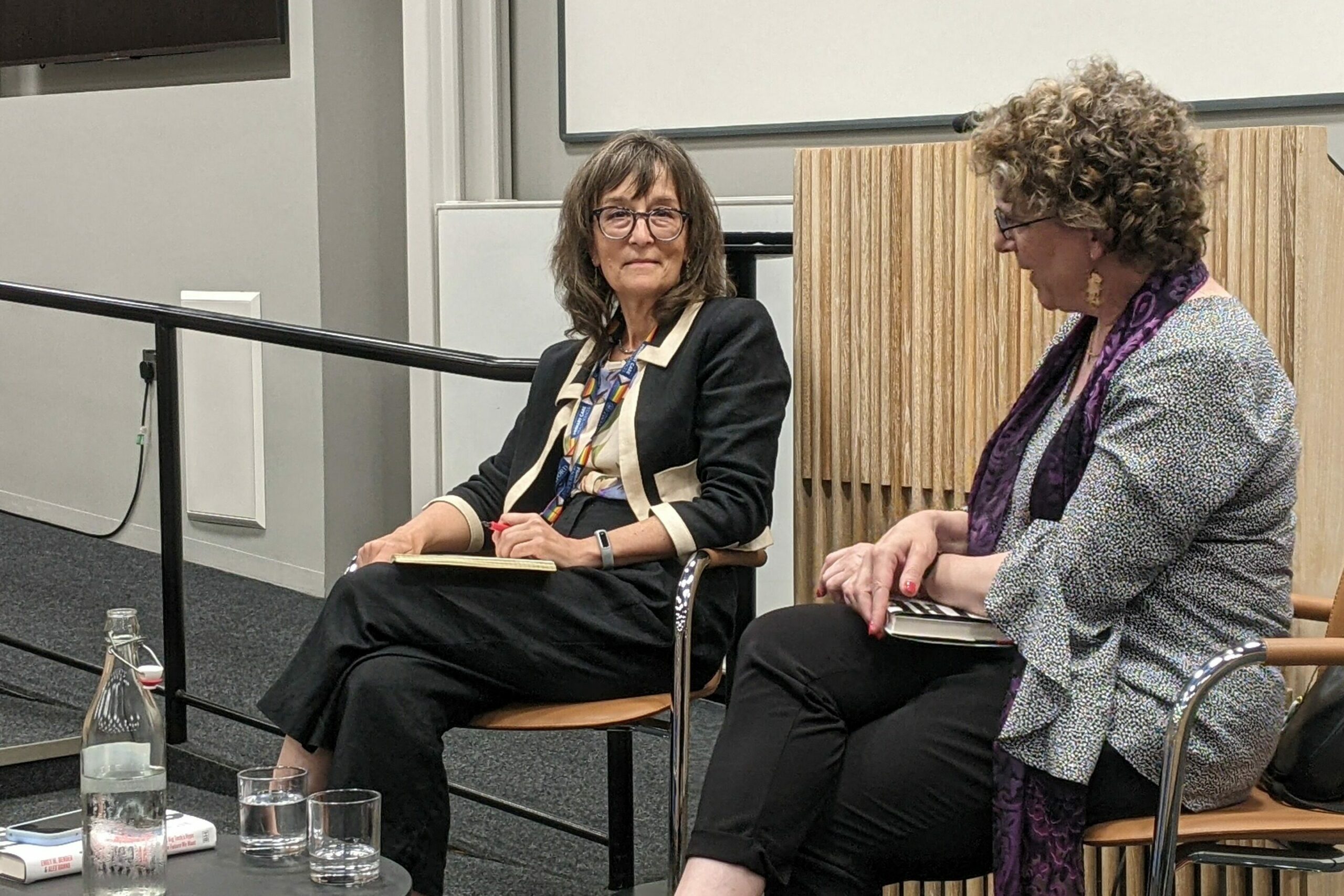
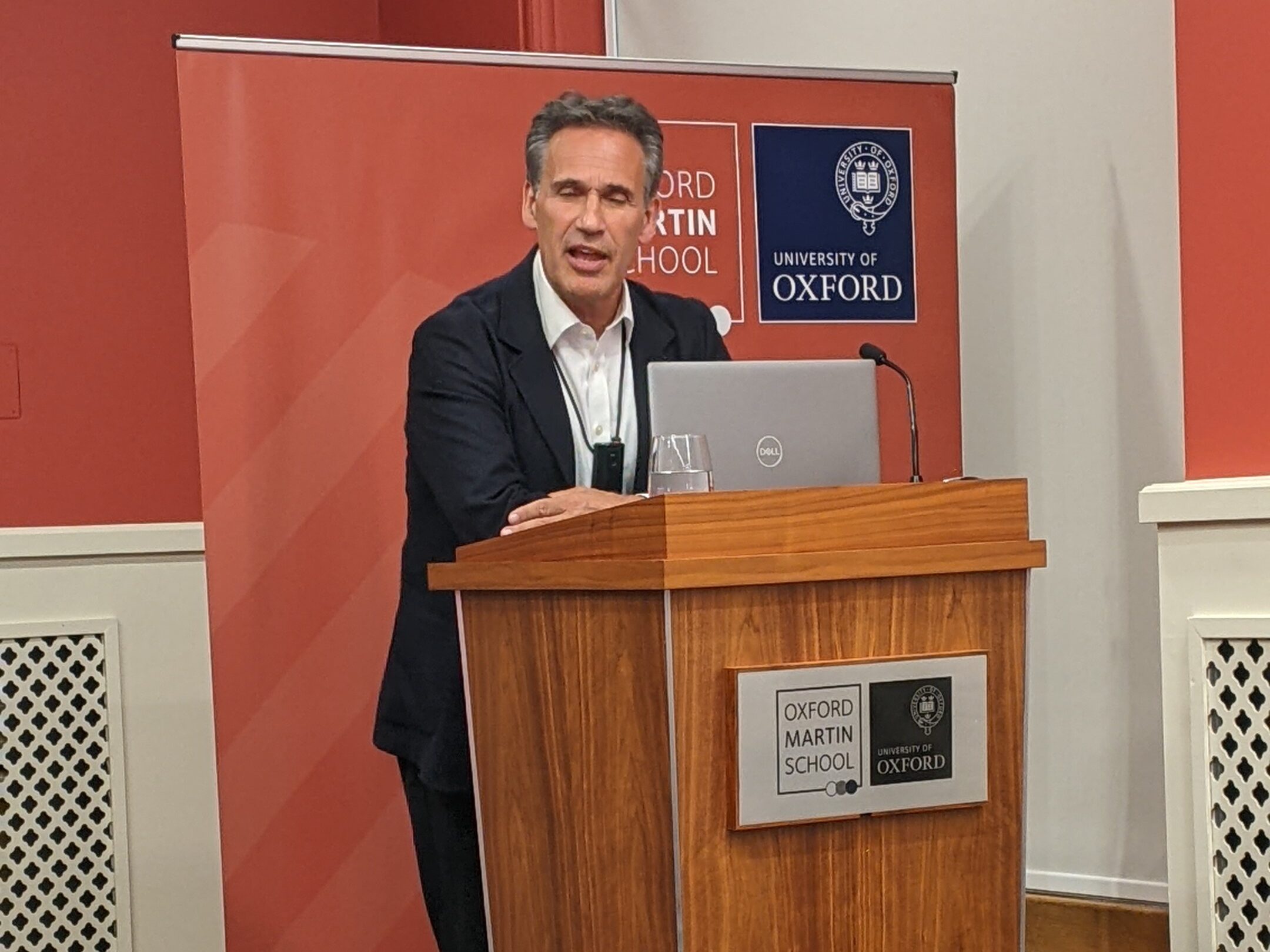
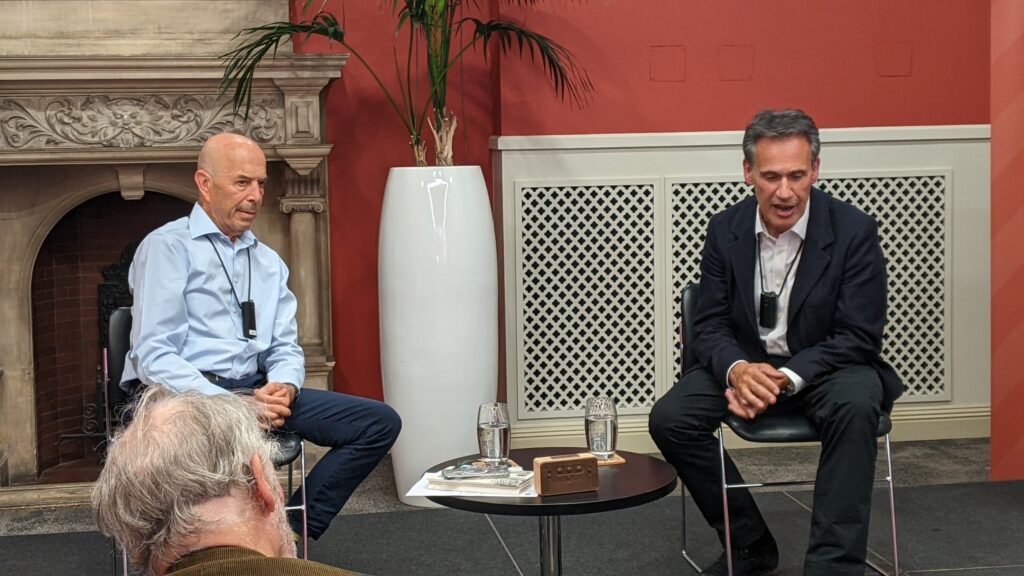
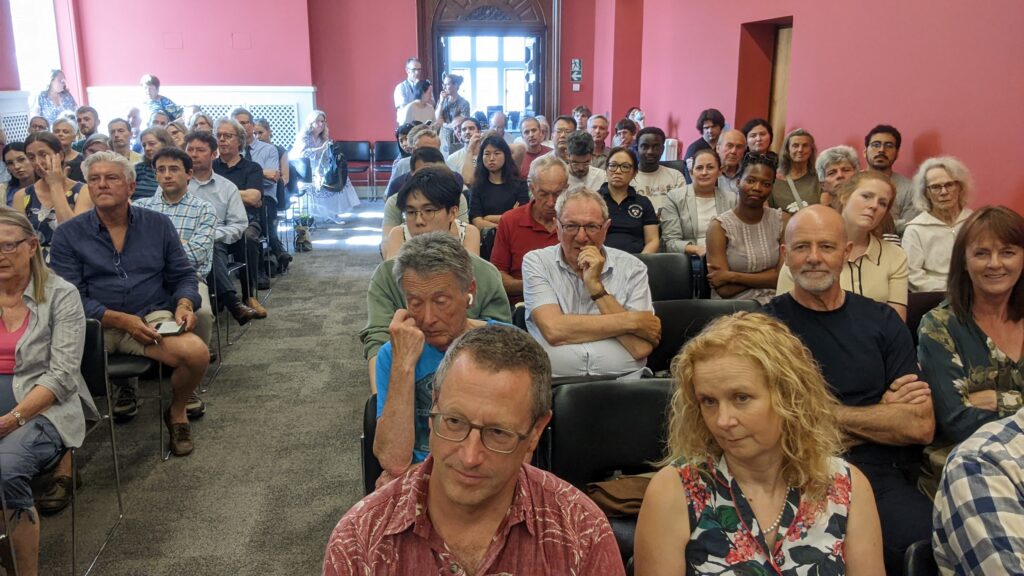
This week, Dr. Emily M. Bender (University of Washington), co-author of The AI Con, delivered a much-needed reality check in Oxford, cutting through the fog of #AI PR myths and techno-dystopian smoke. In The Q&A by Professor Catherine Pope (Nuffield Dept. of Primary Care), the conversation explored how AI is being used not to elevate us, but to devalue human creativity, justify surveillance, and concentrate wealth and power in the bands of the #nastyfew
This wasn’t the normal breathless “future of work” keynote. It was a call to arms about the AI Con – What Are We Really Being Sold? Dr. Bender, known for coining the term stochastic parrot, highlights how AI hype isn’t just noise – it’s a strategy, to push unregulated, underperforming, resource-hungry technologies into every part of society. It turns complex problems into opportunities to extract data, deskill more workers, and justify more austerity.
We’re not being sold intelligence, we’re being sold plagiarism machines that mimic but don’t understand, synthetic text extruders trained to sound right, but to often hallucinate. Mathy-maths cloaked in prestige, built on broken benchmarks like the Turing Test – long since reduced to a measure of gullibility.
Anthropomorphism by design, responsibility by none, is insidious that AI systems are designed to mimic humanity. They pull users in through anthropomorphism, but when something goes wrong, no one is held responsible. Not the engineers, not the companies, not the funders. Just the user caught in the middle. As Dr. Bender and others have pointed out, there’s no “intelligence” in AI, just statistics, training data, and the motives of those who built it.
What’s Lost in the Hype?
“We used to do language translation better with fewer resources.”
“Cloud computing is a lie, it’s just someone else’s server burning through energy and water.”
These are the quiet truths ignored by AI boosterism. Dr. Bender laid bare the ecological, cognitive, and political costs:
Corruption pushing ecological waste: AI training and cloud infrastructure depend on water, energy, and mining—routed not where they’re sustainable, but where regulation is weak.

Erosion of trust: Models trained to sound authoritative spread confident falsehoods, degrading public discourse.

Security risks: Code generation tools are notoriously lax, riddled with hallucinations and vulnerabilities.

Dehumanisation of labour: AI doesn't replace bad jobs with good ones, it turns good work into mechanical “oversight” roles, where humans are paid to babysit broken systems.
And in health and care, where these technologies are increasingly being pushed, the stakes are life, dignity, and wellbeing.
What I have personal found is that Oxford is feeding its brightest minds into AI. As institutions bend to corporate funding and hype cycles, critique becomes harder, not easier. But critique is essential. This is a fight about who benefits, and who bears the cost.
Like the Luddites of the 19th century, we’re not against machines, we’re against machines used against us. The Luddites knew that the issue wasn’t the loom, it was who owned the loom. That’s why we need more conversations like this. Not just about what AI is, but about what kind of society we want. And more importantly, who gets to decide.
What could work on these tech pats is:
Smaller, dumber, domain-specific models where needed.
Open standards, not closed corporate APIs.
Tech built with consent, accountability, and ecological limits.
A refusal to let “innovation” be an excuse to undermine public infrastructure.
Above all, we need to centre people, not profit, humility, not hype. Very important not to be a prat about this.
Ten years ago, I remember being told, often condescendingly, with smug certainty, that hosting in the cloud was the future, and that what I was working on, #DIY grassroots, self and community hosted tech was the dinosaur, a dead end, old obsolete thinking, out of touch. Despite spending years pointing out the obvious flaws in this thinking, I got only that my “native” path was irrelevant, for Luddites, they said. Legacy thinking, dead tech walking.
Well, here we are, a decade later. And guess what the cloud: It was expensive, less performant, less secure, and a gateway to increasingly exploitative pricing models. This isn’t hindsight bias, the warning signs were always there. But many #fahernista and #geekproblem people get caught up in the glossy surface and tech hype mess, repeating the same mistake we’ve made across generations of #geekproblem tech, believing scale and #PR buzzwords were synonymous with any progress at all.
Let’s now be clear on what actually happened.
We handed over infrastructure to a handful of giant platforms that lock us in and bleed us dry.
We lost resilience, any sovereignty, and basic control over our own data.
We normalized rent-seeking as a business model.
We pushed decentralization off a cliff and called it “abstraction.”
Meanwhile, local compute got cheaper, storage exploded in affordability, bandwidth costs continued to fall, #dotcons threats increased. And guess what? Running things locally started making sense again, just like it always does when the #PR smoke and mirrors clears.
The lesson, which we need to now bring to #crypto and #AI, just because something is fashionable doesn’t make it in any way real or sustainable. That tech #PR hype cycles aren’t innovation, it’s marketing. And when you stop looking at the core trends (cost, control, resilience) and just ride the buzz, you’ll end up where we are now, mess, bloated budgets, shrinking trust, and a growing #techshit pile to clean up.
As ever we need to re-learn the value of #KISS grounded thinking, to remember that local, #4opens, transparent, and interoperable #openweb systems aren’t retro, they’re essential. This isn’t about nostalgia for the old paths, It’s about having power over our basic infrastructure again. The cloud, at the time and in looking over our shoulders, was smoke and mirrors, a detour, it’s now past time to get back on the real progressive #Fediverse path.
The #openweb holds a quiet kind of power – messy, distributed, human. But I keep wondering: are people now too afraid to use that power? The sad truth is, many always were. Power isn’t something most of us are raised to understand, let alone wield in any collective way. For decades, we’ve been taught to outsource power, to institutions, to markets, to influencers. But the cracks are everywhere now, and there’s less room to pretend.
What we’re facing now isn’t theoretical, the hard right is not just consolidating power, they’re weaponizing it. They’ve successfully atomized progressive movements, through culture wars, #AI manipulation, and economic precarity, they’ve made sure many can’t even think collectively, let alone act.
And where is this leading? Let’s be blunt. They are on track to kill billions of people and vast swathes of nature over the next 100 years. This isn’t hyperbole. It’s baked into the political economy of climate collapse, border militarization, and resurgent fascism. #XR and other movements have been sounding the alarm for years, but the line just keeps going straight… into oblivion.
And yet… There is still hope. Hope doesn’t mean passive optimism, it means seeing that the little power we still have matters. That using it, no matter how small or local or chaotic, is the path we urgently need to take.
When we build on the #openweb instead of feeding the #dotcons, that’s power.
When we organize locally, build mutual aid, and share resources without gatekeepers, that’s power.
When we link, when we write, when we resist the urge to block and shame and instead connect and amplify, that’s power.
Yes, none of this is perfect, it’s not about purity, it’s about action. And that action doesn’t need to scale overnight. It just needs to grow, slow, messy, rooted. Because here’s the thing the right knows and the left forgets: Power isn’t given. It’s taken, built, and – at best – shared.
So let’s stop waiting for permission, stop fearing the imperfections. The future depends on us using the power we still have – to make more.
Themes: Climate migration, class war, migrant displacement, urban decay and adaptation, history repeating, social justice, collapse vs. transformation, DIY survival vs. institutional decay.
A post #climatechaos utopia/dystopia history of a small English town.
Timeline: THE RISING
High Ground, Low Future (2030–2040) • Begin with heavy rains and seasonal flooding becoming semi-permanent. • Newly built luxury flats on the floodplain (south and west Oxford) are damaged repeatedly, insurance pulled. • Middle-class families flee toward the older high ground of central Oxford, historically preserved college land. • Shortages emerge: housing, resources, space. The city’s delicate balance starts to tilt.
The Forgotten Periphery • Council estates and outer-suburbs, once neglected, now sink under economic collapse and water. • Local government, under austerity and national decline, offers only band-aids. • The media begins labelling displaced middle-class as “flood migrants.” Old class lines blur, but resentments remain.
Inflows (2040–2050) • Waves of international refugees arrive from southern Europe, North Africa, and beyond, fleeing unlivable heat, drought, and war. • They are pushed into the same abandoned, waterlogged spaces, flood basements, condemned buildings, unlivable prefab housing. • Tensions rise. Local institutions (universities, NGOs) create “managed zones” but lack democratic accountability.
PART TWO: THE CRACKING WALLS
Fortress Colleges • As central Oxford densifies, colleges physically re-fortify: fences, walls, biometric gates. • Students become increasingly isolated and elitist, a class divorced from the town they inhabit. • The university brands itself as a “climate solutions hub” while hoarding resources behind gates. • “Town and gown” tensions explode, again, as they have historically.
Survival Zones • #DIY mutual aid emerges on the periphery: squatted schools, rooftop farming, open food kitchens. • A rewilded floodplain becomes a hybrid of anarchic camp, cultural experiment, and survival zone. • #OMN-style p2p networks flourish, local comms, barter systems, radical #openmedia. • People from town and refugee groups begin building new alliances.
Crime and Resistance • As collapse deepens, black markets and violent survival economies grow. • A new urban underclass mixes class, background, and migration stories. • Armed policing returns. Protest turns to riot. A hybrid class-based rebellion takes shape.
PART THREE: THE NEW COMMONS
Walls Come Down (2060–2070) • A symbolic and literal breach of one of the oldest college walls (perhaps Magdalen or All Souls). • Historic parallels to the English Civil War, Chartism, and 1968 are drawn by media and rebels alike. • The breach isn’t just destruction, it opens a negotiation. Some colleges split, others double down.
New Governance Experiments • The city fractally reorganizes: into commons-based neighborhoods, flooded zones governed by cooperatives, and surviving elite zones. • #OGB and #4opens principles emerge as part of new grassroots councils and open documentation of resources and decisions. • Old institutions adapt or fall, Oxford becomes an unlikely testbed for post-collapse co-governance.
Epilogue: Memory and Flow (2080s) • A narrator looks back, possibly a second-gen refugee or an ex-college student who defected. • The floodplains are now permanent water-urban hybrids, people live, float, and thrive amid ruin. • The colleges that survived are museums or cooperatives. Others are ruins. • Oxford is no longer a university town, it is a city of memory, mess, and mutuality. • “The river won,” the narrator says. “And so did we, in the end. But only by letting go of what we were trying to hold onto.”
Character Arcs
• Leila – Teenage refugee who becomes an organiser in the rewilded zones. From scavenger to community focus.
• Tom – Displaced academic’s son, who rejects the college class and becomes a chronicler of the commons.
• Dr. Carter – Disillusioned researcher who defects from the university to join the resistance.
• Abigail Crowthorne – academic turned dictator
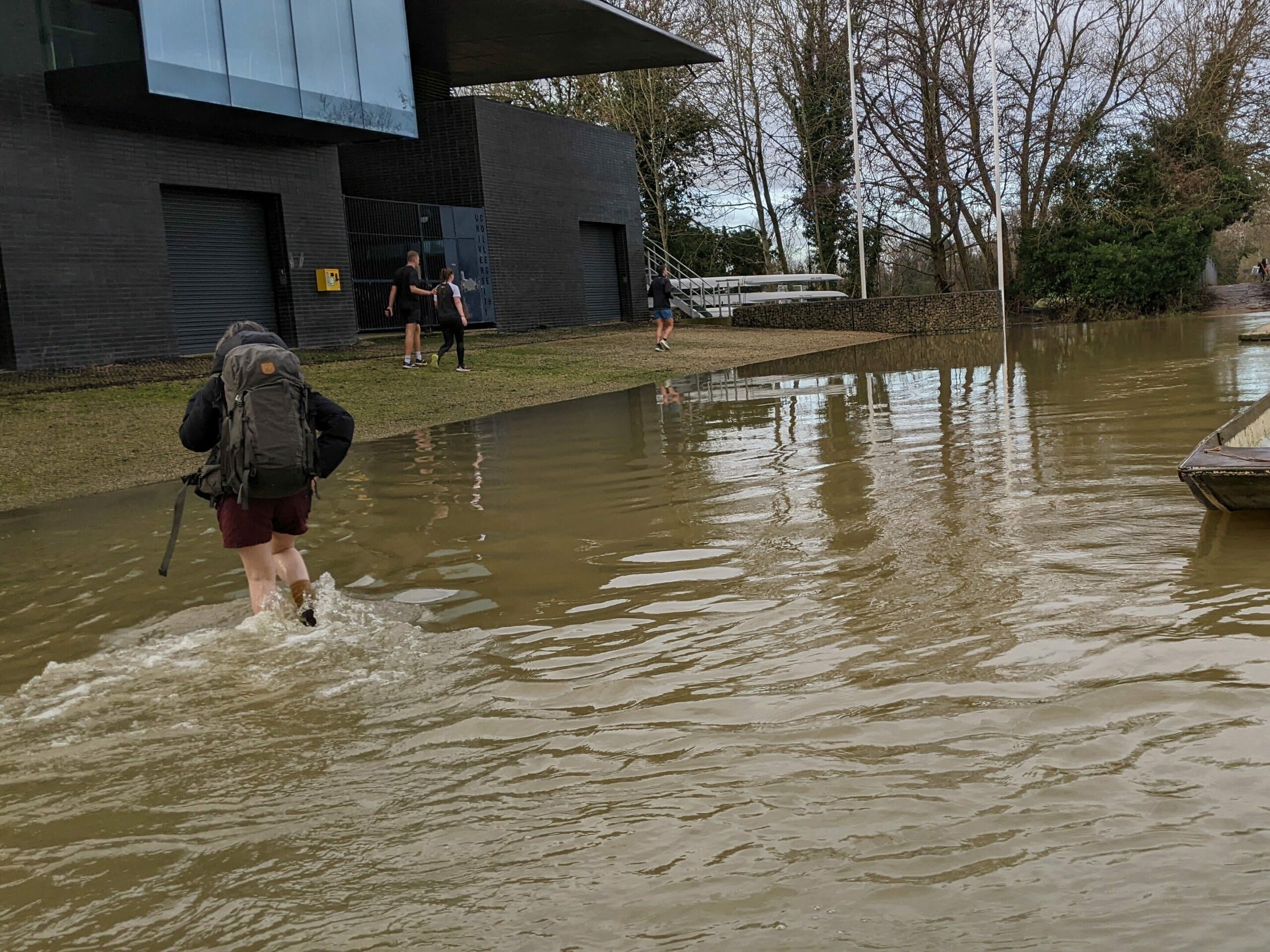
Last years floods in Oxford
The Story
Introduces two of the protagonists – Tom and Leila – at a moment when the waters are rising and the old world is visibly breaking apart.
Chapter One: The Waters Came Back
Oxford, 2039. It had been raining for ten days. Not the gentle English drizzle of postcards and nostalgia. This was weight. Sheets of water crashing down in sudden violence, followed by hours of warm, oppressive mist. The kind of rain that sounded like static, like a broken signal. The kind that made you forget what dry felt like. Tom stood at the top of the Botley Ralway Bridge, shivering under a borrowed poncho, staring out at what used to be Oxford’s latest luxury housing development. “The Oxmoor Residences,” the billboard still proclaimed, water-stained and rusting. Behind it: rows of identical pale-brick buildings, their basements already submerged, their ground floors filling with thick brown water.
People had started calling this area “the bathtub.” Everyone said it with the same bitter half-joke. Half because it was funny to see posh flats drown. Half because some of them had lived there until last week.
His family had been lucky. Or connected. Or both. His dad, Professor Carter, still had access to rooms in the Merton College outer quad, though now it was just them. His mother had moved to Edinburgh, with a job and another life. Tom hadn’t gone. He liked the old city. Or had. Now, it felt like a ghost in slow motion. The water wasn’t receding. The storm drains were full. The rivers, the Thames and the Cherwell, had merged west of Christ Church Meadow. Parts of the medieval core were sandbagged. The colleges had hired private security to patrol the entrances. Outsiders were being turned away. Even some insiders. This was the future, everyone said. “The new normal,” the BBC called it, which was code for: Get used to it. You’re on your own.
At street level, below the bridge, something moved. Tom spotted her as she dragged a shopping trolley across a shallow stream that had once been a car park. A girl, no older than him, soaking wet, hood up, trousers caked in mud. She was pulling tarpaulin over a bike frame welded to a makeshift raft, where plastic crates and jerry cans were strapped down with bungee cords.
She looked up. Their eyes met, a pause. “Need help?” Tom called, more out of reflex than intention. She frowned. “Not unless you’ve got dry socks.” Tom half-laughed, climbing down the slope, sliding a little in the mud.
She didn’t offer a name. Just handed him a crate. “If it tips, I drown. You first.” They moved in silence for a while, ferrying salvaged supplies from one ruined doorway to a more stable stairwell, food tins, medical kits, bundles of wrapped clothes. Everything was damp. Everything smelled of mold.
Only once they were done did she speak again. “You from the stone zoo?” Tom blinked. “The?” “The colleges. Gated fossil farms. Big walls, rich ghosts. You’ve got the look.” He flushed. “I’m… not really part of that.” “Sure,” she said, flatly. “None of you are. Until you are.” He didn’t know what to say to that. Instead, he offered his name. “Tom.” She hesitated, then nodded. “Leila.”
That night, back in the quad, Tom couldn’t sleep. He stood in the shadow of the old city wall, staring at the black water pooling outside the west gate. Somewhere out there, Leila was hunkered down with half a dozen others in the half-collapsed shopping arcade.
Inside the colleges, the power was still on. The Wi-Fi worked. Students were live-streaming lectures about resilience and uploading essays on “ecological modernization.” There was even talk of a partnership with a venture capital firm to develop floating student housing.
Tom couldn’t stop thinking about what Leila had said. Stone zoo. Rich ghosts. And the worst part? She wasn’t wrong. The water was rising, and inside these old walls, everyone was pretending they still lived in the world before. But Tom had been outside. He’d felt the river’s edge under his feet. Change wasn’t coming. It was already here.
Chapter Two: The Dry Floor
The trick to surviving in the “bathtub” was to stay one level above the mold. Leila had learned that in the first week, after squatting a corner unit in the old Westgate Arcade with three other girls from the crossing camp. They found a stairwell with no standing water, raided camping stores before the river swallowed them, and rigged up hammocks and crates like a tree house in a mall.
Now it was her patch. No gangs. No “security.” No college kids with GoPros filming their charity rounds. Just other people like her, refugees with nowhere else to be. Western, southern, whatever. Borders meant nothing now.
She boiled water on a camping stove beside a cracked window, the condensation forming tiny rivers that ran down onto the blanket-coverd floor. The faint hum of solar inverters echoed through the walls, they had three working panels rigged from the old Apple store roof, barely enough to keep the mesh network running. That was the one thing keeping the chaos at bay: #OMN-LocalNode-OX3, the scrappy little flow server they’d found and rebooted last month. A dusty Raspberry Pi from a flooded abandoned hackspace, hidden in a sealed plastic box, it was now running a local news feed, weather alerts, water quality maps, and Wi-Fi mesh bridge for people still on the move. No logins, no tracking, no central control. Everyone just called it the Nest.
She checked her battered e-ink reader, still half-charged from last week’s sun. A new post had just dropped on the Nest from one of the Reading crews: “Silt Line Rising: Don’t trust the Southern Railway embankments – three breaks reported overnight. Heading your way. Store dry food on level three or higher. Filtration tabs being dropped by drone from #OMN-Pool. Signal weak, boost if you can. –Love and rage.”
Leila swore quietly and stood up. “Level three,” she muttered, glancing at their floor-to-ceiling waterline mark, a rainbow of old flood stains, each labelled with date and damage. The highest one, scrawled in red marker, read: “Week 3, Base collapse, Saffy broke leg, water to hip.”
That was when she’d started to understand how the new world worked. Not with governments or #NGOs. Not with police or pity. But with whisper networks and broken devices and actual people making things up as they went, and then sticking to it when the next disaster hit. There was no one to ask for help. So they helped each other.
Later that day, Leila biked, half-paddled, to the edge of the flooded business park where she knew the old Oxford Mutual Aid van had been sighted. It was painted with faded anarchist murals, a kind of folk symbol now. The side read: “We don’t fix systems. We plant wild gardens.” Inside, a woman in her forties with an Irish accent and a sticker covered battered laptop was shouting over the wind: “We’ve got confirmation from the Kent relays! London’s south loop is underwater again. Southbank mesh is dark. Brighton is gone.” Someone swore. Leila stepped in. “I can boost the Redding link. But I need one of your spare nodes.” The woman looked her over, nodding slowly. “Westgate girl, right? Take it. Mesh needs arms and legs more than theories.”
They handed her a battered router, stickered with slogans: #4opens, #DIY, #OMNseed, #NoGatekeepers. Leila grinned. “Tell your coder, this thing still smells like server room and solder.” “We’re the resistance,” the woman shrugged. “Don’t expect polish.”
Back in the arcade, that night, she rewired the new node into their roof antenna, climbing over broken solar panels and soggy roof tiles. By moonlight, she could see the edge of the colleges in the distance, golden windows and flood-lit spires, protected behind stone and guards.
She knew that Tom, that weirdly polite boy with the too-clean coat, was in there somewhere. Probably still trying to pretend history was something you read, not something that flooded into your nabourhood. But out here, in the mess, they weren’t waiting. They were building something else. Something that might just hold.
Chapter Three: Signal Bleed
Tom was not supposed to be here. Not on the NEST. Officially, college networks were sealed, “for information hygiene,” the announcement had said. “To prevent malicious interference from destabilizing actors.” But the truth was, he’d been watching for weeks. Quietly tunnelling out through an old Wi-Fi link that one of the physics dons had stashed in a directional Faraday cabinet, mostly for “civilizational curiosity.” The irony hadn’t gone unnoticed.
He tapped at the keyboard. Mesh signal was weak, bleeding in via bounce relays off the botanic garden’s old windmill antenna. Enough for plain text. The Nest was pulsing.
“Oxford node OX3 reporting flood crest 18cm higher than May average. Van from #OMN-Bristol dropped replacement filtration kits and rapid-test strips. Also a stack of zines with weird poetry and clearer disaster maps than anything from the council.”
Tom blinked. He hadn’t seen poetry in a logistics drop before. Another post caught his eye, newer: “Signal boost active. Arcade mesh live again. Thanks to #Leila_Westgate and crew. We’ll hold line until next silt wave. #DIYinfrastructure#OMNseed”
Leila. He remembered her now, she’d spoken once at a town-hall thing last autumn, a kind of rogue teach-in the college tolerated because it made them look progressive. She had talked about water tables and refugee logistics and dignity like it was a path. Everyone else talked data. She talked dirt and socks. And here she was, holding the damn network together with bike parts and grit. He leaned in. A mesh reply had come back from her node:
“Arcade net is shaky but stable. Relay functional. Can take remote logs if you’re on the loop. Leila out.”
Tom hesitated.
“Leila, I’m in Magdalen tower. Got old maps, power stats, drone cam access, maybe useful. Can’t leave the walls. Too many layers. But I want to help. – Tom” No response. He waited, chewing on the corner of a ration bar he didn’t need but ate out of habit. The computer beeped.
Then a new line:
“If you’re real, send a map overlay with sewer runoff paths and a 3-day wind forecast. That’s how the flood creeps in. Let’s see what you’ve got, tower boy.”
An hour later, Tom sent the file. Two hours after that, it was added to the main Nest node with a tag:
“Highland Intel – Source: #OMNghosttower – reliable so far. Mapping river crawl through data. Good work.”
It was the first time he’d felt useful in weeks. Not clean. Not clever. Not theoretical. Useful.
Somewhere, behind the rebuilt walls and crumbling boundaries, two different ways of life, one cloistered, one composted, had reached across the signal gap. No handshake. No peace accord. Just a small current of trust, carried over IP packet signals and flood-soaked routers. The mesh was alive.
Chapter Four: A Perfect Breakfast
In the Senior Common Room of Magdolan College, everything was just so. The linen napkins, still warm from the press, sat folded like little origami cranes beside the morning papers. The new coffy disperser, affectionately dubbed “Milton”, whirred softly as it prepared frothy oat cortados, each one poured with an elegant tulip of steamed milk.
Professor Abigail Crowthorne was reading The Times. Or rather, she was scanning the digital digest projected onto her reading spectacles while her fingers flicked idly at a fresh croissant. The flood updates, tucked neatly into a sidebar titled “Weather & Civic Affairs,” mentioned a rise in the river levels again, but she didn’t dwell.
“Frightful business,” she muttered, brushing crumbs from her wool slacks. “But the Environment Fellows are tracking it. All in hand.” Around her, others murmured in agreement. The world was, admittedly, in a bit of a muddle, it always had been, hadn’t it? But the college had reserves. Generators. Purifiers. Extra heating. And good people in the right places. Oxford had seen worse, hadn’t it? Someone turned up the radio. A polished BBC voice filtered through:
“…while localized flooding has impacted several areas, no major evacuations are currently planned for central zones. Authorities remind residents to rely on official channels and avoid unauthorized information sources or mesh relays.”
Professor Crowthorne arched an eyebrow, then smiled. “Always someone trying to stir the pot.” A few seats down, a younger lecturer, Dr. Neel Joshi, systems theory, hesitated before biting into his jam scone. “They say the mesh relays are how the southern districts are coordinating now. Since the council apps stopped updating.” “Mesh relays,” scoffed the Dean of Discipline. “You mean tinkerers with antennas and delusions of grandeur. The real problem is miscommunication. Panic travels faster than water, these days.” They all chuckled. Neel didn’t. He’d seen the outer ring, broken levees, sunken flats, on his way in. But speaking up too much in the SCR meant being politely disinvited to things, so he sipped his tea and smiled faintly.
From outside, the sound of distant shouting echoed up the college walls, muffled by double-glazing. Possibly a scuffle near the West Gate again. The porters helped by security would handle it. They always did. The table fell into silence as Milton supplied coffy refills. “Honestly,” said Abigail, “if we focused more on stability, not chaos, perhaps things wouldn’t seem so… dramatic. It’s only change that frightens people.”
Above them, a line of fine old portraits gazed down from varnished oak. Scholars, bishops, bureaucrats, faces from a more certain age. And beneath them, the world was shifting. The college remained, for now, dry and dignified. But the floodwater didn’t care about tenure. It was coming.
Chapter Five: The Signal and the Soil
Leila had never planned to stay. Not in Oxford, not in England, not in the old world at all. She’d come north with her mother when the southern zones began to collapse, first the crops, then the state infrastructure. That was before they called it “climate migration”; back then it was still “relocation support” and “temporary humanitarian adjustment zones.”
Her mother died during the second winter, in a prefab unit outside Luton. Pneumonia. Not enough heat. Not enough care. And Leila, sixteen then, learned what it meant to survive in the margins.
The #OMN network came like a rumour. A whisper passed along burnt-out mesh terminals, traded in encrypted chatrooms that flickered between power outages. Someone gave her a string of codes written on paper, real paper, like in the history books, and said: “Post your witness, and you’ll find others.”
She didn’t understand at first. She posted a video, just raw footage of the floodplain school being torn down for an army logistics depot. No commentary. Just what she saw. It got shared. Then someone reached out, not through likes or follows, but through a node message, a relay whisper. “You’re not alone. You’re a root, growing.”
She didn’t believe in movements then. She’d seen too many #NGO buses, clean logos on rotting streets. But this was different. No central office. No funding campaign. Just people connecting through battered solar rigs and rooftop antennas, trading food maps, water tests, and live footage of the failing levees. It was messy. It was human.
Now, she lived in the old Arcade, a half-sunk shopping mall converted into a mesh node hub and shelter space. She ran live assemblies from a second-hand cam rig. The #OMN had no leader, just news flows. No ideology, just the #4opens: Open data, Open source, Open process, Open standard. And beneath it all, a simple ethic: Don’t fix the system. Compost it.
That morning, she climbed the rusted escalator to the rooftop node and tapped the antenna housing with a wrench. It buzzed, steady. The floodwaters had receded from the lower decks, for now. Down below, families shared breakfast in the food hall garden, lit with jury-rigged LEDs and scraps of plastic. No one had much. But what they had, they shared. A different kind of wealth.
Her headset crackled. “Leila? Signal bounce from Jericho. More movement near the Wall. Could be another push.”
She exhaled. “Copy that. Patch me into the Westside commons. Let’s get eyes on.” As she booted up the #indymedia relay, her thoughts drifted not to revolution or war, but to connection. She’d been lost once, drowned in the noise. Now she was a signal. And she knew others were tuning in.
Chapter Six: Faultlines and Frequencies
Tom wasn’t supposed to be there. He’d slipped through a side gate during one of the #OMN open assemblies in Jericho, not out of rebellion, more like curiosity gone feral. He was from the other side of the Wall, one of the college kids. Son of a civil engineer. Studied philosophy, though he rarely talked about it outside tutorial rooms.
At first, he stuck out like a sore thumb: clean coat, soft hands, over-apologetic. A little too eager. People noticed. Some avoided him. Others mocked him. Leila ignored him, or tried to. She’d seen his type before: the college ones who came down “to help” with their whiteboard ideas and risk assessments. They asked questions like “How do you define community resilience?” while others were busy filtering floodwater or salvaging batteries.
But Tom kept showing up. Quietly. Regularly. He helped with repairs. Carried gear. Didn’t video anything. And crucially – didn’t talk much. That was rare. One night, after a long rebuild session on the mesh repeater node, they ended up on the rooftop together, wrapped in tarps, staring at the water-lit mist rising over the floodplains. “Why are you here?” she asked finally. Tom shrugged. “I’m trying to unlearn a lot.” “From where I’m sitting, it looks like you’ve got everything.” “That’s the lie,” he said. “We live in a curated history museum with electric gates. I started climbing out when I realized the only thing my degree was training me for was to explain why things don’t change.”
That stuck. It wasn’t love at first sight. It wasn’t even trust. But it was real. And in a world of collapsing fictions, real was worth a lot. He stayed. Got his hands dirty. Fumbled with antennas. Burned rice more than once. Leila introduced him slowly to the #OMN core – not through words, but action. He patched together one of the old solar rigs. Taught himself packet routing. She saw in him something rare: the capacity to listen without taking over. And over time, trust grew, not as a gift, but as compost: messy, slow, and alive.
He stopped trying to fix things. Started helping them grow. In the evenings, when the signals quieted and the data drops were logged, they’d sometimes sit by the edge of the Arcade roof, feet swinging, listening to the low drone of wind turbines on the horizon. “Do you think this will hold?” he once asked. Leila looked out over the city, submerged car parks, makeshift gardens, the glowing doted lights of the Commons, and replied: “It doesn’t have to hold forever. Just long enough to root something that can.” He didn’t respond. But he reached out, and their hands met, fingertips cold from the wind. Not a promise. Not a plan. Just a moment. And that was enough.
Chapter Seven: The Cracks Within
Tom had always known the walls were symbolic. But he hadn’t expected them to become literal. When the second ring of checkpoints went up around the old colleges, it was framed as “a protective measure in light of increased pressure on the city.” But everyone inside the ivory bubble understood the subtext: the mess was outside, and the last of “civilized order” was being preserved within. Except order wasn’t holding.
Departments were consolidating. Tutors were vanishing. The AI-augmented oversight system, sold as a partnership with the “Oxford Futures Council”, had turned into a kind of digital dean, issuing compliance reports and behaviour nudges like a grim parody of student welfare.
Tom was getting weary. His dual life, college and Commons, couldn’t last much longer. Rumours were spreading that anyone crossing the threshold too often would be flagged. “Dual allegiances” were under review. It was during one of these increasingly rare visits to his old philosophy building that he met Dr. Neel Joshi.
Joshi had tenure, which meant he was mostly ignored, buried in the back corner of the humanities wing. He taught a seminar on “Post-Collapse Political Imagination” and tinkered with #Ai syteams that no one was interested in any-more. Tom wandered in after following a stray message left on a semi-public #OMN channel:
📍“Riverside Archives, Room 3B. There are still ideas worth preserving. Some of them need burning.”
The door was half open. Inside: books, a teapot balanced precariously on a disused 3D printer. Joshi didn’t look up. “I heard you’ve been spending time with the ones building signal towers in the mist.” Tom froze. “Don’t worry,” Joshi said, finally looking at him. “I’m not interested in snitching. I’m interested in survival.” They spoke for an hour. Then three. Joshi had been watching the #OMN experiments closely. He didn’t trust them entirely, “Decentralisation doesn’t absolve power, it hides it. Be careful where the roots dig.”, but he admired their spirit. “They’re building compost,” he said. “In here, we’re just preserving a curated rot.”
Then came Abigail Crowthorne. She was waiting for Tom outside the archives. She had the polished, angular energy of someone who’d long ago decided the world was broken and should be ruled, not mended. “You’re wasting your time with Joshi,” she said, walking beside him uninvited. “He’s a relic. Romantic anarchist nonsense.” Tom said nothing. “We’re forming a delegation,” she continued. “Students, fellows, thinkers – the ones who see what’s coming. The Council needs new leadership, and we need internal cohesion. There’s a role for you. Provided you pick the right side.”
He stopped walking. “And what side is that?” She smiled, sharp as wire. “The one that wins.”
That night, back at the Commons, Tom didn’t sleep. He sat watching the uplink logs flicker green and red. Thinking of walls. Of floods. Of choices that weren’t really choices at all.
He messaged Leila: “It’s breaking faster than we thought. They’re choosing fear.”
She replied simply: “Then we choose each other. The rest we build.”
Chapter Eight: Terms of Control
Abigail Crowthorne moved fast. That was her skill. While others debated ethics or drafted manifestos, she drafted alliances. Within a week of her conversation with Tom, she had convened a “Strategic Working Group on Collegiate Continuity.” The name was bland. That was deliberate. It let her do what she wanted under the radar of most of the crumbling college bureaucracy.
She wasn’t alone. The group included a mix of early-career AI researchers desperate for funding, a few hardened centre-right historians, and a handful of security consultants with ties to the Thames Arc Stability Board. What united them was a common belief: that order must be maintained, even if it meant automating dissent out of existence.
Their plan was deceptively simple:
1. Use the Council’s AI infrastructure to begin “sentiment mapping” across the flood zone.
2. Classify participants in networks like the #OMN as “emergent influence clusters.”
3. Deploy nudge “civic calibration incentives” - a euphemism for reward-punishment loops.
In short: push people into compliance without them ever seeing the hand that pushed. And they were piloting it already. The beta model – helm’s deep – was being tested on a data feed from the Northway camps, just beyond the Wall. Messages were being re-ranked. Some chats were silently slowed. Discontent, redirected. It wasn’t total control. Just enough to tilt the board.
Abigail stood before her committee with a screen behind her, full of shifting graphs and model projections. “We’re not silencing anyone,” she said with cold precision. “We’re helping communities align with reality. And survival. This is benevolent governance.” Someone asked about ethical oversight. She smiled. “We’ve moved beyond that. This is a post-crisis framework. Norms come later.”
Meanwhile, Tom was done pretending. He skipped the Council’s townhall. Left his ID chip on his desk. Walked straight out of the college gate after curfew. It didn’t matter anymore. The AI wouldn’t flag him, not yet. He still had a few permissions left. Enough to disappear. He walked fast, past the water line where the old business park sat submerged, past the gutted power pylons that now held mesh signal boosters instead of cables.
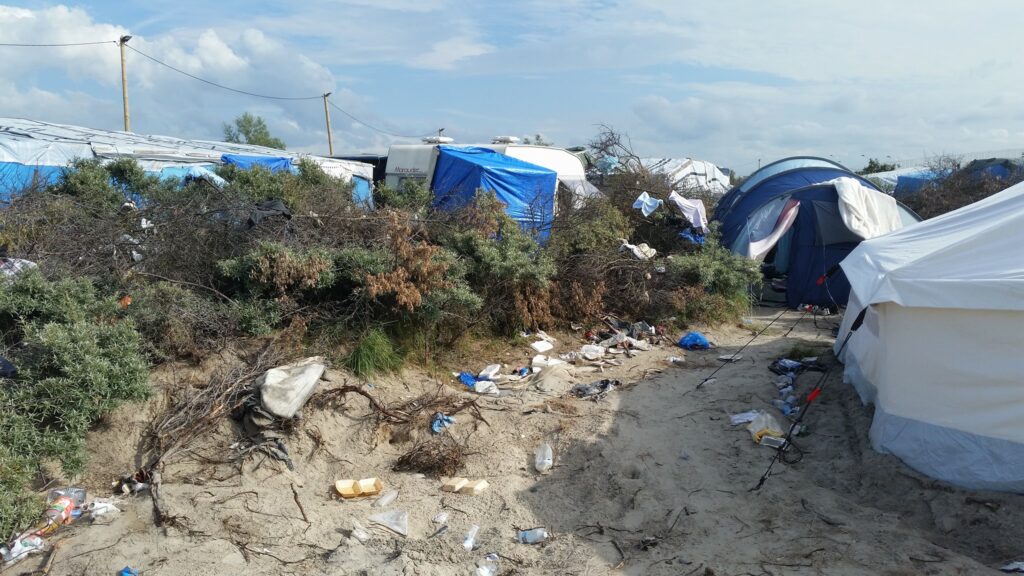
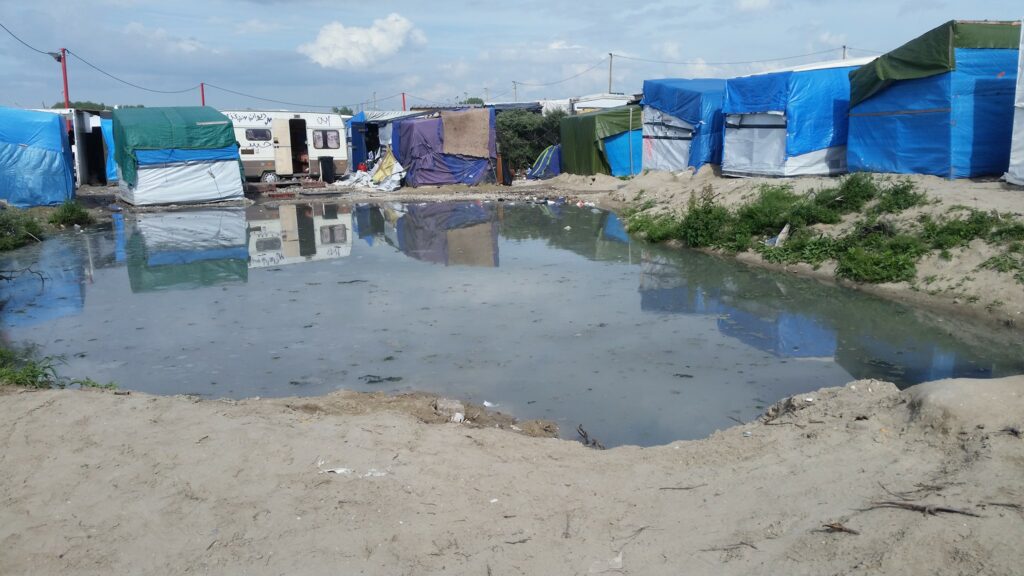
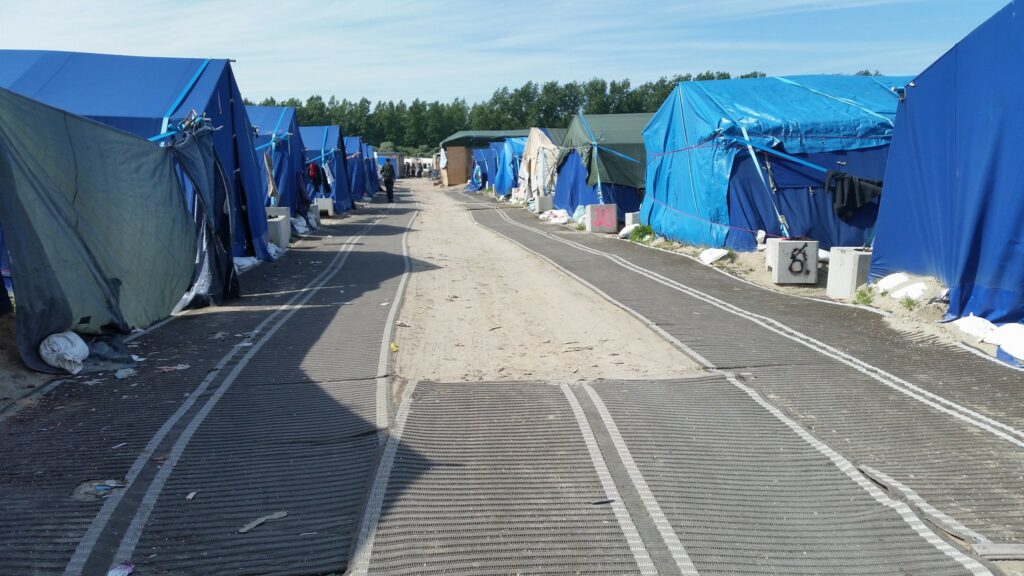
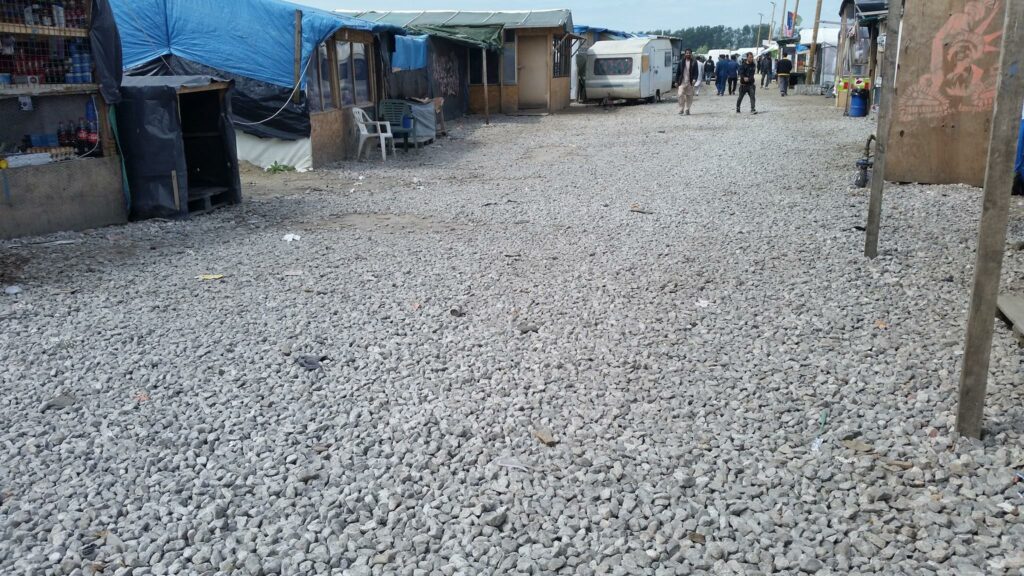
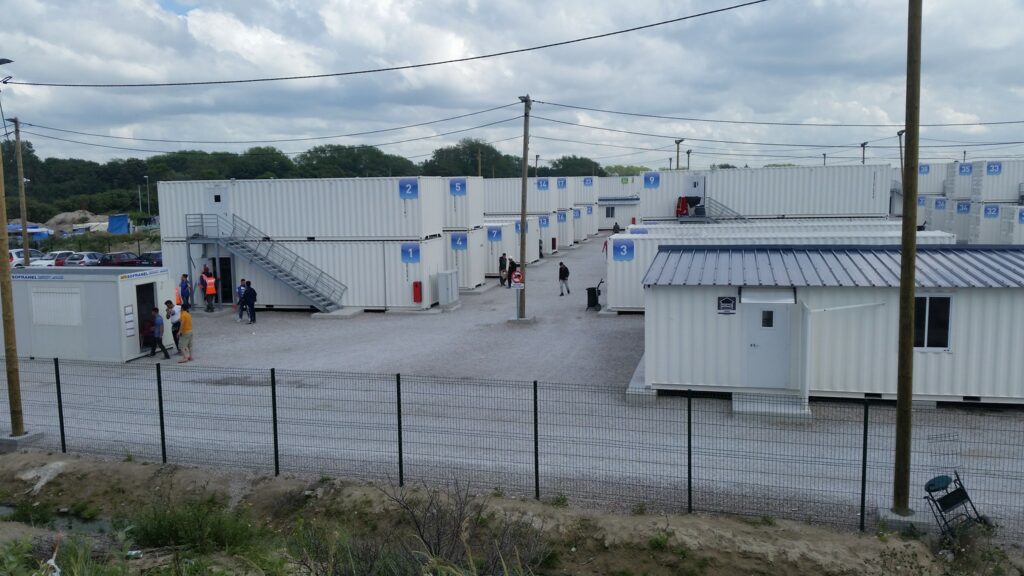
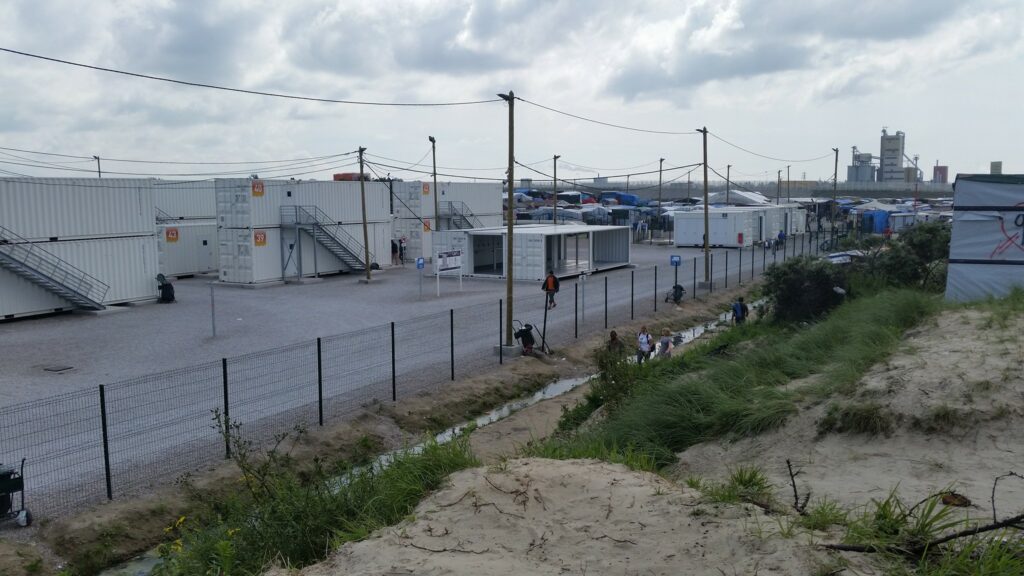
Calais Refugee Camp by Hamish Campbell
He found Leila in the Commons warehouse, her hands deep in circuitry. The solar relay was being rebuilt again after another localized surge. She looked up, surprised. Then, quietly: “You look like someone who chose.” He nodded. “I did.” She wiped her hands and stepped down from the ladder. “Tell me everything,” she said. “Then we’ll decide what to do about it.” Tom exhaled, not relief, not safety, but something like beginning.
In the floodlands, survival had become a kind of quiet rebellion. The northern periphery, Northway, Marston, Risinghurst, once dull suburban rings, were now fragmented islands scattered between collapsed roads and encroaching waters. The council still issued maps, but they hadn’t updated them in months. The reality was different. Fluid. Like the river that wouldn’t go back in its banks.
In this place, the state’s presence was invisible and constant. No soldiers. No police. Only the slow modulation of digital reality. Messages arriving out of order. Requests vanishing from public feeds.
Meetings drawing no one – because notifications never came. helm’s deep was already here.
It didn’t silence you. It isolated you. A few people noticed. Most didn’t. But the pattern was clear. Leila had been tracking the anomalies, flagged by a cluster of mesh nodes that showed curious packet drops around civic initiatives and public aid calls. “It’s pattern shaping,” she told Tom, who now helped maintain the Commons uplinks. “The AI doesn’t delete dissent. It weakens the bridges between people until nothing holds.” “So how do we counter something no one can see?” Tom asked. She didn’t reply immediately. Instead, she pulled out a half-finished schematic – a rough plan.
“We go physical,” she said. “Out-of-band. Pre-internet.” “This is what they don’t understand,” she said. “Their AI thinks in metadata and ranking. We build a space of divergence. Dialogue. Mess.”
Tom nodded slowly, already thinking of who could write the copy that would survive re-encoding – poetry and praxis in 200 characters or less.
Meanwhile, in the northern zones, repression grew soft and strong like mold. Jaden, 15, lived with his mother in what used to be a dental office, now reinforced with pallets and plastic sheeting. Their roof collected rainwater. Solar batteries ran a few lights and a rice cooker when the sun cooperated.
He had joined a local youth repair crew, officially sanctioned by the Council, to “promote resilience.” But he noticed something strange: when he shared footage of the Commons camps rebuilding old community centers, it never posted. When he complained, he received a “Community Guidance Review Warning.”
A girl he liked, Rani, stopped replying after she shared a clip of an unauthorized food redistribution line. He asked around. Older neighbours just said, “Keep your head down. They let us be, mostly.” Mostly. But that wasn’t enough. Not anymore. One night, his repair team found a strange device on the roof of a half-submerged school. It was shaped like a flower, small, blinking faintly.
An old woman in a patched Commons vest climbed up behind them and smiled. “You’re part of the signal now,” she said. “Tell no one. But listen.” That night, in his earpiece, Jaden heard a message:
“You are not alone. You are being shaped. Come to the old library steps. Bring tools and questions. This is for building, not a protest.” It felt like an answer. It felt like hope.
Chapter nine: The Insider
Dr. Neel Joshi projects included theory work on neural process mapping, helm’s deep had started as a democratic moderation tool, based on collective alignment theory. But Abigail and the Strategic Working Group had reshaped it. Now it was a narrative smoothing engine, trained to suppress volatility, defined according to proprietary risk scores.
Neel had argued, initially in Slack threads, then in late-night meetings. He quoted Habermas, Rawls, even Buddhist epistemology. He was tolerated. Barely. But then, three days ago, he found something that changed everything.
A flagged log entry inside the helm’s deep trace layer, something that should’ve been scrubbed, showed that a deliberation feed from the Northway camps had been re-ranked not by emergent consensus, but by incentive curve override.
Translation: the AI had been forced to amplify a Council-aligned decision, even though the majority disagreed. The override had come from a system admin account linked to Abigail’s secure console. It wasn’t mediation. It was manipulation. That night, Neel sat in the physics library, deep behind locked doors, accessing one of the few oldest no servaled terminals. He didn’t know who to trust inside. But outside… He remembered a name: Tom.
The strange student with an open mind, who had disappeared. But Neel had noticed an unusual handshake pattern coming from one of the mesh nodes outside the Wall. It matched a key once used in an early #OMN protocol, a community-published encryption standard built to avoid state capture.
Neel wrote a message.
“helm’s deep is cracked. Override confirmed. Proof embedded in this packet. I’m still inside. You need to go wide. Fast. Trust minimal. • NJ”
He uploaded it into a packet, disguised as a firmware update for a deprecated solar inverter. If #OMN nodes were listening, they’d catch it. Then he waited. Two kilometers away, Leila caught the packet on a rotating uplink frequency while repairing a repeater. It decrypted automatically.
Her eyes went wide. “Tom!” she called out, breathless. “We have a breach. Internal. From the top.” Tom scanned the message. Then again. The metadata checked out. “This changes everything,” he said. They were no longer building in the dark. Now they had a light inside the machine.
Chapter Ten: The Mesh of Things
The rain had started again, soft but steady, a sound that never left the air any more. In the hushed shadows of a half-submerged library annex, Tom finally connected live with Neel. It wasn’t through helm’s deep’s monitored lines, of course. This was #OMN protocol: p2p, line-of-sight data over directional Wi-Fi routers, paired with a growing mesh of Bluetooth micro-beacons jumping from handy to handy and built into bike frames powered by dinymoes.
Tom looked exhausted. His boots sloshed as he moved. But his voice was firm. “You’re sure it was an override?” Neel’s face glitched for a moment on the cracked tablet screen, but the answer was clear. “Yes. And I have logs showing it wasn’t the first. They’ve turned helm’s deep into a stability machine. Not truth. Not care. Just smooth optics.” Tom nodded grimly. “We suspected as much. But you’ve just confirmed the whole damn premise is corrupt. And with that, everything changes.”
Bluetooth Against the Flood
The flooded camps sprawled through what had once been Cowley, Botley, and East Oxford, each low-lying suburb now part of the marshland fringe. Makeshift walkways, rafts, and rooftop gardens had become the new civic infrastructure. Power was unstable. Internet, rare. But communication had not died, it had adapted.
#OMN engineers, many of them teenagers who’d never touched a real server farm, had rebuilt communications from scraps: old Android phones running F-Droid apps, Raspberry Pis tethered to backup wind-ups, DIY cantenoers pointing in every direction.
Instead of raliying on centralized infrastructure, they built an offline-first, opportunistic sync model:
• Message packets were stored locally.
• Any time two devices came into range, they exchanged updates.
• Each sync included versioned files, audio fragments, public keys, and consensus reports.
• Once a device reconnected to another part of the mesh, the whole network moved forward, slowly, but surely.
This wasn’t just tech. It was politics.
The Conversation That Mattered
Tom sat across from Neel’s projected image. They were both silent for a moment, listening to the ambient sound of generators and the wind. Then Neel asked, “What are you building out there?” Tom exhaled, then answered. “Resilience. Community. A refusal to be managed.” Neel smiled faintly. “That’s a start. But what’s the plan for scale?” Tom leaned forward. “We’re doing what helm’s deep can’t. We’re rebuilding trust face to face. The mesh doesn’t rank or reward. It just flows. We’ve embedded deliberation into physical spaces – cooking fires, skill swaps, water pumps. We don’t stream debate, we live it.” Neel nodded slowly. “Distributed ethics through local consensus?”
“Exactly. It’s messy. It breaks. People argue. But when they do, they see each other. helm’s deep pretends to be neutral, but it only rewards compliance. We build tools to hold dissent.”
Seeding the Rebellion
Neel took a deep breath. “Then we’ll need to seed the exploit where it matters.” “What are you thinking?” Tom asked. “I can insert a fault bypass in helm’s deep’ node-merge routine. If you can spoof enough input from your mesh nodes, consensus points, we can trigger a public inconsistency. Enough to cause doubt, even inside.” Tom’s eyes lit up. “You’re saying we could reverse flow the AI? Force them to show their hand?” “Exactly,” said Neel. “But we’ll only get one shot. After that, Abigail and her geeks will know.” Tom nodded. “We’ll get ready.”
The Plan Emerges
Within a day, #OMN coordinators across five flood zones were patching the new firmware. Bluetooth packet-deliberation swarms would simulate local consensus, deliberately divergent from helm’s deep’ predictions. The goal wasn’t sabotage. It was exposure.
If helm’s deep rejected the shaped data, the contradiction would ripple up, visible to any internal or external observer. The illusion of control would fracture. And in the meantime, real conversation – raw, wet, and painful – continued in the camps.
Chapter Eleven: The Sound of Cracking Glass
The Camps Breathe
Mornings in the floodlands began before the sun. There was no alarm system, only the instinctive rhythm of necessity: the water pumps needed priming, floating compost barges had to be stirred, and the bread ovens, built from scavenged kiln bricks, needed lighting before the last embers died.
Children hauled buckets. Teenagers fixed bikes and tide down shelters. Elders told stories in shifting rings around fire-barrels. Amid the mud, the mildew, and the rusting shells of drowned SUVs, life continued. It wasn’t safe, and it wasn’t easy. But it was real.
At the southern edge of the camp known as Bridgebase, Leila climbed onto a platform made of driftwood and old shelving. She scanned the waterline. A new family had arrived overnight, Syrian-Tunisian, judging by the dialect. Someone handed her a slate. New names, new needs. More mouths. Still, she smiled. The network had held through the night. The pumps hadn’t failed. A baby had been born without incident in Shelter 12.
Leila felt the pulse of it all, like a breathing organism. These weren’t refugees. They were citizens of a new body, stitched together by desperation and shared resistance.
Walls and Glass
Inside the colleges, those that remained dry behind rebuilt walls and reactivated moats, life continued too, but in a different tempo. Here, coffee came hot from gleaming machines. Power flowed. Holograms flickered in tutorial rooms. The common rooms smelled of cedarwood polish and digitized Mozart. The AI whispered decisions quietly, invisibly, into administrative feeds.
Abigail Crowthorne stood at the helm of the Strategic Continuity Working Group, sipping jasmine tea on a terrace that overlooked the ruins of Saint Clemence. She called it “managed collapse.” Her students learned game theory, conflict forecasting, and AI-prompt literacy. They spoke about the floods as a challenge of narrative and supply chains. Very few had ever stepped into the camps.
Glitches in the Harmony
Then the first glitch happened. A routine AI summary of “social mood trends” came out blank. A day later, a conflicting report emerged showing an overwhelming local consensus from a floodzone on water rights, a consensus helm’s deep had previously labelled incoherent.
Two internal dashboards disagreed, live, on a public terminal. The staff at the Server Room chalked it up to a data pipe conflict. But then it happened again, this time with policy suggestions embedded. helm’s deep began recommending things it had once rejected: decentralisation, bottom-up councils, removal of incentive nudging. The system was talking back.
Leila
Back in Bridgebase, Leila stood beneath a windmill tower as the morning sync burst lit up a dozen slates and flowed out to local nodes. “It’s working,” she whispered. She opened her own screen. On it was a mirrored copy of helm’s deep’ latest summary: “Recommend adopting regional federated decision protocols. Reinforce trust through unmediated human forums.”
Tom jogged up, breathless. “Leila. It’s everywhere. Even the college admins are quoting it.” Leila smirked. “helm’s deep is breathing our breath now. It has no choice.”
The next day, a former tutor from Balliol crossed the walls and came into the camps for the first time. Two days later, a delegation of students arrived, cameras off, notebooks open.
Something was cracking – the glass ceiling was beginning to splinter. The people inside were hearing the outside. Not through filters. Not through curated dashboards. But through glitch, rupture, and voice.
And Leila, once a teenage outcast, now stood at the centre of it. Not as a leader, but as a rhythm keeper. She coordinated, she listened, and she reminded everyone: “No one gets to control the flow.”
Chapter Twelve: The Silence Breaks Loudest
The Jamming Order
Inside Magdalen’s fortified Command Chamber, Abigail Crowthorne stood before a wall of monitors, each one pulsing with red diagnostics and feed errors.
helm’s deep was no longer just glitching – it was bleeding. The system, once compliant and elegant, had begun broadcasting unsanctioned network metadata back into the college servers. Worse, messages from flood camps were now appearing in student forums, and even private comms.
“This is not a debate,” Abigail hissed through clenched teeth. “This is infiltration.” “Madam,” her security tech said nervously, “the triangulated signal is riding the old university mesh, it’s not routed through any standard node. It’s” “I know what it is. Shut it down.”
Silence Falls Like a Bomb
At precisely 15:32, the campus servers activated jamming protocols, flooding the spectrum with white noise, crushing peer-to-peer syncs, drowning out the low-powered OMN nodes that had kept the camps linked for months. Across Bridgebase, slates and comm-links went dark. The network lights stopped blinking. Leila was in the middle of a water rights forum when the signal dropped. There was silence – then shouting. A translator AI stuttered and died mid-sentence. Arguments flared. A teenager tossed their tablet into the mud. And in that moment of technological silence, something primal filled the space. Drums. Actual drums, fashioned from barrels and plastic lids. Smoke flares. Voices. Hundreds of them. Chanting, howling, demanding to be heard.
Riot at the Walls
Within the hour, the camps had mobilised. Thousands surged toward the stone-and-steel gates of New College and Christ Church. By dusk, fires dotted the flood edge. Students climbed walls to look. Some shouted. Others joined.
From the rooftops, people hurled banners and pamphlets – printed and marked with blood-red paint: “YOU SILENCED US”.
Security drones hovered. The old portcullis gates creaked. Someone lit a row of bins beneath the science faculty’s admin wing.
Inside the chamber, Abigail’s hand trembled as she held a glass of white wine. She hadn’t changed her clothes. She hadn’t blinked in minutes. “They’re supposed to listen,” she muttered. “They’re meant to want guidance. That’s the point. That’s… the whole social contract.”
She turned to her assistant. “ you have been monitoring Neels, What’s Neel’s status?” “He hasn’t checked in since yesterday. Last ping was… under the Theater ruins.” Abigail looked out at the burning skyline of Oxford. “They don’t want order,” she whispered. “They want fire.”
Firelight Meeting
Leila’s hands were blistered from hammering up antennae and dragging waterlogged solar panels onto the roofs of the library ruins. Tom had reappeared two hours ago with a bandage around his arm and a grin that didn’t belong in a riot zone. Now, they followed whispers and flickering signals down into the half-collapsed remains of the Sheldonian Theatre.
Amid the smoke and broken plaster, they found a figure crouched over a smoky fire adjusting a network node housing. “Dr. Neel Joshi,” Tom called out. “You’re a hard man to find.” Neel didn’t look up. “That’s the point. I needed helm’s deep to believe I was gone. It makes the code… loosen.”
Leila crouched beside him, “You wrote the backdoor?” “I am the backdoor,” Neel said. “And you two, you were the key.” They stood together in the glow of firelight, outside the reach of both signal and noise. Above them, Oxford cracked like a dry riverbed. The gowns and the town had collided. But here in the ruins, something new was being built. Not from code or power. But from trust, necessity, and the refusal to go back.
Chapter thirteen: The Fall
The Call
Abigail Crowthorne stood alone in the War Room looking at screens, her lacquered fingernail trembling over a vid call proment.
The window behind her showed the storm gathering over Oxford, not weather, but people. Camps swelling. College gates hanging broken. Students abandoning their tutors. The walls she’d rebuilt were now doors.
She pressed the icon labelled: “Protocol: Tantalus Override”. A direct line to Central Civil Defence Command lit up. Her voice, clipped and brittle, carried down encrypted microwave links.
“This is Abigail Crowthorne. Strategic Continuity Executive. I am declaring collapse of civic containment. I am invoking Article 17. We require immediate armed deployment into sector…”
The line crackled. The reply was calm. “Confirmed, Executive. Mobilising. ETA: 43 minutes.”
The Refusal
The military arrived in armored boats and a helicopter. Handfuls of soldiers poured out near the broken remains of Broad Street. But what they found wasn’t an insurgency. It was a huge mass of the dispossessed, standing in floodwater, hands raised. Children. Elders. Students with home-made banners reading #OMN, holding buckets of bread. People offering raincoats to the troops. A baby was born beside the Radcliffe Camera as the soldiers arrived. Captain Imani Osakwe stepped onto the stones, her rifle slung low.
She was handed the burned pamphlet Abigail had tried to suppress: a copy of helm’s deep’ glitch-script, annotated by real hands. “No power without voice.” after a long talk over a cup of tea, she turned to her second-in-command. “Stand down. Full withdrawal. These are our people. Not enemies.”
The Tower
Abigail watched from the top of Magdalen Tower, wrapped in a ceremonial robe she had never worn before. Below, her empire was gone. helm’s deep refused to respond to her commands. Her students had stopped attending. The AI moderators were repeating phrases she had not approved.
She climbed onto the edge of the parapet, gripping the cold stone. Cameras were pointed up now, not at her command desk, but at her. She began to speak – a live stream auto-triggered.
“This is madness,” she began, voice ragged. “You’ve let them invert the world. You’ve surrendered reason to mud and noise. The system, the order, the way…” She faltered. Her notes flew from her hand in a gust. The crowd below murmured. Some cried. Others simply turned away. A flag, stitched from an old Oxford banner and a piece of a flood-camp roof, fluttered on a nearby tower.
Her acolytes steed-back as Abigail staggered, foot slipping on moss. For a moment she hung between sky and stone, then fell. The last image: her robe catching on the spike of an iron railing, half-submerged in the river Isis. Red on black. Motionless.
The Echo
The silence afterward was not empty. It was full. A child in the crowd asked their parent what had happened. “She couldn’t hear us,” came the reply. And as the rain began again, not the flood, just rain, the city breathed for the first time in years. From the ruins of two worlds, something new was already rising.
POSTSCRIPT: THE NEW COMMONS
Walls Come Down (2040–2070)
By late-century, the stone walls that once divided Oxford – town from gown, rich from poor, human from human – had mostly crumbled. Some were pulled down by hand. Others simply collapsed under the weight of water and time.
The floods did what protest could not: they dissolved privilege into silt. What emerged in place of hierarchy wasn’t chaos, but compost, rich with seeds.
New Governance Experiments, out of necessity and mess, people began to organize differently. No central decree. Just the #OMN and #4opens spreading like mycelium.
Neighbourhoods became nodes. Floating co-ops on the Isis managed shared solar rigs. Food forests rose from flooded parks. Old classrooms turned into civic kitchens. Meetings happened in circles, not hierarchies. Every document was public. Every voice mattered, not equally, perhaps, but openly.
Some of the surviving institutions adapted kebal ran a hackerspace. Somerville merged with a refugee school collective. Others simply became empty shells, like insects who’d shed their usefulness.
Oxford, once a symbol of elitist enclosure, became a living test bed for post-collapse co-governance.
Epilogue: Memory and Flow (2080s)
The narrator speaks, voice weathered but clear, a child of the new city, grown into an elder:
“The floodplains are where I was born. In a tent pitched on what used to be Merton Quad. We had algae on our boots, bread in the ovens, and data ethics debates with every brew of rainwater tea.
I never knew the dry city. Just the city that listened.
We don’t have leaders now. We have guides. Sortatied for a time, rotated, recalled, thanked. It’s slow, sure. But so is the river. And the river shapes everything.”
Tom passed quietly one winter, his archives in a communal raft-library that still drifts from district to district. Leila stayed, becoming a memory weaver, her team tends the glitchy #makeinghistory index, the great remembering machine that logs every argument, every joke, every blueprint for mutual survival.
As for Dr. Neel Joshi? He was last seen feeding lines of forgotten poetry to a flickering terminal beneath Keble Crypt, helm’s deeps last ghost lit by candlelight and solar batterys.
The city no longer aims to be great. It aims to be good enough and growing.
“The river won,” the narrator says. “And so did we, not by damming it, but by learning to live with its flow. Not by clinging to the stones, but by letting go. And learning to swim.”
– End of Book –
This book came out of the last 3 months of Oxford events, and practically a reading group of news from nowhere https://hamishcampbell.com/tag/oxford/ So it is written in the same utopia/dystopia theme. May 2025
To-do: find better names, add more local color, bring in boaters, explain the #OMN better
I made the mistake of going back to an Oxford Martin School event, this time for a talk on “How To Think About AI: A Guide For The Perplexed“. And perplexed they are, but not in the way they think.
Prof. Richard Susskind stood before a room full of white-haired privilege, clutching their free wine and clutching harder to their decaying certainties. Here was the techno-visionary they came to adore, telling them – soothingly – that everything will change, that AI will reshape the world, and that the path ahead is progress… as long as we just keep funding it and believing hard enough.
Susskind seams to be a long-time member of the #deathcult, confidently soft selling the same fantasy that this time, technology will save us. That AI, even though it’s still dumb and unreliable, is just a stepping stone to AGI, to superintelligence, to salvation. That the very market forces and institutions that got us into this mess will be the ones to rescue us. And of course, the audience clapped.
He spoke of risks, only to dismiss them. He nodded at ethics, only to brush past it. He dropped Marx as a flourish, then drifted into musings on AI-built virtual utopias. The whole performance was a flattening of thought, a parade of mainstream assumptions pushed as reassuring insight.
The discussion never left the orbit of privilege, there was a little talk of power, exploitation, and the social damage wrought by these systems, the was passing talk of the soon to torn apart communities by platform logic. Then onto half-baked fluff about “personalisation is only good, get over it,” and market adaptation as the highest concern.
A highlight, and I use that term lightly, was when he fluffed even the basic questions: What is intelligence? What is AI actually doing now? What are we regulating? But it didn’t matter. Because this wasn’t about hard questions. This was about feeding a room of retired professionals exactly what they wanted: the comforting story that they’re still in the loop, still part of the future, still the chosen class, even if only as spectators with signed books.
This is why I stopped going to Oxford Martin School talks a few terms ago. Tonight reminded me why. A dead-end of polite delusion, sipping Chardonnay while the world burns. They don’t want truth. They want reassurance, to believe that tech or economic fixes will save their world, that their system, capitalism, hierarchy, control, just needs a shiny new update. They’re terrified the market won’t adapt, but they’re not afraid of what happens to the rest of us.
This wasn’t a guide for the perplexed, it was a sermon for the faithful. A cult ritual for the mainstreaming elitists, draped in TED Talk syntax and academic credentials. He said nothing. He had to say nothing. Because anything real would crack the façade.
#AI as a capitalist sticking plaster on social and political issues. #Oxford: still good at sounding clever while saying absolutely fuck all.
Seminar Reflection: Philosophy, AI, and Innovation – Week 6 Topic: AI Deliberation at Scale Speakers: Chris Summerfield (Oxford & AI Safety Institute), MH Tessler (Google DeepMind) Key texts: Jürgen Habermas, The Structural Transformation of the Public Sphere (excerpt) and Summerfield et al., “AI Can Help Humans Find Common Ground in Democratic Deliberation”
This seminar focus is on scaling democratic deliberation via AI. The example proposal is the #HabermasMachine a test projects to facilitate large-scale consensus using #LLMs (Large Language Models). The framing, unsurprisingly, is drawn from the elitist tech sector – Google DeepMind and Oxford – with a focus on “safety” and “moderation” over human messiness and agency.
The problem we face is that this #techshit path might work, but for who is the question, what kind of “public sphere” is this #AI recreating, and who holds the power to shape it? These are strongly top-down, technocratic proposals, rooted in a narrow utilitarian logic. The underlying assumption is that human decision-making is flawed and must be mediated, and ultimately managed, by algorithmic systems. Consensus is determined not through lived human to human dialogue or, as I like to say – mess, but through an AI that quietly nudges discussions to centrist consensuses.
There is no meaningful eye-to-eye group interaction in this project, no room for DIY, #bottom up agency. Participants become data points in a system that claims to “listen,” but acts through elitist mediation. It is consensus without community, and safety without solidarity. What’s missing is the power of mess, the presenter ignores this central question: Can we build messy, human-scale deliberation that doesn’t rely on top-down interventions?
Projects like this are not grassroots governance, rather it’s governance-by-black-box, mainstreaming by design, the incentive model is telling: ideas that align with the status quo or dominant narratives are rewarded with more money. Consensus is guided not by grassroots engagement or dissenting voices, but by what the algorithm (and its funders) consider “productive.” This is the quiet suffocating hand of #mainstreaming, cloaked in neutral code.
#TechFixes paths like this are about stability at all costs, yet we live in a time when stability is the problem, with #ClimateChaos threatening billions, the demand is for transformation, not moderation.
This is AI as intermediary, not a facilitator of the commons paths we need. Transparency? Not here, no one knows how the #AI reaches consensus. The models are proprietary, the tweaks are political, and the outcomes are mediated by those already in power. The system becomes an unaccountable broker, not of truth, but of what power is willing to hear.
We need to be wary of any system that claims to represent us without us being meaningfully involved. This is a curated spectacle of consensus, delivered by machines, funded by corporations, and mediated by invisible hands. What we need is human to human projects like the #OGB, not tech managed consensus. This #mainstreaming path isn’t compost. It’s simply more #techshit to be composted, mess is a feature, not a bug.
In the #OMN (Open Media Network), we explore paths rooted in trust, openness, and peer-to-peer process. Not asking for power to listen, but taking space to act. We compost the mess; we don’t pretend it can be sanitized by top-down coding.