One of the successes of neoliberal capitalism has been convincing us that we’re paying less while actually paying more. They promise lower taxes, then they privatise the services, health insurance becomes a private tax, car finance becomes a transport tax, rent becomes a housing tax, student debt becomes an education tax. The electricity surcharge for AI data centres becomes another hidden tax.
You voted to reduce taxes, but all that happened was public taxes became private payments to corporations. A vote for “tax cuts” too becomes a vote for hidden taxes. The same trick plays out across the digital world. We’re encouraged to embrace platforms and AI systems that consume enormous amounts of energy, degrade the quality of public knowledge, undermine independent publishing, harvest our personal data, and concentrate even more power in the hands of a handful of tech oligarchs.
We’re told this is innovation, but it’s mostly enclosure. The latest scandals around Elon Musk and his political networks aren’t the real story. They’re symptoms of a deeper problem. Billionaires don’t simply own companies, they increasingly shape media, public debate, infrastructure and politics itself.
This is what the #deathcult looks like in practice: private wealth buying public power. One path we can take is not simply replacing one billionaire with another or one political party with another, it’s rebuilding the commons. Public goods instead of private monopolies, community media instead of billionaire media, the #openweb instead of the #dotcons and economic democracy instead of oligarchy.
That’s why #OMN exists – not simply to criticise the mess, but to build practical alternatives to mediate the mess as the next crisis arrives.
People sometimes ask why I use the hashtag #deathcult. It isn’t just a provocative label, it is to name the dominant political and economic logic that has shaped the last forty years. By #deathcult, I mean the era of #neoliberalism: a system that treats endless economic growth, privatisation and competition as unquestionable “common sense,” even when the consequences are ecological collapse, growing inequality and social breakdown.
I call it a cult because, like any successful ideology, it becomes difficult to see from the inside. Its assumptions become so normal that alternatives appear impossible. Margaret Thatcher’s famous phrase, “There Is No Alternative,” sums this up perfectly. The “death” part has become harder to ignore, due to movements like #XR (Extinction Rebellion), the reality of #climatechaos has entered mainstream discussion. We can now see that continuing on our current path means ecological collapse, mass displacement and the deaths of millions – and displacement of billions – of people over the coming century.
Of course, neoliberalism is not something entirely new. It is an extreme form of capitalism, and history has seen similar periods before. One example is Britain’s response to the Irish Potato Famine, where market ideology took precedence over human need, contributing to mass starvation, displacement and suffering.
After the Second World War, many countries moved towards forms of social democracy. Capitalism was softened by stronger public services, labour rights and welfare systems. These reforms were far from perfect, but they recognised that completely unrestrained markets created instability and injustice. In part this “liberal golden” era was held in place by there being an alternative of soviet communism.
From the late 1970s onwards, much of that understanding was forgotten. Deregulation, privatisation and financialisation became the dominant ideology once again. Politicians like Jeremy Corbyn and Bernie Sanders represent attempts to move back towards that earlier social democratic settlement. Though this compromise path of social democracy is not a final answer, as it still operates within capitalism, but it is certainly preferable to the #neoliberal model that currently dominates. As radicals, though, we should aim higher. We need to build systems based on commons, cooperation, ecological responsibility and democratic participation, not simply manage capitalism more fairly.
This is where #OMN (Open Media Network) comes in. The problems we face are not only economic, they are also about communication. Today’s digital infrastructure is dominated by #dotcons: corporate platforms that monetise attention, shape public debate and concentrate power. Facebook, Google, Apple, X and similar platforms have become essential infrastructure while remaining accountable only to capital rather than communities.
The answer isn’t simply better regulation, it’s rebuilding the #openweb. Like the #Fediverse, the #OMN is one small contribution towards this path: creating media and communication infrastructure based on the #4opens – Open Data, Open Source, Open Standards and Open Process – so communities can shape their own communication instead of renting it from billion-dollar corporations.
People also ask why I use so many hashtags, the answer is simple, the web is made from links. Hashtags are one of the few linking technologies that work across platforms. They allow conversations to escape individual silos and become discoverable across the wider web. They are not meant to replace ideas; they are signposts pointing towards larger conversations that matter. Yes, they can look cryptic, but every shared language starts somewhere. If we never create language for new problems, we remain only trapped inside the vocabulary of the systems we’re trying to change and challenge.
Changing language doesn’t change the world by itself, but it can change how we think about the world, and changing the conversation is often the first step towards changing society itself. That’s why I still use #deathcult, not as an insult, but as a way of naming a system whose destructive logic has become so familiar that people struggle to imagine anything different. The challenge now is not simply to criticise that system, it is to build practical alternatives.
For those who like to believe in social democracy, this isn’t an argument against the gains it has won. Strong public services, workers’ rights, progressive taxation and democratic institutions have all made life better for millions. They matter, and they are worth defending.
But we should also recognise their limits. As long as investment and production remain under the control of capital, democracy stops at the workplace door. We get to vote for governments, but rarely over what our economies produce, how resources are used, or whose needs come first.
The next step is not simply kinder capitalism, but extending democratic principles into the economy itself. Building commons, cooperatives, public ownership where appropriate, community governance, and digital infrastructure that people collectively control. That’s the direction #OMN points towards: not replacing one elitist crew with another, but growing the practical foundations of economic democracy from the grassroots up.
Today I was half joke about ducks and geese, but there’s something underneath the joke if you lift the lid. After Darwin, many nineteenth-century elitists became fascinated with cataloguing nature. Too often, though, they also saw their own society reflected back at them. Hierarchy, competition, borders and domination weren’t simply political arrangements any more, they were presented as “natural laws”. Social Darwinism grew out of this way of thinking, using selective readings of nature to justify existing inequalities.
Later, ethologists like Konrad Lorenz studied geese, ducks and other animals, revealing fascinating patterns of territoriality, dominance and aggression. The science itself mattered, but the mistake came when people stretched those observations into a claim about human society that this is simply how we are.
You still hear versions of that today. “People are naturally selfish.” “You’ll never stop conflict.” “Communities always need strong leaders.” “It’s just human nature.” But humans aren’t geese, we’re also the species that build commons, mutual aid societies, libraries, volunteer lifeboats, free software, neighbourhood kitchens and countless forms of cooperation that don’t depend on domination. Human nature has always contained both competition and cooperation. The interesting question isn’t which one is “real”, it’s which one our culture encourages.
The #Oxfordboater community is a good example. Every year people help each other through floods, lend tools, tow broken boats, share batteries, pass on local knowledge, watch each other’s moorings and organise collective responses when outside pressure builds. None of that is compulsory, nobody invoices for it. Most of it happens because trust has been built over years. That is one expression of human nature.
But there is another, were every disagreement becomes a territorial dispute, generator hours, mooring space, who arrived first, who “belongs”, who gets to speak for the community, who broke an unwritten rule. None of these conflicts appear from nowhere, they’re amplified by the social environment we create. If every discussion becomes about winning, then people start behaving as though they live in a world where winning is the only thing that matters. The behaviour becomes self-reinforcing, like the geese.
One thing i have learned from practical paths is that infrastructure grows behaviour – this is one reason #OMN spends so much time talking about infrastructure. Not just technical infrastructure but social infrastructure. The customs, stories, shared memory and open processes that quietly shape how people behave. For boaters the old 8.00am-to-8.00pm running generator convention wasn’t simply about engines, it is social infrastructure to reduced conflict before conflict starts. The same is true of slowing down past moored boats, helping someone through a lock, sharing local knowledge with newcomers. These customs don’t eliminate disagreement, they make disagreement survivable. Without them, every generation starts again from zero.
The stories we tell matter – The #deathcult tells us competition is inevitable, that everyone is looking after themselves, that cooperation is naïve, that markets and hierarchy reflect reality. The #openweb and commons stories starts somewhere else, trust can be cultivated, commons can be built, communities can organise themselves. But none of these are guaranteed, they all require maintenance, just like our boats.
Looking out your window it should become obvious to you, we are not ducks, so a real question becomes how do we compost conflict – the challenge here isn’t eliminating disagreement – it is learning how to compost the mess disagreement leaves, like duck shit on our bordering planks. Taking the inevitable friction, the different lifestyles, the competing needs, and turn them into something that strengthens the community instead of poisoning it.
This path means remembering why customs evolved, it means asking not just “What works for me?” but “What helps us keep living together five years from now?” Because that’s ultimately what community is, not the absence of conflict, it is the ability to survive it without becoming geese 🙂
The main character of this post, presiding the ducks: “Lorenz joined the Nazi Party in 1938 and accepted a university chair under the Nazi regime. In his application for party membership he wrote, “I’m able to say that my whole scientific work is devoted to the ideas of the National Socialists.” His publications during that time led in later years to allegations that his scientific work had been contaminated by Nazi sympathies. His published writing during the Nazi period included support for Nazi ideas of “racial hygiene” couched in pseudoscientific metaphors.”
The subject of this post was an actual Nazi. Lorenz, becomes interesting not because he tells us what human nature is, but because he raises questions of how instincts interact with social infrastructure. If humans possess capacities for both competition and cooperation, then the important question becomes – which behaviours do our grassroots social structures and #mainstreaming institutions encourage?
Neoliberal culture rewards competition, extraction and individual greed.
Commons-based societies reward trust, reciprocity and mutual aid.
Human nature contains the potential for both. The infrastructure we build – technical, social and cultural – helps determine which paths become dominant. That’s why debates about boater culture, the #openweb, the commons and grassroots governance are ultimately debates about which version of human nature we want to cultivate, rather than which one is supposedly “natural.” This mess is the “common sense” we need to work to compost – just look at the ducks – to understand why.
#Oxfordboaters: The use of online plebiscites without deliberation is a prat move. Blocking democratic #4opens working-group structures creates this mess in the first place, another prat move. Then diluting the CoC (a terrible name, by the way) leaves us with a “victory” that’s shallow and probably temporary, yet another prat move.
Can you see the pattern? Given the people we’re all working with, perhaps this really is the best we could achieve. Fair enough. But I probably won’t be here when the same people have to go through exactly the same arguments again in a few years. The point, being prats has consequences, we either compost today’s conflicts into something that lasts, or we leave the same mess for the next people to inherit.
In the end, we are all the ones who have to live with those consequences.
One of the biggest problems we face isn’t technology, politics or even money. It’s #stupidindividualism. By this I don’t mean individual freedom, freedom matters. I mean the habit of seeing every issue only through “my” immediate circumstances, with no memory of how we got here and no thought for the wider community. A small example from Oxford boaters illustrates this perfectly.
The generator argument – A discussion recently started about extending generator hours beyond the long-standing 8am–8pm convention. To new boaters this probably looks harmless “Why not be a bit more flexible?” “Surely we can make our own rules?” “My situation is different.” All perfectly reasonable, if you don’t know the history. But memory matters – ten to fifteen years ago, before cheap solar panels transformed life afloat, generator noise was one of the biggest causes of conflict on the waterways. Not occasional disagreement, years of arguments, neighbour against neighbour, boater against boater, and worst of all for our communities boaters against people living ashore.
There were shouting matches, threats, even physical fights. Eventually a rough consensus emerged across waterways: 8am–8pm, it wasn’t perfect, it wasn’t law, it wasn’t even enforceable. It was simply a social compromise that people understood. Then solar arrived, people needed to run engines far less, the conflict quieten down as technology reduced the pressure while the social convention remained.
So why now reopen old wounds? Today people who never lived through those years, only see today’s circumstances. “My train gets in after eight.” “My batteries are low.” “There’s no housing nearby.” “My case is different.” Individually, every point makes sense. Collectively, they recreate the conditions that produced years of conflict. This is what #stupidindividualism looks like, every individual argument is reasonable, the collective outcome is a disaster.
This is about social infrastructure, the 8–8 convention isn’t really about generators, it’s about preserving social peace. It is community infrastructure, like, slowing down when passing moored boats, like helping someone through a lock, like not running a noisy stinky engine outside someone’s bedroom late at night. These customs aren’t primarily technical rules, they’re social technology to reduce friction before it starts.
Hard rules aren’t the answer, ironically, if we destroy informal agreements, people respond by demanding formal enforcement. This is exactly what happened in parts of London – Places that once relied on neighbourly agreement eventually became rule-heavy, regulated pay moorings because communities could no longer manage themselves. Conflict produced more bureaucracy, more bureaucracy produced less freedom, the cycle repeats.
This is why we need to keep talking – to composting conflict – the challenge isn’t to pretend disagreements don’t exist, more it is to stop turning small disagreement into a community-wide battles. Most issues can be solved by talking to your neighbours, emergencies happen, people can be understanding, courtesy works better than enforcement, but courtesy works when people understand the history that produced it, without that memory, every generation all to easily starts the same fights again.
The problem isn’t really about generators, it’s about forgetting that communities inherit solutions as well as problems. When we ignore the reasons those solutions exist, we spend years recreating conflicts that were already settled. That’s the cost of #stupidindividualism, we mistake inherited social infrastructure for arbitrary restriction so we tear it down. And eventually we discover – again – that rebuilding trust is far harder than preserving it.
Who is wispering madness in this kinda mess #4opens
This is a pattern well beyond #Oxfordboaters, it’s visible across the #openweb, activist organising, and politics generally. We inherit social norms that emerged through hard experience, then we dismiss them as unnecessary because we don’t know their history, to then end up recreating the conflicts those norms evolved to prevent. That’s why preserving collective memory is just as important as preserving freedom. Without memory, every generation repeats the same mistakes. With it, we can spend our energy building something better instead of refighting old battles.
In #OMN terms for the hashtag story this is #blocking. So the #CoCo (very bad name) is about “good conduct” rather than regulation. Let’s look at existing regulation to start from:
CRT: Terms and Conditions (which have legal force because of s.43 of the Transport Act 1962) 10.9.2 “… [you must] not use any electricity generator … between 8pm and 8am, unless you are moored in isolation, out of earshot of other people…”
EA Byelaws: General Construct 63(m) “use any … or any other electrical equipment … resulting in the … transmission of any noise … in such manner to give reasonable cause for annoyance to any person in upon or about the river or the banks or the towpaths thereof or adjacent land of the Authority.”
Memory matters – is why I oppose extending the generator stink, smoke and noise hours to 10pm. Not because there will never be exceptions. Life afloat is full of exceptions, and genuine emergencies should always be treated as such. But making the exception into the new normal needlessly reopens old wounds. We already know where that path leads because we’ve walked it before. Years of conflict finally settled into a workable compromise. Forgetting that history means we’ll end up repeating it.
Memory matters, boating isn’t simply about living on a boat. It’s about adapting your behaviour to live well alongside other boaters. Shared customs are part of that adaptation. They’re how communities survive without drowning in rules and enforcement. Yes, there are people whose work patterns make 8pm inconvenient, that inconvenience is real. But solving every individual problem by burning more diesel isn’t a direction that makes sense, socially or environmentally. The world is moving away from fossil fuels, not towards them. And we have bigger battles ahead, we will have to defend our right to use solid-fuel stoves over the coming years. If we normalise running noisy, smelly generators later into the evening, we weaken our position before those fights begin.
The point of the Code of Conduct (bad name, but I can compromise) isn’t simply to satisfy landowners or avoid complaints. It’s to make us better neighbours and a stronger community. That’s how we slow the pressure towards more regulation, more enforcement, and eventually fewer places where people can live afloat.
Sometimes it feels almost as though there is a conspiracy to stop us coming together around simple, common-sense solutions. I don’t actually think that’s what’s happening, I think it’s something more ordinary, and more dangerous. It’s a collective fuck-up, people naturally focus on their own immediate needs and lose sight of the bigger picture. That’s #stupidindividualism again.
The simple question is whether extending generator hours is the least damaging way of meeting those needs. Could we think more creatively? Portable battery packs. Shared charging. Better solar. Community support for people with difficult work patterns.
The first question shouldn’t be, “How do we burn diesel for another two hours?” It should be, “How do we solve this with the least noise, fumes, conflict and fossil fuel?” That’s the direction the world is moving, whether we like it or not. The hardest thing in any community is lifting our eyes from today’s inconvenience to tomorrow’s consequences.
Some have suggested making the Code of Conduct deliberately vague “Boaters agree to keep noise to a minimum and respect their neighbours.” That sounds attractive, until you remember why communities write things down in the first place. Vague agreements don’t resolve recurring conflicts; they postpone them. Every new disagreement starts from zero, every new arrival has to renegotiate the same issue, every argument becomes personal because there’s no shared understanding to fall back on. A simple, well-understood convention can hold a community together for years. A vague aspiration might last a season before the same arguments begin again. This isn’t about winning an argument, it’s about composting conflict instead of continually producing it.
We need to focus on the wider picture, not because everyone has to agree, but because if we keep reopening settled questions without finding better solutions, we’ll spend the next decade refighting the last one. That’s not community, that’s just making more mess, and we already have enough of that. #KISS
There’s a common understanding that we’re living inside a new digital world, that feels like enclosure, where people are “controlled” by platforms they can’t easily leave, where behaviour is shaped at scale, and where #AI intensifies this mess. That’s why #fashernista terms like #technofeudalism are being used to argue that we’ve moved beyond capitalism into something different – a system based not primarily on profit, but on rent extraction through “cloud capital.” In this narrow framing:
Capitalism = wage labour, markets, profit from production
Technofeudalism = platform power, behavioural capture, rent from digital dependency
The “cloud lords” (Google, Amazon, Meta, Apple etc.) operate their digital fiefdoms, making us the “cloud serfs” by producing data and metadata for free. This generating value through participation while feeding tech that learn from us and reshape our behaviour. Even businesses and workers are pulled in, sellers depend on Amazon marketplaces, workers are managed through platform systems and, as the #EU is finding, entire infrastructures depend on AWS-style cloud provision.
From this narrowing view, capitalism starts to look secondary to rent extraction. But is this actually a new economic system? The argument soon starts to break down as critics point out that many of these dynamics are not historically new: supermarkets already control supply chains and choice, advertising has shaped desire for decades, monopolies are standard capitalist patterns and enclosure of markets predates the internet by centuries.
Even “lock-in” effects (like Amazon Prime convenience or #dotcons platform dependency) can be explained through normal capitalist mechanisms: convenience, pricing, network effects, and infrastructure dominance. From this step back view, what we’re seeing is not a new epoch, but late-stage capitalism with intensified digital tools, not a structural break.
The more grounded #OMN suggests something different, the change is not mystical “cloud feudalism”, but that data and metadata has become a primary economic resource. We now live in systems where behaviour is continuously captured as data, that data to be aggregated, sold, and operationalised, then feedback loops reshape what people do next and participation itself becomes productive labour. This shifts relationships, not only worker vs capitalist, not just consumer vs market, but user-as-infrastructure. Yes, people are no longer only buying and selling inside systems, they are constituting the system itself through participation. That is a shift in how production works, even if it doesn’t replace capitalism as the structure, it is reshaping it.
The infrastructural question? Where the #technofeudal framing becomes useful is infrastructure. The real power isn’t only in apps or interfaces, it is in “cloud” hosting (AWS, Google Cloud, Azure), database and compute control and the resulting dependency of entire industries on a few providers. This is less “digital shopkeeping” and more systemic dependency at the infrastructure layer. At that level, switching costs are enormous, entire economies are built on top of systems owned by a handful of #nastyfew actors. Yes, this is a real enclosure of the commons, not of in the old sense land, but of the new digital reality.
Where this leaves us? The danger is less about whether we label this “capitalism” or “technofeudalism”, more, it’s the simple assumption that the system is stable. In reality, we have capitalist dynamics operating the data-driven extraction layered on top of this older mess, with infrastructure consolidation amplifying both. Not a clean break – more a messy transition stage.
From an #OMN perspective, the useful question is not the label, it is where is agency located? Who controls infrastructure? How is knowledge produced and shared? What forms of network are open vs enclosed? Because whether we call it capitalism or #technofeudalism, the political problem is the same that control is concentrating, while participation is being harvested. And that is the mess we need to compost, not the theoretical naming of it.
Three years ago I wrote: “I get the feeling we are running on dregs on the #fediverse dev side. Social movements come in waves; this one is ebbing into the #mainstreaming. No bad thing, but not, I think, what any of us want for ‘our’ #openweb.”
Looking back, I wonder what has actually changed – and more importantly, what have we learned? The #Fediverse has grown, more people know about decentralised social media, more organisations are paying attention, and the ideas that once lived mostly in activist and technical circles have moved closer to the #mainstreaming.
But growth always brings questions – What happens when movements become successful enough that the surrounding culture starts changing? The early #openweb was built around different assumptions that people have agency, communities shaping their own spaces, experimentation over optimisation, trust over control and commons over platforms. The #mainstreaming process brings different pressures of scale, professionalisation, funding, institutional legitimacy, standardisation and “safe” governance structures.
None of these things are automatically bad. A movement cannot stay frozen in its early phase forever, but there is a risk that the thing being scaled is only the technology, while the culture that gave it meaning gets diluted. Maybe we need to talk more about how the #openweb was never just about protocols, federation is a technical idea, living commons is a social one. Three years on, the challenge is still the same, how do we grow without losing the roots? The #OMN view has always been that we need both:
The fluffy path — welcoming people, building bridges, making things usable.
The spiky path — challenging capture, resisting enclosure, keeping power visible.
Without the fluffy path, alternatives stay small and isolated. Without the spiky path, alternatives get absorbed into the same systems they were meant to challenge. So maybe the question is not “did the Fediverse win?” The question is more what kind of victory are we building towards? A bigger version of the old internet? Or a genuinely different culture of communication? This question is still the work, the seeds are there, but are we are tending the garden, or just watching the weeds grow.
It might be useful to look at a narrow view of this. The #FOSS (Free and Open Source Software) world is one of the greatest successes of the #openweb era. Without it there would be no Linux, no Apache, no Firefox, no Wikipedia-scale infrastructure, no Fediverse, and much of the internet would simply not function. The culture has produced extraordinary amounts of shared value. But from an #OMN perspective, success should not stop us looking critically at the social dynamics underneath. The question is not whether #FOSS works. The question is: who does it work for, where does it struggle, and what can we learn from both?
A resent example, from a native #openweb perspective, this non “just fork it” diatribe is not about code at all, more how we misunderstand collective work in an age of growing #stupidindividualism. The #geekproblem framing treats open source as a marketplace of sovereign individuals – I do my work. You do yours. If you don’t like it, go away and rebuild it alone. That looks like freedom, but it’s actually a deep cultural narrowing. Because what gets erased in that framing is the social fabric that makes FOSS work in the first place, yes, technically you can fork, walk away and rebuild. But socially, that’s not neutral. It assumes that collective effort is disposable and that coordination is optional. That’s where #stupidindividualism kicks in, the fantasy that all meaningful action is just isolated agents choosing between exit options.
In reality, most functioning open source systems are not built on exit, they are built on ongoing relationships between contributors, trust built through repeated interaction, informal negotiation of direction, shared norms about responsibility and maintenance and a lot of invisible care work that never shows up in the code. The “just fork it” response hides this by pretending power is symmetrical, it isn’t. Maintainers don’t just “own code” – they sit at choke points of attention, merge authority, reputation, and continuity. Forking isn’t just copying code; it’s rebuilding all of that social infrastructure from scratch. So when “just fork it” is used as a dismissal, it’s not a statement about technical freedom, it’s a way of closing down negotiation while maintaining the appearance of openness.
That’s the concern, not whether forks are possible, but how often they are used to avoid the harder work of collective problem-solving in shared space. Because there are two very different meanings of forking:
Healthy fork (fluffy) based on experimentation, divergence where needs differ, pluralism in practice and sometimes leading back to upstream collaboration.
Fragmentation fork (spiky reality of #stupidindividualism) growing from social breakdown disguised as technical freedom, loss of shared direction, duplication of effort due to failed mediation and communities replaced by isolated projects.
The distinction is not technical – it’s social coherence before the fork happens. In a healthy #openweb culture, “fork it” is a last resort after dialogue has failed, differences are irreconcilable or experimentation genuinely needs independence. Were in #stupidindividualism culture, it becomes the first reflex with disagreement → exit → rebuild alone → repeat fragmentation cycle. That cycle produces the illusion of freedom while steadily destroying any shared capacity that builds real freedom.
The real question is not “Do you have the right to fork?” Of course, you do. The real question is “Are we maintaining enough shared social infrastructure that we don’t always have to?” Because if every disagreement becomes a fork, then we don’t have ecosystems – we have atomised toolboxes with no collective memory. And at that point, the system is no longer open in any meaningful sense. It is just individualism with better licensing.
The commons → #geekproblem → meritocracy → forking → #stupidindividualism. But on a positive note from an #OMN perspective, #FOSS remains one of the healthiest cultures we have. The challenge is not to abandon it, but to compost the #geekproblem and grow stronger social practices alongside the technical ones. The future of the #openweb depends on both.
In this mess we have to keep shovelling to compost the negative smell of #fashionista – That is a socio-political and tech-subculture #hashtag used to describe performative activists, influencers, or lifestyle subcultural participants from the grassroots, open-source tech, and radical political communities who prioritize the aesthetic and language of activism over the unglamorous, foundational work of building actual structures.
Performative engagement, trendy slogans and identity-driven rhetoric over substantive, embedded organisation.
Echo chambers, exclusive, inward-facing discussions that fail to translate into any impact.
Trend hopping, between “ethical” or radical tech and social projects without committing in meaningfully ways to their development or maintenance.
A #blocking cultural tendency to adopt a radical or alternative aesthetic without understanding or participating in the unglamorous work required to enact actual change or challenge.
Let’s look at a #fluffy positive view of the path we need to be on. We are living through a dangerous moment, the systems around us are failing, but the dominant response is still denial at worst or to try to repair the existing structures that created the crisis at best. But, the problem is not one bad policy, one bad company, or one bad government. The problem is a whole way of organising society around extraction, scale, speed and distance.
A system that measures success through endless economic growth has turned the living world into a resource pool, nature becomes something to consume, our communities become markets. People become workers and consumers to turn relationships into transactions. This is the logic of the #deathcult – the belief that there is no alternative to the endless expansion of production, consumption and competition.
But there are very different stories, for most of human history, people lived through relationships with place, community and the natural world. When knowledge was rooted in local experience, skills grew through connection, culture evolved through diversity. The problem is not that humans are incapable of living differently. The problem is that we built systems that separate us from the consequences of our actions. A global supply chain moves food thousands of miles while hiding the real costs. A corporation extracting value from a place without being accountable to the people who live there. A financial system creates wealth for a few while pushing the damage onto everyone else.
The result is not just ecological damage, it is cultural damage to the shared humanist knowledge, ecology, stories and local power. The process that creates monoculture in culture and thinking, when everything becomes standardised, the same products, platforms, economic assumptions, the same idea that progress means becoming more disconnected. This is where the old path of humanism and resulting localisation becomes important. Localisation is not about retreating from the world, it is not about small communities ignoring global problems. It is about rebuilding the connections that make society healthy, creating economies where people can see the impact of their choices.
This is where the #OMN story connects, the Open Media Network is not just about publishing tools, it is about rebuilding the missing social layer. The #openweb originally grew from the idea that people could connect, collaborate and create outside centralised control. It was messy, diverse and alive, in till the #closedweb enclosed this with #dotcons platforms designed around attention extraction, surveillance and profit.
The work of composting this mess is not simply building another platform, it is more about rebuilding culture. We need “native” networks that support local voices to connect #4opens globally to bridge a diversity of communities, ideas and ways of living. Not one giant system trying to manage everyone, we need a garden, not a factory. The challenge is that technical decentralisation on its own is not enough, a network can be decentralised and still reproduce the same problems. We need decentralised power, not just decentralised technology.
The exciting thing is that this is already happening, across the world people are rebuilding commons, the #Fediverse, creating alternative economies, restoring ecosystems and forming communities of resistance and care both online and offline. These stories rarely appear in the mainstream because the #mainstreaming is built around crisis, competition and spectacle. But underneath the noise, seeds are growing. This is why we need to stop only fighting the broken system to also grow alternatives.
Build tools that strengthen communities instead of replacing them.
Move from consumers back into participants.
From isolated individuals back into connected communities.
A movement is not created by everyone agreeing on one answer, a movement grows through many different experiments, connected by shared values. The future is not something we wait for, it is something we build. A flourishing society will not come from making the current system more efficient. It will come from growing something different.
But we also need to be honest about the scale of the challenge. The #deathcult does not simply disappear because we build nicer alternatives. It has power, institutions, money, media, infrastructure and the ability to absorb, dilute and sell back every challenge. This is where many #fluffy movements fail, they mistake visibility for power, mistake inclusion in existing systems for change. They mistake being allowed a seat at the table, for changing who owns the table.
The current system is very good at taking the language of resistance and turning it into another product. It can sell sustainability while accelerating extraction, sell community while building more isolation, sell “open” while creating new forms of enclosure.
This is why the #spiky#OMN is not about creating another nice corner inside the existing mess, the path is not to make the #dotcons slightly less harmful. This path is to grow a tech native humanistic network, an alternative that can change and challenge, culturally, socially and practically. Because the battle is not only over technology or economics, it is over imagination. For decades, we have been trained to believe there is no alternative. That large-scale capitalistic paths are inevitable, humans are just consumers, that communities are outdated, that efficiency matters more than resilience.
The deepest enclosure is of our minds, to break this we need both the fluffy and the spiky path. The fluffy grows gardens, relationships and commons. The spiky challenges the structures that keep the garden fenced in. Without the fluffy, to easily resistance becomes empty anger. Without the spiky, alternatives become harmless hobbies that the system can ignore. We need both, people building the new while also questioning the old.
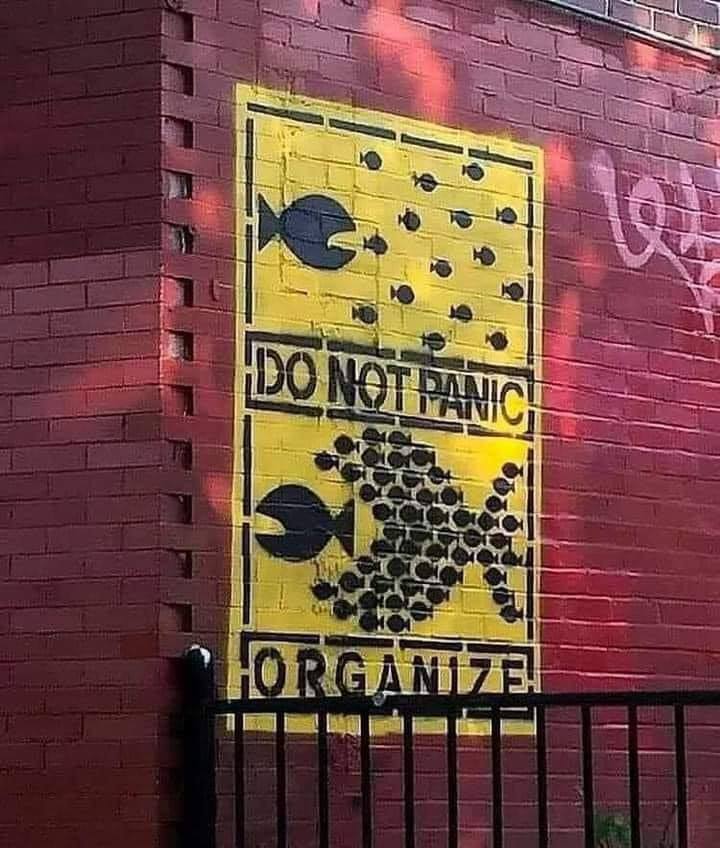
Because the future will not be gifted to us by governments, corporations or platforms, it will be built by people organising together. The question is not whether change is possible, it is whether we organise enough, quickly enough, to make the possible real. Now we need the compost, the networks and the collective effort to help change and challenge grow.
There will be increasing experience of commons as lived infrastructure, not theory, not an idea waiting to be implemented. As the #mainstreaming keeps failing people will need practical, community-led way of meeting shared needs that work and exists wherever people cooperate outside of markets and hierarchy. Commons are not abstract systems, they are what people do when they stop waiting for permission.
We have a recent example – #Oxfordboaters it is messy commons in real time, not a perfect system, more a lived commons under pressure. A community trying to juggle shared infrastructure (boats, moorings, water systems), shared risk (flooding, breakdowns, legal pressure), shared survival (housing precarity, cost of living, access to services) and shared conflict (governance, trust, personality tensions). This example is what commons actually look like in practice, not clean, not tidy, not ideologically pure, but functioning through necessity.
When the state and market do not meet needs, people fall back on each other, that is sometimes the commons’ path… The lesson we learn, it is easy to see, commons are not harmony, they are coordination under pressure. What we can also see is the mistake #fluffy people make in thinking commons are about agreement, they are not, commons are about negotiating conflict, sharing risk, maintaining infrastructure by building trust over time so we can recover from failure repeatedly. The last 4 months of #Oxfordboaters show all of this, the hard truth – Commons fail when they cannot evolve governance faster than crisis accumulates – this is not a moral failure, it is an organisational challenge.
So why do commons break – and why do they keep coming back. Like most grassroots paths, #Oxfordboaters reveals three recurring pressures:
External pressure – State regulation, land pressure, legal ambiguity, the enclosure dynamic never stops.
Internal fragility – Informal systems rely on trust. Trust gets strained under stress, inequality, and burnout.
Governance lag
Decision-making structures rarely evolve as fast as the problems they face, this is a pattern across almost all commons. Commons do not fail because people stop caring, they fail because complexity outgrows structure. But there is a happy part of composting this mess – failure is a part of commons evolution, commons are not stable objects, they are adaptive processes. Oxfordboaters shows that even broken commons still generate mutual aid, shared knowledge, infrastructure repair and survival capacity. Yes, in common sense market logic, this would be “inefficient”, in commons logic, it is resilience under constraint.
The #OMN project framing is why this matters beyond boats. The Open Media Network (#OMN) view is simple – we are not just trying to describe commons. We are trying to improve their ability to survive contact with reality. This example is not a niche story, rather a micro-version of housing systems, digital networks (#fediverse, #openweb), activist spaces, climate adaptation communities and post-institution survival systems. These same patterns repeat everywhere, when systems fail, people build commons whether they call them that or not.
The dangerous mess is we have unlearning commons, the cultural – 40 years of #neoliberal thinking has trained people to believe that trust is weakness, cooperation is fragile, governance must be top-down and commons are “messy exceptions” rather than default behaviour. So even when people build commons, they then try to formalise them into hierarchy by turning them into organisations or burn out trying to manage them individually. This reaction is the mess we need to compost, our example, Oxford boaters currently sits right inside this tension.
We learn what actually works, the pragmatic commons path, a few patterns consistently work: small, local decision loops, visible shared infrastructure, flexible governance that evolves to grow redundancy (no single point of failure), permissionless participation and clear boundaries for conflict resolution. This is not simply, but it is a working #KISS maintenance path.
Markets and states are both reaching limits of adaptive capacity, commons are no longer optional, they are what remains when institutions fail to scale care. The #OMN conclusion is simple, commons are how we survive collapse, that in the wider context is unavoidable, with overlapping systemic crises, ecological, economic, political, informational.
The current mess, and delight at Oxford boaters is a signal, a messy, imperfect signal that says: people will rebuild cooperation when systems break down – but also that we need better ways to support this. Commons are not about perfection, they are about persistence, they are survival systems that people can actually live inside. Our example shows both the fragility and the necessity of this work. The question is not whether commons will exist, it is whether we will learn fast enough to stop repeating the same failures in every new form.
Our #mainstreaming problem. If you are wondering why I keep documenting the issues around activism, this is why. Next time, maybe we can learn, maybe we can mediate our “libertarian cats” a bit better and get a less messy path, because we cannot keep making the same mistakes over and over.
I have been through this mess hundreds of times over 40 years of working on change and challenge, outreach and community building. This is not theory, it is experience. Activism and commons spaces are messy by nature, that is part of their strength. But if we don’t learn from our failures, the same patterns keep returning, so at the very least:
“After hundreds of millennia in which all humans had direct access to the commons, it took only a few centuries… to cut off the vast majority of people on Earth from direct access to the means of economic production and therefore to rob them of the power to say no. It took only a few generations to convince most people that this situation was natural and inevitable. That false lesson needs to be unlearned.”
The starting point is simple, Marx was right about many things. From a commons perspective, Marx understood something fundamental. Capitalism is not just a collection of individual choices and isolated market transactions. It is a system built around extraction, enclosure and the concentration of power. He understood that capitalism emerged through the destruction of older commons systems – taking land, resources and social relationships that had been collectively managed and turning them into private property, commodities and sources of profit.
And, the enclosure of the commons was not simply an economic change, it was a social transformation. People were separated from direct access to the means of survival and production. They became dependent on selling their labour within a system they did not control. With this in mid, the question for the #OMN, is not only “What is wrong with capitalism?” that question is important, but it is not enough. The deeper question is “What kind of structures can replace it without recreating the same problems in a different form?” This is where history, and our projects, becomes complicated.
Capitalism’s contradictions – Marx identified contradictions inside capitalism that remain visible today. The drive for endless accumulation, competition, overproduction and the pressure on profit all create instability. The interesting thing is not that capitalism avoided these contradictions, it did not, instead, capitalism adapted. The state became part of the survival mechanism, financial intervention, corporate subsidies, public spending, monetary policy and crisis management became ways of moving contradictions around rather than resolving them.
The destruction of the commons was not simply progress, it was a loss of social capacity. Communities lost direct relationships with land, production and decision-making, people lost the ability to say no because the alternatives had been enclosed.
The current system survives not because it solved its problems, but because it continually transforms them. The #deathcult adapts, capitalism is good at absorbing criticism, turning challenges into new markets and changing shape while maintaining the underlying logic: growth, extraction and accumulation.
The problem of capturing power – Marx understood that states are often captured by powerful interests, his answer was that the working class should take control of the state and use it as a tool of transformation. The problem is that power does not become harmless simply because different people hold it, a system designed around centralised power tends to attract people who understand and seek centralised power.
The history of the 20th century showed the dangers of this as temporary emergency powers have a tendency to become permanent structures. The promise that authority will eventually disappear is harder to achieve than the promise suggests. This is where the commons’ tradition offers a different starting point, the question then becomes – How do we build systems where power is distributed from the beginning? Not after a revolution, not after someone promises to give power back, now.
Means shape ends, a decentralised, participatory society cannot be built through centralised and authoritarian methods. If the process is based on hierarchy, control and obedience, then the destination carries those same patterns. This is why the commons connects with the libertarian traditions within Marxism, anarchism and movements such as the Paris Commune. The most interesting Marx is often the later Marx, the Marx who became more interested in communal ownership, local organisation and different forms of social production outside the Western industrial model. That Marx is much closer to commons thinking.
Ownership is not enough, a common mistake is to think the problem is only who owns production. Private ownership creates problems, but replacing private ownership with state ownership does not automatically create liberation. A factory owned by the state can still destroy ecosystems, a planned economy can still pursue endless growth.
The deeper question is – What is production for? Capitalism has a built-in requirement, money must become more money, production must expand, markets must grow, but the biosphere has limits. The #climatechaos era makes this impossible to ignore. A system that requires endless expansion inside a finite ecosystem contains a fundamental contradiction. The challenge is not simply changing ownership, it is changing the relationship between humans, technology, production and the living world.
The violence of extraction – capitalism treats value through exchange. Things matter because they can be turned into commodities. This creates a dangerous relationship with the natural world as forests become timber, rivers become sewers, animals become production units, land becomes an investment and life becomes something measured by economic usefulness.
When ecosystems cannot be made profitable, they are treated as obstacles rather than living systems with their own value. This logic spreads into human relationships, over the last 50 years people are increasingly judged through productivity, economic contribution and market value.
The problem is not individual greed alone, the problem is a system that rewards extraction. The question is not whether some people are good or bad, it is what kinds of behaviour the system encourages.
The commons ask a different question, not “Who controls the machine?” But “How do we build systems where nobody can easily capture the machine?” This is where the #4opens matters. The #4opens are not just a technical checklist, they are social infrastructure.
Open process.
Open data.
Open source.
Open standards.
They create transparency, participation and the ability for communities to understand and shape the systems they depend on. The goal is not simply to seize existing structures, it is to build different structures. Revolution as compost to grow alternatives in the cracks. The current crisis is also a crisis of social organisation as change is no longer only organised through traditional institutions. It moves through networks, data, attention and shared platforms.
Building commons, networks and shared memory, creating systems that survive beyond personalities, leaders and moments of attention. From individuals back to collectives, the commons is not one path where everyone must agree, it is a space where many paths can grow together. Diversity is not a problem to solve, it is the resilience.
The commons and climate responsibility – People often say “Humans are to blame for climate change.” But which humans? The responsibility is not evenly distributed, some actors have created far more extraction, pollution and destruction than others. The problem is not humanity, the problem is a particular way of organising human activity.
Keep in mid when building what comes next – capitalism extracts – authoritarian socialism centralises – the commons try to do something different by building power that belongs to everyone and cannot easily be taken away. This task is not to find a perfect blueprint, it is to grow living systems that are adaptable, transparent and rooted in participation. The #OMN, #openweb, #fediverse, #OGB, #indymediaback and #4opens ideas all come from this path.
Not replacing one hierarchy with another, not creating another machine for someone else to control we need to be building commons, trust, collective capacity. The future will not come from waiting for a better version of the existing system, it comes from growing alternatives that make the existing system less necessary.
It is your ability to discern facts that make you an individual, and our collective trust in common knowledge that makes us a society. The individual who investigates is also the citizen who builds. The leader who dislikes the investigators is a tyrant.
The #openweb needs this balance: people with the freedom to question, investigate and challenge – and communities with the shared trust to build together.
Without critical individuals we get conformity. Without common knowledge we get fragmentation. Democracy needs both: curiosity and commons.
A red warning for extreme heat has been issued across parts of the UK this week, including London. For people this heatwave across Europe feels frightening, not because of the temperatures themselves, but of what they imply. Nights stay hot, bodies don’t recover, systems don’t cool down. The baseline is shifting. The question that keeps coming up is simple and unavoidable – if this is what it’s like now, what is it like in 10, 20, 30 years? The answer is not uncertain, it is more heat, more extremes, more instability. There is no “new normal” coming, there is only escalating #climatechaos.
A #deathcult sect for the last 40 years was not built to survive itself, we are seeing this now, the infrastructure is failing. Hospitals, transport systems, housing, food networks – all were built for a climate that no longer exists. Even basic adaptation like cooling is uneven, fragile, and socially unequal. Some workplaces fail under heat stress. Some people have no protection at all. And crucially, we are still not adapting at the scale required.
The UK Climate Change Committee has already said it clearly, adaptation is too slow, stalled, or moving in the wrong direction. That is not a warning about the future, it is a #KISS description of failure in the present. The denial loop over the last 20 years is why we are in such a mess, the pattern is now obvious:
Scientists warn
Media briefly reports
Heat passes
Politics resets to “normal”
Nothing changes
This cycle repeats while emissions continue and global temperatures rise toward 2–3°C and beyond this century. But bland media coverage hides the issues of extremes – heatwaves, floods, droughts, system shocks. And those are already exceeding earlier projections in many regions. Timid climate models underestimating reality due to feedback loops, jet stream disruption, aerosol reduction effects, and regional amplification. We are not just entering a warmer world, we are entering a more unstable one.
Knock-on effects are the real ongoing crisis, the danger is not only heat, it is cascading system failure:
food production under stress
rising prices and political instability
insurance withdrawal from entire regions
economic shocks from simultaneous disasters
infrastructure collapse under compounding extremes
This will obviously trigger the most severe global financial instability in modern history. And then there are the wildcard risks – #WAMOC weakening or collapse, Amazon dieback leading to abrupt regional climate shifts. It is not just science fiction, they are known systemic risks inside a destabilising ecological earth system.
One thing we need to talk about and be more clear on is #climatechaos is #classwar. This mess is not experienced equally, the rich (most of the #nastyfew) up to a point when they die of old age can adapt individually, with industrial air conditioning, private infrastructure, relocation options to second homes in safer climates. While everyone else absorbs the breakdown of overheated housing, unsafe work conditions, failing public services and the resulting rising costs of survival.
This is why #climatechaos is also a strong class issue, the crisis is not just physical, it is political due to the visible distribution of risk and protection. After ten years of warnings, many of us were already naming this:
At the time it was still framed as prediction, now it is reality. The uncomfortable truth is not that we were wrong, it is that nothing meaningful was done at scale. One thing we have learned, that we understand more clearly now is it is not an information problem, it’s a systems’ problem.
Extraction-based economies cannot easily respond to limits
Attention-based media cannot communicate slow crisis
Electoral politics cannot act on long time horizons
So the system produces delay, distraction, and denial even as conditions worsen. There is a strong role of the #dotcons in this mess as the big social media platforms have intensify this failure. They spent the last ten year optimise for outrage, fragmentation, consumption and finally forgetting. Crisis becomes a series of disconnected moments rather than a shared progressive long-term struggle. Each event resets attention to zero, memory does not accumulate. This is not an accident – it is structural.
Why #4opens matters now, becomes more important, not less, this is not the normal #mainstreaming liberal ideology. It is #KISS basic resilience infrastructure, as surviving #climatechaos requires collective intelligence that can persist across time, crises, and institutional failure, we need tecnolagy like the #OMN that can help medate this:
Closed systems concentrate control.
Open systems distribute survival capacity.
But under all this the missing layer is meaning, one of the biggest underestimates from the last decade is psychological – people are not only resisting facts, they are defending meaning – belief in control, belief in technological rescue, belief in stability returning. But these #mainstreaming stories no longer match reality, but this denial persists, not because people don’t know, but because they cannot yet replace the blinded liberal stories. This is where change actually happens,not just information, but shared meaning and practice.
What changes now? Ten years ago the message was, stop feeding the system causing the crisis, now the message is build the systems that can survive what is already here. That means:
The point is not purity of language, its growing commons of action and hashtags are a tool for this.
As we see today, we are not approaching #climatechaos, we are inside it. The urgent question now is whether we can build systems – social, technical, and cultural – that can function while it unfolds or we keep letting things fail.
That is the #OMN challenge, and it is already overdue.
Let’s be clear on the background mess, before the personal attacks start, this is not about individuals. It is about patterns, systems and ideas. The danger is that criticism becomes an #adHominem argument – “you just dislike this because…” – instead of looking at the actual structures being discussed.
The point I am making is that parts of dead #postmodern thinking have ended up embedded inside #neoliberal culture: fragmentation, individual identity, endless discourse and difficulty building any shared collective action. That does not mean every idea, person or piece of work in those spaces is the same, it means we need to look at how ideas interact with power.
The question is – What helps us build collective capacity in a time of #climatechaos, inequality and the #dotcons mess? What creates commons? What creates shared action? This is the conversation.
So with that in mind lets look at the major problem with the #dotcons attention economy the advertising model. The platform logic and the attention economy are now becoming harder to simply ignore. For most of mass media history, the commercial transformation of media was hidden behind a layer of journalism, culture and public value. The advertising model was presented as simply a way to pay for content. Platforms were presented as neutral spaces for communication. Algorithms were presented as tools to help people discover what mattered.
But the #dotcons direction has now stripped this bare – the direction has become clearer, the media landscape looks less like a place for shared knowledge and more like a shopping catalogue with occasional content attached. The focus is no longer even the fig leaf of informing people, connecting communities or building public understanding. The naked goal is simple – more clicks, more engagement, more time captured, more data collected and more consumption encouraged. This is the logic of the #dotcons.
The problem with this #deathcult worshipping mess is not only that companies make money. The deeper problem is that the structures built around making money reshape our culture itself. When attention becomes the product, everything starts being measured through extraction. A story is only valuable because it generates traffic – A person is only valuable because they generate data – A community is valuable because it creates engagement – A conversation is valuable because it keeps people inside the platforms. Any, social value gets pushed aside.
The original #openweb grew from a different idea. People built websites, forums, mailing lists, software projects and communities because they wanted to share, collaborate and create. The value was not only in the information produced, the value was in the surrounding relationships. People corrected each other, developed trust, knowledge was maintained collectively.
The internet worked because there was social infrastructure around the technical infrastructure. The mess we made, was thinking that communication could simply be handed over to commercial platforms without catastrophic changing the nature of communication itself. A platform is not just a tool, it comes with incentives, has owners, rules, a business model. When every space becomes a marketplace, the culture changes.
The mess we have made is that extraction replaces participation, the #dotcons path works by turning human activity into resources. People create, platforms capture. Communities produce culture, companies monetise attention. That extraction eventually damages the thing being extracted from, creators become exhausted, communities fragmented, trust declines as people become audiences instead of participants.
The internet becomes full of “content”, but much poorer in meaning, more information does not automatically create more knowledge, more communication does not automatically create better communities, without care, context and collective responsibility, abundance becomes noise. To compost this mess we have made in the media tech path – the question is not “How do we get more people producing?” The question is “How do we build systems where what people produce strengthens the commons instead of feeding extraction?”
The fashionable people of #AI are pushing at changing the scale of content creation, lowering barriers to producing books, apps, music, legal documents and academic papers. Thus, “output” is exploding. But the #OMN second question is what happens when production grows faster than the ability to filter, discuss, trust and maintain? More books, but more noise, More apps, but more clutter. More papers, more pressure on review systems, more music, but harder to value human creativity.
The #dotcons logic says: more content = more value. The #openweb lesson is different – value comes from communities, trust, context and care. We don’t just need more production, we need better commons, better mediation and better ways to separate signal from noise.
The current wave of generative AI (#GenAI) is presented as inevitable, the message is everywhere: adapt, adopt, integrate, or be left behind. But technology is not neutral, as every tool carries assumptions – who benefits, who controls, what values are embedded, and what damage is accepted as “the price of progress”.
From a #OMN perspective, the question is not simply “can this technology do impressive things?” Of course, it can. The question is what kind of society does this technology build? Does it strengthen human creativity, collective intelligence and open participation? Or does it deepen the existing #dotcons path of centralisation, extraction, dependency and enclosure? The promise and the reality of large language models (#LLM) represent a technical development, they can summarise information, translate languages, generate text, assist coding, and help people interact with large amounts of information. These are real, if floored capabilities.
But the current #techshit hype jumps from useful assistance to much bigger claims: that these systems will replace expertise, solve social problems, revolutionise education, transform science, and create a better future. This is currently not true, and, on the LLM path will never be true as the current GenAI systems do not understand the world. They generate likely patterns based on huge amounts of training data. They do not know truth from falsehood, meaning from appearance, or ethics from probability, a convincing answer is not the same as a system that understands. This matters because the native #openweb was built on a different idea, that knowledge comes from people, communities, discussion, correction and shared responsibility.
The #geekproblem is confusing capability with wisdom is a recurring problem in technology culture – it is the assumption that if something can be built, it should be built. The technical question becomes “Can we?” while the social question “Should we?” gets pushed aside. This is part of what #OMN calls the #geekproblem – the tendency to reduce complex social questions into technical problems. A better search algorithm does not automatically create a healthier information system, a faster way to generate content does not automatically create better knowledge. More automation does not automatically create more freedom. The missing piece is the social context around the technology.
Then we come to the ecological cost of scaling, the current GenAI boom depends on enormous infrastructure. In the era of out of control #climatechaos data centres require huge amounts of electricity, water for cooling, specialised hardware, constant replacement cycles leading to massive extraction of resources. At a time of #climatechaos, we should be asking whether increasing consumption is the only path available.
The lesson is not that technology is bad, the lesson is that technology without social responsibility becomes a tool for whoever already has power. The question is not “how do we make AI bigger?” more it is how do we make technology serve human communities rather than making communities serve technology control systems, it is about who controls. The current dominant systems are owned by a few powerful companies controlled by the #nastyfew actively working to destroy our ecology and societies.
The future is not decided by whether we use AI, it is decided by whether we allow the same old #dotcons logic to shape every new technology. The work remains the same to build alternatives, keep processes open, grow the commons. The answer is not simply rejecting technology, the #openweb has never been anti-technology. The question is what kind of technology grows from what kind of culture. We need tools that strengthen human networks, not replace them. Tools that support commons, not enclosure, that increase agency, not dependency.
If we change this can there be an ethical AI? A socially useful technology? Possibly, but it would require a very different path, it would need many of the things the #openweb has argued for from the beginning.
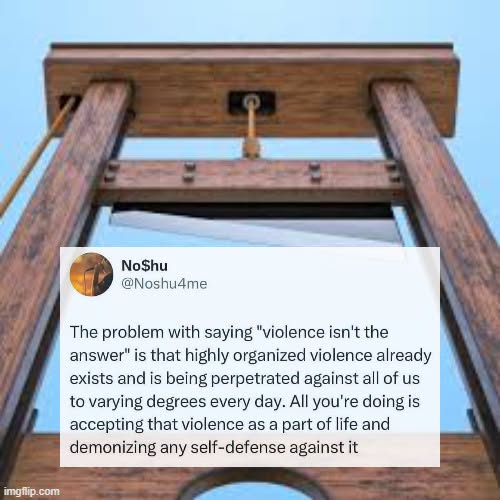
The recurring argument around violence and nonviolence gets trapped in a false choice. One side says “Violence is never the answer.” the other says “Violence is the only thing that has ever changed history.” Both are truth, but both miss real working humanistic paths. So, what kind of society creates the conditions where violence becomes the only option?
A first step is looking at the systems, cultures and social infrastructure that shape how people respond to conflict. If we want people to choose nonviolent methods, then those methods have to actually work. People need meaningful ways to participate, organise, challenge power and create change. Protest without consequence, dialogue without accountability and institutions that ignore people create dangerous paths.
When people feel that peaceful routes are closed, violence becomes a real option. But there is a second social problem to look at – violence is not just a tool, it creates its own culture. A movement built around destruction can easily reproduce the same power structures it fought against. Removing one oppressive system does not automatically create a better one, without new social foundations, history shows new forms of domination grow from the ruins.
Yes, history is written through moments of confrontation, but the is deeper work happens before and after those moments – building the commons that allow people to organise differently. This is where the #openweb lesson matters, change is not only about removing something, it is about building something. The strongest movements create alternatives – new relationships – new institutions – new forms of cooperation – new ways to share knowledge and power.
To build meaningfull alternatives we have to start by compostsing commen sense mess. What meany people do not understand is that our states are based on violence, what we see as private property is based on violence, just about everything we hold and touch is founded on violence. But when we look wider, a narow posative view is the state monopoly on violence is only legitimate when the state itself remains accountable to people. When power becomes accountable only upwards – to wealth, corporations or institutions – then the monopoly becomes simply control.
The same applies to grassroots movements, a movement cannot claim liberation while creating unaccountable power inside itself. The #geekproblem appears here too, reducing social problems to technical solutions – “Use violence.” – “Never use violence.” are simple answers to complex social questions. The harder work is asking, why are people unheard? Why do peaceful methods fail? Who controls the institutions? What alternatives exist? How can we build systems where people have agency before conflict reaches breaking point?
The #OMN path is not about pretending conflict does not exist, it is about understanding that the long-term answer is not simply winning a hard short fight. It is slower, growing a culture where fewer fights become necessary. The #4opens is part of this – transparent processes, shared ownership and accountable structures are not side issues. They are a foundation that allows movements to stay democratic instead of becoming another “common sense” version of the mess they oppose.
Violence is often a symptom, the deeper question is what social conditions keep producing it.