In this #openweb reboot, do you ever stop and wonder, really wonder, why most of the codebases outside #Mastodon are languishing? It’s not a technical issue. It’s not “a lack of funding” (though that’s what they love to talk about). It’s not even about network effects, not really. It’s because they’re all following Mastodon’s lead, straight into the #NGO world.
This is a path paved in smiles and slow death. A warm bath of #NGI grant cycles, #NGO diversity reports, and performative panels. On this dead-end, the goal isn’t to grow, challenge, or change. The goal is to survive, to be tolerated, within existing institutional structures.
Let’s be honest: this is such an obviously pointless and self-defeating direction that it’s stunning more people aren’t calling it out. Why is it pointless? Because in the #NGO world, success isn’t the point. The hierarchy already has its chosen project. It has its darling. And surprise surprise – that’s Mastodon.
Everyone else is there to tick the diversity box. You’re the “alternatives” that prove there’s choice, even if there isn’t. You’re invited to speak, but not to decide. You’re encouraged to exist, but only if you don’t matter.
So these projects stall, not because they’re bad ideas, or bad code, or have no community. But because they’ve internalized powerlessness, shaped by institutions that reward conformity and punish genuine independence.
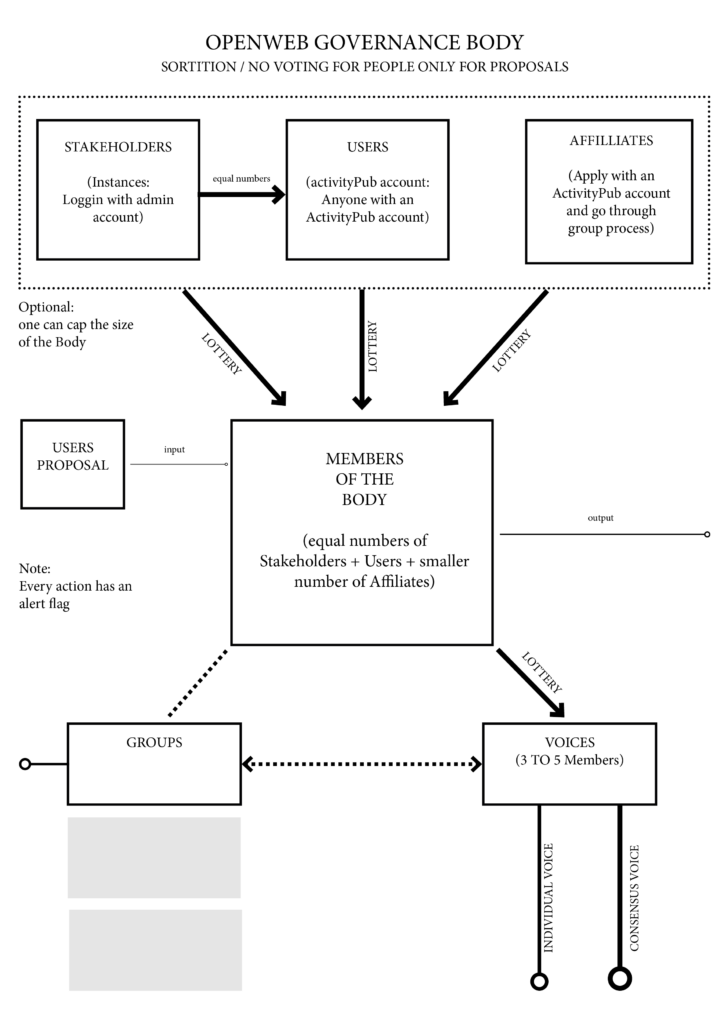
Here’s the bitter truth: If you want your project to thrive, you have to stop only begging at the gates of the palace. You have to stop only trying to be included, you have to also build outside their logic. That’s what the #OGB (Open Governance Body) is about, not building consensus at the top, building trust at the roots.
That’s what the #OMN is about, a web of native projects, not another hierarchy with a different brand. We don’t need to only “be taken seriously” by NGOs. We really need to #KISS build governance that works without them. And what we don’t need is more performative panels, we need compost, shovels, and seeds. Let #Mastodon be the flagship, in the long term, it’s likely to drift into irrelevance, or rot into compromise. Let the rest of us get on with building the working path.
You don’t have to only attack problems, you can also build round them and leave them to decay, then shovel over the mess to compost, the problem we face now is that we need a shovel, a first step is to build that #OMN
Some strategies to mediate the #blocking mess in a way that stays true to the #4opens:
1. Compost the Conflict. Don’t try to avoid the mess – use it.
Acknowledge blocking as an emotional reaction to risk/fear/powerlessness.

Create safe compost heaps where disagreements can break down slowly (forums, slow chat, moderated conversations).

Let things rot before replanting — time is part of the process.
2. Build Friction Where It Helps. Instead of forcing “smooth consensus,” engineer positive friction.
Let friction surface hidden assumptions early, but contain it constructively.

For example, structured disagreements (Yes/And).

Use #4opens to keep the process visible and trustworthy.
Tactic: “This disagreement stays open – until it breaks something or blooms something.”
3. Create Walkable Paths Around Blockers. If someone/some group blocks – don’t go through them, go around them.
Design with pluralism and linked forking paths as core strengths.

Accept divergence — allow others to #4opens fork rather than forcing them to bend.
Metaphor: Every open path has forks. We need more people walking, fewer people standing still yelling.
4. Bridge the ‘Trust Gap’ with Small, Lived Examples. Many people block because they don’t trust the process – they feel tricked, ignored, or co-opted.
Rebuild trust through visible, small-scale functioning examples — real communities doing real things with the #4opens.

Highlight stories where governance and code worked together.

Stay humble: don’t oversell the vision; show, don’t tell.
5. Normalize Changing Your Mind. Most blocking happens because people are afraid of losing face, status, or being co-opted.
Create spaces where changing your mind is not shameful — it’s rewarded.

Public “reconsideration threads,” “I changed my view” badges, etc.

Use organic intellectuals who model doubt and curiosity, not just certainty.

Reframe the debate using values: trust vs. fear, openness vs. control, native vs. extractive.
You don’t solve #blocking by trying to make everyone agree, you solve it by making space for disagreement to stay open and generative – not as a problem, but as part of the compost from which better paths grow.
This mainstreaming/alt mess making is not about real disagreement or dynamic ideas. It’s about channelling noise that flatters the existing structures and silences anything genuinely alternative. This isn’t controversy, it’s signal-to-noise warfare. And right now, the noise is winning.
Let’s be blunt. On the subject of this site, nearly every so-called “alternative” tech event funded or structured by #NGO culture is riddled with parasites – projects more interested in their next grant or their place at the conference table than building anything outside the status quo. They’re not evil – just placated, softly herding us back into the polite cages we were trying to escape.
They block by doing nothing, block by talking too much, block by looking away when real change knocks. They block by turning real signal into noise.
The actual energy, the radical possibility, is elsewhere. The #OGB (Open Governance Body) is designed with this in mind: not to convince the already-compromised, but to build something permissionless and let it loose. Let people feel the value, or not. No “hard” hand-holding, no pre-approval, no gatekeepers.
It’s a #KISS project: Keep It Simple, Stupid. We’re building for the people up shit creek without a paddle, not the people arguing about paddle aesthetics on a conference panel. We don’t need more “controversy” to win attention in the #NGO#PR-sphere. We need real signal, real builds, real grassroots governance to share power.
And yes, we do have a problem with apathy and Laissez-faire “common sense” that lets this cycle repeat. So let’s stop waiting for the right moment or the perfect audience. We build with this problem in mind. We design #DIY structures that can work in the real mess.
These people have a role in the balance of the #openweb reboot, the middle class, careerists, petty capitalist, “privileged” #NGO and co-op crew. But they need pushing themselves, when they push over this balance role… and they do become, when they don’t have any idea or understanding for the need for the balance. This is a very common problem that we need to compost.
Let’s take a step back. In an old thread about online governance, I found it revealing – and a bit frustrating – that almost nobody actually engaged with what the thread was about: building a lightweight, federated, working governance layer. The project in question is the OpenWeb Governance Body (#OGB): https://unite.openworlds.info/Open-Media-Network/openwebgovernancebody/
We were writing a funding proposal to take a simple, well-tested social workflow (which we already know doesn’t scale in its current form), and federate it, to scale through distribution, not centralization. Think of it like this, we already have a proof-of-concept that this can work. It’s called the #Fediverse. Yes, there will be a lot of “smoke”, confusion, distraction, bureaucratic inertia. But we’ve got practice cutting through it, and could use the funding to bring in more people who see clearly and act with purpose.
What we are working on is a cultural problem, not just a technical one. This isn’t about personal attacks, it’s about recognizing a systemic cultural issue. Many people (often, but not exclusively, middle-aged white men) simply can’t see that some projects have value despite being outside their frameworks or institutional comfort zones. It’s a kind of intellectual and emotional poverty endemic to the late capitalist #deathcult era.
“Distilled, grassroots, radical governance is a good fit for the fediverse.”
And that’s what we’re doing. This work comes from decades of experience, 30+ years of distilled practice from social change spaces:
Squats and protest camps

Climate camps and Reclaim the Streets

Indymedia, XR, and even Occupy

And Rainbow Gatherings — still running on consensus-based governance born from the Vietnam-era anti-war movement (not “hippy dippy” utopias, as some imagine)
What we’re doing is embedding this lived practice into the tools and frameworks of the #openweb, creating digital tools that reflect real-world collective experience. These are bottom-up, permissionless, and rooted in doing and trust built through doing. This is not about technical fixes. It’s about using tech to open spaces for people to get messy and find their own path to cooperation.
Why we don’t use #processgeek paths like “Sociocracy”? The “problem people we touch on at the start of this article suggest alternatives like sociocracy. And sure, if that works for your group, go for it. But from the native grassroots side, sociocracy is often the equivalent of a well-meaning hippy round the campfire saying “can’t we all just get along?” while someone pisses on the garden they planted and another person ignores the washing-up rota they just taped up. It’s a structure that presumes goodwill and compliance, and that’s not enough. We’re building for mess, for people who don’t agree, for trust that emerges through doing, not rules imposed from the enlightened #blocking crew from above.
Multi-stakeholder Co-ops? Yes, but not from your typical bureaucratic blueprint. What we’re proposing looks like a multi-stakeholder co-op at times, but it’s far more grounded in anarchist and community-based models. It’s not about creating legalistic enclosures or hierarchical enforcement, we deliberately ignore that mostly irrelevant logic.
About centralization, Yes, Mastodon’s >90% of instances are in five countries. Yes, some instances hold way more users than others. And yes, that’s an issue. But we address this differently, we recognize centralization as a problem and create space for alternatives by encouraging small, local, resilient hosting.
If you run an instance in the #Fediverse, you already understand, It’s your voice, there’s a positive feedback loop here, the more care you give to your space, the more your voice matters. No need for complicated representation schemes. This is the natural governance of federation. You don’t get a vote unless you actually show up, that’s fair, if you want influence, spin up an instance, participate in the culture, do the work.
Governance isn’t something you build from scratch. It’s something you distill from lived experience.

We don’t want complexity. We want clarity, action, and real tools that reflect how people already cooperate.

#KISS wins — every time.

The project matters more for what it refuses to do, than for what it builds.
The #OGB native path is not #mainstreming, it’s a #KISS counter current, about building shared governance for the #openweb, grounded in the #4opens and real-world collective experience. Want to help? Step out of your institutional box, get your hands dirty, help make governance useful again.
Let’s begin from a traditional liberal framing: Most social interactions should be OPEN, some private or sensitive interactions may be CLOSED.
This isn’t radical. It’s been a functional principle across free societies for the last century. But in our current digital culture, this simple framing is often flipped or ignored. Many developers, activists, and even funders uncritically push for closure, often in the name of privacy, safety and control, without recognizing what’s lost when everything closes.
The power of OPEN is in all good forms of social power, and progress comes from open processes:
Transparency builds trust.

Sharing creates knowledge and community.

Federation gives us alternatives to centralized control.
From the printing press to Wikipedia, openness has always been a powerful force for liberation, creativity, and ideas of justice. Meanwhile, much of the worst abuse and corruption festers in the dark:
Hidden surveillance (NSA/Five Eyes).

Closed algorithms (Facebook/YouTube).

Closed decision-making in opaque NGOs and funding foundations.
If we push everything into private silos or locked behind paywalls, we kill the culture that allows us to challenge and change the systems we live and die under. We are left with only closed, and that’s not a world we want to live in.
A real-world example is needed? Let’s talk about the Diaspora project, 15 years ago, in response to Facebook’s rise, a group of well-meaning devs built a “privacy-first” social network. They rejected the openness of exiting paths like #RSS and federated tech like #XMPP. They wanted to start from scratch, build their own private network, and lock down data flows, for “safety”.
The result was a very predictable mess, Diaspora burned brightly and briefly, but never built a vibrant network. In contrast, existing open networks were shouted down, de-funded, and ignored. Ten years passed. Then, we had to reinvent the same open paths, we had shut out, with ActivityPub to get back to what #RSS and other open tools had already done.
This is the #geekproblem, the idea that you can throw away working social infrastructure because it’s not “clean” or “cool”, and replace it with abstract, closed systems… a path that usually ends in failure. Worse, it delayed progress by a decade. Encryptionism, privacy dogma, and the closing of the commons, where mess we now need to compost
Yes, privacy is important, nobody is arguing otherwise, but what many #encryptionists miss is that building only for privacy is building only for fear. You can’t build a shared culture on fear alone, you need to balance this with trust, transparency, and cooperation too. These require openness. When everything defaults to closed, the commons die, and without the commons, there is no #openweb.
A politics of openness, is not just technical. It’s deeply social and political. It touches on human nature, ideology, and power. If you’re new to these ideas, start with some reading of the basics of Sociology (Wikipedia) and Political ideologies then ask what assumptions are built into tech? Who does it empower? Who does it exclude?
This is about where to begin, to understand motivations and outcomes in #openweb development, it helps to name the ideological currents at play:
Conservatism → favors stability, hierarchy, closure.

Liberalism → favors rights, transparency, and balance.

Anarchism → favors decentralization, autonomy, and openness.
Much of the Fediverse, despite the tech mess, is functionally anarchist in ethos. But this is rarely understood or spoken aloud. We have the A (Anarchy) but not yet the O (Order). A job people could take on is to fix this by building the O in the Fediverse, rather than let the default path be imposed, by the natural flow where #NGOs and #foundations bring closed governance models wrapped in the fig leaf of “participation”, we should be working now to build native, open forms of governance.
That’s what the Open Governance Body (#OGB) is outlined to do, to creating soft structure for an open culture. That’s what the #4opens help guide: basic principles for transparency and shared power, let’s support these paths. As if we default to closure – either because of fear, control, or ideology – we kill the #openweb before it can grow back.
Let’s remember, we are the stewards of the future commons, let’s keep the doors opens. Thoughts? Examples? Let’s keep this conversation alive, in the open.
In the face of mounting crisis – social breakdown, political polarization, ecological collapse – many people turn inward. And in this turn, they mistake passivity, irony and detachment for resistance. But hopelessness is not radical, it’s deeply conservative. It says: “Nothing can change.” “Everything is corrupt.” “Why bother?”
This isn’t rebellion, it’s surrender. And it’s the exact emotional state that power systems – what we call the #deathcult of neoliberalism – need us to be in. It feeds on your hopelessness, it wants your sarcasm, it loves that you’re “above it all.”
Meme culture & irony: Subversion or sedation? What started as absurdist and ironic commentary devolves into a feedback loop of reaction over reflection. Sarcasm and irony dominate, and this can be useful satire, but more often it’s deflection. You’ll see it in:
The snide quote-tweets with no solution.

The endless “vibes” critiques in social threads.

The collapse of political dialogue into aesthetics and shitposting.
This “cool detachment” doesn’t move us any were toward change, it actively blocks it. We saw this in the decline of many #Occupy offshoots, where internal meme culture replaced organising. Or more recently in parts of climate circles, where #doomposting pushes people into nihilism instead of movement.
Inward-looking tribalism in a globalising world, the creeping tribalism of identity performance, the tendency to build ever-smaller circles of agreement and define yourself against the world instead of with it. On the surface, this might seem like radical rejection of the #mainstreaming. But it’s the opposite, a deeply conforming reaction to consumer individualism.
“Build your brand.”
“Curate your followers.”
“Find your niche.”
“Be your own revolution.”
This is #stupidindividualism, a self-defeating survival mode learned from decades of #neoliberal collapse. But there is no individual path through #climatechaos, only collective ones. We see this mess when grassroots media creators ignore collaboration and #4opens publishing, instead choosing to grow their own follower count on YouTube, TikTok or Substack. We see it when radical tech projects are siloed by pride and petty grudges, while the #dotcons eat their functionality alive.
This performative tribalism ends in isolation, not revolution. All of this is the problem, not the solution, let’s be clear:
Spaces where we speak with doubt, and listen with care.
Structures of cooperation, not only critique (#indymediaback).
We don’t need perfect answers, we need open processes, and we need to reclaim hope, not as naïve optimism, but as active engagement. So pick up your shovel, join a group of composters, feed the soil of a future worth living in.
And what would that actually look like? Let’s be honest about what the #Fediverse is, despite all the code and standards talk, the heart of the Fediverse is anarchism – not in the chaos sense, but in the older meaning:
The letter A for anarkhia (‘without ruler’), circled by an O that stands for order or organization.
We have plenty of the A with decentralization, voluntary cooperation and resistance to imposed authority. But where’s the O? Of clear coordination, transparent process and federated trust and mediation?
Right now, we’re herding cats – each server, dev group, and community running off on their own, building tools and protocols, often without clear ways to connect, share governance, or defend against capture. This worked when we were small, it will not work now the big boys have arrived.
Warning from experience: The #EU outreach failure, we had a direct taste of this during the 2023–24 EU outreach process. It worked, but was quickly transitioned to the infrastructure of the #Fediverse without its soul. This isn’t theoretical, it is what happened to #FOSS transitioning to #opensource in the 2010s. This is what happens if we keep doing nothing? If we don’t act:
The foundation model is imposed — not built.

The fig leaf of “community governance” will be ignored.

A self-selecting oligarchy will form — friendly faces, perhaps, but still an eliteist power cleqe.

The Fediverse will be co-opted — just like we watched Google and Microsoft do to open source over the last 20 years.
Yes, #ActivityPub is “open” but openness alone doesn’t stop capture. Ask the #FSF, or look at meany #NGO paths in tech.
What would “native” governance look like? Built from our values, not imported from the institutions we’re resisting.
Real federation of trust -Imagine something like “trust instances”, each instance or org can choose to endorse certain process and values (e.g., 4opens, PGA hallmarks), creating a visible network of aligned projects. Not a central body, but a web of consent, the #OMN is an example of this.
Self-accountability + Diversity of tactics. Everyone agrees to transparency and openness. Everyone chooses their own path. Nobody is forced, but the community can see what you’re doing. This is essential for resisting #NGO co-option without creating more gatekeeping elitists
Are Platform Co-ops the Answer? Maybe, but… proceed with caution. Many tech co-op projects I’ve seen:
Become ossified in bureaucratic process

Elevate process geeks over users and communities

Reproduce #NGO behaviours under a different name
We’ve seen this in the #techcoop movement, especially in the UK, where platform co-ops often start with radical aims and drift into “doing B2B consulting for ethical startups.” Fine, but not the revolution we worked for. The stakes are real, we’re not just talking about tech here, we’re talking about:
Climate collapse

Social fragmentation

The rise of digital authoritarianism
We need an #openweb that reflects our values, #fediverse governance that protects the commons, and to move from just the A to the full A inside the O – the anarchist circle of voluntary structure. Let’s not wait for another hijacking, we need to build something native to the Fediverse before it’s too late.
The signal-to-noise problem of our #geekproblem in the #fediverse and the wider #openweb. Let’s be clear: platforms like #Mastodon and the #Fediverse are native openweb projects. They embody the values of the #4opens — open data, open source, open process, and open standards.
The value here is not in hardening and securing these systems to the teeth. People who are pushing for hyper-“security” are missing the point entirely. This isn’t about “common sense” dev practice. It’s about use-case. Public media content should be open — and that’s what the Fediverse is good at. It’s media. It’s conversation. It’s public dialogue. That’s what #ActivityPub is designed for. For private communication, we already have mature and well-tested encrypted tools: #Matrix, #Briar, #Signal, etc. Use those for whistleblowing, direct action, or anything sensitive.
Trying to bolt high-security models onto public communication tools breaks the value of the #Fediverse – its simplicity, accessibility, and low barrier to entry. Right now, the #Fediverse is a functional part of the #OMN – it’s a mesh of many small pieces, loosely joined, low-barrier, easy to host, easy to adapt, easy to grow. This is a fragile ecosystem, not a fortress. By pushing unnecessary “security” requirements, this #geekproblem are:
Scaring away potential users and admins

Raising technical barriers

Spreading #FUD

And most dangerously — undermining real-world activists who rely on open visibility and reach, not secrecy.
The #geekproblem, pushing complexity, abstraction, and fear over usability and trust, has been blocking the alt-tech world for over 20 years, it’s happening again. Let’s not let them smother this moment, the open web works when it’s messy, simple, and human.
This is an old and familiar problem: people who say they want change but consistently choose the path that neutralises it. Welcome to the “common sense” #NGO worldview, currently being repackaged in the #Fediverse as things like the Fedi Foundation. It’s not new. It’s not empowering. It’s a tired institutional gravity that drags every radical project into a fog of bureaucracy, branding, and paid careers.
In contrast, we have the “nativist” #openweb crew – grassroots people working with messy horizontalism and free tools, trying to keep the fire alive. See the more grounded reflections like What would a fediverse “governance” body look like?.
And then, sitting awkwardly in between, we have the #geekproblem, coders who are working hard on technical processes like the FEPs (Fediverse Enhancement Proposals) but who avoid touching anything political. They’ve been pushing the #fep process for years now, and while technically interesting, they often ignore the deep political questions of governance and power. That’s fine. But it leaves a vacuum.
The risk: If native paths don’t move, the NGO model will win by default is the hard truth, if the “native” #openweb people don’t move beyond our tired leftist divisions and infinite internal critique, then the #NGO model will be imposed. History tells us this, over and over again. Nature abhors a vacuum. Institutions are always waiting to fill the space with “best practices,” dull forms, and “inclusive” hierarchy. It’s just what happens when there’s a failure to organise from below.
And here’s the problem, the argument between “structure” and “lack of structure” is largely a strawman. Most functioning grassroots projects have lots of structure, it’s just soft structure: relational, implicit, culturally encoded, emergent. The #OGB project (Open Governance Body), for instance, grew from the #EU outreach work and shows this kind of structure in action. It’s not rigid like an NGO. It’s not anarcho-chaos either. It’s #KISS structure, small, practical, and adaptable. But people often miss this because they’ve been taught to only see hard structure: constitutions, charters, legal entities, chairs, and trustees. This blindness is a serious block.
On coops, NGOs, and the shadows of the #Deathcult. A note on coops: They’re often cited as a model alternative. And yes, coops can be good. But many have been co-opted. They function more like bureaucratic relics than vibrant counter-systems.
Examples:
The Coop supermarket hired Tesco managers to “turn it around,” resulting in soviet-style shopping and a full embrace of corporate logics.

The Coop Bank? Try dealing with them — they’re functionally broken through bureaucracy.

1970s wholefood coops had potential — many evolved into neoliberal health shops in the 1990s, selling overpriced turmeric capsules to middle-class wellness seekers.
In contrast, activist organising – even when messy, clumsy, and exhausting – is a better bet. It rarely becomes the shadow of the #deathcult because it is in active struggle against that system. NGOs and formalised coops often become the shadow by default.
What should we do?
Name the problem without being prats about it. People drift into #mainstreaming by habit, not usually by conspiracy. But habits can kill movements. Name them. Push back gently but firmly.
Embrace diversity of organising models. Don’t push coops or NGOs as a one-size-fits-all. Sometimes a loose affinity group or soft network is better. Sometimes a coop makes sense. But don’t dogmatise structures that we know often fail.
Build soft structure, not rigid rules. Ask simple questions like “How does this work with the #4opens?” or “Does this strengthen the PGA Hallmarks?” This builds accountability without shutting down creativity.
Support native projects like #indymediaback, #OGB, and the #OMN, these are based on working structures, rooted in radical history, and built by people with lived experience of doing the work.
Don’t confuse visibility with substance. Just because a foundation or NGO gets press or looks shiny, doesn’t mean they’re doing anything real. Look under the hood.
Compost what needs composting. Don’t let failed or flawed projects keep clogging up energy space. Say goodbye, thank them for their lessons, and move on. We have enough shit to shovel already.
In summary, we don’t need to choose between chaos and bureaucracy. There’s a third path of soft, relational, rooted organising with shared values, proven history, and practical tools. But we have to fight for it. Because if we don’t, the NGO train will keep rolling through, colonising everything with HR-speak and grant metrics. And we’ll be stuck rebuilding, again and again. Let’s not waste more time on that.
If you’ve ever tried to build something radical, collective, and actually useful, you’ve run into strong #blocking forces. They’re not just annoying, they’re dangerous, structural, and they always show up. This post is about naming those, calling them what they are, and understanding how they’re entangled in the wider problem:
A culture that valorizes individualism, feeds on careerism, and bows to the false “common sense” of the neoliberal #deathcult.
The #NGO agenda: Careerism in activist clothing, highlights how too many grassroots projects are co-opted by well-meaning (or not-so-well-meaning) NGOs and their functionaries, who come waving grant forms and talking about partnerships. But really, they’re selling a diluted, bureaucratic version of change that fits inside capitalist institutions, with jobs and funding flows to protect.
At best, they water down radicalism into “deliverables.” At worst, they actively trample grassroots horizontality to build careers. They normalize the #dotcons. They manage, rather than transform. This isn’t conspiracy, it’s structure. And we need to build outside this deadened swamp.
What keeps this hard to see is the petty politics and personal grudges, as micro-level sabotage, let’s be honest, some people would burn the future to win a petty feud. This is the everyday rot of #stupidindividualism, where narrow self-preservation and shallow ego become more important than collective progress.
Projects like #indymediaback, which depend on shared vision and mutual respect, break down when people refuse to grow beyond grudges. These behaviours reflect deeper cultural damage, we’ve been trained to see each other as threats, not collaborators. #KISS we can’t build anything real if we don’t actively mediate this. That means talking it through, holding space, calling it in, before it derails the work.
The liberal trap is about dogma masquerading as “common sense”. I’ll say something unfashionable, I have respect for old-school liberalism. It gave us social safety nets, education, some rights, a lot of good stuff came out of liberal traditions. But today’s dogmatic liberals, clinging to broken institutions and smearing “common sense” over radical action, are a drain on movement energy. Their default is always compromise, always moderation, even when the world is on fire. We’re stuck negotiating with people who believe the future is a reformed version of the past. It isn’t. We need to move forward, not beg to stay where we are.
The #geekproblem is about control, complexity, and disconnection. We’ve talked about this before, and it keeps coming up. The #geekproblem is when technologists build tools for control rather than empowerment, for complexity rather than access, for themselves rather than people. Often dressed in “neutral” language or “perfect systems,” these tools lock out users, deny social context, and kill collaboration with arrogant assumptions. The fix? Build for people, not machines. Use the #4opens. Work from #DIY practice, not just theory. Centre community. Make it work for the bottom, not only the top.
The path we need is compost isn’t about perfection. We need to admit we’ve all played roles in the mess. The key is naming it, owning it, and moving differently. Tools like #OMN, #indymediaback, and #OGB are not ONLY shiny new things. They’re grounded in lived practice, built to solve real problems. They don’t pretend to be magic fixes, they are basic shovels, to compost the current mess, to old space to grow something better.
Let’s get on with composting the #tecsit. We don’t need another app, another platform, another paper. We need to build trust-based networks, support each other, and get our hands dirty together. If we work for it, a humanistic future is still possible, to make this happen we need to stop feeding the #deathcult and start feeding the soil.
Add your thoughts in the comments: What Blocks the progressive path? We need to name these issues clearly, not to shame individuals, but to make them visible as systemic patterns we all get caught in. So tell me: what else is holding us back? What sabotages collective projects from within? Let’s document the patterns so we can start composting them.
There’s a common confusion, pushed by well-meaning #fashernistas, about how change actually happens. They love theory. They love to talk about change. But when it comes to doing, things go sideways. Why? Because good horizontalists know: theory must emerge from practice, not the other way around.
At the root of radical practice is #DIY culture. We don’t wait for perfect theory or academic approval. We get our hands dirty. We try things, we fail, we try again. Through this, we build theory that is grounded in reality, not floating above it.
The Problem with top-down theory is that when you start from theory alone, disconnected from lived experience, you go ground and round in abstract circles. Then, inevitably, someone tries to apply this neatly wrapped theoretical package as a “solution” to the mess we’re in… and it breaks everything.
At best, this leads to another layer of #techshit to compost. At worst, it becomes academic wank, beautifully phrased but practically useless, imposed on grassroots organisers trying to get real work done. We’re tired of clearing up after these failed interventions. Focus matters. Resources are scarce. Energy is precious. The practice-first approach, is why we’re doing something different with projects like:
#OMN (Open Media Network): building tools from the bottom up, with open metadata flows and radical trust.

#Indymediaback: rebooting a proven model of grassroots publishing that worked, updated for today.

#OGB (Open Governance Body): prototyping governance based on lived collaboration, not abstract debate.
All of this is theory grown from practice. None of it came from think tanks or grant-funded consultants. It came from kitchens, camps, squats, TAZs, mailing lists, and dirty hands. If you want to be part of this work, great. But please engage with it as it is. Bring your experience, your skills, your curiosity. But don’t dump disconnected theory on it. Don’t smother the flow with top-down frameworks or overthought abstractions.
We need people to join the flow of practice. Let the theory emerge where it’s needed, like compost, growing what feeds us. So: Start where your feet are. Build from what works. Trust the process of doing. And please, don’t push mess our way. We’ve got enough of that already.
It took four decades of sleepwalking through #neoliberalism, cultural decay, ecological collapse, and social atomisation, but at last, the #mainstreaming is starting to talk about the #deathcult we’ve been worshipping.
Case in point: Steve Coogan – yes, Alan Partridge – is now publicly accusing Keir Starmer and Labour of “paving the way for Reform UK,” the rising hard-right threat. Here’s the article. It’s not satire, it’s despair. Coogan’s right, and a few years ago, such a comment from a mainstream celebrity would’ve seemed extreme. Today? It’s just stating the obvious.
The “centre” has collapsed. The “left” has hollowed itself out in fear. And the space where #lifecult politics might live is now overrun with fear, cynicism, and opportunism. This is the #deathcult in action, the system that tells you there is no alternative while everything burns down around you. For 40 years we’ve been taught to accept decay as progress, control as freedom, and despair as maturity.
But here’s the thing, we told you so, for people like me, and many others working on open networks, digital commons, grassroots media, and post-capitalist systems, this isn’t news. We’ve been working and talking about this for decades.
In the world I am in, we’ve already working on alternatives: Decentralised governance via the #OGB. Federated publishing through the #OMN. Ethical tech rooted in the #4opens. And a cultural path that doesn’t rely on selling your soul to #dotcons or begging #NGOs for scraps.
We weren’t trying to be ahead of the curve. We were trying to get people to notice the damn cliff. Now that we’re tumbling over it, suddenly everyone’s surprised. Now the #mainstreaming, which ridiculed or ignored these grassroots, native paths, is whispering our language, but still to often refuses to take the paths we are on.
On this continuing common sense #blocking, let’s be blunt – now is the time to stop being prats about this necessary change. No more waiting for the next electoral saviour. No more hiding behind polite inaction. No more pretending that rebranded centrism is going to save us from fascism, it won’t.
If you're reading this, you probably already know the centre won't hold. So what's stopping you?
We don’t need more think pieces, what we need is more people to get their hands dirty, pick up the tools we’ve been building, and start doing the real work. This means, in my area of tech activism:
Federating your networks.
Hosting your own content.
Engaging in horizontal governance.
Publishing with principles.
Building trust and commons, not brands and silos.
The good news? The framework paths exist, the seed communities exist, the infrastructure, with the #Fediverse is small but growing solid. What’s been lacking is you, your time, your courage, your refusal to keep being a prat, to become brave enough to take this different path.
This Isn’t about nostalgia – It’s about now. We’re not dreaming of the past, we’re recovering futures that were lost when the #dotcons, the NGOs, and the #neoliberals buried the #opwnweb’s radical possibilities under a mountain of grift and branding. This isn’t utopianism. it’s simple pragmatism, resilience. It’s how we survive the rise of the new right without defaulting into the arms of the old centre – the ones who made this mess in the first place.
And for the record, if you need reminding: In this tech path, we don’t need another “platform.” We don’t need another fake “community” run by venture capital. We don’t need more loud voices doing nothing. What we need is to take paths back to rooted, open, and federated ways of working.
This is what the #OMN and #4opens have always been about. You can ignore it for another year or two, but you won’t outrun what’s coming, better to start planting now – it’s not too late to grow something real.
The time is now, if you’re waiting for permission, this is it. The people who once called us cranks are now writing op-eds about the collapse we have seen coming for years. The centre is falling, the right is mobilising, the old paths are dead ends.
The future will be built by those who show up now.
We need you, not in six months, not after the next election, now. Stop being a prat, pick up the tools to help build the next world – before the current one burns it all down.
The state of the world, over the last few years, we’ve been watching a familiar story unfold, we’ve seen repeat itself in radical spaces, tech movements, and grassroots networks for decades. It starts in the grassroots with “progressive” #fashernistas (yes, them) pushing themselves into the front to speak for “us.” They talk the talk of decentralisation, care, community, and #FOSS ethics. They wear all the right hashtags: #opensocialmedia, #Fediverse, #commons, #techforgood. But when you look at how power is actually exercised behind the scenes, it’s something else entirely. This is a story of power, plain and simple. Not in the dramatic “revolutionary” sense. But in the subtle creep of careerism, institutional capture, and “safe” social capital games that flatten the real radical and uplifts the fake “palatable”.
Let’s take a few examples from the #activertypub world, first with the #SocialHub stagnation, this open space was originally created by the grassroots crew to shape the standards of the decentralised web. On the surface It was a working common, protocol-building and governance exploration space. So, what happened? The people now “leading” came from lifestyle #fashionista activism and wannabe #NGO circuits, who in the end were all trying to be embedded in the institutional funding environments, or visiting from the safe academic bubble. And thus they brought with them the dogmas of safe spaces, of “emotional consensus,” “hidden affinity group governance,” and “(ex)inclusive dialogue”… that JUST SO happened to exclude the radical and messy paths that are actually native to the #openweb flows, the bad mess they then made, ended up only pushing the dogma of the #geekprolem as it was the ONLY path they could imagine controlling in a way that would not threaten the thin connection to the institutions they were feeding from. This behaviour so often slips into forms of parasitism, that is not a good thing at all.
Then we have the current #Fediverse outreach infrastructure capture, where we’ve seen the same class of actors attach themselves to the most visible projects – like Mastodon, ActivityPub standards, and now “Fediverse governance.” They secure seats on boards. They host conferences with glossy branding and friendly logos. Not only that, but they use these controlled spaces to then push out “code of conduct” documents and “safe space” branding… while closing and excluding the real working infrastructure of discussion and direction that is should be native and needed.
Examples? #Mastodon’s GitHub, issue tracking, and moderation are all tightly controlled by a small clique around the project founder. Community voices are kinda tolerated at best, discarded at worst. The project is moving onto the #NGO path, no bad thing in its self, but with its years of pushing its own branding as THE Fediverse, it becomes a bad thing. In this, there is a very real debt of damage they need to pay back – as a part of a functioning gift economy – saying sorry and admitting mistakes would be a good limited first step.
Then we have the example of the #FediForum events, pushing into the space blindly, with zero historical context or any shared knowledge, to talk over, “represent” the #activertypub ecosystem. The problem is beyond this mess, they paywalled, which lead “naturally” to increasingly gate keeping with #NGO commercial interests being pushed to the front to represent “us”. When the radical and experienced grassroots voices obviously don’t get involved, as they simply refuse to step over the paywall. This is now an ongoing mess, that we do need to compost and not only with #fashionista outrage but with real working paths, we used to do this, but we can’t any more – why?
Over the last few years we have had proposals for genuine horizontal governance, that could have been used to shift this mess making and to actually shifts power outward – but these were labelled “too messy,” “too political,” or “not the right time.” This is not accidental, it is #liberalism functioning as control – with a smile. So… what can we do? Let’s be clear: This is a power issue, it’s not only about bad intentions. It’s about how power is used, and then abused, even in the so-called “horizontal” paths.
The first thing we have to do is recognise the smell of #NGO-style liberalism that so easily hides itself in good intentions, grants, DEI language, and “process.” But it then ends up:
Disempowering community autonomy
Replacing radical potential with “professionalism”
Marginalising away activists and messy real-world projects
Recreating the same vertical hierarchies, just with better “open” branding
Composting this is needed to break the cycle:
Build and back native projects. The only way to push back against capture is to grow infrastructure from within our communities, like: #OMN (Open Media Network) #OGB (Open Governance Body). These must be trust-based, not credential-based. That means supporting those doing the work without demanding they translate it into pointless and most importantly powerless NGO-speak to be taken seriously.
Use the #4opens as a filter, this simple social retelling of #FOSS is designed precisely to push out the 95% of #techshit and focus energy on projects with: Open source Open data Open standards Open governance. Apply these consistently, and the parasite class will struggle to keep and find a foothold.
Push for messy, lived governance, stop waiting for perfect systems. We need to prototype imperfect, transparent, accountable governance now. It should be: Based on trust, not rules-lawyering Driven by use, not representation Grounded in solidarity, not status
Refuse the “leader class”, just because someone has a title, a grant, or a #dotcons following, doesn’t mean they speak for us. Call out the unaccountable influence. Politely or not. Let’s not let careerists write our futures, please.
The Fediverse path could be the most important #openweb reboot of the commons of this decade. But it will only be that if we keep it rooted in social power, not polished #PR and #NGO mess. We don’t need new kings. We need more gardeners, to work together to compost the piles of #techshit and keep the space open and safe.
I think when our #fahernistas say to us “what have we done, please be nice to us, you’re not welcoming.” We need to reply: Am happy to be nice #KISS, just stop being a prat in this space please.
It’s really simple, please stop being (an often nasty) prat.
Themes: Climate migration, class war, migrant displacement, urban decay and adaptation, history repeating, social justice, collapse vs. transformation, DIY survival vs. institutional decay.
A post #climatechaos utopia/dystopia history of a small English town.
Timeline: THE RISING
High Ground, Low Future (2030–2040) • Begin with heavy rains and seasonal flooding becoming semi-permanent. • Newly built luxury flats on the floodplain (south and west Oxford) are damaged repeatedly, insurance pulled. • Middle-class families flee toward the older high ground of central Oxford, historically preserved college land. • Shortages emerge: housing, resources, space. The city’s delicate balance starts to tilt.
The Forgotten Periphery • Council estates and outer-suburbs, once neglected, now sink under economic collapse and water. • Local government, under austerity and national decline, offers only band-aids. • The media begins labelling displaced middle-class as “flood migrants.” Old class lines blur, but resentments remain.
Inflows (2040–2050) • Waves of international refugees arrive from southern Europe, North Africa, and beyond, fleeing unlivable heat, drought, and war. • They are pushed into the same abandoned, waterlogged spaces, flood basements, condemned buildings, unlivable prefab housing. • Tensions rise. Local institutions (universities, NGOs) create “managed zones” but lack democratic accountability.
PART TWO: THE CRACKING WALLS
Fortress Colleges • As central Oxford densifies, colleges physically re-fortify: fences, walls, biometric gates. • Students become increasingly isolated and elitist, a class divorced from the town they inhabit. • The university brands itself as a “climate solutions hub” while hoarding resources behind gates. • “Town and gown” tensions explode, again, as they have historically.
Survival Zones • #DIY mutual aid emerges on the periphery: squatted schools, rooftop farming, open food kitchens. • A rewilded floodplain becomes a hybrid of anarchic camp, cultural experiment, and survival zone. • #OMN-style p2p networks flourish, local comms, barter systems, radical #openmedia. • People from town and refugee groups begin building new alliances.
Crime and Resistance • As collapse deepens, black markets and violent survival economies grow. • A new urban underclass mixes class, background, and migration stories. • Armed policing returns. Protest turns to riot. A hybrid class-based rebellion takes shape.
PART THREE: THE NEW COMMONS
Walls Come Down (2060–2070) • A symbolic and literal breach of one of the oldest college walls (perhaps Magdalen or All Souls). • Historic parallels to the English Civil War, Chartism, and 1968 are drawn by media and rebels alike. • The breach isn’t just destruction, it opens a negotiation. Some colleges split, others double down.
New Governance Experiments • The city fractally reorganizes: into commons-based neighborhoods, flooded zones governed by cooperatives, and surviving elite zones. • #OGB and #4opens principles emerge as part of new grassroots councils and open documentation of resources and decisions. • Old institutions adapt or fall, Oxford becomes an unlikely testbed for post-collapse co-governance.
Epilogue: Memory and Flow (2080s) • A narrator looks back, possibly a second-gen refugee or an ex-college student who defected. • The floodplains are now permanent water-urban hybrids, people live, float, and thrive amid ruin. • The colleges that survived are museums or cooperatives. Others are ruins. • Oxford is no longer a university town, it is a city of memory, mess, and mutuality. • “The river won,” the narrator says. “And so did we, in the end. But only by letting go of what we were trying to hold onto.”
Character Arcs
• Leila – Teenage refugee who becomes an organiser in the rewilded zones. From scavenger to community focus.
• Tom – Displaced academic’s son, who rejects the college class and becomes a chronicler of the commons.
• Dr. Carter – Disillusioned researcher who defects from the university to join the resistance.
• Abigail Crowthorne – academic turned dictator
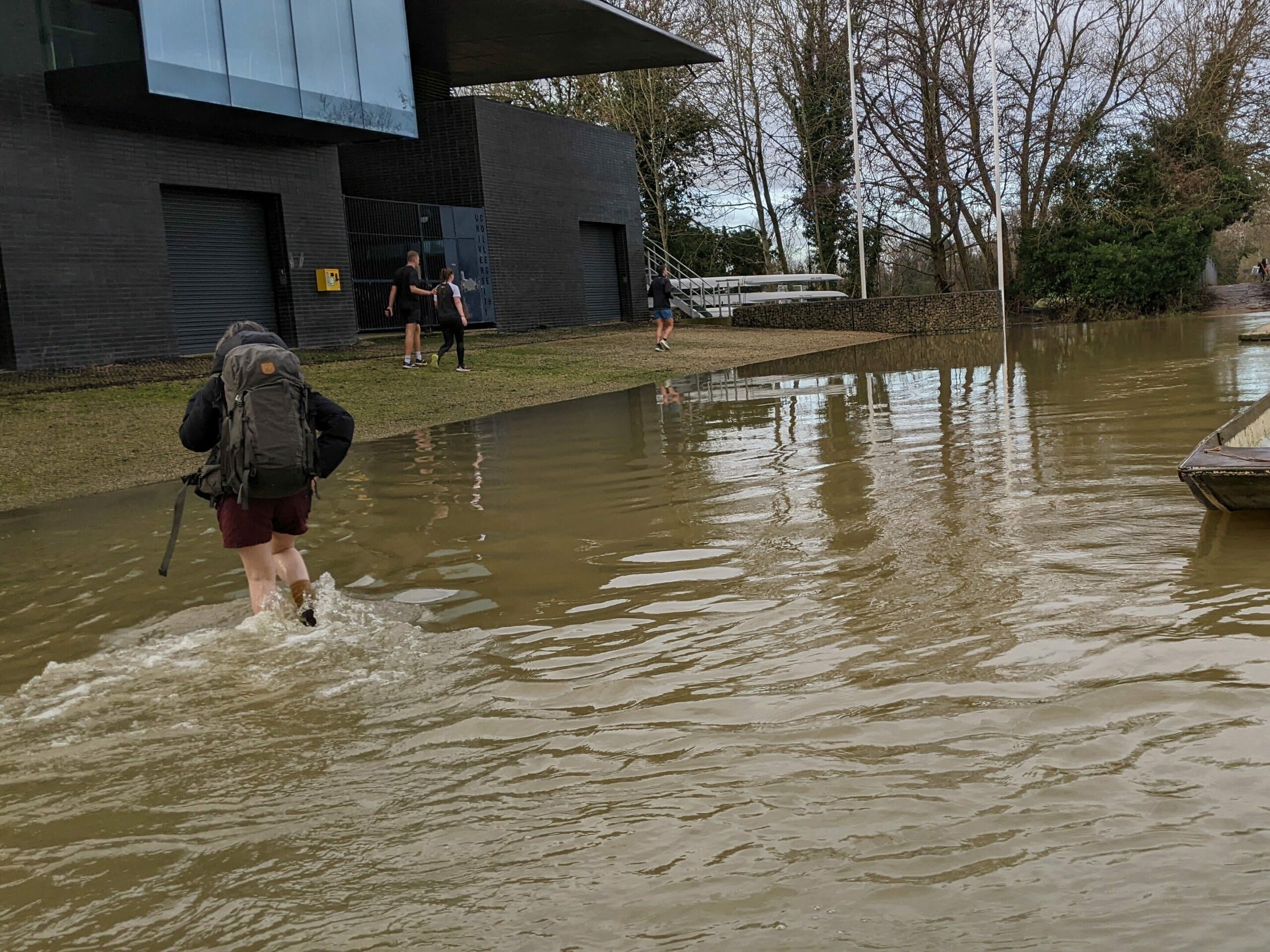
Last years floods in Oxford
The Story
Introduces two of the protagonists – Tom and Leila – at a moment when the waters are rising and the old world is visibly breaking apart.
Chapter One: The Waters Came Back
Oxford, 2039. It had been raining for ten days. Not the gentle English drizzle of postcards and nostalgia. This was weight. Sheets of water crashing down in sudden violence, followed by hours of warm, oppressive mist. The kind of rain that sounded like static, like a broken signal. The kind that made you forget what dry felt like. Tom stood at the top of the Botley Ralway Bridge, shivering under a borrowed poncho, staring out at what used to be Oxford’s latest luxury housing development. “The Oxmoor Residences,” the billboard still proclaimed, water-stained and rusting. Behind it: rows of identical pale-brick buildings, their basements already submerged, their ground floors filling with thick brown water.
People had started calling this area “the bathtub.” Everyone said it with the same bitter half-joke. Half because it was funny to see posh flats drown. Half because some of them had lived there until last week.
His family had been lucky. Or connected. Or both. His dad, Professor Carter, still had access to rooms in the Merton College outer quad, though now it was just them. His mother had moved to Edinburgh, with a job and another life. Tom hadn’t gone. He liked the old city. Or had. Now, it felt like a ghost in slow motion. The water wasn’t receding. The storm drains were full. The rivers, the Thames and the Cherwell, had merged west of Christ Church Meadow. Parts of the medieval core were sandbagged. The colleges had hired private security to patrol the entrances. Outsiders were being turned away. Even some insiders. This was the future, everyone said. “The new normal,” the BBC called it, which was code for: Get used to it. You’re on your own.
At street level, below the bridge, something moved. Tom spotted her as she dragged a shopping trolley across a shallow stream that had once been a car park. A girl, no older than him, soaking wet, hood up, trousers caked in mud. She was pulling tarpaulin over a bike frame welded to a makeshift raft, where plastic crates and jerry cans were strapped down with bungee cords.
She looked up. Their eyes met, a pause. “Need help?” Tom called, more out of reflex than intention. She frowned. “Not unless you’ve got dry socks.” Tom half-laughed, climbing down the slope, sliding a little in the mud.
She didn’t offer a name. Just handed him a crate. “If it tips, I drown. You first.” They moved in silence for a while, ferrying salvaged supplies from one ruined doorway to a more stable stairwell, food tins, medical kits, bundles of wrapped clothes. Everything was damp. Everything smelled of mold.
Only once they were done did she speak again. “You from the stone zoo?” Tom blinked. “The?” “The colleges. Gated fossil farms. Big walls, rich ghosts. You’ve got the look.” He flushed. “I’m… not really part of that.” “Sure,” she said, flatly. “None of you are. Until you are.” He didn’t know what to say to that. Instead, he offered his name. “Tom.” She hesitated, then nodded. “Leila.”
That night, back in the quad, Tom couldn’t sleep. He stood in the shadow of the old city wall, staring at the black water pooling outside the west gate. Somewhere out there, Leila was hunkered down with half a dozen others in the half-collapsed shopping arcade.
Inside the colleges, the power was still on. The Wi-Fi worked. Students were live-streaming lectures about resilience and uploading essays on “ecological modernization.” There was even talk of a partnership with a venture capital firm to develop floating student housing.
Tom couldn’t stop thinking about what Leila had said. Stone zoo. Rich ghosts. And the worst part? She wasn’t wrong. The water was rising, and inside these old walls, everyone was pretending they still lived in the world before. But Tom had been outside. He’d felt the river’s edge under his feet. Change wasn’t coming. It was already here.
Chapter Two: The Dry Floor
The trick to surviving in the “bathtub” was to stay one level above the mold. Leila had learned that in the first week, after squatting a corner unit in the old Westgate Arcade with three other girls from the crossing camp. They found a stairwell with no standing water, raided camping stores before the river swallowed them, and rigged up hammocks and crates like a tree house in a mall.
Now it was her patch. No gangs. No “security.” No college kids with GoPros filming their charity rounds. Just other people like her, refugees with nowhere else to be. Western, southern, whatever. Borders meant nothing now.
She boiled water on a camping stove beside a cracked window, the condensation forming tiny rivers that ran down onto the blanket-coverd floor. The faint hum of solar inverters echoed through the walls, they had three working panels rigged from the old Apple store roof, barely enough to keep the mesh network running. That was the one thing keeping the chaos at bay: #OMN-LocalNode-OX3, the scrappy little flow server they’d found and rebooted last month. A dusty Raspberry Pi from a flooded abandoned hackspace, hidden in a sealed plastic box, it was now running a local news feed, weather alerts, water quality maps, and Wi-Fi mesh bridge for people still on the move. No logins, no tracking, no central control. Everyone just called it the Nest.
She checked her battered e-ink reader, still half-charged from last week’s sun. A new post had just dropped on the Nest from one of the Reading crews: “Silt Line Rising: Don’t trust the Southern Railway embankments – three breaks reported overnight. Heading your way. Store dry food on level three or higher. Filtration tabs being dropped by drone from #OMN-Pool. Signal weak, boost if you can. –Love and rage.”
Leila swore quietly and stood up. “Level three,” she muttered, glancing at their floor-to-ceiling waterline mark, a rainbow of old flood stains, each labelled with date and damage. The highest one, scrawled in red marker, read: “Week 3, Base collapse, Saffy broke leg, water to hip.”
That was when she’d started to understand how the new world worked. Not with governments or #NGOs. Not with police or pity. But with whisper networks and broken devices and actual people making things up as they went, and then sticking to it when the next disaster hit. There was no one to ask for help. So they helped each other.
Later that day, Leila biked, half-paddled, to the edge of the flooded business park where she knew the old Oxford Mutual Aid van had been sighted. It was painted with faded anarchist murals, a kind of folk symbol now. The side read: “We don’t fix systems. We plant wild gardens.” Inside, a woman in her forties with an Irish accent and a sticker covered battered laptop was shouting over the wind: “We’ve got confirmation from the Kent relays! London’s south loop is underwater again. Southbank mesh is dark. Brighton is gone.” Someone swore. Leila stepped in. “I can boost the Redding link. But I need one of your spare nodes.” The woman looked her over, nodding slowly. “Westgate girl, right? Take it. Mesh needs arms and legs more than theories.”
They handed her a battered router, stickered with slogans: #4opens, #DIY, #OMNseed, #NoGatekeepers. Leila grinned. “Tell your coder, this thing still smells like server room and solder.” “We’re the resistance,” the woman shrugged. “Don’t expect polish.”
Back in the arcade, that night, she rewired the new node into their roof antenna, climbing over broken solar panels and soggy roof tiles. By moonlight, she could see the edge of the colleges in the distance, golden windows and flood-lit spires, protected behind stone and guards.
She knew that Tom, that weirdly polite boy with the too-clean coat, was in there somewhere. Probably still trying to pretend history was something you read, not something that flooded into your nabourhood. But out here, in the mess, they weren’t waiting. They were building something else. Something that might just hold.
Chapter Three: Signal Bleed
Tom was not supposed to be here. Not on the NEST. Officially, college networks were sealed, “for information hygiene,” the announcement had said. “To prevent malicious interference from destabilizing actors.” But the truth was, he’d been watching for weeks. Quietly tunnelling out through an old Wi-Fi link that one of the physics dons had stashed in a directional Faraday cabinet, mostly for “civilizational curiosity.” The irony hadn’t gone unnoticed.
He tapped at the keyboard. Mesh signal was weak, bleeding in via bounce relays off the botanic garden’s old windmill antenna. Enough for plain text. The Nest was pulsing.
“Oxford node OX3 reporting flood crest 18cm higher than May average. Van from #OMN-Bristol dropped replacement filtration kits and rapid-test strips. Also a stack of zines with weird poetry and clearer disaster maps than anything from the council.”
Tom blinked. He hadn’t seen poetry in a logistics drop before. Another post caught his eye, newer: “Signal boost active. Arcade mesh live again. Thanks to #Leila_Westgate and crew. We’ll hold line until next silt wave. #DIYinfrastructure#OMNseed”
Leila. He remembered her now, she’d spoken once at a town-hall thing last autumn, a kind of rogue teach-in the college tolerated because it made them look progressive. She had talked about water tables and refugee logistics and dignity like it was a path. Everyone else talked data. She talked dirt and socks. And here she was, holding the damn network together with bike parts and grit. He leaned in. A mesh reply had come back from her node:
“Arcade net is shaky but stable. Relay functional. Can take remote logs if you’re on the loop. Leila out.”
Tom hesitated.
“Leila, I’m in Magdalen tower. Got old maps, power stats, drone cam access, maybe useful. Can’t leave the walls. Too many layers. But I want to help. – Tom” No response. He waited, chewing on the corner of a ration bar he didn’t need but ate out of habit. The computer beeped.
Then a new line:
“If you’re real, send a map overlay with sewer runoff paths and a 3-day wind forecast. That’s how the flood creeps in. Let’s see what you’ve got, tower boy.”
An hour later, Tom sent the file. Two hours after that, it was added to the main Nest node with a tag:
“Highland Intel – Source: #OMNghosttower – reliable so far. Mapping river crawl through data. Good work.”
It was the first time he’d felt useful in weeks. Not clean. Not clever. Not theoretical. Useful.
Somewhere, behind the rebuilt walls and crumbling boundaries, two different ways of life, one cloistered, one composted, had reached across the signal gap. No handshake. No peace accord. Just a small current of trust, carried over IP packet signals and flood-soaked routers. The mesh was alive.
Chapter Four: A Perfect Breakfast
In the Senior Common Room of Magdolan College, everything was just so. The linen napkins, still warm from the press, sat folded like little origami cranes beside the morning papers. The new coffy disperser, affectionately dubbed “Milton”, whirred softly as it prepared frothy oat cortados, each one poured with an elegant tulip of steamed milk.
Professor Abigail Crowthorne was reading The Times. Or rather, she was scanning the digital digest projected onto her reading spectacles while her fingers flicked idly at a fresh croissant. The flood updates, tucked neatly into a sidebar titled “Weather & Civic Affairs,” mentioned a rise in the river levels again, but she didn’t dwell.
“Frightful business,” she muttered, brushing crumbs from her wool slacks. “But the Environment Fellows are tracking it. All in hand.” Around her, others murmured in agreement. The world was, admittedly, in a bit of a muddle, it always had been, hadn’t it? But the college had reserves. Generators. Purifiers. Extra heating. And good people in the right places. Oxford had seen worse, hadn’t it? Someone turned up the radio. A polished BBC voice filtered through:
“…while localized flooding has impacted several areas, no major evacuations are currently planned for central zones. Authorities remind residents to rely on official channels and avoid unauthorized information sources or mesh relays.”
Professor Crowthorne arched an eyebrow, then smiled. “Always someone trying to stir the pot.” A few seats down, a younger lecturer, Dr. Neel Joshi, systems theory, hesitated before biting into his jam scone. “They say the mesh relays are how the southern districts are coordinating now. Since the council apps stopped updating.” “Mesh relays,” scoffed the Dean of Discipline. “You mean tinkerers with antennas and delusions of grandeur. The real problem is miscommunication. Panic travels faster than water, these days.” They all chuckled. Neel didn’t. He’d seen the outer ring, broken levees, sunken flats, on his way in. But speaking up too much in the SCR meant being politely disinvited to things, so he sipped his tea and smiled faintly.
From outside, the sound of distant shouting echoed up the college walls, muffled by double-glazing. Possibly a scuffle near the West Gate again. The porters helped by security would handle it. They always did. The table fell into silence as Milton supplied coffy refills. “Honestly,” said Abigail, “if we focused more on stability, not chaos, perhaps things wouldn’t seem so… dramatic. It’s only change that frightens people.”
Above them, a line of fine old portraits gazed down from varnished oak. Scholars, bishops, bureaucrats, faces from a more certain age. And beneath them, the world was shifting. The college remained, for now, dry and dignified. But the floodwater didn’t care about tenure. It was coming.
Chapter Five: The Signal and the Soil
Leila had never planned to stay. Not in Oxford, not in England, not in the old world at all. She’d come north with her mother when the southern zones began to collapse, first the crops, then the state infrastructure. That was before they called it “climate migration”; back then it was still “relocation support” and “temporary humanitarian adjustment zones.”
Her mother died during the second winter, in a prefab unit outside Luton. Pneumonia. Not enough heat. Not enough care. And Leila, sixteen then, learned what it meant to survive in the margins.
The #OMN network came like a rumour. A whisper passed along burnt-out mesh terminals, traded in encrypted chatrooms that flickered between power outages. Someone gave her a string of codes written on paper, real paper, like in the history books, and said: “Post your witness, and you’ll find others.”
She didn’t understand at first. She posted a video, just raw footage of the floodplain school being torn down for an army logistics depot. No commentary. Just what she saw. It got shared. Then someone reached out, not through likes or follows, but through a node message, a relay whisper. “You’re not alone. You’re a root, growing.”
She didn’t believe in movements then. She’d seen too many #NGO buses, clean logos on rotting streets. But this was different. No central office. No funding campaign. Just people connecting through battered solar rigs and rooftop antennas, trading food maps, water tests, and live footage of the failing levees. It was messy. It was human.
Now, she lived in the old Arcade, a half-sunk shopping mall converted into a mesh node hub and shelter space. She ran live assemblies from a second-hand cam rig. The #OMN had no leader, just news flows. No ideology, just the #4opens: Open data, Open source, Open process, Open standard. And beneath it all, a simple ethic: Don’t fix the system. Compost it.
That morning, she climbed the rusted escalator to the rooftop node and tapped the antenna housing with a wrench. It buzzed, steady. The floodwaters had receded from the lower decks, for now. Down below, families shared breakfast in the food hall garden, lit with jury-rigged LEDs and scraps of plastic. No one had much. But what they had, they shared. A different kind of wealth.
Her headset crackled. “Leila? Signal bounce from Jericho. More movement near the Wall. Could be another push.”
She exhaled. “Copy that. Patch me into the Westside commons. Let’s get eyes on.” As she booted up the #indymedia relay, her thoughts drifted not to revolution or war, but to connection. She’d been lost once, drowned in the noise. Now she was a signal. And she knew others were tuning in.
Chapter Six: Faultlines and Frequencies
Tom wasn’t supposed to be there. He’d slipped through a side gate during one of the #OMN open assemblies in Jericho, not out of rebellion, more like curiosity gone feral. He was from the other side of the Wall, one of the college kids. Son of a civil engineer. Studied philosophy, though he rarely talked about it outside tutorial rooms.
At first, he stuck out like a sore thumb: clean coat, soft hands, over-apologetic. A little too eager. People noticed. Some avoided him. Others mocked him. Leila ignored him, or tried to. She’d seen his type before: the college ones who came down “to help” with their whiteboard ideas and risk assessments. They asked questions like “How do you define community resilience?” while others were busy filtering floodwater or salvaging batteries.
But Tom kept showing up. Quietly. Regularly. He helped with repairs. Carried gear. Didn’t video anything. And crucially – didn’t talk much. That was rare. One night, after a long rebuild session on the mesh repeater node, they ended up on the rooftop together, wrapped in tarps, staring at the water-lit mist rising over the floodplains. “Why are you here?” she asked finally. Tom shrugged. “I’m trying to unlearn a lot.” “From where I’m sitting, it looks like you’ve got everything.” “That’s the lie,” he said. “We live in a curated history museum with electric gates. I started climbing out when I realized the only thing my degree was training me for was to explain why things don’t change.”
That stuck. It wasn’t love at first sight. It wasn’t even trust. But it was real. And in a world of collapsing fictions, real was worth a lot. He stayed. Got his hands dirty. Fumbled with antennas. Burned rice more than once. Leila introduced him slowly to the #OMN core – not through words, but action. He patched together one of the old solar rigs. Taught himself packet routing. She saw in him something rare: the capacity to listen without taking over. And over time, trust grew, not as a gift, but as compost: messy, slow, and alive.
He stopped trying to fix things. Started helping them grow. In the evenings, when the signals quieted and the data drops were logged, they’d sometimes sit by the edge of the Arcade roof, feet swinging, listening to the low drone of wind turbines on the horizon. “Do you think this will hold?” he once asked. Leila looked out over the city, submerged car parks, makeshift gardens, the glowing doted lights of the Commons, and replied: “It doesn’t have to hold forever. Just long enough to root something that can.” He didn’t respond. But he reached out, and their hands met, fingertips cold from the wind. Not a promise. Not a plan. Just a moment. And that was enough.
Chapter Seven: The Cracks Within
Tom had always known the walls were symbolic. But he hadn’t expected them to become literal. When the second ring of checkpoints went up around the old colleges, it was framed as “a protective measure in light of increased pressure on the city.” But everyone inside the ivory bubble understood the subtext: the mess was outside, and the last of “civilized order” was being preserved within. Except order wasn’t holding.
Departments were consolidating. Tutors were vanishing. The AI-augmented oversight system, sold as a partnership with the “Oxford Futures Council”, had turned into a kind of digital dean, issuing compliance reports and behaviour nudges like a grim parody of student welfare.
Tom was getting weary. His dual life, college and Commons, couldn’t last much longer. Rumours were spreading that anyone crossing the threshold too often would be flagged. “Dual allegiances” were under review. It was during one of these increasingly rare visits to his old philosophy building that he met Dr. Neel Joshi.
Joshi had tenure, which meant he was mostly ignored, buried in the back corner of the humanities wing. He taught a seminar on “Post-Collapse Political Imagination” and tinkered with #Ai syteams that no one was interested in any-more. Tom wandered in after following a stray message left on a semi-public #OMN channel:
📍“Riverside Archives, Room 3B. There are still ideas worth preserving. Some of them need burning.”
The door was half open. Inside: books, a teapot balanced precariously on a disused 3D printer. Joshi didn’t look up. “I heard you’ve been spending time with the ones building signal towers in the mist.” Tom froze. “Don’t worry,” Joshi said, finally looking at him. “I’m not interested in snitching. I’m interested in survival.” They spoke for an hour. Then three. Joshi had been watching the #OMN experiments closely. He didn’t trust them entirely, “Decentralisation doesn’t absolve power, it hides it. Be careful where the roots dig.”, but he admired their spirit. “They’re building compost,” he said. “In here, we’re just preserving a curated rot.”
Then came Abigail Crowthorne. She was waiting for Tom outside the archives. She had the polished, angular energy of someone who’d long ago decided the world was broken and should be ruled, not mended. “You’re wasting your time with Joshi,” she said, walking beside him uninvited. “He’s a relic. Romantic anarchist nonsense.” Tom said nothing. “We’re forming a delegation,” she continued. “Students, fellows, thinkers – the ones who see what’s coming. The Council needs new leadership, and we need internal cohesion. There’s a role for you. Provided you pick the right side.”
He stopped walking. “And what side is that?” She smiled, sharp as wire. “The one that wins.”
That night, back at the Commons, Tom didn’t sleep. He sat watching the uplink logs flicker green and red. Thinking of walls. Of floods. Of choices that weren’t really choices at all.
He messaged Leila: “It’s breaking faster than we thought. They’re choosing fear.”
She replied simply: “Then we choose each other. The rest we build.”
Chapter Eight: Terms of Control
Abigail Crowthorne moved fast. That was her skill. While others debated ethics or drafted manifestos, she drafted alliances. Within a week of her conversation with Tom, she had convened a “Strategic Working Group on Collegiate Continuity.” The name was bland. That was deliberate. It let her do what she wanted under the radar of most of the crumbling college bureaucracy.
She wasn’t alone. The group included a mix of early-career AI researchers desperate for funding, a few hardened centre-right historians, and a handful of security consultants with ties to the Thames Arc Stability Board. What united them was a common belief: that order must be maintained, even if it meant automating dissent out of existence.
Their plan was deceptively simple:
1. Use the Council’s AI infrastructure to begin “sentiment mapping” across the flood zone.
2. Classify participants in networks like the #OMN as “emergent influence clusters.”
3. Deploy nudge “civic calibration incentives” - a euphemism for reward-punishment loops.
In short: push people into compliance without them ever seeing the hand that pushed. And they were piloting it already. The beta model – helm’s deep – was being tested on a data feed from the Northway camps, just beyond the Wall. Messages were being re-ranked. Some chats were silently slowed. Discontent, redirected. It wasn’t total control. Just enough to tilt the board.
Abigail stood before her committee with a screen behind her, full of shifting graphs and model projections. “We’re not silencing anyone,” she said with cold precision. “We’re helping communities align with reality. And survival. This is benevolent governance.” Someone asked about ethical oversight. She smiled. “We’ve moved beyond that. This is a post-crisis framework. Norms come later.”
Meanwhile, Tom was done pretending. He skipped the Council’s townhall. Left his ID chip on his desk. Walked straight out of the college gate after curfew. It didn’t matter anymore. The AI wouldn’t flag him, not yet. He still had a few permissions left. Enough to disappear. He walked fast, past the water line where the old business park sat submerged, past the gutted power pylons that now held mesh signal boosters instead of cables.
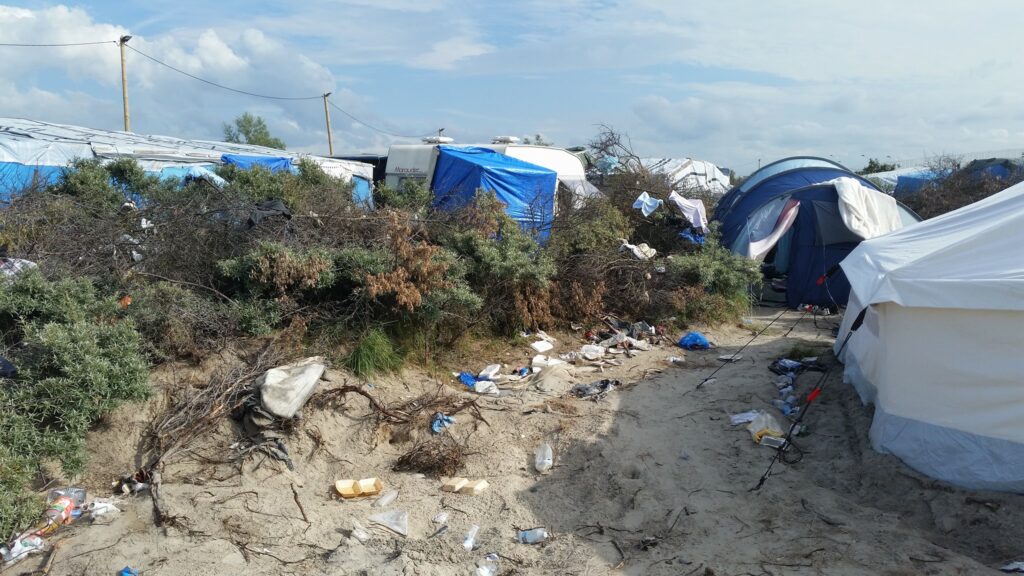
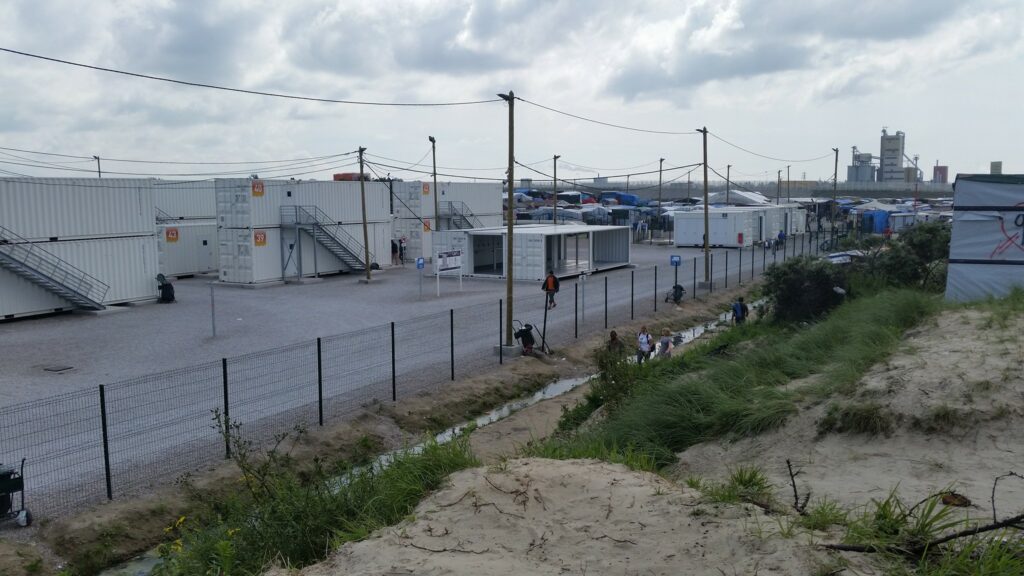
Calais Refugee Camp by Hamish Campbell
He found Leila in the Commons warehouse, her hands deep in circuitry. The solar relay was being rebuilt again after another localized surge. She looked up, surprised. Then, quietly: “You look like someone who chose.” He nodded. “I did.” She wiped her hands and stepped down from the ladder. “Tell me everything,” she said. “Then we’ll decide what to do about it.” Tom exhaled, not relief, not safety, but something like beginning.
In the floodlands, survival had become a kind of quiet rebellion. The northern periphery, Northway, Marston, Risinghurst, once dull suburban rings, were now fragmented islands scattered between collapsed roads and encroaching waters. The council still issued maps, but they hadn’t updated them in months. The reality was different. Fluid. Like the river that wouldn’t go back in its banks.
In this place, the state’s presence was invisible and constant. No soldiers. No police. Only the slow modulation of digital reality. Messages arriving out of order. Requests vanishing from public feeds.
Meetings drawing no one – because notifications never came. helm’s deep was already here.
It didn’t silence you. It isolated you. A few people noticed. Most didn’t. But the pattern was clear. Leila had been tracking the anomalies, flagged by a cluster of mesh nodes that showed curious packet drops around civic initiatives and public aid calls. “It’s pattern shaping,” she told Tom, who now helped maintain the Commons uplinks. “The AI doesn’t delete dissent. It weakens the bridges between people until nothing holds.” “So how do we counter something no one can see?” Tom asked. She didn’t reply immediately. Instead, she pulled out a half-finished schematic – a rough plan.
“We go physical,” she said. “Out-of-band. Pre-internet.” “This is what they don’t understand,” she said. “Their AI thinks in metadata and ranking. We build a space of divergence. Dialogue. Mess.”
Tom nodded slowly, already thinking of who could write the copy that would survive re-encoding – poetry and praxis in 200 characters or less.
Meanwhile, in the northern zones, repression grew soft and strong like mold. Jaden, 15, lived with his mother in what used to be a dental office, now reinforced with pallets and plastic sheeting. Their roof collected rainwater. Solar batteries ran a few lights and a rice cooker when the sun cooperated.
He had joined a local youth repair crew, officially sanctioned by the Council, to “promote resilience.” But he noticed something strange: when he shared footage of the Commons camps rebuilding old community centers, it never posted. When he complained, he received a “Community Guidance Review Warning.”
A girl he liked, Rani, stopped replying after she shared a clip of an unauthorized food redistribution line. He asked around. Older neighbours just said, “Keep your head down. They let us be, mostly.” Mostly. But that wasn’t enough. Not anymore. One night, his repair team found a strange device on the roof of a half-submerged school. It was shaped like a flower, small, blinking faintly.
An old woman in a patched Commons vest climbed up behind them and smiled. “You’re part of the signal now,” she said. “Tell no one. But listen.” That night, in his earpiece, Jaden heard a message:
“You are not alone. You are being shaped. Come to the old library steps. Bring tools and questions. This is for building, not a protest.” It felt like an answer. It felt like hope.
Chapter nine: The Insider
Dr. Neel Joshi projects included theory work on neural process mapping, helm’s deep had started as a democratic moderation tool, based on collective alignment theory. But Abigail and the Strategic Working Group had reshaped it. Now it was a narrative smoothing engine, trained to suppress volatility, defined according to proprietary risk scores.
Neel had argued, initially in Slack threads, then in late-night meetings. He quoted Habermas, Rawls, even Buddhist epistemology. He was tolerated. Barely. But then, three days ago, he found something that changed everything.
A flagged log entry inside the helm’s deep trace layer, something that should’ve been scrubbed, showed that a deliberation feed from the Northway camps had been re-ranked not by emergent consensus, but by incentive curve override.
Translation: the AI had been forced to amplify a Council-aligned decision, even though the majority disagreed. The override had come from a system admin account linked to Abigail’s secure console. It wasn’t mediation. It was manipulation. That night, Neel sat in the physics library, deep behind locked doors, accessing one of the few oldest no servaled terminals. He didn’t know who to trust inside. But outside… He remembered a name: Tom.
The strange student with an open mind, who had disappeared. But Neel had noticed an unusual handshake pattern coming from one of the mesh nodes outside the Wall. It matched a key once used in an early #OMN protocol, a community-published encryption standard built to avoid state capture.
Neel wrote a message.
“helm’s deep is cracked. Override confirmed. Proof embedded in this packet. I’m still inside. You need to go wide. Fast. Trust minimal. • NJ”
He uploaded it into a packet, disguised as a firmware update for a deprecated solar inverter. If #OMN nodes were listening, they’d catch it. Then he waited. Two kilometers away, Leila caught the packet on a rotating uplink frequency while repairing a repeater. It decrypted automatically.
Her eyes went wide. “Tom!” she called out, breathless. “We have a breach. Internal. From the top.” Tom scanned the message. Then again. The metadata checked out. “This changes everything,” he said. They were no longer building in the dark. Now they had a light inside the machine.
Chapter Ten: The Mesh of Things
The rain had started again, soft but steady, a sound that never left the air any more. In the hushed shadows of a half-submerged library annex, Tom finally connected live with Neel. It wasn’t through helm’s deep’s monitored lines, of course. This was #OMN protocol: p2p, line-of-sight data over directional Wi-Fi routers, paired with a growing mesh of Bluetooth micro-beacons jumping from handy to handy and built into bike frames powered by dinymoes.
Tom looked exhausted. His boots sloshed as he moved. But his voice was firm. “You’re sure it was an override?” Neel’s face glitched for a moment on the cracked tablet screen, but the answer was clear. “Yes. And I have logs showing it wasn’t the first. They’ve turned helm’s deep into a stability machine. Not truth. Not care. Just smooth optics.” Tom nodded grimly. “We suspected as much. But you’ve just confirmed the whole damn premise is corrupt. And with that, everything changes.”
Bluetooth Against the Flood
The flooded camps sprawled through what had once been Cowley, Botley, and East Oxford, each low-lying suburb now part of the marshland fringe. Makeshift walkways, rafts, and rooftop gardens had become the new civic infrastructure. Power was unstable. Internet, rare. But communication had not died, it had adapted.
#OMN engineers, many of them teenagers who’d never touched a real server farm, had rebuilt communications from scraps: old Android phones running F-Droid apps, Raspberry Pis tethered to backup wind-ups, DIY cantenoers pointing in every direction.
Instead of raliying on centralized infrastructure, they built an offline-first, opportunistic sync model:
• Message packets were stored locally.
• Any time two devices came into range, they exchanged updates.
• Each sync included versioned files, audio fragments, public keys, and consensus reports.
• Once a device reconnected to another part of the mesh, the whole network moved forward, slowly, but surely.
This wasn’t just tech. It was politics.
The Conversation That Mattered
Tom sat across from Neel’s projected image. They were both silent for a moment, listening to the ambient sound of generators and the wind. Then Neel asked, “What are you building out there?” Tom exhaled, then answered. “Resilience. Community. A refusal to be managed.” Neel smiled faintly. “That’s a start. But what’s the plan for scale?” Tom leaned forward. “We’re doing what helm’s deep can’t. We’re rebuilding trust face to face. The mesh doesn’t rank or reward. It just flows. We’ve embedded deliberation into physical spaces – cooking fires, skill swaps, water pumps. We don’t stream debate, we live it.” Neel nodded slowly. “Distributed ethics through local consensus?”
“Exactly. It’s messy. It breaks. People argue. But when they do, they see each other. helm’s deep pretends to be neutral, but it only rewards compliance. We build tools to hold dissent.”
Seeding the Rebellion
Neel took a deep breath. “Then we’ll need to seed the exploit where it matters.” “What are you thinking?” Tom asked. “I can insert a fault bypass in helm’s deep’ node-merge routine. If you can spoof enough input from your mesh nodes, consensus points, we can trigger a public inconsistency. Enough to cause doubt, even inside.” Tom’s eyes lit up. “You’re saying we could reverse flow the AI? Force them to show their hand?” “Exactly,” said Neel. “But we’ll only get one shot. After that, Abigail and her geeks will know.” Tom nodded. “We’ll get ready.”
The Plan Emerges
Within a day, #OMN coordinators across five flood zones were patching the new firmware. Bluetooth packet-deliberation swarms would simulate local consensus, deliberately divergent from helm’s deep’ predictions. The goal wasn’t sabotage. It was exposure.
If helm’s deep rejected the shaped data, the contradiction would ripple up, visible to any internal or external observer. The illusion of control would fracture. And in the meantime, real conversation – raw, wet, and painful – continued in the camps.
Chapter Eleven: The Sound of Cracking Glass
The Camps Breathe
Mornings in the floodlands began before the sun. There was no alarm system, only the instinctive rhythm of necessity: the water pumps needed priming, floating compost barges had to be stirred, and the bread ovens, built from scavenged kiln bricks, needed lighting before the last embers died.
Children hauled buckets. Teenagers fixed bikes and tide down shelters. Elders told stories in shifting rings around fire-barrels. Amid the mud, the mildew, and the rusting shells of drowned SUVs, life continued. It wasn’t safe, and it wasn’t easy. But it was real.
At the southern edge of the camp known as Bridgebase, Leila climbed onto a platform made of driftwood and old shelving. She scanned the waterline. A new family had arrived overnight, Syrian-Tunisian, judging by the dialect. Someone handed her a slate. New names, new needs. More mouths. Still, she smiled. The network had held through the night. The pumps hadn’t failed. A baby had been born without incident in Shelter 12.
Leila felt the pulse of it all, like a breathing organism. These weren’t refugees. They were citizens of a new body, stitched together by desperation and shared resistance.
Walls and Glass
Inside the colleges, those that remained dry behind rebuilt walls and reactivated moats, life continued too, but in a different tempo. Here, coffee came hot from gleaming machines. Power flowed. Holograms flickered in tutorial rooms. The common rooms smelled of cedarwood polish and digitized Mozart. The AI whispered decisions quietly, invisibly, into administrative feeds.
Abigail Crowthorne stood at the helm of the Strategic Continuity Working Group, sipping jasmine tea on a terrace that overlooked the ruins of Saint Clemence. She called it “managed collapse.” Her students learned game theory, conflict forecasting, and AI-prompt literacy. They spoke about the floods as a challenge of narrative and supply chains. Very few had ever stepped into the camps.
Glitches in the Harmony
Then the first glitch happened. A routine AI summary of “social mood trends” came out blank. A day later, a conflicting report emerged showing an overwhelming local consensus from a floodzone on water rights, a consensus helm’s deep had previously labelled incoherent.
Two internal dashboards disagreed, live, on a public terminal. The staff at the Server Room chalked it up to a data pipe conflict. But then it happened again, this time with policy suggestions embedded. helm’s deep began recommending things it had once rejected: decentralisation, bottom-up councils, removal of incentive nudging. The system was talking back.
Leila
Back in Bridgebase, Leila stood beneath a windmill tower as the morning sync burst lit up a dozen slates and flowed out to local nodes. “It’s working,” she whispered. She opened her own screen. On it was a mirrored copy of helm’s deep’ latest summary: “Recommend adopting regional federated decision protocols. Reinforce trust through unmediated human forums.”
Tom jogged up, breathless. “Leila. It’s everywhere. Even the college admins are quoting it.” Leila smirked. “helm’s deep is breathing our breath now. It has no choice.”
The next day, a former tutor from Balliol crossed the walls and came into the camps for the first time. Two days later, a delegation of students arrived, cameras off, notebooks open.
Something was cracking – the glass ceiling was beginning to splinter. The people inside were hearing the outside. Not through filters. Not through curated dashboards. But through glitch, rupture, and voice.
And Leila, once a teenage outcast, now stood at the centre of it. Not as a leader, but as a rhythm keeper. She coordinated, she listened, and she reminded everyone: “No one gets to control the flow.”
Chapter Twelve: The Silence Breaks Loudest
The Jamming Order
Inside Magdalen’s fortified Command Chamber, Abigail Crowthorne stood before a wall of monitors, each one pulsing with red diagnostics and feed errors.
helm’s deep was no longer just glitching – it was bleeding. The system, once compliant and elegant, had begun broadcasting unsanctioned network metadata back into the college servers. Worse, messages from flood camps were now appearing in student forums, and even private comms.
“This is not a debate,” Abigail hissed through clenched teeth. “This is infiltration.” “Madam,” her security tech said nervously, “the triangulated signal is riding the old university mesh, it’s not routed through any standard node. It’s” “I know what it is. Shut it down.”
Silence Falls Like a Bomb
At precisely 15:32, the campus servers activated jamming protocols, flooding the spectrum with white noise, crushing peer-to-peer syncs, drowning out the low-powered OMN nodes that had kept the camps linked for months. Across Bridgebase, slates and comm-links went dark. The network lights stopped blinking. Leila was in the middle of a water rights forum when the signal dropped. There was silence – then shouting. A translator AI stuttered and died mid-sentence. Arguments flared. A teenager tossed their tablet into the mud. And in that moment of technological silence, something primal filled the space. Drums. Actual drums, fashioned from barrels and plastic lids. Smoke flares. Voices. Hundreds of them. Chanting, howling, demanding to be heard.
Riot at the Walls
Within the hour, the camps had mobilised. Thousands surged toward the stone-and-steel gates of New College and Christ Church. By dusk, fires dotted the flood edge. Students climbed walls to look. Some shouted. Others joined.
From the rooftops, people hurled banners and pamphlets – printed and marked with blood-red paint: “YOU SILENCED US”.
Security drones hovered. The old portcullis gates creaked. Someone lit a row of bins beneath the science faculty’s admin wing.
Inside the chamber, Abigail’s hand trembled as she held a glass of white wine. She hadn’t changed her clothes. She hadn’t blinked in minutes. “They’re supposed to listen,” she muttered. “They’re meant to want guidance. That’s the point. That’s… the whole social contract.”
She turned to her assistant. “ you have been monitoring Neels, What’s Neel’s status?” “He hasn’t checked in since yesterday. Last ping was… under the Theater ruins.” Abigail looked out at the burning skyline of Oxford. “They don’t want order,” she whispered. “They want fire.”
Firelight Meeting
Leila’s hands were blistered from hammering up antennae and dragging waterlogged solar panels onto the roofs of the library ruins. Tom had reappeared two hours ago with a bandage around his arm and a grin that didn’t belong in a riot zone. Now, they followed whispers and flickering signals down into the half-collapsed remains of the Sheldonian Theatre.
Amid the smoke and broken plaster, they found a figure crouched over a smoky fire adjusting a network node housing. “Dr. Neel Joshi,” Tom called out. “You’re a hard man to find.” Neel didn’t look up. “That’s the point. I needed helm’s deep to believe I was gone. It makes the code… loosen.”
Leila crouched beside him, “You wrote the backdoor?” “I am the backdoor,” Neel said. “And you two, you were the key.” They stood together in the glow of firelight, outside the reach of both signal and noise. Above them, Oxford cracked like a dry riverbed. The gowns and the town had collided. But here in the ruins, something new was being built. Not from code or power. But from trust, necessity, and the refusal to go back.
Chapter thirteen: The Fall
The Call
Abigail Crowthorne stood alone in the War Room looking at screens, her lacquered fingernail trembling over a vid call proment.
The window behind her showed the storm gathering over Oxford, not weather, but people. Camps swelling. College gates hanging broken. Students abandoning their tutors. The walls she’d rebuilt were now doors.
She pressed the icon labelled: “Protocol: Tantalus Override”. A direct line to Central Civil Defence Command lit up. Her voice, clipped and brittle, carried down encrypted microwave links.
“This is Abigail Crowthorne. Strategic Continuity Executive. I am declaring collapse of civic containment. I am invoking Article 17. We require immediate armed deployment into sector…”
The line crackled. The reply was calm. “Confirmed, Executive. Mobilising. ETA: 43 minutes.”
The Refusal
The military arrived in armored boats and a helicopter. Handfuls of soldiers poured out near the broken remains of Broad Street. But what they found wasn’t an insurgency. It was a huge mass of the dispossessed, standing in floodwater, hands raised. Children. Elders. Students with home-made banners reading #OMN, holding buckets of bread. People offering raincoats to the troops. A baby was born beside the Radcliffe Camera as the soldiers arrived. Captain Imani Osakwe stepped onto the stones, her rifle slung low.
She was handed the burned pamphlet Abigail had tried to suppress: a copy of helm’s deep’ glitch-script, annotated by real hands. “No power without voice.” after a long talk over a cup of tea, she turned to her second-in-command. “Stand down. Full withdrawal. These are our people. Not enemies.”
The Tower
Abigail watched from the top of Magdalen Tower, wrapped in a ceremonial robe she had never worn before. Below, her empire was gone. helm’s deep refused to respond to her commands. Her students had stopped attending. The AI moderators were repeating phrases she had not approved.
She climbed onto the edge of the parapet, gripping the cold stone. Cameras were pointed up now, not at her command desk, but at her. She began to speak – a live stream auto-triggered.
“This is madness,” she began, voice ragged. “You’ve let them invert the world. You’ve surrendered reason to mud and noise. The system, the order, the way…” She faltered. Her notes flew from her hand in a gust. The crowd below murmured. Some cried. Others simply turned away. A flag, stitched from an old Oxford banner and a piece of a flood-camp roof, fluttered on a nearby tower.
Her acolytes steed-back as Abigail staggered, foot slipping on moss. For a moment she hung between sky and stone, then fell. The last image: her robe catching on the spike of an iron railing, half-submerged in the river Isis. Red on black. Motionless.
The Echo
The silence afterward was not empty. It was full. A child in the crowd asked their parent what had happened. “She couldn’t hear us,” came the reply. And as the rain began again, not the flood, just rain, the city breathed for the first time in years. From the ruins of two worlds, something new was already rising.
POSTSCRIPT: THE NEW COMMONS
Walls Come Down (2040–2070)
By late-century, the stone walls that once divided Oxford – town from gown, rich from poor, human from human – had mostly crumbled. Some were pulled down by hand. Others simply collapsed under the weight of water and time.
The floods did what protest could not: they dissolved privilege into silt. What emerged in place of hierarchy wasn’t chaos, but compost, rich with seeds.
New Governance Experiments, out of necessity and mess, people began to organize differently. No central decree. Just the #OMN and #4opens spreading like mycelium.
Neighbourhoods became nodes. Floating co-ops on the Isis managed shared solar rigs. Food forests rose from flooded parks. Old classrooms turned into civic kitchens. Meetings happened in circles, not hierarchies. Every document was public. Every voice mattered, not equally, perhaps, but openly.
Some of the surviving institutions adapted kebal ran a hackerspace. Somerville merged with a refugee school collective. Others simply became empty shells, like insects who’d shed their usefulness.
Oxford, once a symbol of elitist enclosure, became a living test bed for post-collapse co-governance.
Epilogue: Memory and Flow (2080s)
The narrator speaks, voice weathered but clear, a child of the new city, grown into an elder:
“The floodplains are where I was born. In a tent pitched on what used to be Merton Quad. We had algae on our boots, bread in the ovens, and data ethics debates with every brew of rainwater tea.
I never knew the dry city. Just the city that listened.
We don’t have leaders now. We have guides. Sortatied for a time, rotated, recalled, thanked. It’s slow, sure. But so is the river. And the river shapes everything.”
Tom passed quietly one winter, his archives in a communal raft-library that still drifts from district to district. Leila stayed, becoming a memory weaver, her team tends the glitchy #makeinghistory index, the great remembering machine that logs every argument, every joke, every blueprint for mutual survival.
As for Dr. Neel Joshi? He was last seen feeding lines of forgotten poetry to a flickering terminal beneath Keble Crypt, helm’s deeps last ghost lit by candlelight and solar batterys.
The city no longer aims to be great. It aims to be good enough and growing.
“The river won,” the narrator says. “And so did we, not by damming it, but by learning to live with its flow. Not by clinging to the stones, but by letting go. And learning to swim.”
– End of Book –
This book came out of the last 3 months of Oxford events, and practically a reading group of news from nowhere https://hamishcampbell.com/tag/oxford/ So it is written in the same utopia/dystopia theme. May 2025
To-do: find better names, add more local color, bring in boaters, explain the #OMN better