Ten years ago, I remember being told, often condescendingly, with smug certainty, that hosting in the cloud was the future, and that what I was working on, #DIY grassroots, self and community hosted tech was the dinosaur, a dead end, old obsolete thinking, out of touch. Despite spending years pointing out the obvious flaws in this thinking, I got only that my “native” path was irrelevant, for Luddites, they said. Legacy thinking, dead tech walking.
Well, here we are, a decade later. And guess what the cloud: It was expensive, less performant, less secure, and a gateway to increasingly exploitative pricing models. This isn’t hindsight bias, the warning signs were always there. But many #fahernista and #geekproblem people get caught up in the glossy surface and tech hype mess, repeating the same mistake we’ve made across generations of #geekproblem tech, believing scale and #PR buzzwords were synonymous with any progress at all.
Let’s now be clear on what actually happened.
We handed over infrastructure to a handful of giant platforms that lock us in and bleed us dry.
We lost resilience, any sovereignty, and basic control over our own data.
We normalized rent-seeking as a business model.
We pushed decentralization off a cliff and called it “abstraction.”
Meanwhile, local compute got cheaper, storage exploded in affordability, bandwidth costs continued to fall, #dotcons threats increased. And guess what? Running things locally started making sense again, just like it always does when the #PR smoke and mirrors clears.
The lesson, which we need to now bring to #crypto and #AI, just because something is fashionable doesn’t make it in any way real or sustainable. That tech #PR hype cycles aren’t innovation, it’s marketing. And when you stop looking at the core trends (cost, control, resilience) and just ride the buzz, you’ll end up where we are now, mess, bloated budgets, shrinking trust, and a growing #techshit pile to clean up.
As ever we need to re-learn the value of #KISS grounded thinking, to remember that local, #4opens, transparent, and interoperable #openweb systems aren’t retro, they’re essential. This isn’t about nostalgia for the old paths, It’s about having power over our basic infrastructure again. The cloud, at the time and in looking over our shoulders, was smoke and mirrors, a detour, it’s now past time to get back on the real progressive #Fediverse path.
A reflection on #Oxford, the web, and the invisible gap we’re not naming. It’s a simple question, but one that says a lot about where we’re at with the #Fediverse and the broader #openweb reboot: Why doesn’t every city have its own Fediverse server?
I’ve been looking – specifically for my city: Oxford, UK. And the answer seems to be… Nope. Nothing. Not a single clearly local Mastodon, Lemmy, Pixelfed or similar instance. This might seem trivial, but it’s actually a big red flag about where we are failing to root the #Fediverse in the real world.
Wait – Why should cities have their own servers? Because servers are more than just infrastructure, they’re community spaces. They are places where shared context matters. In a healthy #openweb ecology, you’d expect to see:
A Mastodon instance for Oxford academics and students
A Lemmy server for Oxfordshire campaigners sharing local issues
A Mobilizon instance for local events, climate actions, social meetups
A PeerTube or Castopod space archiving local talks, indie music, alt-news
These are the digital town halls we should be building. But we’re not. Why? Oxford isn’t just any city. It is where the World Wide Web first found public ground in the UK. I used the first web browser in a room set aside for “the internet” here almost 30 years ago, it was a wonder. It’s a place that is full of geeky students, hackers and programmers. With a deep history of academic freedom and radical thought, that has long served as a symbolic cradle for digital culture. If we can’t see clear Fediverse infrastructure here, something’s broken, and not just in Oxford.
What’s holding us back? Possibilities, the myth of spontaneity? We assume that because the Fediverse is “open,” it will naturally emerge everywhere. It won’t. Like any commons, it needs cultivation, volunteers, funding, attention.
Invisible technical barriers, running a Fediverse server isn’t hard, but it’s also not beginner-friendly. And even “geeky” students are under immense pressure, rents, loans, side gigs. Who’s got time to run infra?
Cultural disconnection, we have a user class and a developer class, and they rarely mix. No one’s stepping up to build for their community, because the tech feels distant, or worse, owned by someone else.
#NGO capture & misplaced focus, a lot of #FOSS energy gets eaten up by grant-funded projects that serve other bureaucratic ends. Meanwhile, grassroots needs, like “a city-based server for sharing local stuff”, get overlooked or dismissed as unscalable.
What do we do? Let’s flip the question around. Why NOT have a Fediverse server in every city? If we started treating servers like digital community gardens, then:
Local campaigns could run Lemmy or Mastodon spaces
Libraries could host Pixelfed galleries of community art
Climate groups could run Mobilizon for mutual aid and action
Neighbours could share events and info, outside of corporate silos
Oxford needs a server, so does your city. This is a callout – and a call-in, if you’re a sysadmin, activist, student, tinkerer, or just someone who cares about your city and the #openweb, start asking: where’s our server? Let’s build it. Let’s map it. Let’s make the Fediverse a place of places, not just a cloud of abstract URLs. We need to get the #Fediverse out of “nerd island” and into the towns and cities we actually live in.
UPDATE: On this needed path, let’s try and focus on diversity of codebases. As the is currently too much focus on vertical, #Mastodon is locked into its own trajectory, a closed loop of PR, hierarchy, and “favourites over merit”, so trying to wrestle it into something else is a waste of energy.
The smart path is to let it drift into its own #mainstreaming Fediverse while we work on the #openweb reboot without importing it mess path. The wider challenge is making sure our reboot isn’t just “not Mastodon” but actually functional, grounded, and healthy, with native governance, trust-based collaboration, and the #4opens at the core.
If we’re talking plan, I’d frame it as:
Draw the line – Publicly define what’s “native” openweb culture and what’s toxic carry-over from #geekproblem and #NGOcapture.

Build in public – Open docs, open processes, open code, open governance (#4opens), so trust compounds over time.

Seed alternative centres of gravity – Forge small, working nodes that can federate and interoperate without depending on a single code-base and Dev crew.

Culture over code – Prioritize conviviality, generosity, and horizontal decision-making before feature creep.

Pull people sideways – Attract users and devs who are frustrated with the PR-walled gardens, not by attacking mainstreaming Mastodon but by showing something that feels better to use and be part of.
Here’s a small but powerful challenge for #openweb builders – and a perfect #DIY project if you’re fed up with the current #geekproblem. I’ve been trying to find #Fediverse instances that actually cover my town, Oxford, UK, so I can help promote and grow them locally. You’d think this would be simple, right? But… nope.
Why is this happening? Because our current tools focus only on technical facts (server specs, software used, uptime, etc.) and ignore the uncontrolled (dangerous) metadata that actually makes discovery meaningful:
What’s the instance for?
Who does it serve?
What community does it represent?
Where is it rooted geographically or socially?
This is the #geekproblem in action: great code, but no way to find things people actually want to use. What’s the fix? Someone (maybe you?) creates a community-focused discovery tool that:
Encourages instance admins to tag with location, community, topics, etc.
Provides search/filter UI that works for real people, not sysadmins
Maybe even integrates with OpenStreetMap or a simple opt-in geo-tagged registry
Outputs something friendly – like “Find your Fediverse community in your town”
This is not a hard project, it’s a weekend hack for someone who cares, but it has social value as it helps bridge infrastructure to lived communities. This need to be at the core of the #openweb reboot.
So for people who can’t see why this matter. If we want the Fediverse to grow beyond techies and Twitter refugees, we need to help people find their people, local discovery is key. Place-based communities are still powerful, especially when rebuilding trust, mutual aid, and shared media in a collapsing world.
So, want a simple mission? Build a tool that helps people find #Fediverse instances by town, city, or region. Start with Oxford, but make it global. Make it open. Make it federated. And when you do? I’ll be the first to push it out.
Region (countries are regions, anti-nationalistic)
City/area (a county or city)
local (village, area in city)
Them maybe latter hyper local (but not for now)
Then we have subject – it would be normal to have a multi subject hashtag map, that updates on each click – adding the clicks to a list on the side – with “new button” to jump back to start.
Then you have advanced for the normal tech stuff… which currently is the front end on most pickers. This would also be displayed on the info box for each instance on the map, so still central, just not AT THE FRONT.
UPDATE: can just pull all the existing data out of the current sites like https://instances.social/list#lang=en&allowed=&prohibited=&min-users=&max-users= as these are all #4opens. So the projected site could be up and running with full data in little time. Yes, you would have to ask people to tag their installs to geolocate their instances. This could be done a hard way or a simple #KISS way like any admin in the instance adding a #hashtag with a geolocation hashtag after it. Then periodically go through the instance list and spider all admins on each instance if you find the hashtag – add the next hashtag as a geolocation or something as #KISS simple as this. What is your idea?
Ideas in comments, please.
UPDATE: this is this one https://fediverse.observer/map works better still nothing in Oxford – it seems to be pretty random with little relevance to subject and area, is it by IP address eo location, that would be #geekproblem
The discussions on sovereignty at #NGIForum2025 make me wonder: what year are we in? It’s as if we’re rebooting grassroots conversations we’ve had for decades – but without the mess, memory, or movement that gave them meaning in the first place.
A breath of clarity came from @renchap, who said it plainly:
We need to focus our efforts on funding and supporting public value network infrastructure… THAT CANNOT BE BOUGHT. 💪
Absolutely. If that idea resonates with you, try starting with the #4opens – a pragmatic path to build tech with real accountability and openness. It’s not a utopia, it’s a filter designed to push out 95% of the #techshit we’re constantly drowning in. The rest? That’s the work: compromise, community, governance.
For those curious about mapping this stuff, I appreciate the attempt to formalize governance components of digital commons here: https://commons.mattischneider.fr/2-constituants It’s useful, but my take? Still not messy enough to reflect how real-world horizontal projects actually work. As the site rightly says:
“If you already have experience in operating commons, you or your organisation will probably have specific practices that are more appropriate to your context.”
Exactly, why context matters, and why real commons need trust-based governance, not just metrics and diagrams. Let’s remember:
Tools are only useful if people use them.
And that’s our real problem right now.
Take this audience question as a clear example: What should we do when a US company acquires an EU one – like Cisco buying Slido? It hits the core issue:
Centralized, vertical control is always the endgame of VC funding and the mainstream tech stack.
What’s the mainstream response? Push more AI. Push more “innovation.” Push more #stupidindividualism. This story is heavily funded and constantly amplified. Why? Because it keeps us distracted, divided, and demobilized. We need to compost this garbage.
Let’s stop pretending #opensource is the goal. It’s only useful if it lives in common infrastructure, owned and governed collectively, with embedded solidarity, not slogans. Yes, someone pointed out that:
"Open source licensing permits continued operation of the software with an EU provider."
That’s technically true, but in practice, how many such transitions actually happen? How many of these tools become hollowed-out ghost projects after the buyout? We need the EU to fund #4opens#FOSS and commons-native projects directly, not startups chasing exit strategies.
And yes, I’ll be blunt here:
There’s likely a whole class of people who should be prosecuted for fraud.
Because the current “innovation” circuit is knowingly wasting public money on private gain under “our” banner of openness. It’s a con. A parasitic class living off the #countercultures they parasitise. So let’s call this out, not to “disrupt” for disruption’s sake, but to open up space for what actually matters:
Native projects with shared roots in code, care, and community.
Activism that isn’t tacked on for #PR, but central to the infrastructure itself.
Horizontal governance that embraces mess, rather than paving over it.
We don’t need more products, we don’t need more platforms, we don’t need more panels pushing safe #neoliberal “common sense.” What we do need is to build and protect infrastructure that can’t be bought, captured, or silenced. Because that’s the only way we’re getting through this era of collapse with anything humane intact.
It’s good to see events like #NGIFORUM2025 as it’s trying to be on the path of the #Fediverse and the wider #openweb reboot which are real forces for social good, messy, hopeful, and grounded in decades of grassroots digital culture, which we do need to support. BUT we also need to speak honestly, as these spaces are not healthy by default.
Too often, they are co-opted by #NGO and institutional actors who bring with them a dangerous kind of “common sense”, what I’ve long described as the parasite class. We see this clearly at #NGIFORUM and similar #NGO events. Despite the energy and good intentions, the dominant framing is stuck in a narrow, #neoliberal logic:
Endless discussion about scalability, compliance, branding, and “the market.”
Panels where “on-topic” needs reality-checking and “off-topic” is often the path to sense.
This is not the #openweb native path, and what we need is more shovels and composting, to grow the real grassroots native paths, with open projects from the messy soil of lived social experience. Not more polished “innovation theatre.” And crucially: we need to bring activism back into these spaces – not as token #fashernista crap, but as lived, rooted practice. We need to embed activist tech into the core of these events, not leave it in the hallway as is the current norm.
Because let’s be honest, too much of what’s being showcased is just more #techshit to compost. Take the role of NGI funding (Next Generation Internet): It could be a powerful tool to fund the future of a people-powered web. But right now? It’s structured to reward isolated hard tech with narrow deliverables, and punish anything messy, social, or disruptive. That’s upside-down.
The development side of open-source should be anti-commercial – in its process, not necessarily in its usage. That means public funding should support the huge social layer that keeps FOSS and #openweb projects alive:
Community organising.
UX design from lived needs, not compliance charts.
Onboarding and trust-building.
Accessibility work.
Documenting process for reuse and remix.
But currently these parts are entirely unfunded, and that is pushing us into the arms of the parasite class’s of all types. We are walking backward into the future, again, projects without people, users, and support are dead projects. No matter how elegant the codebase is.
One thing that the event brings up is that we need to shift policy, national governments and #EU to actively intervene in the monopolies running the current internet. Both mobile and fixed-line networks need to be opened up to allow for grassroots, peer-to-peer, and local hosting paths to flourish. The current centralised infrastructure is a block to the native #openweb, and we can’t “build better” on broken foundations.
The also needs to be a cultural shift, to unblock the #geekproblem. This is not a call-out – it’s a call-in. The feedback is there, i’ve personally been working on this issue for over a decade, what we’ve seen is a cycle: Working in a small way… failing in a big way… repeating.
It’s not personal, it is structural. And we can do better, if we compost the fear of doing things differently. A practical example, we need more points that are currently deemed “off-topic.” Because what’s “on-topic” in these spaces is just branding and polite theatre. And that’s exactly how the #dotcons rose to dominance in the first place.
We are at risk of simply recreating their culture in softer tones. Let’s not do that. Let’s take a breath and reflect on what we’re actually building, it’s not a rhetorical question. This is not abstract.
Because if we keep defaulting to #neoliberal “common sense,” if we ignore the reality of climate collapse, digital authoritarianism, and infrastructure lock-in, then we’re just dancing around the edges of a very real #deathcult.
Let’s do the real work, let’s dig, plant, compost, and build trust. Let’s reclaim the tools and shape the #openweb around care, not control. Because anything less? It is just another empty panel on a sinking ship.
“All authority is quite degrading. It degrades those who exercise it, and degrades those over whom it is exercised.” — Oscar Wilde
Our powerlessness feeds our desire to hate. This is not a personal failing – it’s a social design flaw. A social problem built on alienation and distraction that funnels frustration into polarisation. That’s why the controversy-driven algorithms of the #dotcons (corporate social media platforms) are not just annoying, but actively harmful. They feed on our despair, and we, often unknowingly, feed on the drama they serve back to us.
It’s a closed loop of spectacle and spite, profitable to the #nastyfew but corrosive to us, the meany. An extractive business model built on social breakdown. And yet, many of us know this, so why do we stay? Likely It’s because stepping away from this mess is hard, it takes more than wishful thinking, it takes movement, not only that, but it takes organising. It takes the kind of networked activism and lived alternatives the Open Media Network (#OMN) has been building and trying to seed for the last ten years
Let us not overlook vital things, because of the bulk of trifles confronting us.
Truth isn’t declared, it’s built. #Postmodernism taught us that truth is slippery. That’s fine, but in the hands of #mainstreaming culture, that slipperiness has become a tool of endless distraction and decay. People say things like they are true because they feel true. They build tech platforms because they believe in them. They sell movements as brands because it looks like change. But let’s be honest: wishing something into truth does not make it true.
What makes things true is collective struggle, shared purpose, and concrete acts of solidarity. A load of social work, grounded activism, and careful trust-building make something true. This is the hard path, but it’s also the only one worth walking, and when we do it together with joy it’s the happy path.
Pettiness separates; breadth unites. Let us be broad and big.
The #geekproblem is too often a part of this mess. Writing code is seen as a kind of truth declaration. “Look, it runs! So it must be real!” But a thing that compiles is not the same as a thing that lives. Tech without community is a corpse. For anything to matter, you need people. And to keep people, you need some rough-and-ready PR, actual engagement. You need trust, time, and probably a bit of music and food too. We can’t engineer our way out of this crisis, we have to organise our way out.
The #Lifecult vs. the #Deathcult. What we’re up against isn’t just bad ideas, it’s a worship of stability, spectacle, and control, the illusion of movement through aesthetic alone, no real challenge to the dominant system. It feels warm, it promises safety, but it leaves no room for difference, contradiction, or rebellion, this is inside our “cults”.
It requires less mental effort to condemn than to think
This is why we don’t need worship, we need practical action. Change and challenge are not side effects of our projects – they are the sharp point. We don’t do this work to be liked, we do it because there is no other way to make things true. And if we do this together, it becomes fun and meaningful – we create social “truth”.
Working with the #Eurocrats (and other impossible people). Let’s talk about the institutions, the #EU, local governments, #NGOs, big tech “allies.” They are hopelessly incompetent when it comes to grassroots tech and progressive social change. But here’s the thing, they will not go away on their own. If we don’t push, the right-wing will step in and push harder. That mess is already happening.
Revolution is but thought carried into action.
So we take the harder path, we show up, try to guide. We keep the door open even when it slams in our face. And yes, it’s exhausting. We’ve tried to work with #mainstreaming people, many are unbelievably vile, and worst of all, they have no idea they’re behaving badly. They don’t see their role in the decay, they don’t see the crisis, because the spectacle of control makes everything look fine.
Yes, the current #mainstreaming is a mess, a deep, systemic, soul-grinding mess. But we see it, and we are not powerless, refusing the mess is about rebuilding the commons. We don’t need to put up with it, that’s what #OMN is for. That’s what projects like #indymediaback, #OGB (Open Governance Body), and the broader #openweb movement are trying to hold space for.
We don’t need more hype, we do need, slow, messy, grounded work:
Listen more than we preach.
Read each other’s code, politics, and history before rewriting.
Talk about our failures honestly.
Grow media and networks that are native to community, not layered on top like #dotcons digital colonialism.
Build up our own cultures of care and collaboration in the #openweb to replace the dying ones.
This is fun, when it’s not a strategy of purity or perfection, it’s a strategy of survival, and even joy. This is not a closed story, it’s a beginning. If you’re reading this and feeling the weight of it, good. That’s where we start from. But let’s not stop there, come build, talk, and argue. Come plant seeds, come help make the mess into compost. Ideas? Responses?
This post is from being a part of this Oxford reading group. Feedback on William Morris, his life and books, which doesn’t only critique capitalism and dream about its collapse, but also offers a compelling vision of what comes after. Imagines a society without money, coercion, or hierarchical governance. Power is radically distributed, labour is voluntary and meaningful, and the commons is at the centre of life. It’s not a managerial future, it’s an organic one, shaped by lived values. This mirrors the path of the #OMN, building tools, processes, and networks that support autonomy and participation, not through top-down control or commercial funding, but through collective action and care.
With a little bit of historical context, it is clear why William Morris prods his critics, he anticipates the scepticism from theoretically thinkers, especially those following in the tradition of Marx and Engels. In one exchange, Morris inserts a moment of humour to push back against armchair critics. The narrator, William Guest, is exploring a utopian future guided by Dick, a cheerful and capable local. They encounter Bob, a character marked by his outdated bookishness and preference for abstract theory over lived experience. When Guest accidentally slips up, forgetting he’s meant to be posing as someone from overseas rather than from the past, Bob calls him out. Dick steps in with a scathing but playful remark:
“The fact is, I begin to think that you have so muddled your head with mathematics, and with grubbing into those idiotic books about political economy (he he!), that you scarcely know how to behave. Really, it is about time for you to take some open-air work, so that you may clear away the cobwebs from your brain.”
The laughter after “political economy” is key. Morris isn’t just poking fun, he’s positioning his vision as something deliberately different. Rather than being a blueprint built from existing leftist theory, his utopia grows out of lived practice and collective labour. He acknowledges the critiques Marxist thinkers might level, but counters with a subtle provocation: leave the theory room and go outside. Work with your hands. Test your ideas in the open air.
Theory is not dismissed outright, but it is secondary to active participation in community life. Morris invites readers to imagine a world shaped not only by critique, but by doing. His utopia isn’t a perfect extrapolation from Marxist doctrine; it’s an imaginative leap into what might happen when people stop only theorising and start building together.
This is core to the #OMN story, the #openweb failed in part because it became a playground for commercial, #geekproblem abstraction or academic debates, or worse, captured by institutions that fear mess and openness. Morris reminds us that we need doing, not just thinking – and that horizontal systems only thrive when they’re lived and felt, not just diagrammed.
This is a vision without dogma, unlike the rigid structures of Marxist utopia or the technocratic dreams of platform capitalism, Morris offers a soft, slow, human-scale path. It’s full of contradiction, it’s messy, and it values beauty, leisure, and craft. It’s grounded in love for place, people, and cooperative labour.
Horizontal organising as culture, not system, governance happens through conversation, relationships, and shared values. There are no formal elections or bureaucracies. Everything operates on trust, accountability, and mutual care, built over time, not imposed from above. This is a needed lesson for grassroots organising.
The #OMN doesn’t need polished governance frameworks before people act. It needs lived participation, native cultures of trust, and tools that reflect those values. Morris shows that horizontal organising isn’t a tech stack or a voting app, it’s a culture. Projects like the #OGB are about reclaiming this messiness. The idea is not to replace one form of control with another (just more “open”), but to nurture space where real community publishing, trust, and difference can coexist. Like Morris’s vision, it’s a lived, imperfect commons, not a polished platform.
What people in the #OMN path can learn is that utopia is not a blueprint, it’s a compass. Use it to orient, not to dictate. Theory must be grounded in doing. Don’t build systems people can’t live in. Trust is built in the day-to-day and governance starts in how we relate to each other. Beauty, leisure, and joy matter, alternative systems fail when they forget to be human.
News from Nowhere is not a fantasy novel, It’s better to see it as an early manual for how to feel our way into better futures, this path aligns with the #OMN mission of rebuilding media and communication from the ground up, with openness, care, and community at its core.
The project is practical, the #OMN (Open Media Network) is a radical rebooting of what a working grassroot “news” network can be. It’s not another tech platform chasing the latest hype cycle or VC buzzword. It’s grounded in 30+ years of real-world, on-the-ground activist experience, built explicitly on the #4opens
One of the advantages of this path is that we’ve been here before, and we’ve watched it fail, repeatedly. I’ve personally seen projects just like this fail 10–15 times over the last two decades. Brilliant ideas, sometimes beautiful tech, all eventually collapse under the weight of poor social foundations, bad governance, and chasing #geekproblem dreams and #fashionista paths that have nothing to do with real people’s needs. That’s why, from this experience, we’re not doing this as another #techshit project.
We’re not building toys just for geeks, nor another doomed tool for #NGO grant cycles. We’re building a living media network, grounded in the organic, messy, grassroots communities that made independent media, with projects like indymedia and undercurrents, powerful in the first place, It’s where the value is, let’s use this opening to not just walk the same broken paths again.
One thing we don’t need is more #techshit to compost, we’ve got a whole graveyard of it already. Scuttlebutt, Diaspora, SecureDrop, and dozens of others, all had pieces of the puzzle, but lacked cohesive, social-embedded foundations. We don’t want to add to this pile, instead, let’s focus on building something that lasts because it is:
Rooted in existing communities paths

Built for human needs, not dev ego

Simple where it matters (#KISS)

Modular, federated, and easy to adopt
This isn’t about building – The Next Big Thing™, it’s about building something, working, local, resilient, and useful, something people can use and adapt without waiting for permission from gatekeepers or corporations.
Finally, make the most of my attention, I’ll be blunt, you don’t have my attention for long. I’ve seen too much, and I’m tired of false starts. So if we’re going to do this, let’s get real, move fast, and avoid ego traps. Make your work count, keep it grounded, build bridges, not silos. The #OMN is already moving, join in, you can fork it latter and go your own way. But whatever you do, let’s not waste another decade repeating the same tired mistakes. We don’t have that kind of time any more.
Telegram partnering with Elon’s #AI to distribute #Grok inside chats is a clear line crossed. This matters because private data ≠ training fodder, bringing Grok (or any #LLM) into messaging apps opens the door to pervasive data harvesting and normalization of surveillance.
This is an example of platform drift: Telegram was always sketchy (proprietary, central control, opaque funding), but this is active betrayal of its user base, especially those in repressive regions who relied on it.
Any #LLM like Grok in chats = always-on observer: Even if “optional,” it becomes a trojan horse for ambient monitoring and a normalization vector for AI-injected communication.
“Would be better if we had not spent 20 years building our lives and societies around them first.”
That’s the #openweb lesson in a sentence, that the #dotcons will kill themselves. This is what we mean by “use and abuse” of these platforms which have been driven by centralization, adtech, and data extraction, that they inevitably destroy the trust that made them popular. It’s entropy baked into their #DNA. As Doctorow calls this #enshitification, the tragedy is how much time, emotion, and culture we invested in them – only to have to scramble for alternatives once they inevitably betray us.
What to do now, first step, remove data from your account then delete telegram app, not just for principle, but for your own safety. Move to alternatives – #Signal for encrypted, centralized messaging (trusted but closed server). There are other more #geekproblem options in the #FOSS world but like #XMPP, #RetroShare, or good old email+GPG can work too, but they can be isolating, so stick to #signal if you’re at all #mainstreaming.
Then the second step, build parallel #4opens paths by supporting and develop alt infrastructure like the #Fediverse (Mastodon, Lemmy, etc.), #OMN (Open Media Network – decentralized media), XMPP and #p2p-first protocols, #DAT/#Hypercore, #IPFS, or #Nostr etc.
Yeah, things will get worse before they get better, what we’re seeing now is the terminal phase of the #dotcons era. These companies are devouring themselves and will eventually collapse under the weight of their contradictions. The question is, will we have built anything to replace them?
If not, authoritarian tech (like Elon’s empire) fills the void. That’s why we rebuild the “native” #openweb, even if it’s slow, messy, and underground. That’s why projects like #OMN and #Fediverse matter. If you’re reading this, you’re early to the rebuild, welcome, let’s do better this time.
#Musk is a useful example of the #nastyfew: wealthy technocrats wrapping themselves in the cloak of progress while undermining the foundations of any, let alone a just future. These stories and narratives about innovation are a high-tech rebrand of green capitalism, a slick façade masking the same old decaying systems of extraction, inequality, and authoritarianism.
The problem they push is that instead of confronting the #KISS causes of our social and planetary crises, these people offer us distraction: electric cars for the elitists, fantasies of Mars colonies, and #AI overlords dressed up as saviours. This isn’t transformation – it’s #deathcult worshiping continuity in crisis.
People like Musk are useful to the #deathcult because they peddle a seductive, market-friendly myth: that we don’t need to change our behaviour, our economics, or our power structures, we just need to upgrade our tech. Comforting, isn’t it? For those who benefit from the status quo, it’s the perfect nasty con.
He personally embodies the worst of the #geekproblem: the cult of the engineer, disconnected from social reality, obsessed with “fixing” the world through code and hardware while ignoring the human systems that create the problems in the first place. This is dead libertarian ideology dressed in the shrowed of innovation.
We urgently need to compost these myths. Not just resist them, actively decompose them, mix them with grounded knowledge, and grow something better from this soil.
That’s where projects like the #OMN (Open Media Network) come in – a project seeded in the messy, composted soil of decades of grassroots media and digital commons. Unlike the sleek towers of technocratic illusion, #OMN is rooted in public-first values: transparency, participation, autonomy, and trust. It’s not about building new silos or chasing the next unicorn, it’s about connecting the islands of resistance, amplifying local grassroots voices to rebuild public infrastructure for storytelling, organising, and governance.
The #OMN isn’t anti-tech – it’s pro-human. It’s a network built with people, for people – not for investors or ego-driven billionaires. It draws from the radical legacy of projects like #indymediaback, and threads in tools like #OGB to bring coherence and shared narrative to the fractured #openweb reboot. So please stop chasing tech cults and start growing rooted alternatives.
“Use and abuse” is a good strategy for dealing with the #dotcons while they continue to dominate our digital and social infrastructure. Why? Because refusing to engage with these platforms outright is the equivalent of shouting into the void – or living in a cave. And caves, while romantic to a certain type of purist, are never effective social solutions.
The truth is this #dotcons are still where the #mainstreaming people live, and mainstream attention is power, even if borrowed. As radicals or progressives, using their platforms to push counter-narratives, while simultaneously undermining their legitimacy and building our own independent infrastructure, is both necessary and strategic. Think of it as exiting from within by using their reach to grow the seeds of your alt-path.
We need to keep highlighting an old but still urgent tension: the intersection of technology and social change. In this too often unspoken divide, one side leans heavily on practical, technical problem-solving. They want working code, functioning systems, and tangible results, not abstract debates. To them, critiques about capitalism shaping code sound like distractions from the “real work.” The other side insists that technical problems are social problems. They argue that all code is written by people, shaped by culture, power, and history. Ignoring the social dynamics behind technology guarantees we repeat the same failures.
This divide plays out constantly in movements trying to bridge the worlds of #AltTech and social transformation. You see it in tensions between the tech-focused “geek” communities and broader #mainstreaming society. And both sides have blind spots.
The geek camp often falls into the #geekproblem: over-prioritizing tech innovation while ignoring the human and social context. Meanwhile, the #mainstreaming crowd tends to embrace vague social ideals while underestimating the soft power – and necessity – of building real technical infrastructure to support those ideals. Neither side alone can solve anything meaningful, especially not something as vast as rebooting the #openweb or to even start to touch on #climatechaos.
We need bridges, that’s what projects like the #OMN (Open Media Network), #OGB, #IndymediaBack, and #MakingHistory are about: building trust-based, grounded, people-powered platforms that can span the divide between tech and society.
But let’s be honest, there’s a lot of very bad behaviour on all sides of the #openweb reboot. Blocking progress, gatekeeping, aggression, virtue signalling… it’s all too common. Let’s try not to become prats, it’s easy to start, and hard to stop. Mess breeds more mess, prat-ish behaviour comes in waves. It aligns with waves of #mainstreaming and the reactive “alt” backlash, these tides bring a lot of flotsam, it’s up to us to shovel and compost what we can.
Our biggest block right now? The culture war postmodernist fog that has drifted through radical spaces over the past decades. It’s slippery, full of “common sense” that doesn’t hold up, but is hard to challenge because it feels “right”. Composting this will be difficult, but necessary.
The #Fediverse is built on people-to-people relationships. Trust, not just tech, is the foundation. That’s why there’s a healthy pushback against “tech fixes” that try to replace social trust, a path that is much more common in places like #Nostr and #Bluesky, where algorithms and cryptography are too often seen as the solution to everything.
Yes, in reality, we need a balance of both. The debate is fluffy in places, spiky in others. But if we build tech-bridges to span this messy social terrain, we might actually get somewhere. This brings us to the hard green question: how do you scale local, eco-conscious solutions to a disinterested – and sometimes hostile – global population? Green progressives often promote small-scale, ethical living. That’s great for the 1% who can afford to live that way. But what about the other 99%?
Let’s be blunt: some people will die from #climatechaos. Maybe 9%, maybe more. But 90% will still be here, and they will need different kinds of solutions. Right now, the options on the table look like this: A rebooted, green-infused social democracy (the old Corbyn project was an example). A slide into eco-fascism and top-down “solutions” (the Trump path). Or doing nothing, and let #climatechaos run wild (the current #mainstreaming).
One thing is likely, a wartime economy is coming within 20 years, where there’s will be little room for the last 40 years of #neoliberalism, and “soft” liberalism will likely play a secondary role at best, the political landscape is shifting fast. The new #mainstreaming question is which side will you be on?
Because we need more than clean branding and good vibes – we need bold, practical, radical action rooted in both tech and human trust. We don’t just need freedom from the state and the #dotcons – We need freedom from our own dogmas.
The #OMN isn’t just about media, it’s about building the social soil where openness can grow, thrive, and renew. We need compost, and not just as a metaphor.
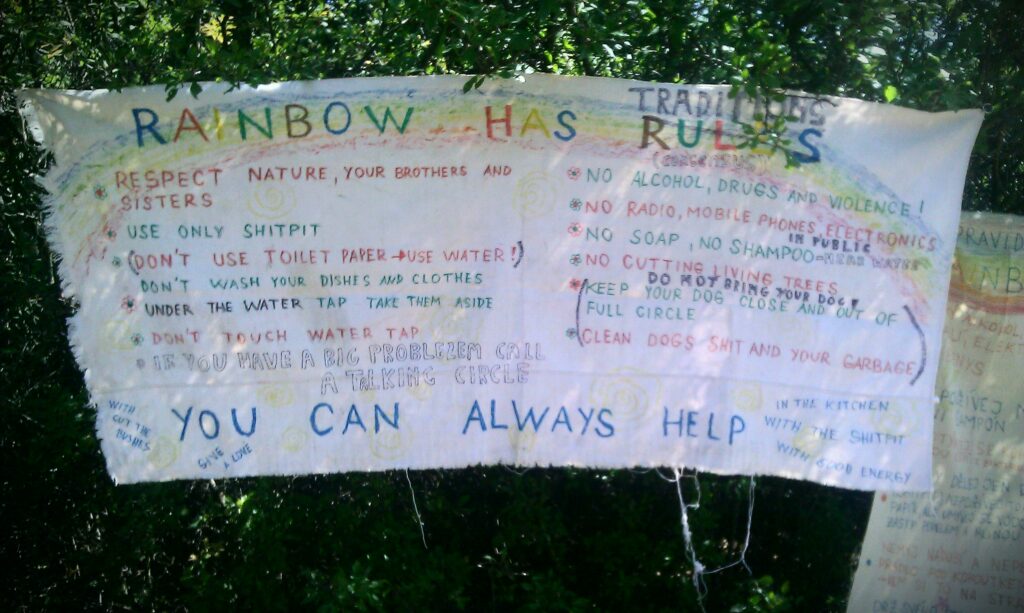
In the alt paths we need to talk about a circler familiar mess: when movements that are open, non-hierarchical, and anti-authoritarian end up recreating the hierarchical problems they set out to escape. This is the “dogma of anti-dogma”, and you see it everywhere, the example I am using here is in groups like the Rainbow Gatherings.
The Rainbow Gatherings have deep roots in 1970s counterculture. Born from the peace and ecology movements, it emerged with a back-to-the-land, anti-establishment, peace-and-love spirit. Think spiritual communes, consensus meetings, and gatherings deep in the forest – far from the control of the state or #mainstreaming system. For #FOSS tech, this sound familiar? It mirrors much of “native” internet culture and resonates strongly with what we’re trying to grow through the #openweb today, in projects like the #OMN.
In the 50-year history of Gathering’s, there are no leaders, no money, no official permissions. People just show up. Communal kitchens are built, spaces are created for kids, elders, ceremonies, workshops. At the heart is the “Open Centre,” where anyone can speak, sing, or simply be. It’s grassroots in its purest form. When it balances, it becomes a lived example of radical inclusivity and cooperation. But as in any movement, issues emerge, beneath the surface freedom lie 50 years of mythos and informal traditions shaping this nomadic utopia.
This openness recurringly becomes a tangled mess for more vertical-minded people. While there’s no formal leadership, some long-timers – “elders” of any age – naturally hold more sway. And while there are no written laws, there’s a strong social tradition to follow certain paths and perform a kind of functional “openness.” When more #mainstreaming folks arrive and try to “suggest” (read: impose) better structures or force their way into consensus processes, the friction can soon become dysfunction. Often, after creating much mess, their well-meaning input ends up having to be set aside, in #OMN terms #rolledback.
Balancing this is active openness – it’s about pushing back against #mainstreaming orthodoxy being imposed without care, without consent. That tension mirrors what we’ve seen again and again in #mainstreaming “horizontal” movements, from Occupy camps to DIY tech spaces to alt-social networks. The desire to avoid hierarchy doesn’t eliminate power – but in a recurring circle it risks making it invisible. The problem isn’t structure itself, it’s unaccountable structure.
With the #OMN (Open Media Network), we face this contradiction head-on. We draw on the “native” mythos of the #4opens – Open Data, Open Source, Open Standards, Open Process – as living traditions. Not just to #KISS build tools and platforms, but to build trust networks. We’re not pretending hierarchy doesn’t exist. We aim to make it visible, accountable, and, crucially, temporary. It’s not only about flattening decision-making, but ensuring it flows through real human relationships, not hidden power or #geekproblem black-box tech.
Rainbow Gatherings walk a nomadic path, grounded in mutual aid, shared meals, and rich social ritual. When we reboot the #openweb, we have to learn from paths like this. Radical inclusivity isn’t just about keeping the doors open – it’s about building shared social mythos and working traditions. And it’s about staying alert to how exclusion creeps back in: through silence, through pressure, and often through the #mainstreaming crowd who refuse to let go of their blindness.
Movements need memory, they need culture, but they also need self-awareness and space for dissent – space to reflect on the paths we’re walking together. A better #Fediverse, a real #openweb, has to be built by communities that can see their own shadows, name their own contradictions, and keep evolving together, link by link.
Because we don’t just need freedom from the state or the #dotcons, we also need freedom from our own dogmas. The #OMN isn’t just about media, it’s about building the social tech, the soil where openness can grow, thrive, and renew. And it needs compost, stinky and alive, not just metaphor.