People moved right becouse the #deathcult pushing of insecurity and distrust has been uncomposted for 50 years

Currently we are to stuck in the liberal response to the current hard rightward shift, as they treat it like a fixed demographic fact. “Those people won’t move.” “Those voters are lost.” “Reform has captured them.” then comes more polling, messaging, focus groups, electoral strategy and process. This is the #geekproblem applied to blinded #fashernist liberal politics: treating a living social system like a technical problem that can be managed from above. But people don’t live inside polling data, they live in communities, institutions, workplaces, families, streets, media systems and increasingly broken #dotcons digital spaces.

And when this #mainstreaming stops giving people security, meaning or trust, something will fill the gap. If government doesn’t deliver, people look elsewhere, institutions aren’t trusted, people look for identity, communities are fragmented, people look for tribes. If #mainstreaming politics can’t offer a believable future, people reach for something that feels solid now. That is why sectarian identity becomes attractive in an age of inchoate policy, captured institutions and bad-faith politics.

At least identity feels tangible, I know who I am, who they are, and I know who is to blame. It is a crude form of social infrastructure, but it is still infrastructure. And this is where the liberal framing goes wrong, the “rightward shift” isn’t some mysterious virus that has infected society, it is a feeding on the very probels our 40 years of worshiping a neo-liberal #deathcult has produced, on broken social trust, insecurity, precarity, housing insecurity, broken public services and loss of community that leads directly to political powerlessness.

And the constant experience of being told that everything is improving while your lived experience says otherwise. You don’t compost that with better messaging, you don’t shoval it with another consultation, you don’t defeat it by telling people they are stupid, racist, backward or “misinformed”. You certainly don’t challange it by becoming better at managing the same broken system.

You change the conditions that produce the politics, this is where the #OMN way of thinking matters. Start with the social infrastructure, build trust, participation to grow commons with space for paths where people see the evidence, challenge it, add context and correct mistakes. Build spaces where people do things together rather than simply consuming politics through algorithmic feeds.

That is how trust grows, from paths where the is more than a technical checklist. Because open process lets people see how power actually works, it turns politics from something done to people into something people can participate in. Communities become visible without first getting permission from the #mainstreaming machine. Where trust is something built through participation rather than handed down by an authority. Where disagreement isn’t automatically treated as failure. Where mistakes can be corrected rather than silently buried. Where history isn’t constantly erased by the next algorithmic cycle.

You don’t solve the rightward shift by endlessly talking about the rightward shift, you rebalence the social conditions underneath it. The right-wing understands something that much of the liberal centre has forgotten – people need belonging. The nasty mess we currently need to compost is allowing belonging to grow from fear, exclusion and enemies. Make people safer, communities stronger, open up space were people can build together.

Because trust is built through doing things together – that is the native #openweb path. We need to compost what the right feeds on: division, so the alternative has to grow from trust. That’s not electoral strategy, its #KISS growing social infrastructure.
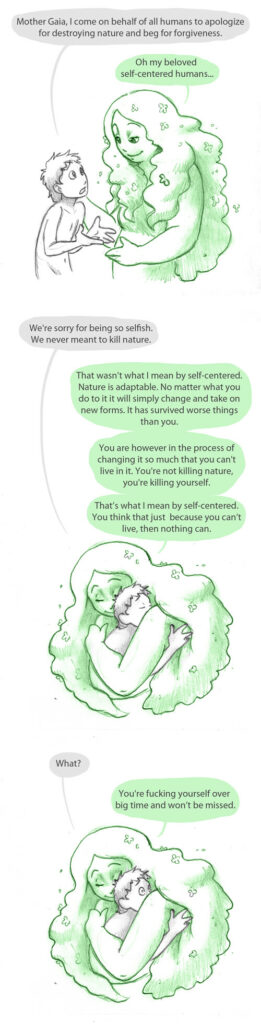
The problem isn’t that humans are stupid, maybe its more that we’re just good at organising stupidity. The planet isn’t dying because it hates us, the planet will be fine. It’s the humans who are having the difficult bit, the economic system says: BUY MORE SHIT. Religion says: TRUST THE INVISIBLE AUTHORITY. Politics says: PICK A TEAM. The #dotcons say: KEEP SCROLLING. And the #geekproblem says: DON’T WORRY, WE CAN ENGINEER OUR WAY OUT OF IT.

We’ve pushed a #nastyfew class to avoid any responsibility, and then people on there knes eyes closed wonder why nothing changes. Maybe the useful position is to step back from the social and ecoloical mess long enough to actually we are creating it. Not abandon people, not give up on society, but stop pretending the existing path is working.

The #OMN starts from that uncomfortable place. News. Memory. Trust. Participation. Eventually governance. Not another shiny platform, another central authority. A bit of infrastructure for people to see what is happening, connect it, challenge it, remember it and build something better together.

The planet doesn’t need saving from humans, humans need saving from the #deathcults we so easely worship. And maybe the first step is getting off our knes opening our eyes and looking around at the mess we need to compost.
#OMN #openweb #commons #FOSS #dotcons #geekproblem #deathcult #KISS

Living through twenty years of #dotcons addiction

For those of us who’ve spent the last twenty years working around alternative technology, grassroots media and activism, the hardest thing to watch has been how deeply the #dotcons have become embedded in the culture. We know the problems, we’ve been talking about surveillance, extraction, algorithmic manipulation, platform lock-in and the destruction of community for years. And yet we keep going back, not because people are stupid, but because addiction is powerful – especially when the thing you’re addicted to is also where everyone else is.

This is where #mainstreaming becomes such a problem. People have been, and still are, vile in their interactions with the alternatives. Instead of helping build something different, too much energy gets spent defending the existing system, attacking people trying alternatives, or having endless prat fights about which alternative is ideologically pure enough. The result? We waste years fighting each other while the #dotcons keep growing.

Our #mainstreaming crew/friends are always pushing pointless fights over alternatives, while defending the obvious worship of the #deathcult – forty years of #neoliberal “common sense” normalised extraction, competition, growth and individual consumption as if these were laws of nature, they aren’t, they are political choices. And “common sense” built around those choices is going to take time – and a lot of messy work – to change.

That’s what we mean by composting, not throwing people away, not creating another subculture purity club. Taking the accumulated #techshit, failed projects, bad assumptions, ego battles, corporate habits and activist baggage and turning it into something useful. Because dumping Big Tech isn’t just a matter of personal politics, it isn’t even primarily about “tech sovereignty” – that is another con when sovereignty means building our own little versions of the same extractive systems. It’s about survival – Big Tech is the latest flag-bearer for our recurring worship of #deathcults.

After living through this mess, we don’t need another shiny platform, we need to recover the ability to build things together. Small-scale, federated, open, human, trust-based, with memory and governance. With communities that can survive the failure of the latest #dotcons or #fashionista platform. That’s the point of the #openweb, #FOSS, #Indymedia and projects like #OMN. Not another tech fashion, more a way out of the addiction. So, grab a shoal and compost this mess, please.

State Funding of #FOSS and Open Source: Is it a Good Idea or a Bad Idea?

The questioning over state funding of Free and Open Source Software (FOSS) and open-source initiatives revolves around invisible ideological debates about benefits and drawbacks. Let’s look at this from a few specific examples: #NLnet, #NGI, and the European Union (#EU), to understanding the implications and effectiveness of this funding path.

  • The #NLnet Foundation is a notable example of an organization that provides funding to open-source projects. Supported by private and public funds, including significant contributions from the #EU, NLnet focuses on promoting a free, open, and secure internet.
  • The #NGI initiative, funded by the #EU, aims to shape the development of the internet of tomorrow. By supporting a range of open-source projects, NGI tries to foster innovation, privacy, and security. It emphasizes human-concentric technology, ensuring that the future internet respects humanistic values and needs.
  • The #EU has been a significant proponent of FOSS, providing funding through programs such as Horizon 2020 and Horizon Europe. The EU’s supports digital sovereignty, reduce dependency on non-European technologies through promoting open standards.

The is some democratization as these state-funded FOSS projects ensure software is accessible to wider groups, thus reducing the digital divide. For instance, NGI-funded projects are supposed to focus on inclusivity and user empowerment. At best, this transparency brings public overview to these processes.

There are some economic benefits and cost savings in using and supporting FOSS instead of expensive proprietary software. Funding initiatives like NGI stimulate innovation by allowing developers to build upon existing open-source projects, fostering a collaborative environment. Though, there are unspoken issues of sustainability in a pure capitalist path, thus the question of balance in state funding.

Open-source software allows for independent security audits, reducing the risk of vulnerabilities. The EU’s investment in secure communication tools underlines this advantage. Reducing reliance on a few large proprietaries #dotcons software vendors enhances national security and control. The EU’s support for open-source projects aims to bolster humanistic digital sovereignty.

For example, #NLnet’s diverse (though #geekproblem) funding portfolio highlights this limited community-driven development. The collaboration between public institutions, the private sector, and community contributors helps #NGI projects bring together diverse stakeholders to work on common goals. #FOSS projects thrive on community contributions, leading to continuous improvement and support and thus in theory community needs, though due to the dogmatic #geekproblem this is currently failing.

Funding Continuity: Projects become dependent on government funding, which currently is not stable or continuous. For example, sudden policy shifts in the EU affect long-term project sustainability. Without a sustainable funding, FOSS projects struggle with long-term maintenance and support.

Most #FOSS projects are too idiosyncratic to meet quality #UX standards. Thus, the current #geekproblem dominated process means that state funding inadvertently support meany unusable and thus pointless, subpar projects. Effective diversity and oversight of these mechanisms are crucial to mitigate this failing path.

Government involvement leads to bureaucracy, slowing down and ossifying development cycles, currently we do not work though this path well, The balance between oversight, diversity and agility is critical. With the #EU path this is a huge problem leading to almost all the current funding bring poured down the drain.

For #mainstreaming capitalism the issue of “Market Distortion”, the idea of competition raises the issue of state funding distorting “market” dogmas to disadvantage private companies and startups that don’t receive government support. For instance, EU funding can overshadow smaller #dotcons, capitalist thinking sees this as a risk that government-backed projects might stifle innovation by shaping the market landscape.

Political and ideological biases influence which projects receive funding, this is currently pushing a #blocking of the needed “native” #openweb path. How to move past this to ensuring diversity and “impartiality” in funding decisions need real work. How can we shift this “common sense” focus that government priorities do not align with the wider needs of the #openweb community and end-users. Aligning funding priorities with community needs is needed to address this concern, how can we make this happen with funding like #NLnet and #NGI?

To sum up, #NLnet are doing some good work, but this is focused on feeding the #geekproblem and building #fashionista careers, evern then on balance they do a better job than most. Then the wider #NGI funding is going into the #dotcons and #NGO mess, thus being poured directly down the drain. Over all, it’s fantastic that the #EU is funding the #openweb even if it is doing it very badly by funding very little that is native or useful.

Conclusion, state funding for FOSS and open-source initiatives, in our examples #NLnet, #NGI, and the #EU, has potential for creating real change and challenge, but this path presents both opportunities and challenges. When implemented thoughtfully, it can foster “native” paths, innovation, reduce costs, and enhance community and security to challenge the current worshipping of the #deathcults by our widespread use of the #dotcons. The question is the will and understanding to balancing this path to ensures that state funding positively contributes to the FOSS ecosystem, driving forward a free, open digital future or just leads to the capitalistic criticism of waste and distortion? At best and at worst, we see some real change and a lot of poring funding down the drain to feed some #geekproblem and build the careers of a few #fashernistas

The is much to compost in the current mess, can we get funding for shovels please #OMN