For most people, the crisis feels recent. Housing costs. Energy bills. Food prices. Debt. Insecure work. Growing inequality. Endless wars. Ecological breakdown. The #mainstreaming story is that these are separate problems with separate causes. COVID. Ukraine. China. Immigration. Technology. Bad politicians. The reality is simpler, these crises grow from the same roots – the moment things changed, one graph tells the story.
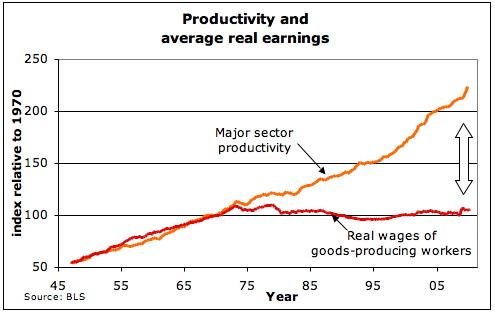
From the end of World War II until roughly the early 1970s, productivity and wages rose together. When workers produced more value, they received a larger share of that value. This was not charity. It was the social settlement that emerged from the disasters of the Great Depression and World War II. Governments understood that if ordinary people could not afford the goods they produced, capitalism would repeatedly collapse into crisis. The answer was public investment, strong unions, social housing, public infrastructure, public healthcare, education, and rising wages.
This was what some people now call the “golden age” of capitalism. Workers bought homes. Families survived on a single income. Public infrastructure expanded. Living standards generally improved. Then the trend broke, as productivity continued rising, but wages stopped. For the last fifty years, workers have produced more and more while receiving proportionally less and less. The wealth didn’t disappear, it moved upward.
Saving capitalism from itself – The original US New Deal wasn’t created because elitists became generous, it emerged because the system faced a legitimacy crisis. Mass unemployment. Mass poverty. Growing labour movements. Strong socialist alternatives. Faced with these pressures, governments invested in public works, strengthened labour rights, regulated finance, and redistributed wealth. The lesson was simple, if people have money, they buy goods, if people buy goods, businesses survive, if businesses survive, the economy functions. This wasn’t radical, it was practical as the state acted to stabilise society.
The neoliberal turn – by the 1970s, a different ideology was waiting in the wings. The solution offered by thinkers such as Milton Friedman and institutions such as the Chicago School was to reverse the post-war settlement. Privatise public assets, break unions, cut taxes on wealth, deregulate finance and reduce social spending to treat everything as a market. This project became government policy under Reagan, Thatcher, and much of the Western political class. The promise was freedom, the result was enclosure. Public wealth became private wealth, collective institutions were weakened, corporate power expanded, the bargaining power of workers collapsed.
The result was clear, the graph above tells the story, productivity kept climbing, compensation stagnated. The gains increasingly flowed upward. For the workers debt replaced wages, the old social contract was based on rising incomes, the new one was based on borrowing. If wages no longer rise fast enough, people still need homes, education, healthcare, transport. The gap was filled with debt: Credit cards, Student loans, Mortgages, Personal loans. Instead of sharing productivity gains directly, people borrowed against their futures. This worked for a while, until it didn’t.
A resent example of this mess is 2008 – The financial crash – exposed the reality, when ordinary people face crisis, they are told to tighten their belts. When financial institutions face crisis, public money appears instantly. Millions lost homes, lost jobs. Meanwhile, banks received vast bailouts. The lesson was clear. The system still knew how to mobilise resources, it simply chose who to save.
This is why we use the harsh hashtag #Deathcult. Composting this mess is where the #OMN idea of the #deathcult becomes useful as neoliberalism is not simply a set of economic policies, it is a cultural common sense. It teaches a “common sense” path that markets solve everything and that public solutions are inefficient. That society does not exist, that individuals succeed or fail alone. That endless growth on a finite planet is normal. That every commons must become a commodity.
This invisible ideology is now so deeply embedded that many people cannot imagine alternatives. The system creates crises and then presents more market solutions as the answer. Climate collapse becomes carbon trading. Housing crisis becomes investment opportunity. Community becomes #dotcons platforms. Citizens become consumers. The cure is always more of the disease.
In this mess we need to remember what we have lost, the biggest loss wasn’t economic, it was social. The institutions that once balanced private power were weakened: Trade unions, Cooperatives, Mutual aid, Community media, Public ownership, Local democracy, Shared stewardship, The commons. These weren’t perfect, but they gave ordinary people collective power. Without them, people are pushed into isolated competition. What #OMN calls #stupidindividualism. Everyone struggling alone against systems too large to influence individually.
Building beyond the mess, is not about post-modern nostalgia, the post-war settlement was deeply flawed. But what is built can be rebuilt, this means on a progressive path creating commons rather than commodities, governance rather than management, participation rather than consumption and community media rather than corporate platforms to grow cooperation rather than extraction.
As social infrastructure, the #4opens provide one practical foundation for this work: open process, open data, open standards and open licences. Because the real challenge is not technological. It is rebuilding the social relationships that make alternatives possible.
To sum up the graph of productivity and wages is not simply an economic chart, it is a map showing where the wealth went. And once we know where it went, we can start asking a more useful question: #KISS how do we build something different?
#OMN #OpenWeb #4opens #Deathcult #Neoliberalism #Commons #MutualAid #FoodSovereignty #CommunityMedia #OpenGovernance #NothingNew #DIY #KISS