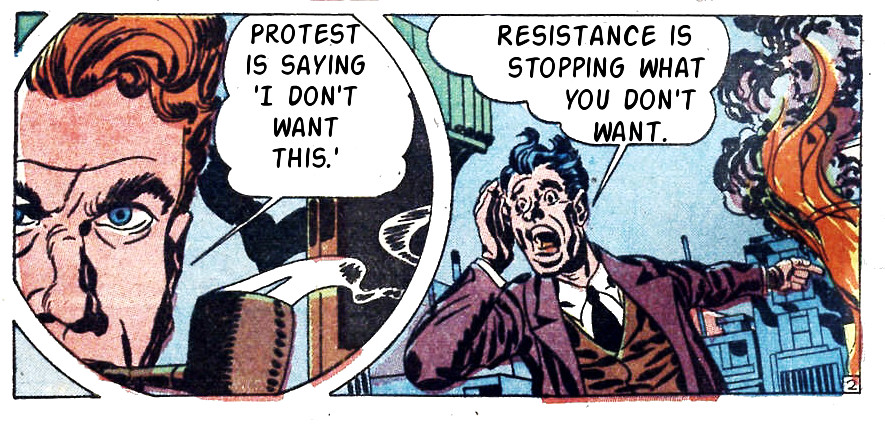
Think that might be a good #openweb slogan, “technologies job is to hold the trust in place” In our example, #OGB decisions only count if a wide number of people engaged in them, because in the end it’s this group that will “enforce” the consensus. So one power mad nutter (quick, take the crown off) has little power to capture.
Only trust groups actually have “power” and as they are trust groups this power will likely be used better, a good outcome. Trust and #4opens solve this hard technology problem in a soft, swishy way. So technology job is to hold the “trust” in place.
#OMN think there are ways to stop people burning the coding project down, ask how their feature fits into the #4opens
* Open process should block most
* Open data sum
* Open licence is obvious, so likely won’t block much
* Open “industrial” standards should block much of the let’s do it my way mess.
So if we keep focused on this, with the check on #PGA we should block much of the #mainstreaming and if very polite keep people in board. This is hard work – #OMN we build strong defaults and we hard-code in #4opens We keep these ideas at the front of the project, though people will want to push them to the back for outreach (#mainstreaming). We need to build tech from grassroots, horizontal. The problem we need to keep focus on composting is people will keep adding #mainstreaming common sense, bring friction that will burn people out fast in tech.
Feudalism is not a good model of governance, yes I understand this is the norm for #opensource and #freesoftware, but we do need to update to something more relevant at some point.
The #fediverse is a good opertunerty to try democracy, maybe?
We need to start from a simple but often-missed point – different starting assumptions lead to different processes – and those lead to very different outcomes. This is the lesson that gets lost when radical #openweb projects are treated like just another app, or reduced to a polished #NGO common sense path.
The #OMN doesn’t come from that place. It grows out of a different worldview, rooted in the lived traditions of the commons, the early internet, and grassroots organising. This isn’t abstract theory; it’s a body of practice that has already worked in many different forms.
We’ve seen it before in the early #indymedia network giving global voice to decentralised movements in the #wikis and early blogospheres building shared knowledge in public and more recently, the #Fediverse (for example Mastodon) showing that federated systems can scale without (yet) falling under corporate control.
These are not utopian ideas, they are working proofs that transparent, decentralised, trust-based systems can function and sustain real communities. Yes, they have limits. But those limits are not simply weaknesses, they are part of what keeps them healthy. They enforce diversity, autonomy, and accountability at a human scale, rather than collapsing everything into a single, extractive system like the #dotcons.
Where things go wrong, the current problem is a loss of context. Many people entering tech and activism today don’t have access to this lineage, or only see half of it. Developers who understand federation but not community process often build technically elegant systems that don’t sustain real social use. You end up with silos that work, but don’t live. Activists who understand horizontal organising but not open standards end up relying on closed tools – Facebook groups, Google Docs, Slack – rebuilding their movements inside systems that ultimately undermine them.
In both cases, something essential is missing. Without a grounding in the subcultures that shaped civil rights movements, free software, and the commons, people default to what feels like “common sense” – but is really just #mainstreaming logic.
That tends to look like discomfort with open governance (“too messy”), preference for control and clarity over participation and suspicion of openness when it challenges institutional norms. The result is familiar: well-intentioned projects that centralise, burn out, and quietly disappear when funding cycles end.
The #OMN is an attempt to break that cycle, it’s not a single platform or product, it’s better understood as shared infrastructure – both social and technical – that helps reconnect what has been fragmented. Think of it as soil, not a finished structure. The aim is to reconnect grassroots practice with open technical standards, compost the backlog of half-built projects and abandoned ideas and create conditions where new work can actually take root and grow.
On the technical side, the building blocks already exist – protocols like ActivityPub and RSS. On the social side, we have long-standing practices of trust, transparency, and collective governance. What’s missing isn’t only the tools, it’s cultural memory, continuity of practice and the confidence to build differently.
If we’re serious about the #openweb, the shift is less about innovation and more about orientation from products → to processes, from platforms → to ecosystems, from control → to trust and from presentation → to practice.
This isn’t about rejecting institutions or funding outright. It’s about recognising that if everything is filtered through those to often blinded lenses, we lose the qualities that make the #openweb viable in the first place.
The challenge – and the opportunity – is to reconnect the layers of narrative with practice, funding with real needs and technology with lived community. Because without that, we don’t get growth, we just get better storytelling about stagnation.
The are few if any working humane alternatives to the current #deathcult worship, thus for meany stepping away from this mess is simply not an option. The #OMN is about proof of concepts to build off what we know works combined with the new technology of federation (activitypub) to scale these small scale to wider social projects. The #OGB#indymediaback#4opens are stepping stones to a different, sustainable world.
Interesting to think about why people put so much energy into #BLOCKING
All #OMN projects are based on grassroots organisation that we know works, the innovation is in using “technological federation” to scale these working social projects using #activitypub that the fedivers is based on, which we know works.
Mainstreaming people who spend energy #blocking the fedivers are the same people who would come into a protest camp and reject and try and force change on the working process.
#mainstreaming is obviously a #deathcult we do need to keep saying this. There are well document alt’s that I push with every use of the hashtags #OGB#OMN#4opens etc. The problem we way too often face is people wanking liberal “common sense” in the era of the #deathcult so need to make this point forcefully.For our liberals (of every type) this comes across as toxic positively if they can see the positive side at all. When they don’t I call this #BLOCKING and often get blocked for doing so.
Compost and shit comes to mind, shit is good compost, so this is NOT actually a negative statement, it’s part of the story, in radical grassroots direct action you need to go through trying meany people to build a affinity group that makes a difference. http://hamishcampbell.com/2022/09/19/
People who PUSH “solutions” while they are obviously bowed down eyes on the ground to the #deathcult are pushing problems, not solutions. This is not an obvious statement to our “liberals” thus they way to often PUSH “solutions” over real working alternatives. #BLOCKING and adding to the social mess and #techshit we need to compost.
No matter how “nice” they are as individuals, their, perhaps well intended, work is a problem adding to the mess. I should not need to talk about this, but lets as few people I know understand these obverse points:
* Liberals talk about individuals, they talk about personal actions and personal responsibility. This is how you tell you are talking to a liberal.
* socialists, anarchists and leftists talk about social groups, community actions, social change and challenge. This is how you tell you are talking to a radical progressive.
So try judging people you are talking about to get a better idea who is #BLOCKING and who has the possibility of doing anything useful.
We need non #deathcult#mainstreaming there are meany ideas to make this happen but no agreement on which one to take 🙂
I am into grassroots as have long expirence of this working at local levels and federation gives us an option to try this for larger groups, that is worth trying #OGB
The problem we face is that most of these tech project paths we know do not work, as the same #geekproblem projects has been tried meany times over the last 20 years.
One thing we need to do is focus on stopping this utterly pointless #techchurn to focus on things we don’t actually know are going to fail… but yes, you would be right to point out we don’t know these ideas will work as we haven’t tried them yet…
Hey, changemakers! Are you tired of shouting into the void on social media? Frustrated with the endless noise and the lack of impact? It’s time to harness the power of #hashtags to fuel a movement that can actually make a difference. And guess what? The #openweb is our playground for this revolution!
Check out The Hashtag Story https://hamishcampbell.com/?s=the+hashtag+story it’s more than just a guide; it’s a blueprint for building something big, something real. If you’re passionate about activism and ready to step up, this is your chance. This isn’t going to be an easy or comfortable path, but hey, who ever said change was easy?
The #OMN (Open Media Network) path is more than a simple call to action. Core to this is that the hashtags story can be more than just noise; it can be seeds for a movement, a way to connect, organize, and grow. But this only works if we make the commitment to turn those hashtags into something more than just digital graffiti. We need to take that extra step, turn talk into action, and make the #openweb a place for real, meaningful activism.
The #hashtags cover technology and society from a progressive view and are very simple, on a surface level, but full of complex conversations when you lift the lid and talk in the context they are planted in.
#BLOCKING = refusing to look/averting eyes/eyes closed
The stroy is complex and interlocking, telling us a wide story and world-view, to show a path out of our current mess.
#deathcult is relevant because of #XR forcing us to look the truth of ecological and social decay in the eye, good to ground this in real historical experiences, think of the Irish Potato and Bengal famine.
#Fashionista is about consumer capitalism, looked at as social illness.
#openweb is about building code for anachronism rather than capitalism
#dotcons are feeding social illness, we cannot keep building this sickness, the step away metaphor is a positive path away from this.
#closedweb is a form of technological slavery, we often choose.
#4opens is a tool that can be used to guide us on to the better humane path and, it gives us the power to JUDGE and thus decide, it is POWER.
#geekproblem is a group of people lost in darkness, blinded to humane light, they inbreed monsters in code #techcurn#techshit
The #geekproblem hashtag is not simply negative, it’s taking obvious “problem” out of “geek”.
The problem is obvious look at #failbook and Google both “geek” projects of domination/control, and yes you are right it’s geek culture shaped by capital in both cases.
What does #openweb geek culture look like? Looking back at early #couchsurfing and #indymedia you have healthy non “problem” examples. Look at both projects late in their decline, we have strong examples of the “problem”.
#techcurn the world is full of me to projects, everyone has the same ideas, few if anyone links.
#nothingnew is a question, do we need this codeing project.
#techshit is when people do not ask this question and build it anyway agen and agen
#encryptionists are in the end way too often about artificial scarcity (web03), this is not actually needed. To be clear this is a minority need for this technology, but as a limited use case not as a dominant way of thinking, codeing. #encryptionists is about the feeling of total control that encryption gives the #geekproblem this is key because all good progressive society are based on trust, which is about giving up this desire. The problem in geek is the problem of socialization… a known geek issue 🙂 in itself is fine, am not judging. BUT this is embedded in code that shapes society, it becomes a “problem”. Good to think a bit more on this one. With power comes responsibility.
This list only touches on the meanings and subjects. Next question, what is the story and world-view that these #hashtags embody?
Looking at the history of socialhub you can see the history of Monocracy, Aristocracy and Feudalism in the #geekproblem
The kings left long ago or never joined, why would a “divine” touch the muddle ground. The aristocrats in their social isolation still preen their fathers and try on their inviable cloths of gold and satin, their nakedness visible to everyone but themselves and the few fear bowed sycophants that hold the imaginary cloth from the mud.
The feudalism of the peasants is ignored as long as the “users” keep signing up for accounts.
This is a fables glimpse of the ruling court we build.
The is hope you can take the “problem” from the “geek” and yes you are right to be frightened and angry this would be taking off a comforting blindfold, and yes the sunlight would hurt the eyes for a time.
We can take this path if we can take the “problem” from “geek”, a simple idea, a hard path #OGB
#fediverse is an accidental#openweb reboot – largely driven by the #fashionistas. Which means – it’s like herding cats – hard to move, hard to align, not a bad thing, not a good thing – just the reality.
If we want to move beyond the mess, one path is #OGB – grassroots, #DIY, producer-led governance.
If not, then we live (and die) with the chaos. And do what we can to stop people bowing down to the #deathcult. Because even holding that line matters, if we want to keep the #openweb alive.
In protest camps, squats, rainbow gatherings, akt-tech the is a long history of “liberals” pushing in with “common sense” agenda to distroy working alternatives. Our “liberals” have little understanding of the damage they do when this happens, for them this disstruction simply proves the alt’s are NOT posspable and thus their common sense is reinforced and the disstruction feeds back this “common sense”.
It’s obviously true that society/ecology is sick from this blinded worship.
From this dogmatic liberalism, one thried is our society’s moving to corporate socialism. That is “law” and norms are shaped to value a tiny number of the nastiest people at the “top”.
Data and metadata is privatised, increasingly “National socialism” is the “common sense” #mainstreaming we code for and agenst.
To address this #geekproblem some of us need to step away and code outside “liberalism” and not in reaction to fascism.