#Identitypolitics, is what happens when liberalism turns inward and fragments – call it mad liberalism. #Culturewar is what happens when that same liberalism hardens and lashes out – bad liberalism. Both look like opposites, but they come from the same place.
The uncomfortable part is both were pushed onto the “left” as the way to fight #neoliberalism the very system that’s been tearing apart the social fabric for decades. Instead of building collective power, we pushed endless identity fragmentation, reactive outrage cycles and symbolic battles detached from material change the left is about.
Energy that could have gone into organising, building, and challenging power structures got redirected into managing discourse and fighting each other. That wasn’t an accident, it was the path of least resistance within a liberal framework that can’t actually confront the roots of the problem, because it’s part of the problem.
So while people were arguing over representation and language, the underlying mess – what we call the #deathcult – carried on concentrating wealth, hollowing out communities and locking in structural inequality. And now, that same system is producing a hard shift to the right, feed by anger without direction, backlash without solutions and reaction filling the vacuum left by the failure of the “left” to build alternatives.
So yes, the liberal centre made the mess, but the more important point is this we’re still stuck inside its framing, still reacting, still fighting on terrain that leads nowhere and still avoiding the work of building something that can actually replace what’s failing. Not to dismiss identity or culture – those matter – but to put them back in proportion, grounded in material reality and collective process. Because if we don’t do that, we stay locked in the loop of liberal fragmentation → right-wing reaction → deeper collapse, and this loop doesn’t end well.
The question isn’t only who to blame, it’s whether we can stop playing the same game long enough to build something else. Let’s look at this from a much wider view.
For a long time, the dominant mainstreaming story has been that today’s instability is blamed on the anger of the “left-behind” in the West, a neat, comfortable narrative. But this is shallow, as long before discontent surfaced in the US or UK, entire societies in Eastern Europe and the former Soviet Union went through something far more extreme.
The 1990s transition to #neoliberalism wasn’t just “reform” – it was a peace-time social collapse when life expectancy dropped, savings were wiped out and crime and addiction surged. This “history” matters now because it shows that what we’re living through isn’t new, it’s the long tail of our worshipping of the same #deathcult, that has been breaking societies for decades.
The illusion of stability from the early 1990s to around 2010, when the world looked unusually stable, even peaceful. Major wars between big powers disappeared, military spending dropped, trade and GDP surged – “Democracy” spread across the globe. This period was framed as success, some even called it the end of history. But this “peace” rested on smoke and mirrors.
#globalisation as control – economic interdependence was supposed to prevent war, the idea was simple if everyone is economically connected, conflict becomes irrational. What actually happened was production was off shored, labour was weakened in the West, global supply chains became fragile and unequal and wealth concentrated at the top. This wasn’t peace, it was #classwar.
The fig leaf of “democracy” was always market compliance, less about collective decision-making and more about maintaining economic growth. In practice governments served markets, institutions constrained popular power and politics became technocratic management. In #OMN terms, this is #mainstreaming – reducing real political choices into narrow, “acceptable” to the #nastyfew options.
The hidden cost was hollow societies, this system did produce growth. But hollowed everything out, communities weakened, industries disappeared, inequality exploded and politics lost meaning. People were told everything was fine, while their lived reality worsened.
So the anger we see today isn’t sudden, it’s delayed. The imperial layer is power without accountability at the global level, this system was held together by a dominant power structure. And here’s where the cracks deepen as rules applied selectively, international law was a tool, not a constraint, economic systems weaponised as needed. The result was a loss of legitimacy, as when rules are not applied equally, they lift the veil to stop functioning as rules at all.
We are now moving out of that world back to no longer having a single uncontested centre of power. Instead, we have competing blocs, regional tensions, fragile alliances and increasing militarisation. This is what’s called a multipolar world in #IR terms. Historically, these systems are unstable unless there are shared norms and limits, right now, those norms are weak or collapsing.
So we understand that the liberal #deathcult logic no longer works, globalisation is fragmenting, states are prioritising more self-sufficiency, supply chain control, strategic industries. The old idea of interdependence is now seen as a risk, not a safeguard.
Liberal ideas of democracy aren’t stabilising conflict, instead of reducing tension, elections amplify nationalism, reward confrontation leading to deepen division. The “#deathcult peace” is no longer holding, It’s a dangerous feedback loop, that without strong shared “rules”, the mess drifts toward proxy conflicts, regional wars, arms races and escalating mistrust. Even if full-scale war is avoided, instability becomes normal, and this instability feeds back into domestic politics – creating more fear, more reaction, more breakdown.
The deeper problem is #neoliberal exhaustion, we no longer treat the #deathcult as sacred and with #climatechaos and social break down our deaths are seeping closer. It’s now visible systemic exhaustion of the rule of the #nastyfew who built this era of #neoliberalism to prioritised finance over production, replaced politics with management, concentrated wealth and power and stripped away collective purpose.
This mess making didn’t resolve contradictions, it displaced them into culture wars, liberal identity conflicts and into abstraction. Now those social control is failing, we see the return of “history” where fundamental questions can’t be avoided anymore:
- What is the purpose of the state?
- Who benefits from the economy?
- What do we protect and why?
- How do we organise collectively?
This is uncomfortable, but necessary. As the previous era avoided these questions, this one forces them.
The #OMN perspective on this mess is compost, don’t collapse, that this moment is not just crisis – it’s raw material. The breakdown of the old system creates space, but we need to use the space, it’s why the #compost thinking matters – don’t deny the mess, don’t romanticise collapse, process it into something usable. Because if we don’t, the vacuum gets filled by reactionary politics, authoritarian control and deeper #mainstreaming mess.
The “end of history” wasn’t an achievement, it was a pause – built on unstable foundations. What we’re living through now is history restarting, messy, risky, uncertain. But also the first real chance in decades to build something that isn’t just a updated version of the same #deathcult logic. We might build a #lifecult if we can hold our nerve, and actually do the work.
So what comes next? We are moving from “stability” without meaning to instability with possibility. Yes, that shift is dangerous, but it also reopens agency, the question is no longer
“how do we maintain the system?” It becomes “what do we build instead?”
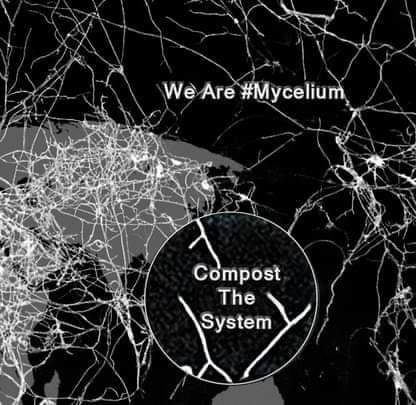
The #KISS choice is the #OMN path to grow new #openweb, grassroots, trust-based structures, or we default fall back into more centralised, extractive systems?