Fediverse – What actually happened (no bullshit version)

A few years ago, the liberation cats of the #Fediverse stopped talking to each other. Not only out of malice, mostly through burnout, distraction, and quiet withdrawal. Nature abhors a vacuum. Into that vacuum stepped the #NGO crew.

They didn’t “win” our spaces through better ideas, didn’t persuade anyone. They simply occupied every role that looked like coordination, representation, legitimacy that was funding-adjacency. That’s their native skill set, #NGO people don’t build ecosystems; they replace them with management layers and then call the stagnant result “sustainability.” The living projects become “stakeholder processes,” and healthy disagreement becomes “risk,” then our history is sold as branding.

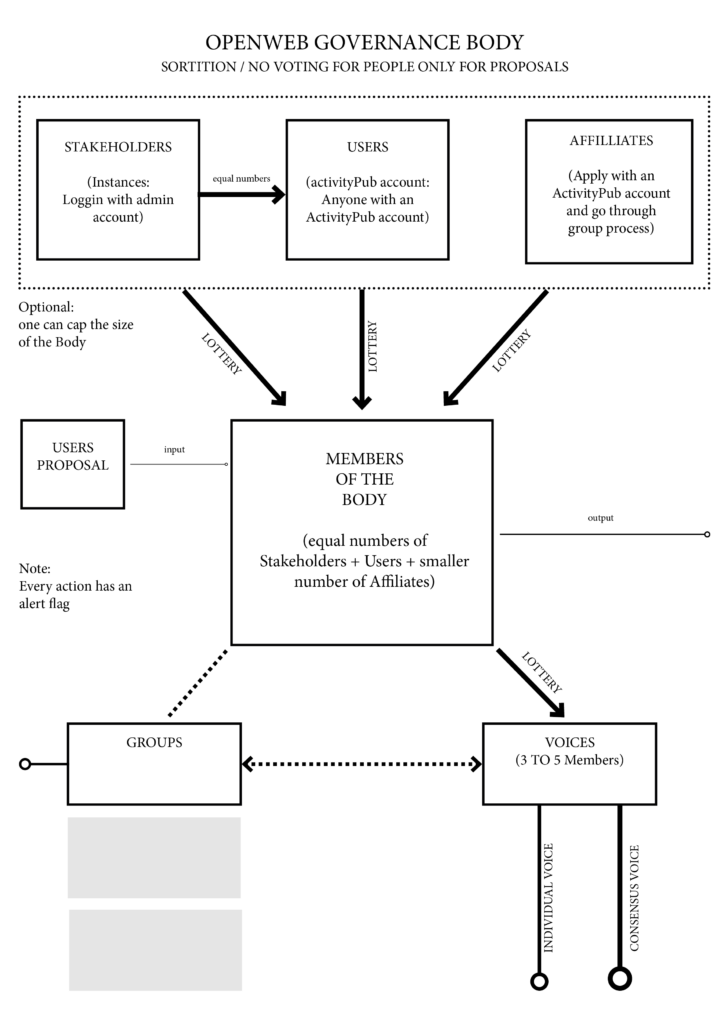
This isn’t accidental, it’s a familiar class of friendly parasites that reproduce by feeding on radical paths and left uninterrupted, they will kill again. The painful part is that we saw this coming, and for a moment, we did interrupt it. Projects like #OGB were attempts to embed power visibility, contestability, and trust before capture could harden. But attention drifted, coordination frayed, and then – quite literally – things were blocked.

So here we are again, the mistake, worth being blunt about, is that we keep trying to solve cultural and mythic problems with structural and procedural tools. That’s why everything feels exhausting. We say we’re doing “easy things,” then find ourselves writing documents, attending meetings, moderating tensions, negotiating legitimacy, and fighting over process.

That isn’t easy work, it’s managerial labour. And the unseen and unspoken problem is that the #NGO crew love managerial labour, it’s their home turf. Of course, they take over spaces defined by meetings, boards, frameworks, and legitimacy rituals. Meanwhile, the actual easy things – talking to each other, telling our own history, naming capture when it happens, building small, obvious, human-scale tools, refusing the respectability game – quietly disappear.

Maybe we’re circling back to an opening, one practical path is to stop trying to win positions and instead start delegitimising them. #NGO power flows from chairs that everyone else treats as “necessary.” so #KISS name the chairs as optional, loudly, repeatedly: “This working group does not represent us.”, “This foundation is not the Fediverse.”, “This board speaks for itself, not the commons.” isn’t only confrontation, it’s calm refusal, low energy, high impact. To #KISS restarts the conversation sideways instead of head-on.

Don’t attack NGO spaces directly, they’re designed to absorb critique, instead, encircle them with parallel spaces: messy notes, half-finished proposals, visible disagreements. This is where #OMN-style media matters – aggregate instead of argue, tell the story of what’s happening without asking permission.

Use #4opens as a litmus test, not a manifesto. It works best like this: “Cool project. Let’s do a quick sanity check.” is it: Open code? Open data? Open standards? Open governance? If the answers get vague, defensive, or managerial, that’s your signal. You don’t need to argue, simply don’t invest trust or energy. Capture starves quietly when it isn’t fed.

And yes, calling “mythical people” matters, it’s the missing layer. We don’t just need more frameworks; we need shared stories that make capture feel wrong. Stories of Indymedia before NGOs. Stories of early Fediverse moments that worked. Stories of small, trust-based wins. Stories of projects that died from NGO-isation. We should ritualise these: remembering posts, anniversary threads, public post-mortems, “how we fucked this up last time” stories. This is how cultures defend themselves without rules.

A hard but hopeful truth is that we didn’t fail because the ideas were wrong, we failed because we stopped tending the compost. Compost needs turning, air, moisture, attention. Leave it alone too long, and something else grows. The good news is that compost is forgiving. You don’t need permission to start turning it again.

Calling mythical people – if you’re out there and this still itches, that is people with long memories, allergic to foundations, who build and then disappear, who value trust over scale. Now would be a good time to stop ignoring each other.

Not to “fix” the #Fediverse, just to make it awkward for capture again. That alone would be a big step forward.

Privacy in the age of #Dotcons

Let’s be honest, we already lost metadata privacy. The #dotcons, the surveillance state, and the data brokers see everything. This isn’t a warning about what might happen, it’s the reality we live in today’s mess. In normal peoples lives every click, every message, every connection is tracked, logged, and monetised. There is no going back to the sealed, closed-off privacy of a pre-digital era. Not legally, not technically. The dream of private digital spaces was always fragile, and today it is gone in the #mainstreaming

So what can we do? The answer is radical, counterintuitive, and deeply political: we open the metadata bag, to make the hidden flows of power visible. Every algorithm, every tracking pipeline, every corporate and state extraction point should be exposed, audited, and understood. Transparency becomes a shield against abuse because secrecy is the tool that enforces power asymmetry. We stop pretending that corporate surveillance is acceptable, or that peer-to-peer transparency is inherently dangerous. The logic flips: if everyone can see what is happening, then no one can hide exploitative behaviour behind opaque systems.

Yes, this is uncomfortable, radical transparency is not convenient, it forces us to confront how deeply control and extraction have penetrated our lives. It means admitting we’ve been stripped naked by Google, Amazon, and the NSA. But in a world where we are already exposed, radical transparency becomes the preferred path to justice.

The question is no longer “how do we hide?” – because hiding is largely impossible, but “how do we share wisely, and govern openly?” In practical terms, this means:

  • Open metadata protocols that let communities see what is being collected and how it is used.
  • Collective oversight of platforms and systems, ensuring that algorithms are auditable and accountable.
  • Peer-to-peer transparency, where participants in networks control their data and can trace its flow.
  • Commons-based governance, so that data isn’t captured by a few corporations or states, but managed in the public interest.

Outside often delusional #geekproblem ghettos, privacy as an individual, sealed-off right, is dead. But privacy as collective control over visibility is still possible. It’s not about hiding; it’s about choosing who sees, how it’s used, and under what paths.

The #OMN path treats transparency not as a threat, but as power to know, power to act, power to hold institutions accountable. By making information visible and governance participatory, we reclaim control in a world that has tried to strip it away. In short, in the age of the #dotcons, radical transparency is the new privacy. And it is not only possible, it is necessary.

#KISS

Power, the social cost we keep talking past in #FOSS

A post sparked Hacker News spouting of noise and smoke. It looks like “just fork it.” phrase in #FOSS culture provokes heat. So worth a second look, for some it’s the purest expression of freedom, to others, it’s a conversation-stopper that quietly protects power. What’s striking isn’t that one side is right and the other wrong, it’s that people are too often talking about entirely different things, while using overlapping words, thus the smoke and heat in the linked discussion above.

It’s worth a little time to look at this issue. The pro-fork view is about permissionless agency. From the classic #Geekproblem perspective, “just fork it” is not an insult or a dismissal, it’s a reminder of where power actually lies. The arguments, often bad-tempered, go like this: Open source removes the need for permission, maintainers are not obligated to implement anyone else’s ideas, if you want something different, you can do the work yourself, forks are non-hostile, temporary, and often merge back.

In this view, forking is not fragmentation, it’s pressure relief, to protects maintainers from entitlement, unpaid labour demands, and endless arguments over direction. It’s also what makes #FOSS resilient: even if a maintainer disappears or a project takes a turn you dislike, the code remains usable.

For libraries, tools, and infrastructure components, this works remarkably well. Many developers maintain private forks, carry patches for clients, or experiment freely without any intention of creating a new community. No drama, no schism, no ideology “mess”, just work. From this “native” angle, criticism of “just fork it” sounds like a demand for obligation where none exists.

The counterpoint is that forks aren’t free in social systems, the critique isn’t only about forking code, everyone agrees that’s normal, healthy, and foundational. The tension is when “just fork it” is applied to social platforms, protocols, and shared infrastructure, systems where the software is only a small part of the project.

Running a fork as a new public project isn’t only technical work, it needs: attracting users, building trust, maintaining governance, handling conflict, sustaining moderation and care and thus carrying long-term responsibility. This is where the phrase starts to feel different, in these contexts, “just fork it” is heard not as empowerment, but as exit over engagement, a way to avoid dealing with governance failures, power asymmetries, or unresolved social conflicts inside an existing social project.

From a social #OMN perspective, this isn’t neutral, forking risks: splitting attention, duplicating effort, losing shared history, weakening already fragile commons. Forking may preserve freedom, but it can still destroy value. Forks vs schisms is maybe a way to look at this:

  • forks – technical divergence
  • schisms – social rupture

You can fork without a schism, but every schism requires a fork. Many arguments talk past each other on this, because one side is defending the right to fork, while the other is warning about the cost of schisms. These are related, but not identical. Power, ownership, and stewardship, are fault lines about how people understand authority.

  • One view holds that open source projects are a #feudalistic kingship – benevolent or not – and contributors knowingly accept this. Maintainers owe nothing, forking is the safety valve.
  • The opposing view sees projects as commons built from collective labour where maintainers are stewards rather than owners, carrying responsibilities that go beyond “my repo, my rules.”

Neither position is imaginary, both exist in the wild. The conflict arises when a project quietly shifts from one model to the other without naming it.

Why this matters for OMN-style projects, they are explicitly social, federated, and historical, they depend on: continuity, shared narrative, visible governance, memory. In this context, common sense “just fork it” instincts unintentionally reinforce the problems #4open paths are meant to solve: fragmentation, invisibility of power, and loss of collective learning.

That doesn’t mean maintainers owe endless emotional labour It does mean that governance and mediation matter as much as code, and can’t be solved by technical exits alone. Two truths at once, the debate becomes clearer if we hold these two truths together:

  • No one owes you unpaid labour, forking is a legitimate, necessary protection for maintainers.
  • Social infrastructure is not just software, treating forks as cost-free exits erodes shared commons over time.

When people argue past each other, it’s usually because they’re defending one truth while denying the other. This creates mess, social mess. So to compost this mess, we need to understand better where this leaves us, “Just fork it” is neither a delusion nor a universal solution, it is:

  • healthy in libraries and tools
  • essential as a last resort
  • dangerous as a reflex
  • corrosive when used to silence governance questions

The real work – the hard, unglamorous part – is knowing which situation you’re in, and being honest about the social costs of the choices you make. That’s not a technical problem, it’s a cultural one, best not to be a prat about this.

This matters because we have social problems created by tech intolerances, #blocking culture. The #dotcons industry’s ability to pull the ladder up behind itself should not be underestimated.

We’ve created digital systems so complex, fragile, and professionally gated that an entire generation is being locked out of owning and understanding their own tools. Communities and people should be able to run their own services, control their own data, and participate meaningfully in digital culture, but few can, because we made everything unnecessarily controlled and complicated.

This wasn’t an accident, it’s a part of the #eekproblem, complexity concentrates power, it creates dependency on experts, platforms, and the corporations that have been quietly erasing the possibility of autonomy. What once required curiosity and modest effort now demands specialist knowledge, constant updates, and institutional backing. The result is a widening gap between those who can build and control systems, and those who are forced to rent/beg access to them.

This is why #KISS simplicity matters, why documentation matters and most importantly why social tooling matters as much as code. And why the #openweb was always about people, not only protocols. When we ignore this, we don’t just lose users, we lose a generation’s ability to imagine, agency, and collective control in the first place.

It’s a real mess we need to compost.

Ecological Transformation via Digital Abundance

The ecological crisis is not a failure of technology, it’s a failure of values. We’ve been trapped in a toxic loop where growth = progress, where every solution must expand markets, increase consumption, and generate profit for the #nastyfew. This logic is killing the planet.

A #4opens world pulls up this mess at its root. Digital goods are different, they are non-rivalrous, freely replicable, and infinitely shareable. When knowledge, culture, and coordination move into open digital commons, the material basis of economic growth begins to shrink. We stop burning forests to print manuals, stop shipping plastic widgets to lock in artificial scarcity, stop wasting energy enforcing ownership where none is needed.

This isn’t abstraction, it’s leverage. By shifting value creation into open digital abundance, we reduce pressure on physical extraction. Fewer things need to be manufactured, shipped, stored, and discarded just to keep the economy “growing.” The economy stops pretending that more stuff equals better lives.

From this shift, the real ecological transformation we need becomes possible. Energy systems localise because coordination and design are shared openly. Communities can build, adapt, and maintain renewable infrastructure without licensing fees or corporate lock-in. Circular economies flourish because repair knowledge, supply chains, and governance are commons, not trade secrets. Waste becomes compost, not externality.

Most importantly, culture changes. Consumerism loses its grip when identity, creativity, and social meaning are no longer mediated by buying things from platforms. We stop confusing consumption with participation. We stop mistaking marketing for culture. Life becomes something we do together, not something we rent from #dotcons.

This is not a retreat to austerity, it’s an expansion of possibility. In a post-consumption world, human needs can be met without destroying the biosphere. Care, knowledge, coordination, and creativity grow, while extraction and throughput shrink. The planet breathes again because we’ve learned to value abundance where it exists, and restraint where it matters.

The #OMN path is not “green capitalism” with better branding, it’s a civilisational pivot: using digital abundance to escape the growth trap, and using collective governance to align human flourishing with ecological limits.

That’s not incremental reform, it survival – with dignity.

#FOSS “Just Fork It” Delusion

One of the most repeated mantras in #FOSS culture goes something like this: If you don’t like it, just fork it.” On the surface, this sounds empowering. And technically, it is true. The beauty of open source is that you can take the Mastodon source code, fork it, and do whatever you want with it. Don’t like how it’s run? Do something different. Don’t like the branding? Change it. Got a better idea? Implement it.

But socially, this mantra is misleading, forking is easy, sustaining is hard. Forking code is cheap, sustaining a living project is not. What “just fork it” quietly ignores is that software is only a small part of what makes a project work. The hard parts are social: users, trust, shared norms, governance, maintenance, conflict resolution and long-term care.

When people say “just fork it,” they usually mean “remove yourself from the social problem rather than engaging with it.” That’s not empowerment – it’s fragmentation at best and prat behaver at worst.

From an #OMN point of view, sometimes this is needed, but its rare as it is mostly value destruction. Fragmentation isn’t neutrality, every fork splits attention, energy, documentation, user bases, and developer time. Most forks don’t die because the code is bad; they die because the social surface area is untrusted or unmanageable.

We end up with: dozens of half-maintained projects, duplicated effort, incompatible implementations, project communities too small to support themselves. This isn’t resilience, it’s entropy, not in a good way. And worse, most of these forks are isolated socially, even when they are technically compatible. The result is lost value, lost history, and lost trust – rinse, repeat, move on.

“Just fork it” hides power, it doesn’t challenge it. The slogan pretends to be anti-authority, but in practice it is used to protect informal power. Core teams stay untouched, governance questions are avoided, structural problems remain unresolved. The people most affected – users, moderators, small contributors – are quietly told to leave and rebuild everything from scratch.

That’s not openness, that’s abdication, it’s a prat move that we need to compost. In social terms, it’s the equivalent of saying: “If you don’t like society, go start your own civilisation.” Contribution is not about submission. There is a healthier, but, less glamorous path – start conversations that include people you disagree with, yes, this is slower than forking. It’s also how shared infrastructure survives.

What we need to talk more about is that contribution is not about obedience to maintainers. It’s about stewardship of commons. That means staying in the mess, mediating conflict, and resisting the urge to walk away every time something feels wrong. Forking skips the hardest step: collective sense-making.

Small steps beat heroic exits, the myth of the heroic fork mirrors the wider #geekproblem: the belief that technical control can replace social process. Change usually comes from boring work, partial wins, awkward compromises, long conversations, incremental shifts, not from dramatic exits. Yes, forks in #FOSS have a place, but not as a default. Forking does matter. It’s an escape hatch. A pressure valve. A last resort when projects become irredeemably captured or hostile. But when “just fork it” becomes the first response instead of the last, it stops being a freedom and becomes #geekproblem pathology.

From a social #OMN standpoint, the goal isn’t endless new projects. It’s shared infrastructure that can be argued with, adapted, and cared for over time. Open source gives us the right to fork, open culture asks us when not to. If we want something better than endless reinvention and burnout, we need to stop treating “just fork it” as wisdom – and start treating it as what it often is: a refusal to do the harder social work in #FOSS

And as ever please don’t be a prat about this, thanks.

Fascism, treats collaboration as weakness.

Fascism, treats collaboration as weakness. Something you only (pretend to) do when you’re not strong enough to dominate outright. In the fascist worldview, cooperation isn’t power, it’s a temporary tactic until hierarchy and force can be re-asserted. That’s why fascists can never be trusted. Not tactically, not strategically, not “just this once.” They don’t believe in shared outcomes, public goods, or mutual care. They believe in command, obedience, and extraction.

We also touch on this in our own #geekproblm, this is why the #OMN line is drawn. Open Media, commons-based infrastructure, and collective governance only work if collaboration is real, if participation isn’t a trick, and if power actually flows horizontally. Fascist politics is structurally incompatible with this. It can mimic collaboration, but only as camouflage. The moment it has leverage, it closes processes, centralises control, and purges dissent.

We have now made such a mess of society and our ecology that getting out of this mess is going to create lots of new mess, this issue is the base of the democratic path of the #OGB project. Please don’t be a prat on this, because this is also why fascism always collapses. Systems built on domination can’t sustain themselves, they can’t maintain shared infrastructure or produce trust, care, and resilience. They can only hoard, police, and coerce, until the system eats itself.

Meanwhile, everyone else survives by doing the one thing fascism cannot: building together. Collective projects, mutual aid, shared media, and public knowledge create abundance through cooperation. They scale through trust, not fear, and grow because people see themselves in the outcome.

In the long run, fascism doesn’t lose because it’s defeated by force alone, it loses because it refuses to participate in the commons. It isolates itself, hardens, and withers, while networked, cooperative cultures keep building better lives in the open.

That’s the wager of #OMN: Not domination, but participation, not hierarchy, but shared process, not spectacle, but collective power. Fascism cannot survive in that terrain.

Reclaiming the Meaning of “Common Sense”

The #OMN is a good-faith project, so let’s begin from that assumption. I don’t value the mainstreaming direction of this podcast, but it is still a useful thinking point when considering our project outlines. It highlights the pressures and narratives that open projects eventually have to navigate when we deliberately choose a diversity of paths rather than a single, optimised one.

Yes, it is always possible to game any system, including those built on trust. That risk never disappears. The difference with trust-based projects is not that they are immune to gaming, but that they consciously refuse to optimise around it. Instead, they rely on serendipity, social norms, shared myths, and lived traditions to provide balance when people do start to “play the game.” These informal constraints matter more than formal rules, because they shape behaviour without hardening into control systems.

This is the tension space #OMN operates in: resisting the urge to over-engineer against bad faith, while nurturing cultures in which bad faith becomes costly, visible, and socially discouraged rather than mechanically policed. In this transition, we will have to rethink almost everything we take for granted.

  • Why do we work so much in jobs that drain us without creating real value?
  • Why do we compete when cooperation would make life easier, richer, and more sustainable?
  • Why is everything treated as a secret – data, knowledge, even culture – and why are we trained to distrust each other at every turn?

Capitalism naturalised its own ideology. It taught us that exploitation is inevitable, that scarcity is absolute, and that hierarchy is a fact of nature. Profit was framed as virtuous, generosity as naïve. Over decades, this conditioning became “common sense.” We internalised it until it became invisible, shaping our behaviour, our policies, and even our dreams.

The #4opens world undoes this conditioning. By making infrastructure, code, governance, and knowledge open and accessible, it forces us to see the assumptions capitalism presented as natural for what they really are. We begin to recognise that scarcity can be artificial, that competition is socially engineered, and that secrecy primarily serves power, not communities.

In this context, our old “common sense” becomes a prison. The rules we followed without question – work harder, own more, hoard, extract – no longer hold. Open systems teach us that cooperation, sharing, and transparency are not just ethical ideals; they are practical tools for living and thriving together.

Open thinking makes new realities possible. When knowledge, governance, and infrastructure are transparent and modifiable, we can ask new questions, and act on them collectively:

  • What if work were aligned with care, creativity, and social need rather than profit for the few?
  • What if trust replaced fear as the default in our networks?
  • What if data abundance, rather than scarcity, became the starting point for planning society?

Reclaiming “common sense” in this way is not abstract philosophy. It is a practical, political, and social act. It means noticing the invisible rules that keep us trapped, and then designing systems that embed fairness, resilience, and collaboration into the foundations of everyday life. The transition will not be easy. It requires questioning almost everything we were taught about “how the world works.” But it is necessary if we want to survive the current mess of exploitation, artificial scarcity, and isolation.

The #4opens give us the tools. The commons give us the space. Open thinking gives us the courage. Together, they allow us to redefine what “common sense” really means, and to build a world that is more humane, more resilient, and more just than the one we inherited.

I hope this helps us keep finding the “native” path.

We need to be explicit that spiky and fluffy are complementary, not opposing paths. They serve different functions in the same path, both are necessary for anything healthy to grow.

The problem is not disagreement between spiky and fluffy. The problem is the large number of people who actively fight against this complementarity – who insist on one mode being legitimate, and work to exclude and delegitimise the other.

This is the majority of people we end up interacting with. So until we name this clearly, we keep misdiagnosing the conflict. It isn’t about tone, strategy, or culture. It’s about a refusal to accept plurality, balance, and context – that refusal blocks progress far more effectively than any external opposition.

  • Spiky without fluffy becomes brittle and exclusionary.
  • Fluffy without spiky becomes easily captured and ineffective.

Together, they create resilience.
For the #OMN and #openweb to survive, we have to stop treating this as a personality clash and start recognising it as a structural issue that needs active mediation, not denial and #blocking

Europe, the Fediverse, and the story we failed to tell

A bunch of native #openweb people spent real time, energy, and focus pushing the #EU toward the #Fediverse. This wasn’t theoretical, it wasn’t speculative, it wasn’t a #NGO whitepaper or a #VC funding pitch. It was practical outreach, grounded in working technology and lived experience, aimed at reducing Europe’s dependency on centralized corporate platforms.

One concrete moment of this work was the webinar organised between the European Commission and the ActivityPub community: https://socialhub.activitypub.rocks/t/webinar-with-the-european-commission-and-ap-community/1507

The webinars mattered, they demonstrated that EU institutions were genuinely open to #ActivityPub as a viable public infrastructure standard, not as a niche hobby project, but as a way to regain institutional and civic agency without defaulting to US-based platforms.

This is the work we needed more of, but this kind of engagement is slow, unglamorous, and politically awkward. It doesn’t fit VC startup narratives or revolutionary aesthetics. But it is the work required if Europe wants digital sovereignty without surrendering to #BigTech or reinventing the same centralized failures under an #EU flag.

So the obvious question is: what went wrong? Drift, fragmentation, and the return of the #dotcons. Instead of consolidating that momentum, the grassroots fractured, attention drifted, energy leaked away, people burned out or moved on. In the end, outreach was blocked from both sides

And then slowly, predictably, attention returned to the familiar #dotcons, because they are easy, visible, and culturally dominant. They offer the illusion of reach without the substance of agency, in the long run, this is just more #techshit to compost later.

#SocialHub itself documents much of this history. The discussions are there, the threads exist, the intent is visible. But there is little aggregation, little synthesis, and almost no narrative continuity. For anyone not already embedded, it’s hard to see what mattered, what succeeded, and what was quietly blocked or abandoned.

The missing piece is our own history – this is the core failure – we are very bad at telling our own history, this thread says it plainly: https://socialhub.activitypub.rocks/t/eu-outreach-if-we-dont-tell-our-story-am-not-sure-who-will/2950

Because we didn’t document, curate, and repeat this story, the same myths keep resurfacing:

“The EU was never interested.”

“Federation can’t work at institutional scale.”

“There were no serious alternatives.”

“Centralized platforms are the only realistic option.”

None of these are true – but they feel true when history is missing. When people don’t know that EU–Fediverse outreach already happened, when they don’t know that viable alternatives already exist, when they don’t know that these paths were actively neglected rather than disproven.

Then people fall – again and again – for the #dotcons mess, believing it’s the only possible future. This matters now, as focus shifts back to tech change, and is exactly why #OMN, #indymediaback, #makinghistory, and #OGB exist, not as competing platforms, not as replacements for everything else, but as infrastructure for memory, communication, and accountability.

Before we argue about funding models, platforms, or scale, we need to get the ordering right:

  • History — to remember what already worked and what failed, and why
  • Media — to tell the story properly, in our own words
  • Governance — to keep power visible, contestable, and rooted in trust rather than myth

Without these, attempts at “European digital sovereignty” will reproduce the same capture dynamics under a different logo. Telling the story is political work, if we don’t tell our story, someone else will, and it won’t be told in our interests. It will be told as inevitability, as market logic, as “there was no alternative.” That story always ends the same way: more centralization, more dependency, more enclosure – followed by another round of cleanup and composting.

We already did part of the hard work, we opened doors, we proved viability. What’s missing is not only technology – it’s memory, narrative, and continuity. Until we fix that, Europe will keep mistaking amnesia for realism, and surrender for pragmatism.

Examples of the problem we need to compost

In #openweb tech, these people are the problem not the solution https://freeourfeeds.com/whoweare

This is spoiler incompetent #techshit and likely funding mess we need to ignore https://cybernews.com/tech/europe-social-media-w/ Then compost.

Diversity is good, but this is a prat move https://www.modalfoundation.org/ the are quite a few of these.

Practical tech philosophy

  • To be fully human is to be empowered to live a meaningful life within society.
  • To be rendered sub-human is to be forced into powerlessness outside of it.

We are not isolated individuals who later “join” society. We are social creators. We make meaning together, and that meaning only exists where people have the power to act, to speak, and to shape the world around them. Remove that power, and what remains is survival, not life.

From this perspective, there is really only one political question that matters: How is power shared inside society? Every political ideology is, at its core, an answer to this question – even when it pretends to be about markets, morals, tradition, or efficiency.

Invisible power today lives in metadata. In the digital age, social power increasingly resides in metadata: who is visible, who is connected, who is amplified, who is silenced, who is predicted, who is categorised, who is excluded.

Metadata determines access to work, housing, speech, legitimacy, mobility, and safety. It shapes behaviour not by force alone, but by nudging, filtering, ranking, and erasing. Control metadata, and you control society’s nervous system.

At present, there are four broad answers to the question of who should hold this power.

  1. Capitalism: Metadata for the #Dotcons

Capitalism seeks to privatise metadata into the hands of corporations – the #dotcons. Platforms harvest social data, enclose it, and convert it into profit and leverage. In turn, capital uses this leverage to shape governments, laws, and public discourse.

This is why fascism is coming back into fashion. Once corporations control social coordination, the state becomes an enforcement arm rather than a democratic counterweight. Surveillance, repression, and exclusion follow naturally. This is not a failure of capitalism; it is its logical outcome.

  1. State Communism: Metadata for the Government

Chinese-style state communism takes the opposite approach but reaches a similar destination. Metadata is centralised in the hands of the state, which uses it to discipline capital and population alike.

This is the command economy rebuilt with digital tools – total visibility, behavioural scoring, and algorithmic governance at scale. Capital is controlled, but society is tightly managed. Power flows vertically. Dissent becomes data noise to be corrected.

  1. Liberalism: Metadata for the Individual

Liberalism proposes a third answer: metadata should belong to the individual. Each person owns their data, controls their privacy, and participates in a market of informed choice.

This vision rests on a mythic past that never existed – a free market of equals making rational decisions with perfect information. In practice, individuals cannot meaningfully manage complex data systems alone. Power does not disappear; it simply re-aggregates through contracts, platforms, and inequality.

Individualised data ownership becomes another abstraction that fails to challenge structural power.

  1. Anarchism: Metadata for the Commons

So what does anarchism want? This is where #4opens and the Open Media Network (#OMN) enter the picture. Anarchism does not seek to privatise metadata to corporations, centralise it in the state, or atomise it to individuals. It seeks to socialise metadata into the commons, governed openly, transparently, and collectively.

Power is shared horizontally, not concentrated vertically. Metadata becomes a tool for coordination, care, and accountability – not domination. Communities can see how systems work, adapt them, and challenge them without asking permission.

This is not utopian. It is infrastructural. It is about building systems that make cooperation easier than coercion.

The real choice is not “AI vs humans,” or “state vs market.” It is about who controls the metadata that shapes our lives. Do we accept systems that render us powerless spectators? Or do we build shared infrastructures that keep us fully human – capable of meaning, agency, and collective action?

#OMN is not a finished answer. It is an attempt to walk this last path seriously, in practice, not just in theory. Because to be human is not just to exist, it is to have power together.

Open Media Network: A Manifesto for the Digital Commons

A cohesive manifesto is needed as the world we inherited is fractured. Wealth, power, and knowledge are concentrated in the hands of the #nastyfew: platform owners, data hoarders, and corporate monopolies who extract value from our work, our attention, and our trust. Democracy has been hollowed out, captured and controlled by algorithms that decide what is knowable, profitable, and even true. Ecology, community, and care are sacrificed on the #deathcult altar of growth and consumption.

In this mess, the Open Media Network (#OMN) is a #KISS project that exists to reclaim the digital commons, reshape society, and redefine what is possible when power, knowledge, and technology are returned to the people.

In the current #dotcons economy, access to infrastructure, information, and governance is rent-based and extractive. Communities pay to participate, and the surplus flows to distant shareholders.

The #4opens – open code, open governance, open data, open processes – upend this system. Putting tools of creation and coordination into grassroots democratic, collective stewardship. Value no longer flows automatically upward; it stays with the communities that generate it.

On this path, inequality stops being “natural.” Rich and poor are revealed as structural outcomes of enclosure and extraction. By reclaiming infrastructure as a commons, we recompose power, and inequality becomes a historical memory, not a permanent fact.

The logic of capitalism equates growth with progress, but infinite growth on a finite planet is impossible. Digital goods – knowledge, code, culture, and coordination – are non-rivalrous, replicable, and shareable. By moving value into open, digital abundance, the material basis of economic expansion shrinks.

This frees human effort to focus on ecological outcomes. Energy systems can localise, circular economies can flourish, and extraction-driven industries can shrink. Consumerism no longer masquerades as culture. Life becomes about care, collaboration, and sustainability. In a post-consumption economy, human needs are met without destroying the biosphere

What we need to compost is the closed, corporate networks, that, reduce people to metrics: clicks, views, and engagement scores, where connection is commodified, communities dissolve into attention economies. Moving to #4opens networks reverse this. Open, modifiable, and transparent paths and systems allow communities to rebuild trust, care, and reciprocity. Collaboration happens without permission, and relationships can persist across distance and time. Communities stop belonging to brands and start belonging to people. Social infrastructure becomes a tool for power and resilience rather than extraction.

The capitalist world naturalised exploitation, scarcity, and secrecy. Our “common sense” became a prison: work more, compete, hoard, distrust. The #4opens world undoes this conditioning. Open infrastructure and governance teach us that scarcity is artificial, cooperation is powerful, and secrecy serves control, not communities. Common sense is no longer what capitalism told us, it is what we collectively choose, this open thinking makes new realities possible.

The transitory shaping of privacy as we imagined it is gone, the #dotcons and surveillance states already see everything. Closed systems cannot protect us; secrecy is a lost battle. The solution is radical transparency. Open metadata, and commons-based governance shift power away from hidden extractors and toward the public. Privacy becomes collective control over visibility: who sees what, and with what accountability. In this world, transparency is justice, and knowledge is a tool of liberation.

In a #4opens world, exchange is no longer driven solely by money. Scarcity loses its grip when knowledge, code, and infrastructure are freely shared. Value can be recognized, tracked, and distributed openly. We give not to accumulate, but to re-balance. Contribution is measured in social and ecological impact, not profit. Capitalism made money sacred; #4opens break that spell, opening paths to redistribute both material and social power.

The next bubble, current #AI#LLMs and ML #systems – is not intelligent. There is no path from these tools to general intelligence. What exists is pattern-matching, statistical correlation, and corporate extraction of public knowledge. But handing locked-up data to corporate systems strengthens anti-democracy structures. Instead of enabling “innovation”, it reinforces surveillance, centralisation, and algorithmic control. Real intelligence is collective, embodied, and social. True change and challenge emerges not from hype bubbles or closed corporate labs, but from communities building shared knowledge and infrastructure in the open.

Fascism vs. Cooperation – Fascism treats collaboration as weakness, hierarchy as inevitable, and domination as the only path to power. It cannot be trusted and cannot survive in open, cooperative networks. The #OMN path is the opposite: power through participation, resilience through trust, and flourishing through shared infrastructure. Communities that cooperate can sustain themselves, adapt, and grow, while isolationist, extractive paths, systems and tools wither. Cooperation is not optional, it is the foundation of any path to security, survival, and progress.

The choice before us, the world we inherited, is extractive, enclosed, and unsustainable. But the tools to reclaim power, knowledge, and community already exist. In #FOSS, the #4opens – applied to infrastructure, governance, culture, and knowledge – allow us to reduce inequality structurally, not through charity, but with rebuilding social trust and care, aligning human activity with ecological limits to make knowledge a public good, not a corporate asset.

Open Media Network is not a platform. It is a social path, to a world where power is distributed, knowledge is shared, and society is governed by the people who live in it. We are not asking for permission. We are building the commons, the question is not whether we can succeed, the question is whether we will choose to. History will remember what we did in this moment.

Why do we need to be this change and challange – when the vertical stack is captured, this is not simply a “shift to the right” in technology, ideas, or voting patterns. It is something deeper and far more dangerous: the capture of institutions themselves, the state as infrastructure. What we are witnessing is the hard right learning how to weaponise liberal, vertical systems against the values those systems claime to uphold.

This capture runs all the way down the stack. From the #dotcons to national governments and regulatory bodies; from university chancellors to local councils; from courts to media regulators. Structures that were designed – at least rhetorically – to mediate power are being repurposed as tools of repression, exclusion, and control.

Crucially, this is done using the language and procedures of liberalism itself: law and order, efficiency, neutral administration, security, common sense. The shell remains liberal. The content is no longer so.

Vertical systems are inherently brittle. They concentrate authority, normalise hierarchy, and rely on trust in institutions rather than participation in decision-making. When functioning well, they can stabilise society. When captured, they become perfect instruments for authoritarianism.

Once the hard right gains control of vertical institutions, it does not need to abolish democracy outright. Instead, it quietly redefines who counts, who is heard, and who is excluded. Algorithms are shaped. Funding rules tightened. Governance boards reshuffled. Enforcement priorities rewritten. Dissent is hollowed out while everything is insisted to be “within the rules.”

Universities become compliance factories. Local councils become enforcement arms. NGOs are defunded or disciplined. Media becomes “responsible.” Protest becomes “extremism.” This is not a breakdown of the liberal system, it is the system functioning as designed, but for different ends.

A dangerous illusion persists: that when the political pendulum swings back, these systems can simply be “returned to normal.” History tells us otherwise. Once vertical systems are captured, they are extremely difficult to bring back to any liberal-centrist path. Rules have been rewritten. Personnel replaced. Norms broken. Trust eroded. Appeals to fairness or precedent no longer land, because the system’s function has shifted from mediation to domination.

This is why “defending institutions” on its own is not enough. Institutions built on vertical authority cannot defend themselves once their legitimacy has been repurposed. At that point, asking them to save democracy is like asking a locked door to open itself from the outside.

Why horizontal power matters, and grassroots, federated power stops being a nice idea and becomes a necessary tool of change. Horizontal systems – commons-based networks, federated media, open governance, mutual aid, cooperative infrastructure – do not depend on permission from captured institutions. They distribute power, knowledge, and coordination across communities instead of concentrating it at the top.

In #OMN terms, this is about balancing power, not fantasising about purity, collapse, or revolution-as-spectacle. When vertical power becomes hostile, horizontal power provides resilience. It creates parallel capacities for communication, care, legitimacy, and collective action.

Federated systems are harder to capture because they have no single choke point. They can route around repression. They can survive attacks. They can continue to function even when formal institutions turn against the people they claim to represent.

We should be clear-eyed about where this leads. When vertical systems are captured and horizontal power is absent, pressure builds. History shows the likely outcomes: civil unrest, civil war, or international intervention. These are not abstract risks. They are structural consequences of power being monopolised without legitimacy.

Building horizontal power is not about accelerating conflict. It is about reducing the likelihood of catastrophic collapse by giving societies non-violent ways to rebalance power. When people have no voice, no access, and no agency, conflict becomes inevitable. When people can organise, communicate, and build alternatives, escalation can be resisted.

Its the strategic choice, the question is no longer whether horizontal power is desirable. The question is whether we build it before the remaining liberal structures are fully repurposed against us. The Open Media Network, the #4opens, federated governance, and open knowledge are not ideological luxuries. They are infrastructure for democratic survival in a world where vertical systems are increasingly hostile.

We are entering a period where balance – not dominance – will determine whether societies fracture or adapt. Horizontal power is what remains when the state forgets who it is meant to serve. Then the future will not be decided by who controls the top of the stack, but by whether people at the edges still have the means to organise, to speak, and to act together.

And that is a fight worth taking seriously, while there is still time.

The Trump show is noise when we need to be focusing on signal

Let’s look at a current issue that is in the news. The Americas have long been treated as a natural U.S. sphere of influence. From early Monroe Doctrine interventions to modern political pressure, the region has been viewed as a geopolitical backyard. Today, with Trump and MAGA pushing renewed U.S. dominance, countries in the region face stark choices: resist, align, or integrate into alternative power structures.

The elitist foreign policy message is blunt: secure U.S. primacy in its hemisphere. For Latin American nations, this translates into pressure on trade, security agreements, and political alignment. Economic coercion and direct military action ensures that Washington tolerates no rival power. Nations are either “on the table” with the U.S. or “on the menu.” As the resent actions in Venezuela shows this is not theoretical, the current geopolitical mess is actively pushing realignment. Latin America cannot afford to wait passively in Washington’s shadow, they must push to act as equal players in a multipolar world.

The driving force behind this renewed mess is Trump’s appeal to disruption. He promises to expose the “deep state,” hold elites accountable, and reveal connections the system would rather hide. Central to this narrative is the saga of Jeffrey Epstein, not merely a story of sexual scandal, but a window into systemic flaws in U.S. political and economic structures.

Trump’s supporters rallied around promises to release files, expose corruption, and challenge entrenched elites. Yet, frustration grew when these promises went unfulfilled. Why? Because the Republican and Democratic establishments are two faces of the same system, bound by shared economic interests, financial incentives, and structural constraints. Trump may disrupt in style, but the underlying power of money and influence remains dominant.

Observers liken Russia to “a giant gas station disguised as a state.” The U.S. is equally artificial: “a giant corporation packaged as a country.” Its factions – Wall Street, Silicon Valley, the military-industrial complex – function like corporate departments pursuing profit and influence above public welfare.

The Epstein case reveals two truths. First, the U.S. system forces actors to operate through illicit or extra-legal channels to achieve objectives. Second, these shadow networks persist, shifting focus from national survival to maximizing elite power at society’s expense. Epstein and his network were not anomalies; they reflect a collective ethos of the financial and political class, where mutual protection and the pursuit of power override accountability and any public interest. In practice, money dominates governance.

Trump’s struggles with Epstein files, and his unfulfilled promises, expose a messy reality: American political power is subordinate to financial power. The #MAGA base seeks disruption, but structural flaws – subordination to money, fragmented institutions, entrenched networks – ensure continuity, not change. The lesson is clear: individuals matter less than the systems that shape societies. Epstein is a mirror reflecting decades of dysfunction of unaccountable power, which always tries to find a way of self-preservation.

Historically, by the late 20th century, U.S. decision-making increasingly served elitist financial interests rather than any public welfare. Power is privatized, corporations, banks, and tech companies operated globally with more influence than elected officials. Media and entertainment reinforced the myth of American exceptionalism, masking the nasty rot we all smell today.

Fast-forward: infrastructure decays, inequality shapes democracy, and geopolitical overreach drains resources while sowing instability abroad. Financial dominance is a trap. What we are seeing now is that short-term advantage of prioritizing money over human welfare eventually fails socially, environmentally, and politically.

The structural mess in the U.S. – inefficiency, financial dominance, and overreach – doesn’t exist in isolation. It ripples globally, fuelling ecological collapse, social instability, and geopolitical crises. Global dominance built on US short-term advantage now amplifies globe systemic fragility. We face, climate disasters increase migration and resource conflicts; inequality that erodes collective response and political polarization and financial concentration block any meaningful reform.

So what can we do? For alternatives, the lesson is urgent: systems-first thinking is essential. Resilient infrastructure, distributed governance, and adaptive processes matter more than relying on individuals or short-term wins. Localized action paired with global awareness creates networks rooted in communities but informed by global interconnections. Transparency and accountability prevent shadow networks from embedding fragility.

This is where movements like #OMN and frameworks like the Open Governance Body (#OGB) come into play. They model resilient, permissionless, decentralized networks:

  • Transparent decision-making ensures accountability without central policing.
  • Horizontal engagement with lightweight coordination outperforms rigid hierarchies under stress.
  • Decentralized media (#indymediaback) feeds local stories into federated networks, resisting co-option.

Iterative, adaptive growth – test, fail, adapt – turns mess into learning and redundancy, building resilience rather than fragility.

Practical principles for grassroots networks:

  • Distributed communication systems: Coordination survives disruption.
  • Layered decision-making: Local autonomy with broader coordination.
  • Resource buffers: Food, water, energy, knowledge accessible to communities.

Graceful degradation: Even if parts fails, the system endures. These networks are not utopian. They scale horizontally, embed ethics into their structures, and grow through “composting” rather than conquest by absorbing lessons from failure while remaining adaptable.

In short, we need to focus on what matters, not the surface mess of Epstein and daily #MAGA insanity, the Trump show is noise when we need to be focusing on signal.

The future belongs to paths and networks that embrace mess and nurture resilience, not centralizing powers clinging to short-term dominance. The work now is to create #KISS paths that survive – and even thrive – amid global crises.

From personal mess to shared paths, #OMN in the post-truth world

Consensus matters – but it’s so hard – collective projects, media, activism and infrastructure require a minimum level of agreement about what the problem is. Not total agreement, but enough shared reality to coordinate sustainable action. Without some form of shared external social truth, progressive projects do not move at all, this is not always because people are malicious, but more often because they are no longer standing on any shared ground. This mess, is a problem, as it means needed paths keep being blocked.

We are living in a post-truth world, but that phrase hides the real problem. The deeper issue is that too meany people are fighting private battles inside their own heads – about identity, status, belonging, fear, and control – and then projecting those battles onto the social world around them. These internal conflicts are treated as universal truths, so when challenged, they harden rather than soften, this is the mess we need to compost. This is why so many conversations that should lead to collective action instead collapse into friction, blinded misunderstanding, and burnout.

In the absence of this, every proposal becomes personal: Critique feels like attack, needed structure feels like control, boundaries feel like exclusion. The result is paralysis disguised as debate, it is not accidental, it is the #dotcons cultural outcome of decades of individualisation, platform capitalism, and algorithmic amplification of conflict. This created mess blocks any progress, including an inability to talk clearly about why existing systems fail, what we have to put up with is constant triggering of defensiveness and rejection.

Two recurring patterns surface here, the “geek problem”: an over-focus on tools, optimisation, and abstract purity, detached from any useful lived social reality. The “fashionista problem”: an over-focus on language, image, and alignment with dominant narratives, avoiding any useful structural conflict. The problem is that if you don’t see these patterns, the current media ecosystem mess looks “natural” and inevitable. If you do see them, the need for something like #OMN becomes much more obvious, thus the hashtag story as a tool some people might understand this path

Why this keeps turning into conflict, it is not really about tone, vocabulary, or even definitions. It is about where responsibility sits, some people want problems softened so they feel welcoming. Others insist problems must be named clearly, or they cannot be solved. Both impulses sometimes come from good places. But when clarity is treated as hostility, and comfort is treated as progress, nothing moves. People disengage, energy drains away, the needed projects stall.

This is all mixed up in a Chicken-and-Egg trap. Outreach is hard because #OMN deliberately refuses to do certain things: It avoids central control, it avoids “common sense” corporate mediation, it avoids vague and easy “platform” path promises. This makes it difficult to write promotional text without either: Over-promising things that don’t exist, or explaining constraints that sound negative without context. To try and compost this chicken-and-egg problem, we need shared understanding to communicate simply, but we need communication to build shared understanding. Can you see the mess from this?

We use hashtags as scaffolding for the needed social truth, not as slogans, but as scaffolding, lightweight markers that point to recurring structural issues: #geekproblem #fashernista #dotcons #blocking are not insults. They are shorthand for patterns that otherwise take pages to explain. But, without shared context, they are still easily misread as personal attacks. Again we face #blocking.

So what can actually help? If #OMN is to happen, we need to change how we resolve these moments of friction. Collective projects do not grow by consensus with everyone, so we need to build shared language gradually, not defensively, social truth is cultivated, not imposed. A first step is #KISS stop treating discomfort as failure, discomfort is often the signal that something real is being touched.

The hard truth, is that no one is obliged to participate, nobody has to do anything. But collective alternatives do not appear by magic. They are built by people willing to sit with tension long enough to let something shared emerge. OMN is an attempt to do that, to move from affinity groups from isolated personal wars toward media commons where cooperation is once again possible.

The #blocking is real, but so is the way through it, if we stop mistaking friction for hostility, and clarity for aggression. The work is not to be nicer, it is to be collective again.